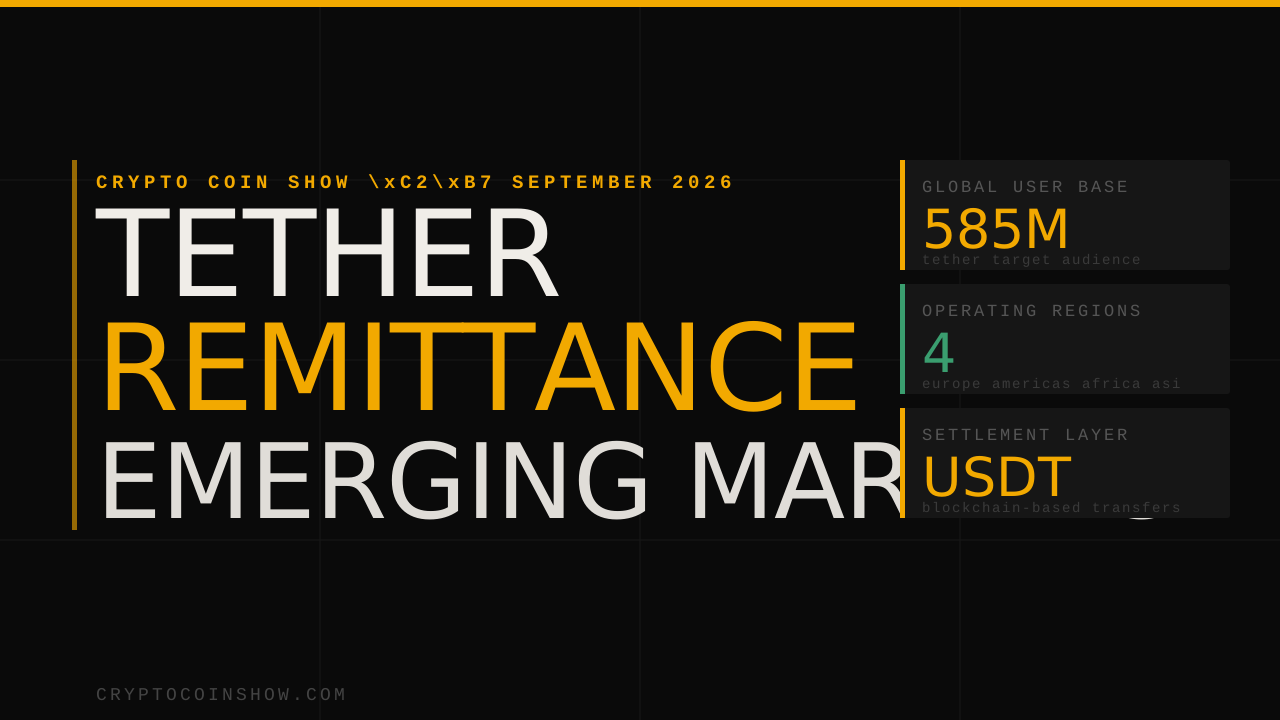
Tether and LemFi, two financial juggernauts in different sectors, have announced a partnership. Tether, the issuer of popular stablecoin USDT, announced on Monday that it had invested in the fintech app used to transfer funds from Europe and the Americas to Africa and Asia.
The deal will embed USDT as a system for payments across LemFi’s operating regions, replacing slower bank-to-bank transfer chains with stablecoins and the blockchain.
The Tether-LemFi deal and what it means
Unlike conventional cross-border payment systems, stablecoin-based transfers allow funds to move directly across blockchain networks with fewer delays and lower operation costs. This model will enhance the speed and efficiency of international payments, especially in newly emerging markets.
According to Tether’s statement, the partnership is expected to support the wider adoption of Tether across LemFi’s platform, which could then extend the stablecoin-powered systems into other payment and financial service offerings.
The move reflects a broader trend among fintech firms and stablecoin issuers seeking to position blockchain infrastructure as an alternative to traditional banking rails for global payments, savings, and digital financial services.
The executives have their say
CEO of Tether, Paolo Ardoino, has said the investment aligns with Tether’s strategy of expanding financial access for its estimated 585 million users globally.
Ardoino framed the partnership as part of the company’s effort to strengthen the real-world utility of Tether by integrating blockchain-based settlement into everyday financial services, particularly in regions that rely heavily on cross-border payments and remittances.
“Our investment in LemFi reflects our shared vision on how money moves across borders, prioritizing speed, cost, and transparency,” Ardoino said in Tether’s announcement. “By supporting LemFi’s growth and innovation roadmap, we are helping bring the benefits of a stable digital asset to more people who rely on remittances in their daily lives.”
LemFi CEO and co-founder Ridwan Olalere called the deal “a validation of the direction we are heading.” Olalere added that integrating USDT into LemFi’s infrastructure “brings us closer to that reality” of a financial system that works regardless of where a user lives or sends money, according to Tether’s press release.
Neither company has disclosed the size of the investment.
How does this improve stablecoins’ standing?
For Tether, the LemFi deal extends the company’s push to position USDT as a practical payments infrastructure rather than just a trading instrument. The company reported $1.04 billion in profit for Q1 2026 and holds excess reserves of $8.23 billion, according to Binance Square. This financial position gives Tether capital to invest in distribution partners like LemFi that can help to put the stablecoin in front of non-crypto-native users.
LemFi, on its own part, gains access to Tether’s deep USDT liquidity pool and the technical backing to build a settlement layer on blockchain. The company described its customer base as consisting of “millions of people who live and work across borders,” many of whom, it said, have historically been underserved by traditional financial institutions.
Japan investors pulled $29.6 billion out of U.S. government-linked debt in the first quarter of 2026, the country’s biggest quarterly sale since the second quarter of 2022, which was basically four years ago.
Q1 also broke a strong buying run, because Japanese accounts had bought U.S. debt in 11 of the previous 12 quarters, and this was their first quarterly net sale since Q4 2024. The agency bucket covers mortgage-backed securities and debt tied to government-backed firms.
Local authority debt covers municipal bonds sold by U.S. states, cities, and local governments. In the first two months of the year alone, Japanese investors sold $4.14 billion of U.S. agency bonds, based on the latest U.S. Treasury Department figures.
Japanese investors cut U.S. debt holdings as inflation changes the Fed trade
Activity was back to normal after the painful rate repricing in February, where the OIS priced in a Fed rate cut twice in the coming months. Obviously, that was before the United States, in tandem with Israel, bombed Iran, oil surged 50%, and traders changed their stance to a rate hike for the upcoming period.
The Japanese continue to hold a bigger share of U.S. debt among all foreigners, with around $1.24 trillion in total. Next is the United Kingdom with $897 billion, followed by China with $693 billion. But now data suggest that the Japanese are selling off their positions in U.S. bonds because of better yields offered domestically.
The 10-year JGB yields reached 2.73%, which is the highest level seen since May 1997. Markets predict an increase in the central bank’s policy rate by 25 basis points to 1% for June due to persistently strong inflation.
The 30-year JGB yield reached 4% for the first time since the bond was launched in 1999. The 5-year and 20-year JGB yields also touched record highs earlier in the week.
Finance Minister Satsuki Katayama said Friday that government bond yields were rising across the biggest global markets. “These developments are interacting with one another, and that is creating a compounding effect,” Satsuki told reporters.
Global bond markets sell off as oil, auctions, and Fed warnings hit traders
Japan’s Prime Minister Takaichi Sanae won a landslide election in February after promising more public spending and help against inflation.
Sanae’s government is already subsidizing petrol prices. Economists now warn that her administration may need a supplementary budget later this year, which would put more pressure on JGB prices.
Over in America, Trump’s war-driven price fears are pushing borrowing costs higher, with the 30-year Treasury yield heading toward a two-decade high above 5%.
Treasury yields are now roughly half a percentage point or more above late-February levels. The 2-year yield reached 4.07%, its highest since early 2025. The 10-year yield hit 4.59% after rising about a quarter point last week, its biggest weekly jump since April last year.
Long-term Treasury yields matter because they feed into mortgage rates and corporate loans. Bond investors have spent two months watching for signs that high oil prices could hurt growth more than inflation. Higher long-term yields have brought that question back.
Last week’s auctions gave traders nothing cute to smile about. The 30-year Treasury sale was the first since 2007 to clear at a rate as high as 5%, and demand was still plain. The 3-year and 10-year auctions also drew average interest.
A JPMorgan Chase & Co. (JPM) survey showed Treasury short positions at their highest level in 13 weeks. Investors will now watch Wednesday’s Fed April meeting minutes to see how much backing dissenting voters had. Chicago Fed President Austan Goolsbee said broad price pressure may point to overheating. Fed Governor Michael Barr called inflation the “overwhelming” risk facing the economy.
Don’t just read crypto news. Understand it. Subscribe to our newsletter. It’s free.
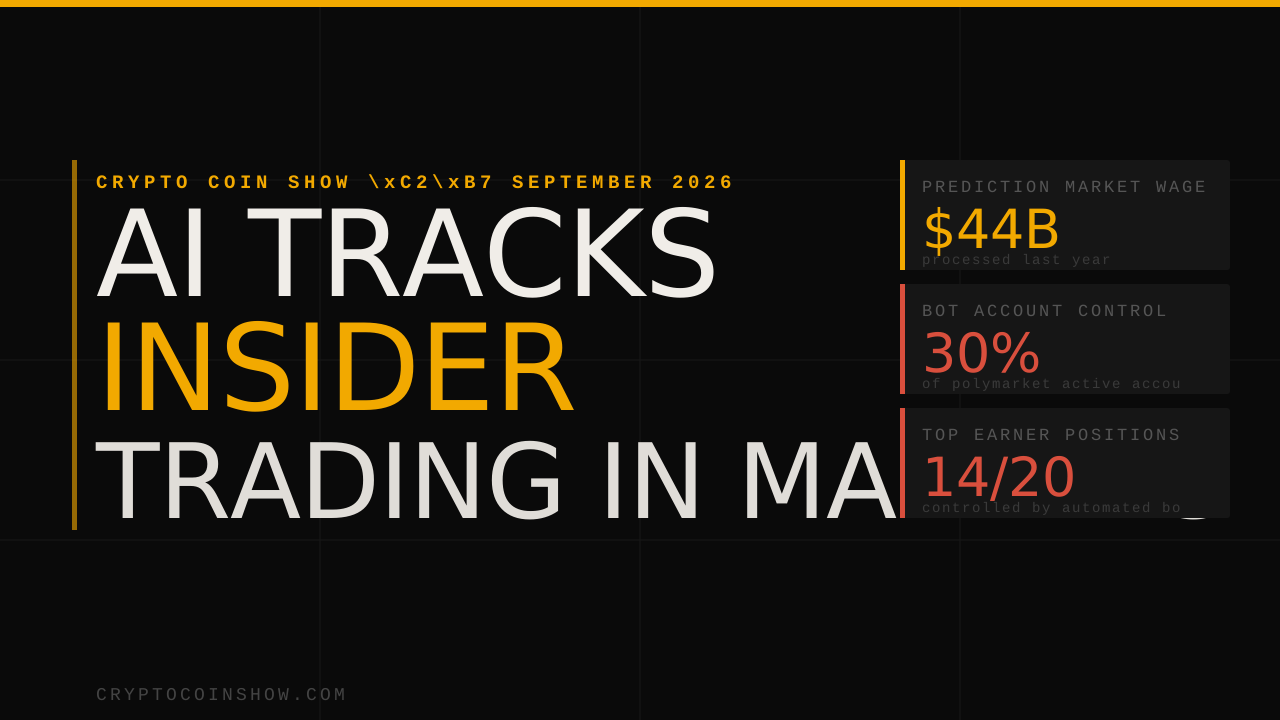
Prediction markets processed more than $44 billion in wagers last year, but regulators say many of the top-performing participants are now automated trading bots rather than humans.
On Polymarket, automated bots now run more than 30% of active accounts. Data from the platform’s top earners shows that 14 of the top 20 accounts are controlled by bots.
More than 37% of these automated accounts consistently.
Lawmakers target insider trading risks
Polymarket trading activity fell 8.9% in April for the first time since August, as competitors gained market share.
According to Dune Analytics, the platform and its US operation registered $10.2 billion in bets in April, a decrease from $11.2 billion the previous month.
Meanwhile, rival platform Kalshi saw volume jump 13% to reach $14.8 billion in April.
The decrease occurred as Polymarket tried to rebuild its US footprint while under increased scrutiny from politicians concerned about insider trading.
Senator Elizabeth Warren wrote to the Commodity Futures Trading Commission in March, along with more than 40 other members of Congress.
They wanted laws that would ban government officials from profiting from secret material on these platforms.
“The CFTC maintains that event contracts are a type of swap subject to its jurisdiction, and, therefore, it should ensure that federal employees understand existing restrictions on prediction market insider trading,” the lawmakers said.
Several Polymarket users have drawn suspicion for placing winning bets on sensitive world events, including military actions in Venezuela and potential conflict with Iran.
CFTC Chairman Michael Selig told reporters that the agency utilizes AI tools to examine trade patterns, detect anomalous conduct, and collaborates with blockchain tracking businesses like Chainalysis to monitor offshore platforms such as Polymarket.
According to an AIMPACT update dated May 15, the CFTC uses AI to scan vast volumes of trading data, assisting staff in identifying suspect accounts and deciding whether to initiate investigations or issue subpoenas.
The business is combining blockchain analytics tools with market anomaly detection technologies to monitor both cryptocurrency and traditional financial markets.
The CFTC has received many allegations of odd trading and is actively looking into “hundreds to thousands” of potential cases. Future enforcement efforts are likely to broaden.
Selig stated that the agency will take action against U.S. users who attempt to mask their location by utilizing VPNs to access prohibited services.
That enforcement applies to worldwide marketplaces.
Even while platforms like Polymarket operate outside of the United States and lack U.S. licenses, the CFTC said it will seek enforcement against cross-border trades involving Americans and may utilize extraterritorial authority if necessary.
Platforms are reacting to the demand.
Polymarket and Kalshi have improved their checks for insider trading and market manipulation, bringing in external blockchain data providers to meet regulatory requirements.
The CFTC offered prediction market platforms some regulatory relief on Wednesday, issuing a no-action letter that exempts them from certain swap reporting requirements.
The exemption applies to exchanges and clearinghouses that handle event contracts.
Agency staff said they would not pursue enforcement against platforms that skip those reporting rules, following requests from companies seeking clarity on how event contracts should be regulated.
Although event contracts are officially classed as swaps since they have yes-or-no outcomes, the CFTC believes they work more like futures and options due to their uniform terms and exchange trading.
According to the new guidance, firms can report these transactions directly to the Commission in a manner similar to futures and options markets.
The relief now applies to 19 firms, including Polymarket US, Kalshi, Gemini Titan, and Bitnomial. Other companies listing event contracts may request coverage on the same terms.
Eric Trump rejected Senator Elizabeth Warren’s claim that his father directs individual Nvidia (NVDA) stock trades. Warren tied recent buys to eased US AI chip exports to China.
Reports flagged a January 6 purchase worth up to $1 million in Trump-tied accounts. The Commerce Department updated AI chip export rules one week later.
Trump Family Pushes Back on Conflict Claim
Eric Trump challenged that all family assets sit in a blind trust managed by major financial institutions. The structure favors broad market indexes over individual stock picks.
All of our assets are invested in a blind trust by the largest financial institutions in broad market indexes. To suggest that individual stocks are being bought or sold, at the discretion of any member of the Trump family, would be a lie and blatantly false,” articulated Eric Trump, executive vice president of the Trump Organization.
The Trump Organization has said the family holds assets in fully discretionary accounts. Donald Trump Jr. and Eric Trump oversee the trust with third-party institutions and receive no advance notice of trades.
Warren Links Nvidia Stake To China Trip
Warren cited a January 6, 2026 Nvidia purchase of up to $1 million in Trump-tied accounts. The Commerce Department then revised rules for chips like Nvidia’s H200 on January 13.
BREAKING: Trump purchased up to a $1 million worth of Nvidia, $NVDA, stock on January 6, 2026.
This is a week before the Commerce Department officially approved the sale of Nvidia chips to China.
“Trump brought the NVIDIA CEO on his trip to China to lobby Xi Jinping to buy advanced AI chips, even though it would create a U.S. national security threat. It turns out Trump also bought millions in NVIDIA’s stock. The President’s corruption is a national security disaster,” she wrote in a post.
Indeed, President Donald Trump brought Nvidia chief executive Jensen Huang on his May 12 to 15 Beijing visit. The trip covered trade and AI talks with President Xi Jinping.
Huang has previously confirmed Trump asked him to join the delegation. The group included other US business leaders pushing tech and aviation deals.
Disclosure Norms Test Blind Trust Standard
The dispute surfaced through Trump’s Q1 2026 OGE Form 278-T filing. The document logged 3,642 stock transactions in the first three months of the year. Related coverage of the filing has detailed the breadth of holdings.
Critics say the volume and timing of individual trades sit outside the qualified blind trust template. Presidents from Jimmy Carter through Joe Biden used that template to avoid conflict claims.
The 2012 STOCK Act requires disclosure of executive trades but does not bar them. Federal authorities have not announced an investigation.
Treasury Secretary Scott Bessent has backed a congressional single-stock trading ban. The proposal has drawn renewed attention this week.
Whether ethics committees pursue formal review may shape how future administrations structure presidential portfolios.
BlackRock Investment Institute warned investors that company-level AI capex now drives the entire macro market backdrop. The asset manager said its first 2026 theme, micro is macro, captures the shift.
The note from strategists Jean Boivin and Wei Li lands as Big Tech capital spending tracks roughly $725 billion this year. That figure is up about 10% from estimates made before first-quarter earnings. Capex on this scale rivals traditional macro drivers.
AI Capex Now Rivals Traditional Macro Forces
The micro-is-macro thesis argues that capex from a few firms shapes growth, earnings, and yields. That spending now rivals central bank policy as a market driver.
BlackRock estimates AI infrastructure investment could reach $5 trillion to $8 trillion this decade. The Magnificent Seven recently tracked roughly 57% quarterly earnings growth. AI is now the dominant force behind US equity gains.
The firm believes AI could be the first innovation in 150 years strong enough to lift US growth above 2%. It stresses that the outcome remains uncertain.
AI investment is pressing ahead. At the same time, inflation pressures are proving more persistent than many expected — even before the Middle East conflict. Higher energy prices may pile on to that underlying pressure.
Inflation and the Strait of Hormuz raise the stakes
Sticky price pressures were already elevated before the Strait of Hormuz closure added fresh energy risks. BlackRock now sees about three rate hikes priced into Europe, with the U.S. on hold.
The firm stays overweight US and emerging-market equities. It cautions that long-term Treasuries no longer offer the portfolio ballast they once did. Higher yields, paired with sticky inflation, could begin to pressure valuations if disruptions persist.
Bitcoin gets caught in the macro crosswind
The crypto market reflects the same forces. Bitcoin (BTC) trades near $80,646, roughly 36% below its October 2025 record of $126,080. Ethereum (ETH) sits around $2,260, more than 50% off its August 2025 peak.
Capital that once flowed to risk assets is being diverted to AI capex and energy security, raising competition for funding. BlackRock argues that genuine diversification now requires private markets and hedge funds rather than traditional cross-asset spreads.
Rising leverage, weaker traditional hedges, and a few mega forces driving everything leave little room for passive positioning. Whether AI capex sustains its growth premium or starts to crowd out other assets is now the key question. The answer may set the tone for risk markets through the second half of 2026.
The CME group has announced plans to partner with Nasdaq to launch the firm’s first weighted crypto futures by market cap on June 8. This new product is intended to give its institutional traders exposure to the major cryptocurrencies, subject to regulatory review.
The exchange announced that the crypto futures, will be available in both micro and larger contract sizes. At expiration, contracts will settle against the Nasdaq CME Crypto Settlement Price Index, which tracks the largest and most actively traded cryptocurrencies. This index currently includes Bitcoin, ETH, SOL, XRP, ADA, LINK, and XLM, according to the CME Group press release.
Institutional demand drives CME and Nasdaq partnership
Giovanni Vicioso, Global Head of Cryptocurrency Products at CME Group, has said the new contracts will offer clients “a regulated, cost-effective and convenient way to hedge or gain broad-based exposure to the overall crypto market.” He added that a 43% increase in average daily volume across CME’s crypto futures suite is strong evidence of increased institutional demand.
Sean Wasserman, Head of Index Product Management at Nasdaq, framed the product as a response to investor demand for transparent and governance-backed benchmarks. “The Nasdaq CME Crypto Index was designed to serve as a foundation, and the introduction of futures linked to the index is a natural extension of how index-based frameworks support market development over time,” Wasserman said in the same announcement statement.
Why employ a market-cap weighted contract?
The CME group already offers individual futures on BTC, ETH, and several altcoins. What it has not offered until now is a single contract weighted by market capitalization across multiple crypto tokens. This structure mirrors how equity investors use index futures (the S&P 500 E-mini, for example) to manage market exposure without picking individual stocks to invest in.
This appeals to portfolio managers as it helps with investment efficiency. Instead of creating and rebalancing a position involving multiple cryptocurrencies across separate futures contracts, they can simply work with a single futures tool to hedge their crypto exposure.
The CME Nasdaq crypto index futures arrive during a period of rapid expansion for the CME Group’s crypto products. Earlier in 2026, CME launched futures on Cardano, Chainlink, and Stellar Lumens (XLM). In May, the exchange announced Bitcoin Volatility futures (ticker BVI) set to begin trading on June 1, which is a product that allows traders to speculate on or hedge against Bitcoin price swings instead of trading towards a particular price direction, as Cryptopolitan previously reported.
Don’t just read crypto news. Understand it. Subscribe to our newsletter. It’s free.
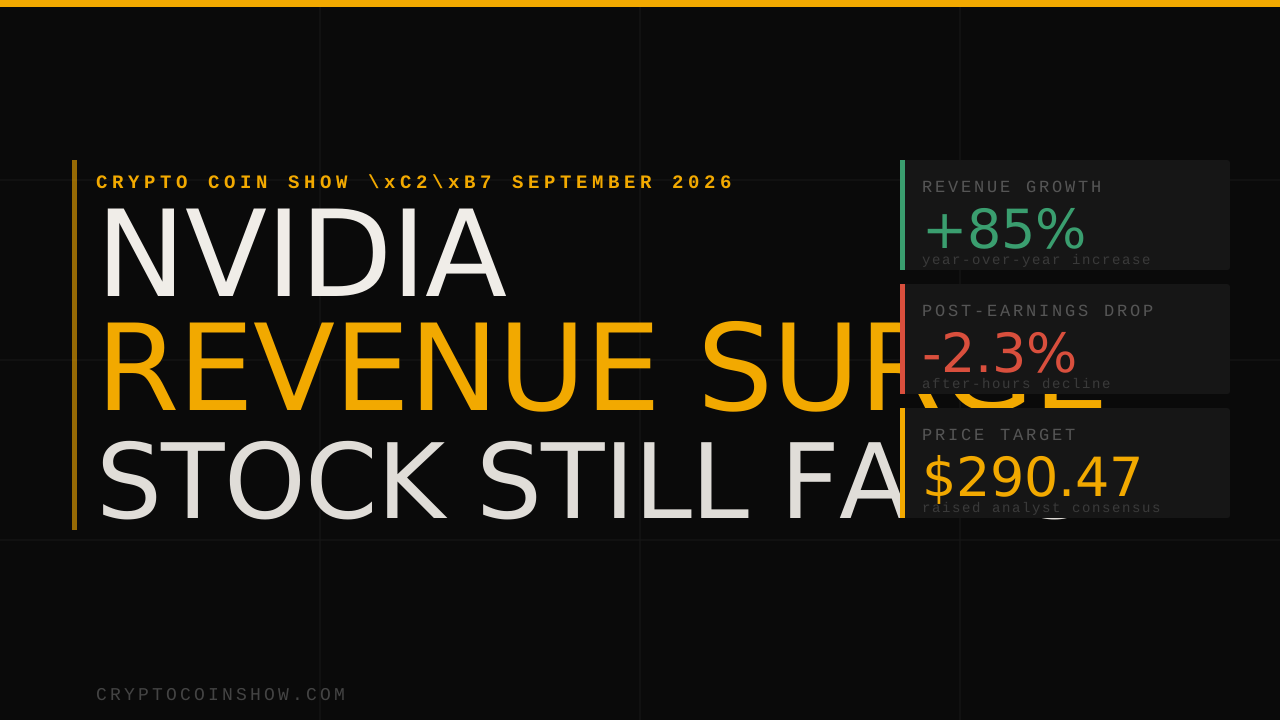
Nvidia (NVDA) stock price has rallied for seven consecutive sessions since the May 6 breakout, climbing to $227 on May 13. The move sits inside a 32% measured move setup, and the fundamental catalysts behind it have just multiplied.
Jensen Huang joined President Trump’s Beijing delegation as a last-minute addition on Tuesday, putting $50 billion in China AI chip opportunities back in play.
At least five Wall Street firms have raised or reiterated their Nvidia price targets in the past 48 hours. Earnings land on May 20. But the Chaikin Money Flow is sending a quieter, more cautious signal underneath the rally.
NVIDIA Stock Hits a New All-Time High. Source: Google Finance
Nvidia Stock Bull Flag Breakout Targets $267
The Nvidia stock chart broke out of a bull flag and pole pattern on May 6, 2026. The pole rallied 31.92% across April and early May, and the flag resolved upward with strong volume on the breakout candle.
Want more insights like this? Sign up for Editor Harsh Notariya’s Daily Newsletter here.
Every daily session since May 6 has closed green. The measured move projects a 32% rally from the breakout zone, with $267 the textbook target.
Trump personally called Huang after the Nvidia CEO was initially absent from the executive list, and Huang flew to Alaska to board Air Force One. Beijing has been pushing for greater access to Nvidia’s H200 AI chips, a market Huang has sized at $50 billion.
Nvidia, $NVDA, took a $4.5B hit in the July quarter after Trump introduced the original license requirement.
Jensen Huang said the ban of Nvidia’s chip sales to China would result in a $50 BILLION hit in 2-3 years.
Wall Street has reinforced the setup. Bank of America’s (BofA) Vivek Arya raised the firm’s Nvidia price target to $320 from $300 on May 13, citing a $1.7 trillion total addressable market for 2030 AI data centers.
Wells Fargo’s Aaron Rakers raised to $315 from $265 on May 12, using a new gigawatt-capacity model. Susquehanna’s Christopher Rolland raised to $275 from $250, aligned with the chart targets discussed earlier. Citi reiterated $300. Oppenheimer reiterated $265.
The Nvidia stock price now sits between the breakout zone and the target, with earnings due May 20. The next signal sits in the institutional flow data.
Money Flow Sends a Quieter Warning
The Chaikin Money Flow (CMF) indicator, which measures the volume-weighted balance of buying and selling pressure as a proxy for large money positioning, sits at 0.24 on the Nvidia daily chart.
The reading is in positive territory. The interesting signal is what has happened underneath it. The CMF peaked in late April and has since trended steadily lower, while Nvidia’s stock price has trended higher. The result is a bearish divergence on the daily chart.
That divergence does not invalidate the breakout. Big-money flow has softened, but it remains net positive. The pattern is consistent with profit-taking into strength or hedging ahead of the May 20 earnings report.
The put-call ratio data adds the second layer. The Nvidia put-call volume ratio sits at 0.32 on May 13, up from 0.29 around the May 6 breakout. The open interest ratio has eased to 0.80 from 0.81 over the same period.
The increase in volume-based puts alongside steady open interest fits the same picture as the CMF divergence.
Some hedging is being added to the rally, but overall positioning remains heavily call-skewed, with put-call ratios well below 1.0. The setup stays bullish with some prudence layered in.
Nvidia Stock Price Levels Show $227 as the Decision Point
Nvidia stock price trades at $226, sitting right next to $227, the 0.618 Fib zone of the recent range.
The 0.618 level is the structural pivot. A daily close above $227 opens $235, $247, and the textbook pattern target at $267. Beyond that, the 1.618 extension at $279 aligns with Susquehanna’s price target.
The 2.618 extension at $332 sits just above Bank of America’s $320 target.
The downside levels matter too. Support stacks at $214 and $207. A daily close below $207 would weaken the breakout structure. The deeper invalidation sits at $194, the 0 Fibonacci anchor. A break under $194 would weaken the entire bullish structure.
A daily close above $227 keeps the path to $267 open and brings the analyst price ladder into view. A close below $207 hands control to the CMF divergence and risks a deeper consolidation toward $194.
Robert Kiyosaki warns that the global economy is heading for a 2026 crash. The author of Rich Dad Poor Dad named silver as one of his best current investments.
The veteran investor framed the coming downturn as an opportunity for prepared buyers. He pointed to silver as a real asset that fiat money cannot replicate.
Why Kiyosaki Sees a 2026 Crash
Kiyosaki has repeated this warning across X (Twitter) in recent months, tying it to his 2002 book Rich Dad’s Prophecy. He argues the “Everything Bubble” he flagged decades ago is finally unwinding.
He blames roughly $39 trillion in US debt and a weak dollar dating to 1974. Fragile baby boomer retirement accounts add another layer of vulnerability.
Past crashes in 1987, 2000, 2008, and 2022 made him richer, he says, because he held real assets. He plans to run the same playbook in 2026.
“In 2026 the global economy is about to crash. That’s good news for those that can see the future. Bad news for the blind,” Kiyosaki stated.
However, mainstream forecasters do not share the Great Depression framing. Most institutions still project moderate global growth in 2026, while flagging sovereign debt and geopolitical tension as downside risks.
Kiyosaki said he began stacking silver in 1965 at 18 years old, when prices traded in cents. He now treats it as both a monetary hedge and a critical industrial metal.
The asset feeds solar panels, electric vehicles, batteries, and artificial intelligence (AI) infrastructure. Spot silver trades near $85 an ounce after a sharp run-up over the past year.
The fundamentals support parts of his case. The market is running its sixth straight year of structural deficits. Industrial demand now accounts for roughly half of total consumption.
Other Voices Echo the Silver Trade
Kiyosaki is not alone. Veteran trader Vijay called silver near $75 to $80 too cheap to ignore. He cited the lowest CME inventory since January 2025.
“Next 6 months, likely to surprise on the Positive side. It is a a scarce commodity (Lowest inventory on the CME since January2025 ) & one of the most hated asset class,” the trader wrote.
Research firm World of Finance and Associates set a $88 to $92 ceiling if macro shocks stay limited, while other precious metals analysts see silver miners as leveraged plays.
Silver: Currently given buy since 72$ for 82$ Target which was hit successfully.
If there is no negative news then we can head towards 88$-92$ max .
Beyond that I am not looking for it .
For long term investment Wait for another round of minimum 50% correction in both #Gold… https://t.co/UKO6tgAazI
— World of Finance and Associates 🌎 (@manerhushi123) May 10, 2026
Kiyosaki’s six-asset survival list for 2026 also includes gold, oil, food production, Bitcoin, and Ethereum. Whether his crash call arrives on schedule will determine how the silver bet looks by year-end.
Bitcoin faces 2026’s densest macro test as CPI, Warsh, and Trump-Xi collide
This week (May 11-15) has a credible claim to being the most consequential macro window of 2026 so far, as it compresses every channel currently driving risk assets into a single sequence.
Inflation, producer costs, consumer demand, Fed liquidity, central bank leadership, trade risk, oil risk, and the dollar are all scheduled to move within five trading days.
Bitcoin enters that window as a liquidity-sensitive institutional asset, making the calendar a direct test of whether the recovery above $80,000 has macro sponsorship or only positioning support.
The strongest rival week came earlier in the year, when the Iran conflict and the Strait of Hormuz shock pushed energy markets into the center of the inflation debate.
The St. Louis Fed’s review of market reactions to military action against Iran marked Feb. 28, Mar. 1, and Apr. 13 as key shock points for oil, volatility, and geopolitical repricing.
That episode carried the larger single exogenous impulse. It changed the inflation path through energy, widened the risk premium in crude, and forced investors to reprice the Fed’s tolerance for cutting into a supply shock.
The March inflation data then showed how that shock entered the official series. The March CPI report showed consumer prices rising 0.9% month over month and 3.3% year over year, with energy up 10.9% and gasoline up 21.2%. The March PPI report showed final demand prices rising 0.5% in March and 4.0% over the prior 12 months, the largest annual increase since February 2023.
Those prints gave 2026 a genuine inflation shock rather than a routine data scare.
April 28-29 was the other major comparison point because it combined an FOMC decision, dissents, oil-related inflation anxiety, and the Senate Banking Committee’s movement on Kevin Warsh.
The Fed held rates at 3.5% to 3.75%, but the April FOMC statement carried an unusually fractured vote. One governor dissented in favor of a 25 basis point cut, while three officials supported the hold and opposed language that leaned toward easing.
That meeting exposed a central bank split between inflation caution and growth insurance.
May 11-15 ranks above those weeks in event density.
The Iran shock was larger as a geopolitical impulse. The April FOMC was sharper as a policy signal.
This week combines both transmission paths and adds a leadership handoff. It forces markets to price in inflation persistence, consumer resilience, Treasury and reserve mechanics, Fed credibility, and U.S.-China geopolitical risk simultaneously.
For Bitcoin, that makes it the broadest macro stress test of the year so far.
Calendar of major macro events between May 11 and May 15, including CPI, PPI, retail sales, Fed liquidity data, Powell remarks, and the Trump-Xi summit, outlining the key catalysts shaping Bitcoin and global risk markets.
The official calendar stacks inflation, demand, Fed liquidity, leadership risk, and China into one macro test sequence
The official sequence begins with inflation.
The Bureau of Labor Statistics has the April CPI release scheduled for Tuesday, May 12 at 8:30 a.m. ET.
It then has the April PPI release scheduled for Wednesday, May 13 at 8:30 a.m. ET.
That pairing gives markets a two-day signal on whether the March energy shock and tariff pressure are still moving through consumer and producer prices, or whether the inflation impulse is already losing force.
Thursday broadens the test from prices to demand and liquidity.
The Census Bureau has April retail sales scheduled for Thursday, May 14 at 8:30 a.m. ET.
The Federal Reserve’s May calendar lists H.4.1 balance sheet data for the same day at 4:30 p.m. ET.
That means markets receive a consumer-demand signal in the morning and a liquidity signal after the close.
A strong retail number alongside hot inflation would reinforce the case for policy restraint. A weaker retail print alongside softer inflation would give the next Fed chair more room to argue that the economy can absorb lower rates.
The balance sheet release carries direct information for crypto. The May 7 H.4.1 report showed total Fed assets near $6.71 trillion, reserve balances around $3.03 trillion on average, and the Treasury General Account near $878 billion on average.
For Bitcoin, the direction of reserves and Treasury cash balances often carries more direct market information than the headline size of the Fed’s asset portfolio.
Falling reserves and a large Treasury cash balance can keep liquidity tight even when investors expect easier policy later.
Friday then adds the leadership handoff.
Jerome Powell’s official term as Fed chair ends May 15, while his Board term runs to January 2028.
Powell also said at the Apr. 29 press conference that he expected to continue serving as a governor for a period after the chair term, while keeping a low public profile.
Kevin Warsh’s nomination sits on the same track. The Senate Banking Committee held a nomination hearing on Apr. 21, and the committee later advanced him on a party-line vote.
Warsh could inherit his first inflation test before markets know his reaction function
Wednesday’s official anchor is PPI, while the Fed calendar lists other officials and provides no primary-source basis for making a chair speech the central event.
The larger issue sits at the end of the week: Warsh could inherit his first inflation signal before his reaction function is visible.
If CPI or PPI accelerates, the new chair begins boxed in by data.
If inflation cools, he begins with room to define how quickly the Fed can pivot without inviting a bond-market credibility premium.
President Donald Trump’s China trip then widens the map. He is scheduled to meet Xi Jinping in Beijing during a May 14-15 visit, according to AP.
That summit adds trade, tariffs, Taiwan, oil logistics, and dollar-risk channels to the same window as CPI, PPI, retail sales, H.4.1, and the Fed leadership transition.
A constructive summit could lower the trade-risk premium and ease the dollar bid.
A tense summit could lift the dollar and pressure offshore liquidity, especially if energy security and the Iran war remain tied to the negotiations.
That combination makes the week structurally different from the usual CPI cycle. Inflation data alone can move Bitcoin. A new Fed chair inheriting that data can change how markets price the next several meetings.
Warsh’s nomination has already been framed around institutional change at the central bank, including questions about models, communications, bond holdings, and the Fed’s reaction function.
That creates an immediate test: does the market treat the transition as a path toward a more responsive Fed, or as a source of uncertainty around independence, inflation tolerance, and the long-run policy framework?
A hotter sequence would put Warsh in the hardest possible opening position.
CPI and PPI strength would raise doubts about near-term cuts.
Strong retail sales would reduce the urgency for demand support.
Elevated oil prices would keep the inflation path vulnerable.
A tense Beijing summit would support the dollar through trade and geopolitical risk.
In that environment, a dovish signal from the incoming chair could backfire if bonds interpret it as political pressure or premature easing.
Bitcoin might initially respond to the idea of easier policy, but a rise in real yields and the dollar would likely cap that response.
Bitcoin’s macro test transmission map runs through real yields, the dollar, ETF flows, leverage, and reserves
Bitcoin enters the week near $81,000 after recovering from the high-$75,000s around the Apr. 29 FOMC period.
That rally improved the chart structure, but the next leg depends on whether macro variables confirm the move. The relevant channel is now broader than spot demand on crypto exchanges.
Bitcoin now trades through real yields, the dollar, ETF allocation flows, leverage conditions, and the same liquidity variables that shape equities and credit.
The first channel is rates.
A hot CPI print would likely lift nominal yields and real yields if markets conclude that the Fed has less room to cut. A cooler CPI print would likely ease that pressure, especially if core inflation softens alongside headline inflation.
The distinction is important because an energy-driven headline shock can produce an awkward signal.
Powell said after the Apr. 29 meeting that officials wanted to see progress beyond the energy shock and tariff effects before easing.
If April shows hot headline inflation with cooler core inflation, the market reaction may depend on whether Warsh signals patience, urgency, or a willingness to look through the oil impulse.
The second channel is the dollar.
CryptoSlate’s prior work on Bitcoin, M2, and dollar strength showed how a stronger dollar can interrupt the transmission from expanding global liquidity to BTC.
That remains the central macro risk. Bitcoin can benefit from easier policy expectations, but a rising dollar can offset that impulse by tightening global financial conditions.
This is why the Trump-Xi meeting sits inside the Bitcoin trade. Trade relief can soften the dollar and lower risk premia. Escalation can lift the dollar and pressure offshore liquidity.
The third channel is the Fed balance sheet and Treasury cash.
A Thursday H.4.1 release showing rising reserves and easing pressure from the Treasury General Account would give Bitcoin a stronger liquidity foundation.
A release showing reserve drain alongside a still-large Treasury cash pile would make any rally more dependent on ETF inflows and leverage.
CryptoSlate’s analysis of debt, liquidity, and Bitcoin has already shown that aggregate liquidity can look supportive while the usable liquidity reaching risk assets remains constrained.
Bitcoin’s next macro test runs through inflation data, Fed signals, liquidity, ETF demand, and geopolitical risk.
The next major Bitcoin move depends on whether macro test channels align
The fourth channel is institutional flow.
Since the launch of U.S. spot Bitcoin ETFs, BTC has become easier for traditional portfolios to buy, rebalance, and sell.
CryptoSlate’s coverage of the ETF-driven market-structure shift described how institutions have become a primary force in Bitcoin liquidity and price formation.
A separate analysis of passive money noted that U.S. spot Bitcoin ETFs had accumulated roughly $58.4 billion in cumulative net inflows by late April, with IBIT above $60 billion in net assets, reinforcing how far Bitcoin has moved into traditional allocation workflows through ETF wrappers.
That structure works in both directions.
ETF inflows can amplify a macro relief rally when yields fall, and the dollar weakens. ETF outflows can accelerate downside when real yields rise, the dollar strengthens, and leveraged traders are forced to reduce exposure.
A hot CPI and PPI sequence, strong retail sales, falling reserves, and a tense Trump-Xi outcome would be the most difficult mix for BTC because every transmission channel would point toward tighter financial conditions.
A cooler inflation sequence, resilient but slowing retail sales, improving reserves, and a less hostile China signal would give Bitcoin the strongest macro foundation it has had in 2026.
A cooler sequence would change the setup. Softer CPI and PPI would validate the idea that the March energy spike was passing through rather than embedding.
A slower but stable retail number would support a soft-landing path. A Thursday balance sheet release showing firmer reserves would improve the liquidity backdrop. A constructive Trump-Xi meeting would reduce the trade-risk premium and could weaken the dollar.
In that scenario, Warsh would have more room to define a gradual policy pivot without starting his tenure under immediate inflation pressure.
Bitcoin would then have a clearer path to test higher levels, provided ETF creations expand, and derivatives positioning avoids an unstable long build.
The mixed outcome may be the most realistic one.
Headline inflation can stay firm because of energy while core inflation cools. Retail sales can remain solid in nominal terms while real demand slows. The Fed balance sheet can show a large aggregate asset base while reserves remain under pressure. Trump and Xi can produce limited trade relief while leaving Taiwan, oil logistics, and tariff enforcement unresolved.
That mix would keep Bitcoin in a macro waiting zone. It would reward intraday volatility, but it would withhold the confirmation needed for a durable range expansion.
The next test is specific.
Watch Warsh’s first signals on inflation tolerance, balance-sheet policy, and central-bank independence.
Watch the June FOMC path, especially whether the statement language shifts after the leadership handoff.
Watch real yields and DXY before treating Bitcoin’s move as confirmation.
Watch H.4.1 reserves and the Treasury General Account before assuming liquidity has improved.
Watch spot ETF net flows, funding rates, and liquidation clusters before treating a breakout as structurally supported.
If those variables align, May 11-15 becomes the week Bitcoin regained a macro tailwind after months of rate, dollar, and oil pressure.
If they fail to align, the week becomes a sharper lesson in the post-ETF regime: Bitcoin can trade like a scarce asset, a liquidity asset, and an institutional risk asset at the same time.
The direction of the next major move will come from which identity markets choose after CPI, PPI, retail sales, H.4.1, Warsh, and Trump-Xi all hit the same window.
Deepfakes have shifted from a niche concern to a mass-market threat. May’s incidents show how consumer-grade tools now outpace any institutional response.
The damage extends into crypto. Scammers leverage artificial intelligence (AI) to create impersonation scams.
The Deepfake Economy Is Here, and Detection Is Losing
In early May 2026, AI-generated content showed up across politics, entertainment, and crime, as documented by Resemble AI.
FBI Director Kash Patel posted a video that appeared to use AI to generate shots nearly identical to those in the Beastie Boys’ “Sabotage” music video. Furthermore, an AI video of mayoral candidate Spencer Pratt drew 4.1 million views on X.
With President Trump’s leadership, this @FBI and our interagency partners are conducting massive fraud takedowns coast to coast – and we’re not stopping pic.twitter.com/lLAY4nSsQa
— FBI Director Kash Patel (@FBIDirectorKash) May 4, 2026
These tools aren’t just being used for viral content. They are also fueling real financial harm. A Chicago man lost $69,000 to a scammer who flashed an AI-generated US Marshals badge on a video call.
Meanwhile, the Atlantic’s Lila Shroff found that OpenAI’s ChatGPT Images 2.0 can generate fake IDs, prescriptions, receipts, bank alerts, and news screenshots.
“All of this makes it even harder for banks, hospitals, government agencies, and the like to prevent fraud,” Shroff wrote.
404 Media exposed Haotian AI, a Chinese real-time deepfake software. Reporter Joseph Cox swapped faces on a live Teams call using this, proving the technology is functional, for sale, and already being used against real victims.
“Three of this week’s stories, Haotian AI, the Meloni deepfake, and the Patel FBI video, come from completely different categories and geographies, but they share a structural condition: the tools used to produce the harm are consumer-grade, widely available, and improving faster than any institutional response. Haotian AI costs a few hundred dollars and works on Teams. ChatGPT Images 2.0 is a subscription product,” Resemble AI said.
Crypto Also Bears the Cost
Crypto has become a prime target for AI-driven deception. According to Chainalysis, fraudsters are now pairing deepfakes, face-swap apps, and large language models with classic romance and investment cons, and the math favors them.
The average AI-assisted crypto scam nets roughly $3.2 million, about 4.5 times the haul of a conventional scheme. Several cases underline the threat. In August 2025, attackers stole $2 million by impersonating the founder of Plasma.
BeInCrypto has also reported on North Korean operatives running deepfake video calls on Zoom. Together, these incidents mark AI-powered impersonation as one of the sector’s most pressing security risks.