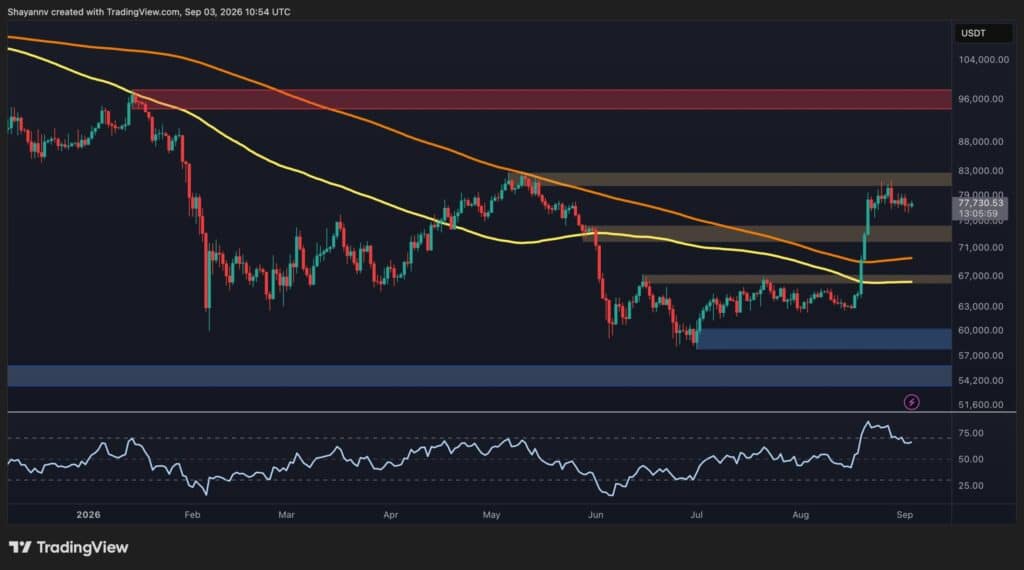

Bitcoin price started a fresh decline below $68,500 and $68,000. BTC is now consolidating and might struggle to start a recovery wave above $68,500.
Bitcoin started a fresh decline after it settled above the $69,500 zone.
The price is trading below $68,000 and the 100 hourly simple moving average.
There was a break below a major bullish trend line with support at $68,900 on the hourly chart of the BTC/USD pair (data feed from Kraken).
The pair might dip again if it trades below the $65,500 and $65,000 levels.
Bitcoin Price Starts Another Decline
Bitcoin price failed to extend its increase above the $68,500 zone. BTC started a fresh decline after it settled below the $68,000 support zone.
The bears pushed the price below $67,500 and $67,200. Besides, there was a break below a major bullish trend line with support at $68,900 on the hourly chart of the BTC/USD pair. Finally, the price tested the $65,500 zone. A low was formed at $65,646, and the price is now consolidating losses.
Bitcoin is now trading below $68,000 and the 100 hourly simple moving average. If the price remains stable above $65,500, it could attempt a fresh increase. Immediate resistance is near the $67,000 level. The first key resistance is near the $67,600 level and the 23.6% Fib retracement level of the downward move from the $74,062 swing high to the $65,646 low.
A close above the $67,600 resistance might send the price further higher. In the stated case, the price could rise and test the $68,800 resistance. Any more gains might send the price toward the $68,800 level. The next barrier for the bulls could be $69,850 or the 50% Fib retracement level of the downward move from the $74,062 swing high to the $65,646 low.
More Losses In BTC?
If Bitcoin fails to rise above the $68,000 resistance zone, it could start another decline. Immediate support is near the $65,500 level. The first major support is near the $65,000 level.
The next support is now near the $63,500 zone. Any more losses might send the price toward the $62,000 support in the near term. The main support now sits at $61,200, below which BTC might struggle to recover in the near term.
Technical indicators:
Hourly MACD – The MACD is now gaining pace in the bearish zone.
Hourly RSI (Relative Strength Index) – The RSI for BTC/USD is now below the 50 level.
Major Support Levels – $65,500, followed by $65,000.
Over the past few days, the Bitcoin price has had one of its better performances so far in the first quarter of 2026. Catalyzed by the rising geopolitical tensions between US-Isreal and Iran, the premier cryptocurrency climbed to $74,000 over the past week.
However, the Bitcoin price did not take long before retreating back below the psychological $70,000 level, confirming that the latest rally was merely a relief. With the bearish market structure still in place, it remains to be seen how low the price of BTC will go in its current phase.
$70 Million Worth Of Longs At Risk Of Liquidation
In a new post on the social media platform X, crypto analyst Ali Martinez revealed why a further decline to around $54,000 in the remaining period of this phase is possible and could be bad news for both investors and the Bitcoin price. Hence, the $54,000 mark could be an extremely pivotal region for the flagship cryptocurrency in this bear market.
Martinez’s evaluation revolves around the Aggregated Liquidation Levels Heatmap metric, which visualizes price zones with high concentrations of long or short liquidations. As expected, the red (hot) color on the map signifies a concentrated liquidation point of several high-leverage positions, often with high liquidity.
These high-liquidity spots often have a somewhat magnetic effect, with prices often drawn to them. According to Martinez, this “hot” zone for the Bitcoin price lies around the $54,000 mark, with over $70 million worth of long positions at risk of liquidation.
Ordinarily, a Bitcoin price drop to around $54,000 would do extra damage to the already low market sentiment. Meanwhile, from a technical perspective, the significant liquidation cascade likely to occur at that level could lead to a phenomenon called a “Long Squeeze,” where the flagship cryptocurrency continues its decline with renewed momentum.
For clarity, a Long Squeeze typically occurs when the falling price of a cryptocurrency (in this case, Bitcoin) forces bull traders to sell their assets either to cut losses or to break even. This sell-off catalyzes the ongoing bearish reaction and sends the BTC price further downwards.
Ultimately, the $54,000 region, which is also around the realized price, appears to be one of the most critical levels for the Bitcoin price trajectory over the next few months.
Bitcoin Price At A Glance
As of this writing, the price of BTC stands at around $67,830, reflecting an over 4% decline in the past 24 hours. Since reaching its one-month high around $74,000 on Wednesday, March 4, the premier cryptocurrency has retraced by nearly 10%.
Headlines about Bitcoin ETF outflows often mix two things: Bitcoin’s price move and actual share redemptions.
If BTC drops, ETF AUM drops in dollars even if nobody sells a single share. That mark-to-market drop gets read as money leaving, and it can look like an institutional exit when the wrapper’s Bitcoin holdings and shares outstanding barely move.
To understand whether investors are actually leaving, you have to separate the USD thermometer from the BTC and share-count thermometer.
Start with the USD thermometer. ETF assets-under-management (AUM) is a mark-to-market number. A 10% drop in BTC produces a 10% drop in AUM even with zero redemptions. Many dashboards put AUM and net flows side by side, but readers mentally treat both as money in or out. But AUM doesn’t show investor behavior, just the asset price plus structure.
The BTC thermometer is closer to behavior. Total Bitcoin held , plus shares outstanding by fund, answers the real question: did the wrapper lose underlying exposure, or did the price do most of the work? Data from Glassnode puts the total US spot Bitcoin ETF balances at around 1.285 million BTC even after a long stretch of outflows, which is the sort of detail the dollar headlines tend to bury.
Graph showing the BTC-denominated balances of spot Bitcoin ETFs from Jan. 1 to Mar. 6, 2026 (Glassnode)
A simple example shows why the USD number misleads. If the complex holds 1.285 million BTC and BTC drops from $70,000 to $63,000, AUM falls from about $89.95 billion to about $70.95 billion.
That’s a $19 billion drawdown with zero selling. The headlines would say that billions left, but the wrapper would remain unchanged in BTC terms.
So why do flow tables still feel violent in certain windows? Because a significant chunk of activity is tied to a trade that treats ETFs as a financing leg.
It’s your run-of-the-mill cash-and-carry trade, or the basis trade.
The idea is straightforward: hold spot exposure and short futures, collecting the futures premium when it exists. When the premium is wide, the trade throws off yield-like returns. But when the premium compresses, the trade stops paying, and desks unwind it. It’s attractive when spreads are wide, but that appeal fades quickly as the spread tightens.
For many institutions, the cleanest and easiest way to gain exposure to Bitcoin is through ETFs.
When the trade grows, it shows up as steady ETF demand. When the trade shrinks, it shows up as ETF selling or redemptions. The motivation behind the trade is just spreadsheet math and is rarely a result of a change in sentiment.
You can see the hedge leg in the data that has nothing to do with ETF narratives.
In the CFTC’s CME Bitcoin futures positioning, leveraged funds often sit heavily net short, consistent with a hedge against spot exposure held elsewhere. A Jan. 6 report showed leveraged funds held 2,554 long contracts versus 14,294 short contracts in the CME “BITCOIN” futures contract. While that doesn’t prove every short is a basis book, it shows how large the hedge constituency can be.
When basis compresses, the unwind starts to matter more than daily flows. One market note in February tied near-neutral futures premium conditions to weaker incentives for basis trades that rely on futures premia to generate carry. CF Benchmarks has also reported on the CME basis behavior, linking it to market structure and positioning rather than pure story-driven sentiment.
Now connect that back to the two thermometers. During a basis unwind, you can get a week where USD AUM drops hard, and dollar flow headlines look catastrophic, while BTC holdings and shares outstanding move less.
It’s the price that does most of the damage in dollar terms. At the same time, desks trim trades, which can create real redemptions in some products and plain secondary-market selling in others. Both can happen at the same time; the point is just that the driver can be structural rather than emotional.
ETFs further amplify the confusion because their creation/redemption mechanism is designed to keep the ETF price close to NAV. Authorized participants create or redeem shares in large blocks, swapping shares for the underlying basket or cash depending on the structure.
Crypto ETP plumbing has also been shifting toward a more commodity-ETF-like model. The SEC has allowed in-kind creations and redemptions for crypto ETFs, which can make the path between redeemed shares and Bitcoin moves more direct. That matters most during trade unwinds, when the exit route gets cleaner.
So how should readers interpret the next flow print?
Treat USD outflows as noise unless you pair them with the BTC and shares numbers. The dollar figure is a mix of mark-to-market and structure. The BTC holdings and shares outstanding are closer to whether the wrapper actually shrank.
A quick decoding framework helps:
Directional exits: BTC held trends down, and shares outstanding decline across the major products. That’s investors leaving the wrapper.
Rotation: flows shift between issuers. Aggregate BTC held stays flatter while the plumbing moves underneath.
Carry unwind: basis compresses, hedge positioning shifts, and ETF prints show stress that maps to spread math and balance sheet limits more than sentiment.
The real hinge for the next market phase isn’t whether tomorrow’s flows are deeply red, but whether the basis stabilizes at a level that makes carry viable again, or keeps sliding toward zero. The trade’s appeal fades when spreads tighten, and other yields compete for capital.
That’s a much better way to say what the viral headlines can’t. Some of what looks like an $80 billion “exodus” is a unit problem, and some of what looks like panic is just a trade closing. Watch the BTC and shares thermometer for behavior.
Watch basis and futures positioning for plumbing. The rest is mostly the dollar lens doing what it always does when Bitcoin moves.
Bitcoin is showing signs of weakening momentum as it struggles to regain higher ground, placing the market at a critical turning point. The $66,000 level has now emerged as a key support zone that could determine the next major move. Holding above it may give bulls a chance to spark a recovery, while a decisive break below could open the door for a deeper decline.
Bitcoin Struggles Below Blue Box Resistance As Buyers Stay Quiet
Bitcoin continues to trade below the blue box resistance, signaling that the market has yet to regain strong bullish momentum. According to crypto analyst Kamile Uray, buyers failed to step in at the $69,407 level that had been closely monitored on the 4-hour timeframe. Although selling pressure pushed the price lower, the pace of the decline has started to slow in the current region.
Uray explained that as long as Bitcoin remains above the $66,187 level, the possibility of another attempt toward the blue box resistance remains on the table. A decisive breakout above the $69,407 resistance, especially with strong high-volume candles, could open the door for a much larger upward move.
Based on the principle of equal waves, such a breakout scenario could propel Bitcoin toward the $100,000 mark. A daily close above $98,200 would also establish a new high peak in the context of the latest wave structure on the daily chart, increasing the chances of a sustained uptrend.
However, caution may be required if the price approaches the $107,000–$109,000 region, as a bearish Libra formation could develop within that zone. Failure to close above the previous peak could activate the pattern and trigger a renewed downward move.
Meanwhile, the $66,187 level remains a key support to watch on the 4-hour chart. Holding above it would keep bullish expectations intact, while a close below it may lead to a retest of $62,433. If the decline deepens further and resistance levels continue to cap upward attempts, the next major support targets are $62,433, $55,230, and $47,256.
BTC Loses $70,000 Support As Bearish Momentum Builds
Crypto analyst Crypto Candy noted that Bitcoin was unable to maintain its position above the $70,000 level and eventually closed below it. Holding above that zone was previously highlighted as crucial for sustaining bullish momentum. Failure to defend the $70,000 mark suggests that sellers have regained control of the market.
The analyst further explained that bearish pressure may continue unless Bitcoin manages to reclaim and break above the $74,000 level. As long as the price remains below that threshold, momentum favors the downside, with a potential move toward the $61,000 region or even lower levels.
Even though South Korea is ending a nine-year ban on its listed companies that prevented them from investing in digital assets, stablecoins like USDC and USDT are expected to be excluded under the new regulations.
Corporations have made several arguments for why they should be allowed to trade stablecoins, including that it would help them settle payments faster and help them avoid volatility.
However, the latest reports from local South Korean outlets claim that regulators plan to pass up on fiat-pegged cryptos in the new regime.
South Korea’s government allows institutional trading of digital assets
In 2017, South Korean companies were barred from digital asset trading, and now, nearly a decade later, the government has made the decision to allow the institutional trading of digital assets.
The Financial Services Commission (FSC) is preparing to release the guidelines for Virtual Currency Trading . However, local reports and official discussions from a March 5, 2026, government meeting indicate that stablecoins, the very tools many companies want for international trade, are set to be excluded from the rule.
Under the current Foreign Exchange Transaction Act, stablecoins are not recognized as a formal method for external payment.
In South Korea, all foreign exchange payments must traditionally go through a foreign exchange bank. If the FSC were to allow companies to invest in stablecoins now, it would create a legal contradiction where firms hold investment assets that they are simultaneously forbidden from using for commercial payments like trade.
Furthermore, regulators are worried about the indiscriminate investments that could flood the market in the early days of legalization.
like USDT (Tether) and USDC, the government hopes to prevent easy-to-use “digital dollars” from being used for illegal money laundering or unchecked capital flight
Why do corporations want to trade stablecoins?
Many listed firms with high trade volumes have argued that using stablecoins would allow them to use real-time exchange rates to avoid currency volatility, settle overseas payments faster and cheaper than traditional bank wires, and manage digital-first balance sheets without constantly converting back to fiat.
Companies can currently still use personal wallets like MetaMask or overseas OTC (over-the-counter) platforms to handle stablecoins, but they have to do so without official corporate accounts.
The Digital Asset Framework Act is split into Phase 1, which was focused on protecting individual users, and Phase 2, which is designed to build the actual infrastructure for a professional market.
Recent discussions from the March 2026 Virtual Asset Committee meeting suggest that the government plans to let the 3,500 listed firms and professional investors buy major coins like Bitcoin and Ethereum and then draft new rules for stablecoin issuance that might begin a won-based stablecoin ecosystem.
There is already a growing push to require stablecoin issuers to have at least 5 billion KRW in capital and for banks to hold a majority stake (over 50%) in these ventures.
The ruling party has settled on a plan to cap major shareholder stakes in crypto exchanges at 20% but there are exceptions that allow for up to 34%. This could force giants like Upbit and Bithumb to undergo massive corporate restructuring within a three-year grace period.
Cryptopolitan previously reported that Bithumb dealt with an accidental $43 billion transfer error; now the FSC has fresh ammo in its reasoning for pushing for a 5% equity capital limit on corporate crypto buys in order to ensure that if a company loses money on an accidental trade or market crash, it doesn’t sink the entire firm.
Bitcoin is testing the $70,000 level after briefly surging toward $74,000, as the market attempts to stabilize following a volatile period marked and rapid price swings. While the recent rally helped restore short-term momentum, analysts are closely monitoring on-chain data to determine whether the move reflects a broader shift in market structure or simply a temporary recovery within an ongoing consolidation phase.
According to top analyst Axel Adler, recent exchange flow data reveals a notable development that could signal underlying accumulation. An unusually large Bitcoin outflow was recorded this week, with approximately 31,900 BTC leaving exchanges in a single day. Historically, events of this magnitude have often been associated with large-scale transfers into cold storage, suggesting that some market participants may be moving coins off trading platforms for longer-term holding.
Over the past seven days, Bitcoin netflows from exchanges have remained consistently negative. Daily outflows included roughly 2,867 BTC on February 27, 1,205 BTC on February 28, 251 BTC on March 1, 6,129 BTC on March 2, 1,819 BTC on March 3, a sharp 31,900 BTC on March 4, and 3,478 BTC on March 5. In total, approximately 47,700 BTC exited exchanges during the week, one of the largest weekly outflow figures observed over the past year.
Stablecoin Flows Reveal Liquidity Deployment Into Bitcoin
The report also examines stablecoin activity across exchanges, highlighting an important shift in liquidity dynamics during early March. Data from the All Stablecoins (ERC20) Exchange Netflow metric tracks the daily net movement of stablecoins across trading platforms and provides insight into how capital flows into and out of the crypto market.
For most of 2025, stablecoin netflows displayed a largely neutral pattern, characterized and outflows without a sustained directional trend. Several notable spikes occurred during the year, including inflows of roughly $2.7 billion in July and approximately $2.4 billion in September. However, a more significant regime shift emerged in early March 2026.
At that time, the chart recorded a large stablecoin inflow of about $1.1 billion entering exchanges. Within just a few days, the trend reversed, with netflow falling to around -$37.5 million. While the current outflow is not extreme relative to historical swings, the rapid transition from inflow to outflow suggests that incoming liquidity was quickly deployed.
According to the analysis, this movement likely connects directly to the anomalous Bitcoin outflow observed on March 4. The sequence suggests that stablecoins were first deposited onto exchanges, converted into Bitcoin through spot purchases, and then withdrawn into cold storage. Large-scale accumulators trigger this behavior, buying Bitcoin on exchanges and immediately transferring it to long-term custody.
Bitcoin Tests Key Level Around $70K
The 4-hour chart shows Bitcoin consolidating near the $70,000 level after a sharp recovery from the late-February lows around $63,000. Following the geopolitical-driven selloff, BTC entered a sideways structure for several weeks before breaking higher in early March and briefly reaching the $74,000 region. This move pushed the price above the short-term moving averages, signaling improving momentum.
Currently, Bitcoin is testing the confluence of several technical levels near $70K. The price has pulled back from the recent local high and is now hovering around the descending 200-period moving average, which is acting as immediate resistance. The 50-period and 100-period moving averages are slightly below the current price, forming a short-term support cluster in the $68,000–$69,000 range.
From a structural perspective, the recent breakout shifted the market from a short-term downtrend into a consolidation phase with slightly higher lows. However, the rejection near $74,000 indicates that bullish momentum still faces overhead pressure.
If Bitcoin manages to hold above the $69K support zone, the market could attempt another push toward the $73K–$74K resistance area. A decisive break above that region would confirm renewed bullish momentum. Conversely, losing the $68K support cluster could trigger another retest of the $65K–$66K range where strong buying previously emerged.
Featured image from ChatGPT, chart from TradingView.com
Exhausted sellers may be giving Bitcoin some breathing room — but analysts say that’s a long way from a recovery.
US Buyers Return, Pushing Prices Off Multi-Week Lows
Data from on-chain analytics firm CryptoQuant shows the Coinbase Bitcoin Premium — a measure of US-based buying demand — has flipped from its most negative readings in early February to its highest point since October.
That shift helped carry Bitcoin to a one-month high of $74,000 on Thursday, briefly touching the 50-day exponential moving average. It didn’t last.
, the price had dropped more than $3,000, sliding back below $71,000 as momentum faded almost as fast as it built.
The rally came alongside a wave of ETF inflows and what Nick Ruck, director of LVRG Research, called “renewed risk appetite.” But even as buyers stepped in, the broader conditions hadn’t changed.
Ruck said that the advance “quickly faced headwinds,” with macro uncertainty and softer economic signals pulling the market back down.
Bitcoin is still in a bear market despite the recent rally.
Our Bull Score Index remains at 10/100, deep in bearish territory.
The current move is likely just a relief rally, not the start of a new bull phase. pic.twitter.com/bh4O6jQPD6
CryptoQuant’s Bull Score Index — a composite reading of Bitcoin’s technical and fundamental health — sits at just 10 out of 100. That places it, ’s own assessment, deep in negative territory.
Reports from the firm say the number hasn’t moved despite the recent price action. “Even after the recent price rally, fundamental and technical indicators still point to a bear market environment,” CryptoQuant stated Thursday.
The firm was blunt about what the brief climb likely represents: a short-term release of pressure, not a turning point.
Unrealized losses among traders and long-term holders had reached levels last seen in July 2022 before the recent easing. That kind of exhaustion can slow a slide without reversing it.
One signal pointing to easing pressure emerged Friday, when analysts said market momentum appears to be approaching a “critical shift.”
According to their assessment, Bitcoin may be moving out of a phase marked momentum — a stage that has often preceded broader changes in market direction. What follows that shift, and how quickly it unfolds, remains uncertain.
Macro Headwinds Keep A Lid On Any Optimism
February nonfarm payrolls data, expected to show a slowdown, loomed as an added weight on sentiment. Analysts pointed to those “softer macro signals” as a reason cryptocurrencies remain open to fresh downside.
Liquidity conditions had been supportive enough to spark the relief move, but not strong enough to sustain it.
Bitcoin’s brief climb above $74,000 drew attention. The pullback drew more. With the Bull Score Index anchored near the floor and macro conditions still unsettled, analysts are watching for whether US buying demand holds — or fades just like the rally did.
Featured image fromDefenders of Wildlife, chart from TradingView
Bitcoin is regaining strength after pushing back above the $70,000 level, a move that has helped restore a degree of bullish sentiment following weeks of heightened volatility. The recovery comes after a turbulent period for global markets, during which geopolitical developments and macro uncertainty triggered sharp swings in price action across risk assets.
According to a recent report from CryptoQuant Japan, Bitcoin experienced notable volatility between late January and early March 2026. During this period, the asset briefly fell into the mid-$60,000 range before staging a sharp rebound in early March that lifted prices back toward the $73,000 area.
The report notes that the initial decline was largely triggered . On February 28, reports of a US–Israel military strike on Iran escalated tensions across the Middle East, injecting significant uncertainty into global markets. As risk sentiment deteriorated, Bitcoin quickly dropped to roughly $63,000 on February 29.
However, the sell-off proved short-lived. Market conditions stabilized within days, and by March 2 Bitcoin had already recovered to around the $70,000 level.
Momentum accelerated shortly afterward, as renewed buying pressure between March 4 and March 5 pushed BTC above $73,000, signaling a potential shift in short-term sentiment as investors reassess the broader market environment.
ETF Inflows And Short Covering Fuel Bitcoin’s Rebound
The CryptoQuant report further explains that renewed inflows into US spot Bitcoin ETFs played a major role in driving the recent rebound. In early March, several hundred million dollars flowed into these investment vehicles, providing direct support to spot market demand. On March 4 alone, ETF inflows exceeded $200 million, highlighting a resurgence in institutional participation after a period of weaker activity.
Derivatives markets also contributed significantly to the rally. Open Interest increased sharply while funding rates shifted into negative territory, indicating that many traders had positioned aggressively on the short side. As Bitcoin’s price began to rise, these crowded short positions were forced to unwind, triggering waves of short liquidations that amplified upward momentum through short covering.
On-chain indicators present a more nuanced picture. The report notes that some bearish signals remain, including the 90-day Realized Profit/Loss Ratio staying below 1.0 and a growing share of coins currently held at unrealized losses. At the same time, constructive developments are emerging beneath the surface.
One example is the Coinbase Premium Index, which recently returned to positive territory after an extended period of negative readings. This shift suggests that demand from US-based investors is beginning to recover.
The move toward $73,000 appears to be driven primarily by a combination of ETF inflows and short-covering in derivatives.
Bitcoin Breaks Above Key Resistance As Momentum Strengthens
The chart shows Bitcoin trading near $73,100 after a strong upward move that pushed the price decisively above the $70,000 level. This breakout follows several weeks of consolidation between roughly $64,000 and $69,000, where the market repeatedly tested both support and resistance without establishing a clear direction.
From a technical perspective, the recent rally allowed Bitcoin to reclaim its short-term moving averages, including the 50-period and 100-period lines, which had previously acted as resistance during the consolidation phase. The ability to break above these levels suggests a shift in short-term momentum as buyers regain control of the market.
Price is now approaching the 200-period moving average, which sits slightly above the current level and represents a key technical barrier near the $74,000 region. This level could act as the next resistance zone, as longer-term participants often use it as a reference for trend confirmation.
Volume has also increased during the breakout, indicating stronger participation as the market moves higher. The sharp upward candles reflect aggressive buying pressure, which aligns with the short-covering dynamics observed in derivatives markets.
If Bitcoin manages to consolidate above $70,000, the breakout could establish this level as a new support zone. However, failure to maintain this structure could lead to another retest of the $68,000–$69,000 region before the market attempts a new directional move.
Featured image from ChatGPT, chart from TradingView.com
Bitcoin price started a steady increase above $70,500 and $72,500. BTC is now consolidating and might aim for a fresh increase above $72,500.
Bitcoin started a fresh increase after it settled above the $70,000 zone.
The price is trading above $70,000 and the 100 hourly simple moving average.
There is a bullish trend line forming with support at $69,000 on the hourly chart of the BTC/USD pair (data feed from Kraken).
The pair might dip again if it trades below the $70,000 and $69,000 levels.
Bitcoin Price Starts Downside Correction
Bitcoin price extended its increase above the $68,500 zone. BTC gained pace for a move above the $70,000 resistance zone. The price even rallied above the $72,000 resistance.
Finally, the bears appeared near $74,000. A high was formed at $74,062, and the price recently started a downside correction. There was a move below $72,000 and the 23.6% Fib retracement level of the upward move from the $66,164 swing low to the $74,062 high.
Bitcoin is now trading above $70,000 and the 100 hourly simple moving average. There is also a bullish trend line forming with support at $69,000 on the hourly chart of the BTC/USD pair.
If the price remains stable above $70,000, it could attempt a fresh increase. Immediate resistance is near the $72,000 level. The first key resistance is near the $72,500 level. A close above the $72,500 resistance might send the price further higher. In the stated case, the price could rise and test the $73,200 resistance. Any more gains might send the price toward the $74,000 level. The next barrier for the bulls could be $75,000 and $75,500.
Downside Correction In BTC?
If Bitcoin fails to rise above the $72,000 resistance zone, it could start another decline. Immediate support is near the $70,000 level or the 50% Fib retracement level of the upward move from the $66,164 swing low to the $74,062 high. The first major support is near the $69,000 level.
The next support is now near the $68,500 zone. Any more losses might send the price toward the $68,000 support in the near term. The main support now sits at $66,200, below which BTC might struggle to recover in the near term.
Technical indicators:
Hourly MACD – The MACD is now losing pace in the bullish zone.
Hourly RSI (Relative Strength Index) – The RSI for BTC/USD is now below the 50 level.
Major Support Levels – $70,000, followed by $69,000.