Ethereum recorded a major on-chain milestone in the first quarter of 2026 across its base layer activity. Data from Artemis shows the network processed over 200 million transactions, its highest quarterly total on record.
On a quarterly basis, this represents a 43% increase from 145 million transactions in the previous quarter ending late 2025. Quarterly activity previously bottomed near 90 million in 2023 before stabilizing through most of 2024.
What’s Driving Ethereum’s Activity Growth?
Growth was driven mainly by Layer 2 networks that process transactions off-chain and settle on Ethereum. Rollups such as Base and Arbitrum bundle activity, increasing recorded base-layer transaction counts significantly over time.
Alongside this scaling effect, stablecoin issuance also expanded, pushing total supply on Ethereum to about $180 billion in the quarter. These dollar-pegged tokens now support decentralized finance activity, payments, and remittance flows across the ecosystem.
Network-level efficiency also played a role. The Dencun upgrade reduced data costs for Layer 2 networks, limiting direct fee pressure on the Ethereum mainnet. As a result, higher usage did not translate into proportional gas fees or increased ETH token burns.
What This Means for Ethereum’s Next Phase
Despite stronger network activity, Ether price remains near $2,400, still more than 50% below its 2025 peak levels. Analysts note a growing divergence between on-chain usage and market valuation trends.
Some market observers view this gap as a sign of delayed pricing response to network fundamentals. Historical cycles suggest sustained on-chain expansion often precedes broader price recovery phases in crypto markets.
However, analysts caution that transaction growth may include automated stablecoin movements rather than new user adoption. This raises questions about how much of the activity reflects genuine economic demand on the network.
Future momentum depends on whether the network maintains over 200 million transactions into the second quarter of 2026, alongside continued stablecoin and Layer 2 activity. These factors will determine whether the current level of network usage is sustained or fades.
The broader question is whether strong on-chain activity will eventually translate into renewed long-term market strength. This uncertainty is amplified as Ethereum’s usage, scaling, and price trends continue to move in different directions.
Crypto rhetoric has long prized the ability to transact without gatekeepers, to move value across borders without asking permission, and to hold assets no institution could seize.
Crypto culture treated these as design virtues, properties that builders embedded with ethical weight by deliberate architectural choice. Then the Drift exploit happened, and the backlash told a different story.
On Apr. 1, Drift suffered a major exploit. Circle later described the publicly reported losses as exceeding $270 million, while other reports put the figure around $285 million and documented criticism that Circle had not frozen stolen USDC as it moved across its cross-chain rails.
The attacker routed roughly $232 million in USDC from Solana to Ethereum using Circle’s Cross-Chain Transfer Protocol. The backlash stemmed from users and observers wanting to know why Circle had not intervened sooner.
Days later, Tether CEO Paolo Ardoino posted that Tether had frozen 3.29 million USDT tied to the Rhea Finance attacker, framing the intervention as proof that “Tether cares.”
Circle published its formal response on Apr. 10, and its core argument was that USDC freezes occur when the law requires action. Circle is legally compelled by an appropriate authority through a lawful process.
Circle pushed back on the idea that an issuer should act as an ad hoc chain police force, arguing that open access to permissionless infrastructure is a feature, and that the bigger problem is that legal frameworks have not yet kept pace with the speed of on-chain exploits.
The stablecoin issuer also made a property-rights argument, claiming that arbitrary freezes set dangerous precedents for lawful users, and the power to freeze is a compliance obligation, constrained by lawful process and legal compulsion, authorized only through formal legal channels.
The complication is that Circle’s own legal documents tell a more layered story.
USDC terms state that transfers are irreversible and that Circle carries no obligation to track or determine the provenance of balances.
Those same terms also reserve Circle’s right to block certain addresses and, for Circle-custodied balances, freeze associated USDC in its sole discretion when it believes those addresses may be tied to illegal activity or terms violations.
Circle holds meaningful freeze power and frames it as a tightly bound compliance function, constrained by legal process and compulsion.
Ardoino’s Rhea post was a boast, and Tether’s terms grant it broad discretion by stating that the company may freeze tokens as required by law or whenever it determines, in its sole discretion, that doing so is prudent, and authorizing it to blacklist token addresses.
In February, Tether froze approximately $4.2 billion in USDT due to links to illicit activity, with $3.5 billion of that since 2023.
Circle freezes USDC only when legally compelled, while Tether reserves sole discretion to freeze and has frozen $4.2 billion over illicit-activity links.
The feature nobody advertised
What Drift and Rhea forced into the open is a question that stablecoin competition had not yet fully surfaced: in a hack, what do users actually want from an issuer?
The anti-censorship instincts that shaped crypto’s early culture tend to lose their force the moment users need an emergency brake. Affected protocols, exchanges holding stolen funds, and victims watching their balances drain want to know who can stop the thief.
That reframes freeze capacity as more of a consumer-protection feature.
Tether has been accumulating a record of intervention and visibility. Ardoino’s Rhea post was designed to be read as a product statement, and in the context of a fresh exploit, it worked.
The emotional and practical logic is accessible, showing that one issuer froze stolen funds the same day an attacker moved them, while another issuer said legal timelines tied its hands.
This makes optics difficult for Circle regardless of the legal merits of its position.
Stablecoins are quietly differentiating themselves in emergency governance, alongside reserve composition and exchange liquidity.
The cost of the feature
The case for Circle’s position is real and does not require dismissing the Drift backlash to hold. Broad issuer discretion over freezes creates risks that extend far beyond hack scenarios.
An issuer that can freeze tokens in its sole discretion when it determines it is prudent can freeze tokens for reasons unrelated to protecting victims. Politically contentious addresses, disputed transactions, regulatory scrutiny from a single jurisdiction, or simple operational error can all trigger freezes under terms as broad as Tether’s.
The same capacity that lets an issuer stop a thief also lets it stop a protester, a dissident from a sanctioned country, or a business whose activity it finds inconvenient.
Circle’s public writing on the Drift exploit is, among other things, a defense against that risk. The argument that emergency intervention needs new legal frameworks and safe-harbor structures is also an argument that the current situation is a problem, even when the targets are criminals.
The absence of defined standards means an issuer can act generously today and overreach tomorrow, with no formal mechanism to distinguish the two.
Tether’s freeze record has not yet produced a major documented wrongful-freeze controversy, but that record is also vast and not fully transparent.
Reports on the $4.2 billion in frozen USDT withhold the details of each decision, the legal process underlying each freeze, and the error rate across thousands of enforcement actions.
Fast intervention looks different in the abstract when the process generating those interventions is opaque.
Benefit of fast freezes
Cost of broad freeze discretion
Can slow or stop stolen funds
Can enable arbitrary intervention
May improve recovery odds
Can affect lawful users
Helps exchanges/protocols in crises
Can reflect political or regulatory pressure
Looks like consumer protection in hacks
Process may be opaque
Becomes a due-diligence feature
Wrongful-freeze risk may be hard to challenge
Two paths from here
The bull case for intervention-first issuers runs in a world where hacks keep coming, and recoverability keeps rising on the priority list.
More regulatory scrutiny on exchanges to show they take asset protection seriously, and more institutional users who need to demonstrate due diligence in custody and recovery. These are factors that push emergency freeze capacity to the center of stablecoin evaluation.
In that scenario, Tether’s public freeze record and broad discretionary terms become genuine competitive assets. Exchanges and protocols that have experienced exploits now treat fast-intervention capacity as a due diligence criterion when choosing which stablecoin to hold as primary liquidity.
Circle has to either act faster through new legal mechanisms or accept that some market segments will treat its rule-of-law posture as a liability in crises. Ardoino’s Rhea post, in retrospect, looks like an early entry in a competition that the market eventually formalizes.
The bear case for that same model runs through wrongful freezes, regulatory backlash, and the discovery that broad discretion is often a liability as much as a virtue.
A high-profile incorrect freeze, such as an address flagged as malicious that belongs to a legitimate user, a jurisdiction-specific enforcement action that appears to be politically targeted at users in other markets, or an operational error that freezes clean funds during a market stress event, turns the same emergency-governance story toxic.
In that world, Circle’s insistence on lawful process and defined standards looks like principled restraint, a deliberate commitment to defined limits over speed, and users place a real premium on an issuer whose freeze decisions carry formal accountability.
The crypto community’s historical skepticism toward centralized control reasserts itself as hard-won practical wisdom, grounded in the documented costs of unchecked issuer discretion.
The stablecoin winners in that scenario are the ones whose intervention power is real but bounded. Issuers who can act in genuine emergencies and demonstrate they held back in ambiguous ones.
Stablecoin governance splits between intervention-first issuers gaining crisis goodwill and bounded-discretion issuers winning users who reprice centralization risk, per Circle and Tether materials.
As stablecoins deepen their role in institutional payments, treasury workflows, and regulated financial infrastructure, governance under stress becomes as material as reserve quality or distribution reach.
The question that Drift and Rhea put on the table of how much control users want an issuer to have has no clean universal answer. Institutions with large exposures and recovery obligations may want emergency brakes, while individuals holding stablecoins across politically sensitive jurisdictions may want the opposite.
Protocols with mixed user bases need to answer for both.
The real contest now is for the version of stablecoin governance that earns enough trust from enough users to become the default.
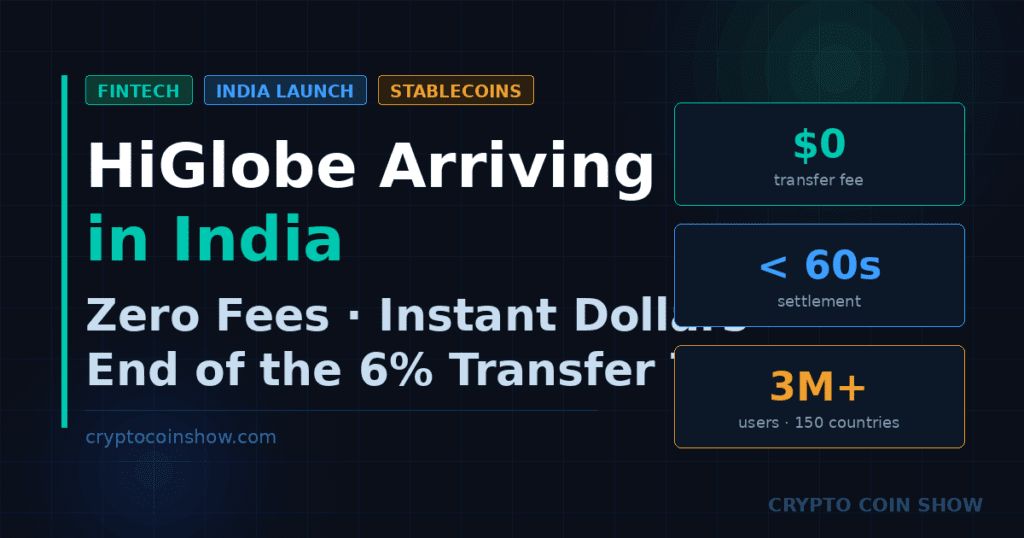
Higlobe Arriving in India — Zero Fees, Instant Dollars
Global Payments · Stablecoins · Emerging Markets
Higlobe Arriving in India — Zero Fees, Instant Dollars, and the End of the 6% Transfer Tax
The San Francisco fintech that pioneered stablecoin-native payments is bringing its lowest-cost guarantee to one billion global south users — starting with the world’s most globalized diaspora.
AA
Ashton Addison
Founder & CEO · Crypto Coin Show · Since 2014
9 April 2026
For most of the last decade, sending money across a border has meant choosing between speed and cost — and losing on both. Bank wires: five days, six percent. PayPal and Stripe: faster, but the fee is baked into the exchange rate. Stablecoin wallets bolted onto old rails: crypto in, SWIFT out, same problem. Higlobe was built to eliminate all three of those compromises — and it is now bringing that infrastructure to India.
The company is launching in India within days, becoming the first stablecoin provider with direct local rails into the Indian market. The move is significant not just for its scale but for its structure: India’s government permits citizens to invest up to $250,000 USD overseas — a legal opening that does not exist in Brazil or Mexico, two of Higlobe’s existing markets. Combined with the most globally distributed diaspora of any country on earth, India represents a structural opportunity unlike any the company has entered before.
“Waiting lists are bursting at the seams,” said Teymour Farman-Farmaian, Co-founder and CEO of Higlobe. “We’ll be the first stablecoin provider linked into India. Zero fees. USD in, rupees out.”
Higlobe · Key Metrics · April 2026
Active Markets
6
Transfer Time
<60s
Average User Monthly Volume
$5,000 – $6,000
Transfer Fees
Zero — lowest cost guaranteed
Compliance
SOC2 Type 2 · FinCEN MSB Registered
Infrastructure
Dual bank partners · Crypto-native rails
I.The Problem
Why the Old Rails Keep Failing
The traditional cross-border payment system wasn’t designed to fail — it was designed to profit. Banks maintain local currency balances in target markets, a model called netting, which allows faster settlement but requires significant capital. That capital cost flows directly to the user as a percentage fee. The result: industry averages above six percent per transfer, a rate the UN targeted at three percent in 2015 and has never seen met.
Newer entrants like Wise and Revolut compressed fees somewhat but never restructured the underlying incentive. They still make money on the transfer — which means the fee can go lower, but never to zero. PayPal, which processes hundreds of billions in cross-border volume, faces the same constraint. Its shareholders expect per-transfer margin. That model works until a competitor prices it into obsolescence.
“Technology moves faster than the business model. PayPal will keep minting money on the old rails until a competitor takes enough market share — then capitulate. Exactly what happened with music streaming.”
Farman-Farmaian reaches for Clay Christensen’s definition of disruptive technology: cheaper, worse at first, makes money differently. Kazaa gave away music in 2000. Spotify monetized it through subscription in 2005. Apple kept charging 99 cents per download until 2015 — minting profit for a decade before capitulating. Stablecoins were invented in 2014 by Tether. The Genius Act legitimized them in March 2025. “Same arc,” he said. “Five years to the capitulation.”
II.The Architecture
Built Crypto-Native From the Start
Higlobe’s core insight dates to 2019. Farman-Farmaian — who describes himself as “Two Revolution Teymour,” having lived through the Iranian and Venezuelan revolutions and watched family wealth erased twice — made a decision the rest of the industry hadn’t yet reached: go all-in on stablecoin end-to-end. No hybrid. No SWIFT fallback. Crypto-native rails, country by country.
Most competitors, he argues, missed the point entirely. “They slap a stablecoin wallet onto old-world rails. You get paid in stablecoin, but to cash out it goes through SWIFT — five days, three percent fee.” Higlobe builds direct fiat on- and off-ramps at the market level, partnering with local crypto exchanges in each country. Users never see a stablecoin interface. They put money in and it appears as US dollars, instantly, at near-zero cost.
Factor
Legacy Model
Higlobe
Transfer time
1–5 business days
Under 60 seconds
Transfer fee
3–6% (often in FX spread)
Zero — lowest cost guaranteed
Rail architecture
Correspondent banking / netting
Crypto-native, local exchange partnerships
Revenue model
Per-transfer margin
FX, debit card, yield, loans, subscription
User experience
Multi-step, multi-platform
Single interface, no crypto knowledge needed
The lowest-cost guarantee is contractual: if a user finds a better rate anywhere and sends a screenshot, Higlobe returns the full transfer plus a “headache bonus” within 48 hours. It is a structural bet, not a marketing claim.
III.The Business Model
How You Build a Billion-Dollar Business Without Charging for Transfers
When the marginal cost of moving money through a stablecoin rail reaches near zero, the pricing of that transfer trends to zero. Fighting that trajectory — as PayPal and Wise do today — is a posture, not a strategy. Higlobe was built from the start to monetize the relationship, not the transaction.
Revenue today comes from four sources: foreign exchange spread optimization on currency conversion, debit card interchange, yield on user deposits placed with yield providers at three to four percent APY, and loans currently in testing against US receivables. The long-term model points to subscription — a bundled product giving users unlimited access to transfers, jobs, financial services, and lending in a single monthly fee. The analogy Farman-Farmaian returns to is Amazon: retail is the relationship hook, but Prime, advertising, and AWS are where the margin lives.
On yield: Higlobe automatically places user dollar deposits with yield providers at 3–4% APY. For users whose local currency loses 10% or more per month against the dollar — as is common across Latin America — the yield is almost secondary to the stability of simply holding dollars at all.
IV.The India Launch
Why India Changes Everything
Each of Higlobe’s six markets required a country-specific build: local exchange partnerships, regulatory licensing, and on-the-ground compliance infrastructure. The company’s deliberate choice to go six countries deep rather than 150 countries wide is the source of its structural cost advantage — and its defensibility.
India is different in three ways that compound. First, India’s Liberalised Remittance Scheme permits citizens to remit up to $250,000 USD overseas per year — a legal channel unavailable in comparable form in Brazil or Mexico. Second, the Indian diaspora is the most globally distributed of any nation, with large communities in the United States, United Kingdom, Canada, the Gulf, Southeast Asia, and Africa. Third, India’s tech sector has a deep structural connection to the US — software engineers, exporters, and remote workers are exactly the high-volume professional users Higlobe built its first four years around.
Individual onboarding is complete in under 24 hours. From there: dollars arrive, are automatically placed on yield, can be spent on Higlobe’s debit card, and can be withdrawn to a local bank account in rupees — without the user ever interacting with a crypto interface.
Blockchain Interviews · Crypto Coin Show
Teymour Farman-Farmaian, Co-founder & CEO · Higlobe · 9 April 2026
Full Interview
Selected Excerpts
Q Most stablecoin competitors still route cash-outs through SWIFT. What did Higlobe figure out that they didn’t?
We go country by country and work with the best local exchanges for a seamless interface. Our users move in and out of dollars without even knowing it. Instant. No fee. When friction is taken out, growth occurs. That’s what we’ve seen.
Q If you’re not making money on transfers, where does revenue actually come from?
Think of Amazon. It doesn’t make money on retail — it makes money on Prime, ads, and AWS. Move money is the relationship hook. Real revenue is the services around it: FX trading, debit card, yield, loans. We’ll end up with a Spotify-like subscription — unlimited access to jobs, loans, transfers.
Q What makes India different from your other markets?
India allows overseas investment up to $250,000 per person — Brazil and Mexico don’t. The Indian diaspora is the most globalized in the world. We’ll be the first stablecoin provider linked into India. Zero fees, USD in, rupees out. Waiting lists are bursting at the seams.
Q How does the lowest-cost guarantee actually work?
If you think you got a better price somewhere, email us a screenshot and you’ll get your money back plus a headache bonus within 48 hours. We make money differently — so moving money is covered at cost only. We don’t do 150 countries with Frankenstein stablecoin-on-old-rails. We do six countries with the best rails.
Higlobe is currently live in Argentina, Colombia, Brazil, Mexico, the Philippines and India. Sign up and access the lowest-cost guarantee at higlobe.com.
This article draws on an interview conducted by Ashton Addison, Crypto Coin Show, with Teymour Farman-Farmaian, Co-founder and CEO of Higlobe, on 9 April 2026. The full interview is available on the Crypto Coin Show YouTube channel.
Stablecoin tax treatment in the U.S. is at the center of a new legislative push to exempt qualifying daily transactions involving regulated payment stablecoins from tax.
The latest version of the PARITY Act would stop gain or loss recognition on certain stablecoin sales unless a taxpayer’s basis falls below 99% of the token’s redemption value, marking a direct attempt to treat routine stablecoin spending more like cash payments. The proposal also revises rules on staking rewards and digital asset wash sales, while lawmakers in Washington continue to debate broader crypto legislation.
Stablecoin payments provision removes small transaction tax burden
The bill is grounded on the past discussion drafts issued in December 2025 and on March 26, 2026. The earlier proposal recommended a $200 limit on payments made with regulated payment stablecoins, as in the de minimis section.
That structure was altered in the March 2026 draft. Instead of using a de minimis criterion, the text states that no gain or loss would be recognized on the sale of a regulated payment stablecoin unless the taxpayer’s basis in that stablecoin is less than 99% of its redemption value.
Another standard eliminated by the draft was the previous $200 standard. In addition, it created a deemed basis of $1 for exchanges, which the text treats separately from the stablecoin’s sales. That development solves one of the long-term problems of crypto users. The current tax treatment states that any payment made using USDC or USDT can result in a taxable event, even when the change in value is minimal.
Meanwhile, the bill creates a distinction between passive staking and other activities, such as trading. It would also enable taxpayers to decide when to record staking rewards, upon receipt or after a deferral period of not more than 5 years, as indicated in the material. To qualify under the proposed stablecoin treatment, the asset must be regulated under the GENIUS Act and remain within 1% of its $1 peg.
Stablecoin debate comes alongside ongoing crypto policy pressure
The tax proposal comes following pressure on other digital asset legislation, including the CLARITY Act. Senator Cynthia Lummis recently pointed out that the bill could remain stalled until 2030 if the Senate fails to act before the 2026 election cycle.
At the same time, as reported by Cryptopolitan, the Trump White House has pushed back on concerns over stablecoin yield provisions. A Council of Economic Advisors report dated April 8 said the effect on bank lending would be limited, estimating a 0.02% increase, or about $2.1 billion.
The same report said community banks would face about $500 million in additional obligations, equal to a 0.026% increase over current lending activity. It concluded that banning yield would provide little protection for bank lending while giving up consumer benefits tied to competitive returns on stablecoin holdings.
Your bank is using your money. You’re getting the scraps. Watch our free video on becoming your own bank
RealFi Launches USDr — Turning Idle Stablecoins into Real-World Returns
Press Release — Embargo Lifted 09 April 2026, 11:00 BST
London · 09 April 2026 · DeFi & Real-World Assets
RealFi Launches USDr: Turning Idle Stablecoins into Real-World Returns
New crypto-native platform targeting up to 9%* APY, putting hundreds of billions in dormant stablecoins to work through real-world market investments
9%*Target APY
$1BTVL Target
USDrYield-Bearing Stablecoin
No Lock-UpLiquidity
RealFi today announced the launch of its platform alongside the introduction of USDr — a decentralised, yield-bearing stablecoin pegged to the US dollar that enables investors to put their dormant stablecoins to work, earning real returns backed by real-world market investments.
The Opportunity
RealFi is a crypto-native financial platform targeting one of the most underleveraged assets in digital markets: stablecoins. With hundreds of billions in circulation globally across high-growth markets including Nigeria, Vietnam, Kenya, Indonesia, Turkey, Brazil and Argentina, stablecoins have become DeFi’s most successful digital asset. Yet for most holders, they remain idle — preserving value but failing to work as an investment tool.
USDr changes that. Through exposure to real-world market investments rather than traditional banking infrastructure or passive fiat reserves, USDr enables investors to earn yields of up to 9%* APY with no lockup — delivering meaningful returns in a market increasingly focused on capital efficiency.
“Stablecoins are the most underleveraged asset class in crypto — hundreds of billions sit idle when they could be generating real returns for their holders. USDr changes that equation entirely. We’ve built a platform that is transparent, accessible and designed to deliver genuine value.”
— John O’Connor, CEO & Founder, RealFi
How It Works
The platform is designed for accessibility. Users can purchase USDC directly in their Lace wallet, convert it seamlessly into USDr, and stake to begin earning yield immediately — lowering the barrier to entry for retail users while remaining attractive to crypto treasuries and sophisticated DeFi participants.
USDr’s yield is backed by real-world economies: a diversified reserve of Money Market Funds and Corporate Floating Rate Bonds — meaning every dollar in USDr supports real businesses and real infrastructure, rather than relying on risky crypto-native leverage.
Infrastructure & Ecosystem
RealFi is currently entering a testnet phase alongside an initial institutional onboarding process, with broader availability anticipated later this year. The platform is supported by Input Output Global and follows the integration of USD Coin on the Cardano network in March, boosting DeFi capabilities across the network before expanding to other ecosystems.
RealFi is targeting $1 billion in TVL as it scales across Cardano, Ethereum and Bitcoin networks.
“We’re bringing investors and borrowers closer to the company, and closer to the rewards, whereas a traditional banking sector keeps them at arms length, in many cases depriving them of any kind of financial autonomy.”
— John O’Connor, CEO & Founder, RealFi
Early Participation
Early participants on the RealFi platform will have the opportunity to earn R-Points through active engagement and platform participation. R-Points recognise and reward community contribution during the platform’s early growth phase and distribution across chains. Further details regarding R-Points, including any future utility or conversion mechanics, will be communicated to participants in accordance with applicable regulatory requirements and platform terms.
Investors can register their interest now at realfi.co, as well as sign up for the testnet waitlist.
About RealFi
RealFi is a crypto-native stablecoin platform that bridges decentralised finance with real-world market investments. Through its flagship product USDr — a yield-bearing stablecoin pegged to the US dollar — RealFi enables stablecoin holders to earn sustainable returns. Built on the Cardano blockchain and integrated with the Lace wallet, RealFi is designed to make DeFi yields simple, transparent and accessible to users worldwide.
Important Notices & Disclaimers
Geographic Restrictions: RealFi products are not available to users in the United States (US), European Union (EU), United Kingdom (UK), Hong Kong (HK), or other restricted or sanctioned jurisdictions. It is the responsibility of each user to ensure compliance with the laws and regulations applicable in their jurisdiction prior to accessing the RealFi platform or any of its products.
Forward-Looking Statements: This press release contains forward-looking statements, including statements regarding anticipated product launch timelines, platform development milestones, and projected TVL targets. These statements reflect current expectations and targets only, and are subject to risks, uncertainties, and changes in circumstances that could cause actual outcomes to differ materially. RealFi undertakes no obligation to update or revise any forward-looking statement following publication of this release.
Risk Disclosure: USDr is a digital asset that provides exposure to a portfolio of real-world financial instruments. It is not a bank deposit, is not insured, and carries risk, including potential loss of principal. Returns are variable, based on market conditions, and are not guaranteed. Redemptions may be subject to timing delays, liquidity constraints, and market conditions. The value of underlying assets may fluctuate, and there is no assurance that USDr will maintain a constant value relative to the US dollar at all times. Access to the platform is subject to onboarding procedures, including identity verification and compliance with applicable anti-money laundering and sanctions regulations.
*APY is indicative, based on current rates, and subject to change. Not a guaranteed return. Capital at risk. *Indicative only
Stablecoin Yield: Why Washington’s Battle Could Reshape Crypto Banking Forever
Regulation·28 March 2026·5 min read
Stablecoin Yield: Why Washington’s Battle Could Reshape Crypto Banking Forever
A single clause in the US CLARITY Act has sent Circle’s stock to its worst-ever single-day drop, alarmed Coinbase, and put stablecoin yield at the centre of a fight that will determine whether crypto platforms or traditional banks control the future of digital money.
AA
Ashton Addison
Founder & CEO · Crypto Coin Show · Since 2014
Syndicated via Refinitiv TV London Stock Exchange Group
A leaked draft of the Digital Asset Market Clarity (CLARITY) Act sent shockwaves through crypto markets on 24 March 2026, when provisions proposing to ban stablecoin platforms from offering yield on customer balances were reported by The Wall Street Journal. Circle Internet Group recorded its largest-ever single-day share price decline, while Coinbase also fell sharply — before both partially recovered the following day. By 25 March, Senate negotiators announced they had reached an agreement in principle with the White House on the disputed yield provisions, but the broader regulatory uncertainty remains unresolved.
Key Concept
Stablecoin Yield
Interest or rewards paid by a crypto platform to users who hold stablecoin balances — functioning similarly to a savings account interest rate, but often at significantly higher rates than traditional banks offer.
Key Concept
The CLARITY Act
US legislation currently before the Senate aimed at establishing a comprehensive regulatory framework for digital assets, covering market structure, stablecoin issuance, and the treatment of crypto platforms under existing financial law.
Context
The Fight Behind the Bill
The stablecoin yield dispute has been the single largest obstacle blocking the CLARITY Act’s advancement through the Senate. On one side, traditional banks — led by the American Bankers Association — have argued that allowing crypto platforms to pay yield on stablecoin balances risks triggering significant deposit flight away from savings accounts, ultimately threatening bank lending capacity. On the other, the crypto industry has maintained that restricting yield would leave US platforms uncompetitive against offshore alternatives and damage innovation domestically.
SEC Chairman Paul Atkins, speaking at the Blockworks Digital Asset Summit in New York on 24 March, described the prior week as “a historic week for America’s digital asset markets” and characterised recent regulatory actions as “the end of the beginning” — while cautioning that congressional legislation remains the only route to a durable framework. Atkins also criticised the prior administration’s enforcement-first approach, acknowledging that it had pushed crypto activity toward offshore jurisdictions.
Analysis
Who Wins, Who Loses if Yield Is Banned
The stakes of the yield debate extend well beyond compliance costs. If enacted in their strictest form, the CLARITY Act’s yield restrictions would align stablecoins more closely with traditional deposit products — effectively handing incumbent banks a structural advantage they have lobbied hard to preserve. For crypto-native stablecoin issuers, the consequences vary significantly by business model.
“
“The impact may be less about restriction and more about redistribution — determining who captures value and under what conditions.”
CCS Analysis · 28 March 2026
Circle, issuer of USDC and the most US-regulated of the major stablecoin operators, faces the most direct exposure given its business model’s reliance on yield-generating activities. Tether, by contrast, operates largely outside US jurisdiction and would face fewer direct constraints. This competitive asymmetry is one reason analysts suggest that a strict yield ban could paradoxically strengthen offshore operators while pressuring the more compliant, domestically-oriented platforms the legislation ostensibly aims to support.
Compounding the picture, the New York Stock Exchange announced on 24 March a collaboration with digital asset infrastructure firm Securitize to develop a blockchain-based trading platform capable of 24/7 settlement using stablecoin funding. If stablecoin yield is curtailed, the economic incentive underpinning much of that institutional infrastructure weakens alongside it.
What It Means
A More Proactive Regulatory Philosophy
What may distinguish the current regulatory moment from prior crypto policy cycles is not merely the content of the rules, but the approach underpinning them. Earlier frameworks largely focused on enforcement after misconduct, or on clarifying asset classifications as disputes arose. The CLARITY Act represents a more proactive posture — attempting to define market structure before it fully matures rather than reacting to crises once they develop.
Whether the Senate’s reported agreement in principle on stablecoin yield translates into final legislative language — and how that language is ultimately worded — will determine how value flows through digital asset markets for years to come. For crypto-native firms, the challenge is to demonstrate that innovation can operate within regulatory constraints. For traditional institutions, it is to move quickly enough to remain relevant in a market they did not build.
The CLARITY Act’s March deadline passed without a final signing. Institutional money has remained hesitant, and altcoin sentiment has stayed subdued as traders wait for Washington to deliver a definitive answer. The bill’s trajectory in the coming weeks will be one of the most consequential regulatory developments in digital assets since the FTX collapse in 2022.
Algorand’s U.S. Return: CEO Staci Warden Interview — Crypto Coin Show
Crypto Coin ShowMarch 2025
Exclusive Interview · Blockchain Infrastructure
Algorand’s U.S. Return: CEO Staci Warden on Stablecoins, Humanitarian Aid, and the Future of Finance
After years of regulatory exile, the Algorand Foundation is coming home — and its CEO has a clear vision for how blockchain becomes invisible infrastructure.
AA
By Ashton Addison
Refinitiv TV · 600k+ institutional
Full Interview
After years of regulatory uncertainty forcing U.S. crypto companies to operate from Singapore and the Cayman Islands, Algorand Foundation is coming home. In this exclusive interview, CEO Staci Warden discusses the foundation’s return to the United States, how blockchain is transforming humanitarian aid in Afghanistan, and why instant finality makes Algorand uniquely positioned for the stablecoin economy.
I.Coming Home: Why Algorand Moved Back to the U.S.
For blockchain companies operating during the previous administration’s regulatory crackdown, staying clear of U.S. jurisdiction wasn’t just cautious — it was survival. Warden described the contortions Algorand Foundation had to perform:
“
I couldn’t even hold the token of the company I run. We’d immediately convert any algo compensation into dollars because we were so careful about not issuing algos to U.S. citizens. It’s a bad look for the CEO not to be holding the coin of the company.
The foundation relocated from Singapore to the United States, transitioned from nonprofit to for-profit status while maintaining its mission-driven reinvestment approach, and completely revamped its board with crypto, policy, regulatory, and payments heavyweights.
“We deserve to be here,” Warden explained. “We were founded out of MIT, one of the most prestigious universities in the United States, by one of the most important cryptographers in the country. The core chain was built in the U.S. We’re coming back where we belong.”
II.Blockchain Humanitarian Aid: The Afghanistan Model
One of the most compelling use cases Warden discussed was Algorand’s role in humanitarian payments in Afghanistan — a project that demonstrates blockchain’s ability to bring transparency, speed, and dignity to aid distribution.
When the Taliban returned to power and Afghanistan was sanctioned, traditional financial rails collapsed. International aid organizations still needed to support women and families they’d been helping, but banks wouldn’t touch transactions. Hassan Pay, an Algorand partner, built an Afghani stablecoin running on Algorand rails and created a transparency portal — a user-friendly overlay on the blockchain explorer that lets aid agencies track every payment.
“
You can see your list of recipients, match them to wallets, see where your aid has gone, and even track the next hop — what those wallets are doing with the payments. You might see lots of wallets sending to one place: turns out it’s a money changer, or the electric company. So they’re paying their bills.
The benefits extend beyond transparency:
Instant payments — no waiting in lines
Safety — recipients aren’t targets for theft when they don’t queue at distribution centers
Dignity — electronic payments instead of public handouts
Flexibility — usable via smartphone, basic phone, or card
“The Taliban is very aware of this. The central bank of Afghanistan understands that this is happening, but they appreciate the transparency, the speed, and of course the money that this enables,” Warden noted. The project has since been approached to expand into Syria for similar purposes.
III.Why Instant Finality Matters for Stablecoins
Algorand’s technical differentiator — instant finality — becomes critical in the stablecoin economy. Unlike chains where transactions can be reversed or require multiple confirmations, Algorand’s architecture ensures that once a transaction hits the ledger, it’s permanent.
“
When you’re promising to give $1 back for every $1 stablecoin that a customer redeems, you can’t have — even for a nanosecond, especially with bots running around — two versions of that world where you might have to redeem $2 for one stablecoin.
This becomes especially important for agentic payments — automated transactions where merchants accept payment from an AI agent, deliver merchandise immediately, but prefer settlement certainty before committing. Without instant finality, these workflows break down. Warden also addressed the coming proliferation of stablecoins, noting that as companies from Amazon to Exxon realize they can issue their own to manage supplier relationships, the ecosystem will fragment — then consolidate around quality and regulatory compliance.
IV.The GENIUS Act and Path to Regulatory Clarity
The GENIUS Act represents the biggest regulatory unlock for Algorand and the broader industry, allowing foundations to offer services to U.S. customers without fear of enforcement actions. When asked about the stalled CLARITY Act, Warden took a pragmatic stance:
“
I’m of the mind that you just get legislation enacted and you can always improve it. Legislation is not frozen once it’s enacted. You have an opportunity through rulemaking to improve things and fix things. We tend to act cautiously but opportunistically.
For Algorand, the current environment is already transformative. “We can now offer things to U.S. customers. The rest is a cherry on top,” Warden said. She acknowledged the industry’s debt to Coinbase CEO Brian Armstrong’s policy machine, while noting different stakeholders have different priorities — for Coinbase, the ability to pay interest on stablecoins is critical; for Algorand, it’s about being treated “appropriately and having a right to exist.”
V.When Blockchain Becomes Infrastructure: The 2030 Vision
Asked what needs to happen for blockchain to move from “approaching foundational” to “fully embedded in finance,” Warden pointed to wallet-based banking:
“
If I had to pick one thing, banks would have a wallet-based solution for their customers — with tokenized deposits from banks and the ability for banks to accept stablecoins. Then I think we’re here. We’ve finally arrived.
She contrasted traditional liability-based banking — where payments are reconciled in batch files at day’s end — with crypto’s wallet-based infrastructure where clearing is settlement. But the ultimate measure of success won’t be adoption metrics. It’ll be invisibility:
“
We’ll really be embedded when people stop talking about the blockchain. They’ll just know they’re making payments really easily, earning the reference rate on all their assets — they’ll know all these things. They might not know why.
Warden quoted Senator Tim Scott’s approach to advocacy: “If you’re trying to make somebody see the light, turn on the light switch for them. Don’t teach them how electricity works. What we need to do now is turn on some light switches for people.”
VI.Beyond Stablecoins: Tokenizing Capital Markets
Warden emphasized that stablecoins are just one example of tokenized financial assets. The real opportunity lies in on-chain capital markets — from money market funds to liquid stocks to private credit.
Her north star: paying for a Starbucks coffee with a sliver of a BlackRock money market fund, where you’re earning yield until the moment you hand it over to the merchant, who immediately starts earning yield on receipt.
“The challenges aren’t technical, they’re regulatory,” she noted. “That money market fund is a security. For me, it’s much more that the lawyers need to get busy making all of this possible than the engineers.” She also highlighted Lofty AI, built on Algorand, which lets investors buy into rental-earning real estate for as little as $50 — with full transparency on rental history, tax receipts, and property documentation.
VII.Six Years of Uptime, and Just Getting Started
Warden opened the conversation with a point of pride: Algorand hasn’t gone down for one nanosecond in over six years of operation. That reliability, combined with instant finality and energy efficiency, positions the chain as infrastructure-grade — not experimental tech.
With regulatory tailwinds, a U.S. domicile, and proven use cases from Afghan refugee payments to institutional stablecoin settlement, Algorand’s “future of finance” tagline looks less like startup hyperbole and more like a roadmap unfolding in real time.
About the Guest
Staci Warden
CEO and board member of the Algorand Foundation, leading the energy-efficient, quantum-secure blockchain built for institutional-grade certainty and real-world scale. She serves on the board of the Global Blockchain Business Council (GBBC) and advises the U.S. Financial Technology Association. Before Algorand, Warden led the Global Market Development Practice at the Milken Institute for eight years, and has held senior roles at J.P. Morgan, Nasdaq, and as a senior economist for the U.S. Treasury Department, the Center for Global Development, and the Harvard Institute for International Development.
Founder and CEO of Crypto Coin Show (CCS), a blockchain media platform operating since 2014. CCS reaches 150,000+ YouTube subscribers and is the only blockchain media outlet syndicated on Reuters Insider/Refinitiv TV, delivering content to 600,000+ institutional subscribers via the London Stock Exchange. The platform distributes across 10+ podcast networks and publishes a weekly Substack newsletter. Ashton has conducted 1,500+ blockchain interviews and won the 2025 Web3 Influencer Award for “Best Interviews” (his second win after 2022). He previously raised $5M for EventChain SmartTickets and has served as advisor to Syscoin, Pundi X, and CoinPayments.
Mastercard’s Crypto Power Move Could Reshape Global Payments Forever
The payments giant just unified 85+ crypto-native firms — including Binance, Circle, Ripple, and PayPal — under one global program. Here’s what it means for blockchain’s mainstream moment.
Crypto Coin Show EditorialMarch 11, 20266 min read
85+
Crypto Partner Firms
↑ Launched March 11, 2026
$27.6T
Stablecoin Volume (2025)
↑ Exceeded Visa + Mastercard combined
$4.5B
Stablecoin Card Spend (2025)
↑ +673% YoY
200+
Countries in Mastercard Network
Global on-chain reach
The Announcement
On March 11, 2026, Mastercard dropped what may be the most consequential institutional crypto announcement of the year. The company officially launched its Mastercard Crypto Partner Program — a global initiative bringing together more than 85 companies spanning crypto exchanges, blockchain developers, fintech firms, and traditional banks.
The roster reads like a who’s who of the digital asset space: Binance, Circle, Ripple, Gemini, PayPal, Paxos, BitGo, Crypto.com, and dozens more. But this isn’t a PR stunt or a tentative pilot. Mastercard is signaling that on-chain payments are now a core business line — not a side experiment.
“The next phase of on-chain payments will be built through collaboration. Expertise and insights must flow both ways as we shape the future together.”
— Mastercard, Official Program Statement
What the Program Actually Does
At its core, the Mastercard Crypto Partner Program is a unified integration framework. Unlike previous one-off partnerships, it provides a shared set of technical and compliance standards that allow crypto-native firms to connect their on-chain infrastructure directly to Mastercard’s global payment rails.
The program is built on Mastercard’s Multi-Token Network (MTN), designed to handle tokenized deposits and stablecoins at scale. The goal is to make blockchain technology effectively “invisible” to end users — delivering the speed and programmability of digital assets through the familiar rails of existing card infrastructure.
Program Architecture
Four Core Focus Areas
01
Cross-Border Remittances
Faster, cheaper global money movement using stablecoin settlement — bypassing correspondent banking friction entirely.
02
B2B Payments
Enterprise-grade on-chain transfers with compliance baked in. The $226B annual B2B stablecoin market now has institutional rails.
03
Global Payouts
Connecting crypto-native payroll and treasury operations to Mastercard’s 200+ country network in real time.
04
Collaborative Product Design
Partners co-advise on Mastercard’s future digital asset products — a two-way flow of expertise across 85+ firms.
Why Mastercard Can’t Ignore Crypto Anymore
The numbers tell the story. Stablecoin transaction volumes hit $1.26 trillion in February 2026 alone. Annual stablecoin transfer volumes topped $27.6 trillion in 2025 — a figure that now exceeds the combined transfer volumes of both Visa and Mastercard’s traditional networks. The thing that’s supposed to disrupt you is already bigger than you.
Stablecoin-linked card spending reached $4.5B in 2025, up 673% year-over-year. B2B stablecoin payments hit roughly $226B annually — a staggering 733% growth. These aren’t incremental gains. This is infrastructure-level adoption happening in real time.
Metric
Figure
Growth
Stablecoin Volume (Feb 2026)
$1.26 Trillion
↑ Record high
Annual Stablecoin Transfers (2025)
$27.6 Trillion
↑ Exceeds Visa + MC
Stablecoin Card Spending (2025)
$4.5 Billion
↑ +673% YoY
B2B Stablecoin Payments (2025)
~$226 Billion
↑ +733% YoY
USDC Circulation Share
~70% of volume
↑ Circle dominant
The 85+ Partner Ecosystem
The sheer breadth of firms involved tells a story of industry convergence. Exchanges, infrastructure providers, stablecoin issuers, fintech platforms, and traditional banks — all operating under one Mastercard roof.
Binance
Circle
Ripple
PayPal
Gemini
Paxos
BitGo
Crypto.com
SoFi
Marqeta
Nuvei
+ 74 More
Notably, SoFiUSD — the first stablecoin issued by a US nationally chartered bank — crossed $1B in circulation by March 2026, the same week this program launched. Ripple’s RLUSD similarly exceeded $1B since its late 2024 debut. The stablecoin market is fragmenting in interesting ways, and Mastercard is positioning itself as the connective tissue across all of them.
Key Players to Watch
Not all 85+ partners carry the same weight. Here are the firms whose role in this program will shape how on-chain payments evolve over the next 12–24 months.
Stablecoin
Circle
USDC powers ~70% of stablecoin volume. Circle’s IPO is pending — this program adds institutional credibility at the right moment.
Cross-Border
Ripple
RLUSD crossed $1B in circulation. XRP remains the liquidity layer for fast cross-border settlement at scale.
Exchange
Binance
Largest partner by user volume. Binance’s global reach gives the program instant consumer-facing distribution.
Banking
SoFi
First US nationally chartered bank to issue a stablecoin. SoFiUSD crossing $1B signals TradFi is fully in the game.
Infrastructure
Paxos
Regulated stablecoin infrastructure provider. Paxos is the compliance backbone behind multiple program participants.
Mastercard vs. Visa: The Race Is On
Mastercard isn’t moving in a vacuum. Visa has been equally aggressive — hitting a stablecoin settlement run rate of $3.5B by November 2025 and expanding those services to over 40 countries. The two payment giants are effectively racing to become the default bridge between legacy finance and the crypto economy.
When two $450B+ companies compete aggressively in a new market, the entire ecosystem benefits. Better infrastructure, lower fees, and faster settlement times are all likely outcomes. For blockchain projects, this competitive dynamic is a rising tide.
“This is a legitimacy signal that matters more than another Bitcoin ETF approval. When the company that processes billions of transactions annually builds dedicated infrastructure for digital assets, it validates the thesis.”
— Crypto Briefing Analysis, March 2026
What This Means for the Blockchain Ecosystem
For builders, investors, and projects operating in Web3, Mastercard’s move carries several implications worth tracking closely.
CCS Takeaways
Stablecoin liquidity deepens — more on-ramps and off-ramps through Mastercard’s network means more capital flowing between fiat and crypto
Compliance becomes table stakes — the program’s shared standards will push the whole industry toward cleaner compliance frameworks
Institutional B2B is the real story — consumer crypto card spend is visible, but $226B in B2B stablecoin volume is where the structural shift is happening
Regulatory tailwinds are real — MiCA in the EU and evolving US stablecoin legislation are making institutional players more confident to deploy
The “blockchain is dead” narrative is officially dead — this is infrastructure-level adoption at Mastercard scale
Final Word
Mastercard has spent years dipping its toes in the digital asset space through pilots, Start Path programs, and tentative card integrations. This is different. Organizing 85+ firms under a unified framework, backed by the MTN and focused on enterprise use cases, represents a fundamental posture shift — from observer to architect.
For the Crypto Coin Show audience, this is the kind of institutional validation that takes years to reverse. Whether you’re bullish on USDC dominance, Ripple’s cross-border play, or Binance’s global reach — all roads now run through infrastructure that Mastercard is actively building.
The future of payments is on-chain. And as of March 11, 2026, Mastercard has officially decided to build it.
South Korea is dismantling a nine-year restriction that has prevented its 3,500 listed companies from investing in digital assets, marking a significant shift in the country’s approach to institutional cryptocurrency participation. However, regulators plan to exclude stablecoins like USDC and USDT from the new framework, despite corporate requests to include them for payment settlement purposes.
A Decade-Long Prohibition Finally Lifted
Since 2017, South Korean publicly listed companies have operated under an effective ban on digital asset investments. The Financial Services Commission (FSC) is now preparing formal guidelines to permit institutional trading, a development that reflects changing perspectives on blockchain technology across the region.
The timing aligns with broader regulatory maturation. Rather than maintaining blanket prohibitions, South Korea’s government is implementing a phased approach that distinguishes between different asset classes and investor categories. This represents a pragmatic recognition that cryptocurrency markets have evolved significantly since the ban’s original implementation.
The government is preparing to allow major institutional investments while simultaneously restricting the tools many companies most want to use.
— Regulatory Framework Analysis
Industry Context: South Korea’s Cryptocurrency Ecosystem
South Korea represents one of Asia’s most sophisticated financial markets, with advanced technological infrastructure and a population deeply engaged with digital innovation. The country has been simultaneously a global cryptocurrency hub and a restrictive regulatory environment—a paradox rooted in the 2017 ICO boom and subsequent market volatility.
The nation’s cryptocurrency exchanges, including Upbit and Bithumb, rank among the world’s largest by trading volume. Retail investors have participated enthusiastically in digital asset markets despite institutional restrictions. This created an unusual dynamic where individual citizens could trade cryptocurrencies freely while corporations faced near-total prohibitions.
The 2017 investment ban emerged from concerns about corporate speculation, market manipulation, and capital flight during the cryptocurrency bubble. However, as blockchain technology matured and institutional markets developed globally, South Korea’s absolute prohibition increasingly appeared outdated. Competitors in Hong Kong, Singapore, and other Asian financial centers began developing permissive frameworks, potentially attracting South Korean capital and talent.
The FSC’s policy shift reflects this competitive pressure. Government officials recognized that maintaining an indefinite ban could disadvantage South Korean corporations compared to international peers while simultaneously limiting the country’s position in blockchain innovation and digital finance infrastructure.
The Stablecoin Exclusion
The most controversial aspect of the new rules involves the explicit exclusion of stablecoins. Companies have consistently argued that fiat-pegged tokens like USDT and USDC would streamline cross-border transactions, reduce settlement times compared to traditional banking, and minimize currency volatility exposure for international operations.
Regulators, however, view stablecoin inclusion differently. Under South Korea’s existing Foreign Exchange Transaction Act, stablecoins lack formal recognition as legitimate payment instruments. This creates a legal contradiction: companies could theoretically hold stablecoins as investments while remaining prohibited from using them for commercial transactions like international trade.
Key Constraint
All foreign exchange payments in South Korea must currently route through licensed foreign exchange banks. Allowing corporate stablecoin holdings without permitting their use in payments would generate regulatory inconsistency.
Beyond legal technicalities, financial regulators express concern about potential market instability. A sudden influx of institutional capital into stablecoins during the initial legalization phase could create conditions for excessive speculation or enable circumvention of existing capital controls.
Why Companies Are Pushing for Stablecoin Access
The corporate interest in stablecoins stems from practical operational advantages. Firms conducting substantial international trade face persistent challenges with traditional banking infrastructure: slow settlement periods, currency conversion costs, and exposure to volatility between transaction initiation and completion.
Stablecoins address these pain points directly. Real-time settlement reduces counterparty risk. Elimination of currency conversion steps lowers transaction costs. Companies can maintain digital-native accounting systems without constant fiat conversion cycles.
For South Korean export-oriented manufacturers and technology companies, these advantages carry significant competitive implications. A firm executing international payments in minutes rather than days can reduce working capital requirements, improve cash flow predictability, and respond more nimbly to market opportunities. In industries like semiconductors, electronics, and chemicals where South Korea maintains global leadership, operational efficiency directly affects profitability.
Currently, South Korean companies operate in a gray area. Many access stablecoins through personal wallets or offshore over-the-counter platforms, but without official corporate authorization. This informal approach creates compliance uncertainties and limits institutional-scale adoption. Legitimate legalization would enable treasuries to integrate stablecoins into official foreign exchange management and settlement procedures.
Companies see stablecoins as infrastructure for faster, cheaper international payments—but regulators see potential vectors for capital flight and money laundering.
— South Korean Financial Services Analysis
The Phased Regulatory Approach
South Korea’s Digital Asset Framework Act operates across two phases. Phase 1 prioritized consumer protections and individual investor safeguards. Phase 2 now focuses on building professional market infrastructure capable of supporting institutional participation.
Within this framework, the FSC intends to permit listed companies and professional investors to purchase major cryptocurrencies like Bitcoin and Ethereum. A March 2026 government meeting indicated that stablecoins would be handled separately, potentially through future rules governing domestic stablecoin issuance.
Implementation Strategy
The government plans to allow institutional Bitcoin and Ethereum investments immediately while developing separate regulatory pathways for stablecoin activity, possibly including a won-denominated stablecoin ecosystem.
This bifurcated approach reflects competing policy objectives. Officials want to enable legitimate institutional participation in cryptocurrency markets while controlling specific risks associated with fiat-pegged tokens and capital flight scenarios. The distinction between volatile assets (Bitcoin, Ethereum) and stable assets (stablecoins) suggests regulators view them as presenting different risk profiles.
Market Implications and Competitive Dynamics
The lifting of the investment ban removes a major structural constraint on South Korean institutional capital. Three and a half thousand listed companies represent substantial potential purchasing power once formal guidelines take effect. Industry analysts estimate that even conservative corporate adoption rates could direct billions of dollars toward cryptocurrency markets over the next three to five years.
This influx would likely increase liquidity and reduce volatility in Bitcoin and Ethereum markets, particularly in won-denominated trading pairs. South Korean exchanges would experience increased institutional trading volumes, strengthening their competitive position against global competitors. Asset managers may develop cryptocurrency investment products targeting corporate clients, creating new revenue streams across the financial services industry.
However, the stablecoin exclusion limits the practical utility for many corporate use cases. Companies seeking to optimize payment infrastructure will likely continue workarounds or advocate for regulatory revision as the framework matures. This persistent limitation may drive some firms toward international alternatives or accelerate corporate blockchain development initiatives focused on private settlement networks.
What This Means for Markets and Business
For the broader cryptocurrency ecosystem, South Korea’s approach signals selective openness rather than comprehensive adoption. The country is integrating digital assets into institutional portfolios while maintaining tight control over payment infrastructure and capital flows. This balanced stance contrasts with both extreme prohibition and unrestricted permissiveness observed in other jurisdictions.
International cryptocurrency firms may establish South Korean subsidiaries or expand operations to capture institutional demand. Traditional financial institutions will face competitive pressure to develop digital asset services. Technology companies focused on blockchain and settlement infrastructure will find increased demand for institutional-grade solutions.
The stablecoin question remains pivotal. If regulators ultimately develop a domestic won-backed stablecoin ecosystem, companies would gain settlement capabilities within the regulated framework. Such a path would align with broader government digital currency initiatives while maintaining capital control mechanisms. Alternatively, if international stablecoins eventually gain approval, cross-border payment efficiency could accelerate substantially.
The coming months will reveal whether the stablecoin restrictions hold firm or evolve as implementation proceeds. Corporate pressure, international competitive considerations, and practical payment challenges may eventually push regulators toward inclusion. For now, the framework represents a cautious expansion that prioritizes oversight over accommodation, reflecting South Korea’s characteristic approach of technology adoption balanced with financial system stability.
Learn more about cryptocurrency regulatory developments and institutional adoption trends at CCS News. For detailed analysis of Bitcoin and Ethereum market dynamics, visit our Bitcoin and Ethereum coverage sections.
Get weekly blockchain insights via the CCS Insider newsletter.
Tether has invested $150 million to acquire roughly 12% of Gold.com, signaling a strategic shift toward bridging on-chain assets with traditional commodity markets. The move includes plans to integrate XAU₮, Tether’s gold-backed token, directly into Gold.com’s retail platform—creating what amounts to a direct payment pathway for cryptocurrency holders seeking exposure to physical precious metals without leaving the digital ecosystem.
The Macro Backdrop: When Gold Moves, Risk Sentiment Shifts
Gold trading above $5,000 per ounce typically signals a broader market mood. When bullion prices climb to these levels, investors are often signaling concern about macroeconomic stability, currency devaluation, or systemic risk in traditional markets.
Historically, such price movements correlate with periods when investors retreat from risk assets. The crypto market, in particular, experiences these sentiment swings acutely—markets can spend months in risk-on euphoria before a sharp correction forces participants to reassess their positions within hours.
That’s when hedges matter. That’s also when it becomes interesting that some of the hedging is happening on-chain, not outside it.
— Market Analysis
What makes Tether’s move noteworthy is the timing and structure. Rather than treating gold tokenization as a niche experiment, Tether is positioning it as infrastructure for risk-off scenarios—moments when crypto participants need an exit velocity that doesn’t involve traditional banking delays.
The Deal Structure: Strategic Positioning Over Simple Investment
Tether will acquire 3.371 million common shares at $44.50 per share. Simultaneously, Gold.com has committed to investing $20 million into the XAU₮ token itself, creating aligned incentives between the two entities.
On the surface, this appears to be a standard minority stake purchase. The deeper mechanics, however, reveal something more architectural. Tether isn’t simply buying an equity position—it’s acquiring distribution infrastructure at a precise moment when tokenized commodities are moving from theory to practice.
Key Transaction Details
Tether’s $150 million investment captures approximately 12% of Gold.com. The per-share price of $44.50 values the transaction at a specific premium reflecting the strategic importance of distribution access. Gold.com’s parallel $20 million commitment to XAU₮ demonstrates mutual confidence in the integration.
Gold.com operates as a retail precious-metals marketplace—not a crypto exchange. The platform already handles the unglamorous but essential functions that make physical gold feel tangible to traditional buyers: bar selection, delivery logistics, authentication, and storage options. This existing infrastructure becomes the storefront that Tether needs.
Industry Context: The Tokenization Boom and Traditional Finance Integration
The cryptocurrency industry has spent the better part of a decade exploring how digital assets could represent traditional financial instruments. Real-world asset (RWA) tokenization—the process of converting physical or financial assets into blockchain-based tokens—represents what many consider the next frontier for blockchain adoption beyond pure speculation.
According to industry analysts, the RWA tokenization market was valued at approximately $2-3 billion as of 2023, with projections suggesting growth to $100 billion or more within the next five years. Projects attempting to tokenize everything from government bonds to real estate have emerged, but adoption has remained limited by several factors: regulatory uncertainty, custody concerns, and critically, the absence of reliable distribution mechanisms.
Tether’s position in this landscape is unique. As the issuer of USDT—the stablecoin that dominates crypto transactions and currently exceeds $120 billion in market capitalization—Tether controls a settlement layer that processes trillions in annual transaction volume. This network effect represents genuine competitive advantage when entering commodity tokenization.
However, the RWA space has also attracted heavyweight competitors. BlackRock, Franklin Templeton, and other traditional asset managers have launched tokenized investment products. The World Economic Forum has positioned tokenization as a key pillar of future financial infrastructure. Within this context, Tether’s investment isn’t merely a corporate acquisition—it represents a claim on distribution territory in an emerging market where distribution determines viability.
The Distribution Problem That Tether Is Solving
Tokenization projects face a persistent challenge: minting a token is straightforward; finding willing buyers at the moment they actually need it is considerably harder. Most blockchain-based asset projects struggle with this final-mile problem—getting from technological capability to user adoption.
Tether’s existing position as the dominant stablecoin creates a natural on-ramp. USDT holders already possess a settlement asset within the crypto ecosystem. If those holders can convert USDT into XAU₮ directly through a familiar retail interface, the friction drops substantially.
A user holds USDT, wants gold exposure, and can execute that trade without leaving the crypto rails or waiting for traditional bank settlement.
— Product Integration Logic
The architecture resembles a three-layer system: USDT functions as the settlement layer (the cash equivalent), XAU₮ acts as the hedge wrapper (the exposure mechanism), and Gold.com serves as the storefront (the user-facing interface). Each component has a specific function within a cohesive user experience.
This differs meaningfully from tokenized gold projects that focus primarily on blockchain infrastructure without addressing the retail distribution challenge. By acquiring a stake in an established precious-metals retailer, Tether is purchasing access to customer relationships and operational credibility that took Gold.com years to build.
Gold.com’s Market Position and Operational Fundamentals
Gold.com emerged as an online precious metals retailer serving both institutional and retail customers. The company’s relevance to this transaction extends beyond branding—its operational infrastructure encompasses several critical functions that tokenization projects typically underestimate.
First, Gold.com maintains relationships with accredited storage and vaulting facilities. Physical gold requires secure storage, insurance, and regular auditing. The company’s existing partnerships with major vault operators reduce the operational burden on Tether to build these capabilities independently. This addresses one of the primary concerns institutional investors raise regarding commodity tokenization: where is the physical asset actually held, and who verifies its existence?
Second, Gold.com’s customer base includes investors already comfortable purchasing physical commodities online. These customers understand the custody, delivery, and logistics questions. This familiarity accelerates adoption compared to attracting new users unfamiliar with commodity markets. The platform already performs customer due diligence and compliance functions necessary for regulated commodity transactions.
Third, Gold.com operates within established regulatory frameworks for precious metals dealers. Rather than Tether navigating commodity regulations independently—a process that typically requires years and considerable legal complexity—the partnership allows XAU₮ to integrate into an already-compliant framework.
Implications for On-Chain Infrastructure and Risk Management
The transaction reflects a broader evolution in how cryptocurrency infrastructure is maturing. Rather than assuming blockchain-native solutions will automatically displace traditional finance, successful projects are increasingly integrating with established market participants.
For crypto market participants specifically, the development addresses a practical gap. During periods of elevated volatility or systemic stress, on-chain alternatives to traditional hedging become valuable. If USDT holders can access tokenized gold without KYC friction or multi-day settlement, that functionality could prove meaningful during market dislocations.
Strategic Significance
This partnership demonstrates that tokenization’s future may depend less on isolated blockchain projects and more on integrated connections between crypto infrastructure and regulated commodity markets. Distribution, not technology, has become the limiting factor for asset tokenization adoption.
The arrangement also suggests Tether’s confidence in XAU₮’s potential utility beyond trading speculation. Physical gold delivery, storage, and insurance represent meaningful operational requirements. By partnering with Gold.com rather than attempting to build these capabilities independently, Tether is acknowledging that commodity-backed tokens require more than cryptographic guarantees—they require operational reliability in physical settlement.
For the broader crypto market, the precedent may matter more than this single transaction. If tokenized commodities can achieve meaningful adoption through established retail channels, it opens questions about what other assets might follow similar integration patterns. The model—acquire distribution, integrate the token, align incentives—could extend to other asset classes where on-chain infrastructure offers genuine advantages.
Market Implications and Long-Term Positioning
This investment signals Tether’s strategic evolution from stablecoin issuer toward broader financial infrastructure provider. Rather than remaining purely within the crypto ecosystem, Tether is actively building bridges to traditional commodity markets—a move that positions the company at the intersection of digital and physical assets.
From a competitive standpoint, the deal also represents preemptive positioning. As regulatory frameworks for tokenized assets crystallize globally, first-movers establishing functional, compliant infrastructure gain substantial advantages. Tether’s $150 million commitment demonstrates that the company believes this market will mature substantially over the next 3-5 years.
Gold trading above $5,000 is a market tell about macro sentiment. Tether’s $150 million investment is a different kind of tell—one about how infrastructure providers are adapting to uncertainty by building pathways between worlds. Rather than waiting for traditional finance to adopt crypto, Tether is meeting it halfway by bringing crypto-native tools into established commodity markets.
The success of this initiative will likely determine whether tokenized commodities evolve into meaningful infrastructure components or remain niche products for crypto enthusiasts. Tether’s distribution advantage through USDT and Gold.com’s operational credibility suggest the probability tilts toward the former.
Get weekly blockchain insights via the CCS Insider newsletter.