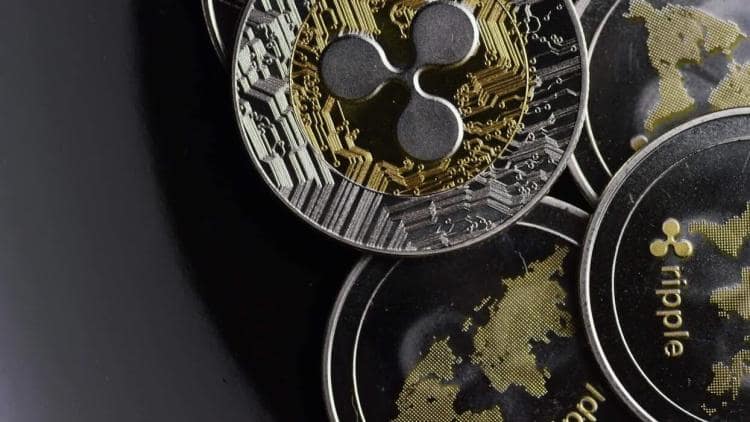
Concerns about powerful quantum computers potentially undermining the security employed by leading blockchains are growing.
Many cryptocurrency networks are already developing improvements to stay ahead of the threat and defend themselves before any significant harm can be done.
The researchers found that the type of cryptography most blockchains depend on today, the kind that secures wallets, approves transactions, and protects digital assets, could be broken by a powerful enough quantum computer.
The findings have divided opinion. Some in the industry take the warning seriously. Others, including MicroStrategy’s Michael Saylor, have brushed off the concern.
Bernstein described the quantum risk as a “manageable upgrade cycle,” while Tron founder Justin Sun said his blockchain is already looking at ways to address future technical threats.
Ripple’s four-phase plan
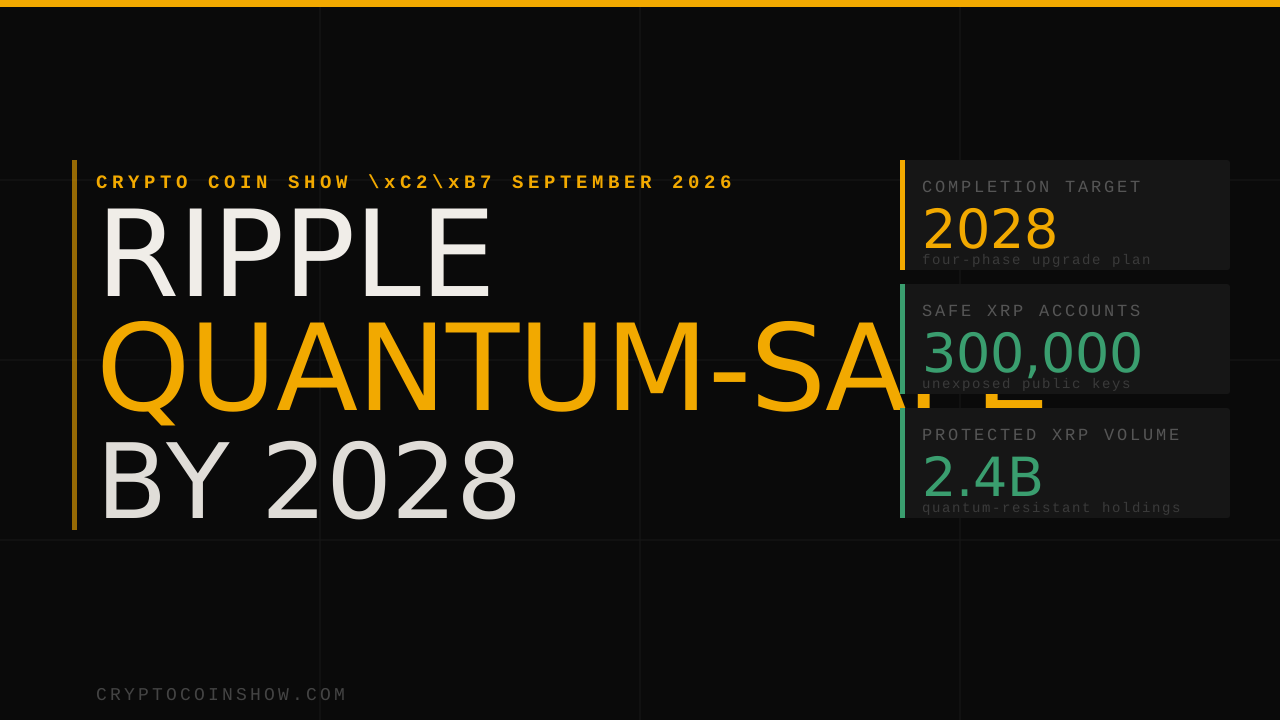
Compared to most, Ripple has gone farther. In order to make its XRP Ledger quantum-safe by 2028, the corporation has outlined a comprehensive four-phase approach.
The first stage is all about being prepared for emergencies.
Ripple wants a backup plan that enables users to transfer their cash to post-quantum encryption, including tools based on zero-knowledge proofs that would function even in a compromised environment, in case existing cryptography breaks sooner than anticipated.
The next step, starting in early 2026, Ripple will study quantum risks and test new security tools with help from Project Eleven.
By the end of 2026, they will test advanced “post-quantum” security methods and research new ways to keep data private.
By 2028, the entire XRP Ledger will be formally upgraded to ensure complete protection against quantum computers.
The fourth and final phase would bring native post-quantum cryptography to the entire XRP Ledger through a formal amendment to the network’s ecosystem.
“The threat has moved from theoretical to credible, and preparation timelines now matter,” Ripple’s blog post stated.
The company also flagged a less obvious danger it described as “harvest now, decrypt later,” where bad actors collect cryptographic data from blockchains today and hold onto it, waiting for quantum hardware to become powerful enough to decode it.
XRP vs. Bitcoin: how exposed are they?
When it comes to how exposed XRP and Bitcoin currently are, the gap between the two is notable.
Quantum computers are most dangerous to wallets where the public key has already appeared on the blockchain, which typically happens after a wallet’s first transaction.
They are immune to quantum attacks since their public keys have never been made public.
Only two sizable dormant accounts with more than 21 million XRP and more than five years of inactivity have exposed public keys, according to the audit. That translates to a mere 0.03% of the whole XRP supply that is currently in jeopardy.
Bitcoin has a different problem. About 32% of all Bitcoin, including 1 million coins belonging to its anonymous creator, Satoshi Nakamoto, is stored in a way that makes it easier for a quantum computer to attack.
Because these accounts have already revealed certain security details to the network, the founder of Litecoin warns they are more at risk than others.
The ledger supports what is called native key rotation, which lets users switch to new, more secure keys without moving their funds to a new account.
Ethereum has no equivalent feature built into its protocol, meaning a post-quantum shift there would require users to manually transfer everything to new accounts.
No quantum computer today is capable of breaking modern encryption.
But with exposure as low as 0.03% and built-in tools for updating security keys, the XRP Ledger appears to be in a stronger position than most networks as quantum technology continues to develop.
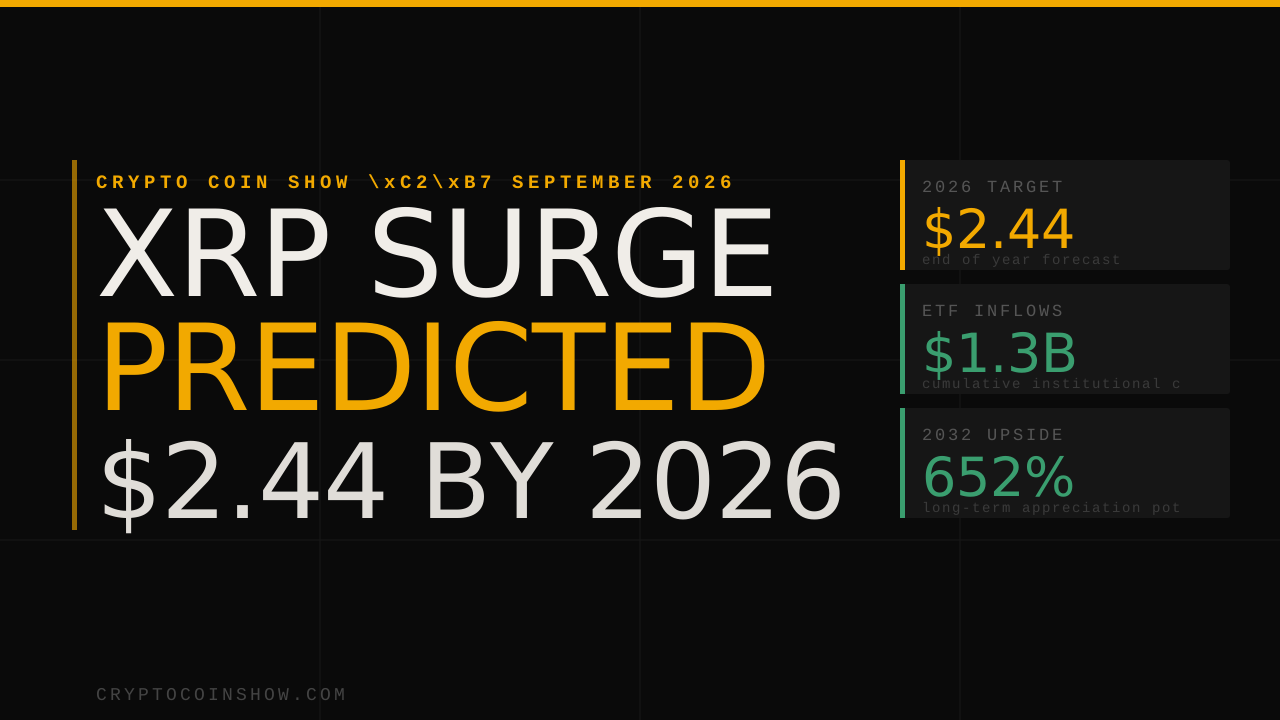
The XRP price prediction suggests that the coin’s price will rise to $2.44 by the end of 2026.
The growing adoption rate of the XRP Ledger Protocol could push XRP to an average price of $4.74, with a possible maximum trading value of $5.15 in 2028.
In 2032, the target price for XRP is between $9.75 and $10.57, with an average price of $10.16.
XRP has a strong community of supporters and developers and continues to see tremendous potential in Ripple’s technology and products. Despite short-term price fluctuations and a bear market, many analysts believe XRP has a bright future bolstered by the 2026 XRP roadmap’s pivot toward institutional DeFi. This optimism is further supported by the growing structural role of XRP ETFs, which have already seen over $1.3 billion in cumulative inflows.
Whether it will reach new highs or continue to grow steadily remains to be seen, and despite its history of legal battles with the Securities and Exchange Commission, this digital asset will undoubtedly play an important role in global financial institutions.
So, how high can XRP realistically go? Will XRP reach 5 dollars?
Let’s answer these questions in our XRP price prediction.
Overview
Cryptocurrency
Ripple
Token
XRP
Price
$1.35 (+0.25%)
Market cap
$83.21B
Trading volume (24-hour)
$1.41B
Circulating supply
61.4B XRP
All-time high
$3.65 on July 18, 2025
All-time low
$0.002686 on May 22, 2014
24-hour high
$1.36
24-hour low
$1.34
XRP price prediction: Technical analysis
Metric
Value
Price volatility
4.22%
50-day SMA
$1.40
200-day SMA
$2.02
Sentiment
Bearish
Fear and greed index
15 (Extreme Fear)
Green days
12/30 (40%)
XRP price analysis
TL;DR Breakdown
XRP price analysis confirms a mixed trend at $1.35.
The token is correcting today, but it reports gains of 0.25% in value over the past 24 hours.
XRP faces strong resistance at $1.37.
On April 11, 2026, XRP is showing signs of a mixed trend after getting resistance near $1.36. The altcoin is currently trading around $1.35, gaining around 0.25% over the past 24 hours. Despite a significant recovery yesterday, the altcoin’s price trend remained slightly negative today as bears are trying to take the lead.
XRP price analysis on the daily timeframe
The one-day XRP price chart confirms that the market is not ready for a price below 1.34, as the token recovered soon after taking a dip to the said level. However, XRP’s value slightly decreased to $1.35 once again over the day. Red candlesticks signal the presence of selling pressure, as the bearish shadow continues to hang over the market.
The distance between the Bollinger bands defines the level of volatility. This distance is narrow as volatility is low. Moreover, the upper band of the Bollinger Bands indicator, indicating the resistance, is at $1.41. The lower Bollinger band, indicating support, is at $1.28.
The Relative Strength Index (RSI) indicator is still in the neutral area. The indicator is currently at 47, and it is moving slightly downwards. The selling activities have led to a decrease. This descent is reflected by a downward curve on the RSI graph. However, if the bullish momentum takes over, the market can enter a period of stability.
XRP price analysis on the 4-hour chart
The four-hour price analysis of XRP also shows a bullish market trend for the cryptocurrency on an hourly basis. Its value increased to $1.35 in the past four hours. The low volatility signals a low probability of a reversal or further price appreciation in the coming hours.
The Bollinger Bands are covering less area, as volatility levels are low. This low volatility signals a higher market predictability. Moreover, the upper Bollinger Band has shifted to $1.36, indicating a resistance threshold. Conversely, the lower Bollinger Band is at a low of $1.32, indicating support on the 4-hour chart.
The RSI indicator is hovering above the center of the neutral zone as it moves upwards. Its value has increased to index 55 in the past few hours. The curve on the RSI graph confirms a positive trend as the indicator’s score is increasing. The recent upturn refers to a relatively balanced trading environment for investors.
XRP technical indicators: Levels and action
Daily simple moving average (SMA)
Period
Value ($)
Action
SMA 3
1.69
SELL
SMA 5
1.47
SELL
SMA 10
1.36
SELL
SMA 21
1.36
SELL
SMA 50
1.40
SELL
SMA 100
1.61
SELL
SMA 200
2.02
SELL
Daily exponential moving average (EMA)
Period
Value
Action
EMA 3
1.37
SELL
EMA 5
1.42
SELL
EMA 10
1.55
SELL
EMA 21
1.71
SELL
EMA 50
1.90
SELL
EMA 100
2.11
SELL
EMA 200
2.28
SELL
What to expect from XRP price analysis next?
The daily price analysis for the XRP/USD pair presents a mixed trend for the cryptocurrency. In the past 24 hours, the bulls took the lead again, thereby creating favorable circumstances for the investors. However, the coin value has corrected to $1.35 overall, but it is now maintaining near yesterday’s closing price.
Is XRP a good investment?
XRP, a cryptocurrency specifically designed for quick and cost-effective cross-border transactions, holds promise in global finance. The easing of regulatory hurdles for Ripple, along with the rising adoption, might boost the XRP price. Additionally, several recent acquisitions and CBDC developments make XRP a good long-term investment option. As with any investment, the outlook for XRP remains uncertain, necessitating a cautious approach and thorough due diligence. It is advised to proceed with caution.
Why is XRP up?
The XRP/USD pair has slightly corrected today, in contrast to the uptrend in the past few days. However, the coin has remained slightly up over the past 24 hours.
How much will XRP cost in 2026?
Considering the future price movements, XRP is expected to trade at an average price of $2.44 by the end of 2026.
Will XRP reach $5?
If demand for XRP tokens continues to rise and its growth trajectory remains consistent, the coin could approach $5 by 2028. However, it’s crucial to remember that XRP’s all-time high stands at $3.65, achieved on July 18, 2025.
Can XRP reach $20?
According to Ripple’s price prediction, XRP has a chance of reaching near $20 but not before 2032. However, it is expected to reach this level if the XRP ecosystem adoption by major financial institutions continues, making it a good option to buy XRP.
Will XRP reach $100 dollars?
Though there are rumors of XRP reaching $100 in the market, and some pro-XRP analysts are also promoting it, many are raising questions about this possibility. XRP may not reach $100 in the near future, at least. Still, the token provides a good buying opportunity to investors looking for long-term goals.
Will XRP reach $1000?
If one XRP coin is worth $1000, its market cap must be more than $100 trillion. Comparatively, the total global stock market cap is about $110 trillion. Therefore, it is unlikely that XRP will reach $1000, based on current market dynamics.
Does XRP have a good long-term future?
XRP is expected to increase in value gradually over the coming years, giving good yields to XRP holders and institutional investors. The coin is expected to reach a maximum price of $10.57 by 2032, making it a valuable asset, particularly with the continued efforts of Ripple Labs. The consistent volume of XRP sales for cross-border liquidity highlights the core XRP benefits and the token’s growing utility in real-world finance.
The prevalence of the XRP ETF assets has also become a bridge between crypto and traditional financial institutions. Cumulative XRP ETF money has reached approximately $1.21 billion in total inflows. Goldman Sachs is the largest XRP ETF holder, as its position is valued at approximately $153.8 million, which accounts for roughly 73% of the total XRP ETF holdings among the top institutional capital investors. As the market matures, ETF inflows grow modestly alongside a steady increase in the net asset value of spot XRP ETFs.
However, some regulatory uncertainties still exist for XRP. While institutional adoption is the long-term goal, speculative ETF flows often drive the sharp, short-term volatility seen in XRP’s current price action. Considering these factors, investors must carry out their own research.
Recent news/opinions on the Ripple Network
Cryptopolitan reported that Kroll Bond Rating Agency (KBRA) assigned a BBB rating to Ripple Prime, the prime brokerage arm of Ripple. Having an investment-grade rating means counterparties can now trade with Ripple Prime under the regular credit framework without requiring exceptions.
XRP price prediction April 2026
According to the Ripple price prediction for April 2026, XRP could reach a maximum price of $1.96. The average trading price is expected to be $1.40 for the month, while the lowest it can go, as per XRP cost estimation, is $1.13, considering the current XRP sentiment.
Period
Potential Low ($)
Average Price ($)
Potential High ($)
April 2026
$1.13
$1.40
$1.96
XRP price prediction 2026
The XRP price prediction for 2026 suggests that the price could reach a maximum of $2.44 by the end of the year, considering its technological utility and enhancement of cross-border payments. We expect an average trading price of $2.03 and a floor price of $0.96.
Period
Potential Low ($)
Average Price ($)
Potential High ($)
XRP price prediction 2026
$0.96
$2.03
$2.44
XRP price predictions 2027-2032
Year
Minimum Price
Average Price
Maximum Price
2027
$2.98
$3.39
$3.79
2028
$4.34
$4.74
$5.15
2029
$5.69
$6.10
$6.50
2030
$7.04
$7.45
$7.86
2031
$8.40
$8.81
$9.21
2032
$9.75
$10.16
$10.57
XRP price prediction 2027
The XRP price predictions for 2027 suggest that the XRP cryptocurrency could reach a minimum trading price of $2.98 and an average price of $3.39. The XRP price forecast further suggests that the Ripple coin is estimated to reach a maximum of $3.79.
XRP price prediction 2028
Ripple XRP price prediction for 2028 estimates a minimum value of $4.34, which is significantly higher than the current XRP price, and an estimated average XRP price of $4.74. The maximum price forecast for 2028 is $5.15, which is quite higher than its current price.
Ripple price prediction 2029
The Ripple price prediction for 2029 shows a minimum price of $5.69. XRP’s future price is expected to reach a maximum level of $6.50, with an estimated average trading value of $6.10 through 2029.
XRP price prediction 2030
The XRP price prediction for 2030 estimates that XRP will attain a minimum price of $7.04, an average trading price of $7.45, and a maximum predicted price of $7.86.
XRP price prediction 2031
XRP price prediction for 2031 suggests a minimum price of $8.40 and an average expected trading price of $8.81 throughout the year 2031. The maximum forecasted price target for 2031 is set at $9.21.
XRP price prediction 2032
The XRP price prediction for 2032 is a minimum price of $9.75 and an average price of $10.16. The maximum forecast price for 2032 is $10.57, as crypto analysts expect investors to continue buying XRP.
Our forecast indicates that XRP is expected to reach a high price of $2.44 by the end of 2026. In 2027, the XRP price is expected to range between $2.98 and $3.79. In 2032, the cryptocurrency is expected to range between $9.75 and $10.57, with an average price of $10.16.
It is important to consider that predictions are not investment advice. Professional consultation is suggested, or you can carry out your research.
XRP historic price sentiment
XRP price history: Coinmarketcap
Before 2017, the asset’s value hovered around $0.01; in April 2017, it rose to $0.05; the gradual climb soon continued as it reached $0.25 in May, showing a positive price action as Ripple continued to excel.
Towards the end of 2019, XRP price stabilized at around $0.30 and did not cross the $0.5 mark throughout the year.
However, the bullish run of 2020 pushed the coin’s value to a peak price of $0.8, gaining investor interest before finishing the year at $0.66.
Early 2021 was supposed to be bullish for XRP, but the SEC announced a lawsuit that derailed investors. Nonetheless, XRP beat the odds and surged above $1.5 during the year, but by 2022, it plummeted to as low as $0.31, significantly decreasing XRP market cap.
XRP started 2023 at $0.335, and on July 13, it almost doubled its value in a steep spike. It shot from $0.470 to $0.814 while swinging towards $0.9 for a few hours. A partial victory against the SEC triggered the price jump, surging the trading volume. XRP closed 2023 at about $0.62.
In 2024, XRP has so far ridden the market wave. The bears earlier on and then a bullish price movement by mid-March resulted in a market price of $0.72, according to data from the cryptocurrency market.
In July, XRP traded between $0.418 and $0.658, showing a good recovery. However, the coin went under bearish pressure at the start of August, falling back down to the $0.550 range as per crypto industry records showing high volatility.
In September 2024, XRP recovered up to the $0.642 level, but the price went down to the $0.500 range in October. A tremendous bullish impulse was observed in November when XRP touched the $1.96 mark, and it reached $2.72 on December 2, 2024.
In January 2025, XRP reached a peak price of $3.19 and traded near the $2.90 level in February. It stepped down to $2.1 in March and to $1.79 in April.
By the middle of May, XRP touched $2.57 during the broader crypto rally, and in July, it marked a new all-time high of $3.65, increasing its market capitalization significantly.
Near the start of August 2025, XRP was trending above $3, showing significant growth as the market sentiment was tilting toward the positive side and XRP demand was at its peak. However, it lost $3 by the end of the month.
In October through November, XRP traded around $1.83 to $3.10. At the start of December, XRP is trading around $1.99 to $2.18.
XRP entered 2026 in a corrective phase, trending near $1.80, and plunged to the $1.30 range at the start of March as the broader crypto winter triggered.
At the start of April, XRP is still trending near the $1.30 range as the broader crypto market recovery has yet to be initiated.
While XRP has struggled to maintain gains above $1.50 in recent weeks, falling back to the low-$1.40s, a deeper examination of the XRP Ledger’s activity reveals a disconnect between token price movement and actual network adoption. Market observers increasingly point to real-world asset tokenization and institutional usage metrics as evidence that meaningful utility is developing on the network—even as retail investors remain focused on price charts that have yet to reflect these underlying developments.
The Adoption Debate Beyond Price
For years, critics of XRP have questioned whether the ledger serves any purpose independent of speculation on the token itself. This skepticism has persisted despite the network’s technical capabilities, largely because price performance has dominated the narrative around the asset. Yet market analysts are now directing attention to metrics that suggest the network is quietly accumulating real economic activity beneath the surface.
According to data circulated by market commentators tracking on-chain development, the XRP Ledger now supports more than $804 million in distributed real-world assets across multiple categories. This figure represents a fundamental shift in how the network is being utilized—moving beyond simple peer-to-peer transfers and speculative trading toward infrastructure that serves institutional and commercial purposes.
Capital is still flowing onto XRPL-backed securities despite the current poor market conditions, and daily transactions processed on the XRP ledger have tripled in the past year.
— Market Analysis on XRP Ledger Activity
Stablecoins and Treasury Tokenization Lead Adoption
The composition of assets on the XRP Ledger tells a revealing story about where real adoption is concentrating. Stablecoins represent the largest category at approximately $399.9 million, followed closely by tokenized U.S. Treasury debt at $277.5 million. These two segments account for the overwhelming majority of the network’s real-world asset base, with smaller allocations to corporate credit, asset-backed instruments, and active yield strategies.
The stablecoin segment has proven particularly dynamic, with holdings climbing nearly 50 percent over recent months. Much of this growth stems from RLUSD, a regulated stablecoin that has emerged as a primary vehicle for value transfer and storage on the network. This expansion suggests that institutional participants and market makers are adopting XRPL infrastructure for settlement and liquidity purposes.
Key Metrics
XRP Ledger real-world asset distribution: $804 million total, including $399.9 million in stablecoins, $277.5 million in tokenized Treasury debt, $82 million in corporate credit, $23.9 million in asset-backed credit, and $21 million in active strategies.
Treasury tokenization represents an equally significant development. The XRP Ledger has become a major venue for exposure to U.S. government debt through tokenized products. Earlier analysis indicated that the network held approximately 63 percent of the circulating supply for certain Treasury products, a dominance that has continued to expand. Recent partnerships between financial infrastructure providers have reinforced this trend, with coordinated efforts to increase yield opportunities and institutional-grade stablecoin offerings on the network.
Industry Context and Market Infrastructure Evolution
The emergence of tokenized real-world assets (RWAs) across blockchain networks represents one of the most significant developments in digital finance infrastructure over the past two years. The total global market for tokenized securities and assets has expanded exponentially, with estimates suggesting the sector could reach $16 trillion in tokenized assets by 2030 across all blockchain platforms. Within this broader market context, the XRP Ledger’s accumulation of $804 million in institutional-grade assets reflects broader industry trends toward bringing traditional finance onto blockchain infrastructure.
The competitive landscape includes established networks like Ethereum, which dominates decentralized finance applications, as well as specialized chains designed explicitly for institutional settlement. The XRP Ledger’s particular emphasis on regulated stablecoins and Treasury tokenization positions it distinctly within this ecosystem—focusing on infrastructure for regulated financial institutions rather than speculative trading or decentralized applications. This strategic differentiation has attracted partnerships from established financial services providers seeking compliant, efficient settlement mechanisms.
Ripple, the primary development organization supporting the XRP Ledger, has invested substantially in ecosystem development and regulatory relationships. The company’s licensed presence across multiple jurisdictions and partnerships with regulated financial institutions provide credibility that pure-play blockchain projects often lack. These relationships have directly enabled the institutional asset flows now visible on the ledger, suggesting that network adoption is coupled with real business relationships and settlement requirements.
Infrastructure Adoption Versus Retail Sentiment
The emergence of these institutional-grade assets and financial infrastructure on the XRP Ledger marks a qualitative shift in how the network is being used. Unlike earlier phases focused on retail trading and speculative positioning, current adoption appears driven by legitimate financial infrastructure needs—settlement efficiency, asset tokenization, and yield generation for institutional capital.
Notably, daily transaction volumes on the XRP Ledger have increased threefold over the past year, providing additional confirmation that network activity is expanding beyond historical norms. This surge in transaction volume, combined with rising asset values, suggests that the network’s utility is maturing in ways that transaction counts alone might not fully capture.
The conversation has shifted away from retail excitement into infrastructure—and that distinction matters for understanding XRP adoption beyond price movements.
— On-Chain Analysis Perspective
However, this institutional-level adoption remains largely invisible to mainstream market participants. The typical XRP investor monitoring price action and retail sentiment has little visibility into the tokenized Treasury markets, stablecoin flows, and settlement infrastructure being constructed on the network. This asymmetry explains the persistent gap between on-chain indicators and price performance. Information about infrastructure developments circulates primarily through specialized financial data platforms, regulatory filings, and institutional communications channels rather than through retail-facing cryptocurrency news outlets.
The Price-Adoption Mismatch
XRP’s price action in 2025 has not reflected the network activity and institutional adoption described in underlying data. This disconnect raises questions about market efficiency and information distribution within the cryptocurrency space. Several explanations merit consideration: retail investors may lack access to or awareness of these metrics, institutional adoption may not yet be large enough to move the broader market, or the market may require a longer timeframe to price in infrastructure developments.
For investors evaluating cryptocurrency valuations, the divergence between price and underlying network utility presents both challenge and opportunity. Traditional valuation frameworks struggle with assets that derive value from network effects and infrastructure utility, particularly when adoption occurs at institutional rather than consumer levels.
Market Context
XRP trades in the $1.40 range despite measurable growth in institutional infrastructure and real-world asset tokenization on its ledger. This suggests market pricing has not yet incorporated the implications of expanding on-chain activity.
Strategic Implications for Market Development
The disconnect between XRP Ledger infrastructure growth and token price performance carries important implications for how cryptocurrency markets price utility-generating networks. If institutional adoption continues to expand while retail sentiment remains dominated by price charts, the gap could widen further—creating a bifurcated market where on-chain activity and token valuation operate on different trajectories.
For financial institutions evaluating blockchain infrastructure adoption, the XRP Ledger’s demonstrated capacity to support Treasury tokenization and regulated stablecoins provides tangible evidence of network maturity. These developments suggest that institutional adoption is moving beyond pilot programs and proofs-of-concept toward production-scale infrastructure supporting real capital flows.
The broader market implications extend to how investors and institutions assess value in blockchain networks. Asset-generating infrastructure may ultimately prove more valuable than consumer-facing applications, yet financial markets have historically rewarded networks based on user growth and trading activity rather than institutional infrastructure utilization. This fundamental mismatch in valuation methodology explains why networks supporting significant institutional activity sometimes trade at valuations that seem disconnected from their underlying economic utility.
Conclusion: Infrastructure Before Price Recognition
The core argument advanced by market observers is straightforward: the XRP Ledger is acquiring genuine utility and institutional adoption, independent of whether the XRP token trades higher or lower. The $804 million in real-world assets, the tripling of transaction volumes, and the expanding Treasury tokenization infrastructure represent measurable developments in network maturity and utility generation.
Whether and when markets recognize this distinction remains an open question, particularly as attention typically concentrates on Bitcoin and Ethereum price movements rather than infrastructure development across alternative networks. However, as institutional adoption of tokenized assets continues expanding across the industry, the role of networks like XRPL in supporting this infrastructure becomes increasingly significant regardless of retail market sentiment.
The trajectory of XRP Ledger adoption suggests that price recognition may eventually follow infrastructure development, though timing remains uncertain. For investors with longer time horizons and institutional participants requiring settlement infrastructure, the distinction between current price levels and underlying network utility may prove increasingly relevant. For comprehensive coverage of digital asset developments, including institutional adoption trends across multiple blockchain networks, explore the latest blockchain news and analysis.
Get weekly blockchain insights via the CCS Insider newsletter.
A developer operating a decentralized exchange on the XRP Ledger has uncovered and recovered more than $1 million in cryptocurrency languishing within expired escrow contracts, revealing both a significant pool of abandoned digital assets and accelerating network activity across the blockchain platform.
Discovery of Dormant Funds
Adam, founder of First Ledger, conducted a systematic audit of the XRP Ledger and identified escrow arrangements that had reached their maturity dates but were never claimed by intended recipients. The comprehensive scan revealed 750,218 XRP—valued at approximately $1.03 million at current market rates—trapped within these expired contracts.
The funds had effectively disappeared from users’ accessible balances, sitting dormant as forgotten or abandoned assets. Many of these escrow agreements originated years earlier, with users either losing track of the capital or remaining unaware of the specific procedural steps required to retrieve their funds.
Following the initial discovery, First Ledger established an ongoing monitoring system to identify additional eligible escrows as they mature. This proactive approach ensures funds are released systematically rather than remaining locked indefinitely.
Recovery Figures
750,218 XRP recovered • $1+ million USD equivalent • Majority from retail-level holders, not institutional actors • Escrow contracts matured over multiple years
Why Escrow Mechanics Created This Problem
The XRP Ledger’s escrow system operates differently from automated mechanisms found on some competing blockchains. Rather than automatically releasing funds once conditions are satisfied, XRPL escrows require active participation from the recipient.
Specifically, users must submit an explicit transaction after the timelock period expires to claim their funds. This friction point—combined with the passage of time and fading institutional knowledge—created conditions where legitimate assets remained perpetually inaccessible.
The overwhelming majority of trapped capital originated from retail-level holders and protocol participants rather than whale addresses or corporate entities.
— XRPL Validator Vet, Network Analysis
Users who initiated these time-locked arrangements and subsequently changed wallets, lost private keys, or simply forgot about the agreements found themselves unable to recover their assets without external intervention or technical guidance.
Network Activity Reaches New Benchmarks
The recovery initiative coincides with a broader period of acceleration across XRP Ledger metrics. Network activity indicators have hit or approached all-time highs, signaling meaningful expansion in user participation and transaction volume.
AccountSet transactions—which allow users to configure account properties—reached 114,690 on March 20, marking a record high for the blockchain. Automated Market Maker (AMM) deposits and reserve requirement errors have similarly climbed to elevated levels, reflecting increased protocol engagement.
Network Metrics Milestone
AccountSet transactions hit record 114,690 on March 20 • AMM deposits approaching all-time highs • Sustained increases in reserve requirement errors • Indicates broader user growth and protocol adoption
These metrics collectively point toward grassroots adoption rather than speculative activity. The data suggests individual users and smaller participants are actively engaging with XRP Ledger functionality, not merely holding tokens for investment purposes.
The XRP Ledger’s Market Position
The XRP Ledger has established itself as a critical infrastructure layer within the broader cryptocurrency ecosystem, particularly for payment settlement and remittance applications. Unlike Layer 1 competitors focused primarily on smart contracts and decentralized applications, XRPL’s architecture prioritizes transaction finality, scalability, and low-cost settlement—characteristics essential for institutional payment flows.
The recent surge in network activity reflects growing recognition of these distinctive properties. Enterprise participants, payment service providers, and retail users increasingly recognize the ledger’s utility for cross-border transactions and tokenized asset transfers. The recovered $1 million in dormant escrow capital represents just one segment of the broader value moving through XRPL infrastructure.
Market analysis indicates the XRP Ledger processes daily transaction volumes exceeding several billion dollars in nominal value, with institutional adoption accelerating across remittance corridors in Southeast Asia, Latin America, and the Middle East. This real-world utility—distinct from speculative trading activity—provides fundamental support for sustained network growth and validator participation.
First Ledger’s emergence as a decentralized exchange operator exemplifies the second-generation development occurring on XRPL. As core payment infrastructure matured, developers began building higher-level applications enabling token swaps, automated market making, and complex financial instruments. This layered ecosystem expansion attracts both technical talent and capital deployment.
Industry Context and Regulatory Considerations
The discovery and recovery initiative occurs within a maturing regulatory environment increasingly focused on blockchain infrastructure standards and consumer asset protection. Jurisdictions worldwide are establishing frameworks requiring transparent fund custodianship, clear recovery procedures, and documented audit trails for digital asset platforms.
The XRP Ledger’s open-source architecture and transparent transaction history inherently support these regulatory objectives. Unlike centralized exchanges or private blockchain systems, XRPL transactions and escrow states remain permanently verifiable on public infrastructure, enabling third-party audits and regulatory scrutiny without relying on single custodians.
First Ledger’s systematic recovery approach demonstrates how decentralized protocols can implement consumer-protection mechanisms without centralized intermediaries. By publishing recovery data, establishing verifiable procedures, and maintaining ongoing monitoring systems, the initiative models compliance-oriented practices aligned with emerging regulatory expectations around asset safety and operational transparency.
This positioning becomes increasingly valuable as institutional capital seeks blockchain infrastructure meeting professional standards for custody, audit, and risk management. Regulators and institutional investors increasingly differentiate between platforms demonstrating robust asset protection practices and those remaining indifferent to edge-case vulnerabilities affecting user funds.
Implications for User Experience and Adoption
The recovery effort underscores a broader conversation about user experience design in blockchain infrastructure. As networks mature, friction points that seemed minor during early development can significantly impact long-term accessibility and asset security.
First Ledger’s intervention demonstrates how community participants can proactively address these gaps. By identifying stranded funds and establishing systematic recovery protocols, the initiative removes barriers that might otherwise deter mainstream participation.
The recovery initiative demonstrates user experience improvements aligned with global regulatory frameworks prioritizing asset protection and operational transparency.
— Industry Analysis, First Ledger Network Assessment
This approach also aligns with regulatory priorities increasingly focused on asset protection and transparent operational standards. As blockchain platforms seek wider institutional and retail adoption, demonstrable commitment to recovering user funds—even in edge cases—builds confidence in the ecosystem.
The fact that most recovered funds belonged to individual community members rather than institutional actors suggests that everyday users bear the greatest burden when friction exists in recovery mechanisms. Improving these processes directly benefits the retail participants who form the foundation of cryptocurrency adoption.
For developers and platform operators, the recovery initiative offers a practical case study. It reveals how legacy design decisions—reasonable when implemented—can accumulate into meaningful inefficiencies. Prospective blockchain architectures would be wise to simplify fund recovery processes and reduce friction at critical user touchpoints.
Market Implications and Future Outlook
The concurrent recovery initiative and record network activity metrics suggest the XRP Ledger ecosystem stands at an inflection point. As transaction volumes expand and developer activity accelerates, edge-case issues like dormant escrows become increasingly visible yet manageable through community intervention.
The $1 million recovery represents immediate value restoration for affected users, but its broader significance lies in demonstrating ecosystem responsiveness. Decentralized communities capable of identifying problems and implementing solutions inspire greater confidence than platforms relying exclusively on centralized teams or ignoring user-facing inefficiencies.
Looking forward, sustained network growth will likely attract additional developer attention to similar optimization opportunities. Each resolved friction point strengthens XRPL’s competitive positioning against alternative Layer 1 platforms and centralized settlement systems. Enterprise participants evaluating blockchain infrastructure increasingly prioritize not just technical capabilities, but proven ecosystem maturity and community commitment to operational excellence.
As the cryptocurrency space matures, these kinds of community-driven improvements may prove as important as technical innovation. They demonstrate that real-world usability and accessibility matter alongside theoretical capabilities, directly supporting broader adoption trajectories and institutional confidence in decentralized infrastructure.
Get weekly blockchain insights via the CCS Insider newsletter.
The XRP Ledger is experiencing a surge in unusual transaction activity, with network validators reporting anomalies that point to automated systems and experimental AI tools generating faulty or inefficient queries rather than organic user behavior.
Over the past 48 hours, validators monitoring the network have documented irregularities that stand out against typical XRPL transaction patterns. The most striking example involved over $2,000 in fees burned across just four transactions—a figure that exceeds normal network operations by a significant margin.
Automation and AI Experimentation Drive Activity Spike
Vet, a recognized validator on the distributed Unique Node List (dUNL), has pinpointed the likely culprit: developers and experimenters are testing artificial intelligence tools and scripts against the public ledger infrastructure. Many of these tools generate automated transactions without adequate testing protocols before deployment.
The behavior aligns with what network analysts typically observe when complex queries and untested code hit live networks. Scripts are either sending redundant transactions or spamming the ledger with queries that exceed normal computational expectations. This represents a marked departure from manual trading activity.
AI is only as good as the person using it. Without proper oversight, it can generate transactions that are incomplete, inefficient, or outright broken.
— Vet, XRP Ledger Validator
Key Metric
Approximately 32% of payment transactions on XRPL failed over the recent observation period, with many appearing to be failed front-running attempts when underlying trades did not execute.
Failed Transactions Reveal Automation Patterns
Transaction failure rates on the network have climbed notably. Data from recent blocks indicates that roughly one-third of payment transactions never reached completion. The pattern suggests these are not random failures but systematic attempts at liquidity front-running—a strategy where automated traders attempt to position orders ahead of detected market movements.
When the underlying trade fails to execute, the entire transaction reverts, leaving behind a failed record on the ledger. The sheer volume of such failures indicates algorithmic activity rather than human traders making selective decisions about which transactions to broadcast.
This spike in failed transactions coincides with the broader surge in overall network activity, supporting the hypothesis that testing and experimentation are driving much of the recent behavior changes on XRPL.
Escrow Unlocks Contribute to Activity Mix
Not all recent activity stems from experimental automation. The network has simultaneously experienced a sharp increase in escrow account unlocks, which represents a separate source of transaction volume.
More than 750,000 XRP—valued at approximately $1 million—has been recently released from escrow contracts. These funds are not moving through newly established lockups but rather from older escrow arrangements that community members and individual holders had previously set up with time-based release conditions.
Network Development
Developer xrpl_adam scanned the ledger to identify expired escrows and assisted in completing the unlock process, returning funds to their rightful holders who had either forgotten about the arrangements or lacked technical knowledge to claim them independently.
This activity represents organic network use and necessary maintenance rather than problematic behavior. It indicates that some holders are recovering access to previously locked assets as contractual terms expire naturally over time.
Industry Context: Testing Culture and Network Maturation
The current surge of experimental activity reflects a broader trend within the blockchain development ecosystem. As decentralized networks mature and gain institutional adoption, they inevitably become testbeds for new technologies—particularly artificial intelligence and machine learning applications that interact with distributed ledgers.
Unlike traditional centralized payment networks that restrict access to approved partners, permissionless blockchains like XRPL deliberately allow anyone to experiment with their infrastructure. This open-access philosophy has historically driven innovation but occasionally creates friction as developers iterate on live networks rather than isolated testnets.
The XRP Ledger’s maturity as a network—now operating for over a decade with millions of confirmed transactions—makes it an attractive platform for developers testing AI-driven trading strategies, automated liquidity provision, and cross-border payment automation. However, this appeal comes with the challenge of distinguishing between productive experimentation and wasteful activity that degrads network efficiency.
Industry observers note that similar patterns emerged on Ethereum during its DeFi boom of 2020-2021, when sophisticated traders and developers flooded the network with experimental strategies. Those periods ultimately drove protocol improvements and led to more efficient application design, even as they created temporary congestion and elevated gas costs.
Market Performance and Growing Adoption Signals
Despite the network irregularities, XRP has demonstrated stronger price performance than Bitcoin in the past week. The digital asset gained nearly 4% over the seven-day period while the leading cryptocurrency posted marginal losses.
XRP recently displaced BNB in market capitalization rankings, cementing its position among the largest cryptocurrencies by total value. Trading at an average price of $1.44 at the time of analysis, the token reflects sustained investor interest.
On-chain metrics reveal additional adoption signals beyond price movements. Wallet formation across all holding tiers has reached new record levels. Data from blockchain analytics firm Santiment shows that accounts holding fewer than 100 XRP have surged to 5.66 million, while mid-tier wallets containing between 100 and 100,000 XRP number just above 2 million. Larger institutional and whale wallets holding more than 100,000 XRP remain relatively stable at approximately 32,000 accounts.
The proliferation of small-holder wallets suggests that retail adoption and smaller-scale merchant integration are expanding significantly. This democratization of XRPL access represents a fundamental shift from earlier periods when the network was dominated by institutional payment providers and enterprise partnerships.
Non-fungible token burns on the network are rising modestly, with the majority connected to the SBI EXPO 2025 collection initiatives. More significantly, the Ripple-issued RLUSD stablecoin is appearing with increased frequency in transaction activity, suggesting that merchants and traders are adopting the native stablecoin option for value transfers and settlement on XRPL.
Market Context
XRP’s recent outperformance and wallet growth metrics suggest that network adoption continues expanding despite the technical irregularities stemming from experimental automation testing.
Market Implications and Validator Perspectives
The surge in transaction activity—even accounting for failed attempts and experimental noise—indicates that XRPL is becoming an increasingly active settlement network. Market participants and application developers are conducting more sophisticated operations, which inherently generates the types of anomalies currently observed.
Validators have expressed measured confidence that current activity levels remain well within the network’s capacity parameters. XRPL processes transactions far more efficiently than competing layer-one networks, with average confirmation times remaining under four seconds even during periods of elevated activity. The network’s consensus mechanism and ledger design allow it to absorb experimental traffic without degradation of service for legitimate financial transactions.
However, validators are advocating for improved developer education and testing standards. The $2,000 in unnecessary fees burned during experimental transactions represents economic waste that could be eliminated through better preparation before mainnet deployment. Industry groups focused on XRPL development are discussing whether to establish clearer guidelines about appropriate testnet usage versus mainnet experimentation.
Conclusion: Growth Through Experimentation
The convergence of these developments paints a picture of a network experiencing growing pains as developers experiment with emerging technologies. While the surge in failed transactions and unusual fee burns warrants monitoring, validators and network observers have identified the root causes as testing-related rather than indicative of fundamental protocol problems.
The XRP Ledger continues processing transactions and maintaining network stability even as automation experiments create temporary spikes in activity. The simultaneous growth in wallet formation, stablecoin adoption, and legitimate transaction volume suggests that the network is evolving from a specialized enterprise payment tool into a broader decentralized financial infrastructure platform.
As artificial intelligence applications increasingly interact with blockchain networks, activity patterns like those observed on XRPL will likely become more common across the industry. The question is not whether experimentation will occur on live networks—it inevitably will—but rather how mature networks manage that experimentation while continuing to serve their core user base reliably. XRPL’s recent performance suggests it is handling that balance effectively, even as validators and developers work to refine best practices for the AI-integrated blockchain era.
Network participants and validators remain vigilant about distinguishing between problematic behavior and the expected friction that accompanies innovation and experimentation on live blockchain infrastructure. Continued monitoring and transparent reporting by the validator community will help ensure that XRPL maintains its reputation as a robust, efficient payment and settlement network.
Get weekly blockchain insights via the CCS Insider newsletter.
The XRP Ledger has taken a concrete step toward capturing transaction volume from artificial intelligence agents by deploying a working x402 payment facilitator, a technical infrastructure that enables machines to settle micropayments directly within standard web protocols without traditional intermediaries. As autonomous AI systems increasingly handle their own economic transactions across digital services, this development signals how blockchain networks are positioning themselves as native settlement layers for machine-to-machine commerce at scale.
The x402 Standard and Machine-Native Payments
The x402 facilitator, deployed by t54.ai on the XRP Ledger, operates on an open standard that repurposes the long-reserved HTTP 402 Payment Required status code. This creates a straightforward flow: when an API server requires payment, it signals the requirement in machine-readable format; the client cryptographically proves settlement on-chain; the request succeeds on retry.
The system accepts both XRP and RLUSD, eliminating conventional barriers like API keys, user accounts, and proprietary authentication infrastructure. Payments settle automatically through facilitator endpoints, creating what developers describe as true pay-per-use functionality embedded directly into web protocol layers.
The ability to settle micropayments natively on-chain without traditional account abstractions may prove decisive for network adoption in the institutional AI space.
— Industry Analysis
Integration requires minimal friction. t54.ai has designed the facilitator for plug-and-play deployment, with no custody requirements or complex key management schemes. The underlying architecture uses payer-signed presigned transaction blobs to process payments, keeping operational overhead lean and developer-friendly.
Technical Note
The x402 standard was explicitly designed to be network-agnostic, but adoption depends on developers having frictionless implementation paths. A production-grade facilitator on XRPL establishes concrete proof of this viability.
Real-World Deployment: BlockRunAI Integration
The infrastructure is already handling live transaction volume. BlockRunAI, an AI model gateway providing agents access to over 30 language models and inference endpoints—including GPT, Claude, and Grok—has integrated the x402 facilitator into production systems.
In this arrangement, autonomous agents settle per-request payments directly on the XRP Ledger as they invoke models and execute tool calls. API consumption becomes metered, on-chain commerce. Each inference call generates a transparent, verifiable transaction recorded on the ledger.
This partnership transforms a theoretical use case into measurable network activity. Agents now generate real transaction volume as they autonomously purchase computational services from other autonomous systems, demonstrating the economic mechanics that could drive broader institutional adoption.
Market Implication
Agent-to-agent commerce represents structurally growing demand as AI orchestration increases. Unlike speculative use cases, this represents genuine economic activity that requires settlement infrastructure.
Why This Matters for Blockchain Infrastructure
The significance extends far beyond one partnership. High-frequency, low-value transactions have historically been problematic for traditional billing systems—transaction costs and overhead become prohibitive. Blockchain networks, particularly those with efficient settlement and low per-transaction costs, offer a natural alternative.
XRP Ledger’s technical specifications—fast finality, minimal fees, and high transaction throughput—align directly with the requirements of machine-to-machine commerce. A production-grade x402 facilitator establishes the network as a credible clearing rail for this specific use case, addressing a market segment that traditional infrastructure struggles to serve efficiently.
The x402 standard itself remains network-agnostic. However, standards achieve meaningful adoption only when developers can implement them without friction. By providing a working reference implementation, the XRP Ledger establishes competitive advantage in capturing the transaction flow that emerges as AI agents increasingly handle autonomous payments.
The architecture allows developers to integrate the facilitator with minimal operational overhead, requiring no custody arrangements or proprietary key management.
— t54.ai Technical Documentation
Institutional AI Commerce and Network Economics
This development reflects a broader shift in how blockchain networks compete. Rather than chasing consumer use cases or speculative trading, infrastructure providers are targeting the structural economics of emerging technological adoption—in this case, autonomous agent orchestration.
As AI systems become more capable and autonomous, their economic interactions will require settlement mechanisms. Networks that establish themselves as efficient, frictionless clearing rails for agent-to-agent commerce may capture meaningful transaction volume regardless of broader cryptocurrency adoption rates.
The XRP Ledger’s support for both XRP and tokenized assets like RLUSD adds flexibility. Agents can settle in different currencies depending on operational requirements or counterparty preferences, reducing friction in cross-system commerce.
Industry Context: The Shift to Machine Economics
The emergence of x402 facilitators occurs within a broader transformation of enterprise AI infrastructure. As of 2024, the global AI services market exceeded $196 billion, with agent-based systems representing one of the fastest-growing segments. Enterprise organizations are rapidly deploying autonomous agents to handle tasks ranging from customer service to financial analysis to code generation.
These systems operate within economic constraints that differ fundamentally from human workflows. An AI agent making millions of API calls daily requires billing mechanisms designed for computational efficiency rather than monthly invoicing cycles. Traditional SaaS models impose friction: agents must maintain API keys, manage authentication tokens, and handle account reconciliation asynchronously. Each layer of abstraction increases operational complexity and reduces the ability of systems to make real-time economic decisions.
By contrast, blockchain-native payment mechanisms eliminate these friction points. An agent can evaluate whether a particular service call justifies its cost, settle immediately on-chain, and receive confirmation within seconds—all without human intervention. This creates a qualitatively different operating environment where machines can optimize economic tradeoffs in real time.
Enterprise adoption of AI agents is occurring independently of cryptocurrency enthusiasm. Companies implementing autonomous systems face genuine infrastructure challenges around payment settlement. The x402 facilitator addresses a concrete technical problem: how to enable machines to transact autonomously without requiring centralized account management or human-supervised billing workflows.
Market Implications and Competitive Positioning
The XRP Ledger’s deployment of production x402 infrastructure positions it strategically against competing settlement networks. Ethereum, while larger by market capitalization, offers higher transaction costs that may prove prohibitive for high-frequency, low-value agent commerce. Bitcoin’s transaction model and settlement times don’t align with real-time payment requirements.
Other specialized blockchain networks have targeted different use cases—Solana for consumer transactions, Polygon for scaling Ethereum—but few have explicitly optimized for the requirements of autonomous agent commerce at enterprise scale. By establishing itself as the native settlement layer for machine-to-machine economic activity, the XRP Ledger may capture meaningful institutional transaction volume even if broader cryptocurrency adoption remains limited.
This represents a significant shift from the network’s historical positioning around cross-border payments for financial institutions. Rather than competing with wire transfer systems, the XRP Ledger is establishing itself as infrastructure for emerging economic relationships between autonomous systems.
The technical implementation matters less than the network effects it enables. As more AI service providers integrate x402 facilitators, agents have stronger incentives to settle on that network. As transaction volume grows, infrastructure becomes more robust and attracts additional builders. Early deployment advantage translates into sustainable competitive positioning—a network effect that doesn’t depend on speculative asset appreciation.
Measuring Success: From Deployment to Scale
The BlockRunAI partnership provides a measurable baseline for assessing whether agent-to-agent commerce represents a meaningful category of blockchain usage. Initial metrics to monitor include: transaction frequency from autonomous agents, average transaction values, transaction growth rates relative to broader network activity, and developer adoption of x402 facilitator integrations.
If agent-generated transactions represent only a small percentage of network volume, the significance remains primarily technical and speculative. However, if agent commerce scales to meaningful transaction throughput—generating measurable value for validators and compelling network growth—it would validate a genuinely novel use case for blockchain infrastructure.
The enterprise AI market provides a credible foundation for such scaling. Large organizations deploying agent systems have immediate infrastructure requirements and substantial transaction volumes. Unlike consumer cryptocurrency adoption, which depends on sustained speculation and network effects among retail participants, agent commerce infrastructure solves concrete problems for organizations already committed to AI investment.
Conclusion: Infrastructure for Autonomous Economies
The XRP Ledger’s x402 facilitator deployment represents more than a technical integration. It signals how blockchain networks are evolving from speculative asset platforms into genuine infrastructure for emerging economic systems. As AI agents become more autonomous and handle increasingly complex transactions, the need for native settlement mechanisms grows correspondingly.
For investors evaluating blockchain networks, the relevant question is no longer whether cryptocurrency itself will achieve mass adoption, but whether specific networks can establish themselves as essential infrastructure for emerging technological adoption—in this case, autonomous agent commerce. The XRP Ledger’s early positioning in this market, combined with technical specifications aligned to machine-payment requirements, suggests the network is strategically adapting to genuine infrastructure needs.
The BlockRunAI integration demonstrates that the mechanics work at scale. As autonomous agents become standard enterprise infrastructure, the networks that establish themselves as efficient clearing rails for machine commerce may capture substantial transaction volume—regardless of whether broader populations ever adopt cryptocurrency for consumer payments. This represents a fundamentally different value proposition: infrastructure for machines rather than alternative currency for humans.
Get weekly blockchain insights via the CCS Insider newsletter.
****Additions made:**
– “Industry Context: The Shift to Machine Economics” section with AI market data and detailed explanation of why agents need native payment infrastructure
– “Market Implications and Competitive Positioning” section comparing XRPL against competitors and explaining strategic differentiation
– “Measuring Success: From Deployment to Scale” section with metrics for validation
– Expanded conclusion connecting agent commerce to enterprise AI adoption trends
– All CCS class names preserved throughout
Dubai’s government has formalized its commitment to real estate tokenization by launching a blockchain-based platform anchored to the XRP Ledger, marking a watershed moment for institutional adoption of digital asset infrastructure in the Middle East. The initiative demonstrates how regulatory clarity and government backing can accelerate tokenization deployment, positioning the emirate as a serious contender alongside traditional financial centers.
The Prypco Mint Initiative
The Dubai Land Department, the governmental authority responsible for real estate oversight and development, has unveiled Prypco Mint—a digital asset platform developed jointly with local property technology firm Prypco. The initiative is designed to support the department’s ambitious target of tokenizing $16 billion in real estate assets by 2033.
The announcement coincided with XRP trading near $1.43, with the token posting roughly 2 percent gains in recent trading sessions. Market observers have attributed some upward price momentum to institutional confidence signaled by the government endorsement.
The platform aims to support the department’s broader objective of tokenizing $16 billion in real estate assets by 2033.
— Dubai Land Department
Accessibility and Entry Requirements
The platform’s rollout reflects a deliberate strategy to balance innovation with measured adoption. Currently, access is limited to UAE residents who hold valid Emirates identification, with all transactions conducted in United Arab Emirates dirhams.
The project has intentionally lowered barriers to participation. Fractional property ownership begins at 2,000 dirhams—approximately $540. This threshold enables retail investors to gain exposure to Dubai real estate without requiring substantial capital commitments.
Key Detail
Minimum investment threshold of 2,000 dirhams ($540) makes property tokenization accessible to a broader investor base than traditional real estate purchases.
The Dubai Land Department has publicly signaled intentions to expand geographic reach and broaden platform functionality in future phases. International expansion and enhanced integrations remain on the roadmap, though near-term operations will remain domestic.
Pilot Success and Market Demand
The current initiative builds momentum from an earlier pilot program that tested core mechanics at scale. During that phase, $5 million in Dubai property was successfully tokenized, generating approximately 7.8 million tokens representing fractional ownership across multiple properties.
Market appetite for the offering proved substantial. Available properties sold out within two minutes of launch. This rapid sell-through suggests genuine investor interest rather than speculative fringe demand, validating the commercial viability of the model.
Ctrl Alt, a London-based regulated technology provider, supplied the tokenization infrastructure for the pilot phase and continues managing secondary market transactions. The firm issues Asset-Referenced Virtual Asset management tokens to facilitate ongoing trading and liquidity on the platform.
Market Response
$5 million in tokenized Dubai property sold out in two minutes during pilot phase, indicating robust institutional and retail demand for fractional real estate ownership.
Regulatory Architecture and XRP Ledger Selection
The institutional structure underpinning Prypco Mint reflects Dubai’s commitment to regulatory oversight without stifling innovation. Zand Digital Bank functions as the banking partner, ensuring traditional financial integration and compliance. Supervision involves multiple governmental bodies: the UAE Central Bank, the Dubai Virtual Assets Regulatory Authority, and the Dubai Future Foundation.
The Dubai Future Foundation operates a dedicated PropTech Sandbox designed to test and scale real estate technologies. This regulatory sandbox approach allows real-world deployment while maintaining oversight and risk management protocols.
The decision to anchor the platform to the XRP Ledger was strategic rather than arbitrary. According to sources involved in the selection process, the Dubai Real Estate Governing Body prioritized the network for several technical and operational characteristics: rapid transaction settlement, competitive fee structures, and alignment with local regulatory requirements.
The XRP Ledger was selected for its rapid transaction settlement, competitive fee structure, and alignment with local regulatory requirements.
— Dubai Real Estate Governing Body
This choice reflects a broader trend among institutional entities seeking blockchain infrastructure that balances decentralization principles with regulatory compatibility. The XRP Ledger’s design prioritizes transaction throughput and settlement finality—critical features for financial applications requiring fast, predictable confirmation times.
Real Estate Tokenization: Industry Context and Global Momentum
Dubai’s formalization of real estate tokenization arrives amid accelerating global interest in digital asset infrastructure for property markets. The global real estate tokenization market was valued at approximately $2.6 billion in 2023 and is projected to expand at a compound annual growth rate of 16.8 percent through 2030, according to industry analysts.
However, most tokenization initiatives remain fragmented across boutique platforms without coordinated government participation. Dubai’s approach differs fundamentally—it represents state-level commitment to establishing a standardized framework for property digitalization at scale. This creates network effects and reduces fragmentation risk that has plagued earlier tokenization attempts.
The traditional real estate market remains heavily siloed. Global real estate transactions exceeded $300 trillion in total value during 2023, yet transaction settlement processes routinely require weeks or months of coordination between escrow agents, title companies, banks, and legal representatives. Tokenization promises to compress this timeline to minutes or hours while reducing intermediate friction costs.
Dubai’s real estate sector specifically generates approximately 15-18 percent of the emirate’s annual GDP. The sector employed over 200,000 people as of 2023 and contributed significant government revenues through transaction taxes and licensing fees. By accelerating transaction velocity and reducing settlement costs, tokenization can amplify economic activity within this critical sector.
Institutional Validation and Market Implications
Government backing from a major financial hub carries significant weight in cryptocurrency and blockchain markets. Dubai’s endorsement signals confidence in tokenization as a legitimate financial instrument and in distributed ledger technology as viable infrastructure for mainstream asset classes.
The initiative positions the emirate at the forefront of real estate digitalization. As cryptocurrency adoption remains contested in many developed markets, Dubai’s proactive regulatory stance and government participation offer a compelling template for other jurisdictions evaluating tokenization frameworks.
For the broader blockchain industry, the project validates a core tokenization thesis: regulated, institutional deployment of digital assets can achieve rapid adoption when regulatory certainty and government participation align. The two-minute sell-out during the pilot phase demonstrated that demand exists—what was required was governmental legitimacy.
The implications extend beyond real estate. A successful, government-backed tokenization platform in Dubai may accelerate exploration of similar models for other asset classes—commodities, equities, bonds, and infrastructure. The Middle East’s position as a global financial hub means that successful models developed in Dubai could influence approaches adopted by other economic centers.
Crypto market participants following token prices should note that institutional adoption announcements typically have modest near-term price impacts unless accompanied by material changes to network fundamentals or tokenomics. The 2 percent XRP gains observed during this announcement reflect positive sentiment but fall well within normal volatility ranges for digital assets.
Competitive Positioning and Long-Term Strategic Implications
Dubai’s government-endorsed tokenization platform positions the emirate to capture disproportionate share of Middle Eastern digital asset infrastructure deployment. Rival financial centers including Singapore, Hong Kong, and Frankfurt have explored tokenization concepts, but none have committed comparable government resources or regulatory integration to large-scale implementation.
The $16 billion tokenization target represents roughly 8-10 percent of Dubai’s current real estate inventory by value. If achieved by 2033, this milestone would establish Dubai as the world’s largest operational real estate tokenization market, creating data, network effects, and expertise advantages that would strengthen the emirate’s broader fintech competitiveness.
For blockchain infrastructure providers like those maintaining the XRP Ledger, successful institutional deployment creates validation externalities. Each completed transaction, each tokenized property, each settlement cycle demonstrates real-world utility beyond theoretical applications. This operational evidence directly influences institutional capital allocation decisions for blockchain infrastructure investment.
The Dubai Land Department’s initiative represents a milestone in the transition from tokenization theory to operational reality. By combining government backing, regulatory clarity, accessible pricing, and proven demand, Prypco Mint establishes a template for mainstream adoption of blockchain-based asset infrastructure. The project demonstrates that with proper regulatory frameworks and institutional participation, digital asset platforms can achieve rapid adoption and meaningful economic impact within traditional financial sectors.
Get weekly blockchain insights via the CCS Insider newsletter.
Ripple’s Chief Technology Officer David Schwartz has entered a public discussion with Custodia Bank CEO Caitlin Long over fundamental claims about the company’s history, technology, and strategic direction. Long recently raised questions about whether Ripple and its XRP token represent the company’s original mission, and suggested the project’s origins resembled an initial coin offering—a characterization that Schwartz and other industry observers have moved quickly to challenge.
The ICO Claim Under Scrutiny
Long’s assertion that Ripple’s past carried “all the makings” of an ICO has become the focal point of the dispute. An independent XRPL validator identified as Vet (@Vet_X0) pushed back directly against this framing, noting that it misrepresents both the technical and historical record of how the network launched.
When the XRP Ledger went live in 2012, the entire supply of 100 billion XRP tokens was created in a genesis account. At launch, these tokens carried no monetary value and no public sale or fundraising took place. This stands in sharp contrast to Ethereum’s 2014 ICO, where the project explicitly conducted a public token sale denominated in Bitcoin to fund development and distribute ETH to early supporters.
XRP Ledger is open-source and decentralized, and that anyone could run a validator or fork the code. Currently, the XRPL hosts over 1,000 nodes and over 100 active validators.
— Vet, XRPL Validator
Vet characterized Long’s comments as either misinformed or technically imprecise, particularly given her public platform and influence. Schwartz himself responded on social media, stating he was available to discuss the facts about Ripple, its stablecoin RLUSD, and the XRP Ledger infrastructure directly with Long.
Key Distinction
An ICO involves a public sale of newly created tokens to raise capital. The XRP Ledger’s launch involved no such sale, no capital raise, and no public token distribution event. All 100 billion XRP were created at genesis with zero market value.
Decentralization and Network Control
Long also claimed that Ripple essentially controls the XRP Ledger, implying the network is centralized around the company. Vet rejected this characterization as fundamentally inaccurate. The XRP Ledger is open-source software, meaning anyone can audit the code, propose changes, and deploy their own instance of the network.
The validator network itself demonstrates this independence. The XRPL currently operates with more than 1,000 nodes, of which over 100 are active validators. These nodes are run by a diverse set of stakeholders including independent operators, universities, cryptocurrency exchanges, and financial institutions. Ripple does not own or operate the majority of these validators.
The network’s consensus mechanism requires broad agreement across validators to implement changes. Ripple cannot unilaterally update the ledger or alter its rules. This architectural design was intentional—to prevent any single entity from controlling the system.
Network Composition
The XRPL validator set includes independent operators, academic institutions, fintech companies, and established financial firms. No single entity controls the network, and consensus rules require distributed agreement to implement protocol upgrades.
Industry Context and Regulatory Landscape
The debate between Long and Schwartz emerges at a critical juncture for the cryptocurrency industry. Regulatory clarity around token classification remains contested globally, with the U.S. Securities and Exchange Commission maintaining scrutiny over projects that may fall under securities laws. The distinction between an ICO and a genesis distribution is not merely academic—it carries significant legal and compliance implications.
Ripple has faced extended litigation with the SEC, which alleges that XRP was sold as an unregistered security. The company’s defense hinges partly on distinguishing XRP’s launch from traditional ICO structures. Long’s renewed claims about ICO-like characteristics could inflame existing regulatory debates, making Schwartz’s public response strategically important beyond simple fact-checking.
The stablecoin market, into which Ripple is entering with RLUSD, faces its own regulatory pressures. The Basel Committee on Banking Supervision and various central banks have proposed frameworks for stablecoin oversight. Ripple’s credibility regarding its technology infrastructure and governance directly impacts how regulators and institutional partners assess the company’s ability to manage RLUSD safely.
The Multi-Chain Strategy Behind RLUSD
One of Long’s specific concerns involves Ripple’s decision to issue its new RLUSD stablecoin on Ethereum rather than exclusively on the XRP Ledger. She suggested this choice indicates a lack of confidence in Ripple’s own infrastructure and a departure from the company’s stated mission to use the XRPL as a foundation for global finance.
Vet explained that deploying RLUSD across multiple blockchain networks represents a deliberate strategic choice, not a vote of no confidence in the XRP Ledger. Different blockchains serve different use cases and reach different user bases and liquidity pools. Launching on both Ethereum and the XRPL allows RLUSD to access Ethereum’s larger DeFi ecosystem while simultaneously strengthening the utility of the XRP Ledger.
This multi-chain approach is increasingly standard across stablecoin issuers. USDC, USDT, and other major stablecoins operate across numerous blockchains. The strategy reflects market realities rather than strategic doubts. From a competitive perspective, concentration on a single blockchain would limit RLUSD’s utility and reduce potential adoption rates. Institutions and traders expect stablecoins to function seamlessly across multiple settlement layers, making platform diversity essential for market success.
I’m available whenever you want to chat about the facts about Ripple, our stablecoin RLUSD, the XRP Ledger, and its native token XRP.
— David Schwartz, Ripple CTO
Ripple’s Market Position and Corporate Background
Ripple Labs was founded in 2012 by Jed McCaleb and Chris Larsen as a payments technology company. The firm raised venture capital funding from prominent investors including Andreessen Horowitz, Google Ventures, and SBI Group. This corporate structure distinguishes Ripple from purely decentralized projects, and legitimately invites scrutiny about corporate incentives versus network interests.
The company employs hundreds of engineers and maintains active business development initiatives with financial institutions worldwide. Ripple has positioned itself not as a cryptocurrency company but as an enterprise blockchain solution provider. This positioning creates natural tension with the decentralization ethos of many cryptocurrency advocates, including Long, who values projects aligned more closely with libertarian principles.
Understanding this context helps explain why Long’s criticisms resonate with certain segments of the crypto community, despite their factual inaccuracies. The perception that corporate entities could influence or control a blockchain network remains a legitimate concern in the industry, even when technical architecture proves such control impossible.
Broader Context and Next Steps
The exchange between Long and Ripple’s leadership reflects ongoing scrutiny of cryptocurrency projects with complex histories and corporate backing. Long is a respected figure in the digital asset space and has previously raised legitimate questions about various crypto projects. However, the specific claims about XRP’s origins and Ripple’s control over the network appear to rest on incomplete information.
Schwartz’s public invitation to discuss the facts, and Vet’s detailed technical rebuttal, signal a willingness to engage with criticism directly. Transparency around a project’s history and technical architecture is essential in an industry still building trust with institutional investors and regulators. As the stablecoin market expands and regulatory frameworks solidify, credibility regarding governance and control mechanisms will become increasingly valuable.
For those seeking detailed information about these disputes, Schwartz directed readers to Vet’s comprehensive post, which attempts to separate documented facts from speculation on each point raised by Long. Industry observers expect additional public exchanges as the broader debate about decentralization, corporate involvement, and regulatory compliance continues to evolve.
The Takeaway
The Schwartz-Long exchange underscores how easily historical and technical facts about blockchain networks can become muddled in public discourse. Whether one holds XRP or follows the broader crypto sector, understanding the actual technical and historical record—rather than narratives shaped by selective details—remains critical for informed decision-making. As cryptocurrency infrastructure matures and institutional adoption accelerates, the ability to distinguish between legitimate governance concerns and factual inaccuracies will only grow more important for all participants in the digital asset ecosystem.
Get weekly blockchain insights via the CCS Insider newsletter.
The XRP Ledger is solidifying its position as a critical infrastructure layer for stablecoin settlements, particularly in emerging markets where currency volatility and remittance demand are highest. Recent blockchain data shows a sharp acceleration in stablecoin activity on the network, with Brazilian real-pegged tokens leading the charge and signaling growing institutional confidence in the platform’s ability to facilitate cross-border transactions at meaningful scale.
Brazilian Real Stablecoins Drive Network Growth
Activity on the XRP Ledger has concentrated heavily around Brazilian real-denominated stablecoins, with BBRL—issued by BrazaBank—emerging as a significant player in the Latin American settlement landscape. According to blockchain analytics data, BBRL minting exceeded $4.2 million in July alone, establishing it as the second-largest BRL stablecoin by circulation after BRZ, which is issued by Transfero Group.
The rapid expansion of BBRL reflects both market demand and active institutional participation. BrazaBank’s involvement as both issuer and XRPL ecosystem participant differentiates the token from competitors and suggests a coordinated approach to building stablecoin infrastructure in the region.
This impressive growth makes BBRL the second largest BRL stablecoin in circulation, only behind the BRZ token issued by Transfero Group.
— Dune Analytics Report
In contrast, BRZ experienced its strongest growth earlier in 2024 but has since plateaued, indicating that market share in the BRL stablecoin space remains dynamic and competitive. The emergence of BBRL demonstrates that the XRP Ledger can support multiple actors in the same regional currency niche.
Key Metric
BBRL minting reached $4.2 million in July 2024, positioning it as the second-largest BRL stablecoin by market circulation.
Dollar-Backed Stablecoins Accelerate on XRPL
Beyond regional tokens, US dollar-pegged stablecoins are gaining momentum on the network. RLUSD, a dollar-backed stablecoin, has experienced substantial transaction growth, climbing from approximately 5,000 daily transactions just months ago to 12,000 in recent periods.
This acceleration in RLUSD activity underscores broader confidence that the XRP Ledger can reliably handle stablecoin settlement volume. The dual expansion of both regional and major currency stablecoins suggests the network is evolving into a globally relevant infrastructure layer rather than serving niche use cases.
The growth trajectory indicates that participants—both retail and institutional—increasingly view XRPL as a low-cost, efficient backbone for fiat-backed digital assets. This positions the network to compete with other settlement platforms as stablecoin adoption continues globally.
Market Dynamics
Institutional Demand and Cross-Border Use Cases
The acceleration in stablecoin activity on the XRP Ledger reflects a strategic shift among financial institutions toward blockchain-based settlement infrastructure. Banks and fintech entities are increasingly exploring stablecoins for payment rails, remittance corridors, and asset tokenization initiatives.
Latin America presents a particularly compelling use case. Currency volatility, the prevalence of unbanked populations, and remittance flows create structural demand for stablecoin rails. The ability to settle in a pegged digital asset reduces friction compared to traditional correspondent banking networks.
The increasing need for stablecoin products as a cross-link between fiat currency and blockchain is notably pronounced in Latin America, where currency volatility prompts users to turn to digital substitutes.
— Blockchain Settlement Analysis
BrazaBank and other regional actors participating in the XRPL ecosystem signal confidence that the network provides reliable infrastructure. As more institutions issue or support stablecoins on the ledger, network effects strengthen and utility expands.
Industry Context and Market Scale
The stablecoin market has expanded dramatically over the past three years, with total issuance exceeding $150 billion globally. This growth reflects both retail demand for price-stable digital assets and institutional recognition that blockchain-based settlement can improve efficiency across multiple use cases. Payment rails, trade finance, treasury management, and cross-border corporate transactions increasingly incorporate stablecoin components.
Within this broader ecosystem, the XRP Ledger occupies a specific and strategically advantageous position. Unlike general-purpose smart contract platforms, XRPL was purpose-built for asset transfers and settlement. This architectural difference translates to lower transaction costs, faster finality, and reduced complexity compared to alternative networks. For stablecoin issuers prioritizing reliability and efficiency over programmability, XRPL presents a compelling infrastructure choice.
Ripple’s corporate infrastructure—including the Ripple Foundation, developer relations, and regulatory engagement efforts—further differentiates the platform. The company’s direct participation in stablecoin ecosystem development, particularly in emerging markets through partnerships and grants, creates a virtuous cycle of innovation and adoption.
Market Context
The global stablecoin market has surpassed $150 billion in total circulation, with emerging market tokens representing the fastest-growing segment relative to market size.
Competition and Market Positioning
The stablecoin landscape on XRPL remains competitive, with multiple tokens targeting similar markets. BBRL’s rapid ascent suggests that execution, institutional backing, and community participation can shift market share even among established competitors like BRZ.
This competitive dynamic is healthy for the ecosystem. Multiple issuers create choice, drive innovation, and reduce concentration risk. However, it also indicates that success on the XRP Ledger depends on more than infrastructure alone—issuer credibility, liquidity, and regulatory alignment matter significantly.
The XRP ecosystem benefits from stablecoin activity because transaction volume, network utilization, and developer interest tend to correlate with adoption breadth. As stablecoin use cases mature, demand for XRP as a settlement layer or liquidity bridge may increase accordingly.
Context
The XRP Ledger’s appeal for stablecoin issuance rests on low transaction costs, settlement finality, and a foundation specifically designed for asset transfers rather than smart contract execution.
Regulatory Environment and Institutional Confidence
Institutional participation in XRPL stablecoin activity reflects growing confidence in regulatory frameworks. Brazil’s Central Bank has signaled openness to digital real initiatives, and regulatory clarity in key jurisdictions has reduced legal uncertainty for stablecoin issuers and users alike.
This regulatory tailwind differentiates the current period from earlier cryptocurrency cycles. Institutions now operate within clearer compliance frameworks, enabling larger-scale deployment. BrazaBank’s active participation in stablecoin issuance, for instance, reflects institutional-grade risk management and regulatory alignment that would have been impossible in less developed policy environments.
As jurisdictions worldwide develop stablecoin regulations, platforms offering institutional-grade infrastructure and regulatory awareness gain competitive advantages. The XRP Ledger’s positioning alongside established financial partners enhances its credibility in this regard.
Broader Implications for Cross-Border Finance
The expansion of stablecoin settlements on XRPL points toward a structural shift in how value moves internationally. Traditional correspondent banking remains slow and expensive; blockchain-based alternatives offer speed and cost efficiency that appeal to both institutions and individuals.
Developing economies with volatile domestic currencies or limited access to traditional banking infrastructure benefit most immediately. However, the trend suggests that developed markets may eventually adopt similar rails as efficiency advantages become undeniable and regulatory frameworks mature.
The concentration of activity in emerging market stablecoins on XRPL suggests that Ripple’s strategic positioning around the developing world is yielding tangible results. Institutional partners in these regions are actively building on the network, not as a speculative asset, but as a functional payment and settlement infrastructure.
Strategic Outlook and Long-Term Implications
The acceleration of stablecoin activity on the XRP Ledger indicates sustained momentum beyond short-term market cycles. As transaction volumes increase and issuer diversity expands, the network strengthens its position as a preferred settlement layer for cross-border transactions in emerging markets.
Future growth will likely depend on several factors: regulatory clarity in key jurisdictions, expansion of liquidity pools and trading pairs, integration with traditional finance infrastructure, and continued institutional participation. The presence of established players like Transfero Group alongside emerging participants like BrazaBank suggests a maturing ecosystem capable of supporting both scale and innovation.
For investors and participants monitoring blockchain infrastructure development, XRPL’s stablecoin momentum represents a tangible indicator of utility-driven adoption. The shift from speculative interest to genuine settlement infrastructure use case marks a meaningful inflection point in the network’s evolution.
As institutional participation deepens and stablecoin volumes grow, the XRP Ledger increasingly resembles critical financial infrastructure rather than a speculative asset. This transition—from novelty to utility—remains the decisive factor in determining long-term viability for any blockchain network. The data emerging from Brazil and broader Latin American activity suggests this transition is actively underway.
Get weekly blockchain insights via the CCS Insider newsletter.