Ripple’s win over the US Securities and Exchange Commission (SEC) had a hidden weapon. Attorney John Deaton says nearly 4,000 XRP holders helped swing the case by telling their stories to the court.
Deaton represented those holders as a friend of the court. He shared how they shaped the outcome, with the revelation coming only days after the ruling turned three years old.
The Judge Read the Holders’ Stories
Judge Analisa Torres issued her order on July 13, 2023. XRP itself is not a security, she ruled. However, $728.9 million in direct sales to institutions broke securities law. Sales to everyday buyers on exchanges did not.
Ripple paid a $125 million fine in 2024. The case formally closed in August 2025, when both sides dropped their appeals. The fight almost killed the company first. CEO Brad Garlinghouse admits Ripple nearly shut down rather than face the SEC in court.
So where do the holders come in?
Deaton collected sworn statements from almost 4,000 of them. By his account, Torres cited those statements in her decision and very little else.
“Out of the thousands of exhibits submitted in the case overall, in her final summary judgment decision, she only cited to several dozens exhibits. XRP holder affidavits was one of those exhibits,” Deaton finally revealed.
He says the judge also cited his amicus brief and his courtroom exchange in the LBRY case, another SEC crypto lawsuit.
Why Small Holders Made a Big Difference
John Deaton made one simple argument. XRP is just computer code. Code cannot be a security on its own, even if someone sells it like one.
He pointed to orange groves, and that choice was no accident. The Howey test, which is the standard for determining whether something is a security, stems from a 1946 Supreme Court case about Florida orange groves. The groves were sold as investments, yet the fruit itself was never a security. Torres took the same view on XRP.
Meanwhile, Ripple Chief Legal Officer Stuart Alderoty marked the anniversary with a celebratory post declaring an unofficial holiday in honor of the ruling.
Still, the ruling shapes US crypto policy today, and Congress is now weighing crypto market structure rules. The bigger lesson may be simpler. Ordinary XRP holders showed up, and a federal judge listened.
Ripple and XRP landed two institutional wins in 24 hours: a Japanese partnership between Doppler Finance and SBI Digital Finance, and a premier seat at the new x402 Foundation.
Neither headline lifted the token, which keeps sliding and widening the gap between real utility and market price.
Doppler Finance and SBI Digital Finance formalized their agreement through an official statement, without revealing launch dates or technical specifications. Doppler builds infrastructure for markets where instruments such as bonds and loans are issued directly on blockchain rails.
SBI Digital Finance, for its part, runs crypto lending services within the SBI Group, including the HashHub Lending platform. The partnership is limited for now to a shared roadmap, with concrete products still pending.
The plan centers on giving XRP concrete financial functions. Those include collateral management, institutional lending, and tokenized asset operations under Japanese regulation. Rox, Doppler’s Head of Institutions, described the objective as converting digital assets into productive capital.
Doppler Finance X SBI Digital Finance
Doppler Finance and SBI Digital Finance Announce Strategic Partnership to Expand Institutional XRP Finance in Japan
The partnership brings together Doppler’s digital asset infrastructure and SBI Digital Finance’s institutional market… pic.twitter.com/pTSyxkXgYM
Japan makes sense as the testing ground. Clear regulation, one of the world’s largest XRP communities, and a long Ripple relationship with SBI-linked entities give the initiative solid foundations, even if institutional demand remains unproven.
Ripple Joins the x402 Foundation for AI Agent Payments
The second announcement points to a different frontier. Ripple became a premier member of the x402 Foundation, an initiative hosted by the Linux Foundation and focused on payments between AI agents.
The x402 standard establishes how autonomous programs can pay each other natively across the internet. As software agents handle more of the transaction lifecycle, they will need settlement rails as reliable as their data channels.
Ripple is proud to join the x402 Foundation as a Premier Member.
As AI agents begin to take on more of the transaction lifecycle, they’ll need a way to pay that’s as fast and reliable as the way they already exchange data. We’ve been helping build that future on the XRP Ledger… https://t.co/eSzTyXBQFm
Ripple has been preparing for that scenario on the XRP Ledger, where it already supports x402 for agentic payments. The company said it will participate in the foundation’s technical and governance work around open standards.
The Foundation describes itself as a neutral, industry-led home for the protocol. It remains in formation, with a governing board expected within the next few weeks.
Why Does the XRP Price Keep Falling Despite the News
XRP trades near $1.10, soaring 2.93% over the past 24 hours, according to BeInCrypto data. However, the token has lost 6% over the past 30 days, a decline that no announcement has managed to reverse.
The disconnect is not unusual. Fundamental progress rarely produces immediate rallies, because short-term prices respond to trading volume, liquidity, and global risk appetite.
The muted reaction follows a well-known market pattern. Institutional and fundamental advances rarely move prices immediately, since trading volume, global risk appetite, and competing headlines dominate short-term action. History shows that utility milestones tend to compound slowly rather than ignite instant repricing.
Good Morning ☀️
On the flip side, $XRP market dominance is likely to revisit the lower 1% region before it travels anywhere higher.
Macroeconomic conditions currently weigh more than regional partnerships. Broader crypto sentiment remains cautious, keeping Ripple’s token anchored despite a market capitalization above $66 billion and a spot among the top cryptocurrencies. That scale means only large capital flows shift the price meaningfully.
The coming months will test whether these alliances generate measurable adoption. Until implementation details or fresh capital arrive, XRP holders face the same old equation: growing utility, falling price.
Demand for XRP is weakening across several key market indicators, testing whether the XRP Ledger’s (XRPL) growing institutional pipeline can translate into sustained investor and network activity.
US spot XRP exchange-traded funds recorded about $7.2 million in net outflows in the week ended July 10, according to SoSoValue. The withdrawals ended a nine-week inflow streak that brought nearly $200 million into the products.
The weekly outflow ranked among the five largest for XRP funds this year, though it represented only a modest reversal in the broader trend. The products have attracted cumulative net inflows of $1.48 billion, while their combined assets approached $1 billion at the end of the week.
Still, the shift coincided with a decline in futures exposure and some of the weakest XRPL user activity recorded in 2026, suggesting that demand is cooling across both regulated investment products and the wider market.
XRP open interest falls as bullish traders pay more
That cooling in fund demand is also showing up in the leveraged market, where traders are cutting exposure.
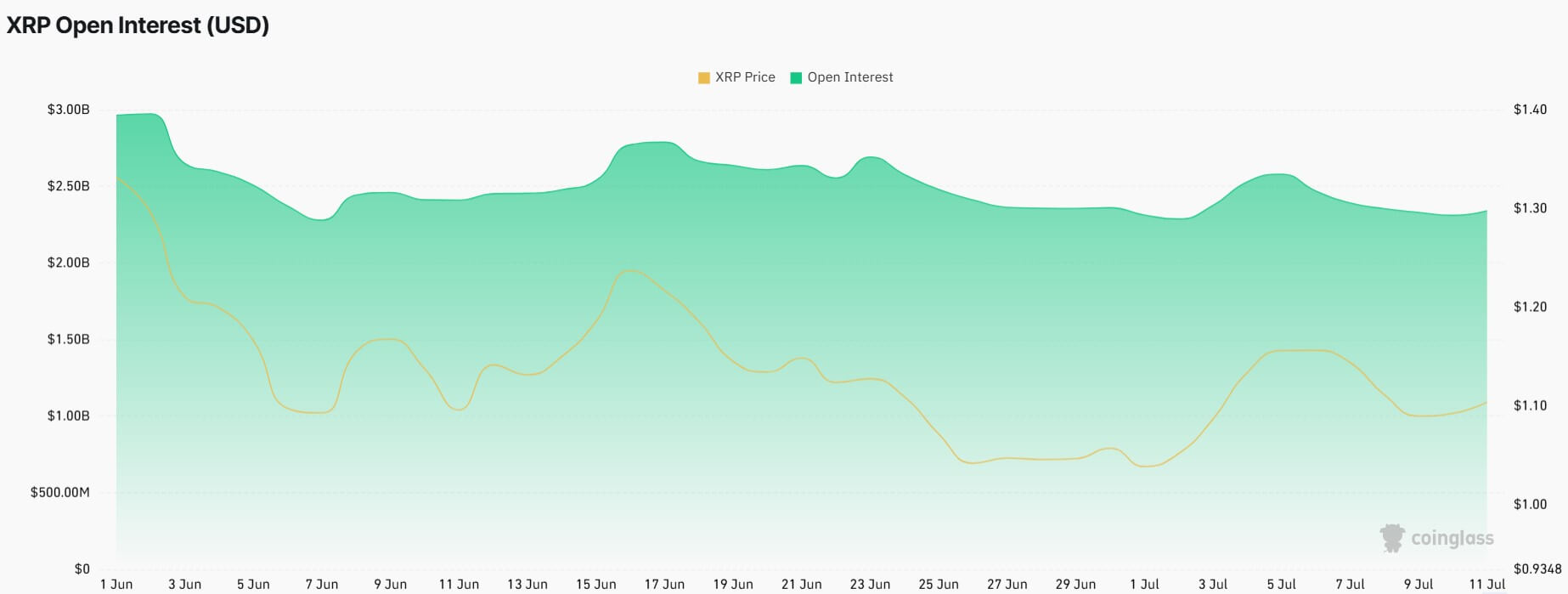
Global open interest in XRP futures fell from nearly $3 billion in June to about $2.3 billion by mid-July, according to CoinGlass.
XRP Open Interest (Source: CoinGlass)
The decline was most evident on Binance, where open interest fell from over $500 million in mid-June to $399 million by July 10, according to CryptoQuant data. Long liquidations rose 94% from the previous week and stood 172% above their three-month average, while short liquidations fell by more than half.
Meanwhile, XRP funding rates moved in the opposite direction. Binance’s XRP funding rate increased 266% over the week despite a shrinking pool of open positions and elevated long liquidations.
The divergence suggests that the remaining bullish traders are paying higher premiums to maintain exposure in a contracting derivatives market.
That structure could leave XRP vulnerable to another funding reset if prices weaken and additional long positions are forced to close.
XRPL activity concentrates as wallet growth stalls
The retreat from leveraged trading is also evident in XRPL, where fewer wallets are participating even as established services generate more activity.
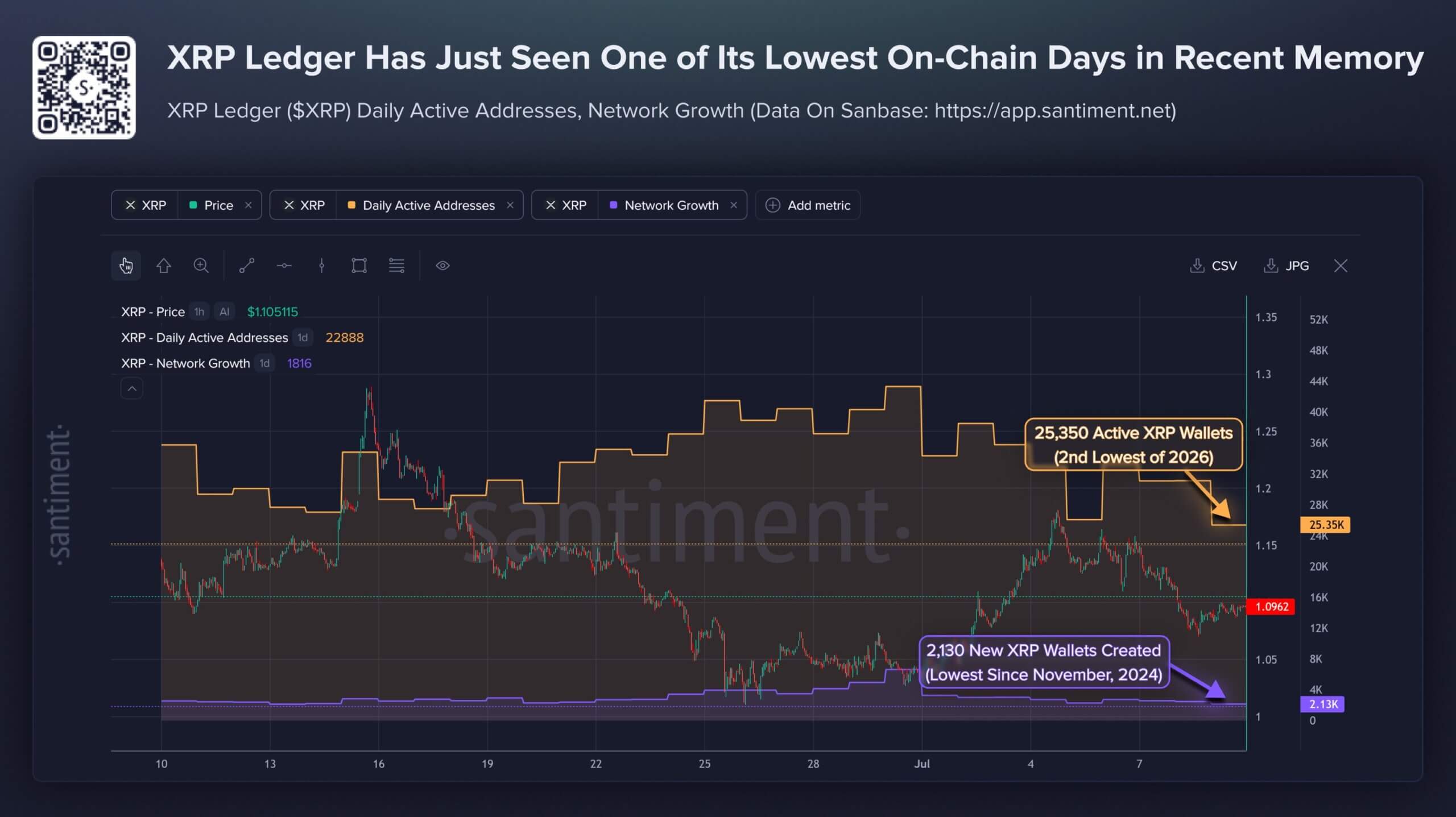
Blockchain analysis platform Santiment reported that XRPL experienced its second-quietest day of the year this week, logging only 25,350 active wallets.
The pipeline of new participants has similarly dried up, with new wallet creation plummeting to 2,130. This is the lowest level recorded since November 2024.
XRPL Network Activity (Source: Santiment)
The slowdown followed a brief increase in dip-buying activity in late June. Since then, both active wallet numbers and new wallet creation have fallen back, with no clearer price or network catalyst.
However, other indicators suggest that network activity has become more concentrated among existing users and applications rather than disappearing altogether.
Vet, an XRP Ledger validator, said transactions containing source tags rose 28.6%, while the number of source tags increased 13%. The tags are commonly used by exchanges, payment providers, and other services to identify transactions linked to customers who use shared accounts.
The increase points to greater activity from service-based applications, but it does not necessarily signal broader adoption. A smaller group of established platforms can generate more transactions even as the number of active and newly created wallets declines.
CryptoQuant data showed the same divide. Transaction counts increased about 3% to 4% over the previous week and month, but remained roughly 21% below their three-month average. Active addresses were also 11% below their three-month baseline.
The network-value-to-transactions ratio eased over the period, suggesting utilization may be stabilizing after an earlier decline.
However, the improvement remains limited, as transaction volumes and user participation continue to trail their longer-term averages.
Can XRPL’s institutional growth revive demand for XRP?
Data from CryptoSlate shows that the token has fallen about 5% over the past week to roughly $1.11, as ETF outflows, declining futures exposure and weaker wallet growth point to reduced demand across several parts of the market.
That growth gives developers an incentive to make the ledger more suitable for banks, asset managers and other financial companies. Their latest effort focuses on privacy, one of the main features institutions often require before moving sensitive financial activity onto public blockchains.
The proposed XLS-96 standard would introduce confidential transfers for Multi-Purpose Tokens. It would use encryption and zero-knowledge proofs to hide individual balances and transfer amounts while still allowing validators to verify that transactions comply with the ledger’s supply rules.
The proposal would also allow selective disclosure, enabling issuers to provide transaction information to regulators and auditors without making it publicly available. Controls such as freezing and clawback functions would remain available for confidential assets.
Those features could make XRPL more attractive to institutions that do not want competitors or outside observers monitoring their collateral movements, settlement amounts or trading positions in real time.
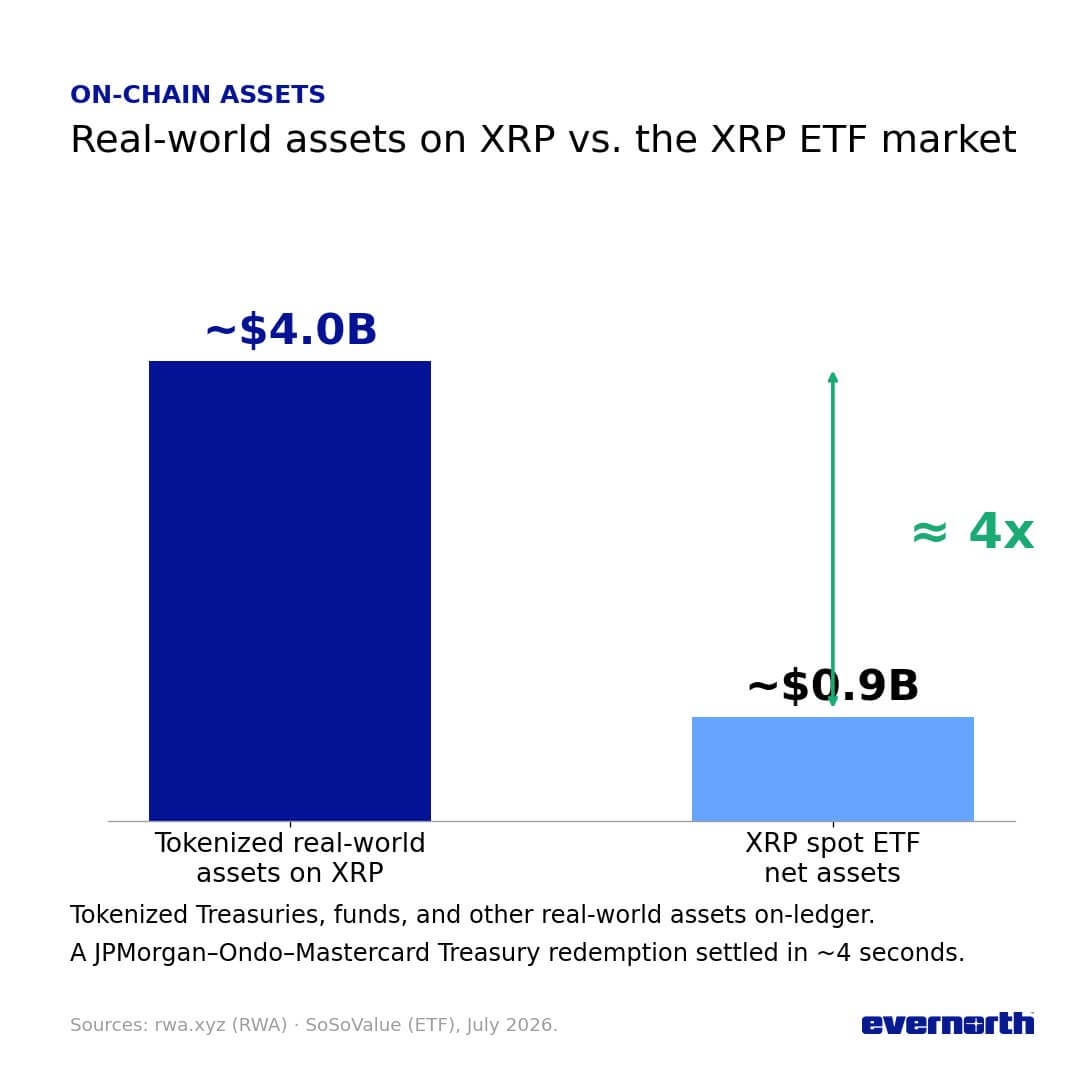
The tokenized asset portion was processed on XRPL in less than five seconds, while the corresponding dollar payment moved through Kinexys and JPMorgan’s banking network. The transaction showed how assets recorded on the ledger could interact with traditional financial infrastructure.
Adding confidential transfers could help expand that activity by removing a key obstacle to institutional adoption. More tokenized assets, settlement transactions, and financial products on XRPL could, in turn, strengthen demand for XRP if the token is used for liquidity, transaction fees, collateral, or settlement.
Ripple’s XRP has shown signs of stabilization after its prolonged downtrend, with buyers successfully defending a key support region and triggering a short-term market structure shift. Although the broader trend remains bearish, the recent price action suggests that selling pressure is weakening, and the market may be preparing for a larger recovery attempt if current support levels continue to hold.
XRP Price Analysis: The Daily Chart
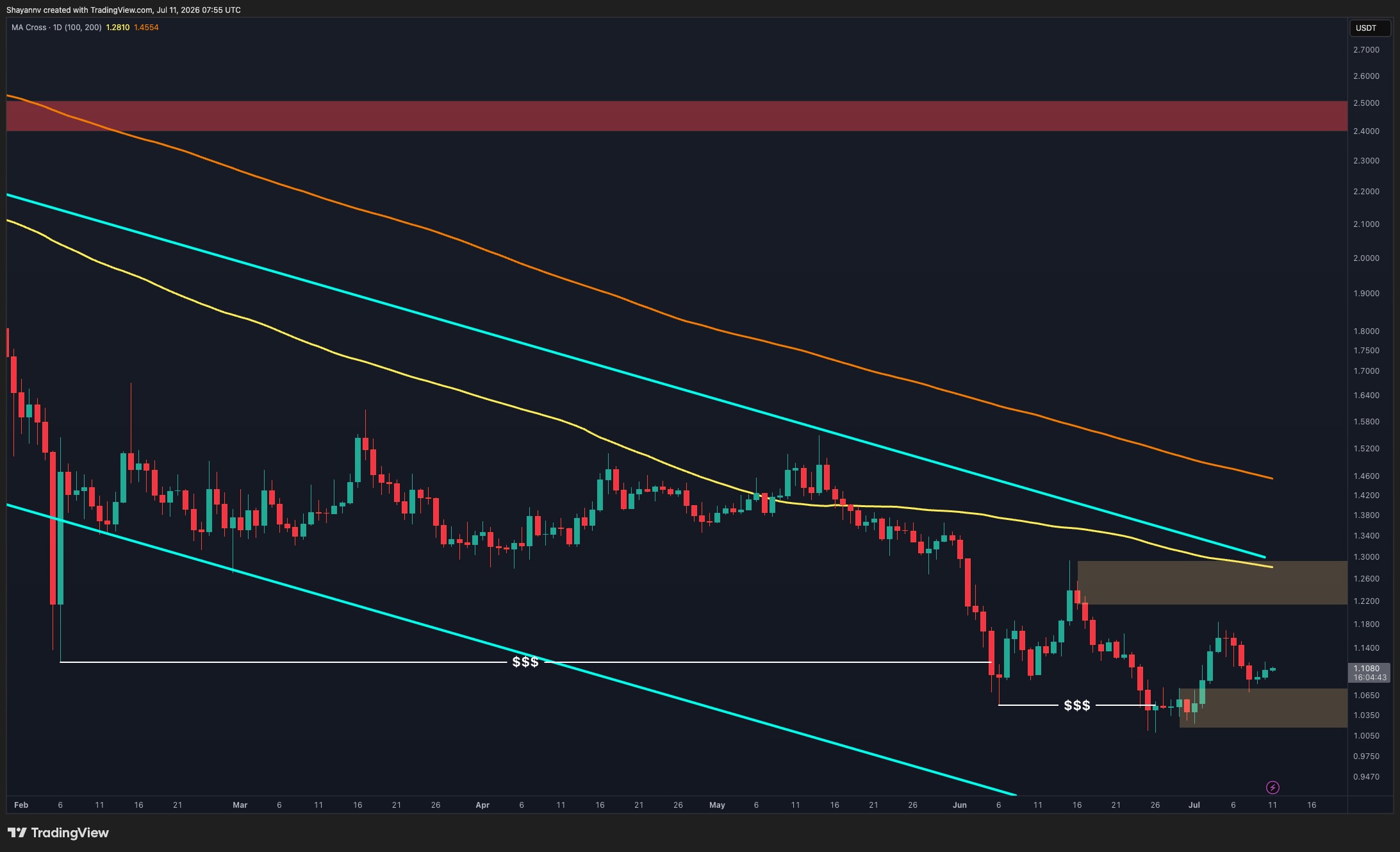
On the daily timeframe, XRP remains inside a broader descending channel and continues to trade below the 100-day and 200-day moving averages, which are both trending lower and maintaining the long-term bearish structure.
However, the recent decline toward the $1.02-$1.06 support zone appears to have attracted significant demand. This region aligns with a previous liquidity sweep below the April lows, where the market briefly traded beneath support before quickly recovering. Since then, the asset has established a higher low and has begun building a base above this demand area.
The price recently bounced from the support zone and is now attempting to reclaim the horizontal resistance region around $1.22-$1.28. This area is particularly important because it also coincides with the descending 100-day moving average and the upper boundary of the broader bearish structure.
A successful reclaim of the $1.22-$1.28 resistance zone would strengthen the recovery scenario and potentially open the path toward the major supply area near $1.55. Until that breakout occurs, the broader trend remains corrective within a larger downtrend.
XRP/USDT 4-Hour Chart
The 4-hour chart presents a more constructive outlook. Following the sweep of liquidity below the $1.02-$1.06 support region, XRP formed a market structure shift (MSS), marking the first indication that sellers were losing control of the short-term trend.
The subsequent rally produced a change of character (ChoCh) as the price broke above a previous lower high and challenged the descending trendline that has capped rallies since mid-June. Although the token initially faced rejection near trendline resistance around $1.16-$1.18, the pullback has remained relatively shallow, and buyers continue defending the former breakout zone.
Importantly, the market has not returned to the lows despite the rejection, suggesting that demand remains active beneath current prices. As long as XRP holds above the $1.03-$1.06 support area, the bullish structure established after the liquidity sweep remains intact.
The key level to monitor now is the descending trendline and the $1.15-$1.18 resistance area. A decisive breakout above this region would confirm a higher-high formation and could accelerate momentum toward the larger daily resistance zone between $1.22 and $1.28.
Conversely, failure to break the trendline could lead to additional consolidation between support and resistance before a larger directional move develops.
Overall, the recent price action favors gradual recovery, but XRP still needs to reclaim the trendline resistance and the $1.22-$1.28 supply zone before a broader bullish reversal can be confirmed.
Ripple’s XRP has delivered a strong recovery from its recent lows, validating the bullish divergence that developed near support. While the broader market structure remains corrective, the latest rally has pushed the price back toward a critical technical inflection point where the next directional move could be determined.
Ripple Price Analysis: The Daily Chart
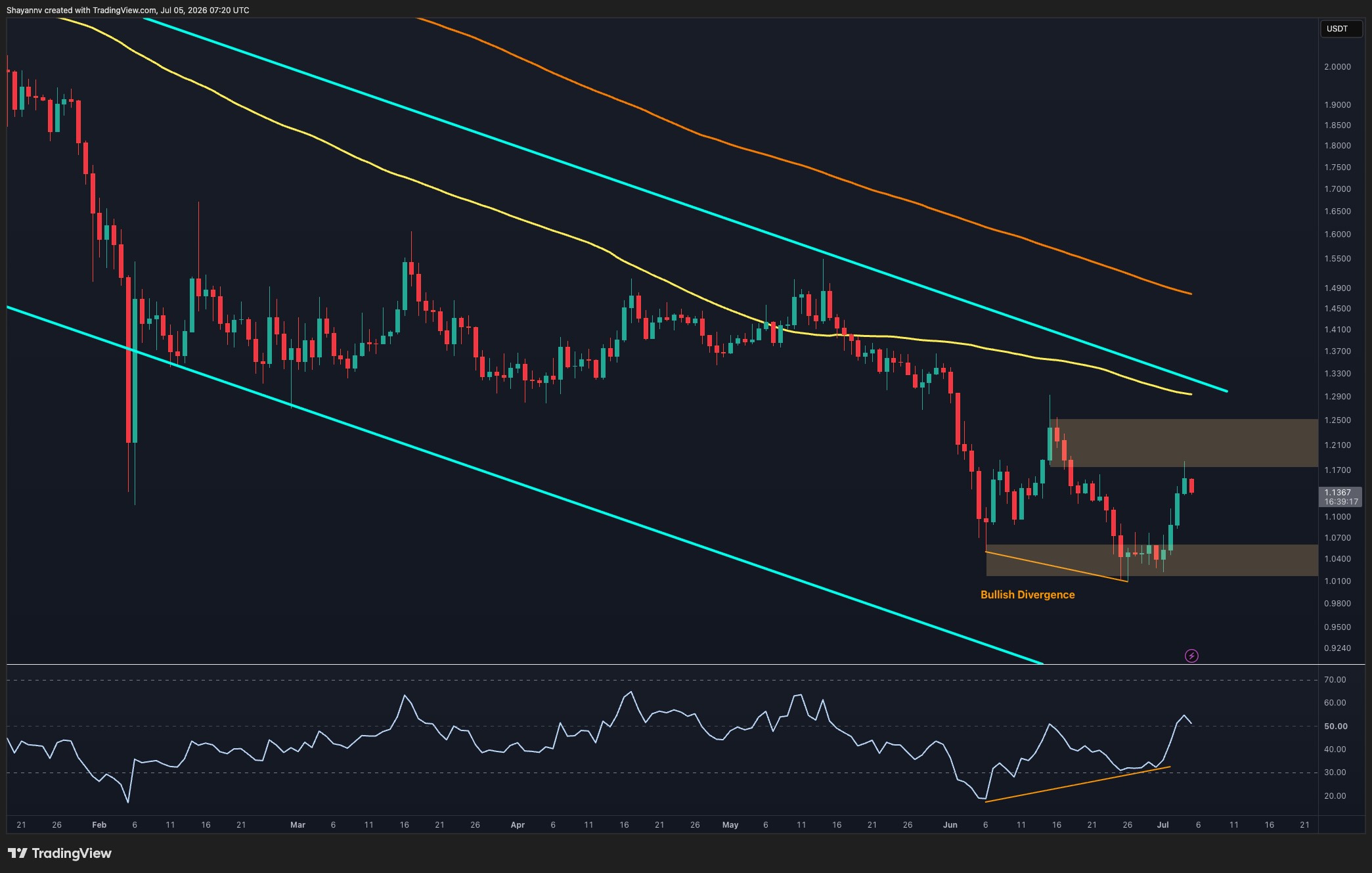
The daily timeframe continues to show XRP trading inside a long-term descending channel, remaining below the major moving averages and the channel’s upper boundary. Despite the broader bearish structure, the recent price action has improved considerably.
The bullish RSI divergence that formed around the $1.02-$1.05 support zone has played out as expected. While the asset was making lower lows, momentum was printing higher lows, signaling weakening selling pressure. Since then, XRP has rebounded sharply and reclaimed the lower support region around $1.02-$1.06.
The recovery has now carried the price toward the first major resistance zone between $1.17 and $1.24. This area previously acted as support before the latest breakdown and is now functioning as supply. The RSI has also pushed back above the midline, confirming improving momentum and strengthening the case for a continued recovery attempt.
However, the broader trend remains bearish as long as the token trades beneath the descending channel resistance and the major moving averages overhead. A successful reclaim of the $1.17-$1.24 region would be the first sign that the market is attempting to build a larger reversal structure.
XRP/USDT 4-Hour Chart
The 4-hour chart provides a clearer view of the recent breakout. XRP spent several days consolidating inside the $1.02-$1.06 demand zone before buyers aggressively stepped in and triggered a sharp rally toward the descending trendline resistance.
The move has already reclaimed the local support area and pushed price directly into the trendline that has capped lower highs since mid-June. XRP is now testing this dynamic resistance as it approaches the lower boundary of the broader $1.21-$1.29 supply zone.
This creates a pivotal setup. A confirmed breakout above the descending trendline would likely open the door for a move into the upper resistance region, where sellers may attempt to regain control. Such a breakout would also confirm a short-term structural shift after weeks of lower highs and lower lows.
On the other hand, failure to break through the trendline could trigger a temporary pullback toward the recently reclaimed support zone. As long as the asset remains above the $1.02-$1.06 area, the current recovery structure remains intact.
For now, momentum favors the bulls in the short term, but the market is approaching a major resistance cluster where a decisive breakout is needed to confirm that the recovery is evolving into something more significant than a relief rally.
Confirmed XRP network addresses grew at their fastest average pace since March 2026, helping defend the key $1.00 level during a leverage shakeout that flushed long open interest.
The key caveat: Highlight that the $1.00 support is psychological and volatile; avoid implying a guaranteed rally from here.
For traders, the story matters because it affects how capital, liquidity or confidence is being priced across crypto right now.
What Happened
XRP Holds $1 Support As Wallet Growth Hits Three-Month High. The update comes from Coindesk, with the core claim checked against XRP Ledger Explorer (XRPScan) Address Charts / CoinGlass Liquidation Database. That matters because this is the sort of story that can quickly become noisy if it is treated as a simple price headline rather than a market-structure development.
Confirmed XRP network addresses grew at their fastest average pace since March 2026, helping defend the key $1.00 level during a leverage shakeout that flushed long open interest. The clean read is not that one data point should dominate the whole market, but that the latest signal gives traders a better sense of where risk appetite is shifting. In a market still being driven by ETF flows, leverage, treasury decisions and rotating altcoin liquidity, context is doing a lot of work.
Why It Matters For Crypto Traders
XRP’s $1 level is simple, visible and psychologically important. The stronger part of the story is that wallet growth reportedly improved while leverage was being flushed from the market. That gives traders something more useful than a round-number headline: it shows whether network participation is holding up while speculative positioning resets.
The practical takeaway is that this is not just about the headline asset. These stories tend to spill across related trades: Bitcoin treasury names can affect altcoin sentiment, ETF flow data can shape institutional positioning, and token-specific network metrics can change how traders think about support, demand and supply. When liquidity is thin, those second-order effects can matter almost as much as the original news.
The Caveat To Keep In Mind
Highlight that the $1.00 support is psychological and volatile; avoid implying a guaranteed rally from here. That is the line readers should keep front and center. Crypto markets are very good at taking a narrow data point and turning it into a sweeping narrative within minutes. The better read is usually more measured: this is a signal, not a guarantee.
For example, an outflow does not automatically mean long-term holders have lost conviction. A governance warning does not mean a network is broken. A token unlock does not mean every released coin is being dumped at market. And a derivatives shift does not mean price must follow in a straight line. The useful part is understanding what the signal says about positioning, confidence and incentives.
What To Watch Next
The next step is to watch whether the data keeps confirming the story. If the same pattern appears across follow-up flows, on-chain metrics, open interest, governance dashboards or official filings, it becomes a more durable market theme. If it fades quickly, it may end up looking like a short-term positioning scare rather than a structural shift.
That distinction is especially important in the current market. Traders are still trying to work out whether capital is truly leaving crypto, rotating into safer crypto assets, or simply sitting in stablecoins waiting for a cleaner entry. This story adds one more piece to that puzzle, but it should be read alongside broader liquidity, macro and derivatives conditions.
Ripple secured preliminary approval as a Crypto-Asset Service Provider from Luxembourg’s financial regulator, the CSSF, on June 23. The approval was delivered as a “Green Light Letter,” which the company is pairing with the EMI license it finalized in the same jurisdiction in February.
Together, the two approvals put Ripple inside MiCA’s perimeter, where one member-state license passports across all 30 European Economic Area states, ahead of the July 1 deadline that closes the bloc’s grandfathering window and makes full authorization mandatory.
That’s a huge milestone, even for a company that reportedly holds more than 75 licenses worldwide and has run over $95 billion through its payments network.
However, a Green Light Letter is a conditional commitment. It shows that the CSSF is comfortable in principle, and the conditions still attached are the proof stage. Ripple now has to show, service by service, that the Luxembourg entity can actually run the payments, custody, transfer, and stablecoin business it’s asking to be trusted with.
The build sheet behind a CASP license
The detail that gets lost in the celebration is how much of this rides on the Luxembourg entity itself, because MiCA scrutinizes that local company and treats Ripple’s global track record as context at best.
Article 62 asks Ripple to name the exact services it wants cleared, since permission to move and hold crypto is a separate grant from permission to run a trading venue, and it wants a three-year business plan that models the lean years as well as the good ones.
It also requires a capital test, because the European Securities and Markets Authority (ESMA) expects the local entity to hold its own funds or insurance against the services it offers, and Ripple’s group balance sheet doesn’t answer that for the Luxembourg subsidiary.
Governance is where the CSSF will push hardest, and it’s the part that will affect how Ripple staffs Europe.
ESMA has told regulators there’s no such thing as a low-risk applicant, and that a licensed firm has to run itself inside the EU with real people making real decisions, the guardrail against an office that exists on paper while the work happens in San Francisco.
In practice, that means a named management team with real authority, a CEO giving the company effectively all of their time, and limits on how much can be handed back to the parent before the entity counts as hollow.
All of that will then need to sit on the operational evidence: background checks on managers and major shareholders, a clear map of who controls the company, a plan for keeping client assets walled off from Ripple’s own money, and the wallet security, key handling, and recovery procedures spelled out for supervisors.
In its guidelines, ESMA singled out one combination as higher risk: a company that issues a stablecoin and provides crypto services simultaneously, which describes Ripple precisely.
Why the stablecoin overlay is the real test for Ripple
RLUSD, with a circulating supply of around $1.6 billion, is an “e-money token” under MiCA, and that label pulls Ripple into a second rulebook the moment the stablecoin starts moving for clients.
The European Banking Authority spent the past year confirming as much: in a No-Action Letter and a follow-up Opinion, it ruled that transferring or holding a stablecoin constitutes a payment service, so a crypto company doing so needs a payment license alongside its MiCA one. The grace period ended on March 2, so the rule is already biting.
Most crypto companies are now scrambling to bolt a payments license onto permissions they only just won, and Ripple walked in already holding the Luxembourg EMI that does that, with the new CASP approval layered over it.
The two licenses let it offer European banks a single regulated integration that handles cash and crypto at once, which is what institutional clients have been asking for all along, and Ripple’s European strategy has been built around that dual-license hub for more than a year.
The catch is the conflict ESMA warned about: issuing RLUSD while also servicing it means the CSSF will look closely at how Ripple keeps those two roles apart.
None of this managed to move XRP, though, as it was trading near $1.10 on June 25, largely unmoved by the news. That lack of price volatility suggests that Ripple’s regulatory wins built the institutional case slowly, giving the market ample time to adjust.
What will definitely affect the price will be the volume that ends up running through the rails. The Green Light Letter gives Ripple a regulated foothold in Europe today, and it becomes a license the day the CSSF agrees that the Luxembourg entity does, for real, what its application promises.
Ripple CTO Emeritus David Schwartz has clarified a long-running point of confusion in the XRP community: XRP did not exist before Bitcoin. The debate often resurfaces because RipplePay, an early trust-based payment concept created by Ryan Fugger, dates back to 2004. But Schwartz drew a clear line between that earlier idea and the XRP Ledger, which launched years after Bitcoin.
TL;DR
David Schwartz clarified that XRP was not created before Bitcoin.
Bitcoin launched in 2009, while the XRP Ledger and XRP token were developed from 2011 and launched in 2012.
The confusion comes from RipplePay, a 2004 credit-trust network concept that did not use blockchain technology or a native asset.
Schwartz also pushed back on claims linking an old distributed computing patent to XRP or blockchain design.
RipplePay Versus XRP Ledger
The heart of the confusion is the word “Ripple.” Ryan Fugger’s RipplePay was conceived in 2004 as a way to think about payments through trust relationships and credit lines. It was not a blockchain, and it did not include XRP as a native digital asset. That distinction matters because some social media narratives have blurred the early RipplePay idea with the later XRP Ledger.
According to the validated writing pack, Schwartz clarified that development of the XRP Ledger and XRP token began in 2011, with the ledger launching in 2012. Bitcoin, by comparison, launched in 2009. On that timeline, XRP clearly does not predate Bitcoin.
Why The Claim Keeps Returning
The claim is sticky because the XRP ecosystem has a complicated history. RipplePay predates Bitcoin, the company that became Ripple later became associated with XRP, and several early crypto builders explored payment-network ideas before blockchains became mainstream. That creates enough overlap for misleading claims to spread quickly online.
But the technical distinction is straightforward. A credit-trust payment network is not the same as a blockchain ledger with a native token. RipplePay was an early payments concept. The XRP Ledger was a later cryptographic network built in the post-Bitcoin era.
Schwartz Also Addresses Patent Rumors
The validation notes also state that Schwartz pushed back on rumors connecting his 1988 distributed computing patent to blockchain or XRP. That type of claim has circulated in parts of the XRP community for years, often as part of broader theories about XRP’s origins or supposed pre-Bitcoin design.
Schwartz’s clarification narrows the historical record. His earlier work in distributed computing may be part of his broader technical background, but it should not be treated as proof that XRP existed before Bitcoin or that the XRP Ledger was secretly developed before 2009.
A Cleaner Timeline
The clean version is simple: RipplePay was an early 2004 payment-network concept without blockchain technology or a native digital asset. Bitcoin launched in 2009. The XRP Ledger and XRP token were developed beginning in 2011 and launched in 2012. Those dates do not diminish XRP’s role in crypto history, but they do correct the idea that XRP came first.
For traders and long-term XRP holders, the clarification is less about price and more about narrative discipline. Crypto communities often build identity around origin stories, but when those stories become inaccurate, they can create unnecessary confusion. Schwartz’s comments help separate genuine XRP history from social media mythology.
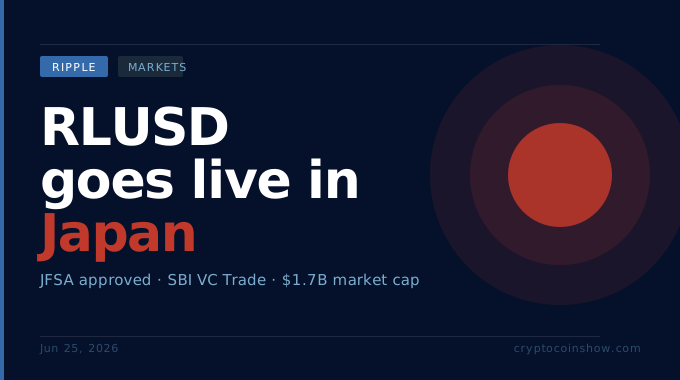
Ripple’s dollar-backed RLUSD stablecoin is now available in Japan through SBI VC Trade, adding a regulated Asian market to Ripple’s stablecoin push.
TL;DR
Ripple says RLUSD is live in Japan following regulatory approval.
SBI VC Trade is the distribution route for the launch.
The rollout gives Ripple a regulated Asian stablecoin foothold while competition in tokenized payments intensifies.
Ripple Brings RLUSD Into Japan
Ripple’s RLUSD stablecoin has moved into Japan through a rollout with SBI Group, giving the dollar-backed token a regulated route into one of Asia’s most closely watched crypto markets. The announcement matters because Japan has been relatively cautious with stablecoins, requiring clear structures around issuance, custody and consumer protection before foreign stablecoin products can reach users.
According to Ripple’s public announcement, RLUSD is now available in Japan after approval from the country’s Financial Services Agency. The company said the token will be offered through SBI VC Trade, the crypto arm of SBI Group, extending a long-running partnership between Ripple and one of Japan’s most active digital asset financial groups.
Why Japan Matters For Stablecoins
Japan’s stablecoin rules are important because they separate regulated payment instruments from the looser offshore stablecoin market that dominated earlier crypto cycles. That makes Japan a useful test market for companies trying to prove that stablecoins can operate inside bank-like or payment-service frameworks rather than purely through offshore exchanges.
The RLUSD launch also lands as stablecoins are becoming a central piece of the broader crypto policy debate. In the United States and Europe, lawmakers are still drawing the line between payment tokens, bank liabilities and securities-like products. Japan’s framework gives Ripple a practical example of how a foreign-issued stablecoin can enter a major market without relying only on informal liquidity.
Ripple’s Bigger Payments Push
For Ripple, RLUSD is not just another token listing. The company has been trying to expand beyond XRP-linked payment corridors and into broader enterprise settlement, treasury and tokenization services. A regulated dollar-backed stablecoin gives it a product that can be used by institutions that may not want direct volatility exposure to XRP but still want blockchain-based settlement.
The market question is whether RLUSD can attract meaningful liquidity outside Ripple’s existing partner network. Launching through SBI gives the stablecoin a credible distribution channel in Japan, but adoption will still depend on exchange depth, corporate use cases and whether users see a practical reason to move from existing stablecoin giants.
The main point is not that one headline settles the direction of the market by itself. It is that the same themes keep showing up across the tape: regulation is becoming more specific, institutional products are moving closer to normal financial rails, and traders are reacting quickly whenever liquidity thins out. That is why the source detail matters here. The development gives the market one more data point at a time when Bitcoin, Ethereum and the wider altcoin complex are already being judged through the lens of leverage, policy risk and institutional participation.
This coverage is based on information from Ripple.
This article was written by the News Desk and edited by Samuel Rae.
This report is based on information from Ripple, available at Ripple
Ripple’s RLUSD Debuts in Japan After Regulatory Approval
StablecoinsJune 25, 2026 · cryptocoinshow.com
Ripple’s RLUSD Debuts in Japan After Regulatory Approval
Japan’s Financial Services Agency greenlights Ripple’s dollar-backed stablecoin — distributed through SBI VC Trade in one of Asia’s most tightly regulated crypto markets.
cryptocoinshow.comCategory: MarketsJune 25, 2026
$1.7BRLUSD market cap
10yr+Ripple–SBI partnership
Type 4Classification under Japan’s Payment Services Act
Ripple and Japan’s SBI Holdings have officially launched RLUSD in the Japanese market after receiving approval from the Financial Services Agency. The dollar-backed stablecoin has been classified as a Type 4 foreign-issued electronic payment instrument under Japan’s Payment Services Act — the same regulatory framework updated on June 1, 2026, to allow qualifying foreign stablecoins to operate inside one of Asia’s most controlled financial markets.
Distribution is handled through SBI VC Trade, a subsidiary of SBI Holdings. The exchange was already licensed to distribute USDC in Japan, meaning the infrastructure for dollar-denominated stablecoins was in place before RLUSD arrived.
“Japan has long been a leader in digital asset adoption, underpinned by both regulatory clarity and financial innovation. Through our collaboration with SBI Group, RLUSD will serve as a bridge for payments, tokenization and collateral management.”
Jack McDonald, SVP Stablecoins, Ripple
The launch marks a key milestone in Ripple’s effort to grow RLUSD beyond the US. Since debuting in late 2024, the stablecoin has reached a market capitalization of roughly $1.7 billion. Ripple and SBI expect RLUSD to play a role in cross-border payments, tokenized financial products, and institutional liquidity management — areas where stablecoins are gaining traction among regulated financial institutions globally.
Key Facts
Regulatory approvalJapan Financial Services Agency (JFSA), June 24, 2026
ClassificationType 4 Electronic Payment Instrument under Japan’s Payment Services Act
DistributorSBI VC Trade (subsidiary of SBI Holdings)
BlockchainEthereum (not Ripple’s own XRP Ledger at launch)
SBI Holdings has been one of Ripple’s most prominent institutional partners globally since 2016, collaborating across cross-border payments, digital asset custody, and now stablecoin distribution. The Japan launch represents more than a new market — it validates the regulatory pathway Ripple spent months building through its dual-jurisdiction structure: NYDFS oversight on the issuance side, FSA approval on the distribution side.
The timing also puts RLUSD directly alongside SBI’s own JPYSC yen stablecoin, which launched the same week. With Metaplanet backing JPYC and the three Japanese megabanks progressing toward their own joint stablecoin, Japan’s on-chain currency stack is being built quickly — and Ripple now has a formal seat at the table.