EquitiesMay 24, 2026·6 min read
The SEC’s planned “innovation exemption” for tokenized stocks could allow crypto exchanges to list digital versions of major equities like Tesla and Apple without issuer consent or traditional custody safeguards, forcing the industry to clarify whether retail buyers understand they are purchasing price exposure rather than legal ownership. This regulatory flexibility poses both growth opportunity and systemic risk for institutional investors evaluating on-chain equities as an asset class.
- SEC preparing “innovation exemption” for tokenized stocks expected within one week, permitting crypto-native platforms lighter regulatory oversight during experimental period
- Kraken’s xStocks platform lists 100 fully backed tokenized US stocks and ETFs with $25 billion transaction volume since June 2025 launch
- On-chain RWA market at $30 billion represents just 0.02% of $126.7 trillion global equity capitalization, with tokenized stocks as negligible subset
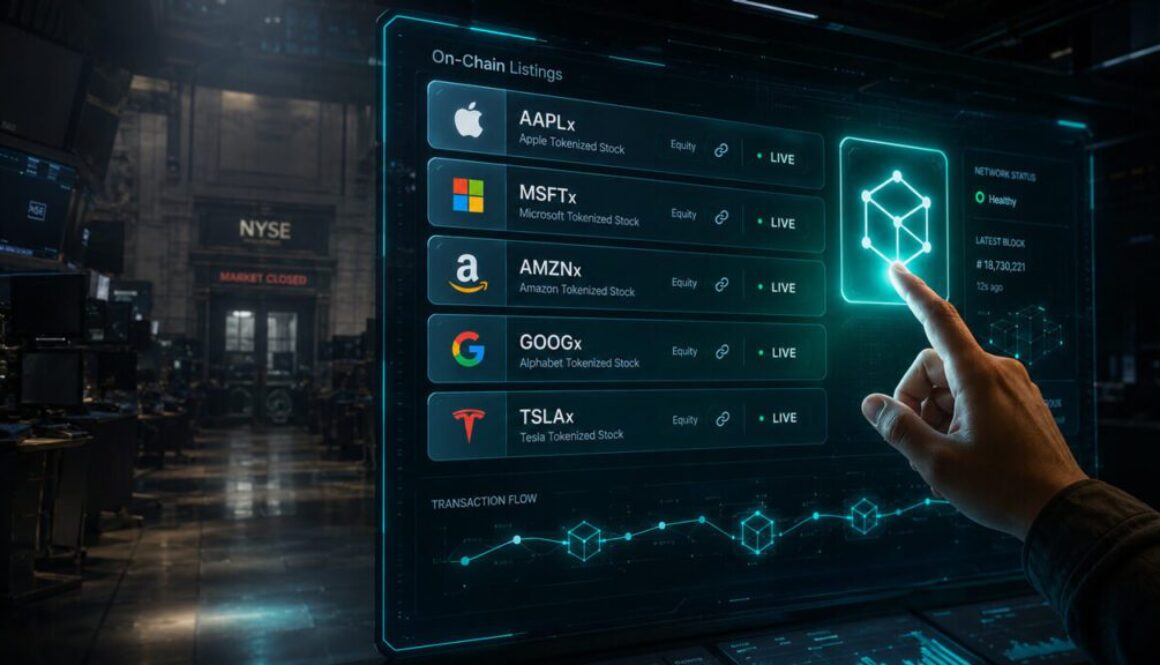
The Securities and Exchange Commission is preparing a regulatory framework that would permit crypto-native trading platforms to list tokenized versions of publicly traded stocks, including major companies like Tesla, Apple, and Nvidia, under an expedited approval process with reduced compliance requirements.
Bloomberg Law reported on May 18 that the SEC plans to introduce an “innovation exemption” within days as part of its broader Project Crypto initiative, designed to enable broader on-chain trading of digital securities during a limited experimental window.
The move represents a significant departure from the agency’s traditional stance: unlike the March 2026 Nasdaq approval and April 2026 New York Stock Exchange approval for tokenized equities, which kept digital trading tethered to existing market infrastructure and regulated custody arrangements, the new exemption would permit trading on decentralized finance protocols and unregistered crypto platforms with substantially lighter oversight.
The conceptual divide between tokenized stocks and synthetic price trackers sits at the core of the regulatory tension. A traditional equity is a legal ownership stake in a company, backed by federal securities law and held in regulated custody.
A fully backed security token, as exemplified by Kraken’s xStocks platform launched in June 2025, maintains that legal claim: each token represents a 1:1 claim on an underlying share held by a qualified custodian. In contrast, a synthetic or derivative token offers price exposure without conferring legal ownership, governance rights, or any equity stake.
A buyer of a synthetic Tesla token, for instance, profits or loses as the price moves, but holds no shareholder claim on Tesla itself.
Kraken’s xStocks operates in the first, fully backed category and has processed $25 billion in transaction volume while listing 100 tokenized stocks and ETFs, though currently available only outside US jurisdiction.
Nasdaq and NYSE approvals set precedent but left crypto-native platforms outside regulated framework
The SEC’s approval of Nasdaq’s tokenization rules in March 2026, followed one month later by the New York Stock Exchange, established a contained model for digital equities: both exchanges could offer tokenized versions of select securities using the Depository Trust Company’s tokenization pilot, allowing digital and traditional shares to trade in parallel.
These approvals operated within existing market structure and custodial safeguards. Institutional investors had clarity: the underlying assets were held by regulated entities following decades-old securities law protocols. Price discovery remained tied to the traditional exchange venue, and settlement occurred through familiar infrastructure.
The pending innovation exemption takes a fundamentally different approach by opening tokenized trading to platforms and protocols the SEC has not traditionally regulated as exchanges or brokers.
Crypto-native venues, exchanges that operate primarily on-chain without physical headquarters or traditional broker-dealer registration, would gain conditional approval to list tokenized equities under an experimental framework. Some decentralized finance protocols could participate as well, provided they meet certain disclosure and operational thresholds.
The exemption is explicitly time-limited, designed as a testing ground rather than a permanent regulatory classification.
This bifurcation creates a two-tier market structure that did not exist before. Institutional investors using Nasdaq or NYSE for tokenized equities operate in a tightly controlled environment with full legal ownership and traditional custody.
Retail participants on crypto-native platforms or DeFi protocols during the exemption period would operate under looser rules, with less certainty about what they actually own.
Synthetic tokens dominate crypto markets, obscuring ownership versus price exposure distinction
The crypto industry’s preference for synthetic or derivative tokenized assets has already created confusion in the market. Platforms like Binance and Bybit offer perpetual futures and “tokenized stocks” that track real-world equity prices without granting legal ownership.
A retail trader buying what appears to be a “Tesla token” on these venues typically holds a derivative contract, not a share or tokenized share. The economic outcome, profit or loss based on price movement, feels identical to ownership, but the legal substance differs fundamentally.
The buyer has no voting rights, no dividend claims, and no recourse if the underlying company faces bankruptcy or corporate restructuring.
The SEC’s January 2026 joint staff statement addressed this distinction by emphasizing that instruments offering only price exposure fall outside the definition of “security tokens” and should be treated as derivatives under Commodity Futures Trading Commission jurisdiction, not securities law. However, enforcement has lagged, and marketing language across crypto platforms remains ambiguous.
Retail investors routinely mischaracterize synthetic trackers as tokenized stocks, and platforms themselves often blur the distinction in product naming and description.
The innovation exemption would permit crypto exchanges to list instruments during an experimental period without requiring clear disclosure of whether tokens represent actual ownership or synthetic price exposure.
$30 billion on-chain RWA market remains negligible against institutional equities landscape
The absolute scale of tokenized equities remains tiny relative to global securities markets. DefiLlama data puts the total on-chain real-world asset market at approximately $30 billion, which represents just 0.02 percent of SIFMA’s 2024 global equity market capitalization of $126.7 trillion.
Within that $30 billion RWA category, tokenized stocks constitute a fraction, Kraken’s $25 billion transaction volume since launch in June 2025 is expressed as cumulative trading activity, not asset under management, and includes both fully backed security tokens and price-tracking derivatives.
The addressable market for actual tokenized equity ownership remains in the hundreds of millions of dollars globally, not billions.
The exemption’s significance lies not in immediate market size but in its potential to determine whether tokenized equities become a regulated extension of the US securities market or remain confined to the crypto ecosystem as speculative price trackers.
If the exemption succeeds in establishing clear custody and disclosure standards for crypto-native platforms, institutional investors might treat on-chain equities as fungible alternatives to traditional brokerage accounts.
If it instead permits ambiguous marketing and synthetic derivatives under lighter oversight, the segment risks embedding fraud and regulatory arbitrage into a nascent asset class.
Institutional adoption depends on legal certainty. A pension fund or endowment considering tokenized equities needs to know whether its underlying holdings are protected by the same custody and investor protection rules that govern traditional brokerage.
The innovation exemption’s experimental framework, coupled with the SEC’s stated emphasis on disclosure requirements, suggests the agency is attempting to create that clarity without immediately subjecting crypto platforms to full broker-dealer registration, which would be operationally prohibitive for many.
Investor protection hinges on disclosure standards the exemption has not yet defined
The SEC has not disclosed the specific disclosure requirements or custody standards that will govern the innovation exemption. Bloomberg Law’s reporting indicates the framework is still being finalized, with public release expected within days of May 18.
The agency’s January 2026 joint staff statement established that synthetic derivatives should be regulated as commodities, not securities, but that determination does not prevent a crypto exchange from offering them under the exemption, it only clarifies which regulator has jurisdiction.
The critical open question is whether the exemption will mandate that platforms clearly distinguish between fully backed security tokens (which confer legal ownership) and synthetic price trackers (which do not) at the point of sale.
Get this in your inboxThe Crypto Coin Show newsletter covers the policy and market moves institutional crypto investors are pricing in.
Subscribe