Coinbase (COIN) stock heads into second-quarter earnings today after the close under a warning from one of its biggest backers.
Citigroup still rates the stock a buy. Even so, it cut its Coinbase price target from $400 to $235 on July 24, a 41% reduction that landed days before the report.
Citi Keeps Its Buy Rating but Slashes the COIN Stock Target
The gap between that rating and that target is the real story into earnings. Citi analyst Peter Christiansen kept the buy call, yet he still cut 41% off his goal for COIN stock.
Positioning, however, sends a mixed message. The put-call ratio, which weighs bearish put bets against bullish calls, points two ways at once.
In standing bets, or open interest, the ratio has eased to 0.74 from about 0.86 in early June. That shift means longer-term positions have turned slightly more bullish on Coinbase stock.
Fresh activity, by contrast, looks defensive. The volume ratio has climbed to 0.75 from about 0.44, which shows traders buying puts to hedge before the results.
Big money, though, has held firm. Chaikin Money Flow, a gauge of whether institutions are buying or selling, sits at 0.03 and has stayed above zero even as COIN stock drifted lower since June.
For now, tonight’s transaction revenue and any volume guidance will decide whether Citi’s caution or those steady inflows prove right. Beyond the quarter, traders are watching Washington, where crypto legislation could reset the story for Coinbase stock.
Coinbase (NASDAQ: COIN), Bybit, Circle (NYSE: CRCL), and Gemini lead the names on CNBC and Statista’s 2026 ranking of 500 global Fintechs. Coinbase, listed as decentralized, returned after appearing in an earlier edition.
Bybit is based in Dubai, while Circle and Gemini are in New York. Statista’s ranking covers eight market groups and includes companies of different sizes.
According to McKinsey, the fintech industry generated $650 billion in sales in 2025, up 21% from 2024. The $15 trillion financial services industry as a whole grew by 6%. Public listings also began to rebound, with 31 major fintech initial public offerings (IPOs) in 2025. To McKinsey, those agreements have “returned to prominence.”
Fintech companies represented about 12% of the total value of the world’s 100 biggest IPOs. Listed Fintechs reached a record combined value of $850 billion, helped by Adyen (AMS: ADYEN), Nu Holdings (NYSE: NU), and Robinhood (NASDAQ: HOOD).
At the same time, software suppliers spread throughout banking systems, challenger banks obtained financial licenses, and big institutions began to employ blockchain more frequently.
Digital asset companies turn blockchain tools into services for banks and businesses
The digital asset category in the Fintech 500 covers companies that make crypto services usable, but leaves out individual coins and blockchain protocols.
Crypto demand has risen and fallen, but companies building the working parts of the market have kept attracting customers. Companies that create and manage tokens for other businesses also earned several places.
The Singapore group includes Amber Group, ChainUp, Crypto.com, Triple-A, and previous winner StraitsX. US entries include Bakkt (NYSE: BKKT) in Atlanta; previous winners BitGo in Sioux Falls and Blockdaemon in Los Angeles; Digital Ascension Group in Dallas; Everstake and Securitize in Miami; Payward in Cheyenne; and Zero Hash in Chicago.
San Francisco contributes previous winners CoinTracker and VGS, plus Phantom. New York adds previous winners Fireblocks and Turnkey, alongside Gauntlet, Lukka, NYDIG, Paxos, and Zebec. Galaxy Digital (NASDAQ: GLXY), another earlier winner, is also based there. Fort Worth is home to previous winner Consensys.
Canada has Blockstream in Montreal and previous winner, Figment, in Toronto. London has BVNK, Copper, and TIMVERO. Previous winner Finery Markets is in Limassol, Cyprus. Hong Kong includes HashKey Group and previous winner OSL Group (HKEX: 0863). The remaining names are Kem in Abu Dhabi, previous winner Ledger in Paris, and Wavebridge in Seoul. Blockchain services from these companies now support payments, recordkeeping, asset storage, issuance, and other commercial uses as crypto becomes part of formal finance.
AI and stablecoins force Fintechs to rebuild products and controls
McKinsey expects four trends to shape the next fintech era, though its report detailed two major ones here. Artificial intelligence comes first. “Fintechs are deploying AI to build products in weeks that once took years, to serve customer segments that were previously not economically viable, and to compress cost structures so that legacy operating models cannot compete on price. Early-adopter incumbents are seeing real returns,” said McKinsey.
McKinsey said, “With instant, near-free settlement, the promise of stablecoins for cross-border payments and remittances is clear. However, of the $35 trillion reported annual stablecoin transaction volume, only about 1 percent, or $390 billion, represents true end user payments, such as paying suppliers or sending remittances.”
Trading, arbitrage, and crypto-only transfers make up the rest. Industry forecasts place the stablecoin market between $2 trillion and $4 trillion by 2030. Reaching that range would require an average annual growth of about 40%.
Other tokenized assets on blockchains could grow faster as banks and companies use them for settlement, custody, payments, ownership records, and issuance.
McKinsey predicts that, “A range of industry estimates suggests that by 2030, the market value of stablecoins will be between $2 trillion and $4 trillion, implying a compounded annual growth rate of about 40 percent, with a broader range of on-chain tokenized assets potentially even higher.”
Don’t just read crypto news. Understand it. Subscribe to our newsletter. It’s free.
Malaysian authorities have revoked the business license of Network School, a technology community founded by former Coinbase CTO Balaji Srinivasan.
The decision followed scrutiny over alleged links to Israeli participants. However, local officials said they cancelled the license over business and premises violations.
The Iskandar Puteri City Council ordered NS0 Malaysia Sdn Bhd to stop all operations at Forest City from July 22. Officials said the company operated from two premises. One site did not have the required business license.
Meanwhile, inspectors found that the company carried out activities beyond those approved under its existing license. Authorities also found problems with its advertising signboard.
Network School is not shutting down; that’s fake news.
We received two notices. The first tells us to change the text of a sign. The second says that our coworking site, which was created by joining two adjacent units, evidently has a valid license on the left hand side but not…
The case began after pro-Palestinian activists raised concerns about possible Israeli participation at Network School.
Online posts alleged that Israeli entrepreneurs had entered Malaysia using passports issued by other countries. The claims also raised questions about the school’s admission process and its interest in Israel, politics and military technology.
However, Malaysian immigration officials later inspected 266 foreign residents from 40 countries.
They said everyone checked had valid travel documents. Authorities did not publicly confirm that any participant had entered Malaysia illegally as an Israeli national.
Malaysia does not recognise Israel and generally does not allow entry using Israeli passports. However, Israeli dual nationals may enter using valid passports from other countries if they meet Malaysian immigration rules.
Prime Minister Anwar Ibrahim said authorities would expel any Israeli national found breaking local laws.
Breaking News: The state of Johor has shut down @balajis‘ Network School.
The only remaining Network School entity will be in Singapore, where it is incorporated.
Congratulations, Singapore now you can have Balaji, the Network State, and the Network School. https://t.co/cKR15y2kws
Network School opened in Forest City, Johor, in 2024.
Despite its name, Malaysia’s Higher Education Ministry said it was not a registered university or private education provider. Officials described it as a residential and co-working community for technology founders, investors and startup workers.
The project became known for promoting Srinivasan’s “network state” idea. The concept involves online communities building physical settlements and developing their own economic and governance systems.
The school offered accommodation, meals, workspaces, startup programmes and fitness activities. It attracted people from the crypto, technology and investment sectors.
I am pleased to announce that a memorandum of understanding has been signed between the Republic of Kazakhstan and Network School. Our new campus will become a haven for global techno-optimism, with expedited visas, streamlined redomiciliation, and active recruitment of talent. pic.twitter.com/R20i8UAYoc
Srinivasan denied the claims about Israeli links before the license was cancelled.
He said anonymous social media accounts had spread false allegations. He also warned that the investigation could damage Malaysia’s reputation among international technology investors.
According to Srinivasan, Network School had invested more than 100 million Malaysian ringgit in Forest City. He said the company had planned a further 500 million ringgit expansion.
The company placed those plans on hold during the investigation.
Srinivasan joined Coinbase in 2018 after the crypto exchange acquired Earn.com, where he served as chief executive.
Coinbase appointed him as its first CTO. His role focused on technology strategy, crypto advocacy and recruitment. He left the company in May 2019.
Malaysia and Israel’s Diplomatic Roadblocks
Malaysia has a long-standing policy of refusing formal diplomatic relations with Israel and strongly supporting Palestinian statehood. Israeli passport holders are generally barred from entering without special permission, and Malaysian passports have historically excluded travel to Israel.
Malaysia warns any Israelis found in the country will be immediately deported —— Malaysian Prime Minister Anwar Ibrahim said on Wednesday that authorities are investigating allegations that an Israeli national may have been involved in the activities of a private residential… pic.twitter.com/PyL28Ye5b4
In 2024, 22 Malaysian civil-society organisations urged the government to block a consortium’s proposed privatisation of Malaysia Airports because one consortium member, Global Infrastructure Partners, was being acquired by BlackRock.
Campaigners alleged that BlackRock had significant Israeli connections and investments.
The government did not cancel the airport transaction solely on that basis. Global Infrastructure Partners later said BlackRock would not participate in the deal.
With the cryptocurrency exchange scheduled to report data on July 30, traders on prediction market platforms are wagering that Coinbase’s trading volume in the second quarter fell significantly below projections.
Part of the reason the bets are getting attention is that the platforms that handle them have expanded significantly in the last 12 months.
In April 2026, the total trade volume on Kalshi and Polymarket reached $24 billion, almost five times more than it had been less than a year before.
Traders on Kalshi believe that Coinbase’s trading activity was impacted by the roughly 12% drop in Bitcoin’s price during the second quarter.
It is anticipated that the exchange will announce a third consecutive quarterly decline in volume.
There is a good chance that the total would fall below $200 billion, which would be the lowest amount the corporation has reported since the third quarter of 2024.
The prices of Kalshi’s contracts spell out just how cautious sentiment has become. Traders put a 41% probability on Coinbase’s quarterly volume clearing $160 billion.
According to FactSet, the likelihood of it exceeding $170 billion is merely 25%, which is already below Wall Street’s consensus forecast of $168.5 billion.
However, there is a 99% chance that volume will remain above $150 billion, so bettors are not pricing in a complete collapse. Kalshi determines how these contracts settle using information from the investing research site Fiscal.ai.
The stock of Coinbase hasn’t fared any better. Since Bitcoin peaked in October 2025, shares have dropped more than 55%.
This decline is consistent with the general pressure that has built up throughout the cryptocurrency markets during that time.
World Cup drives a surge in new users
The growing use of prediction markets to price in financial results is happening alongside a sharp growth period for both of the industry’s leading platforms.
According to CBS Sports, their best picks for prediction markets 2026 include Kalshi at number one, while Polymarket at number two, with DraftKings and FanDuel Predicts following after.
Both have added large numbers of users in recent months, helped in part by high-profile events that brought them in front of audiences who had never used prediction markets before.
The amount traded in a single contract on which nation will win the title exceeded $1.2 billion, setting a record for any one market on the platform.
The total amount spent on Kalshi during the World Cup was $12 billion. In addition to promoting Luka Modric, José Mourinho, Lionel Messi, Timothée Chalamet, and J Balvin, the platform partnered with OpenAI to show current contract odds within ChatGPT.
The strategy, according to Tarek Mansour, CEO and co-founder of Kalshi, is “where the news is at.”
Now that the World Cup is over, the platform’s problem is how to retain those new users when nothing of a similar magnitude is scheduled.
Political volume and the regulatory divide
In the world of political betting, Polymarket is still in the lead.
The site generates about $507 million in weekly political bets, accounting for an estimated 93% of all political prediction market transactions.
In contrast, Kalshi registers a weekly political volume of roughly $16.8 million. Politics accounts for 32% of Polymarket’s total activity, but only 4% of Kalshi’s.
Within Polymarket, the business is divided between two very different operations.
Its offshore platform generated $9 billion in volume during April 2026. The US-regulated version of the platform brought in $1.3 billion in the same period.
For traders who wish to use prediction markets to hedge positions around outcomes from established firms like Coinbase, that separation has significant ramifications.
The CFTC is currently looking investigating Polymarket for potential insider trading in contracts related to geopolitical events.
Institutional traders have a legally valid way to take positions on company earnings and volume expectations in real time thanks to Kalshi, a local, licensed business.
The outcome could also serve as another test of whether prediction markets are becoming a reliable barometer for corporate earnings expectations.
Don’t just read crypto news. Understand it. Subscribe to our newsletter. It’s free.
A reported Coinbase announcement about a World Cup result, likely using AI, created a problem bigger than a flawed alert. It showed how quickly exchange-run prediction markets can blur the line between tradable outcomes and unverified automated content inside the same consumer app.
The episode surfaced on July 5, when a user posting as jay_drainjr said on X that Coinbase had sent a breaking-news-style alert claiming Norway had won a World Cup game, with Erling Haaland scoring, before the match had been played.
Coinbase CEO Brian Armstrong replied later that day, saying he was looking into it with the team.
Coinbase has not published a full public postmortem as of press time. The public record also does not yet show how many users saw the notification, whether anyone traded after seeing it, or which system generated it. Those unanswered facts are material, but they do not erase the design problem the alert surfaced.
Exchanges are moving toward a product mix in which AI-generated alerts, sports-event contracts, and retail trading interfaces can sit within the same user journey. That means users need to see exactly what has been verified, what is automated, and what remains unresolved before market-adjacent content reaches them.
The timing made the episode sharper. Armstrong had already framed prediction markets as a breakthrough in how markets discover truth, saying in January that Coinbase users in the US could trade outcomes across sports, politics, culture, news, and more through the app’s Predict tab.
Coinbase’s own prediction markets page presents the product as focused on real-world outcomes, while its sports page shows event markets tied to World Cup, goalscorer, correct-score, and other sports outcomes.
That creates a basic tension for any exchange operating this kind of product. If a prediction market is meant to let prices reflect what participants believe will happen, the app also has to preserve the difference between an unresolved event, a live update, and a verified result.
A bad alert becomes market infrastructure when trading is one tap away
A mistaken pre-match alert would be a content failure in most consumer apps. In a trading app, it can become more serious because information and action sit side by side.
Prediction markets are contracts whose value can move as users react to new information. A notification that an event has already occurred can change a user’s understanding before the user sees the market, places a trade, exits a position, or decides to wait.
Even if no trades later show they relied on the alert, the product design has exposed the pressure point.
The reported Coinbase incident therefore belongs in a different category from a generic AI hallucination story. A wrong sentence from a model is embarrassing. A wrong sentence near a tradable event market can appear to be market-relevant information if the app does not indicate whether the event has been resolved.
The later outcome of the match does not settle that risk. If an alert reports a result before a reliable source has resolved the event, it has crossed the key boundary.
In prediction markets, the boundary is between pre- and post-resolution as much as between true and false.
That distinction will become more important as exchanges add more event markets to retail apps. Sports markets are especially sensitive because they produce constant live data, user attention is close, and the line between commentary, odds movement, and outcome confirmation can be thin.
A product can disclaim that users bear risk, but the interface still teaches users what to treat as settled.
Coinbase’s own pages already contain the legal and risk framing that makes the question of standards hard to avoid. The sports prediction market page says prediction markets are offered by Coinbase Financial Markets, a CFTC-registered futures commission merchant and National Futures Association member.
The same disclosure warns that event contracts can result in the loss of the full investment.
The product pages also state that information is provided for informational purposes and is not investment advice. They include language saying Coinbase is not responsible for third-party content errors, delays, or actions taken in reliance on that content.
That kind of disclosure may help allocate legal risk, but it cannot replace product-level clarity.
Users experience one app. If that app shows an event market, pushes a breaking alert, and presents a price that moves with new information, users will naturally treat the information environment as part of the product.
That is where provenance becomes more than a label. A trading app that uses automated alerts around event markets may need to show the source of the claim, the time it was verified, the status of the underlying event, and whether the alert was generated, summarized, or approved by a human.
A simple AI label would be too weak if it does not say whether the event itself has been resolved.
A practical standard would separate at least four states: rumor or social report, scheduled event, live event, and officially resolved result. The user should not need to infer those states from the wording of a push notification.
The app should make the state visible before the user can mistake commentary for settlement.
Latency is also a risk control. Prediction markets can move on seconds-old information. If the app’s alert pipeline is faster than its verification pipeline, the product can push users toward a claim before the market has a reliable basis to treat it as fact.
Speed is valuable only if proof travels with it.
Proof controls have to sit above the contract
The CFTC’s June 12 Federal Register proposal discusses prediction markets as registered venues offering event contracts and frames the category around public-interest determinations, market integrity, manipulation prevention, clear settlement terms, and objective information that can be publicly verified.
Those concepts are usually discussed in relation to the contract itself: what event is being traded, how the outcome is determined, and what conditions trigger settlement.
The Coinbase alert episode points to the layer above the contract. If the market’s settlement criteria are objective but the app’s surrounding content pipeline lacks the same discipline, users can still receive a misleading signal before settlement.
That is the gap exchanges will have to close as prediction markets move from specialist venues into mainstream crypto apps. The settlement rule may say one thing. The app notification may imply another.
The user experiences both as part of the same financial interface.
CryptoSlate has already covered how sportsbooks and prediction markets are converging as event contracts draw more trading interest. That trend raises the stakes for Coinbase because the company’s advantage is distribution.
If event markets live in the same app as spot crypto trading, wallets, alerts, and consumer finance tools, a content failure can travel faster and feel more authoritative than it would on a smaller market-only platform.
The regulatory context also explains why a disclaimer alone is incomplete. Prediction markets depend on clear evidence of what happened and when.
If the content layer can race ahead of that proof, the market still has a trust problem even when the contract’s final settlement criteria are objective.
For consumer exchange apps, verification has to cover both layers. The contract can have objective settlement terms while the surrounding feed still creates confusion if an alert uses final-result language too early.
Controls around content, data vendors, and push timing therefore become part of the same trust system that supports the market.
The next standard is operational
The core Coinbase question is operational. Did the alert come from a model-generated summary, a data vendor, a third-party feed, a human-entered story card, or a mix of those systems?
What source marked the event as resolved? What check should have stopped a pre-match result from being pushed? Could users distinguish a generated alert from an official result?
Those details remain unresolved without a Coinbase postmortem, but the most likely conclusion is clear: exchange-run prediction markets will need visible proof standards before AI-generated alerts can scale alongside tradable outcomes.
Those standards should be measurable. A market operator can log the data source for every event alert, the timestamp when a result becomes eligible to be described as final, separate the generated commentary from the official settlement language, and retain an audit trail for any push notification tied to a tradable market.
It can also prevent content systems from using final-result language until a verified source has crossed a predefined threshold.
The hard part is that these controls may slow down the very alerts that make consumer apps feel timely. That is the tradeoff.
If an exchange chooses speed over provenance, it risks turning the alert layer into an unpriced part of the market structure.
The Coinbase incident is therefore a preview of a larger fight over the credibility of prediction markets. Market prices can serve as useful signals only when users can distinguish among a forecast, a report, and a resolved fact.
As exchanges add AI summaries and real-time alerts, the next competitive standard may shift from who lists the most markets first to who can show the fastest proof without asking users to trust a black box.
Until Coinbase explains the alert pipeline, the unanswered facts remain important. How many users saw the notification, whether anyone traded because of it, and what system generated it are all material details.
The broader lesson is already visible: prediction markets sold as truth-seeking tools need proof infrastructure before automated content becomes part of the trading experience.
Bitcoin’s US demand signal is still struggling to recover, with the Coinbase Premium Index reportedly sitting in negative territory for eight straight weeks. The run began on May 6, 2026, and now marks the longest continuous negative stretch for the metric in more than a year.
TL;DR
The Coinbase Premium Index has reportedly been negative since May 6.
That marks an eight-week weak stretch for the US Bitcoin demand signal.
The index compares Bitcoin pricing on Coinbase Pro with Binance.
A negative reading suggests weaker relative buying pressure from Coinbase-linked traders, not a collapse in global volume.
The Coinbase Premium Index is one of those market indicators that can sound more complicated than it really is. In simple terms, it tracks the gap between the Bitcoin price on Coinbase Pro and the price on Binance. Because Coinbase is closely associated with US institutions and retail users, the premium is often used as a rough proxy for US spot demand.
What a negative premium actually means
When Bitcoin trades at a premium on Coinbase, traders often interpret that as a sign that US buyers are paying slightly more than global buyers. When the premium turns negative, it suggests that Coinbase-linked demand is weaker than demand on other major venues.
That does not mean nobody in the US is buying Bitcoin. It also does not mean global trading volume has vanished. The metric is relative. It says more about where demand is stronger or weaker than it does about absolute market size.
Still, an eight-week negative run is difficult to ignore. Short dips can be noise. A two-month stretch points to a more persistent imbalance in the market.
Why this matters after a difficult June
The timing is important because Bitcoin has already been dealing with pressure from other parts of the market. Spot Bitcoin ETFs saw heavy June outflows, price action weakened, and traders became more defensive around risk assets. A negative Coinbase premium adds another signal that the US side of the market has not been leading the recovery.
For bulls, the ideal setup would be a return to positive ETF flows and a Coinbase premium that moves back above zero. That would suggest US buyers are stepping back in rather than leaving the rebound to offshore or global venues. Until that happens, rallies may continue to look vulnerable to fading.
Not bearish on its own, but hard to ignore
No single metric should be treated as a full market thesis. The Coinbase Premium Index can move quickly, and it is best read alongside ETF flows, exchange reserves, derivatives positioning, and spot volume. But it remains useful because it captures a part of the Bitcoin market that traders care about deeply: whether US demand is leading or lagging.
Right now, the signal is lagging. That does not guarantee further downside, but it does tell traders that Bitcoin’s next leg higher likely needs stronger participation from Coinbase-linked buyers. Without that, the market may continue to feel like it is recovering on thinner ground.
This report is based on information from CryptoQuant.
This article was written by the News Desk and edited by Samuel Rae.
Bitcoin’s quantum-risk debate is no longer just a theoretical developer conversation.
TL;DR
A Coinbase-linked quantum-risk discussion has put Bitcoin address reuse and legacy cold wallets back in focus.
The issue is not an immediate break of Bitcoin, but a long-term custody and migration problem.
Large holders, exchanges, and institutions have the strongest reason to care because old exposed public keys could become future risk points.
Why Address Reuse Matters
A Coinbase-linked advisory discussion has reportedly flagged address reuse and legacy Bitcoin wallets as long-term exposure points if quantum computing advances far enough to threaten today’s signature assumptions. That does not mean Bitcoin is suddenly unsafe. It does mean custody practices that look acceptable today may need a migration plan before the risk becomes urgent.
The most important word here is “future.” This is not a panic story. It is a preparation story.
Bitcoin users are generally encouraged not to reuse addresses. The reason is privacy, but there is also a security angle.
When coins are spent from an address, the public key becomes visible on-chain. Under today’s cryptographic assumptions, that does not create an immediate problem. But in a future where powerful quantum computers can attack certain public-key systems, exposed public keys could become more sensitive.
That is why old wallets and reused addresses matter. They may represent a class of coins that would require special attention in a future post-quantum migration.
This is especially important for large custodians and exchanges. A retail wallet with a small balance is one thing. A cold wallet holding large institutional balances is another.
The Institutional Custody Problem
Bitcoin is becoming more institutional every year.
Banks, ETFs, custodians, public companies, and large asset managers are all part of the market now. That makes long-term custody assumptions more important. Institutions do not just need Bitcoin to be secure today. They need confidence that their custody model can adapt over time.
That is where quantum migration becomes complicated.
If the ecosystem eventually needs to move to quantum-resistant signatures, users, exchanges, wallets, developers, and custodians will all need clear paths. The harder question is what happens to dormant coins, old addresses, and funds controlled by entities that no longer exist or cannot respond.
That is not an easy problem to solve quickly.
Not Immediate, But Not Ignorable
The mistake would be to frame quantum risk as either an emergency or nothing at all.
It is not an emergency today. Bitcoin is not being broken by quantum computers in the current market. But it is also not a topic serious custodians can ignore forever.
Good security planning happens before a threat becomes active. That is why these discussions matter now. If the industry waits until quantum risk becomes obvious, migration will be more stressful, more political, and more technically difficult.
What The Market Should Take From This
For traders, this is unlikely to move Bitcoin’s price today. It is not like ETF flows, miner selling, or a macro shock.
But for the long-term investment case, it matters. Bitcoin’s value proposition depends partly on credible long-term security. If large institutions are going to keep building Bitcoin vaults, they need confidence that those vaults can adapt to future cryptographic threats.
The address-reuse warning is useful because it turns a vague quantum debate into a practical custody question: which coins are exposed, which wallets need to migrate, and how early should the process begin?
Bitcoin does not have a quantum crisis today. But it does have a planning challenge, and the larger the asset becomes, the more important that challenge gets.
JPMorgan Chase CEO Jamie Dimon said US banks “will not accept” the current draft of the CLARITY Act. He vowed the industry will fight the bill, escalating a public clash with Coinbase.
At the Reagan National Economic Forum on Friday, Dimon attacked a CLARITY Act provision. The clause lets crypto firms pay interest-like rewards on stablecoin balances without bank-style consumer protections.
Banks ‘Will Fight’ the CLARITY Act
Dimon framed the dispute as a fairness issue. He argued any firm taking deposits should face the same capital, liquidity, and reporting requirements as regulated lenders.
“If he takes deposits like a bank, should have bank rules … If you want to be a bank, be a bank,” Dimon stated in an interview with Fox Business.
The CEO said the American Bankers Association, smaller banks, and credit unions all oppose the current text.
“It will be fought. Don’t bow down to this guy or company.”
“I am not that worried about stablecoin. I would have nothing to do with it. Would blow up on its own.”
The bill is heading for markup in Congress. The dispute now pits Wall Street’s largest bank against the largest US crypto exchange. Dimon said his ask is simple.
The securities regulator was preparing to release its “innovation exemption” for tokenized stocks as soon as this week, and a draft of the plan had been prepared and reviewed by staff.
However, the timing has since been pushed back as the SEC weighs input from stock-exchange officials and other market participants, reported Bloomberg, citing people familiar with the matter on Saturday.
The exemption would have allowed the trading of tokenized stocks on decentralized exchanges that do not have the backing or consent of the public companies whose shares they track.
Experts Weigh Pros And Cons
However, the SEC noted that allowing the trading of third-party tokens has raised concerns. Several former regulators reportedly said it was unclear how companies could fulfill the same rights criteria as tokens traded on third-party blockchains.
Bloomberg also reported that public companies might face uncertainty over normal practices such as issuing dividends and counting shareholder votes. There was also concern about tokens ending up in the hands of bad actors overseas.
SEC Commissioner Hester Peirce said earlier this week that any exemption would be “limited in scope” by only permitting “digital representations of the same underlying equity security that an investor could purchase in the secondary market today.”
“The SEC deserves a lot of credit for preparing diligently for legislation and for moving ahead expeditiously under its existing authority to provide clarity to markets in adopting tokenization in capital markets,” said Coinbase chief legal officer Paul Grewal on Saturday.
Thank you @HesterPeirce. @Coinbase has long supported the thoughtful SEC staff comments already published on tokenization.
The SEC already has the existing authority it needs to permit innovation in securities markets, particularly for real, onchain tokenized NMS equities that… https://t.co/Mwr5VBrSVQ
Meanwhile, Tiger Research director Ryan Yoon cautioned that allowing third-party trading of tokenized stocks could risk liquidity and revenue fragmentation. The move could create “price discrepancies across platforms,” in addition to increasing slippage on large orders, and ultimately “degrading overall market efficiency,” he said.
He added that financial revenues that should accrue to domestic US exchanges could flow offshore instead. Benefits from the move could include faster settlement, fractional ownership, lower transaction costs, the potential for 24/7 trading, and giving non-US citizens access to popular US stocks.
Crypto Markets Bounce on Trump Deal
Crypto markets have recovered from their Saturday slump today following the latest announcement from US President Donald Trump, who said on Truth Social that an agreement has been “largely negotiated, subject to finalization between the United States of America, the Islamic Republic of Iran, and the various other countries.”
The deal would include reopening the Strait of Hormuz, and “final aspects and details of the deal are currently being discussed and will be announced shortly,” he added.
Bitcoin reclaimed $77,000 in early trading on Sunday following its dip to a five-week low of $74,200 on Saturday.
ICP is the worst-performing cryptocurrency today (at least among the top 100), posting a 10% price decline.
However, certain technical indicators suggest this might be only a short-lived pullback, while multiple analysts support the bullish scenario.
ICP Heads South
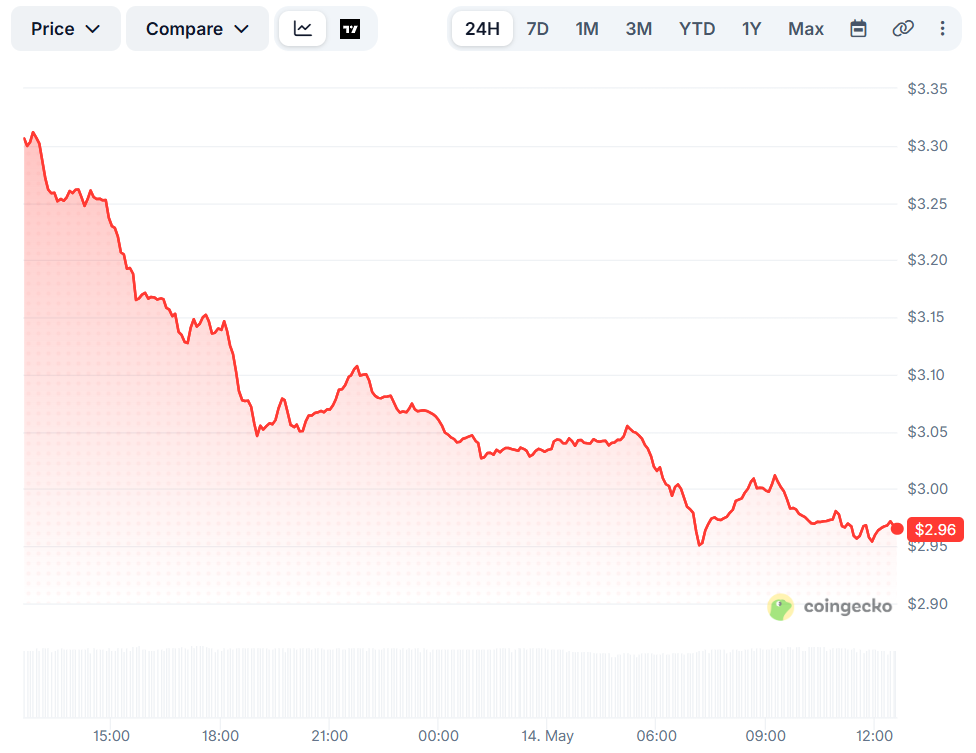
Just a few hours ago, the asset’s valuation plunged to a one-week low under $3, while its market capitalization sank to approximately $1.6 billion.
ICP Price, Source: CoinGecko
It is important to note that ICP’s negative performance aligns with an overall correction sweeping through the broader crypto market. Bitcoin (BTC) slipped beneath $80,000, while popular altcoins like Worldcoin (WLD), Cronos (CRO), Arbitrum (ARB), and Aptos (APT) tumbled by 7-8% over the past day.
In the meantime, Coinbase could have also played a role in Internet Computer’s downfall. Recently, it removed six non-USD trading pairs, including ICP/USDT and ICP/GBP.
Such actions by one of the biggest cryptocurrency exchanges reduce liquidity for the affected tokens and make it harder for traders to enter or exit positions. Fewer trading options often mean lower volume and weaker investor confidence, especially amid a crypto pullback.
At the same time, one should keep in mind that if Coinbase had removed all ICP-related services, the impact would likely have been far more severe and could have triggered a much sharper price collapse.
The asset remains available on numerous well-known exchanges, including Binance, Bybit, Bitget, OKX, and more. Two months ago, the leading South Korean trading venue Upbit also hopped on the bandwagon, fueling a 16% price increase for ICP following the news.
Resurgence Comes Next?
ICP’s Relative Strength Index (RSI) signals that the price pullback may soon be replaced by a revival. The technical analysis tool runs from 0 to 100, and readings below 30 indicate that the valuation has dropped too much, too quickly, potentially setting the stage for an upside move. Conversely, anything under 70 is considered a warning of impending correction. Currently, the RSI stands at around 28.
ICP RSI, Source: CryptoWaves
Analysts like Kong Trading and JAVON MARKS expressed confidence in the coin’s outlook. The former noted that almost half of ICP’s supply is locked in staking, with people committing for years.
“That’s not weak conviction. Hard to ignore when supply keeps tightening like this,” they added.
For their part, JAVON MARKS recently argued that ICP has displayed a Falling Wedge pattern and shows signs of strength. They believe a potential breakout could spark a 300% move above $10 and “may act as the start of an even larger reversal.”