Hackers took over the X account of Robinhood CEO Vlad Tenev on Thursday. They used it to push a new crypto coin, Vladhood (VLAD), that has already been flagged as a likely scam.
The fake post called VLAD the official mascot of Robinhood Chain. It even said the coin would be listed in the Robinhood app.
Inside the Robinhood CEO X Account Hack
Robinhood’s own accounts stayed silent. So did Robinhood Crypto. That was the first clue the post was fake.
The message started with a question. Does Robinhood love memes? It answered yes, then shared the coin’s address and signed off, “Welcome to the Hood.”
Robinhood CEO’s X Hacked to Push ‘Scam’ Meme coin on Robinhood Chain. Source: Vlad Tenev’s Account
The post has since been deleted.
A blockchain tracker for Robinhood Chain marks the coin as a likely scam. The token holds no real money. It has changed hands about 1,868 times since launch.
According to on-chain monitoring by MLM, the attacker generated around 650 ETH in proceeds from the VLAD token, worth approximately $1.2 million to $1.3 million.
Scams like this keep hitting the network. Reports of rug pulls have multiplied. The trick is not new. A fake coin named after Coinbase boss Brian Armstrong crashed this month, a lesson about trusting posts from executive accounts.
Meme Coins Keep Testing Robinhood Chain
Robinhood Chain went live on July 1. It is a new blockchain that Robinhood built on Ethereum. The company wants it to power tokenized stocks and other real-world assets.
But memecoins took over fast. The network now handles millions of trades a day. Risky meme coins drive most of it, and recently pushed it to record trading volume. Total trading has topped roughly $9 billion, according to Entropy Advisors.
Daddy Tate (DADDY), the Solana meme coin built on Andrew Tate’s brand, fell 24% on Sunday. The trigger was the arrest of Andrew and Tristan Tate in Miami, where US Marshals detained them on a UK extradition request.
UK prosecutors also added 38 new charges against the brothers. That lifts their combined total to 59. Once again, the token moved in lockstep with its namesake’s legal troubles.
Tate Brothers Face 59 UK Charges After Miami Arrest
Bedfordshire Police, the UK force leading the case, said in a statement that officers detained the brothers on Saturday. The Crown Prosecution Service (CPS) approved the new counts after reviewing fresh evidence. The number of alleged victims rose from three to seven.
Two brothers have been detained by officers in the United States of America, following an investigation by our major crime unit into sexual offences.
Andrew Tate, 39, and Tristan Tate, 38, were arrested in Miami yesterday (Saturday).
Andrew Tate, 39, now faces 42 charges. The new ones include seven rape counts, three trafficking counts, three assault counts, and 19 charges tied to indecent images of a child and extreme pornography. Tristan Tate, 38, faces 17 charges after six new counts, including two of rape.
The alleged offenses date from July 2010 to August 2017. Prosecutors want the brothers extradited on all 59 counts. Both deny every allegation.
They already face a separate trafficking trial in Romania dating back to a 2023 indictment. Markets have seen this movie before, as celebrity meme coins tend to swing hard on courtroom news.
DADDY Token Slides Toward Its February Low
BeInCrypto data shows DADDY near $0.0112, down 24% in a day and 22% on the week. Its market value slipped to about $6.7 million, according to DADDY price data.
The market is also thin. Only about $429,000 traded over the day, so even modest selling moves the price fast. DADDY now sits 96% below its June 2024 peak of $0.2886, and not far above its record low of $0.0045 set on February 6.
DADDY Market Cap and 24-Hour Trading Volume. Source: Coingecko
The pain started earlier this month. Andrew Tate sold his TATE airdrop for about $23,000 despite a public pledge to hold. Meanwhile, analysts have long warned about the risks of celebrity tokens, which run on hype alone.
The next move now hangs on the extradition hearings. For DADDY holders, the chart matters less than the courtroom.
The meme coin remains stuck in a heavy downtrend caused by the prolonged bear market and other negative factors.
Despite the grim conditions, Shiba Inu’s holders base continues to rise, recently reaching a new all-time high.
The New Record
The total number of SHIB wallets has been rising slowly recently, but at the beginning of the month there was a sharp jump. According to the X account BSCN, the meme coin saw an explosive jump of almost 75,000 new holders between July 5 and July 6 – far above its typical daily growth.
It remains unclear why the figure soared so sharply, as some speculate there might have been a technical glitch. In any case, the total number currently stands at 1,676,535, which is a new all-time high.
The growing figure contrasts with the plummeting price of Shiba Inu. As of this writing, it trades at around $0.0000042, reflecting a 15% plunge on a monthly scale and a staggering 95% crash from the historic peak witnessed in 2021.
SHIB Price, Source: CoinGecko
SHIB remains the second-largest meme coin, but only thanks to the double-digit collapse MemeCore (M) recently experienced. The market capitalization of the self-proclaimed Dogecoin killer has tumbled below $2.5 billion, making it the 36th-biggest cryptocurrency.
Further Slump Incoming?
The rising number of SHIB wallets is perhaps the only real glimmer of optimism for Shiba Inu lately. Its burning mechanism, which saw a major resurgence last week, has once again slowed, while Shibarium’s activity has fallen to near-idle levels.
The layer-2 scaling solution, designed to enhance Shiba Inu’s ecosystem by boosting speed, lowering transaction fees, and improving scalability, initially processed millions of transactions on a daily basis. Over the past months (especially after Shibarium’s exploit last year), those have tumbled to mere thousands and hundreds.
These negative factors, combined with the fading interest in the meme coin, suggest that bulls might have to suffer more pain in the near future. According to BSCN, SHIB’s daily trading volume was close to $700 million a year ago, but today (July 13) it is struggling to reach $50 million.
The sentiment among analysts and industry participants is also particularly negative. Recently, popular trader James Wynn described SHIB as “old, dead, and boring,” suggesting it may not recover for another 5-10 years until nostalgia potentially brings it back.
Binance founder Changpeng “CZ” Zhao just denied rumors of secretly backing meme coins on BNB Chain, after sending 400 million spam tokens worth $1.6 million to a burn address.
The transfers sparked manipulation theories, but on-chain data reveals a routine cleanup that has been repeating for years.
CZ Burns $1.6 Million in Spam Meme Coin Tokens. Source: BscScan
Inside CZ’s $1.6 Million Token Cleanup
A burn address is a wallet without an accessible private key, so any tokens sent to it are removed from circulation forever. About a day ago, CZ moved roughly 400 million units of third-party tokens into one of these addresses.
Furthermore, the batch totaled $1.6 million. Moreover, the destination was the well-known dead address starting with 0x000, a common target for permanent token removal.
The crypto community reacted fast. On-chain researchers flagged the transfers, and theories about market manipulation quickly began circulating. However, CZ promptly clarified on X that he was simply clearing out digital garbage accumulated in his public wallet.
“I simply hadn’t checked that wallet in a long time; when I opened it, I discovered there were too many tokens (tens of thousands), and the software interface wasn’t very user-friendly. I made a suggestion and then ran a test. Instead of sending it to my address, it’s better to send it directly to a ‘black hole’ address; it saves a step and is more direct and effective: 0x000000000000000000000000000000000000dEaD,” CZ said on X.
The explanation points to a long-running problem. Creators of third-party projects had been sending spam tokens to his address for years, chasing free publicity.
As a result, the wallet interface eventually stopped displaying his balance correctly, forcing the manual cleanup.
Additionally, burning the tokens directly removes clutter in a single step, without selling or transferring each asset individually.
Why Do Projects Send Spam Tokens to Famous Wallets
The most famous precedent involved Vitalik Buterin in 2021. Shiba Inu’s team transferred an enormous share of the supply to the Ethereum co-founder without asking him. Instead of validating the project, he burned 90% of those holdings and publicly asked developers to abandon the practice.
CZ now faces the same dynamic on a recurring basis. According to Arkham, his wallet has absorbed unwanted tokens for years, forcing periodic purges of ever-increasing size. Altogether, the Binance founder has erased more than $6.24 million in spam assets over the past twelve months.
The takeaway is straightforward. The transfers carry no hidden market signal and reflect maintenance rather than manipulation.
Zhao even joked that depositing tokens into his wallet works like a shortcut to a black hole. As a result, projects hoping for free promotion simply watch their tokens vanish faster.
World, a week-old Solana (SOL) prediction market, staged a fake exit. On July 8, it said it was leaving Solana for Robinhood Chain, then admitted the whole thing was a crypto prank the following day.
The gag drew millions of views and briefly fooled parts of the crypto industry. It also divided opinion on whether staged deception is smart marketing or a costly gamble for a young platform.
How the Crypto Prank Spread
World went live on Solana on July 1 inside the Phantom wallet, with Chainlink (LINK) handling data and settlement. Solana’s official account had promoted the debut just a week earlier.
Days later, the project told followers it was leaving for Robinhood Chain. It thanked the Solana Foundation and posted a polished logo for the supposed move.
The target made the fake believable. Robinhood Chain is a real Arbitrum-based Layer 2 that launched on July 1 for tokenized stocks.
That same week, the network set a record daily volume of $563.9 million, according to DefiLlama. Meme coins, not tokenized stocks, drove the frenzy. It was arguably crypto’s hottest new chain.
Several outlets reported the migration as fact. Within a day, World revealed the joke.
The reception split. Solana co-founder Anatoly Yakovenko amplified the gag, and CoinGecko co-founder Bobby Ong called it sharp marketing.
“I’m still trying to figure out if they moved to Robinhood Chain or staying at Solana. I think this is a parody and they are actually staying on Solana. I guess it triggered many folks and got them the attention that they really want, which is all that matters in consumer tech,” Ong remarked.
Critics, however, saw a bait-and-switch that erodes trust in a product handling real bets.
The on-chain record complicates any victory claim. An independent dashboard built by analyst ario_57 tracks World’s activity. It shows roughly $4.37 million in notional volume. Daily users peaked near 3,000 since the July 1 launch.
World’s daily on-chain volume, showing the pre-prank peak. Source: Dune/ario_57
Yet that volume crested around July 6, two days before the stunt. The cumulative totals cover the full launch week, not one viral afternoon. The prank coincided with World’s momentum. It did not create it.
The 2.3 million views were World’s own tally, a measure of attention rather than adoption. Meanwhile, prediction markets face fresh scrutiny, raising the cost of any misstep in trust.
For now, World has crypto’s attention and a working product behind the gag. Whether that attention becomes lasting users is the question the coming weeks will answer.
SPX6900 may reach $0.5078 by the end of 2026, according to the forecast.
By 2028, SPX could peak at $0.7917, with an average price near $0.7006.
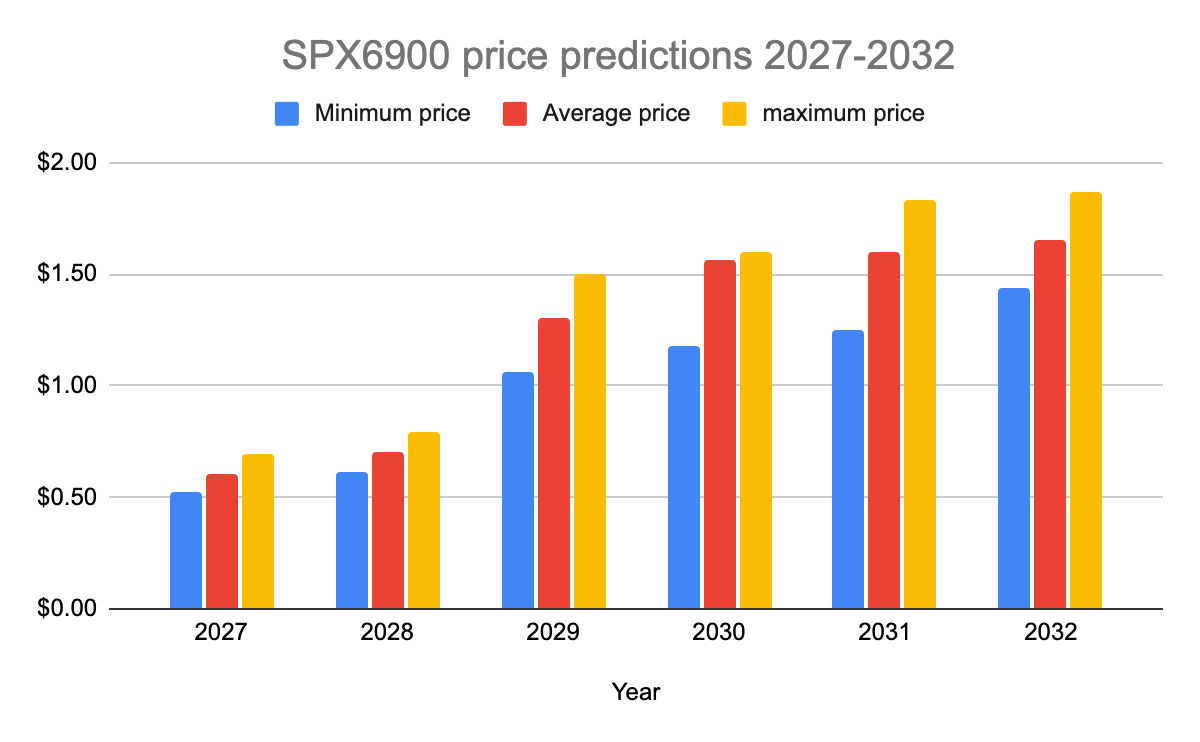
SPX6900’s long-term outlook places its 2032 target between $1.44 and $1.87.
SPX6900 (SPX) operates mainly on the Ethereum network and was initially created as an entertainment-focused meme token. The project has no direct connection to stocks, equities, or securities, with its value largely influenced by community engagement, social media activity, and market speculation.
The token attracts traders through spot markets, speculative activity, and perpetual contracts on centralized and decentralized exchanges. However, leveraged trading carries significant risks due to meme coins’ high volatility and is generally unsuitable for inexperienced traders. SPX can be stored through wallets such as Trust Wallet, Bitget Wallet, and hardware wallets including Ledger Nano S Plus.
SPX6900 is traded across multiple platforms, with Bybit among the leading exchanges by trading volume for the token. The meme coin currently has a circulating supply of 930.99 million SPX, matching its total supply, while its maximum supply is capped at 1 billion tokens.
Although launched as a non-serious meme project, SPX6900 gained attention after becoming one of the notable-performing meme tokens in 2024. The token recorded a sharp rally of nearly 9,000% within a month, attracting continued interest from traders as the market looks ahead to SPX6900’s price outlook for 2026 and beyond.
Overview
Cryptocurrency
SPX6900
Token
SPX
Price
$0.3690
Market Cap
$347.98M
Trading Volume (24-hour)
$7.94M
Circulating Supply
930.99M SPX
All-time High
$2.28 (July 28, 2025)
All-time Low
$0.000002634 (August 16, 2023)
24-hour High
$0.3933
24-hour Low
$0.3674
SPX6900 price prediction: Technical analysis
Metric
Value
Price Prediction
$ 0.2781 (-25.13%)
Price Volatility
9.40% (High)
50-Day SMA
$ 0.3479
200-Day SMA
$ 0.3715
Market Sentiment
Bearish
Fear & Greed Index
20 (Extreme Fear)
Green Days
15/30 (50%)
14-Day RSI
59.65 (Neutral)
SPX6900 price analysis
SPX6900 trades under pressure as sellers dominate after the token fails to sustain its recent recovery attempt.
The price remains between key support and resistance zones, with buyers watching the daily low for potential stabilization.
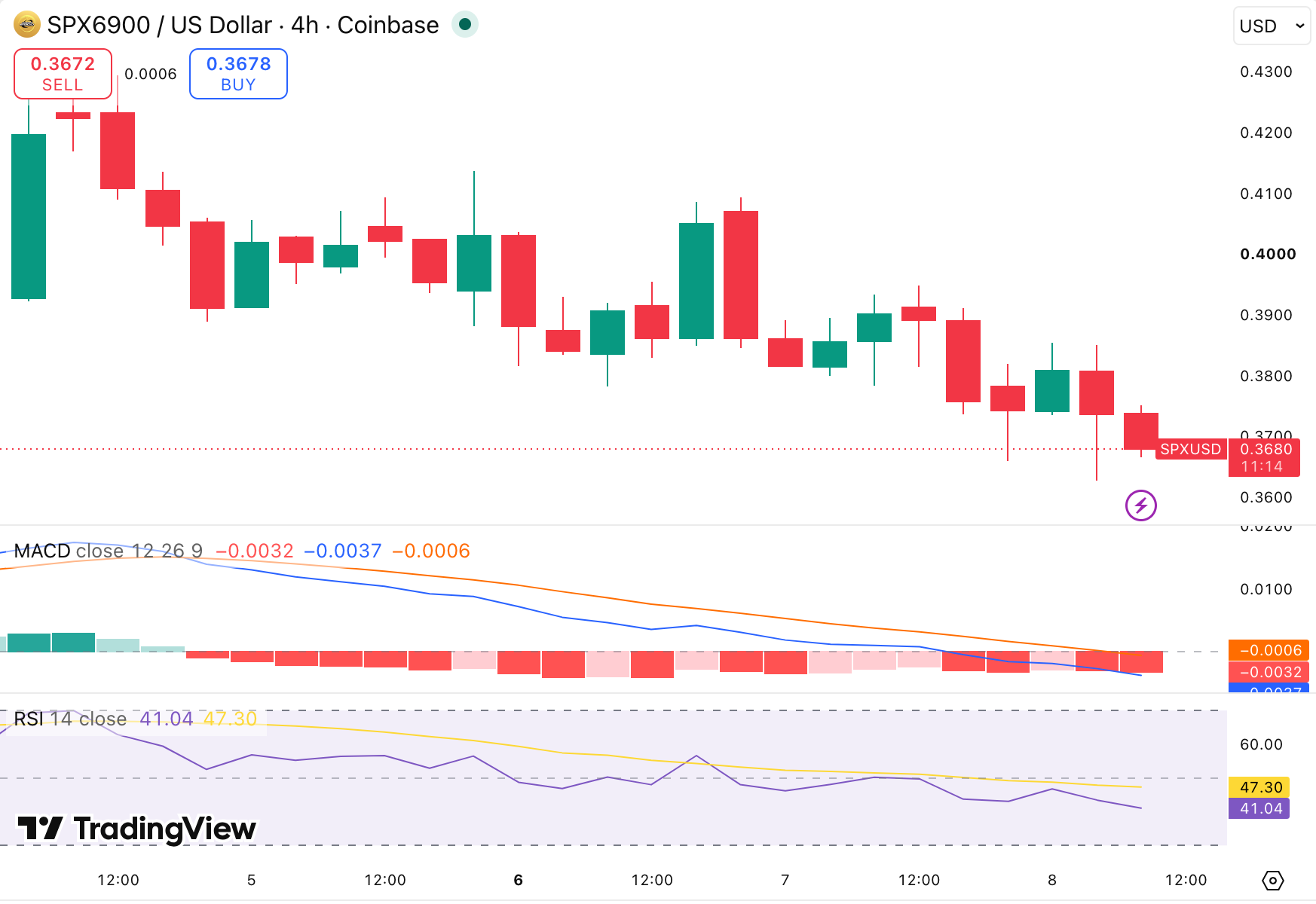
Short-term momentum weakens on the 4-hour chart as SPX struggles to regain its previous upward trend.
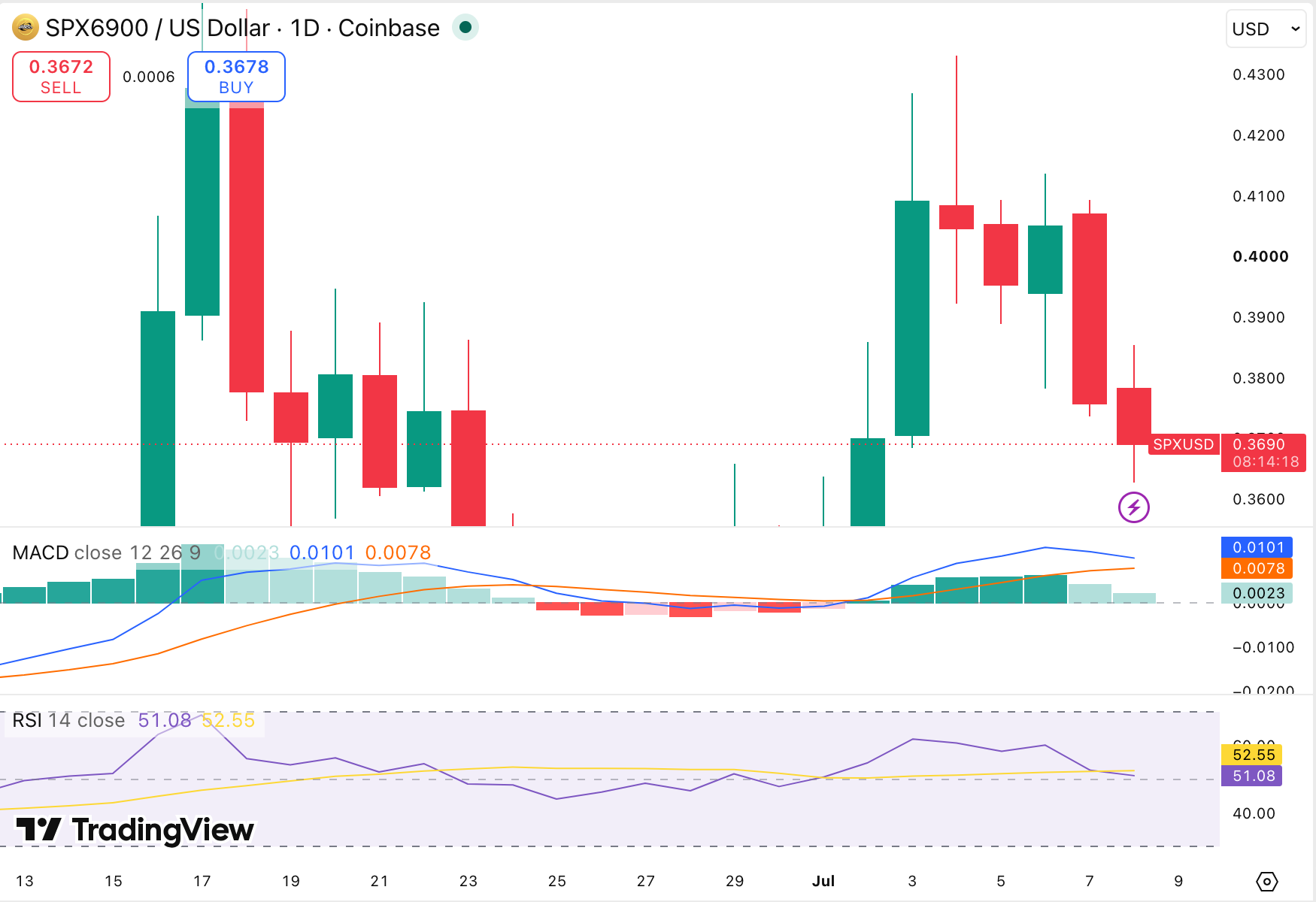
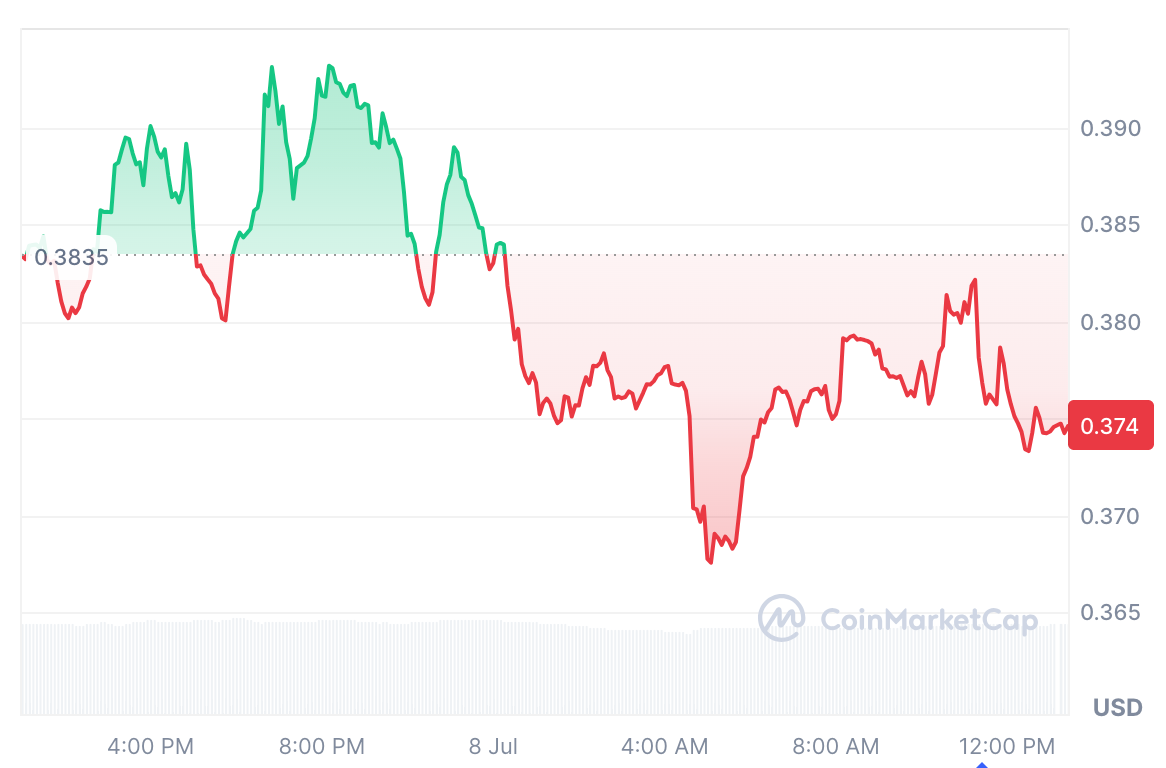
On July 8, 2026, the price of SPX6900 (SPX) is trading at $0.3690, marking a 1.76% decline in the last 24 hours. The most significant support level is at $0.3674, while the immediate resistance is at $0.3933.
SPX6900/USD analysis on the 24-hour timeframe
The daily chart shows SPX6900 starting with early buying strength before sellers regain control near the upper trading range. The token fails to maintain its upward momentum, creating a lower-high pattern as price gradually moves toward the lower end of the session range.
The price of SPX6900 (SPX) is currently trading at $0.3690 on the daily chart, where sellers are starting to gain the upper hand following a recent bounce in the token. RSI 14 is at 51.08, which is a neutral market state with a balance between buyers and sellers.
The MACD is still positive as the MACD line is 0.0101 above the signal line and the histogram is declining, indicating weakening bull market momentum. If SPX is to turn up the heat and get some upward momentum, it may require more buying pressure in the short-term.
SPX6900 analysis on the 4-hour chart
The 4-hour structure suggests sellers still have the upper hand as the SPX6900 breaks out of the previous recovery zone. The token has to gain buying momentum in order to make a comeback and make it better in the short term.
On the 4-hour chart, SPX6900 (SPX) is still under selling pressure, as the token has fallen below its previous recovery levels. RSI 14 levels have fallen to 41.04, which is below the oversold level but still not strong momentum, implying that sellers still dominate and buyers are trying to level the market.
The MACD indicator continues to be bearish, with the MACD line remaining below the signal line, indicating a downward trend. Red bars are the current trend of waning purchasing power, and unless it turns around, SPX could continue to move lower.
SPX6900 technical indicators: Levels and action
Daily simple moving average (SMA)
Period
Value
Action
SMA 3
$ 0.4011
SELL
SMA 5
$ 0.3968
SELL
SMA 10
$ 0.3705
BUY
SMA 21
$ 0.3673
BUY
SMA 50
$ 0.3479
BUY
SMA 100
$ 0.3514
BUY
SMA 200
$ 0.3715
BUY
Daily exponential moving average (EMA)
Period
Value
Action
EMA 3
$ 0.3988
SELL
EMA 5
$ 0.3924
SELL
EMA 10
$ 0.3792
SELL
EMA 21
$ 0.3659
BUY
EMA 50
$ 0.3576
BUY
EMA 100
$ 0.3638
BUY
EMA 200
$ 0.4570
SELL
What to expect from SPX6900 price analysis?
SPX6900 is still trying to work out if buyers are able to hold the current support zone following the recent breakdown. If the token recovers well, it may test higher resistance levels, and if the selling pressure continues, SPX will be heading towards lower price levels.
The near-term picture will rely on whether buyers gain control and bring about a reversal in the positive trend. If SPX maintains its price range, then the token might try to rally again, but without finding new buying interest, it could continue to be under pressure for the short term.
Why is SPX down?
SPX6900 is trending down because those who are selling take over control while the token is unable to sustain its recent recovery rally. The price is under selling pressure as buyers are unable to hold onto higher price levels, causing a reversal down to the lower end of the trading range.
The weakness also indicates lower short-term demand, as traders remain more conservative as a result of the slow momentum in the market. Once the first bounce off the wall fades, SPX begins to consolidate and puts buyers to the test to avoid additional bear market pressure.
Is SPX6900 a good investment?
SPX6900’s future value could benefit from its limited supply and growing market interest, as scarcity can influence demand over time. However, price movements remain uncertain and depend on market conditions, investor sentiment, and broader crypto trends.
Investors should consider the risks associated with volatile assets and conduct thorough research before making investment decisions. Only allocate funds that match individual risk tolerance and financial circumstances.
Will SPX reach $5?
SPX6900 would require a substantial increase in both price and market capitalization to reach the $5 level. While achieving this target is challenging, it remains possible if the token experiences strong adoption and market growth. Current projections suggest SPX could approach this range after 2032, supported by a significantly higher market valuation.
Will SPX6900 reach $10?
SPX6900 is not expected to reach the $10 price level based on current prediction models. According to the forecast algorithm, the token’s highest projected value could reach approximately $8.06 by 2046, suggesting a long-term growth trajectory that falls below the $10 milestone.
Does SPX6900 have a good long-term future?
Long-term forecasts suggest a gradual increase in SPX6900’s value, with projections indicating stronger upward momentum toward 2029. By 2032, SPX is expected to trade above $1.3, with a projected fully diluted valuation (FDV) of around $427.33 million.
SPX6900’s growth is primarily driven by community support, meme culture, and market speculation rather than traditional utility. The token is a satirical project that uses phrases like “scientific utilization” to parody finance and crypto concepts, while its S&P 500 references highlight its humorous approach to market valuation.
SPX6900 price prediction July 2026
SPX is projected to trade within a range this month, with a potential high of $0.3980, an average price of $0.3720, and a minimum trading level of $0.3590.
SPX6900 price prediction
Minimum price
Average price
maximum price
SPX6900 price prediction July 2026
$0.3590
$0.3720
$0.3980
SPX6900 price prediction 2026
SPX6900 is expected to reach a minimum price of $0.4690 in 2026 based on price projections and technical analysis. The SPX price could rise to a maximum of $0.5078, with an average trading price of around $0.4760.
SPX6900 price prediction
Minimum price
Average price
maximum price
SPX6900 price prediction 2026
$0.4690
$0.4760
$0.5078
SPX6900 price predictions 2027-2032
Year
Minimum price
Average price
maximum price
2027
$0.522
$0.6069
$0.6919
2028
$0.6095
$0.7006
$0.7917
2029
$1.06
$1.30
$1.50
2030
$1.18
$1.56
$1.60
2031
$1.25
$1.60
$1.83
2032
$1.44
$1.65
$1.87
SPX6900 price prediction 2027
SPX6900 is expected to trade at a minimum price of $0.522 in 2027, with a maximum projected value of $0.6919 and an average trading price of $0.6069.
SPX6900 price prediction 2028
SPX6900 is projected to reach a minimum price of $0.6095 in 2028, with a potential maximum price of $0.7917 and an average trading price of around $0.7006 throughout the year.
SPX6900 price prediction 2029
SPX6900 is projected to trade at a minimum value of $1.06 in 2029, with the potential to reach a maximum price of $1.50. The average trading price during the year is estimated at around $1.30.
SPX6900 price prediction 2030
SPX6900 is projected to reach a minimum price of $1.18 in 2030, with the potential to climb to a maximum value of $1.60 and an average trading price of $1.56 throughout the year.
SPX6900 price prediction 2031
SPX6900 is expected to reach a minimum price of $1.25 in 2031, with a potential maximum value of $1.83 and an average trading price of around $1.60 throughout the year.
SPX6900 price prediction 2032
SPX6900 is projected to reach a minimum price of $1.44 in 2032, with a potential maximum level of $1.87 and an average trading price of around $1.65 based on technical analysis of historical price data.
SPX is projected to reach a high of $0.5078 by the end of 2026. In 2027, the token could trade between $0.522 and $0.6919, while the 2032 outlook places SPX within a range of $1.44 to $1.87, with an average price of $1.65. These estimates may change based on market conditions, and investors should conduct their own research and due diligence before making decisions in the volatile crypto market.
SPX6900 was launched in August 2023 by its primary creators with an opening price of $0.003 but remained under the radar for over a year.
In October 2023, SPX’s value spiked to $0.023 under bullish control, which was a considerable growth trajectory, but it still remained far from market attention.
December of 2023 saw a low price of $0.008, which was quite low compared to the price in October, as per crypto market historical data.
SPX6900 saw a stagnating price movement from January to May 2024, only to rise periodically to $0.015.
In September 2024, SPX6900 gained an enormous 5600% from September 12 to October 14, reaching $0.913, resulting in a massive market capitalization.
The token made higher spikes till November 7, 2024, adding significantly to its market cap; however, the token’s price has deteriorated afterwards.
On November 21, SPX6900 stooped to $0.450, losing 50% of its value, which made holders cautious. However, the token regained its lost value and ended the year at $0.856.
The meme token entered January 2025 with a price tag of $0.866, but it soon jumped to $1.55 as its circulation and acceptance increased.
It corrected strongly in search of support at the start of February, attaining an average price of $0.66, but came down to the 0.46 range in March.
In April, the coin was trading near $0.386 on the lower side, while in May, it saw a fabulous recovery, peaking at $1.11 along with some other cryptocurrencies.
On June 11, the meme coin attained its all-time high of $1.73, and on July 28, it marked another ATH at $2.27.
SPX maintained a trading range of $1.06 to $2 in August under complete bullish dominance, proving itself a reliable asset, and was trading at an average price of $1.16 in September.
In October 2025, SPX6900 was trading near $1.6, and in November, it fell to $0.78 after losing 50% of its value. In December, the downtrend continued as the token touched $0.63.
At the start of January 2026, SPX6900 was trading near $0.648, but in March, it slipped to $0.336.
In April, SPX6900 was trading near $0.28, and in May it increased to $0.42, but it decreased to $0.316 again in June, as the current market sentiment turned bearish to neutral.
According to the latest data, SPX is trading near $0.3770 as July begins, reflecting its current market position at the start of the month.
Pump.fun built one of crypto’s fastest meme-token liquidity machines. Now, on July 12, its own token faces the kind of liquidity test the platform usually creates for others.
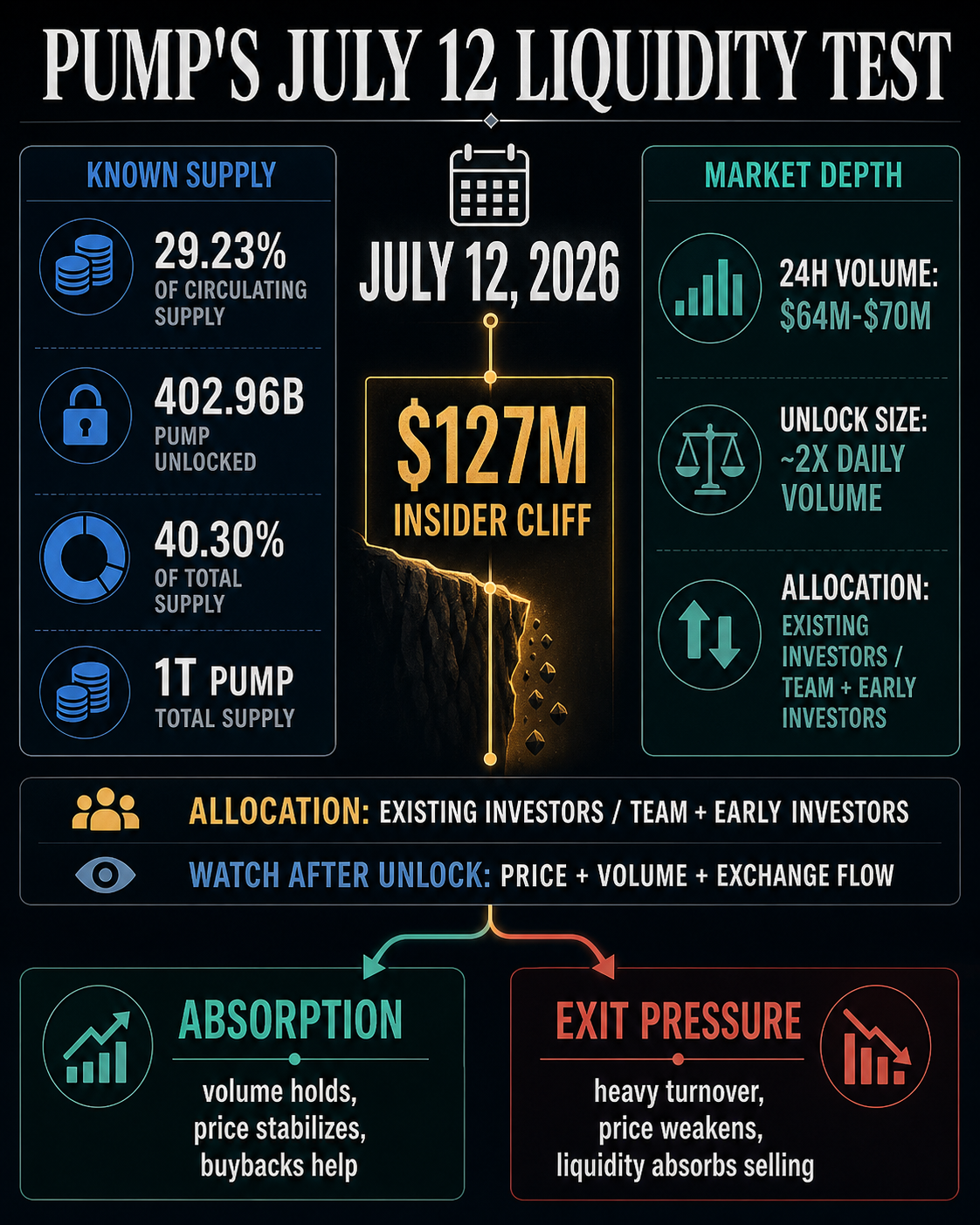
The platform’s PUMP token is set to unlock on July 12, with Tokenomist valuing it at $127 million, equal to 29.23% of the circulating supply.
The scheduled release is tied to insider allocations: Tokenomist’s weekly unlock digest describes the tranche as flowing to team and early investors, while its PUMP vesting page identifies the next release as Existing Investors.
That matters because PUMP is facing a large scheduled release against an order book that recently showed far less daily turnover than the unlock size.
CryptoSlate market pages showed PUMP trading near $0.00155 on July 8, with 24-hour volume between roughly $64 million and $70 million across the PUMP asset page and the broader coin rankings.
The scheduled cliff is therefore close to twice recent visible daily volume before any adjustment for how much of the unlocked allocation is actually sold.
The full $127 million may stay off exchanges if recipients hold. Unlock size only sets the maximum new supply available; sell-through decides the pressure.
But the token is entering a more direct liquidity test than most meme-coin narratives produce: if recipients hold, demand may absorb the date. If they sell into weak depth, the unlock can turn from a calendar entry into visible exit pressure.
Tokenomist’s vesting page says roughly 402.96 billion PUMP, or 40.30% of the token’s 1 trillion supply, has already been unlocked. The remaining supply is still governed by the project’s vesting schedule, which extends into 2029.
The same page says Pump.fun uses cliff vesting across most allocations, meaning tokens are released in large, scheduled blocks rather than being smoothed into the market over time.
That is why the July 12 event is more than a tokenomics footnote. Cliff structures concentrate risk into dates traders can see in advance.
Traders can price them in, hedge them, ignore them, or use them as liquidity windows. The supply still arrives in a visible block.
The upcoming release also lands in a token whose float is still maturing. Tokenomist lists the Initial Coin Offering at 33% of allocation, Community & Ecosystem Initiatives at 24%, Team at 20%, Existing Investors at 13%, Livestreaming at 3%, Liquidity & Exchanges at 2.6%, Ecosystem Fund at 2.4%, and Foundation at 2%. That mix puts a meaningful share of future supply in categories whose behavior can shape market confidence.
The strongest bearish case is simple. A large block of insider-controlled PUMP becomes available while the token’s daily trading volume is lower than the scheduled release amount.
If even a meaningful portion of that allocation seeks liquidity, buyers have to absorb it without demanding a larger discount. That is the definition of an exit-liquidity test.
The strongest counterargument is also straightforward. Recipients can hold unlocked tokens, and PUMP is attached to a platform with real activity, fees, and past buyback demand.
The trade turns on two observable outcomes: supply meets enough demand to clear without lasting damage, or the market reprices PUMP because the available bid is thinner than the insider supply.
For traders, timing is the point. Cliff vesting compresses a supply decision that could have unfolded over months into a single window, so price action around the date becomes a live signal of confidence, depth, and whether holders want cash or exposure.
Pump Fun retail demand was already tested once
The tension is more acute because Pump.fun’s token already had one spectacular demand event. CryptoSlate reported in July 2025 that the memecoin launchpadsold 150 billion PUMP tokens to retail investors, raising $600 million in 12 minutes and bringing total token-sale proceeds to $1.32 billion.
That was primary-market demand under launch conditions. The July 12 cliff tests something different: whether secondary-market liquidity can absorb supply after the trade has aged, the token has fallen far below its peak, and insiders have a new path to liquidity.
The platform context makes the reversal harder to miss. Pump.fun built its reputation by making meme-token creation and trading fast.
CryptoSlate’s launchpad review describes it as a Solana-native, bonding-curve launchpad where ordinary users can usually buy and sell quickly, and where the practical constraint is liquidity rather than formal vesting.
In other words, Pump.fun turned fast retail flow into a product.
Now PUMP has to demonstrate that the same market reflex exists for its own token when the seller profile changes. Retail buyers once funded the token sale at extraordinary speed.
The next question is whether secondary traders are willing to provide sufficient depth when the scheduled supply comes from the team and investor categories rather than from new public demand.
The question is market structure rather than a moral judgment about meme coins. PUMP can remain a tradable, revenue-linked token and still face pressure from cliff vesting.
It can also suffer short-term volatility without proving the business is broken. The important point is that the July 12 date turns an abstract dilution risk into a measurable trade.
That is where Pump.fun’s own design history tightens the story. The launchpad trained users to expect immediate market access and fast exits; PUMP’s unlock asks whether the platform’s token has the same depth when the flow moves in the other direction.
The platform created liquid attention for thousands of tokens, but insider supply tests whether attention is durable enough to support its own market.
PUMP buybacks make the case for absorption
The strongest case for absorption rests on Pump.fun’s revenue and buyback history. Tokenomist’s digest notes that Pump.fun has been a consistent revenue generator and has run token buybacks in the past, which can absorb some incremental supply if the program is large enough.
CryptoSlate previously examined that question in the broader token-buyback market, noting that Pump.fun had spent $233 million to buy 62.2 billion PUMP as of Jan. 6.
The same buyback analysis warned that buyback programs only change the supply picture when fee revenue scales faster than scheduled unlocks.
That is the relevant filter for the July 12 cliff. A buyback headline is insufficient on its own.
What matters is coverage: how much demand the program creates relative to newly available supply, and whether that demand is visible when insiders are allowed to sell.
If PUMP volume rises into the unlock, price holds, and buyback demand is evident, the market can interpret the event as manageable dilution.
The result would leave future vesting risk in place, but it would show that the token has a deeper bid than the headline unlock suggests.
If volume rises while price weakens, the signal changes. Heavy turnover can mean absorption, but it can also mean distribution.
The difference is whether buyers are taking supply without forcing a sustained discount. That is why post-unlock price behavior matters more than the unlock calendar itself.
The broader backdrop adds pressure. Tokenomist’s weekly digest described June as defensive, with Bitcoin dropping below $60,000 late in the month and spot Bitcoin ETF flows acting as a headwind.
It also said capital had become selective, favoring tokens with clearer revenue and value-accrual mechanics rather than the market as a whole. That is a mixed setup for PUMP: the project has revenue, but the token has a large insider cliff.
Before the unlock, the cleanest conclusion is conditional. Pump.fun’s July 12 cliff is large enough, concentrated enough, and close enough to recent visible daily volume to qualify as PUMP’s first real exit-liquidity test.
Sell-through remains the missing variable.
The next signal will come from how PUMP trades after the tokens become available.
A constructive outcome would show elevated volume without a lasting price break, limited evidence of exchange-bound supply, and enough demand or buyback activity to keep the market orderly.
A weaker outcome would show heavy volume paired with price deterioration, suggesting that liquidity is being used to exit rather than to accumulate.
That makes July 12 a deadline with a measurable aftermath. Pump.fun built one of crypto’s fastest retail attention machines.
PUMP now has to show whether that attention is deep enough to meet insider supply when the cliff arrives.
An anonymous trader turned a $754 bet into roughly $271,000 in under 48 hours, scoring a 357x return. The windfall came from CZ, a BNB Chain meme coin tied to Binance founder Changpeng Zhao.
Here is how the trade unfolded, what powers the token, and why the story is both inspiring and risky.
In less than 2 days, this lucky trader turned $754 into $271K — a 357x return!
Trader 0xf349 spent just $754 to buy 5.1M $CZ yesterday, which is currently worth $271K.
Over the past 2+ months, he traded 260 tokens, with a 31.88% win rate, and lost money on most of them. But he… pic.twitter.com/0Iv9CFUFeA
How the Trader Scored a Staggering 357x Return With a CZ Meme Coin
A meme coin is a cryptocurrency built around an internet joke, personality, or cultural reference rather than a specific technical use case. The CZ token, known as “The Final Form Bull,” leans entirely on that formula across the BNB Smart Chain.
On-chain platform Lookonchain reported the details. The wallet acquired roughly 5.1 million CZ tokens across three transactions totaling $754.49. Furthermore, the average entry price sat near $0.000147 per token during the early accumulation phase.
The payoff was explosive at its peak. As the token surged, the position’s value skyrocketed to around $271,100. However, the meme coin has since pulled back from 0.0592 to $0.0418, according to GeckoTerminal.
As a result, the holder’s unrealized gains have eased to roughly $246,000, though the trader still holds 100% of the position without selling a single token.
The token itself draws direct inspiration from a viral CZ tweet. On January 17, 2021, Zhao wrote, “Everyone knows I’m a bull. You haven’t even seen my final form yet,” alongside a muscular bull image. As a result, that phrase became legendary crypto folklore.
Launched recently via the Four.Meme platform, CZ meme coin now holds a market capitalization of around $41 million. Furthermore, its 24-hour trading volume briefly topped $80 million during the rally’s peak, reflecting intense speculative interest.
Why This 357x Win Comes With Real Warnings
The trade looks glamorous, but the trader’s history reveals the harsh reality of meme coins. Over the past two months, the wallet made roughly 260 trades with just a 31.88% win rate. Most positions ended in losses.
The CZ phenomenon also reflects the ongoing popularity of Binance-themed meme coins. Low fees and fast transactions on BNB Chain continue to attract retail traders seeking high-volatility opportunities amid an increasingly crowded speculative market.
However, experts caution that such extreme returns remain rare. Meme coins can pump violently and then correct just as sharply. Sustainable success requires discipline, risk management, and the understanding that most participants never achieve life-changing results.
Nearly 1 million buyers of the Official Trump (TRUMP) meme coin are sitting on a combined $3.81 billion in losses, according to blockchain analytics firm Nansen. The TRUMP meme coin now trades roughly 98% below its January 2025 record high.
The losses look like the final stage of a familiar meme coin cycle. Early buyers captured most of the gains, while later arrivals absorbed the decline that followed the launch hype.
Official Trump (TRUMP) Price Performance. Source: BeInCrypto
The TRUMP Meme Coin Cycle Played Out in 18 Months
TRUMP launched on January 17, 2025, three days before President Donald Trump’s second inauguration. Its price jumped from below $1 to a record $73.43 within two days. That briefly lifted its market value near $15 billion.
Nansen tracked about 1.48 million wallets that bought the token. Just under 500,000 locked in profits worth roughly $4 billion. Most of those gains went to early traders who sold into the first rally.
The buyers who followed became the exit liquidity. Nansen counted 988,905 wallets underwater, about two out of every three, once paper losses are included. The token’s own website had warned that it was not an investment.
The outcome fit a pattern that analysts flagged for celebrity meme coins from the start. A month later, Argentina saw a faster version. President Javier Milei promoted the LIBRA token in February 2025. Its near $4 billion valuation collapsed within hours, triggering a fraud probe.
The Token Earned for Its Backers Regardless of Price
The design meant the decline barely touched the people behind it. The token’s code routes a share of every trade to creator-linked wallets. Chainalysis traced more than $324 million in such fees to those addresses in the months after launch.
Those fees accrued whether buyers won or lost. Trump’s 2025 financial disclosure later listed a $636 million windfall from the meme coin. The royalties were routed through CIC Digital, the Trump-linked entity behind the token.
Retail buyers had little legal cover. In a February 2025 statement, the Securities and Exchange Commission said meme coins are not securities. That left the market outside its oversight.
Economist Peter Schiff has called the tokens a way to buy access to the president rather than a real investment.
“He’s actually had events at the White House where the top owners of Trump coin are allowed to attend. But it’s really a way to bribe the president. You don’t have to give him money directly, just buy his token, because who else would buy the token? It’s a lousy investment,” he said.
The White House rejects that view. According to a New York Times report, Spokeswoman Anna Kelly said there are no conflicts of interest and that the president acts in the public interest.
TRUMP set an all-time low of $1.50 in early June and has barely recovered. Appetite across the wider meme coin market has stayed subdued. The token now trades close to $1.79, little changed over the past month. Its market value sits near $424 million, ranking around 115th.
Political branding drew far more attention than a typical meme coin. It did not rewrite the math. The TRUMP token traced the same boom-and-bust arc as the speculative coins that came before it.
Crypto trader Ansem has urged Pump.fun to launch a PUMP airdrop worth up to $300 million for early users. The demand lands less than two weeks before the platform’s first investor token unlock on July 12.
Pump.fun (PUMP) trades near $0.0015, more than 80% below its September 2025 peak. The debate now centers on whether rewards or burns offer holders better protection when locked tokens hit the market.
Ansem’s argument is that a large distribution would reward loyal traders and repair public opinion toward the platform, potentially driving price upwards.
“all im saying is if they give the trenches a $250-$300M airdrop stimmy as solana is breaking out & gaining attention again + incentivize future trading volumes, the public opinion towards them would change at breakneck speeds,” Ansem suggested.
His words carry weight in the meme coin community. The ANSEM token gained nearly 20,000% in a week after he pledged weekly creator fee airdrops. The platform, however, has not announced any airdrop plans.
He originally received 65% of the supply, and has since sent out a total of 6.6% as airdrops. That’s $11.22 MILLION of airdrops sent out at the current price.
Pump.fun has so far chosen destruction over distribution. In April, the platform executed a $370 million token burn that removed about 36% of the circulating supply. It also committed half of its revenue to automated buybacks and burns for one year.
Critics said those tokens should have gone to users instead. Co-founder Alon Cohen defended the strategy at the time.
“Every dollar not burned is a dollar being put to work toward the same outcome,” Cohen said in a post.
Yet supply reduction has not delivered lasting price gains. An earlier buyback program struggled against sustained whale selling in late 2025.
The July 12 unlock now poses a bigger test. It falls one year to the day after PUMP sold at $0.004 in its initial coin offering.
As the cliff expires, 82.5 billion tokens worth roughly $133 million will vest to existing investors, according to Tokenomist data.
The tranche equals about a fifth of the circulating supply. Moreover, PUMP remains 62% below its ICO price despite gaining almost 20% over the past week.
Pump.fun can answer Ansem with an airdrop, more burns, or silence. Whichever it chooses, July 12 will test whether shrinking supply and renewed attention can cushion its first investor unlock.












![World's daily on-chain volume, showing the pre-prank peak, Source: Dune/ario_57]](https://assets.beincrypto.com/img/-avHN9_82Fzf-o66hJTGVAYBSIg=/smart/9bf00bf07a9042d7bfc0990ea56902d6)