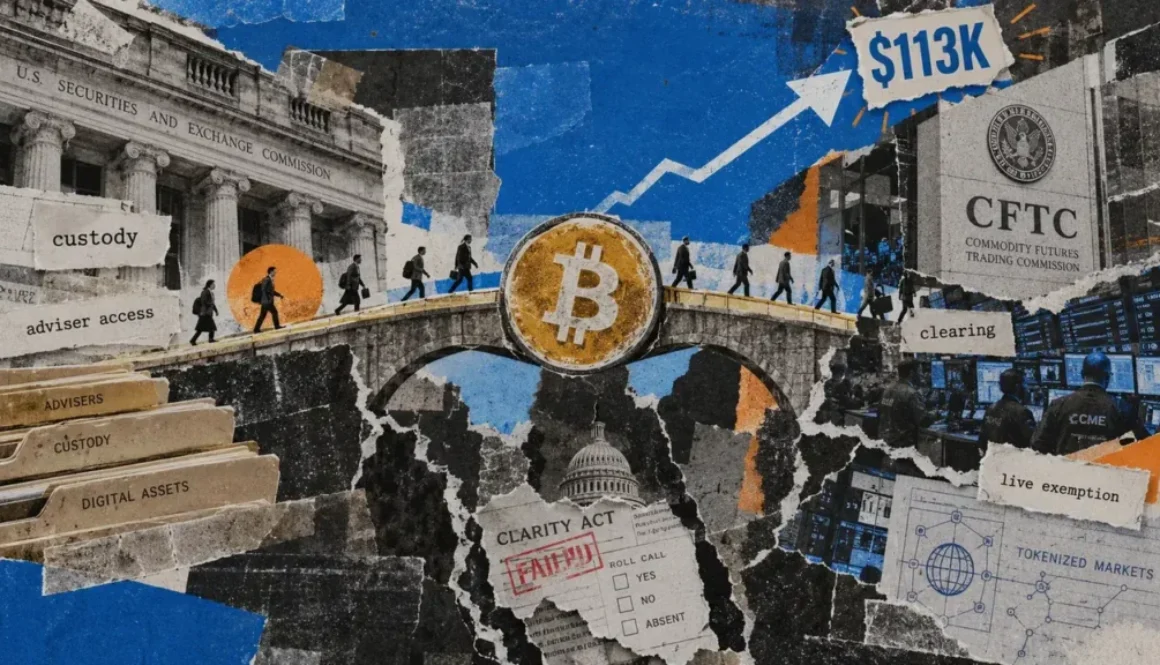
The Senate Banking Committee voted 15-9 on Thursday to move forward on the CLARITY Act, a crypto market structure proposal that has been the subject of debate for a while now.
Nevertheless, just ahead of the vote, the Bank Policy Institute (BPI) put out a series of tweets on X about illicit crypto flows hitting $154 billion in 2025, adding another dimension to what was already an intensely debated topic on the extent of regulation in digital assets.
Bank Advocates Lean on Crime Data
The timing of BPI’s thread drew attention because lawmakers were simultaneously debating amendments tied to stablecoin yield restrictions and enforcement standards inside the CLARITY Act markup session.
According to data from Chainalysis that the institute shared, in 2025, illicit crypto addresses received $154 billion. This was a 162% year-over-year increase, driven largely by a 694% jump in value received by sanctioned entities.
Furthermore, the on-chain money laundering ecosystem grew from $10 billion in 2020 to over $82 billion in 2025, with stablecoins, primarily Tether (USDT), now accounting for 84% of all illicit transaction volume, displacing Bitcoin as the preferred payment method for criminals.
In a separate piece, the BPI argued that banks have spent decades staffing tens of thousands of AML employees while crypto companies have been largely exempt.
It said that the GENIUS Act imposed some obligations on US stablecoin issuers, but did not cover foreign issuers operating stateside. Tether, incorporated in El Salvador, sits outside that net.
The piece also cited the Islamic Revolutionary Guard Corps, whose crypto activity reportedly reached over $3 billion in 2025, representing roughly 50% of Iran’s total crypto ecosystem by Q4 of that year.
According to the BPI, unhosted wallets, cross-chain bridges, and mixers are “specifically designed to frustrate tracing and openly advertised as such.”
The stablecoin debate has become one of the most contentious parts of the CLARITY Act negotiations, with banking groups, including members of the American Bankers Association, spending weeks lobbying senators to tighten language restricting yield-bearing stablecoins.
As CryptoPotato reported earlier this week, banking groups sent Senate offices more than 8,000 letters ahead of the markup vote, while the crypto advocacy group Stand With Crypto said its supporters had contacted lawmakers nearly 1.5 million times in support of the bill.
But despite more than 40 amendments proposed by Senator Elizabeth Warren and procedural disputes during the hearing, the legislation advanced with support from Democratic senators Ruben Gallego and Angela Alsobrooks.
The Counter-Argument
While the BPI is demanding stricter anti-money laundering laws and sanctions regulations to be applied to crypto the same way it has been done to the traditional banking sector, data shared by Binance Research on May 14, offered some pushback to its claims.
According to Binance, trapped illicit funds on-chain have grown every year because less is being successfully laundered, not more.
Their report showed that more exit points are being blocked by KYC and more balances are being frozen by stablecoin issuers. Even the largest mixers have been processing at most $10 million per day.
The Solana price has struggled to shake off its early-year woes despite a slightly improved general market climate in recent weeks. After falling from a nearly $150 valuation in the first quarter of 2026, the altcoin has been stuck within a consolidation range between $75 and $100 over the past few months.
The upper boundary of this consolidation zone proved formidable after the Solana price failed to fully capitalize on the injection of bullish momentum (triggered by news of the CLARITY Act passing the US Senate banking committee). A popular market analyst on the social media platform X has identified this specific resistance level and what lies on the other side for Solana.
A Break Above $98 Could Mean A Sustained Rally For SOL Price
In a recent post on the X platform, crypto pundit Ali Martinez pinpointed $98 as the level to break for the Solana price to reach its upside potential. According to the analyst, the cryptocurrency could embark on an approximately 30% rally if it sustains a break above this overhead resistance.
Martinez highlighted that the SOL token has been trading within a “well-defined” horizontal channel, with the lower and upper boundaries at $78 and $98, respectively. As a result of the CLARITY Act-induced market-wide rally, Solana’s price enjoyed some bullish momentum, only to be quickly truncated by the $98 ceiling.
Having bounced back from this rejection around the pivot point at $88, Martinez believes the altcoin could be returning to the channel ceiling for another breakout attempt. The crypto trader noted that if the price of Solana does manage to break and close above the $98 (on the daily timeframe), investors could see a surge toward $107.
However, that is only an immediate target, as Martinez believes the Solana price could travel further up towards its secondary target at $117. As hinted earlier, this secondary target represents a more than 30% uptick from the current price point.
At the same time, Martinez offered an alternative scenario where the $98 resistance refuses to give way. According to the market analyst, the price of Solana could experience a pullback to the $88 pivot point — or even to as low as the channel floor at $78 — if the resistance continues to hold strong.
In any case, the general market condition would need to improve if the altcoin is to enjoy sustained upside, especially given how sensitive financial markets have been to broader market dynamics in 2026.
Solana Price At A Glance
As of this writing, the price of SOL stands at around $89.33, reflecting an over 3% decline in the past 24 hours.
Bitcoin’s latest retreat below $80,000 shows how quickly the bond market has reclaimed control of crypto trading, even after lawmakers advanced one of the industry’s most closely watched regulatory bills.
Data from CryptoSlate showed that the top asset was trading at $79,083 as of press time, down more than 3% after another failed attempt to hold above $82,000.
Blockchain analytical firm Santiment attributed the reversal to a “buy the rumor, sell the news” market reaction to the Senate Banking Committee’s approval of the CLARITY Act. This was a policy milestone that would typically improve sentiment across digital assets by moving market-structure legislation closer to a full Senate vote.
However, the rally attempt faded as traders shifted their focus back to Treasurys.
The 10-year Treasury yield moved above 4.5% for the first time since June 2025, while the 30-year yield climbed toward 5.1%. Jim Bianco of Bianco Research said the long bond was only 8 basis points away from a fresh 19-year high.
US 30-Year Yield (Source: Bianco Research)
That move has raised the return threshold for Bitcoin exposure. Higher yields make cash, bills, and longer-dated government debt more competitive, while BTC is trying to recover a key technical level.
Nicolai Sondergaard, a research analyst at Nansen, told CryptoSlate that rising yields are narrowing the compensation investors receive for holding assets such as Bitcoin.
According to him:
“The 10-year Treasury yield pressing toward multi-month highs is compressing the risk premium available to assets like BTC, which remain structurally sensitive to the real rate environment. At current levels, the cost of holding zero-yield assets rises meaningfully when alternatives offer 4.5% risk-free.”
The result is a market where crypto-specific progress is no longer enough to carry price action on its own. Washington has improved the industry’s policy outlook, but the rates market is setting the near-term allocation decision.
ETF outflows show where the rate pressure is landing
SoSoValue data show the funds were on pace for more than $700 million in weekly outflows, the largest weekly retreat since late January. The pullback removes a key source of spot demand as Bitcoin tries to reclaim the $82,000 area and move back above its 200-day moving average.
The ETF channel has become central to Bitcoin’s market structure since the funds began trading, providing institutions with a regulated, liquid way to add exposure. When those flows weaken, the spot market loses one of the clearest sources of marginal demand.
Lacie Zhang, a research analyst at Bitget Wallet, told CryptoSlate that higher yields have made institutional buyers more selective because government debt now offers a stronger return profile.
She said:
“Rising US Treasury yields are acting as a clear macro headwind for Bitcoin. As yields move higher, the relative appeal of government debt improves, raising the opportunity cost of holding a volatile, non-yielding asset like BTC.”
Moreover, the weaker ETF picture is being reinforced by on-chain spot-flow data.
CryptoQuant data show that Cumulative Volume Delta has deteriorated across major venues after stronger readings in March. According to the firm, monthly averages of $50 million on Binance and $30 million on Coinbase have slipped to about $6.5 million and $5.7 million, respectively.
Bitcoin Spot Net Volume Delta on Binance and Coinbase (Source: CryptoQuant)
The indicator also briefly turned negative on May 8, pointing to a weaker balance between buyers and sellers. That leaves Bitcoin trading around a major pivot zone, with thinner spot support than during the earlier phase of the rally.
Moreover, the macro backdrop has also become less supportive for risk assets. The unresolved conflict between Iran and the US has added uncertainty around growth and inflation, even after President Donald Trump initially suggested the conflict would last only a few weeks.
Bitcoin’s hedge case remains longer term
Despite this current market situation, the broader investment argument for Bitcoin has not disappeared.
Analysts at Bitunix told CryptoSlate that while the higher treasury yields can pressure BTC in the short term by draining liquidity and reducing speculative appetite, the same forces could strengthen the case for scarce, non-sovereign assets.
According to the firm, if investors are demanding greater compensation for US deficits, debt issuance, and inflation risk, Bitcoin’s fixed supply could continue to attract buyers looking for an asset outside the sovereign credit system.
However, that argument is more likely to influence long-term strategic allocation than short-term positioning.
For now, Bitcoin appears dependent on two catalysts: a retreat in Treasury yields or a recovery in ETF inflows strong enough to absorb the rate shock.
Without either, price action could remain boxed between support in the upper $70,000s and resistance near $82,000.
Stablecoins and tokenized Treasurys draw cautious capital
In light of the current rate environment, crypto traders are repositioning their capital in the market.
Nansen’s Sondergaard said smart-money wallets have moved incrementally toward stablecoins over the past two weeks, showing a preference for flexibility over directional exposure.
This shift points to caution rather than a full exit from the market as the traders seek fresh market catalysts for their trades.
Marcin Kazmierczak, co-founder of RedStone, told CryptoSlate that the risk-free yields above 4% have become a direct competitor to non-yielding assets while strengthening demand for tokenized real-world assets.
Data from Token Terminal shows that tokenized US Treasurys have reached a record high of $15.35 billion in value, up from about $8.9 billion at the start of the year. This represents a 70% growth in under five months.
US Tokenized Treasury (Source: Token Terminal)
According to Kazmierczak, that growth shows capital is still moving through blockchain rails, but with a stronger preference for products tied to short-duration government debt. He added:
“BlackRock BUIDL, VanEck VBILL, Apollo ACRED, Hamilton Lane SCOPE, Franklin Templeton BENJI are all live in production today. Institutions get 4%+ yield with 24/7 settlement, programmable collateral, and composability with DeFi.”
This shift gives the current market cycle a different shape from earlier rate shocks.
Now, Bitcoin is absorbing pressure from a stronger bond market, while another corner of the crypto industry is expanding because that same bond market now offers yield worth tokenizing.
From its early, rapid-growth stages, Binance has become the largest global player in the cryptocurrency brokerage space.
That position has given Binance a clear, pro-crypto voice worldwide as countries look to regulate and adapt to the growth and implementation of cryptocurrency assets.
At Consensus 2026 in Miami Beach, BeInCrypto met up with Jimmy Su, Chief Security Officer at Binance. We discussed the crypto market, Binance’s latest tools, and how it is adapting to institutionalization by traditional financial companies.
The 30,000 Foot View
In recent weeks, news broke that the US Senate would move on the Clarity Act. This legislation would create the regulatory rails to enable adoption by large financial institutions.
That helped to push cryptocurrencies higher in May, although prices are still well off of last year’s peak.
According to Su, even though crypto prices are trending higher over time, the real story is in increasing adoption itself:
“I don’t pay too much attention to the day-to-day market movements, but I do see more adoption in crypto, more rural use of crypto, like RWA, tokenizing different rural assets. Those are all moving in the right direction.
We have a five to ten year window and longer horizon within the assets, and I think it’s going well. We’re seeing a lot of the tradfi solution products and the crypto products moving into the same arena in the middle, where you are seeing crypto companies providing access to stock tokens, commodity tokens. And then you are seeing on the other side, tradfi providing more crypto services.”
Crypto Meets Oil
Binance has recently added significant new features to its platform.
One of the more interesting features is the addition of contracts to trade oil prices. That’s a sign that crypto companies are moving towards the middle, with features that trend towards tradfi. More tradfi features are likely to be added to the platform in the months ahead.
While that may mean less overall focus, it can also mean that cryptocurrency brokerages like Binance can grab a bigger market share:
“We are expanding into areas where we are attracting new interest in trading. That moves us into a place where we’re moving from crypto, there are more tradfi trading products so our competitor pool is getting bigger.”
Crypto Security In the Age of AI
As the Chief Security Officer of Binance, Su has been at the forefront of protecting user data and developing new tools to guard against the ever-increasing sophistication of criminals seeking to gain access.
Both the white hats and the black hats are increasingly turning to AI tools to identify threats – or create them.
Looking at the attacker side of things, AI tools are speeding up the size and scale of attacks. Per Su:
“Over the last six months, the adoption of AI has been expanding, not just in security, but all over our business. But especially in security, we see that it has both the advantages for the attacker and the defender.
On the attacker point of view, using the AI tools, they’re able to scale much faster.
What used to be needing a team of five or six red teamers to find vulnerability, now can be done with one person from my AI tool over a span of a weekend. So the time between the exploit and actually the coin attack is decreasing.”
AI Can Be Used Defensively Too
Typically, attackers in the security space can have a first-mover advantage. AI tools can speed that up. But defenders have access to similar tools as well. And the speed and sophistication of defensive AI tools can continue to thwart attacks.
AI may even be able to identify attack vectors and plug holes before they’re exploited, or recognize the start of an attack well before a human can see the pattern at play.
“On the defensive side, we see AI as a partner, as a SOC team member that we can partner with. It’s able to synthesize signals from different areas, different logs, email network on the endpoint device. So that helps us on the defensive side as well, so that we can look at the logs more broadly and more in depth and make it up just using our SOC team.”
Security Threat #1: Check Your Links
Regarding recent specific security threats, Su noted that malicious links in search engine results have soared, and the malware from those links could create a security breach:
“Recently, we’ve seen a lot of distribution of AI tools. Many of the searches that you see on the search engine actually return ad results that has been poisoned. And sometimes when the user is not careful, they’re looking just in the top of the screen. The ads are not so obvious, and they might be installing a malicious AI tool.
So that’s what we have caught in recent weeks. we have seen that users are actually installing AI tools that have malware in it, which would expose their credentials, including private keys, account credentials. So that’s a trend that we’ve seen.”
Security Threat #2: Wrench Attacks
Even if a crypto wallet is digitally secure, other threats exist. One is a so-called wrench attack, which involves physical violence to give up a digital wallet.
While such an attack may not be completely avoidable, it can be possible to lock a wallet and ensure that even if some information is compromised, your crypto holdings aren’t:
“We released a feature called Withdrawal Protection. This helps our users to have a control to specify the freeze for a certain amount of time in their withdrawal.
This is at the moment, the crypto withdrawal is at the highest risk. Because many times when you withdraw crypto, it’s irreversible. Let’s say you were doing ACH on Jack and Young, that’s much more reversible.
So we introduced this as a control, as a layer approach where the user gets to control when their withdrawal is frozen, so they get more time to recover in case they get into that potential.”
From Security to a Streamlined User Experience
AI tools can help balance security and protection with a seamless user experience. Binance’s growth and continued success has come from astutely managing this balance.
Su sees ways to further streamline the experience with AI tools:
“We are always looking for ways to balance the user experience with user protection. So sometimes the improvement you see is actually what you don’t see in the workflow.
For example, we are adding more AI in terms of learning about the context of our users, so that when either they are logging in or doing withdrawal, if we know they are on a trusted device, and the behavior of the user matches what they had before, then we will introduce fewer challenges so that the experience is smoother.
But the AI can also help us to spotlight users that have high-risk behavior, and that’s when we step up our challenges, such as using 2FA or biometrics or face recognition.”
Looking Ahead
Although Binance has added some significant features recently, there’s much more work that it can do.
And they’re not resting on their laurels, instead looking for more ways to streamline the user experience, keep systems secure, and do so with fewer resources thanks to AI. One area with some improvement ahead? Faster and better coding thanks to AI tools:
“We are using cloud code. So I think what we see is that from just being a tool to write code faster, test code faster, it seems to have a step up in this AI capability, where it’s able to synthesize the entire queue chain of an attack.
So that’s very promising. Because that would mean that from discovering vulnerability to all the way deploying in the real world, AI can do that independently. So in that case, it’s not just a tool, but it’s a very capable Red Team member that we can have as a partner.”
The CLARITY Act Just Passed Committee. Here’s What It Means for Bitcoin.Regulation & Markets
The CLARITY Act Just Passed Committee. Here’s What It Means for Bitcoin.
For four months, the most important crypto legislation in a decade sat in limbo. Today it moved — and Bitcoin hit $82,000 on the news. Here’s what actually happened, what’s still unresolved, and what it means for your portfolio.
Ashton AddisonCrypto Coin ShowMay 14, 2026
BreakingSenate Banking Committee votes 15-9 to advance the Digital Asset Market Clarity Act — Bitcoin surges to $82,000, triggering $236M in liquidations.
For four months, the CLARITY Act sat in limbo. Today it moved.
The U.S. Senate Banking Committee voted 15-9 to advance the Digital Asset Market Clarity Act — the most significant crypto market structure legislation since the GENIUS Act was signed into law last July. Two Democrats broke ranks to vote yes. Bitcoin jumped to $82,000 on the news, triggering $236 million in total liquidations and a 3.5% gain on the day.
Here is what actually happened, what is still unresolved, and what it means for your portfolio.
01 — What the CLARITY Act Actually Does
The CLARITY Act is a comprehensive rulebook for digital asset markets. It draws a clear line between which assets are regulated as securities by the SEC and which are regulated as digital commodities by the CFTC. That distinction matters enormously for every crypto project operating in the US — and for every exchange listing them.
The bill also establishes registration frameworks for digital commodity brokers, dealers, and exchanges, and adds Treasury as a key rule-making authority alongside the SEC and CFTC. It is, in short, the regulatory foundation the industry has been waiting a decade for.
“Durable, lasting digital asset policy must be built on a bipartisan foundation, and today’s vote reflects the growing recognition across party lines that the United States needs clear rules of the road.”
— Blockchain Association CEO Summer Mersinger
02 — What Happened in the Hearing Room
The Senate Banking Committee hearing started with partisan friction. Senator Elizabeth Warren called the bill “just not ready,” citing a survey finding that only 1% of voters list crypto as a top priority. Dozens of amendments were proposed — most from Democrats seeking to substantially rewrite portions of the bill.
Chairman Tim Scott held the line. A last-moment maneuver secured the 15-9 bipartisan vote. Democratic Senators Ruben Gallego and Angela Alsobrooks voted yes, though both signalled their floor votes would depend on further progress on two outstanding issues: a law enforcement provision and an ethics clause designed to limit government officials from profiting in the crypto industry.
That ethics provision is the central unresolved tension. Democrats have said explicitly that the full Senate will not get their votes without it. Republicans and White House officials have pushed back hard, given that the provision is widely seen as targeting President Trump’s own crypto holdings.
03 — What Still Has to Happen
Passing committee is one step in a longer process. Here is the full path to law:
The Banking Committee version must be merged with the Senate Agriculture Committee’s version of crypto legislation
The ethics provision must be negotiated and inserted — the make-or-break issue for Democrat floor votes
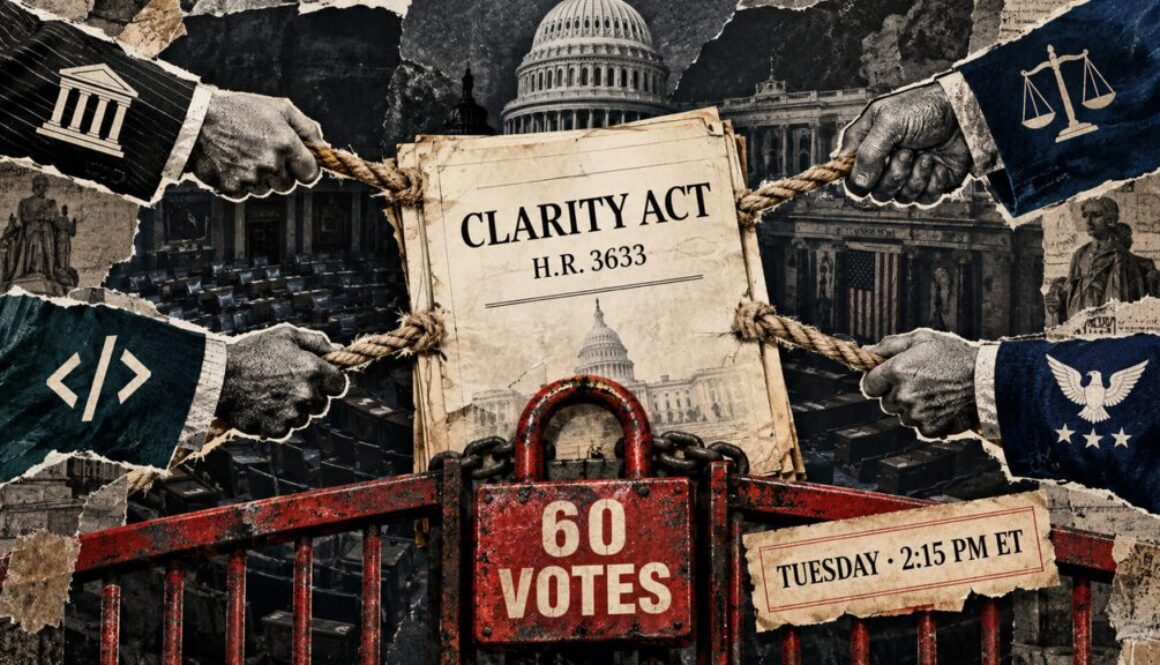
The combined bill must clear the full Senate at 60 votes, requiring meaningful Democratic crossover support
The House must approve the final version
President Trump must sign it — White House target is July 4, 2026
White House adviser Patrick Witt said at Consensus Miami last week that July 4th is an achievable signing date. That timeline is aggressive. If the bill does not clear before August recess, Senator Lummis has warned the next realistic window is 2030.
04 — What It Means for Bitcoin
Bitcoin moved from $79,500 to $82,000 during the hearing. The 3.5% gain triggered a short squeeze — $145 million in short liquidations, $236 million in total liquidations across the market. Polymarket odds on BTC hitting $85,000 in May climbed 5 points to 56%.
Technically, $82,000 is where Bitcoin needs to close to confirm the next leg up. It sits right at the 200-day moving average. Analysts note that a confirmed close above that level opens $92,000-$98,000. A failure to hold $78,500 brings $76,500 back into play.
The structural picture has not changed. The institutional floor is intact. ETF inflows remain positive. The CLARITY Act is now the macro catalyst driving price. But the bill is not law yet, and the market knows it.
First support level. Must hold or $76,500 comes back into view
69%
Polymarket odds the CLARITY Act becomes law in 2026
60
Senate votes needed — requires Democrat crossover support
July 4
White House target signing date — aggressive but achievable per Patrick Witt
2030
Next window if August recess is missed, per Senator Lummis
05 — The Bigger Picture
The CLARITY Act passing committee is not the finish line. But it is the clearest signal yet that the US is moving from enforcement-driven crypto regulation toward a defined legal framework. That shift matters more than any single price move.
For builders, it means the years of operating in legal grey zones may be coming to an end. For institutions, it means the compliance infrastructure they have been waiting for is finally taking shape. For retail investors, it means the rules of the game are becoming clearer.
Coinbase CEO Brian Armstrong called the bill “strong” and said it “will benefit the American people by making the US financial system faster, cheaper and more accessible.” The Blockchain Association called today “a defining moment.”
Whether July 4th becomes the day the CLARITY Act is signed or just another deadline missed, today was real progress. In Washington, that is not nothing.
Sources
CoinDesk — CLARITY Act committee vote coverage, May 14, 2026
CryptoTimes — Bitcoin $82K rally report, May 14, 2026
Bitcoin.com — Short squeeze and liquidation data, May 14, 2026
Grayscale — CLARITY Act framework analysis
Polymarket — Probability data, May 14, 2026
This article is for informational and educational purposes only and does not constitute financial, investment, legal, or other professional advice. Investments in cryptocurrencies involve significant risk including loss of capital. Always conduct your own research and consult a qualified financial advisor before making investment decisions.
The Senate Banking Committee’s CLARITY Act is heading into Thursday’s markup, buried under opposition.
According to reports, Senator Elizabeth Warren alone filed more than 40 amendments before Tuesday’s 5 p.m. ET deadline, and American Bankers Association members sent over 8,000 letters to Senate offices in less than a week demanding changes to the bill’s stablecoin yield rules.
Over 100 Amendments Filed
The total number of proposed amendments going into Thursday is still being confirmed, but according to a list obtained by Politico, there have been more than 100 proposed. To put things in perspective, a total of 137 revisions were proposed before the markup scheduled for January, which was canceled.
Warren’s batch alone covers a wide range of restrictions. One amendment that stood out would bar the Federal Reserve from issuing master accounts to crypto companies, which would effectively cut such firms off from the core infrastructure of the US banking system.
The lawmaker also attacked the updated bill on X, arguing that it lacked ethics provisions tied to President Donald Trump’s crypto businesses.
“No bill should move through the Banking Committee without real ethics guardrails,” she wrote.
That dispute has become harder for negotiators to avoid. Late last month, analyst Simon Dedic claimed that Trump’s meme coin and his crypto-related dinners were part of the reason the CLARITY Act was going nowhere, with Democrats demanding conflict-of-interest language before backing the legislation.
Another revision, filed by Senator Jack Reed of Rhode Island, would prohibit crypto from being used as legal tender, including for paying taxes. That proposal runs directly counter to a bill Representative Warren Davidson introduced last year that would have allowed Bitcoin to be used for precisely that purpose.
Senators Reed and Tina Smith of Minnesota also filed a joint amendment that would incorporate bank-requested changes to the stablecoin yield language.
According to journalist Brendan Pedersen, the proposal will force senators to choose between crypto and the banks on a single vote, making it an uncomfortable moment for Republicans who tend to side with both.
Bankers Blitz Senators With 8,000 Letters
Elsewhere, members of the American Bankers Association have reportedly sent more than 8,000 letters to Senate offices since last Friday, pushing lawmakers to change the bill’s stablecoin yield compromise.
However, Stand With Crypto, the crypto advocacy group, responded with its own numbers on Tuesday, saying its advocates had called Congress 8,000 times and sent 300,000 emails over recent months to protect stablecoin rewards, and have contacted lawmakers nearly 1.5 million times in support of the CLARITY Act overall.
Those on the side of digital assets are framing the banking industry’s lobbying campaign as an attempt to block competition from yield-bearing stablecoins.
Senator Bernie Moreno accused banks of trying to “kill stablecoins that would let everyday Americans earn real yields on their own money.” He also described the banking industry as a “cartel” protecting low-interest deposit models.
But not everyone inside Washington thinks this fight ends at Thursday’s committee vote. According to reporter Sander Lutz, banking policy leaders are already preparing for another push on the Senate floor if they lose the markup battle over yield restrictions.
Meanwhile, crypto journalist Eleanor Terrett reported that Senate Minority Leader Chuck Schumer privately encouraged Democrats to work toward supporting the bill.
As the Senate Banking Committee prepares to mark up the long-anticipated CLARITY Act on Thursday, Coinbase CEO Brian Armstrong has argued that the newest version of the bill represents a workable “compromise” and could meaningfully improve the US financial system.
Speaking to FOX Business, Armstrong said the updated draft reflects concessions on both sides—what he described as the crypto industry meeting requests from bank lobbyists and lawmakers, while the banking sector also gave ground during negotiations.
Coinbase CEO’s CLARITY Act Pitch
Armstrong also highlighted one specific element tied to stablecoin rewards. He said the approach in the latest bill would only apply when there is “some sort of material activity on the account,” adding that he believes the overall package would make the system “more efficient.”
The claim is that the legislation would help streamline financial services, reduce friction, and make access easier for consumers and businesses—while still keeping the framework aligned with banking-sector concerns that were raised during talks.
Still, critics point to the banking industry’s pushback as evidence that the dispute is far from settled. As reported throughout the week by Bitcoinist, banking trade groups have opposed the CLARITY Act’s stablecoin-rewards provision, arguing that it could give crypto firms too much flexibility.
Their position is that the policy might also encourage deposits to shift away from traditional, insured banking channels rather than strengthening them.
Beyond the details of stablecoin rules, Coinbase CEO argued that the broader direction of the CLARITY Act reflects growing institutional interest in digital assets.
In his view, banks are increasingly integrating stablecoins and crypto-related services because customer demand is rising—an angle that suggests the bill, if passed in its current form, could provide the clearer structure institutions want before expanding further.
Can The Latest Crypto Bill Draft Survive?
Supporters of the bill are not limited to Coinbase. Ripple CEO Brad Garlinghouse also backed the current push, commenting on social media site X (previously Twitter) that the Senate Banking Committee is “putting in the work” to move the CLARITY Act forward.
Garlinghouse’s message emphasized that Ripple supports the bill because crypto businesses and major participants should have the “same rules and protections as every other asset class,” and because—if the US is serious about leading in crypto—this is the moment to finalize legislation and get it done.
Even with that backing, the legislative road ahead is not smooth. Politico reported that Senator Elizabeth Warren, a well-known crypto skeptic, is vowing to pursue extensive changes to the bill through amendments.
The reporting says Warren and others are preparing more than 100 amendments ahead of the markup, following the release of an updated 309-page draft that expands on an earlier 278-page version introduced in January.
According to the same reporting, Warren submitted more than 40 amendments on her own, with much of the rest attributed to Democratic members of the Banking Committee.
This mirrors earlier moves around the bill: the January markup session drew 137 amendments, and it was eventually cancelled after a period of resistance that included Armstrong and Coinbase withdrawing support for the bill at the time.
For now, the core question going into Thursday’s markup is whether the latest CLARITY Act draft can hold together.
Featured image created with OpenArt, chart from TradingView.com
A senior White House official has accused major banking trade leaders of refusing to join earlier talks on stablecoin rewards, escalating a dispute that has become one of the final pressure points ahead of the Senate Banking Committee taking up the CLARITY Act this week.
In a May 11 post on the social media platform X, Patrick Witt, executive director of the White House Presidential Advisory Committee on Digital Assets, said he had asked American Bankers Association President Rob Nichols and other bank trade CEOs to attend the February meetings aimed at resolving the question of stablecoin rewards and yield.
“I specifically requested the attendance of Mr. Nichols and other bank trade CEOs at the meetings we hosted back in February to resolve the stablecoin rewards/yield issue. They refused. I guess the White House was beneath them?”
The criticism injected the White House more directly into a fight that has divided banks, crypto companies, and lawmakers ahead of a scheduled May 14 markup of the CLARITY Act.
The bill is designed to create a broader market structure framework for digital assets, but the treatment of stablecoin rewards has become a flashpoint over competition for deposits, consumer yield, and the future shape of dollar-based payments.
Witt’s comments also reframed the timing of the banking industry’s objections. Rather than a new technical concern emerging before a committee vote, the White House official cast the dispute as an unresolved issue that banking leaders had an opportunity to address months earlier.
Banks reopen stablecoin rewards fight before markup
Over the weekend, the American Bankers Association (ABA) urged bank executives and employees to press senators for tighter restrictions in the CLARITY Act before the committee vote, warning that the current bill could still allow crypto firms to offer reward structures that resemble interest on deposit-like products.
Nichols told bankers that lawmakers needed to hear from the industry before the legislation advanced.
The ABA’s concern is that stablecoin issuers, exchanges, or related companies could attract customer funds by offering returns on assets that compete directly with traditional bank deposits.
Banks rely on deposits as a funding base for loans to households, small businesses, farms, and corporations. If customers move cash into stablecoins that offer rewards, banks argue that lenders could face higher funding costs, tighter margins, and less capacity to extend credit.
The banking industry has described the current compromise language as leaving a loophole.
In its view, a ban on stablecoin issuers paying yield would be insufficient if affiliated exchanges, brokers, or other crypto platforms could deliver similar economic benefits through rewards, rebates, or incentive programs.
That position has put banks at odds with crypto companies that see the rewards language as a basic competition issue.
Stablecoin reserves are typically held in cash, short-term Treasuries, or other liquid instruments that generate income. The policy fight centers on whether consumers should be able to receive part of that return, and which type of institution should be allowed to offer it.
The recent Senate compromise has attempted to separate passive yield from activity-based rewards.
That distinction was meant to prevent stablecoins from becoming direct substitutes for interest-bearing deposits while preserving room for crypto platforms to reward users for participation, payments, or other services.
White House analysis undercuts the lending warning
The Council of Economic Advisers said in an April report that banning stablecoin yield would provide only a marginal lift to bank lending under its baseline assumptions. The CEA estimated that such a ban would increase bank lending by about $2.1 billion, equal to roughly 0.02% of total lending in the base case.
That finding gives the administration a counterweight to the banking sector’s claim that stablecoin rewards could meaningfully damage credit creation.
The report argued that most stablecoin reserves would not be permanently removed from the banking system. Instead, reserves held in cash, bank deposits, or Treasury instruments would continue to circulate through financial markets in different forms.
The CEA also said a more severe impact would require a much larger stablecoin market and more restrictive assumptions about how reserves are held. In the administration’s framing, stablecoin rewards may affect bank margins, but the baseline effect on lending capacity appears limited.
Moreover, a separate analysis by Galaxy Research furthered the argument by focusing on the international flow of dollars.
Galaxy said banks were overstating the risk that stablecoin growth would simply drain domestic deposits. Its model projected that much of the growth under a regulated stablecoin framework would come from offshore users seeking easier access to dollar-denominated assets.
That finding changes the economic lens. If stablecoins mostly draw funds from US bank accounts, banks face a direct deposit migration problem.
However, if much of the growth comes from foreign users moving into dollar stablecoins, the effect could be an inflow into US financial infrastructure rather than a one-way drain from domestic lenders.
Galaxy estimated that 60% to 70% of stablecoin growth under the GENIUS Act framework could originate offshore. It also projected that imported deposits from foreign demand could exceed domestic deposit migration by roughly 2:1.
The firm said each newly minted stablecoin dollar could generate about 32 cents of net US credit, with total credit expansion reaching about $400 billion through 2030 in its base case and as much as $1.2 trillion in a stronger growth scenario.
GENIUS Act Impact on Stablecoin (Source: Galaxy Digital)
It also projected that stablecoin reserve demand could compress Treasury bill yields by 3 to 5 basis points, potentially lowering federal borrowing costs.
Meanwhile, Galaxy did not dismiss the pressure on banks. The report said some low-cost deposits would likely migrate, funding costs could rise at the margin, and net interest margins could compress in business lines sensitive to rate competition.
Still, the firm concluded that stablecoins could pressure banks that rely on cheap deposits, increase demand for US Treasury bills, import offshore dollar capital, and expand the reach of the US financial system.
Crypto allies accuse banks of protecting margins
Crypto advocacy groups have seized on the ABA’s push as evidence that banks are trying to block competition days before the committee vote on the CLARITY Act.
Coinbase-backed Stand With Crypto urged supporters to contact senators, saying banking lobbyists were trying to weaken stablecoin rewards language before the markup.
The group framed the dispute as a consumer-rights issue, arguing that users should be able to earn returns on their own digital assets rather than have that value captured by intermediaries.
Cody Carbone, CEO of The Digital Chamber, said banks had months to negotiate over the issue and were now trying to force changes late in the process. He described the ABA campaign as an attempt to shield incumbents from competition after earlier opportunities to engage had passed.
Sen. Bernie Moreno, an Ohio Republican on the Banking Committee and a supporter of crypto legislation, used sharper language about the bank’s opposition to CLARITY Act.
He accused the “banking cartel” of trying to preserve a system in which banks pay depositors little while earning profits from lending and securities portfolios.
Moreno wrote on X:
“During the Biden era, these same banks worked hand-in-glove with Sen. Warren and her allies to debank Americans, including President Trump’s own family. They shut down accounts of conservatives, patriots, and anyone who dared challenge the regime, all while regulators applied pressure under schemes like Operation Choke Point 2.0. It wasn’t about risk. It was about political control. Now that innovative stablecoins threaten to break their monopoly and give you actual financial freedom? They’re running to Congress again, screaming about ‘threats to economic growth and financial stability.’”
Moreno’s statement showed how the stablecoin rewards dispute has moved beyond technical drafting.
The fight now carries a broader political message about financial competition, consumer returns, and resentment toward large banking institutions.
That rhetoric could help crypto advocates rally support, especially among Republicans who view stablecoins as part of a broader agenda around financial innovation and dollar competitiveness.
However, it also risks hardening opposition from lawmakers who are already concerned that crypto firms are seeking bank-like privileges without equivalent oversight.
Markup will test whether the stablecoin compromise can hold
If the committee advances the CLARITY Act with the current language largely intact, crypto firms will claim momentum, and banks will likely shift their campaign to the full Senate.
If lawmakers tighten the rewards provisions, the banking industry will have succeeded in reopening one of the most contested parts of the bill at the final stage before markup.
Meanwhile, the vote will also test the broader coalition behind the CLARITY Act. Republicans have pushed digital-asset legislation as a priority, while some Democrats have remained open to a market-structure bill if it includes stronger consumer protections, ethics, and anti-money-laundering provisions.
The stablecoin fight complicates that effort because it cuts across several policy lines at once. It raises questions about bank funding, consumer yield, Treasury demand, offshore dollar usage, and the role of crypto firms in payments.
That gives senators several reasons to demand changes, but also makes the issue difficult to settle cleanly.
Senator Bernie Moreno on Monday accused the U.S. banking lobby of full panic mode over CLARITY Act stablecoin yields. The American Bankers Association is urging bank CEOs to pressure senators against the provisions.
The Ohio Republican sits on the Senate Banking Committee. He published the criticism on X ahead of Thursday’s CLARITY Act markup.
ABA Letter Targets CLARITY Act Stablecoin Yield Language
ABA CEO Rob Nichols sent a Sunday letter to every bank CEO in the country. He called for “immediate engagement” on stablecoin yield policy.
Nichols warned that the current proposal would prompt deposit flight into payment stablecoins, citing risks to growth and stability. His note described what banks call a stablecoin loophole in the committee’s draft.
“we believe committee members may not be fully aware of the risks to the economy by the stablecoin loophole,” read an excerpt in the letter, citing Nicholas.
Moreno rejected that framing, saying the question was already litigated during the GENIUS Act debate led by Senator Bill Hagerty.
🚨 The banking cartel is in full panic mode. 🚨
While Americans were celebrating Mother’s Day with their families, the CEO of the American Bankers Association sent a frantic alert to every bank CEO in the country, demanding “immediate engagement” to lobby Senators and kill… pic.twitter.com/Phd6HsdBXR
The Senate Banking Committee marks up the CLARITY Act on Thursday, May 14, at 10:30 a.m. ET. Polymarket bettors now give the bill a 73% chance of becoming law this year.
Senators Thom Tillis and Angela Alsobrooks brokered the disputed compromise text. It bars yield “economically or functionally equivalent” to deposit interest. The provision still permits rewards from bona fide platform activity.
“I specifically requested the attendance of Mr. Nichols and other bank trade CEOs at the meetings we hosted back in February to resolve the stablecoin rewards/yield issue. They refused. I guess the White House was beneath them? In their defense, I wouldn’t want to have to defend their position in public either,” he said.
A successful markup would advance the bill toward a full Senate floor vote. A stall could sideline U.S. crypto legislation for the rest of the session.
Washington is turning stablecoins into regulated payment instruments while trying to keep issuer-paid yield away from holders. That combination changesthe economics of digital dollars and puts the value of user balances up for grabs across the intermediary stack.
The GENIUS Act bars permitted payment stablecoin issuers and foreign payment stablecoin issuers from paying holders any form of interest or yield solely for holding, using, or retaining a payment stablecoin.
The FDIC’s April 7 proposal would turn parts of that law into operating standards for FDIC-supervised issuers, including reserves, redemption, capital, risk management, custody, pass-through insurance, and tokenized-deposit treatment.
That leaves a practical question for a market that reached roughly $320 billion in stablecoin supply in mid-April. If holders cannot receive direct issuer-paid yield, the value created by tokenized dollars still has to land somewhere.
The redistribution runs through the operating stack. The fight shifts to issuers, exchanges, wallets, custodians, banks, asset managers, card networks, and tokenized-deposit providers. They are the parties positioned to collect reserve income, distribution payments, custody fees, payment fees, settlement benefits, loyalty economics, or deposit economics.
The rulebook pushes yield into the plumbing
The stablecoin framework begins with reserves. GENIUS requires permitted issuers to maintain identifiable reserves backing outstanding payment stablecoins at least 1:1, with reserve categories that include cash, bank deposits, short-term Treasuries, certain repo arrangements, government money market funds, and limited tokenized reserve forms.
It also requires reserve disclosures and redemption policies, restricts reserve reuse, and calls for capital, liquidity, risk management, AML, and sanctions controls.
That makes compliant payment stablecoins look more like regulated cash-management products than free-form crypto instruments. Issuers can hold large pools of income-producing assets. At the same time, the statute blocks those issuers from paying stablecoin holders direct interest or yield merely for holding or using the token.
The economic trade-off looked uneven in the White House’s April 8 yield-prohibition note, which estimated a baseline $2.1 billion increase in bank lending from eliminating stablecoin yield, equal to a 0.02% lending effect, alongside an $800 million net welfare cost.
The same note said affiliate or third-party arrangements could remain unless CLARITY variants close that channel.
That caveat is where the post-CLARITY money map starts. A direct issuer-yield ban controls the issuer-holder relationship. It leaves open the harder economic question of how platforms, partners, payment apps, and bank structures treat the same value once it moves through distribution or product design.
CryptoSlate has already explored how the CLARITY fight is tied to stablecoin yield, regulatory control, market structure, and banking-sector pressure.
The commercial layer asks whether the law captures only the obvious form of yield, or also the ways a platform can turn stablecoin economics into something that feels like rewards, pricing power, or bundled financial service access.
The split runs through two layers. One side of the stack is statutory and prudential: reserve assets, redemption rights, capital standards, and supervision. The other side is commercial: distribution, wallet placement, exchange balances, merchant pricing, and settlement liquidity.
The policy debate becomes sharper when those layers are separated, because a ban at the issuer level can still leave value moving through the rest of the stack.
Issuers and exchanges already show the money trail
One clear example is USDC. Circle’s public filings describe a business built around reserve income, distribution costs, and partner economics. Its 2025 Form 10-K says Coinbase supports USDC usage across key products and that Circle makes payments to Coinbase tied principally to net reserve income from USDC.
The mechanics are more explicit in Circle’s S-1/A. The payment base is generated from reserves backing the stablecoin after management fees and other expenses.
Circle keeps an issuer portion, Circle and Coinbase receive allocations tied to stablecoins held in their own custodial products or managed wallets, and Coinbase receives 50% of the remaining payment base after approved participant payments.
That structure is the money map in miniature. A holder may see a stable dollar token. In the reserve and distribution structure, the reserve yield can move through issuer retention, platform-balance economics, ecosystem incentives, distribution agreements, and payments to approved participants.
Coinbase’s own filing shows why that channel is economically meaningful. Its 2025 Form 10-K reported stablecoin revenue as a business line and said a hypothetical 150 basis-point move in average rates applied to daily USDC reserve balances held by Circle would have affected stablecoin revenue by $540 million for 2025.
The point is specific: a large platform with distribution, balances, liquidity, and a deep issuer relationship can capture economics that the statute keeps away from holders in direct form.
Asset managers and custodial infrastructure sit on the same map. BlackRock’s Circle Reserve Fund showed a 3.60% seven-day SEC yield as of April 27, while Circle’s filing describes BlackRock as a preferred reserve-management partner and discusses the reserve-management relationship.
Stablecoin economics can accrue to the reserve stack, the manager, the custodian, the issuer, and the distributor before a user ever sees a token in a wallet.
Intermediary
Economic lane
User-facing form
Policy constraint
Issuer
Reserve income and issuance scale
Stable dollar token and redemption promise
Issuer-paid holder yield is barred under GENIUS
Exchange or wallet
Distribution payments, platform balances, loyalty incentives
Rewards, fee offsets, product access, liquidity
Third-party reward treatment remains the live CLARITY fork
Custodian or asset manager
Reserve management, custody, safekeeping
Operational trust and reserve transparency
FDIC and issuer rules shape permitted reserve and custody practices
Payment integration raises intermediation and resiliency questions
Bank or tokenized-deposit provider
Deposit economics and insured-bank balance-sheet activity
Deposit-like digital dollars with bank treatment
FDIC says qualifying tokenized deposits would be treated as deposits
Wallets and payment rails turn yield into product economics
The Fed’s April 8 FEDS Note gives the policy version of that table. It identifies complex intermediation chains, vertical integration, and accelerating retail adoption through wallet partnerships as structural stablecoin vulnerabilities.
It also points to integration with payment networks, banks, retail applications, broker-dealer funding, and card networks.
The Fed is studying a market where the issuer is only one node. Wallet providers, infrastructure firms, payment processors, brokers, banks, and card networks can all sit between the reserve asset and the user experience.
The company described instant crypto-to-stablecoin or fiat conversion, a 0.99% merchant transaction rate through July 31, 2026, support for more than 100 cryptocurrencies and wallets, and PYUSD rewards for funds held on PayPal at the time of the announcement.
That is a different economic shape from direct issuer yield. The holder sees payment access, merchant savings, wallet connectivity, or rewards attached to a platform. The platform can monetize conversion, distribution, customer balances, merchant pricing, and product stickiness.
Visa’s December 2025 USDC settlement launch shows the card-network version of the same intermediary lane. Visa said U.S. issuer and acquirer partners could settle VisaNet obligations in USDC, with Cross River and Lead Bank among initial banking participants.
It described more than $3.5 billion in annualized stablecoin settlement volume as of Nov. 30, 2025, and framed the product around seven-day settlement, liquidity timing, treasury automation, and operational resiliency.
Those benefits accrue through payment networks, issuing banks, acquiring banks, fintech partners, and corporate treasury operations. The user-facing return is payment access, faster settlement, or better pricing rather than issuer-paid yield.
That distinction is central to the policy fight. A yield ban can reduce the visible consumer return on a token while allowing platforms to compete through pricing, access, loyalty, and settlement benefits. The economics remain, but the claim on them becomes mediated by the platform relationship.
Banks gain leverage if the third-party channel closes
The banking lobby understands that channel. The Bank Policy Institute argued in August 2025 that GENIUS’s issuer-yield prohibition could be undermined if exchanges, affiliates, or distribution partners are still able to pay interest indirectly on stablecoins.
BPI framed that as a loophole that could increase deposit-flight risk and weaken credit creation.
Crypto trade groups answered from the other side. Their August 2025 response argued that third-party rewards are competitive consumer benefits rather than evasion of the statute.
The dispute determines whether the post-GENIUS stablecoin market becomes a platform-rewards market or a bank-protected payments market.
The FDIC proposal adds the second bank lane. It says tokenized deposits that satisfy the statutory definition of deposit would be treated no differently from other deposits under the Federal Deposit Insurance Act.
That gives banks a cleaner argument if stablecoin rewards face stricter limits: deposit tokens can keep the economics inside the banking perimeter, where interest, insurance, and lending relationships already have a legal home.
CLARITY’s market-structure section-by-section summary points to another intermediary layer. Digital commodity exchanges, brokers, and dealers would face registration, listing, custody, segregation, disclosure, and customer-election requirements.
Customers could elect into blockchain services such as staking under conditions, while access to the exchange could not be conditioned on that election.
Those provisions reinforce the same intermediary shift by moving economic activity into supervised channels. The contested issue is who owns distribution, customer balances, wallet access, custody, settlement, and optional services.
As of press time, USDT was around $189.71 billion in market capitalization and USDC around $77.63 billion.
CryptoSlate rankings also showed USDe around $3.79 billion, PYUSD around $3.42 billion, and RLUSD around $1.6 billion. That scale means the issuer-yield rule lands first on the largest payment-stablecoin rails.
The next test is the definition of indirect yield. If lawmakers and regulators allow third-party rewards, the advantage sits with platforms that own users, balances, payments, and distribution. If they limit those arrangements, banks and tokenized-deposit providers get a stronger path to keep digital-dollar returns inside deposit products.
The emerging U.S. framework decides whether stablecoin holders can receive yield and how much of the economics of digital dollars becomes visible to users. The rest is absorbed by the intermediaries that move, custody, package, and settle those dollars.