
Tether invests in financial platform LemFi to increase stablecoin remittance in emerging markets
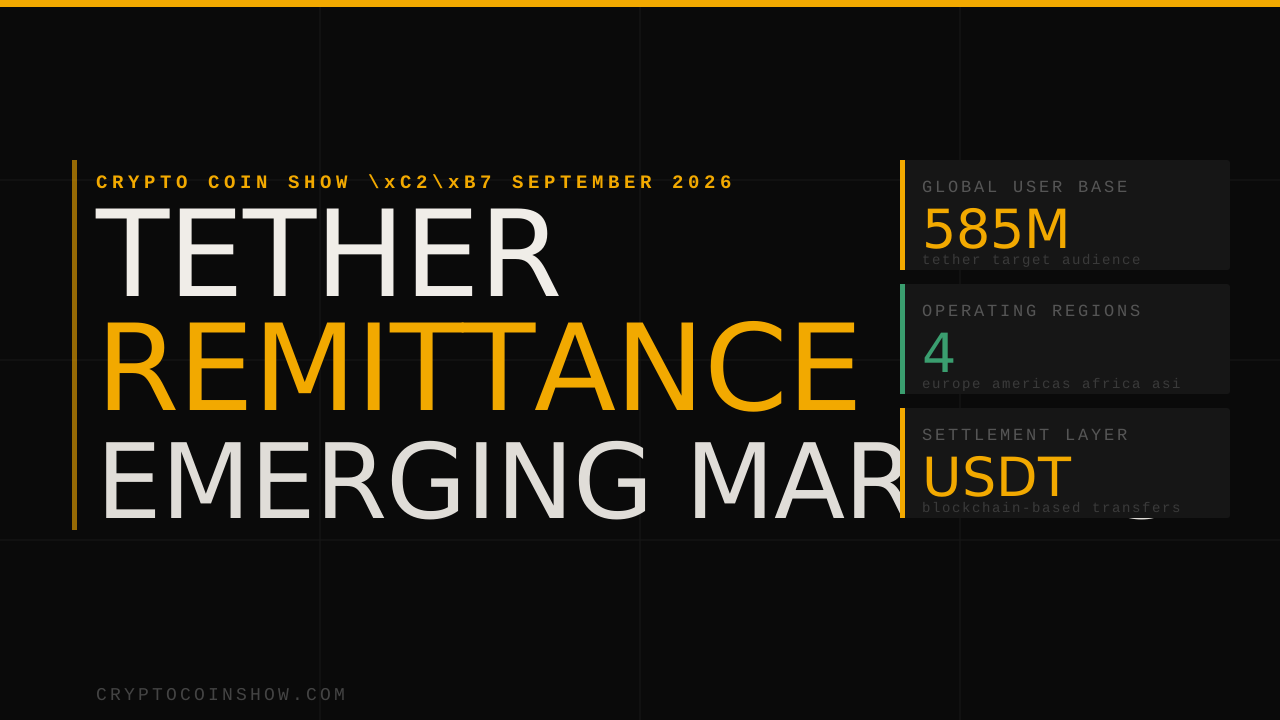
Tether has invested in LemFi, a fintech platform operating across Europe, the Americas, Africa, and Asia, embedding USDT as the settlement layer for cross-border remittances and replacing traditional bank-to-bank transfers. The move signals institutional stablecoin adoption beyond trading desks and into regulated remittance infrastructure serving emerging markets.
- Tether CEO Paolo Ardoino stated the investment targets the company’s 585 million estimated global users, with focus on regions dependent on cross-border remittances and daily transfers.
- LemFi will replace slower bank transfer chains with USDT-based blockchain settlement across its operating regions in Europe, the Americas, Africa, and Asia.
- Neither Tether nor LemFi disclosed investment size, but Tether reported $1.04 billion Q1 2026 profit and $8.23 billion in excess reserves fueling expansion.
- 585M estimated Tether users globally that the partnership targets for financial inclusion
- $1.04B Tether Q1 2026 profit demonstrating capital available for strategic investments
- $8.23B excess reserves held by Tether backing USDT liquidity pool and expansion
Tether announced on Monday that it has invested in LemFi, a fintech platform specializing in remittances between Europe, the Americas, Africa, and Asia, to integrate USDT directly into cross-border payment flows. The partnership embeds Tether’s stablecoin as the settlement mechanism across LemFi’s operating regions, replacing traditional bank correspondent networks with blockchain-based transfers.
The investment represents a direct institutional bet on stablecoin utility in regulated remittance corridors rather than speculative trading or arbitrage venues, a use case that has long remained theoretical despite stablecoin issuers’ repeated claims about real-world payments adoption.
Neither company disclosed the investment size.
Tether Deploys Capital to Position USDT as Remittance Infrastructure Rather Than Trading Token
Tether’s financial position underpins this move into distribution. The company reported $1.04 billion in profit for Q1 2026 and holds $8.23 billion in excess reserves, according to company disclosures, giving it substantial dry powder to acquire stakes in fintech platforms that can distribute USDT to non-crypto-native users.
For years, USDT has been primarily used as a liquidity bridge on centralized and decentralized exchanges, allowing traders to move value between markets without converting to fiat currency. This partnership signals a strategic pivot toward embedding the stablecoin into everyday payment infrastructure.
Our investment in LemFi reflects our shared vision on how money moves across borders, prioritizing speed, cost, and transparency. By supporting LemFi’s growth and innovation roadmap, we are helping bring the benefits of a stable digital asset to more people who rely on remittances in their daily lives.
Paolo Ardoino, CEO of Tether
Ardoino framed the investment as a direct response to Tether’s strategic goal of expanding financial access for its estimated 585 million users globally. The LemFi partnership targets users in emerging markets where remittance corridors consume significant portions of household income and where traditional banking infrastructure imposes speed and cost friction.
Blockchain-based settlement reduces the multi-day clearing periods inherent in correspondent banking, allowing recipients to access funds in hours rather than a week, while lowering the transaction fees that intermediary banks extract from remittance flows.
USDT Replaces Correspondent Banking Rails in Cross-Border Payments for First Time at Scale
The structural advantage of stablecoin-based remittances lies in direct asset transfer across blockchain networks rather than sequential bank-to-bank messaging and clearing.
Traditional remittance corridors require originating banks to maintain nostro accounts (deposits held in foreign banks) and pass instructions through the SWIFT network, with each intermediary extracting fees and imposing processing delays.
Blockchain settlement eliminates these correspondent relationships entirely: a sender holds USDT on Ethereum, Tron, or another chain, and the recipient receives USDT in their LemFi wallet within minutes, with settlement finality guaranteed by protocol rather than by clearing house processing windows.
LemFi CEO Ridwan Olalere called the deal “a validation of the direction we are heading,” adding that USDT integration “brings us closer to that reality” of a financial system agnostic to user geography or destination corridors.
For institutional investors, the partnership’s significance lies in demonstrating that stablecoin-based payment infrastructure can operate within regulated remittance frameworks rather than competing against them.
LemFi operates under financial licenses in the jurisdictions where it offers remittance services, meaning USDT integration must comply with existing anti-money-laundering, know-your-customer, and sanctions screening protocols.
This is not a libertarian bypass of banking rails but rather a technical replacement of outdated settlement infrastructure while preserving regulatory guardrails, a critical distinction that institutions and central banks have long insisted upon before adopting stablecoins in operational payment systems.
Tether Extends Market Position While Stablecoin Utility Case Remains Unproven at Remittance Scale
The partnership expands Tether’s competitive moat at a moment when other stablecoin issuers, including Circle (USDC) and Ripple-backed competitors, are pursuing similar real-world payments adoption strategies. Tether’s size, as the largest stablecoin by market capitalization and daily settlement volume, gives it liquidity depth that smaller competitors cannot match.
When LemFi users convert local currency to USDT and back again, they rely on sufficient market depth to exchange large volumes without slippage. Tether’s existing liquidity on centralized exchanges and through its own treasury operations provides that depth more reliably than newer entrants can.
However, the remittance use case introduces complexities that trading volumes do not. Remittance corridors vary in size and direction: a corridor sending funds from the UK to Nigeria operates at a different scale than one moving money from the US to the Philippines, and flow directionality can shift seasonally.
LemFi must build local liquidity provision in each corridor it serves, either by partnering with regional exchanges, operating its own market-making function, or negotiating with Tether directly for reserved capacity.
The deal’s terms on liquidity provision and pricing mechanics remain undisclosed, leaving open questions about how the partnership will manage capacity constraints or volatility during periods of high remittance demand.
The investment does not resolve the longer-term question of whether stablecoin-based remittance flows will materially displace traditional corridors or remain a niche service for crypto-native senders and recipients.
Regulatory Clarity and Corridor Scaling Will Determine Whether Partnership Generates Sustainable Returns
Institutional investors should monitor three forward-looking variables: remittance volume flowing through the LemFi-USDT pipeline, regulatory responses in key corridors (particularly from African and Asian financial authorities), and whether the cost and speed advantages translate into market share gains against incumbent players like Western Union, MoneyGram, and bank-based corridors.
Tether’s capital position allows it to sustain investments that take years to scale, but institutional LPs expect concrete metrics on user acquisition, transaction volume, and unit economics within 18 to 24 months.
Olalere stated that USDT integration is intended to extend into “other payment and financial service offerings” beyond remittances, suggesting LemFi sees stablecoins as foundational to a broader platform strategy. This mirrors moves by other fintech firms to position themselves as stablecoin-native financial services providers rather than cryptocurrency platforms.
The success of this model depends on whether regulators in emerging markets accept stablecoin-based savings, lending, and payments services as substitutes for traditional banking products, a regulatory outcome that remains unsettled in most jurisdictions outside El Salvador.
The next meaningful indicator will be LemFi’s disclosure of remittance volumes and user counts flowing through USDT corridors within six months, along with any regulatory actions from African or Asian financial