
Solana co-founder Anatoly Yakovenko publicly rejected Senator Bernie Sanders’ AI jobs warning. The senator argues artificial intelligence (AI) and robotics could wipe out millions of American jobs.
Sanders paired the warning with a renewed call to ban super PACs. Yakovenko answered with a string of posts defending markets, profit, and decentralized finance (DeFi).
Sanders’ AI Jobs Warning Meets a Free Market Rebuttal
The Vermont senator said Congress has abandoned workers threatened by automation because of industry money.
Is Congress doing anything to help the millions of workers who could lose their jobs to AI and robotics? No.
They’re intimidated by the hundreds of millions the AI industry is pouring into super PACs.
The spending claim tracks with disclosures. Leading the Future, an AI super PAC network backed by OpenAI president Greg Brockman and Andreessen Horowitz, raised $125 million in late 2025.
The group has pledged at least $100 million for the midterms.
“Senders [Sanders] is focusing on hypothetical sci fi problems because he is completely f’ing useless at solving any real problems,” the Solana co-founder posted in the thread.
Capital, Trillionaires, and the DeFi Defense
Yakovenko widened the argument across more than a dozen replies. Billionaires hold capital rather than hoarded wealth, he argued, and surplus production is what raises living standards.
He also claimed 500 more trillionaires would roughly double the global standard of living, all else equal. Reportedly, his family left the USSR with $50 per person, he shared, casting central planning rather than AI as the real threat to workers.
The thread looped back to crypto. Any profitable market will be rebuilt endlessly as a smart contract, he wrote, months after he gave away code for a perpetuals exchange.
There is no last train. Anything that is generating a profit that can be built as a smart contract will be built, over and over. That’s the whole point of DeFi. Reduce the cost of finance to the cost of software.
Solana (SOL) traded at $65.36 at press time, up nearly 6% in 24 hours. The coming primaries will test whose framing carries more weight with lawmakers.
There’s a scene in the new film Obsession (2026) that’s been living rent-free in a lot of heads since its release. A character gets a fragile little novelty toy, the “One Wish Willow”, and wishes for a billion dollars. (Spoiler alert) and cash literally rains from the ceiling. It’s absurd, it’s funny, and for about three seconds, everyone watching thinks: what would I wish for?
Here’s a better question: what if you didn’t need a wish at all?
The crypto market has always attracted dreamers. That’s not a criticism; it’s how generational wealth gets built. But there’s a difference between dreaming and deciding. Between waiting for the moment to feel right and recognizing that the moment is already here, already moving, already filling up.
Solana Unchained ($UCHN) is in Phase 1 of its presale. The price is $0.05. The listing target is $0.50. That’s a 10x multiple, not a projection, not a promise, a number locked into the structure of the raise before a single token hits an exchange. Phase 1 is already over 30% sold, and the window closes June 6, 2026.
Phase 2 Opens At $0.07. Math Doesn’t Get Easier From Here
$UCHN is a utility-driven token built on Solana, one of the fastest, most battle-tested blockchains in the world. The kind of infrastructure that doesn’t flinch when volume spikes. The kind of network that institutional money has started to take seriously. Solana Unchained is designed to operate inside that ecosystem with purpose, not as a meme, not as a gamble, but as a project built for what comes after the hype cycle settles.
The tokenomics are transparent. The roadmap is public. The presale is structured into 10 phases with incrementally rising prices, each phase rewarding those who moved earlier rather than those who wished they had.
And about that billion-dollar wish
(Spoiler alert) In Obsession, the wish works, but nobody’s in control of what happens next. A $1 billion market cap for Solana Unchained is a different kind of story. With a total supply of 100 million, a $1B market cap would put $UCHN at $10 per token. A long way from current numbers, but crypto has seen even more fascinating stories.
So, What Does Solana Unchained Do?
Solana Unchained isn’t chasing a trend; it’s building infrastructure.
At the core of the ecosystem is the AI Tool Hub, a token-gated platform giving $UCHN holders access to premium AI tools for trading insights, content automation, and DeFi workflows, live during 2026, and some will be live during presale and upon launch, not promised for someday.
Stack that with the Unchained Vault, which offers presale investors a tiered yield account paying 15% to 150% APR weekly, directly to users’ wallets in USDC or $UCHN, with zero lockup requirements. Then there’s the Unchained Wallet, a non-custodial, mobile-first wallet with built-in crypto commerce, social recovery, and on-chain inheritance, solving one of the most overlooked problems in the space: permanent loss of access.
Underneath all of it runs a Native Commerce Protocol that enables real crypto transactions without KYC or middlemen, on Solana’s fast, low-fee network. The supply is fixed to100 million tokens, and 60% is allocated to the presale. There’s no hidden inflation.
The Community Is Paying Attention, And So Are the Auditors.
Trust in crypto isn’t claimed; it’s verified. Solana Unchained has passed independent security audits by Solidproof, Spywolf, and Cyberscope, three of the most recognized names in blockchain contract verification. The team verified their identities to Spywolf, and it is on record. The audit reports are public. Some analysts have already produced coverage on the project, like Crypto League and Crypto Volt. Coverage has also landed across Fidelity, Business Insider, and Benzinga, putting Solana Unchained in front of audiences well beyond the typical crypto bubble. The foundation is audited, the community is growing, and Phase 1 closes June 6, 2026.
Disclaimer: The above article is sponsored content; it’s written by a third party. CryptoPotato doesn’t endorse or assume responsibility for the content, advertising, products, quality, accuracy, or other materials on this page. Nothing in it should be construed as financial advice. Readers are strongly advised to verify the information independently and carefully before engaging with any company or project mentioned and to do their own research. Investing in cryptocurrencies carries a risk of capital loss, and readers are also advised to consult a professional before making any decisions that may or may not be based on the above-sponsored content.
Readers are also advised to read CryptoPotato’s full disclaimer.
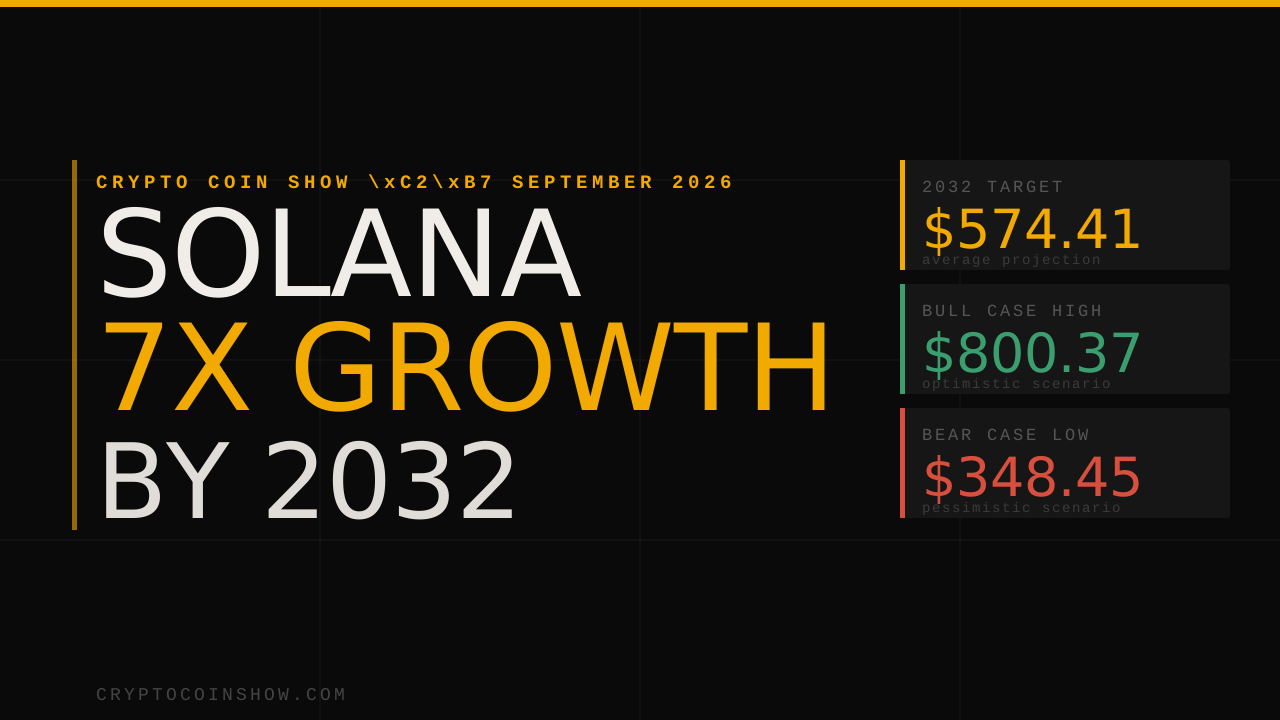
Solana’s price can reach a maximum of $197.30 with an average trading value of $127.03 in 2026.
By 2029, SOL is expected to reach a high of $381.45, supported by continued ecosystem growth and network adoption.
Solana’s price could see further upside by 2032, potentially reaching $734.95 with an average trading price around $527.46.
Despite occasional challenges for the Solana network ecosystem, including network congestion and competition from other blockchain platforms, the current sentiment shows that Solana demonstrates resilience and adaptability, despite the current price fluctuations, positioning itself as a leading player in the decentralized finance (DeFi) and Web3 landscape.
Overall, the prevailing sentiment regarding the current Solana price within the Solana community reflects the current sentiment of confidence and excitement among investors, driven by the growing interest in Solana with stakeholders eagerly anticipating the platform’s continued evolution and impact on the broader crypto ecosystem.
While uncertainties persist, Solana’s innovative approach, along with its low transaction fees and robust infrastructure instill optimism for its future price action, as indicated by the technical factors and technical analysis. In this article, we’ll explore Solana price prediction and market dominance, particularly when evaluated against momentum indicators. This brings the question “How high can SOL go in 2026 and beyond?” and we’ll try to answer that.
Overview
Cryptocurrency
Solana
Token
SOL
Price
$82.75(-0.26%)
Market Cap
$47.87 Billion
Trading Volume (24-hour)
$2.45 Billion
Circulating Supply
578.45 Million SOL
All-time High
$294.33 Jan 19, 2025
All-time Low
$0.5052, May 11, 2020
24-hour High
$83.05
24-hour Low
$81.56
Solana price prediction: Technical analysis
Market Sentiment
Bearish
50-Day SMA
$86.27
200-Day SMA
$106.01
Price Prediction
$81.43 (-1.59%%)
Fear & Greed Index
15.75 (Extreme Fear)
Green Days
17/30 (57%)
14-Day RSI
41.52 (Neutral)
Solana price analysis: SOL falls below $85
TL;DR Breakdown:
Solana price analysis shows bearish momentum as price crashes to $82
The altcoin lost 0.26% of its value in last 24-hours.
Support for SOL/USD is at $82
Today, on May 30, the Solana price analysis reveals bearish momentum as the price falls to $82
Solana price analysis 1-day chart: SOL rejected at $88
The daily price chart shows a slow decline to the $82 mark where SOL trades at press time.
The distance between the Bollinger Bands defines the intensity of volatility. This distance between high and low bands is wide, leading to increased volatility. Moving ahead, the upper limit of the Bollinger Bands indicator, acting as the resistance band, has shifted to $94.90. The indicator’s mean line, which shows a support level, has shifted to $78.49.
The Relative Strength Index (RSI) indicator is trading below the mean level of the neutral region. The indicator’s value has decreased to 41.73 in the last candle, and its curve suggests bearish market sentiment at the level. If selling activities continue to intensify, further volatility in the market can be expected.
SOL/USD 4-hour price chart
The four-hour price analysis of the Solana shows the price finds resistance above $86 and has observed strong bearish movement across the last 7 days as price crashed to $82. Since then, the price has made steady recovery to the current $82.96 mark.
The Bollinger Bands are wide and show convergence, hinting at a falling volatility level. This level of volatility signifies increased market unpredictability. Moving forward, the upper Bollinger Band has shifted to $84.00, securing the resistance point. Conversely, the lower Bollinger Band has moved to $80.44, indicating support.
The RSI indicator is in the overbought region. Currently at 50.81, the RSI’s position is showing bearish momentum. The level of the index suggests low room for movement in downwards direction across the short-term. The current slope suggests bearish pressure but we can expect a rise back to the $90 mark if the bearish pressure subsides.
The Solana price analysis suggests a bearish prediction based on ongoing market events for the day. The SOL/USD pair fell to the current $82 mark from the highs of $98. If the current bearish pressure sustains, we might see SOL price falling back to the $78 mark.
Is SOL a good investment?
Solana is a high-performance blockchain platform known for its robust scalability and speed due to various technological advancements, particularly in the crypto space boasting a substantial Total Value Locked (TVL). The network continues to hit key development milestones. Despite a challenging month, price predictions indicate a more positive outlook, suggesting the potential for Solana’s growth and future growth.
Why is SOL down?
Solana faced rejection at the $98 mark resulting in a steep drop. The bulls then recovered to $86 before crumbling to the current $82 mark.
What is Solana going to be worth in 2026?
The Solana (SOL) price prediction for 2026 suggests a minimum value of $83.93 with an average price of $115.48, driven by fundamental factors in the market. The price could reach a maximum of $179.36 during the year.
Will SOL reach $1,000?
The price forecasts indicate that SOL could reach the $1000 mark by mid 2030s, influenced by trends in the broader crypto market. Given the bullish scenario and the projected positive market sentiment and growth trend, SOL might reach $1,000 within the next five years.
Can Solana reach $5,000?
Reaching $5,000 is plausible but would likely take several years beyond the current forecast period. However, a snowball in the asset’s adoption might bring the moment sooner.
Does SOL have a good long-term future?
Yes, Solana has a good long-term future, with a promising market capitalization and exciting potential ROI due to its high scalability, which makes Solana an attractive investment. Its growing adoption, strong developer community, and strategic partnerships further enhance Solana’s forecast of its potential for sustained growth.
Recent news/updates on Solana
Solana recently announced that the Solana Foundation and Shinhan Card have signed an MOU to bring stablecoin payments to its 28 million cardholders.
BREAKING: South Korea’s #1 card issuer Shinhan Card is bringing stablecoin payments to its 28 million cardholders on Solana 🇰🇷🔥 pic.twitter.com/2hxlyHuKhi
The SOL price prediction 2026 for May suggests a range of outcomes based on current market trends, greed index, and analysis. The forecast anticipates SOL to fluctuate between a minimum of $82.17 and an average of $88.18, and potentially attain a maximum of $101.23.
Month
Minimum Price ($)
Average Price ($)
Maximum Price ($)
May
82.17
88.18
101.23
Solana Price Prediction 2026
Solana (SOL) is predicted to reach a minimum of $72.32 in 2026. Experts suggest that future price movements indicate the coin could climb to a maximum of $197.30, with an average price around $127.03.
Year
Min. Price ($)
Average Price ($)
Maximum Price ($)
2026
72.32
127.03
197.30
Solana (SOL) price prediction 2027-2032
Year
Min. Price ($)
Average Price ($)
Maximum Price ($)
2026
92.32
127.03
197.30
2027
119.13
142.51
232.44
2028
134.83
204.58
351.57
2029
177.29
279.37
381.45
2030
208.47
331.94
455.39
2031
209.62
369.75
529.90
2032
319.97
527.46
734.95
Solana Price Prediction 2027
In 2027, Solana’s price is forecasted to trade at a minimum of $119.13, reflecting the continued growth of the Solana blockchain. The coin may reach a maximum value of $232.44, with an average trading price of $142.51.
Solana Price Prediction 2028
If bullish momentum continues into 2028, SOL may record a minimum price of $134.83, a maximum of $351.57, and an expected average of $204.58.
Solana Price Prediction 2029
Analysis indicates that Solana could maintain its upward trajectory in 2029, with the price potentially hitting a minimum of $177.29, a maximum of $381.45, and an average of $279.37.
Solana Price Prediction 2030
Based on projections for 2030, Solana may trade at a minimum of $208.47, with an average price around $331.94 and a possible peak of $455.39.
Solana Price Prediction 2031
Solana’s price is expected to reach a minimum of $209.62 in 2031. Analysts forecast a maximum value of $529.90 and an average trading price of $369.75.
Solana Price Prediction 2032
In 2032, Solana is projected to trade at a minimum of $319.97, with an average price of $527.46, while the maximum price could reach $734.95 if favorable market conditions persist.
Solana Price Prediction 2026-2032
Solana market price prediction: Analysts’ SOL price forecast
FirmName
2026
2027
Changelly
$167
$248.
DigitalCoinPrice
$132.89
$162.57
Cryptopolitan’s Solana (SOL) price prediction
Our predictions show that SOL will achieve a high of $197.30 in 2026. In 2029, it will range between $177.29 and $381.45, with an average of $279.37. In 2032, it will range between $319.97 and $734.95, with an average of $527.46.
However, it is advised to do your own research and conduct expert opinion before investing in the volatile crypto market.
Solana (SOL) historic price sentiment
Solana Price History
Solana was launched in April 2020 and has gained popularity over the last 18 months. Its price surged from $0.75 to a high of $214.96 in early September.
Following NFT hype and growing demand in the DeFi community, the cryptocurrency Solana (SOL) price more than tripled during the summer of 2021. Solana (SOL) token became the fastest-growing cryptocurrency and is currently ranked fifth with a live market cap of nearly $66 billion.
2022 saw Solana leap to its all-time high of $260, but SOL failed to close the year anywhere near that high, as the price came crashing down to below $40 by June. The bearish markets were marked by high skepticism as trading volumes declined throughout the crypto markets.
The price continued to trade below the $40 level until November 2023, when Solana gained momentum and started a bullish rally again to close the year at $101.84.
In 2024, Solana (SOL) saw significant growth, with its price rising from $83.62 in January to a high of $202.87, fueled by its dominance in DeFi, NFTs, and decentralized exchanges. However, the price fluctuated through the year, retracing to $131 in September after struggling to maintain key levels.
October brought a positive rebound as SOL rose from $152 to close at $167, but early November started bearish, with the price dipping to $160.
However, Solana bounced back sharply and closed the month above the $230 mark. December, on the other hand, has observed a slow start as price volatility remains low.
Solana’s (SOL) price rose significantly in January 2025 from below the $190 level to close the month above $210. However, the latter half of the month saw the price decline from the $230 mark, a trend that continued through February ending the month below $150.
In March the price continued falling as the bears continued dominating the short to mid term markets ending the month below $125. In April the bearish rally has only continued as the price falls towards $100. However, the bulls bounced back in the middle of the month and ended the month around $150.
In May the price continued to rise and ended the month above the $165 price level, a trend that could not extend through June as the month saw a decline falling below the $150 price level to end the month.
July saw a sharp rise to the asset’s volatility with SOL crossing the $200 mark. However, the price could not be maintained and SOL ended the month below the $180 level. In August, on the other hand, SOL made strides and managed to close the month above the $205 mark.
In September, the volatility rose sharply as the price rose to the $250 price level but failed to maintain the level and ended the month at $230. In October, the decline increased sharply as SOL ended the month below $170. In November, and December the decline continued with SOL ending the year at the $125 mark.
In January, the trend continued with Solana crashing towards the $100 mark during the period. In February the decline continued as SOL declined below the $80 mark near the end of the month. In March, the trend continued for the first half but later made some recovery ending the month around the $78 mark. In April, SOL saw volatility as price spiked to the $90 mark but ended up closing the month around the $83 mark.
The Solana price has struggled to shake off its early-year woes despite a slightly improved general market climate in recent weeks. After falling from a nearly $150 valuation in the first quarter of 2026, the altcoin has been stuck within a consolidation range between $75 and $100 over the past few months.
The upper boundary of this consolidation zone proved formidable after the Solana price failed to fully capitalize on the injection of bullish momentum (triggered by news of the CLARITY Act passing the US Senate banking committee). A popular market analyst on the social media platform X has identified this specific resistance level and what lies on the other side for Solana.
A Break Above $98 Could Mean A Sustained Rally For SOL Price
In a recent post on the X platform, crypto pundit Ali Martinez pinpointed $98 as the level to break for the Solana price to reach its upside potential. According to the analyst, the cryptocurrency could embark on an approximately 30% rally if it sustains a break above this overhead resistance.
Martinez highlighted that the SOL token has been trading within a “well-defined” horizontal channel, with the lower and upper boundaries at $78 and $98, respectively. As a result of the CLARITY Act-induced market-wide rally, Solana’s price enjoyed some bullish momentum, only to be quickly truncated by the $98 ceiling.
Having bounced back from this rejection around the pivot point at $88, Martinez believes the altcoin could be returning to the channel ceiling for another breakout attempt. The crypto trader noted that if the price of Solana does manage to break and close above the $98 (on the daily timeframe), investors could see a surge toward $107.
However, that is only an immediate target, as Martinez believes the Solana price could travel further up towards its secondary target at $117. As hinted earlier, this secondary target represents a more than 30% uptick from the current price point.
At the same time, Martinez offered an alternative scenario where the $98 resistance refuses to give way. According to the market analyst, the price of Solana could experience a pullback to the $88 pivot point — or even to as low as the channel floor at $78 — if the resistance continues to hold strong.
In any case, the general market condition would need to improve if the altcoin is to enjoy sustained upside, especially given how sensitive financial markets have been to broader market dynamics in 2026.
Solana Price At A Glance
As of this writing, the price of SOL stands at around $89.33, reflecting an over 3% decline in the past 24 hours.
Pump.fun traders, after a long stretch of weak performance, are beginning to see a clear turnaround in 2026, according to fresh data from CoinGecko.
Between April 2024 and late 2025, most traders exiting positions on the popular Solana-based meme coin platform ended each month with losses. During this period, the share of profitable wallets rarely crossed the 50% mark and fell as low as 30.1% in June 2025, amid significant underperformance among active participants.
Pump.fun Profitability Improves
The trend began to reverse in early 2026. In February, Pump.fun recorded almost 57% of traders in profit, followed by a sharp rise to 70% in March and 73.3% in April 2026. In April 2026, profits were heavily concentrated at the lower end of the spectrum.
CoinGecko found that the largest cohort, about 2.05 million wallets or 65.1%, earned between $1 and $500. Another 87,000 wallets, or 2.8%, made between $500 and $1,000, while 169,000 wallets, representing 5.4%, booked gains above $1,000.
On the loss side, 793,000 wallets, or around 25%, lost between $1 and $500, while 22,000 wallets (0.7%) lost $500 to $1,000, and 24,000 wallets (0.8%) saw losses of more than $1,000. The data indicated that both gains and losses are largely clustered in small amounts, which “reflects the small-size, high-frequency nature of memecoin trading, where participants typically deploy small amounts of capital.”
The report also noted that the improvement in profitability may be tied to a shakeout of weaker participants, as monthly active wallets fell from a peak of 5.2 million in May 2025 to 1.8 million in December 2025. The subsequent recovery in early 2026 points to a smaller but potentially more experienced trader base returning to the platform.
“This decline can be seen as the exit of the broader retail crowd and subsequent recovery in wallet counts from early 2026 onward implies the return of a more selective, experienced trader base, naturally shifting the profitability distribution in their favour.”
Token Policy Change
Last week, Pump.fun announced it had burned all previously repurchased PUMP tokens and introduced a new buyback-and-burn program funded by 50% of future net revenue. The project said the burned tokens were worth about $370 million and represented 36% of the circulating supply.
It added that, facing trust issues over the longevity of its business, the certainty of buybacks, and how repurchased tokens would be used. According to Pump.fun, the move was meant to address uncertainty through a community-first approach going forward.
A single Solana wallet lost about $150,000 buying Scam Altman (SCAM) near the top of its launch. The trader sold close to the bottom after SCAM crashed 95% in 24 hours, on-chain analytics firm Bubblemaps reported.
The same address, tagged AuKRRB…L7sN, also dropped roughly $81,000 on UNC and $14,000 on ASTEROID in earlier trades. The three-token streak put combined realized losses at about $245,000 in a single week.
How the Scam Altman Trade Went Wrong
The Scam Altman token launched on Pump.fun this week as Elon Musk’s lawsuit against Sam Altman and OpenAI opened in federal court in Oakland.
Musk spent much of the morning calling the OpenAI chief “Scam” Altman across multiple X posts. Solana traders read the nickname as a tradable meme and raced to mint a token before competitors could.
Within eight hours, SCAM hit a market cap above $10 million on roughly $19.6 million of volume. The peak briefly approached $20 million before sellers stepped in.
The reversal was equally fast. SCAM shed close to 88% of its value over the next 24 hours. The drop from the highlighted wallet’s entry to its exit reached about 95%.
What Bubblemaps Showed
Bubblemaps shared a post with a visualization of SCAM holders that flagged clusters of interconnected wallets. That pattern often signals insider distribution or coordinated buying on Solana meme coin launches.
Having a bad day?
This guy lost $150k yesterday buying $SCAM right before it dumped -95%.
The map placed wallet AuKRRB…L7sN inside an active buyer cluster near the top of the chart. Bubblemaps shared a direct map so traders could inspect the wallet relationships themselves.
The same trader’s earlier picks tell a similar story. Wallet AuKRRB…L7sN bought UNC and ASTEROID after each token had already pumped, suggesting late-entry timing on Solana tickers.
A Familiar Pump.fun Cycle
Tokens launched on Pump.fun rarely survive a full trading week. Galaxy Research has argued the meme coin economy rewards bots and snipers, while retail traders absorb most of the losses.
❌ Las memecoins NO hacen ricos a los traders…
Esto es lo que dice el último informe de Galaxy Research, que resalta que los que ganan son las plataformas como Pump fun, los DEX y los bots 🫠
Industry compliance figures put Solana rug pull losses at roughly $500 million in 2024 alone.
SCAM followed the familiar template. A hype-driven launch attracted retail buyers, early holders distributed into the demand, and the chart collapsed within hours.
The token had no whitepaper, no team, and no product. Its only narrative was Musk’s recurring nickname for Sam Altman during the OpenAI trial.
Sam Altman’s existing crypto venture, Worldcoin (now rebranded as World), had no connection to SCAM. The meme coin was an unaffiliated joke trade riffing on the courtroom drama.
Whether SCAM stabilizes or fades will likely depend on how long the Musk and Altman feud dominates crypto X. For the trader behind AuKRRB…L7sN, the bill has already arrived.
Solana processes over 162 million transactions daily at slot times averaging 390 milliseconds. For most users, that speed is more than sufficient. For trading firms, arbitrage bots, and liquidation engines, it is barely enough margin to work with.
The difference between landing a transaction in slot 0 and landing it in slot 2 is not a rounding error. It is the difference between a profitable execution and a missed opportunity with fees already paid. On Solana, landing late is not free. Priority fees paid to win a slot are still charged when the transaction arrives after the opportunity is gone.
The real bottleneck is not Solana. It is the path to the leader.
Most teams submitting transactions to Solana are using public RPC endpoints. These are designed for accessibility and general use, not for execution-critical workflows. They share bandwidth across thousands of concurrent users, offer no prioritization for time-sensitive transactions, and route through a constrained set of paths with no guarantee of directness or delivery speed.
Research found that Stake-Weighted Quality of Service is the most effective mechanism for reducing transaction landing latency across all transaction types, outperforming both priority fees and Jito tips. Standard public RPC endpoints, those not peered with a staked validator, cannot access SWQoS priority bandwidth. They compete for the remaining approximately 20% of leader capacity alongside every other unstaked connection on the network.
The result is structural: teams relying on public RPC are competing for the remaining 20% of available bandwidth, regardless of how much they pay in priority fees. Fees influence ordering after a transaction arrives. They do nothing to improve the probability that it arrives at all.
This is not an API problem. It is a network design problem.
How Solana transaction routing determines execution outcomes.
What makes Syncro Sender different from other Solana transaction senders
Syncro Sender is a Solana transaction sender built on P2P.org‘s validator infrastructure, designed specifically for execution-critical workflows. Several architectural choices differentiate it from standard RPC submission and from competing sender solutions.
Validator-level routing through SWQoS connections. Syncro Sender routes transactions through P2P.org‘s staked validator infrastructure, giving transactions access to priority bandwidth lanes reserved for staked connections. This happens at the network layer, before fee-based ordering comes into play. The advantage is most pronounced during congestion, which is precisely when it matters most for trading and liquidation workflows.
Multi-path delivery to current and upcoming leaders. Rather than relying on a single submission path, Syncro Sender sends transactions simultaneously through multiple routes: directly to the current block leader, toward upcoming leaders identified through the leader schedule, and through staked validator connections in parallel. Whichever path reaches the leader first determines the outcome. The others become redundant. Independent 2025 benchmarks of Solana transaction endpoints confirmed that without SWQoS and well-placed infrastructure, even high-fee transactions consistently land in the seconds range. Multi-path delivery through staked connections pushes teams into sub-second territory, which already places them ahead of the majority of network traffic.
Global infrastructure across six regions. Syncro Sender endpoints are deployed in Amsterdam, Frankfurt, New York, London, Tokyo, and Singapore. Because the Solana leader schedule rotates continuously, consistent performance across different slot leaders requires geographic coverage, not proximity to a single location. The endpoint closest to the active validator cluster handles each submission, minimizing network hops and reducing latency at every step.
Drop-in integration with no logic changes. Syncro Sender works as an additional submission endpoint alongside existing infrastructure. Teams do not need to rebuild their transaction flow, change their signing logic, or replace their current providers. The only required change is adding a tip instruction to the transaction. Most teams run Syncro Sender in parallel with their current setup, compare landing performance on real transaction flow, and evaluate results directly.
Solana transaction landing performance in production
Syncro Sender reports a 99.2% transaction inclusion rate and a 99% slot 0 to 1 landing rate across production traffic from trading firms and searchers. Average latency sits at 1.2 slots.
For context, a July 2025 peer-reviewed study published in ACM Proceedings on Software Engineering, analyzing over 1.5 billion failed Solana transactions, found that automated accounts experience a transaction failure rate of 58.43%. For execution-critical teams, the gap between network-average performance and purpose-built infrastructure is where execution outcomes are decided.
P2P.org is one of the largest non-custodial staking providers in the industry, with over 10 billion dollars in assets under validation across 40 blockchain networks. Syncro Sender is built directly on that validator infrastructure, which means the staked connections it routes through are not sourced from third parties. They are P2P.org‘s own validator relationships, maintained and operated as part of the same infrastructure stack that secures billions in staked assets.
That infrastructure depth is what enables the SWQoS priority routing and global endpoint coverage that define Syncro Sender’s performance profile.
Getting started
Syncro Sender is available via a public endpoint for testing with no API key required, and via a dedicated private endpoint for production use cases. The public endpoint supports up to 1 request per second at a tip of 0.0001 SOL per landed transaction. The dedicated endpoint supports up to 50 requests per second with full RPC method support.
Teams looking to understand how Solana transaction landing works before integrating can read the full technical breakdown in P2P.org’s Solana transaction landing explainer. Full integration documentation, including endpoint details, tip configuration, and code examples, is available in the Syncro Sender documentation.
For teams where execution is the edge, routing is where that edge is built or lost.
Disclaimer: This is a sponsored post. CryptoSlate does not endorse any of the projects mentioned in this article. Investors are encouraged to perform necessary due diligence.
Arkham has set its sights on Solana’s thriving DEX market as it announced the launch of its decentralized trading functionality, integrated exclusively with the Solana ecosystem.
Arkham will now incorporate decentralized trading into its Intel platform. As things stand, it will not just operate as a standalone DEX but as a hybrid that provides intel that it integrates with actual execution for Solana tokens.
Arkham’s new functionality now allows users to discover, filter, and most importantly, trade Solana tokens with high frequency and low latency without leaving the Arkham platform.
Arkham evolves from CEX to DEX
Arkham is currently making a concerted effort to expand its DeFi functionalities by allowing users to trade directly on the platform.
Arkham originally expanded into trading territory in late 2024 with the launch of Arkham Exchange. The platform offered CEX services like spot and perps; however, it struggled with low volume.
Earlier this year, rumors started circulating that the exchange was getting shut down, but instead of closing, the platform pivoted, switching instead to decentralization.
Supporters of the move back to Arkham to separate itself from other regular DEXs that don’t provide as much intel. They have also praised the decision to test it out on Solana first, as the ecosystem, with its high throughput and bustling DeFi scene, makes a perfect sandbox for the experiment.
Solana’s DEX market is thriving
The Solana DeFi scene and DEX market are bustling with activity, even though most of that activity is currently driven by memecoin trading.
According to data from Defillama, Solana currently ranks third among all blockchain chains, behind Ethereum and Base, as far as 24-hour spot DEX volume is concerned, with $921 million traded in the past day alone.
The network jumps to the first spot over the 7-day period, nearing $46 billion over the monthly time frame. Orca, Raydium, Manifest Trade, Meteora and Pump led activity on the network.
Solana has sustained its lead in DEX activity. Source: Defillama
The thriving DeFi scene has also been attracting developers, with Solana’s share of all active developers reportedly surging from 6% in 2020 to 23% in 2026. In contrast, Ethereum’s share dropped drastically to 31% from 82%.
Solana also now attracts the highest number of hobbyist developers, with its share growing to 28% in 2025, 4% more than Ethereum and 12% more than Base.
In the same year, Solana also attracted the highest number of new developers at 4,100, while Ethereum took on 3,700, and Base about 2,500. Together, all three ecosystems accounted for 61% of all new developers in 2025.
The growth has had an effect on Solana’s product shipping rate. According to reports, the Solana dApp store currently hosts over 700 applications, and more are most likely on the way, if the Solana Foundation has anything to say about it.
In March of this year, the foundation launched the Solana developer platform, a unified interface meant to simplify development for enterprises and institutions. It already has early adopters, including Mastercard, Worldpay, and Western Union, signaling increased institutional engagement with the ecosystem.
Don’t just read crypto news. Understand it. Subscribe to our newsletter. It’s free.
Just a couple of days after a cryptic tweet on X containing XRP’s logo, the official channel behind the Solana ecosystem announced that a 1:1-backed token redeemable for Ripple’s cross-border token has launched on its blockchain.
The statement coincided with notable price gains charted by XRP and SOL today as the geopolitical tension in the Middle East eased.
XRP is a digital asset native to the XRP Ledger, a decentralized public blockchain designed for fast, low-cost transactions.
The product, dubbed wXRP, will be available on the Solana blockchain through a partnership with Hex Trust, which will provide custodial services, and LayerZero’s cross-chain bridge.
The new wrapped asset is verifiable on tokens.xyz and immediately available for use in several Solana DeFi applications, including Phantom wallet, Jupiter Exchange, Titan Exchange, byreal_io, and Meteora.
The move now follows a pledge from Hex Trust from late 2025 to expand XRP’s DeFi capabilities across different chains, starting with Solana.
The ever-vocal XRP Army was quick to pick up and praise the announcement, with John Squire saying, “The flip just switched.” The timing is also quite intriguing as it comes on a day when the crypto market jumped after the de-escalation developments in the war between the US/Israel and Iran.
XRP was at the forefront of gains today, surging to just over $1.50 for the first time in almost a month. SOL briefly surpassed $90 before it slipped to just under that level now.
Iran Threatens U.S. Tech Giants as Middle East Conflict Escalates — Crypto Coin Show
Breaking News · Middle East · Geopolitics
Iran Threatens U.S. Tech Giants as Middle East Conflict Escalates
Oracle’s Dubai tower takes debris strike. Iran’s Revolutionary Guard names Nvidia, Apple, Microsoft and Google as targets. A missing U.S. airman, two downed aircraft and a 48-hour ultimatum from Trump.
AA
Ashton AddisonFounder & CEO · Crypto Coin Show · Since 2014
5 April 2026
Refinitiv TV · 600K+ Subscribers
Location
Dubai Internet City — Oracle Building
Threats Intercepted (UAE)
Dozens in 24 hours
U.S. Aircraft Lost
F-15E downed · A-10 crashed (Kuwait)
Trump Ultimatum
48 hours · Hormuz Strait
01 —
Oracle Building Hit as American Corporate Sites Enter the Blast Zone
Iran launched a broad wave of missile and drone attacks across the Middle East on Saturday, marking a significant shift in the conflict’s geography. The UAE said it intercepted dozens of incoming projectiles in the 24 hours prior — and debris from one intercept struck the facade of the Oracle building in Dubai Internet City.
The Dubai Media Office confirmed no injuries and described the incident as minor. Damage was limited. But the symbolic weight was not: American corporate infrastructure in the Gulf is no longer sitting outside the blast zone.
Iran’s Revolutionary Guard simultaneously issued direct threats against a wider group of U.S. technology companies operating across the region — naming Nvidia, Apple, Microsoft and Google by name.
⚠ Iran’s Revolutionary Guard has directly threatened U.S. tech infrastructure in the Middle East, including Nvidia, Apple, Microsoft and Google.
02 —
Missing Airman, Two Downed Aircraft and Trump’s 48-Hour Warning
The U.S. military continued searching Saturday for a missing airman after an F-15E was shot down over southwestern Iran on Friday — the first U.S. combat aircraft successfully downed by Iranian forces since the conflict began in late February. One crew member was rescued. The second remained missing, with both U.S. and Iranian forces searching the same area.
In a separate incident, an A-10 Warthog pilot ejected after the aircraft was struck by Iranian fire over Kuwait. Two Black Hawk helicopters deployed in the search operation also came under fire inside Iranian airspace, though both returned safely. U.S. officials privately expressed concern the missing airman could be captured and used as political leverage by Tehran.
“Time is running out — 48 hours before all Hell will reign down on them.“
Donald Trump · Truth Social · 5 April 2026
President Trump posted on Truth Social on Saturday referencing his earlier ultimatum over the Strait of Hormuz, warning Iran it had 48 hours before consequences. The threat followed his earlier demand that Iran open the strait or make a deal within ten days.
03 —
India Resumes Iranian Crude as Bushehr Plant Takes Strike
India’s oil ministry confirmed its refiners had secured crude supplies including Iranian oil, after disruptions to Strait of Hormuz shipping lines cut into global supply. India had not received Iranian crude since May 2019, when U.S. pressure pushed buyers away from Tehran’s exports. The ministry also confirmed that 44,000 metric tons of Iranian liquefied petroleum gas had berthed at Mangalore this week aboard a sanctioned vessel.
The move signals a realignment in energy trade. The United States had temporarily removed sanctions on Iranian oil and refined products to reduce supply shortages — a decision now being tested by the ongoing strikes.
Near Bushehr, a projectile struck close to Iran’s nuclear power plant overnight, killing at least one worker and damaging part of the site. The International Atomic Energy Agency confirmed radiation levels remained normal but issued a warning against further strikes near nuclear facilities. Iran’s Foreign Minister said Tehran was not ready to rush into negotiations and would accept only a “conclusive and lasting” resolution to the war.
Russian state nuclear company Rosatom evacuated an additional 198 staff from the Bushehr site. It has been withdrawing workers since the conflict began at the end of February.
This article is based on reporting from Reuters, official statements from the Dubai Media Office, India’s oil ministry, the International Atomic Energy Agency, and Truth Social. Crypto Coin Show has not independently verified all claims made by parties to the conflict.