Anthropic odds collapse on prediction markets following confidential OpenAI IPO leaks
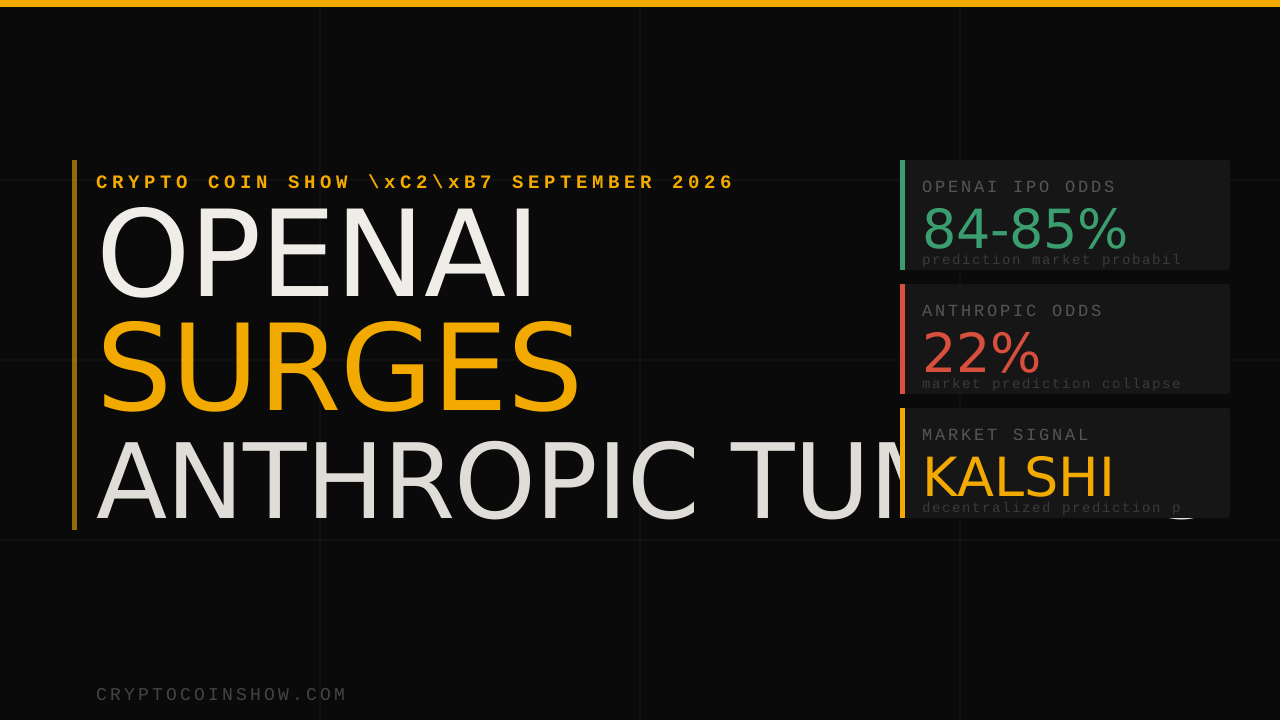
OpenAI’s reported acceleration toward an IPO filing, driven by resolution of Elon Musk’s lawsuit and paired with Goldman Sachs and Morgan Stanley engagement, has triggered a sharp repricing across prediction markets, with OpenAI odds reaching 84-85% on Kalshi while rival Anthropic has collapsed to 22%, signaling institutional traders now expect a near-term public listing over competing AI generative platforms. For institutional crypto investors and blockchain-tracking funds, this market repricing reveals how traditional equity capital flows and sentiment can move faster than on-chain signals, and demonstrates the predictive power of decentralized betting platforms in frontrunning official corporate announcements.
- OpenAI assigned 84-85% probability of IPO before 2026 on Kalshi; Anthropic odds fell to 22% on same platform
- Goldman Sachs and Morgan Stanley engaged for IPO prep; draft filing potentially submitted as early as Friday
- Elon Musk’s $150 billion lawsuit dismissed by federal judge, removing legal barrier to for-profit conversion
- 84-85% OpenAI IPO probability assigned by Kalshi traders versus prior consensus
- 22% Anthropic IPO odds on Polymarket, down sharply from implied prior probability
- $850B+ OpenAI current private valuation according to sources close to banking discussions
OpenAI is moving toward a stock market debut with accelerating momentum, according to confidential sources and prediction market activity that has now outpaced any official corporate statement.
The company, valued at over $850 billion in private markets, has retained Goldman Sachs and Morgan Stanley to advise on initial public offering preparations, according to people familiar with the discussions. A draft IPO filing could be submitted as early as this week, with the company potentially targeting a listing during the final quarter of this year or early 2026.
The move comes two days after a federal judge dismissed Elon Musk’s lawsuit seeking $150 billion in damages and an injunction to block OpenAI’s conversion from nonprofit to for-profit status, a legal outcome that removes what was widely viewed as the most significant regulatory and judicial impediment to a public offering.
Federal Judge Throws Out Musk Lawsuit, Clearing Path to For-Profit Conversion
Musk’s legal challenge to OpenAI’s corporate restructuring has been a shadow over the company’s capital plans since it was filed. The suit sought to reverse the company’s shift from a nonprofit research organization to a for-profit entity backed by Microsoft investment and controlled by a for-profit general partner.
Dismissal of the case removes what legal experts had flagged as the highest-risk obstacle to an imminent public offering, since any ongoing litigation could have complicated SEC filings or investor confidence in OpenAI’s governance structure.
Company leadership appears to have interpreted the court decision as a clear signal to accelerate timelines that had previously been under deliberation. OpenAI stated publicly that it “regularly evaluates strategic options” while focusing on current business priorities, a carefully neutral formulation that stops short of confirming an IPO but does not deny active preparation.
Internal teams have reportedly been positioned to move a formal filing forward within weeks rather than months, with Q4 2024 or early 2026 emerging as the target window for a listing.
The legal resolution also coincides with SpaceX preparing its own public offering, creating a window where multiple high-profile tech companies may be in market simultaneously.
Multiple sources have suggested OpenAI’s banking advisors viewed concurrent IPO filings as strategically advantageous, allowing the company to capitalize on investor appetite for AI exposure without bearing the full weight of market attention alone.
Goldman Sachs and Morgan Stanley Retained to Manage IPO; Draft Filing Imminent
The engagement of two of Wall Street’s largest investment banks signals that OpenAI’s management has moved beyond theoretical planning into active execution. Goldman Sachs and Morgan Stanley bring deep institutional relationships, SEC expertise, and track records managing mega-cap technology listings.
Their involvement, disclosed to sources within the banking and venture capital communities, suggests OpenAI intends to move quickly and with the scale and rigor expected in a $100+ billion-plus offering.
According to multiple accounts, a confidential draft registration statement could be submitted to the Securities and Exchange Commission as early as this Friday, with subsequent filings and amendments following over the next two to four weeks.
The timing implies OpenAI’s legal, finance, and corporate teams have substantially completed the foundational work required for a formal filing, audited financials, governance structures, risk disclosures, and regulatory compliance documentation.
An IPO of this magnitude would rank among the largest technology listings in history, potentially exceeding recent debuts like Arm Holdings ($54.7 billion raised in 2023) or matching the scale of Microsoft’s 1986 IPO when adjusted for market cap.
The exact valuation and share structure remain undisclosed, but private market pricing at $850+ billion suggests institutional investors expect a listing price in the high double digits per share, with the company seeking $10-15 billion or more in primary proceeds.
Prediction Markets Price OpenAI at 84-85%, Anthropic Collapses to 22%
The market response to leaked IPO details has been immediate and quantifiable on decentralized prediction platforms. On Kalshi, a CFTC-regulated prediction market, OpenAI odds surged to 84-85% probability of going public before a competitor IPO, whereas Anthropic, the Amazon and Google-backed generative AI startup, fell to 22% odds on Polymarket, a cryptocurrency-denominated prediction exchange.
The spread reflects trader consensus that OpenAI has dramatically outpaced rivals in capital access, valuation momentum, and IPO readiness.
Broader measures of IPO likelihood confirm the repricing. Kalshi traders assigned an 88% probability to OpenAI filing or going public by the end of 2026, while Polymarket data showed a 73% probability of a formal public listing by year-end 2026.
These overlapping timeframes and high-confidence probabilities indicate professional traders and sophisticated investors are now pricing in near-term execution rather than viewing a listing as speculative or distant.
The collapse of Anthropic’s odds, from implied parity with OpenAI to less than one-quarter the perceived probability, reveals how fast-moving capital markets and prediction platforms can reprice competitive dynamics once new information reaches the market.
Anthropic, despite backing from two of the world’s largest cloud companies and a reported $15 billion funding round, now trades at odds that suggest traders expect it to lag OpenAI’s IPO timeline by 18-24 months or longer.
Institutional Capital Flows Show Prediction Markets Outpace Official Announcements
For institutional crypto and blockchain investors, the repricing across Kalshi and Polymarket carries two critical implications. First, prediction markets have proven capable of incorporating confidential information faster than traditional equity research or SEC filings can surface it, suggesting these platforms now function as leading indicators for institutional capital deployment.
Traders who positioned ahead of the leaked OpenAI details gained significant returns, while those tracking only public corporate guidance missed the alpha window.
Second, the sharp divergence between OpenAI and Anthropic odds reveals how concentrated investor confidence in AI has become, despite multiple funded competitors.
OpenAI’s 84-85% probability on Kalshi does not mean a 15% chance of failure; rather, it reflects trader belief that the company will be first to list among AI generative companies, with Anthropic forced to follow at a later date and potentially at a lower relative valuation. This structure suggests the market is pricing in “winner-take-most” dynamics in large-scale AI commercialization.
The timing also carries implications for cryptocurrency and blockchain infrastructure plays tied to AI development, as the impending OpenAI listing may trigger a rotational shift of capital from late-stage AI startup bets into public equities, potentially reducing dry powder available for blockchain or decentralized AI infrastructure funding rounds in Q4 2024.
OpenAI’s $850 Billion Valuation and Implied Share Price Point to Mega-Cap Listing
Current private market valuations place OpenAI at $850 billion or higher, according to sources involved in recent funding discussions and secondary market transactions. This val
Original reporting: cryptopolitan.com