Alibaba Aims for Independence with New AI Chips, Model
The chip highlights the vendor’s move toward a full-stack AI strategy and its efforts to wean itself off Nvidia AI chips.
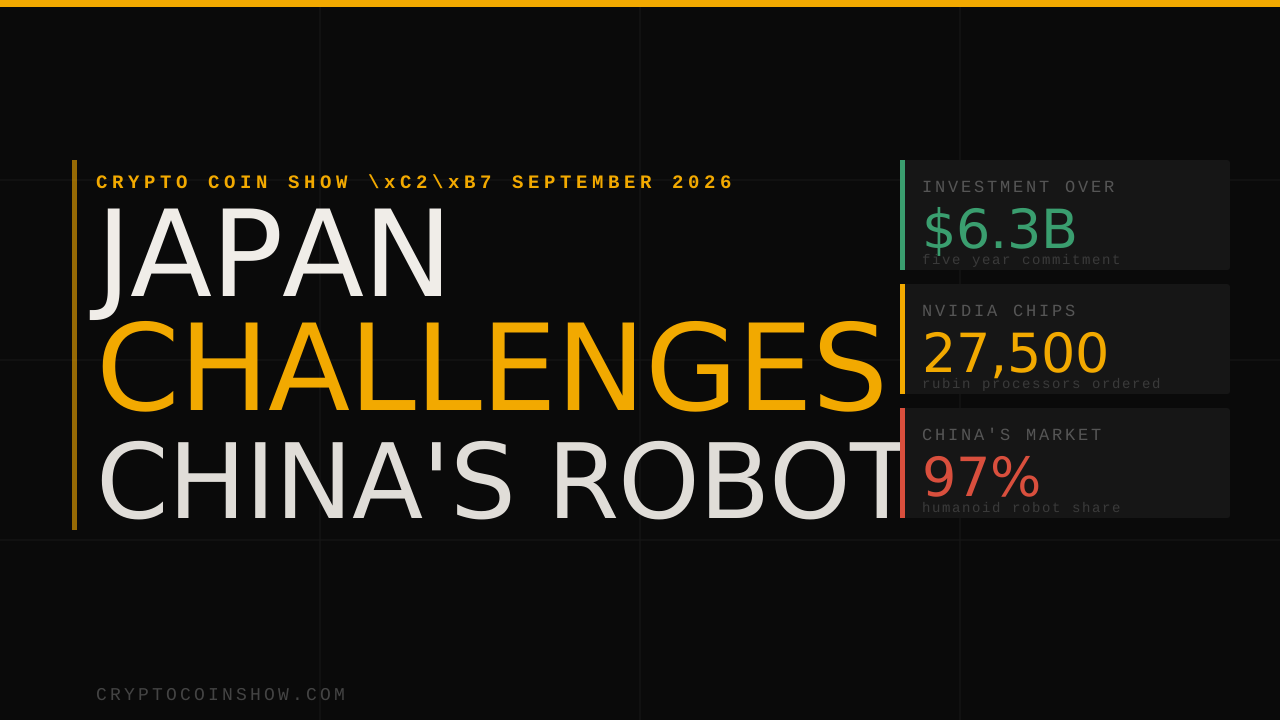
Japan is searching for its place in the global AI race. While American and Chinese companies dominate AI models and computing infrastructure, Japanese companies believe their expertise in robotics could help pioneer AI in real world tasks.
On May 13 Japanese industrial equipment maker, Fanuc, announced a partnership with Google that aims to create factory robots that can understand spoken and handwritten instructions and carry out factory tasks autonomously.
Fanuc, founded in Japan in 1956, is one of the world’s largest industrial machinery manufacturers. It’s developed an AI system with the help of Google Gemini that can be operated without programming skills. It plans to make all its robots compatible with Google software.
In December 2025, Fanuc also announced a collaboration with NVIDIA which will see it open its previously closed robot software systems. At a press conference on May 13, Senior Managing Officer Kenishiro Abe said the partnership stems from the limitations of developing an entire AI ecosystem in-house. It plans to incorporate AI systems from a host of different companies.
Factories are set to benefit the most from physical AI. While robots are already used extensively, they remain limited to repetitive tasks.
Physical AI is the practical application of AI. These AI systems are trained to perceive the real world, reason with it, act autonomously in real time as well as learn and collaborate from humans. They excel at handling complex and unpredictable tasks.
For decades, Japanese factories have been shaped by knowledge that was never written down. Now, Japanese companies are trying to teach that knowledge to machines.
According to a Nomura Securities report, Japan’s decades-long manufacturing expertise and factory-floor data could power industrial humanoid robots.
In the 1990s Japanese manufacturers made up 80 percent of the global industrial robot market, according to the International Federation of Robotics. The figure has since fallen to roughly 40 percent.
As of 2024, Chinese companies such as Estun Automation and Inovance Technology are gaining ground and account for 40 percent of the global humanoid robot market.
But many Chinese companies still rely on Japanese machinery components. Nomura Securities predicts that Japan’s expertise in motion control technologies, industrial datasets, precision manipulators (i.e. robot hands) and semiconductor equipment could drive growth in a post-2030 economy.
Fanuc’s decision to open its source robotics software is a significant pivot from the Japanese manufacturing sector’s emphasis on hardware.
The country trails behind the U.S. and China in AI digital transformation (DX). Japanese companies rely heavily on software from U.S. tech giants resulting in a massive ‘digital deficit’ in which payments for digital services flow overseas.
The Ministry of Economy, Trade and Industry (METI) recorded a $4.9 billion digital services deficit in 2023. The U.S. on the other hand, posted a $173.7 billion surplus while China logged a $40.4 billion digital surplus.
As companies integrate AI into manufacturing, the Japanese government anticipates that rising demand for industrial robots will support the growth of Japanese industrial machinery companies.
Japanese technology company ARUM Inc has developed a fully automated, AI-enabled production line for metal part manufacturers. Its TTMC system costs approx. $2.3 million each. At Tokyo Sushi Tech Expo 2026, the company said it will install 100 units across Japan and has received enquiries from South Korea and the United States.
“We are not simply selling machines. We are connecting them through the cloud and building infrastructure,” said Takayuki Hirayama, CEO of ARUM Inc.
ARUM Inc believes that AI-driven manufacturing automation can solve global labor shortages and changing career preferences.
“Even in younger countries like India and Southeast Asia, skilled manufacturing workers are disappearing because IT and tourism are seen as more lucrative.”
At a New Years press conference, Japanese Prime Minister Sanae Takaichi announced plans to accelerate physical AI innovation and expand the technology globally. She stated that AI-powered robots will learn from high-quality domestic data, in particular, Japan’s long established factory know-how.
The initiative builds on remarks made in December 2025 when Takaichi directed the government to support domestically produced general purpose AI models which are an essential component of physical AI. METI is set to launch a one trillion yen funding package (approx. $6.45 billion) over five years to help develop Japanese physical AI.
CEO Masato Fujino of Japanese industrial devices company, Fairy Devices Inc, believes that the challenge is no longer using AI within computers but bringing AI into the real world.
The company has produced wearable AI devices that prevent technicians from missing important checks. They are built with cameras, microphones, sensors and communications capabilities. The devices have accumulated large volumes of data and have trained the company’s vision language model which aims to replace experts such as air conditioner repair technicians.
At Tokyo Sushi Tech Expo 2026, Fujino said specialized data directly from skilled workers is indispensable for industrial AI systems.
“Google Gemini is powerful because Google owns Youtube. But when it comes to highly specialized industrial tasks, such as repairing industrial equipment, that data does not exist on Youtube.”
Japan’s answer to AI is not frontier models but industrial data. Despite fierce competition for low-cost, high-quality physical AI, Japanese industry leaders are optimistic about Japan’s trajectory.
In their eyes Japan’s reputation for manufacturing excellence and proven track record in factory automation is difficult to replicate anywhere else.
If you’re reading this, you’re already ahead. Stay there with our newsletter.
Eric Trump rejected Senator Elizabeth Warren’s claim that his father directs individual Nvidia (NVDA) stock trades. Warren tied recent buys to eased US AI chip exports to China.
Reports flagged a January 6 purchase worth up to $1 million in Trump-tied accounts. The Commerce Department updated AI chip export rules one week later.
Eric Trump challenged that all family assets sit in a blind trust managed by major financial institutions. The structure favors broad market indexes over individual stock picks.
All of our assets are invested in a blind trust by the largest financial institutions in broad market indexes. To suggest that individual stocks are being bought or sold, at the discretion of any member of the Trump family, would be a lie and blatantly false,” articulated Eric Trump, executive vice president of the Trump Organization.
The Trump Organization has said the family holds assets in fully discretionary accounts. Donald Trump Jr. and Eric Trump oversee the trust with third-party institutions and receive no advance notice of trades.
Warren cited a January 6, 2026 Nvidia purchase of up to $1 million in Trump-tied accounts. The Commerce Department then revised rules for chips like Nvidia’s H200 on January 13.
She called the timing a national security risk.
“Trump brought the NVIDIA CEO on his trip to China to lobby Xi Jinping to buy advanced AI chips, even though it would create a U.S. national security threat. It turns out Trump also bought millions in NVIDIA’s stock. The President’s corruption is a national security disaster,” she wrote in a post.
Indeed, President Donald Trump brought Nvidia chief executive Jensen Huang on his May 12 to 15 Beijing visit. The trip covered trade and AI talks with President Xi Jinping.
Huang has previously confirmed Trump asked him to join the delegation. The group included other US business leaders pushing tech and aviation deals.
The dispute surfaced through Trump’s Q1 2026 OGE Form 278-T filing. The document logged 3,642 stock transactions in the first three months of the year. Related coverage of the filing has detailed the breadth of holdings.
Critics say the volume and timing of individual trades sit outside the qualified blind trust template. Presidents from Jimmy Carter through Joe Biden used that template to avoid conflict claims.
The 2012 STOCK Act requires disclosure of executive trades but does not bar them. Federal authorities have not announced an investigation.
Treasury Secretary Scott Bessent has backed a congressional single-stock trading ban. The proposal has drawn renewed attention this week.
Whether ethics committees pursue formal review may shape how future administrations structure presidential portfolios.
The post Eric Trump Pushes Back at Warren Over Nvidia Stake Tied to China Trip appeared first on BeInCrypto.
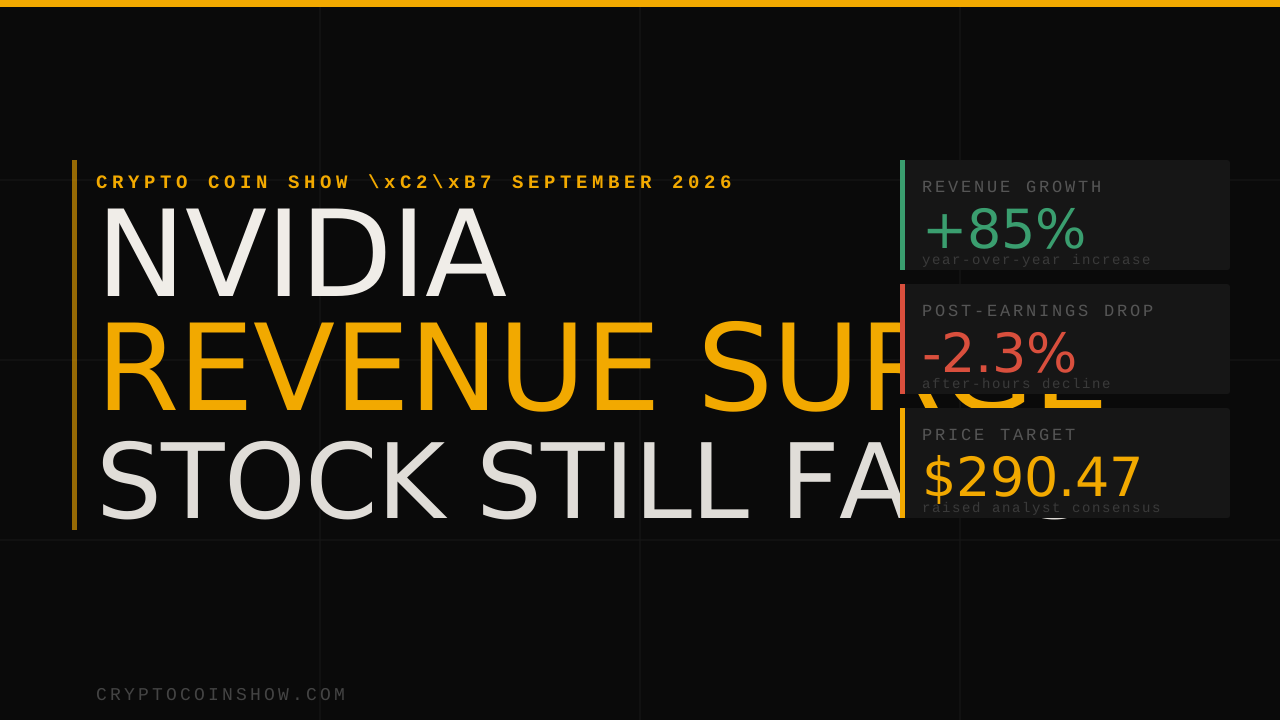
Nvidia (NVDA) stock price has rallied for seven consecutive sessions since the May 6 breakout, climbing to $227 on May 13. The move sits inside a 32% measured move setup, and the fundamental catalysts behind it have just multiplied.
Jensen Huang joined President Trump’s Beijing delegation as a last-minute addition on Tuesday, putting $50 billion in China AI chip opportunities back in play.
At least five Wall Street firms have raised or reiterated their Nvidia price targets in the past 48 hours. Earnings land on May 20. But the Chaikin Money Flow is sending a quieter, more cautious signal underneath the rally.
The Nvidia stock chart broke out of a bull flag and pole pattern on May 6, 2026. The pole rallied 31.92% across April and early May, and the flag resolved upward with strong volume on the breakout candle.
Want more insights like this? Sign up for Editor Harsh Notariya’s Daily Newsletter here.
Every daily session since May 6 has closed green. The measured move projects a 32% rally from the breakout zone, with $267 the textbook target.
The fundamental catalysts have stacked up in the past 48 hours. Jensen Huang joined President Trump’s delegation to Beijing as a last-minute addition on May 12.
Trump personally called Huang after the Nvidia CEO was initially absent from the executive list, and Huang flew to Alaska to board Air Force One. Beijing has been pushing for greater access to Nvidia’s H200 AI chips, a market Huang has sized at $50 billion.
Wall Street has reinforced the setup. Bank of America’s (BofA) Vivek Arya raised the firm’s Nvidia price target to $320 from $300 on May 13, citing a $1.7 trillion total addressable market for 2030 AI data centers.
Wells Fargo’s Aaron Rakers raised to $315 from $265 on May 12, using a new gigawatt-capacity model. Susquehanna’s Christopher Rolland raised to $275 from $250, aligned with the chart targets discussed earlier. Citi reiterated $300. Oppenheimer reiterated $265.
The Nvidia stock price now sits between the breakout zone and the target, with earnings due May 20. The next signal sits in the institutional flow data.
The Chaikin Money Flow (CMF) indicator, which measures the volume-weighted balance of buying and selling pressure as a proxy for large money positioning, sits at 0.24 on the Nvidia daily chart.
The reading is in positive territory. The interesting signal is what has happened underneath it. The CMF peaked in late April and has since trended steadily lower, while Nvidia’s stock price has trended higher. The result is a bearish divergence on the daily chart.
That divergence does not invalidate the breakout. Big-money flow has softened, but it remains net positive. The pattern is consistent with profit-taking into strength or hedging ahead of the May 20 earnings report.
The put-call ratio data adds the second layer. The Nvidia put-call volume ratio sits at 0.32 on May 13, up from 0.29 around the May 6 breakout. The open interest ratio has eased to 0.80 from 0.81 over the same period.
The increase in volume-based puts alongside steady open interest fits the same picture as the CMF divergence.
Some hedging is being added to the rally, but overall positioning remains heavily call-skewed, with put-call ratios well below 1.0. The setup stays bullish with some prudence layered in.
Nvidia stock price trades at $226, sitting right next to $227, the 0.618 Fib zone of the recent range.
The 0.618 level is the structural pivot. A daily close above $227 opens $235, $247, and the textbook pattern target at $267. Beyond that, the 1.618 extension at $279 aligns with Susquehanna’s price target.
The 2.618 extension at $332 sits just above Bank of America’s $320 target.
The downside levels matter too. Support stacks at $214 and $207. A daily close below $207 would weaken the breakout structure. The deeper invalidation sits at $194, the 0 Fibonacci anchor. A break under $194 would weaken the entire bullish structure.
A daily close above $227 keeps the path to $267 open and brings the analyst price ladder into view. A close below $207 hands control to the CMF divergence and risks a deeper consolidation toward $194.
May 20 earnings will likely break the tie.
The post A Phone Call From Trump Just Earned Nvidia Stock a Potential 30% Boost appeared first on BeInCrypto.
Despite a new chip challenge from Google and a billion-dollar contract loss hitting one of its key suppliers, Nvidia remains the dominant force in artificial intelligence hardware, with fresh deals in the UK, China, and the automotive sector reinforcing that position.
Wall Street research firm TD Cowen reaffirmed its buy rating on Nvidia this Thursday, brushing aside concerns raised by Google’s Wednesday announcement of new AI training and inference chips.
The firm said it continues to see Nvidia as “the market leader in terms of performance and breadth of software ecosystem.”
The endorsement came as Nvidia announced a string of new partnerships across multiple industries on the same day.
In Britain, telecom company BT and cloud infrastructure firm Nscale announced a joint plan to build AI data centers on UK soil using Nvidia’s full-stack infrastructure.
The goal is to let organizations run AI systems securely and independently, without relying on foreign-controlled infrastructure.
Under the plan, Nscale will build up to 14 megawatts of AI data center capacity across three existing BT sites.
BT will provide the connectivity needed to handle rising compute demand. The project extends BT’s business platform to offer new AI services to both the private and public sectors.
Use cases include AI-powered analysis of sensitive healthcare data, as well as applications in energy, finance, and security.
On the automotive front, Nvidia and Chinese company Desay SV are set to jointly unveil a new intelligent driving solution at the Beijing Auto Show.
The system is built on Nvidia’s DRIVE AGX Thor computing platform and uses NVLink interconnect technology, which links two AGX Thor chips together.
The combined setup delivers a maximum computing power of 4,000 FP4 TFLOPS and is designed to tackle the technical challenges of building Level 3 and Level 4 autonomous vehicles, cars that can largely or fully drive themselves under specific conditions.
The system runs entirely on edge-side computing, meaning it does not rely on the cloud to function.
According to the companies, this approach improves real-time performance, data security, and overall reliability, making it suitable for both highway and urban driving.
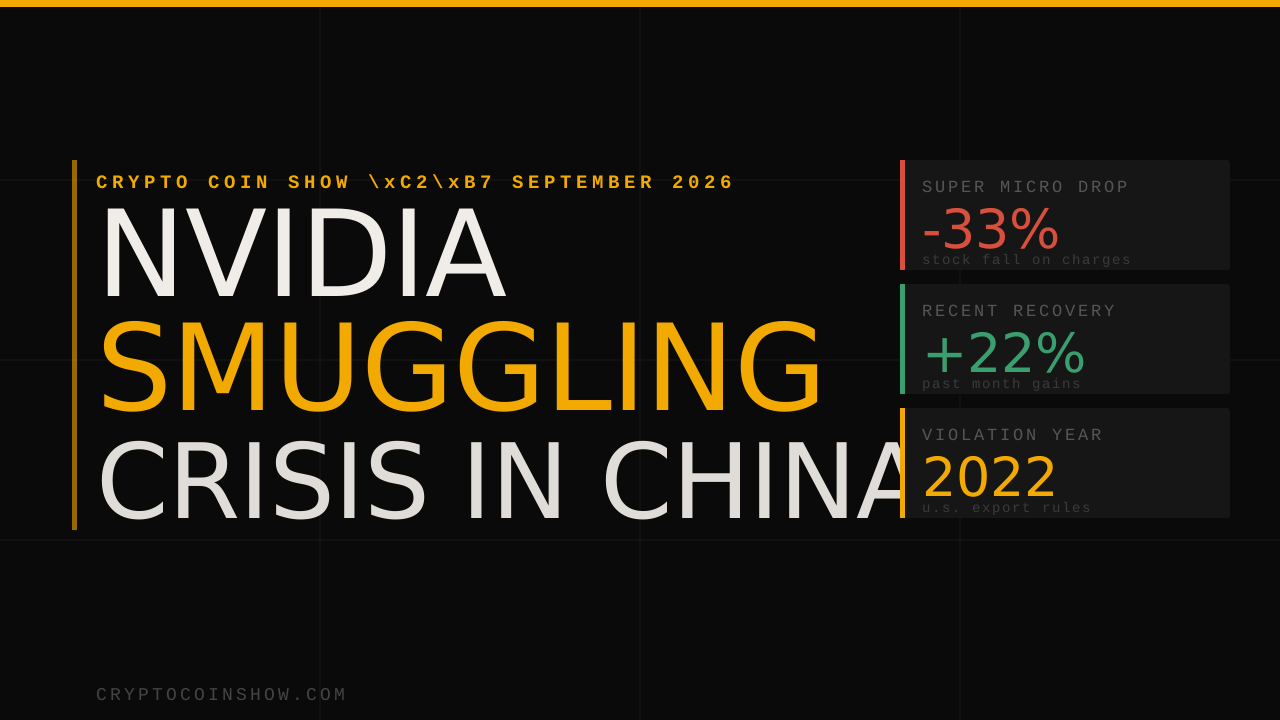
While Nvidia’s partnerships continue to grow, trouble is brewing in its supply chain. Shares of Super Micro Computer fell 10% on Thursday after reports surfaced that the company lost a major contract with Oracle for Nvidia’s GB300 NVL72 server racks.
A report from research firm Bluefin said Oracle canceled an order for between 300 and 400 racks, wiping out a contract worth between $1.1 billion and $1.4 billion for Super Micro.
Bluefin, citing industry sources, said the cancellation is believed to be connected to a lawsuit against Super Micro’s co-founder over the alleged smuggling of AI graphics processors to China.
Bluefin also reported that Wistron NeWeb is believed to have taken over the racking business that Super Micro lost.
At the same time, sources within the supply chain flagged concerns about a build-up of unsold B200 GPU inventory, describing the levels as “considerable.”
The accumulation is being linked to a shift in demand.
Buyers have moved away from B200 hardware toward the newer GB200 NVL72 racks, and the contracts for those were awarded to Dell and Hewlett-Packard Enterprise, not Super Micro.
The situation highlights how even the world’s most in-demand AI chips can run into complicated distribution problems.
As Nvidia pushes further into sovereign infrastructure, self-driving technology, and financial services, keeping its hardware moving through the right hands is becoming just as important as building it.
So Wall Street is betting on Nvidia’s software strength, but overlooking real cracks in its supply chain.
The buy rating assumes these problems will sort themselves out. That is not guaranteed. Unsold chips and contract shuffles signal growing pains.
The real test is whether Nvidia can get its own operations under control before rivals move in.
The smartest crypto minds already read our newsletter. Want in? Join them.
DeepSeek is now chasing a valuation above $20 billion as Tencent Holdings and Alibaba Group discuss possible investments in the Chinese AI startup.
The Information reported that on Wednesday, citing four people who knew about the talks. DeepSeek, which is owned by hedge fund High-Flyer Capital Management, had only just started talking to outside investors for the first time.
By Friday, the reported target was at least $300 million at a valuation of at least $10 billion. Now the asking price has climbed fast as interest builds around DeepSeek.
The talks are still going on, so the final number could still change. The amount DeepSeek wants to raise could also change. Some U.S. venture capital companies may be cautious because DeepSeek is a Chinese startup.
Earlier this year, Cryptopolitan reported that DeepSeek did not show U.S. chipmakers its flagship model for performance tuning. We also reported that one of DeepSeek’s newer models was trained on Nvidia’s most advanced banned chip.
Back in January 2025, the first big DeepSeek release helped trigger a global tech selloff and pushed Chinese rivals to upgrade their own models.
Meanwhile, on the Dwarkesh Podcast on Wednesday, Nvidia chief executive Jensen Huang said it would be “a horrible outcome” for the United States if DeepSeek optimized its new AI models to run on Huawei chips instead of American hardware.
Jensen said, “If future AI models are optimised in a very different way than the American tech stack,” and as “AI diffuses out into the rest of the world” with Chinese standards and technology, China “will become superior to” the United States.
On chip performance alone, Huawei still trails Nvidia. The Ascend 910C, which came before the 950PR, delivers about 60% of the inference performance of Nvidia’s H100. That H100 is already two generations behind Nvidia’s current best chip.
American chips are about five times more powerful than Chinese rivals today, and that gap is expected to widen to 17 times by 2027. Huawei is targeting 750,000 AI chip shipments in 2026, but its total production amounts to only about 3% to 5% of Nvidia’s combined computing power.
“A lot of work has to go into it to change. But go to the global south, go to the Middle East. Coming out of the box, if all of the AI models run best on somebody else’s tech stack, you’ve got to be arguing some ridiculous claim right now that that’s a good thing for the United States,” said Jensen.
Jensen said his real concern is not just the gap in chip strength. He said China could still catch up in AI because it has “abundant energy” and a “large pool of AI researchers.”
If DeepSeek V4 runs well on Ascend chips, that would give China another route in AI development that does not depend on Nvidia across the supply chain.
That same funding rush showed up elsewhere on Wednesday. Vast Data announced a $1 billion funding round at a $30 billion valuation, and Nvidia was one of the backers.
The company says it supports projects that power millions of GPUs. Its customers include CoreWeave, Mistral, the U.S. Air Force, and Cursor. The new round more than tripled Vast’s $9.1 billion valuation from 2023. Drive Capital and Access Industries led the Series F. Fidelity Management and Research Co., NEA, and Nvidia also joined.
The financing included both primary and secondary capital. Dealroom said AI companies globally have already raised $280.5 billion this year, with more than $170 billion going to OpenAI, Anthropic, and xAI.
Chris Olsen of Drive Capital said, “The scale and speed of AI adoption are creating a new class of infrastructure company.” Chris added, “VAST is emerging as the clear leader in this category, with the architecture and momentum to support the world’s most demanding AI environments.”
The smartest crypto minds already read our newsletter. Want in? Join them.
Nvidia’s share price fell to $199.86 on Monday, a drop of less than 1%. On its own, that barely registers. But zoom out, and the picture looks more complicated. Google is coming for Nvidia’s fastest-growing market, billions of dollars are flowing into rivals, and a South Korean startup just raised $400 million with Nvidia squarely in its sights.
Nvidia closed at $199.48, down 0.79% on the day. The stock still sits well above its 20-day, 50-day, and 200-day moving averages, which are clustered around $181-$183, so the longer-term trend remains intact.
The MACD is still flashing a buy signal, and the ADX reading of 15.28 points to a weak but continuing upward trend.
While Nvidia’s stock treads water, Google is making its most direct push yet into the chip market.
The Alphabet-owned company is preparing to announce a new generation of tensor processing units, known as TPUs, at its Google Cloud Next conference in Las Vegas this week, with a focus on inference: the process of running AI models once they have already been trained.
“It now becomes sensible to specialize chips more for training or more for inference workloads,” Google Chief Scientist Jeff Dean said. The company is “looking at a whole bunch of different things,” he added, including how fast it can deliver AI results to users.
Big names are now in for the TPUs. Anthropic has signed a contract for 1 million TPU’s while Meta is using them through Google’s cloud as part of a multi-billion-dollar agreement. In the upcoming Google conference, Citadel Securities will be talking about how TPU’s are faster at training models than GPUs. This isn’t where it ends. Abu Dhabi’s G42 is also in discussion to access them.
Google is also loosening the rules around TPU access, letting some customers run the chips inside their own data centers and supporting outside tools like PyTorch, rather than locking users into Google’s own software stack.
Not to forget, OpenAI is also growing frustrated by Nvidia’s inference hardware and looking for alternatives, as reported by Cryptopolitan previously.
Google is not the only one sensing an opening. AI chip startups pulled in $8.3 billion globally in 2026, according to data from Dealroom, putting the sector on track for a record year. In the U.S., Cerebras raised $1 billion in February. MatX, Ayar Labs, and Etched each secured $500 million rounds. In Europe, Axelera and Olix both raised over $200 million.
“It’s no longer a niche bet,” said Carlos Espinal of European VC firm Seedcamp. “It’s becoming a core part of how people think about AI infrastructure.”
Samsung-backed South Korean startup Rebellions raised $400 million at a $2.34 billion valuation, led by Mirae Asset Financial Group and South Korea’s state-backed National Growth Fund. The company has raised $650 million in the past six months alone, more than 75% of its total funding, and is now targeting U.S. customers and preparing for a public listing.
Its Rebel100 chip is built specifically for inference.
One constraint is memory. High-bandwidth memory is tight across the industry, and prices have risen sharply. “Memory is not very easy to get. But our demand is so huge,” Park said. Rebellions has an edge there: both Samsung and SK Hynix are investors, giving it better access than most rivals.
The crypto card with no spending limits. Get 3% cashback and instant mobile payments. Claim your Ether.fi card.
Oracle’s Dubai tower takes debris strike. Iran’s Revolutionary Guard names Nvidia, Apple, Microsoft and Google as targets. A missing U.S. airman, two downed aircraft and a 48-hour ultimatum from Trump.
Iran launched a broad wave of missile and drone attacks across the Middle East on Saturday, marking a significant shift in the conflict’s geography. The UAE said it intercepted dozens of incoming projectiles in the 24 hours prior — and debris from one intercept struck the facade of the Oracle building in Dubai Internet City.
The Dubai Media Office confirmed no injuries and described the incident as minor. Damage was limited. But the symbolic weight was not: American corporate infrastructure in the Gulf is no longer sitting outside the blast zone.
Iran’s Revolutionary Guard simultaneously issued direct threats against a wider group of U.S. technology companies operating across the region — naming Nvidia, Apple, Microsoft and Google by name.
⚠ Iran’s Revolutionary Guard has directly threatened U.S. tech infrastructure in the Middle East, including Nvidia, Apple, Microsoft and Google.
The U.S. military continued searching Saturday for a missing airman after an F-15E was shot down over southwestern Iran on Friday — the first U.S. combat aircraft successfully downed by Iranian forces since the conflict began in late February. One crew member was rescued. The second remained missing, with both U.S. and Iranian forces searching the same area.
In a separate incident, an A-10 Warthog pilot ejected after the aircraft was struck by Iranian fire over Kuwait. Two Black Hawk helicopters deployed in the search operation also came under fire inside Iranian airspace, though both returned safely. U.S. officials privately expressed concern the missing airman could be captured and used as political leverage by Tehran.
“Time is running out — 48 hours before all Hell will reign down on them.“
President Trump posted on Truth Social on Saturday referencing his earlier ultimatum over the Strait of Hormuz, warning Iran it had 48 hours before consequences. The threat followed his earlier demand that Iran open the strait or make a deal within ten days.
India’s oil ministry confirmed its refiners had secured crude supplies including Iranian oil, after disruptions to Strait of Hormuz shipping lines cut into global supply. India had not received Iranian crude since May 2019, when U.S. pressure pushed buyers away from Tehran’s exports. The ministry also confirmed that 44,000 metric tons of Iranian liquefied petroleum gas had berthed at Mangalore this week aboard a sanctioned vessel.
The move signals a realignment in energy trade. The United States had temporarily removed sanctions on Iranian oil and refined products to reduce supply shortages — a decision now being tested by the ongoing strikes.
Near Bushehr, a projectile struck close to Iran’s nuclear power plant overnight, killing at least one worker and damaging part of the site. The International Atomic Energy Agency confirmed radiation levels remained normal but issued a warning against further strikes near nuclear facilities. Iran’s Foreign Minister said Tehran was not ready to rush into negotiations and would accept only a “conclusive and lasting” resolution to the war.
Russian state nuclear company Rosatom evacuated an additional 198 staff from the Bushehr site. It has been withdrawing workers since the conflict began at the end of February.
SK Hynix is making record profits due to the increasing demand for AI chips, particularly from Nvidia. This performance has propelled it past its competitor, Samsung, in the high-end memory space.
SK Hynix reported a major boost in Q2 earnings following rising demand for its AI-focused memory chips. The South Korean firm reported an operating profit of ₩9.2T, which is about $6.7B, for the second quarter, a 68% increase from the same period last year as demand for high-bandwidth memory (HBM) chips used in AI systems continues to rise.
Revenue rose 35% to ₩22.2T, about $16.1B, exceeding analyst forecasts of ₩20.6T, according to Yonhap Infomax.
SK Hynix has outgained Samsung Electronics in advanced memory sales for the second quarter in a row, mainly because of its position as the leading supplier of HBM chips to Nvidia.
SK Hynix pointed out growing investment in sovereign AI, which refers to government efforts aimed at developing independent national AI infrastructure, as a source of demand in the future. The company’s shares went up by more than 2% in early trading, following the earnings release.
SK Hynix’s performance contrasts with that of Samsung’s, which projected a 56% profit decline in Q2. One of the major causes is its struggle to meet Nvidia’s strict requirements for its AI chips.
SK Hynix’s share price has tripled since the beginning of 2023, with Bank of America analysts forecasting further growth in global HBM revenue from $35.7B in 2024 to $57.5B in 2027.
Despite SK Hynix’s momentum, analysts are pointing out potential risks further down the line. Analysts at Goldman Sachs reduced their rating for the company from “Buy” to “Neutral” in a note published last week. As more memory chip makers expand production, the competition is expected to intensify.
Goldman Sachs warned that HBM pricing could decline for the first time next year, as the market gets more saturated. SK Hynix’s reliance on Nvidia especially leaves it exposed to changes in customer strategy or pricing leverage.
This could become a problem if Nvidia decides to diversify suppliers or push for lower prices.
Analysts have also identified areas of opportunity for competitors like Samsung. Goldman Sachs stated that application-specific integrated circuit (ASIC) chips may become the fastest-growing segment in the HBM market.
As SK Hynix focuses on supplying Nvidia, it gives Samsung the opportunity to target companies building their own ASIC chips.Samsung may be able to benefit from Nvidia resuming shipments of its less advanced H20 AI chip to China.
Your crypto news deserves attention – KEY Difference Wire puts you on 250+ top sites
Nvidia, the leading producer of artificial intelligence (AI) chips, is at the heart of the geopolitical standoff as semiconductors become increasingly central to the US-China rivalry.
The company’s reentry into the Chinese market last week, reportedly with Washington’s blessing, has stirred debate about the strategic consequences for both nations.
For the US, Nvidia’s continued presence in China may serve as a strategic lever to maintain its dominance in AI. Experts told CNBC that keeping Chinese firms reliant on US-designed chips and software, especially Nvidia’s widely used CUDA platform, helps cement America’s global leadership.
“This relationship is symbiotic, but I do believe China needs US technology more at this moment in time,” said Daniel Newman, CEO of Futurum Group, in an interview with CNBC’s The China Connection.
For China, Nvidia’s return provides a crucial window through which to develop its domestic semiconductor ecosystem further while continuing to build AI capabilities.
Earlier this year, the US tightened export restrictions on Nvidia’s H20 chip—a downgraded version of its flagship hardware designed to meet earlier compliance requirements. Washington cited concerns about these chips potentially advancing China’s military or homegrown AI industry.
The move forced Nvidia to take a $4.5 billion writedown on unsold inventory and warn of revenue impacts running into the billions. Nvidia CEO Jensen Huang has openly criticized the export curbs, arguing they could accelerate the country’s chip development and undermine America’s tech leadership.
“It would be a tremendous loss for us not to participate in China,” Huang stated, adding that in Nvidia’s absence, domestic players like Huawei would step in to fill the gap.
That message appears to have resonated in Washington. Nvidia confirmed last week that it had received US government approval to resume H20 sales to China.
While Nvidia is poised to benefit financially, US officials say the move also serves national interests.
In an interview with CNBC, Howard Lutnick, US Commerce Secretary, said that they want to keep having the Chinese use the American technology stack because they still rely upon it.
Nvidia’s influence extends beyond hardware. Its CUDA software platform has become a cornerstone for AI developers, forming a sticky ecosystem that competitors find difficult to displace.
Pranay Kotasthane, deputy director at the Takshashila Institution, noted that reintroducing H20 in China gives US firms breathing room while slowing China’s drive for chip independence.
“China is Nvidia’s largest market and is home to 50% of AI developers, according to Jensen Huang. If that market closes, it becomes harder for Nvidia to reinvest in R&D,” Kotasthane said.
Huawei remains China’s frontrunner in AI chip development, but its hardware still lags behind Nvidia’s top-tier products. Meanwhile, a growing field of Chinese startups is racing to produce viable alternatives.
Nvidia’s renewed market access could potentially blunt that momentum. Tejas Dessai, director of research at Global X ETFs, warned that easier access to Nvidia chips could siphon capital away from domestic projects and delay the maturation of Chinese alternatives.
Dessai told CNBC that If Nvidia’s chips are made available to Chinese firms, it could weaken momentum behind domestic chip projects, cut off capital, and delay progress in domestic Chinese hardware.
Experts say Nvidia’s lead isn’t just about performance but usability. Chinese developers continue to prefer Nvidia’s ecosystem due to its flexibility and depth.
Paul Triolo, a partner at DGA-Albright Stonebridge Group, noted that Chinese model developers still prefer Nvidia hardware because Huawei’s software environment remains difficult to use.
Still, China’s ambition to reduce reliance on foreign tech remains unchanged. While Nvidia dominates chips used to train large AI models, Chinese firms may find opportunities in inferencing—the process of running trained AI models, such as chatbots and virtual assistants.
“In chips, China’s opportunity could come when the focus shifts to inference,” said Dessai. “That’s when demand for lower-cost, efficient processors could scale, and custom chips from Chinese tech companies could step in.”
Nvidia’s reentry into China is more than a business decision—it’s a geopolitical calculation. As the AI arms race heats up, both Washington and Beijing are trying to manage a delicate balance between competition and dependence. Whether this détente holds will depend on how fast China can build a viable Nvidia rival—and how long the US is willing to keep the door open.
KEY Difference Wire helps crypto brands break through and dominate headlines fast