Harvard University has taken a bold step into the digital asset market, revealing a $116.7 million investment in BlackRock’s iShares Bitcoin Trust (IBIT). The stake, disclosed in a Friday filing with the U.S. Securities and Exchange Commission, represents roughly 1.9 million shares as of June 30, 2025.
This position ranks as Harvard’s fifth-largest equity holding—behind Microsoft, Amazon, Booking Holdings, and Meta—and even surpasses its $102 million stake in the SPDR Gold Trust. According to the filing, Harvard is now the 29th-largest institutional holder of IBIT among about 1,300 investors.
The investment comes from Harvard Management Company (HMC), which oversees the university’s $53.2 billion endowment, the largest among U.S. universities. It marks a notable shift toward cryptocurrency-linked assets for a fund traditionally focused on equities, bonds, and alternative investments such as real estate and private equity.
Universities expand crypto exposure
Harvard’s allocation follows a broader trend of prestigious universities entering the regulated crypto investment space. Brown University disclosed a $13 million IBIT stake during the same reporting period. Emory University took an earlier leap in 2024, acquiring 2.7 million Grayscale Bitcoin Mini Trust shares, valued at over $15 million.
Due to volatility, custody challenges, and governance hurdles, most university endowments steered clear of direct crypto holdings for years. The emergence of spot Bitcoin ETFs has changed the equation. These funds are SEC-approved, exchange-traded, and professionally custodied, making them easier to integrate into large, compliance-heavy portfolios.
Harvard’s move also reflects growing confidence in Bitcoin’s role as both a diversification tool and a growth asset. The timing comes after a strong start to 2025 for Bitcoin, with institutional inflows helping push prices higher.
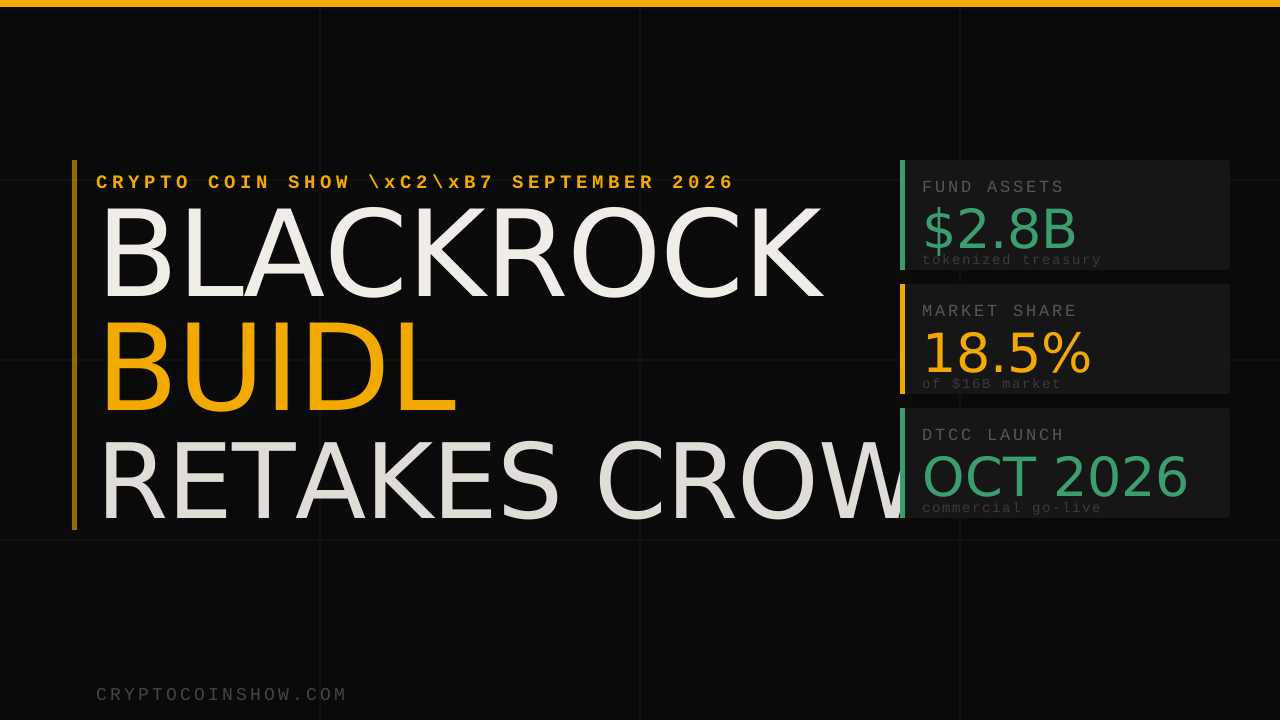
BlackRock’s iShares Bitcoin Trust has seen explosive growth since its launch in January 2024, when the SEC approved it alongside ten other spot Bitcoin ETFs. IBIT has since amassed over $86 billion in net assets, holding around 738,000 bitcoins—roughly 3.5% of the cryptocurrency’s total supply.
The continuation of institutional adoption has been a domino effect on this growth. Hedge Funds, Pension Funds, and University Endowments use IBIT to own Bitcoin without incurring the operating complexities of owning it directly. Industry analysts, including those at State Street, expect North American crypto ETFs to be the third-largest this year behind equities and fixed income, eclipsing precious-metal ETFs.
That IBIT is now one of the largest and certainly most-tracked by Wall Street algorithms, in Harvard’s endowment, speaks to how far Bitcoin has ventured from a fringe, speculative asset. It is not long before it takes its place alongside the likes of big tech in some of the world’s most conservative (and influential) portfolios.
SEC rule changes boost market appeal
While the SEC’s approval spot for Bitcoin ETFs in January 2024 was a landmark, regulators are still adjusting to shape the market. Earlier this week, the SEC allowed 25000 options contracts per ETF. The addition of IBIT to the roster as such opens this new rule up for some more multi-directional trading and hedging strategies typically favored by institutional investors.
Analysts believe the move will help channel further liquidity into Bitcoin ETFs, building on top of their obvious appeal. Harvard has already increased the amount of its endowment allocated to IBIT each year, and the change certainly strengthens.
Harvard’s investment adds to the growing list of prominent institutions that believe bitcoin will play an essential long-term role in the world economy. What was once a speculative experiment is increasingly becoming a standard part of diversified, forward-looking portfolios—even for the world’s oldest and most established academic endowments.
President Trump has moved to end debanking with an executive order that prohibits banks and federal regulators from denying financial services to Americans based on their personal beliefs.
Trump’s administration is following through with its promises to safeguard free expression, economic participation, and fairness in the U.S. financial system.
President Trump signs executive order to end politicized debanking
President Donald J. Trump has signed a sweeping executive order prohibiting banks and federal regulators from denying financial services to Americans based on political beliefs, religious affiliations, or lawful business activities.
The order, titled “Guaranteeing Fair Banking for All Americans,” directs federal banking regulators to eliminate guidelines and practices that facilitate what it calls “politicized or unlawful debanking.” The policy also targets the removal of the widely criticized “reputational risk” as a factor in bank decision-making.
The administration describes these guidelines as systemic abuses by financial institutions and regulators that have, in some cases, frozen payrolls, denied account openings, or refused payment processing to lawful individuals and businesses.
The White House fact sheet noted several examples of such cases including a major banking institution that denied ticket-payment processing for a Republican event and only reversed its decision after receiving backlash, federal regulators encouraging banks to flag individuals for transactions with companies like Bass Pro Shop or Cabela’s, or for using terms such as “Trump” or “MAGA” in payment descriptions without any evidence of criminal activity. Two major banks also allegedly denied services to Trump’s own business.
“The banks discriminate against conservatives, they discriminate against religion, because they’re afraid of the radical left, I suspect,” Trump said. “Nobody knows the banking industry better than me, and I’m not going to let them take advantage of you any longer.”
The executive order requires federal regulators to remove all language in their guidance and examination materials that supports politicized or unlawful debanking. It instructs regulators to review financial institutions for current or past policies encouraging such practices and take remedial actions, including fines or consent decrees. Cases of unlawful debanking based on religion are to be reported to the Attorney General.
The order instructs the Small Business Administration to push financial institutions under its jurisdiction to reinstate clients previously denied services for these reasons. Finally, it states that federal regulators should develop a comprehensive strategy to prevent such practices in the future, including potential legislative solutions.
The White House said the order also addresses issues raised during a Senate Banking Committee hearing earlier this year, where witnesses testified about being “debanked” for political or ideological reasons.
Trump opens retirement vehicles to crypto
Trump signed a second order, this one titled “Democratizing Access to Alternative Assets for 401(k) Investors,” which will allow more than 90 million American private-sector workers to invest in alternative assets, including digital assets, that have previously been available mainly to government employees and certain institutional investors.
Under the current system, many private sector workers with 401(k) accounts have access only to a limited selection of mutual funds and traditional investments.
According to Trump’s AI and crypto czar, David Sacks, who praised the announcement on social media platform X, the change will “allow more than 90 million American workers… to access the same range of alternative assets… that are available to government workers, for better returns and diversification.”
The White House said this move is designed to “level the playing field” between private and public sector workers and offer Americans more tools to achieve long-term financial security.
Digital asset advocates see the policy as a major win for the cryptocurrency industry, which has often struggled with access to traditional banking services. Within the cryptocurrency community, Trump’s orders are being viewed as a means to dismantle structural barriers that have hindered innovation and financial participation.
“No American should be denied access to financial services because of their political or religious beliefs,” the fact sheet states, adding that investment opportunities should not be “limited by outdated rules or unfair restrictions.”
Litecoin (LTC) shows more signs of a resurgence after a long period of sideways trading. The asset rallied close to $130 after MEI Pharma added the first batch of token to its balance sheet.
Litecoin tokens traded as high as $128.30 before retreating to around $124. One of the oldest coins is now showing signs of a resurgence based on expectations of a general altcoin season. LTC rallied ahead of other assets, remaining in the green while other coins and tokens struggled to recover their bullish direction.
As previously reported by Cryptopolitan, MEI Pharma set out to build a $100M Litecoin treasury. The recent price rally was linked to the first addition of LTC to the company’s balance. Now, MEI Pharma filed a new 8-K form with the US Securities and Exchange Commission, outlining the parameters of its first LTC purchase.
Litecoin trading volumes also recovered to a one-month high, rising above $1.7B. The recent activity once again raised the question of LTC’s future, not as a forgotten asset but as a reliable treasury token.
LTC rallied to a three-month high with peak volumes after MEI Pharma completed and announced its first treasury purchase. | Source: Coingecko
Litecoin remains one of the most widely transacted coins, with representation on major exchanges and brokerages. LTC has also remained the most popular crypto of choice on BitPay. Despite its long-running history, it failed to break out to a new all-time high. Its exposure as a treasury asset and an eventual ETF asset sparks hopes of rising to a high price range after years of depressed market prices.
MEI Pharma completed its first LTC acquisition
Two weeks after announcing its treasury plans, MEI Pharma completed its first acquisition. The company added 929,548 LTC to its portfolio for an average price of $107.58, below the current market prices.
The market did not appear to be primed for the effect of MEI Pharma, as the company managed to acquire the tokens during a recent period of depressed market prices.
The strategic LTC purchase was developed with the guidance of Litecoin’s creator and MEI board member Charlie Lee, who rejoined the project after stepping aside from leadership roles in 2018. MEI Pharma is also guided by crypto investment company GSR with robust governance and market expertise.
“Litecoin has long embodied sound, scalable, and decentralized money,’ said Lee. ‘By initiating this strategy, MEI is taking a clear, institutional step forward that recognizes Litecoin’s role as both a reserve asset and an integral part of global financial systems.”
Litecoin was launched with no premine, though earlier whales may hold significant wallets. The coin is used on Robinhood, PayPal and Venmo due to its reliability and constant uptime for 13 years.
MEI Pharma to rebrand as a Litecoin supporter
In the coming weeks, MEI Pharma will rebrand to reflect its support for LTC and its identity as a treasury company. Following the announcement, MEI Pharma shares recovered to $5.30, gaining a net 87% over the past six months.
The company aims to expand into Litecoin mining activities, in addition to long-term financial innovation. Litecoin mining remains competitive, but allows for the addition of new companies with a still accessible network. The coin reached 2.6 PH/s, close to its all-time mining peak.
MEI Pharma will retain its pre-clinical trials, testing drug candidates for additional research and true trials.
As Ethereum closes out with a scorching 57% rally, crypto insiders are already turning their gaze to what could be the top token of the summer. One ETH-based gem is quietly heating up, Mutuum Finance (MUTM), a low-price DeFi disruptor that’s generating serious buzz across Telegram and X. Over 14,800 investors have already invested in the project, and over $14 million has been raised by Mutuum Finance so far.
The project is already in Presale Phase 6 at $0.035, a 16.67% increase from Presale Phase 5. Phase 7 will also see an increase in price by 14.29% to $0.04. Now, investors can make a 71.43% return on investment when the token goes out at $0.06. While Ethereum and other majors are cooling off, the smart money is already eyeing on Mutuum Finance.
Ethereum Climbs 57% in July, Looking Toward $4,000+ as Market Shifts
Ethereum has surged approximately 57% over the past 30 days, climbing from around $2,400 to nearly $3,940 by mid‑July, before stabilizing in the $3,750–$3,800 zone. This rally has been driven by strong institutional demand, over $5 billion flowed into spot ETH ETFs in just a few weeks, and heavy accumulation by large holders, pushing total ETH held by whales to record highs while exchange reserves hit multi-year lows.
On-chain metrics support a bullish setup: shrinking liquidity, rising TVL in ETH DeFi protocols, and momentum indicators pointing toward breakout territory. Short-term resistance around $3,940–$3,965 may delay further gains, but a clear move above $4,000 is viewed by many analysts as the trigger for a broader rally into end‑of‑year targets ranging from $5,000 to $7,000+. With ETH’s fundamentals strengthening, attention is increasingly turning toward smaller, utility-driven altcoins such as Mutuum Finance.
Mutuum Finance Phase 6 Presale is Now Live
Following the presale sellout of Phase 5, Mutuum Finance has now opened Phase 6 and the tokens are trading at $0.035, which is an increase of 16.17% from the previous round.
The next price cap is at $0.04, a 14.29% increase. Phase 6 investors can reap a 71.43% profit when MUTM launches at $0.06. The presale itself has already topped over $14 million and onboarded over 14,800 individual investors thus far, testifying to the project’s burgeoning traction.
Secured by CertiK and a $50K Bug Bounty Program
Mutuum Finance (MUTM) is launching a USD-backed stablecoin on Ethereum. Aside from that, the project has a CertiK audit with a 95.0 trust score. Mutuum Finance also launched a $50,000 USDT Bug Bounty. It will reward on a four-severity basis: critical, major, minor and low.
$100,000 in MUTM Tokens Available
Mutuum Finance has launched a $100,000 giveaway that will distribute a total of $10,000 MUTM among 10 winners in gratitude for the investor’s initial belief in the project.
Ethereum’s 57% rally in July proves the market is heating up. But with ETH cooling near resistance, traders are looking elsewhere for high-upside plays. Mutuum Finance (MUTM) is one of the top ETH-based tokens gaining momentum. It’s priced at $0.035 in Phase 6, up 16.67% from the last round.
The next price will jump to $0.04, and launch is set at $0.06, giving early buyers a 71.43% return. So far, over $14 million has been raised from 14,800+ investors. With a CertiK audit, $50K bug bounty, and $100K giveaway, the project is drawing smart money fast. Act before Phase 6 ends.
For more information about Mutuum Finance (MUTM) visit the links below:
Ethereum’s path to a potential all-time high is heating up again as institutional interest spikes. According to a recent Cointelegraph report, the push for an Ethereum ETF that allows staking has created renewed excitement, especially among fund managers seeking passive yield exposure to ETH. Several analysts say the approval of a staking-enabled Ethereum ETF could be a game-changer, accelerating demand from asset managers already familiar with Bitcoin ETFs.
Galaxy Digital’s Christine Kim emphasized that ETH’s ecosystem has matured significantly since the last bull run, making it a fundamentally stronger candidate for institutional capital. With Ethereum’s staking yield offering a 4–5% annual return, traditional investors now view ETH as both a growth and yield product—a rare combination in crypto.
MAGACOIN FINANCE, another emerging altcoin, has also begun attracting early capital attention as percentage-based forecasts place it in the spotlight for huge gains.
On the XRP front, ETF speculation is also mounting. Coingape reports that Grayscale has filed a spot XRP Trust with the SEC, renewing debate over whether Ripple’s partial court victory last year could open the door for regulatory greenlighting. While a decision has yet to be made, investors are watching closely – particularly after XRP’s earlier price action showed strong upside potential when legal clarity improved.
Crypto market participants believe that if a spot XRP ETF is approved, the coin’s suppressed valuation could rapidly reverse. Traders note that XRP remains one of the few top-10 assets not to retest its prior highs this cycle, leaving room for a sharp move. Whales have recently increased their holdings, adding to the speculation that a major rally could be in play.
MAGACOIN FINANCE gains traction as forecasts show up to 18,600% upside
As Ethereum and XRP dominate headlines, speculative capital is already rotating into earlier-stage opportunities. One project attracting that momentum is MAGACOIN FINANCE, now gaining serious attention among altcoin traders. Updated market research highlights potential returns of up to 18,600% based on current valuation and community growth forecasts. The project’s consistent presale sellouts, expanding ecosystem, and viral social reach have made it a standout among low-cap altcoins.
What’s drawing comparisons to early DOGE and SHIB cycles isn’t just hype – it’s the structured utility and strategic tokenomics that analysts say could reward early participants exponentially. With whale wallets already initiatinglargetransactions, and community metrics surging, MAGACOIN FINANCE has cemented its status as a high-upside contender for those betting on the next wave of altcoin breakouts.
Which coin gets there first—XRP or Ethereum?
The race to new all-time highs between XRP and Ethereum may come down to regulatory timing. ETH has the advantage of broader institutional awareness and an ecosystem bolstered by staking. But XRP offers more “catch-up” potential if ETF approval hits and clears the way for broader U.S. exposure. That said, for retail investors seeking asymmetric opportunities, the price discovery phase of newer assets like MAGACOIN FINANCE may offer more explosive upside.
Conclusion: ETF approvals could drive surges—but early plays may outperform
Both XRP and Ethereum are positioned to benefit from potential ETF catalysts in Q3 or Q4. While their upside may depend on timing and SEC decisions, MAGACOIN FINANCE’s current valuation leaves room for up to 18,600% projected gains, making it one of the highest-potential altcoins on traders’ radars.
The average SNX price prediction for 2025 is $1.01.
In 2028, it will range between $2.36 and $2.69, with an average price of $2.53.
In 2031, it will range between $4.04 and $4.38, with an average price of $4.21.
SNX is the native token for the Synthetix Network and is used for governance. It is listed on top exchanges like Binance, Uniswap, Coinbase, OKX, and Bybit. Synthetic is a decentralized protocol that allows you to create and transact synthetic tokens on the Ethereum blockchain.
Is SNX a good investment? Will it go up? Where will it be in five years? Let’s get into the SNX price prediction and technical analysis.
Overview
Cryptocurrency
Synthetix
Abbreviation
SNX
Current Price
$0.570 (+2.07%)
Market Cap
$196.41 Million
Trading Volume (24-hour)
$9.96 Million
Circulating Supply
343.46 Million SNX
All-time High
$28.77 (Feb 14, 2021)
All-time Low
$0.03258 (Jan 5, 2019)
24-hour High
$0.5765
24-hour Low
$0.5468
SNX price prediction: Technical analysis
Metric
Value
Price Volatility (30-day Variation)
8.84%
50-day SMA
$0.630282
200-day SMA
$0.923086
Sentiment
Bearish
Fear & Greed Index
53 (Neutral)
Green Days
17/30 (57%)
Synthetix price analysis
TL;DR Breakdown:
Synthetix coin price analysis confirmed an uptrend as the price increased to $0.570.
Cryptocurrency gains 2.07% of its value.
SNX coin to face resistance around $0.580.
On August 3, 2025, Synthetix Coin price analysis revealed a bullish trend for the cryptocurrency. The altcoin’s value increased to $0.570 in the past 24 hours. From an overall perspective, the cryptocurrency gained up to 2.07% of its value. The altcoin’s price action has been bullish once again, and the market still presents a favorable outlook for investors, as the altcoin is gaining value.
SNX/USD 1-day chart: SNX continues bearish momentum at $0.624
The one-day price chart of Synthetix coin confirmed an upward market trend for the altcoin. The cryptocurrency value has increased to $0.570 over the day. A green candlestick on the price chart signifies the presence of buyers’ support at the current price level.
The distance between the Bollinger Bands defines the volatility. This distance is increasing, leading to high volatility. Moreover, the upper limit of the Bollinger Bands indicator, indicating a previous resistance, has shifted to $0.771. Its lower limit, serving as support, has moved to $0.538.
The Relative Strength Index (RSI) indicator curve is trending in the neutral zone, currently at 38.40. This situation suggests that the SNX price is increasing; however, selling pressure can take over the market as the RSI score is quite low.
SNX/USD 4-hour chart analysis
The four-hour price analysis of Synthetix Coin referred to a bearish trend in the market. The SNX/USD value has slightly decreased to $0.570 in the past few hours. The decreasing volatility is suggestive of a lesser chance of an upcoming reversal.
The Bollinger bands are converging, leading to decreasing volatility. This decrease in volatility signals a lower market unpredictability. Moving ahead, the upper Bollinger band has shifted to $0.607, marking the resistance. Its lower Bollinger band has moved to $0.543, showing support.
The RSI indicator is trending in the neutral region. Its value has dropped to index 40.73 in the past four hours. The downward curve on the RSI graph reflects returning selling pressure. The bears had been ruling the price chart for the past few hours, as the price has been slowly decreasing. This has resulted in a relatively unbalanced trading setup for investors.
SNX technical indicators: Levels and action
Daily simple moving averages
Period
Value ($)
Action
SMA 3
0.591411
SELL
SMA 5
0.612438
SELL
SMA 10
0.65191
SELL
SMA 21
0.682674
SELL
SMA 50
0.630282
SELL
SMA 100
0.70634
SELL
SMA 200
0.923086
SELL
Daily exponential moving averages
Period
Value ($)
Action
EMA 3
0.63711
SELL
EMA 5
0.641694
SELL
EMA 10
0.657004
SELL
EMA 21
0.692744
SELL
EMA 50
0.81031
SELL
EMA 100
1.043656
SELL
EMA 200
1.36736
SELL
What can we expect from the SNX price analysis next?
Synthetix Coin price analysis shows an upward trend regarding the ongoing market events. The coin value has increased to $0.570 in the last 24 hours. If the bullish momentum continues, the SNX price might retest resistance at the $0.580 level.
Is SNX a good investment?
The Synthetix rebranding in 2018 rejuvenated the ecosystem, which has grown continually with multiple listed synths. Despite concerns over the stability of its stablecoins, SNX, the native token, is set to mark new records, as seen in Cryptopolitan’s SNX price predictions from 2025 to 2031. It is expected that SNX will reach $3.82 by 2030.
Why is SNX up?
The cryptocurrency market is in a bullish mode, and SNX is following suit. From a larger perspective, the token is getting positive sentiment as the SNX price increased to $0.570, gaining 2.07% of its total value in the last few hours.
What is the target price for SNX?
The target price for SNX is $1.01 for the current year.
Will SNX reach $5?
The current price action does not justify predicting a $5 target. However, in the cryptocurrency market, things change rapidly, and if the token maintains its price levels, a recovery can be initiated. It can be expected that SNX will reach near $5 by 2031.
Will SNX reach $6?
According to SNX price prediction, SNX will reach near the $6 level after 2031. The last time SNX was seen at the $6 level was April 2022.
Will SNX reach $10?
According to crypto analysts’ price predictions, SNX may not reach this level in the next five years. Considering the current market cap of the token, it seems like far target.
Will SNX reach $100?
No, market analysts don’t expect SNX to reach $100 during the next 10 years.
How high can SNX go?
The highest expected price for SNX is $4.38, which it will achieve in 2031.
Does SNX have a future?
SNX is trading significantly lower than its mid-December price levels, making it an ideal time for buyers to enter the market. Given its current low price and a favorable future valuation of $4.38 by the end of 2031, the asset appears to be a worthwhile investment.
Recent news/ updates on SNX
Synthetix Network said in a post that it is ending its L2 (Layer 2) experiment. In the future, only L1 will be available to users, as most users voted for a 50% increase in the L1 gas limit to 45 million. The network said that the gas limit is already increasing and is now at 37.3 million.
This month, SNX is expected to reach a high of $0.786, with an average price of $0.627 and a minimum trading price of $0.455.
Month
Potential Low ($)
Potential Average ($)
Potential High ($)
August
$0.455
$0.627
$0.786
SNX price prediction 2025
The price of SNX is predicted to reach a minimum value of $0.372 by Q4 of 2025. Traders can anticipate a maximum value of $1.01 and an average trading price of $0.841715.
Year
Potential Low ($)
Potential Average ($)
Potential High ($)
2025
$0.372
$0.841715
$1.01
SNX price prediction 2026 – 2031
Year
Potential Low ($)
Potential Average ($)
Potential High ($)
2026
1.23
1.40
1.57
2027
1.80
1.96
2.13
2028
2.36
2.53
2.69
2029
2.92
3.09
3.25
2030
3.48
3.65
3.82
2031
4.04
4.21
4.38
Synthetix price prediction 2026
The year 2026 will experience more bullish momentum. According to the SNX price prediction, it will range between $1.23 and $1.57, with an average trading price of $1.40.
Synthetix price prediction 2027
The Synthetix Network token price prediction climbs even higher into 2027. According to the projections, the price of SNX will range between $1.80 and $2.13, with an average of $1.96.
Synthetix price prediction 2028
According to our Synthetix Network token price prediction for 2028, we expect a maximum price of Synthetix to be $2.69, a minimum price of $2.36, and an average price of $2.53.
Synthetix price prediction 2029
According to the Synthetix price prediction for 2029, the price of SNX will range from $2.92 to $3.25, with an average price of $3.09.
Synthetix price prediction 2030
The Synthetix Network token price prediction for 2030 indicates the price will range between $3.48 and $3.82. The average Synthetix price forecast is $3.65.
SNX price prediction 2031
The Synthetix forecast for 2031 is a high of $4.38. According to the SNX coin price prediction, it will reach a minimum price of $4.04 and average at $4.21.
Our analysis shows that SNX has been highly volatile since its historical listing price. It remains unpredictable at current levels, with predictions indicating it will break out higher. SNX will achieve a high of $1.01 by the end of 2025. SNX is expected to trade between $1.23 and $1.57 in 2026. In 2031, SNX will be priced between $4.04 and $4.38 with an average price of $4.21.
Kain Warwick launched Synthetix in September 2017 under Havven (HAV).
The HAV Airdrop Campaign ran between 4 and 14 February 2018 and offered two million tokens for around $1 million.
On November 30, 2018, Synthetic announced its rebranding from Havven. This included renaming its native token, HAV (Havven token), to SNX. The contract address did not change.
It registered its lowest price at $0.03258 on January 5, 2019.
Different from most mega-altcoins, SNX did not rally after launch; it consistently traded below $0.5 until the last quarter of 2019.
In 2020, it made a mega rally to $7.3. In the 2021 bull cycle, it shot higher, and on February 14, it registered its all-time high at $28.77.
It reversed to $5 in July before pumping again to $15 in September.
In the 2022 crypto winter, SNX shed most of its value as it retreated to the $2 mark by the end of the year.
In 2023, it consistently traded between $1.5 and $3 until the last quarter, when it had its break.
In March 2024, SNX reached a high of $5; in July, SNX came down from the $2.01 to $1.65 range.
In August 2024, the SNX token’s price dipped as low as $1.20, and September saw a maximum price of $1.71.
In October 2024, SNX dipped and became rangebound. It closed the month with a $1.31 price tag, while December saw a stream of improved prices with a peak price of $3.38.
During the remainder of December, SNX kept shedding its value, and it entered 2025 with a wave of correction to $1.90.
The average price of the SNX token was 1.74 in January and has since corrected to $1.20 in February.
In March, SNX price declined to $0.89, and in April it further descended to the $0.77 range.
In May 2025, it saw some recovery to $0.926, improving its market capitalization, and in July, the token peaked at $0.781.
At the start of August, SNX is trending near $0.56, as the current Synthetix sentiment is bearish.
US Solana ETFs are one step closer to becoming a reality. On Wednesday, asset managers Grayscale and VanEck filed amended S-1 documents with the Securities and Exchange Commission (SEC).
These filings have such critical data as fund fees, custodians, staking models, and operational specifics. Market watchers said these updates represent a significant move closer to regulatory approval.
If the ETFs are approved, they would be the first available to mainstream US investors to directly expose them to Solana (SOL), the fifth-largest cryptocurrency by market capitalization.
Grayscale’s proposed fund, the Grayscale Solana Trust ETF, will trade under the ticker GSOL on NYSE Arca, one of the largest US exchanges for trading securities.
According to the amended filing, the ETF will boast a 2.5% annual sponsor fee—a lofty fee compared with traditional ETFs but roughly in line with Grayscale’s other crypto products. The trust’s custodian will be Coinbase Custody, a qualified digital asset storage solutions provider.
Interestingly, it won’t permit in-kind redemptions or creations at inception either. Instead, it is designed to follow a cash model, so authorized participants will create and redeem shares with US dollars. Liquidity providers can convert that cash to SOL to align it with the fund’s net asset value (NAV).
Grayscale will value GSOL based on the CoinDesk SL50 Index, a market benchmark that measures the price of Solana across major cryptocurrency exchanges. This would provide transparency and an equitable price.
Grayscale noted that the ETF will hold SOL passively and not use derivatives, lend, or trade to accumulate cryptocurrency. Staking is not included at launch, though Grayscale has left open the possibility of including it in the future, subject to its so-called “Staking Condition.”
VanEck to Lower Fees and Opt for Staking on VSOL
VanEck’s new proposal is a more aggressive pitch for innovation. The VanEck Solana Trust fund will be listed under the ticker VSOL on Cboe BZX, pending regulatory approval.
VanEck charges a more aggressive 1.5% annual sponsor fee, well below Grayscale’s. It’s a model that could appeal to cash-strapped institutional and retail investors alike.
VanEck’s filing is unique among US-based crypto ETFs, including staking of SOL from the start.
To mitigate risk, VanEck added that it will have stringent criteria to select staking validators, such as performance metrics, slashing history, and security certifications.
The ETF starts with regular staking first, but VanEck is already ready to scale. The company revealed that it might integrate liquid staking tokens (LSTs) in the future, once the regulatory framework is clearer. These can be symbols that enable users to stake assets and maintain liquidity — a common theme in the DeFi world.
Gemini Trust Company and Coinbase Custody will share the custody of the Solana tokens for the VanEck trust.
SEC advances review process for Solana ETFs
The filing of these amended S-1s is critical in the process. It indicates that, as both Grayscale and VanEck, they likely have both had initial responses from the SEC and are moving in the right direction towards compliance.
According to experts in the world of the cryptocurrency industry, it is a reflection of the broader trend.The SEC has shown an increasingly open stance towards crypto investment products.It prefers those that emphasize transparency, custody security, and investor safety following the groundbreaking spot Bitcoin ETF approval in January 2025.
Both Solana ETFs are in the form of grantor trusts, which is a structure that other Bitcoin and Ethereum funds use.This would exempt them from the Investment Company Act 1940 and the Commodity Exchange Act.As a result, they won’t be subject to the same restrictions as mutual funds or commodity pools.
Grayscale and VanEck hope to capitalize on rising demand for Solana’s high-speed, low-cost blockchain, which is used for decentralized applications (dApps), gaming, and tokenized assets.
KEY Difference Wire helps crypto brands break through and dominate headlines fast
The US Securities and Exchange Commission (SEC) has approved in-kind creations and redemptions for two crypto ETPs, which will pave the way for these products to be made available to the public on exchange platforms.
The new rule allows investors to exchange real Bitcoin or Ether for shares of the ETF, and vice versa. The shift means that digital asset ETFs will now be on the same operational status as traditional commodity ETPs, adds the SEC, and will further create a more level playing field and an element of consistency across derivative-based investment products.
SEC Chairman Paul S. Atkins confirmed the change in his statement on X: “I am pleased the Commission approved these orders permitting in-kind creations and redemptions for a host of crypto asset ETPs. Investors will benefit from these approvals, making these products less costly and more efficient.”
In its press release, Jamie Selway, the SEC’s Division of Trading and Markets director, echoed similar sentiments. He said the announcement was a positive development for the developing crypto ETP market, as this operational change offers additional flexibility and could mitigate investor costs.
The SEC’s action comes in response to a mounting push from issuers such as BlackRock, Fidelity, and Grayscale, which had lobbied for more traditional fund structures for their spot crypto ETFs. It also comes just days after the agency formally requested public comment on a Nasdaq filing for staking options for BlackRock’s spot Ethereum ETF, providing further evidence of a move toward regulatory approval of riskier crypto features.
SEC revises restrictions and expands options for crypto ETPs
The vote on in-kind redemptions was one of several significant regulatory decisions made. The SEC also cleared a new model for trading options for spot Bitcoin ETFs. That includes introducing FLEX options and customizable derivatives, allowing market participants more say in the contract characteristics, including strike price, expiration date, and exercise style.
In the most headline-catching move, the SEC raised the position limit for Bitcoin ETF options from 25,000 to 250,000 contracts. The step leads to enhanced liquidity and increased participation by institutional investors in the derivatives segment.
In apost on X, Bloomberg ETF analyst Eric Balchunas highlighted what it all means, airing comments from an anonymous ETF issuer who wrote in to say, “This is huge… and will create an explosion of option-based Bitcoin ETFs.”
The SEC said that these changes are now effective. The regulator is broadening the accessibility and range of cryptoderivative financial products to build a stronger investment framework for wading into digital assets via fiat-based, orderly markets.
Meanwhile, the market’s evolution indicates a maturing crypto ecosystem in which derivatives products and alternative structures are essential to price discovery, hedging strategies, and market growth.
SEC paves the way for altcoin wave with crypto ETPs, analyst predicts
Market watchers say the approval indicates a wider strategic pivot toward deeper crypto integration in the traditional financial system. Bloomberg’s James Seyffart pointed out that by approving in-kind processes on Bitcoin and Ethereum ETFs, the SEC paves the way to future altcoin ETFs—such as those based on Solana, Avalanche, or Cardano—to follow suit.
In-kind redemption and creation features could be built in for new ETF applications from the beginning, making them more interesting to sophisticated investors and offering the cost-efficient arbitrage and better price tracking they offer.
This new attitude comes amid mounting political and institutional support for regulating crypto. The recently enacted Genius Act, which was signed into law by President Donald Trump, brings financial accountability into the 21st century and embraces technology-centric policy. This legislation likely incentivizes the SEC to become more accommodating and creative on digital assets.
The in-kind decision also promotes price transparency and makes it easier for ETFs to represent the real-time value of their underlying crypto assets. That’s a win for investors, who enjoy narrower bid-ask spreads and fewer tracking errors.
Your crypto news deserves attention – KEY Difference Wire puts you on 250+ top sites
Flow coin price prediction for 2025 could reach a maximum value of $ 0.9203.
By 2028, FLOW could reach a maximum price of $1.77.
In 2031, FLOW will range between $4.59 to $5.54.
Flow coin, the native token of the Flow blockchain created by Dapper Labs, is essential for powering decentralized applications (dApps) and digital assets. Flow aims to provide a high-performance, user-friendly platform that tackles scalability without sacrificing decentralization. Its unique architecture allows developers to build secure and efficient smart contracts.
FLOW, its native token, has several key uses within the ecosystem, including paying transaction fees, staking, and participating in network governance. The growing number of dApps and users on the platform drives demand for Flow coin, influencing FLOW’s price movements.
Given Flow coin’s strong fundamentals and growing support levels in the ecosystem, the question arises: how high can FLOW go? What will FLOW price be in 2025?
Overview
Cryptocurrency
Flow
Token
FLOW
Price
$0.3943
Market Cap
$630.1M
Trading Volume
$34.82M
Circulating Supply
1.59B FLOW
All-time High
$46.16
All-time Low
$0.2916
24-hour High
$0.4298
24-hour Low
$0.3932
Flow coin technical analysis
Metric
Value
Volatility (30-day Variation)
11.08%
50-Day SMA
$0.3698
14-Day RSI
62.55
Sentiment
Neutral
Fear & Greed Index
75 (Greed)
Green Days
19/30 (63%)
200-Day SMA
$0.4319
Flow coin (FLOW) price analysis
TL;DR Breakdown
FLOW broke below key support at $0.406 with MACD turning negative.
Short-term indicators show heavy selling volume.
The critical support for FLOW lies at $0.380-$0.385.
Flow coin 1-day price analysis: FLOW sees a breakdown from consolidation pattern
The FLOW/USDT 1-day price chart for July 28 shows that the coin has experienced a significant technical breakdown, falling from $0.458 to the current level of $0.394. The token has broken below critical support levels that had been holding since mid-July, with the price now trading beneath the middle Bollinger Band at $0.406.
The breakdown occurred after FLOW failed to sustain momentum above the upper Bollinger Band resistance near $0.458, creating a classic rejection pattern that has now led to a cascade lower. The MACD indicator has turned decisively bearish with the signal line crossing below the MACD line, while the histogram shows increasing negative momentum that suggests the selling pressure is accelerating.
FLOW maintains its bearish pattern on the 4-hour timeframe, with price action showing a clear breakdown from what appeared to be a consolidating range between $0.420-$0.425. The token has fallen through the 20-day SMA at $0.414 and is now testing the psychological support level at $0.390, which coincides with recent swing lows.
The On-Balance Volume indicator has plummeted to -37.93M, indicating that the recent selling has been accompanied by substantial volume, which adds credibility to the bearish move and suggests distribution. The price structure shows lower highs and lower lows forming, with each bounce getting weaker and failing to reclaim previous support levels that have now turned into resistance.
FLOW technical indicators: Levels and action
Daily simple moving average (SMA)
Period
Value
Action
SMA 3
$0.3934
SELL
SMA 5
$0.4088
SELL
SMA 10
$0.4235
SELL
SMA 21
$0.4042
SELL
SMA 50
$0.3698
BUY
SMA 100
$0.3882
BUY
SMA 200
$0.4319
SELL
Daily exponential moving average (EMA)
Period
Value
Action
EMA 3
$0.3887
BUY
EMA 5
$0.3798
BUY
EMA 10
$0.3752
BUY
EMA 21
$0.3797
BUY
EMA 50
$0.4151
SELL
EMA 100
$0.4846
SELL
EMA 200
$0.5644
SELL
What to expect from Flow?
FLOW appears positioned for further downside testing, with immediate support at $0.380-$0.385 and potential deeper retracement toward $0.350 if current support fails. The combination of broken trend support, bearish momentum indicators, and high-volume selling suggests this move lower has legs, though oversold conditions may provide temporary bounces that should be viewed as selling opportunities rather than reversal signals.
Is FLOW a good investment?
Flow coin has potential as an investment due to its strong partnerships with major brands and its focus on powering decentralized applications, especially in the NFT and gaming spaces. However, like all cryptocurrencies, it carries significant volatility and risks, so investors should carefully consider market conditions and risk tolerance before investing.
Will FLOW reach $1?
The $1 price mark is within range, having reached that level in early December 2024. Renewed buyer interest could push FLOW to $1 and above in the coming months.
Will FLOW reach $5?
This level has not been achieved since February 2022. For FLOW to recapture the $5 levels, significant cash inflows will be required.
Can FLOW reach $50?
FLOW has previously reached an all-time high (ATH) of $46.16, so reaching $50 is achievable. However, a significant bull run and tangible ecosystem updates are required to achieve this feat, as the coin is currently 98% below its ATH.
Is Flow a good blockchain?
Flow is a solid blockchain, especially for gaming and NFTs. It is designed for scalability, fast transactions, and low fees. The network’s unique multi-role architecture improves efficiency without compromising decentralization.
However, it faces fierce competition, and adoption levels are not as high as those of Ethereum and Solana.
Does FLOW have a good long-term future?
Projections suggest substantial growth over the coming years, with a potential peak of $3-$4 by 2031. This positive outlook reflects a strong potential for sustained value appreciation and continued market relevance.
Flow blockchain is seeing massive growth in DeFi, with TVL reaching $80.53M and wrapped FLOW at 46.64M. Additionally, Flow has gone live on the multi-chain DEX @hitdex, expanding DeFi capabilities with non-custodial wallets.
Plus, Flow is live on @hitdex — a multi-chain DEX with non-custodial wallets via social platformshttps://t.co/lpRnhfa14I
— Token Relations 📊 (@Token_Relations) July 3, 2025
Flow coin price prediction July 2025
Per expert opinion, the Flow predictions for July 2025 suggest a minimum price of $0.3100, an average price of $0.3747, and a maximum price of $0.482.
FLOW price prediction
Minimum Price
Average Price
Maximum Price
FLOW price prediction July 2025
$0.3100
$0.3747
$0.482
Flow price prediction 2025
The price of Flow in 2025 is a minimum price of $0.2900, an average price of $0.4315, and a maximum price of $0.9203.
FLOW price prediction
Minimum Price
Average Price
Maximum Price
FLOW price prediction 2025
$0.2900
$0.4315
$0.9203
Flow coin price predictions 2026 – 2031
Year
Minimum Price ($)
Average Price ($)
Maximum Price ($)
2026
0.5085
0.7282
1.17
2027
0.89
1.05
1.25
2028
1.55
1.6
1.77
2029
2.2
2.28
2.69
2030
3.19
3.31
3.79
2031
4.59
4.76
5.54
Flow coin price prediction 2026
Flow’s price prediction indicators for 2026 indicate a potential peak of $1.17, a minimum price of $0.5085, and an average trading price of $0.7282.
Flow coin price prediction 2027
Flow network price predictions for 2027 suggest a prevailing bullish market sentiment. Investors can anticipate a maximum price of $1.25, a minimum price of $0.89, and an average market price of $1.05.
Flow coin price prediction 2028
Investors could see significant profit opportunities based on the 2028 Flow coin price prediction. Expert projections anticipate the asset’s price reaching a peak price of $1.77, maintaining an average price of $1.6, and a minimum price of $1.55.
Flow coin price prediction 2029
The Flow cryptocurrency price prediction for 2029 suggests a maximum trading price of $2.69, an average price of $2.28, and a minimum price of $2.2.
Flow price prediction 2030
The Flow price forecast suggests a notable appreciation in value in 2030, with a projected peak price of $3.79. Additionally, traders can expect an average FLOW price of $3.31 and a minimum price of $3.19.
Flow crypto price prediction 2031
The Flow prediction for 2031 suggests a maximum trading price of $5.54, an average price of $4.76, and a minimum price of $4.59.
Cryptopolitan’s FLOW forecast highlights a positive outlook over the coming years. For 2025, the coin is expected to range from $0.38 to $0.92. By 2028, the Flow price forecast suggests the coin could reach as high as $2 while maintaining an average price of $1.52. Looking forward to 2031, investors can expect FLOW to reach a maximum price of $5.2 and an average price of $4.30.
FLOW coin showed early potential in 2020, with prices ranging from $0.30 to $29.96 and closing the year at $9.75.
In 2021, the price peaked at $46.16 in March but declined to $8.8 by year-end. The volatility continued in 2022, fluctuating between $1.5 and $8.11, with a close at $2.71.
In 2023, the price ranged from $0.4372 to $1.27, closing at $0.8994.
The coin started in 2024 at $0.6538 and $1.69, experiencing highs and lows before stabilizing at $0.58 – $0.61 by August. In September, FLOW reached $0.6367; in October, it traded between $0.5073 and $0.5175.
In November 2024, Flow reached a peak price of $1.0242; in December, it reached a maximum price of $1.271 and closed the year at $0.697.
In January 2025, FLOW maintained a range of $0.599 – $0.851; in February, it peaked at $0.555; in March, it dipped, trading between $0.3739 and $0.3899. April and May showed some gains, with FLOW reaching as high as $0.4161 and $0.4765, respectively. Prices were flat in June, maintaining a trading range of $0.2915 and $0.3996.
In July 2025, FLOW is trading between $0.3939 and $0.4297.
BlackRock’s iShares Bitcoin Trust (IBIT) has made financial history as the fastest ETF to reach $80 billion in assets under management (AUM).
BlackRock’s iShares Bitcoin Trust (IBIT) gathered $80 billion in AUM in just 374 days since launch, making for the most rapid ascent to that figure in ETF history.
According to SoSoValue data, IBIT saw $448 million in net inflows on July 10. On the same day, trading volume exceeded $5.39 billion, reflecting strong liquidity and sustained investor demand. The ETF’s net asset value is $80.11 billion, with each share trading around $64.50.
These numbers represent not just a lot of money going into IBIT, but also the inclination of Bitcoin’s market value. IBIT now owns over 700k BTC and is one of BTC’s largest institutional holders. This holding represents around 3.55% of the total amount of Bitcoin.
The fund was doing well amid a spurt in investor confidence in Bitcoin and the demand for exposure in a secure, regulated form. Unlike having Bitcoin directly under management, these ETFs, like IBIT, mean you can gain exposure without handling wallets or private keys, making them an attractive prospect for institutional/traditional investors.
IBIT outpaces traditional ETFs and gold
Though the meteoric trajectory of IBIT has no precedence in the crypto space, it has also outperformed the most successful traditional ETFs.
IEFA required 2,034 days to achieve the same level while IEMG required 2,089 days. In contrast, the BlackRock Bitcoin ETF achieved this in just over a year. However, and in complete contrast, IBIT pulled off the task within a little over a year.
According to Bloomberg analyst Eric Balchunas, the growth was “historic,” noting that IBIT hit the AUM milestone five times faster than any other fund. He also pointed out that the combined total AUM for all US-listed spot Bitcoin ETFs has topped over $140 billion for the first time.
The BlackRock Bitcoin ETF has also beaten gold to the accumulation finish line. It has taken in $70 billion AUM five times faster than gold-backed EFTs captured that level. This is a sign that more and more people are treating Bitcoin not as a risky bet, but are comparing it to something like traditional commodities in being a store of value.
This change is crucial, as international financial uncertainty encourages investors to find alternative methods to protect themselves against inflation and fiat currency fluctuation. Bitcoin, the “digital gold,” is being looked at in some quarters as a rival to physical gold in institutional portfolios.
Another major milestone has been reached: BlackRock’s IBIT is home to more than 700k BTC. This puts the firm on course to top the estimated holdings of Bitcoin’s enigmatic creator, Satoshi Nakamoto, who is thought to have as much as 1 million BTC. If the current pace of accumulation continues, BlackRock would exceed that amount by 2026.
Today, IBIT is the 21st largest ETF in the world — a stunning accomplishment for an upstart newcomer. Its success has reset the baseline for how swiftly a crypto-related financial product can earn trust and traction on Wall Street.
This shift mirrors a fundamental change in the relationship between digital assets and traditional financial systems. Institutional players hesitated to get involved with crypto for years, citing volatility, lack of regulation, and security issues. However, the approval of spot Bitcoin ETFs, particularly one that Forbes reported was backed by BlackRock, the world’s largest asset manager, opens a new chapter.
With ongoing interest from pension funds, family offices, and big wealth managers, the fund will likely experience even bigger inflows as Bitcoin becomes more mainstream in finance.
KEY Difference Wire: the secret tool crypto projects use to get guaranteed media coverage