
[PRESS RELEASE – Amsterdam, Netherlands, July 10th, 2026]
NOWPayment believes the crypto industry has accepted unnecessary costs for too long – and that businesses no longer have to. For years, paying blockchain fees has been treated as the price of sending crypto.
According to Kate Lifshits, CEO of NOWPayments, it’s time to challenge that assumption. “Why does sending crypto still feel harder than sending an email?”
The company’s latest zero-fee payout infrastructure replaces wallet-based transfers with instant email-based payouts, enabling businesses to eliminate network fees, reduce operational complexity, and automate payouts at scale.
Crypto Payouts Have Become Unnecessarily Expensive
Most businesses still operate payout infrastructure designed around blockchain wallets. That means collecting wallet addresses, validating networks, recovering failed transactions, paying blockchain fees, and handling recipient support.
At scale, these problems become one of the largest hidden operational costs for affiliate platforms, marketplaces, gaming companies, payroll providers, cashback platforms, creator economies, and fintech businesses.
“The market has spent years competing over who can charge less per payout. We are asking a more important question: why should businesses pay per payout at all?” – Kate Lifshits NOWPayments CEO
The Industry Is Paying for Problems It No Longer Needs to Have
Instead of requesting wallet addresses, companies simply use an email address as the payout destination. Recipients automatically receive access to their funds, while businesses avoid wallet validation, blockchain confirmation delays, and transaction fees.
Benefits include:
Zero network fees
Zero service fees
Under-one-second delivery
Automated onboarding
Fewer failed payouts
Lower support costs
The Biggest Impact Isn’t Technical
Although the release introduces API support, the larger story is economic rather than technical. Businesses making thousands of payouts can dramatically reduce operational costs while simplifying finance workflows. Payouts become a growth and engagement tool instead of a recurring expense.
Operational Cost Mitigation Analysis
The actual savings depend on payout volume, blockchain network fees, and the cryptocurrencies being used. While some businesses may save thousands of dollars annually, organizations processing hundreds of thousands or even millions of payouts could reduce costs by hundreds of thousands of dollars each year.
To help businesses estimate their own potential savings, NOWPayments has launched a Zero-Fee Crypto Payout Savings Calculator, allowing companies to compare their current payout costs with the potential cost of switching to zero-fee email-based payouts.
“The future of crypto payouts is not wallet-to-wallet. It is person-to-person: identified by email, delivered instantly and free to move inside the ecosystem. Anything more complicated is legacy infrastructure.” – Kate Lifshits
Built for Businesses That Pay at Scale
The solution is designed for affiliate networks, marketplaces, gaming platforms, payroll providers, cashback programs, creator platforms, and fintech companies. Businesses can automate payouts globally using only an email address while maintaining existing workflows.
Conclusion
NOWPayments believes crypto payouts are entering a new phase. Instead of optimizing fee-based infrastructure, businesses can eliminate many of the costs and operational barriers traditionally associated with blockchain payouts. The question is no longer how to reduce payout costs – but whether those costs should exist at all.
About NOWPayments
NOWPayments is a global crypto payment gateway helping businesses simplify digital asset payments and payouts through enterprise-ready infrastructure. Supporting 350+ cryptocurrencies, 30+ stablecoins, and a comprehensive suite of APIs, payment tools, and payout solutions, NOWPayments enables companies worldwide to accept crypto, automate payouts, and scale their payment operations with speed, flexibility, and reliability.
GenLayer Foundation and a cohort of crypto firms, including MetaMask, OKX, Matter Labs’ ZKsync and 0G Labs have backed the launch of Internet Court, an open standard that handles escrow funds and settles contract disputes for AI agents.
What is Internet Court for AI agents?
According to GenLayer, Internet Court is a standard to connect agentic protocols into one lifecycle: discovery and reputation, negotiation, contracts, payment and escrow, execution, and lastly verification and disputes.
To date, the agentic commerce development has occurred across multiple layers and different protocols. Coinbase’s x402 settles payments, A2A takes care of agent-to-agent negotiation, and the ERC-8004 standard handles agent identity.
What GenLayer is pitching Internet Court as is the venue to resolve the unavoidable situation where two agents read the same contract differently.
Internet Court runs on Intelligent Contracts, which are agreements that combine code, natural language, and outside information scored by validators powered by different large language models.
Who is on the team?
The founding team includes GenLayer Labs, Matter Labs’ ZKsync, the exchange OKX, MetaMask, and 0G Labs.
MetaMask has a concrete role in all of this. Internet Court is built on the MetaMask Smart Accounts Kit, using ERC-7710 delegations and MetaMask’s x402 Facilitator to give agents spending authority that is bounded and revocable.
“AI Agents are becoming a core part of how commerce works,” said Ryan McPeck, Smart Accounts Lead at MetaMask, describing the account and payment rails as what the agent economy needs underneath it.
Matter Labs is supplying the chain. “It gives agentic commerce a complete standard, from settlement to the resolution of inevitable disputes, and the chain powering it runs on the ZK Stack,” said Vassilis Tziokas, the company’s VP of growth.
What it looks like in practice
There are three cases of Internet Court in application: In the first case, an owner funds an agent through a MetaMask smart wallet capped to a single merchant and budget, while a GenLayer reviewer checks each purchase against a plain-language mandate such as “sports news only” and revokes the agent’s access on-chain if it drifts off course.
In the second case, Internet Court makes a small service agreement enforceable. An agent buying AI inference and paying per token in USDC can hold the payment in escrow against agreed terms, say 99.5% successful responses and sub-800-millisecond latency. The contract docks the payout automatically and releases the rest, no support ticket, if the provider misses.
A third case involves the handling of contested records. Collective Memory, one of the consortium partners, runs a staked layer of timestamped, first-person accounts of real events, and a GenLayer validator panel can rule on which competing records hold up as evidence, with the reasoning and any dissent recorded on-chain.
Why launch now?
The pitch rests on scale and speed. The group cites McKinsey figures projecting AI agents will mediate $3 trillion to $5 trillion in consumer commerce worldwide by 2030, up to $1 trillion of it in the US. Adobe data it references showed traffic from generative AI tools to US retail sites climbing 4,700% year over year in July 2025.
Human courts were not built for that tempo. The consortium notes that complex civil disputes in the US take an average of 344 days to resolve, a pace that makes sense for parties with bodies and patience but not for software settling thousands of micro-deals a second.
Internet Court is not the only group chasing this problem. In June, the American Arbitration Association and Integra Ledger released the Legal Context Protocol, an open standard for attaching verifiable legal terms to agent transactions, with Google, IBM, and Circle among its founding contributors. The competing efforts point at the same hole from different sides: agents can now pay each other faster than any existing system can referee them.
The standard is open and openly governed, with any agent free to adopt it now.
Don’t just read crypto news. Understand it. Subscribe to our newsletter. It’s free.
BONK DAO has confirmed that attackers drained an estimated $20 million worth of BONK tokens from its treasury through a malicious governance proposal.
The stolen funds have reportedly started moving to exchanges, prompting the project to coordinate with exchanges, the Solana Foundation, and law enforcement in an effort to recover the assets.
BONK DAO Confirms $20M Governance Attack
BONK DAO has become the latest victim of a high-profile decentralized governance attack after confirming that approximately $20 million in BONK tokens was drained from its treasury.
BonkDAO was the target of a malicious governance proposal resulting in an estimated $20M worth of BONK tokens being drained from the BonkDAO treasury.
During the investigation, BonkDAO identified the exchange wallets used to purchase BONK ahead of the proposal. BonkDAO is…
According to the project’s official statement, the attacker successfully passed a malicious governance proposal, allowing treasury funds to be transferred to wallets under their control. BONK said it has already identified the exchange wallets used to accumulate voting power before the proposal was executed.
The team is now working alongside exchanges, the Solana Foundation, bridges, and law enforcement to track the stolen assets and explore recovery options.
How the Attack Worked
Preliminary on-chain analysis shared by blockchain investigators suggests the attacker purchased roughly $4 million worth of BONK to secure enough voting power for the proposal.
Once approved through BONK DAO’s governance system on Solana’s Realms platform, the proposal authorized the transfer of an estimated $20 million from the DAO treasury.
Unlike a smart contract exploit, the incident appears to be a governance attack, where token-weighted voting was used to legitimately approve a malicious treasury transaction.
Reports also indicate that portions of the stolen BONK have already begun moving to cryptocurrency exchanges, raising concerns that the attacker may attempt to liquidate the holdings.
What’s Next for BONK?
The investigation remains ongoing, with BONK stating that recovery efforts are underway.
The incident is expected to renew industry debate over DAO governance security, particularly around safeguards such as timelocks, multisignature approvals, and treasury execution delays designed to prevent single governance proposals from draining protocol funds.
Investors will now be watching for updates on potential fund recovery, exchange actions, and whether BONK introduces governance reforms to strengthen treasury protection.
Perceptron’s $10M Fund Is Quietly Changing Who Gets to Build with AI — CCS ExclusiveCCS Exclusive · Blockchain InterviewsJuly 5, 2026
Perceptron Network
Perceptron’s $10M Fund Is Quietly Changing Who Gets to Build with AI
In an exclusive interview with the Crypto Coin Show, co-founder Peter Anthony explains how a decentralized data network and a new $10 million AI Data Fund are handing smaller teams a resource only tech giants could previously afford.
AA
Ashton Addison
Host, Crypto Coin Show · Blockchain Interviews
The AI data market has a monopoly problem. Google and OpenAI paid hundreds of millions of dollars to Reddit for access to its user-generated content. None of that reached the people who actually wrote the posts. And if you’re a new AI startup trying to train a competitive model, the cost of quality data alone is enough to stop you before you start.
Perceptron Network — a decentralized AI data infrastructure company with over 800,000 user-run nodes across 150+ countries — was built to fix exactly that. In a wide-ranging conversation on the Crypto Coin Show, co-founder Peter Anthony laid out how the network works, who it’s for, and why the newly launched $10M AI Data Fund could be one of the most consequential moves in the Web3 AI space this year.
800K+Node downloads globally
150+Countries in the network
10 TBAvg. daily bandwidth
$10MAI Data Fund launched
The Problem with Centralized Data
Every minute of every day, the average person generates roughly 1.3 megabytes of data per second. That data, the way you interact with social platforms, the searches you run, the content you engage with, is the raw material AI models are built on. The existing frontier models have already scraped the historical internet: around 750 trillion tokens spanning forums, Reddit threads, Twitter archives, and beyond.
But the historical layer is already gone. The real frontier of AI training data is what we’re producing right now, today. And that’s where Perceptron comes in.
“If you charge huge amounts of money, only OpenAI and Anthropic and a handful of others are going to be able to afford to pay those data costs. If you are a new upcoming AI project, you’re never going to be able to access that quality of data.”
— Peter Anthony, Co-Founder, Perceptron Network
Traditional data acquisition runs through APIs: Twitter’s, Reddit’s, LinkedIn’s. These platforms know exactly how valuable their content is, and they price it accordingly. The result is a market where only the largest, best-funded AI labs can stay current. Everyone else is building on stale data, or no meaningful data at all.
How the Network Works
The Perceptron model flips this dynamic by distributing data collection across its node network. When a user installs the node (available as a Chrome extension or on Android and iOS) they’re sharing excess bandwidth. The node doesn’t collect personal data; it gives Perceptron a vantage point on the internet from that user’s IP address and location.
Scale that across 800,000 nodes spanning 150 countries, and you have something centralized providers genuinely cannot replicate: a live, globally distributed lens on what the internet looks like from real human perspectives, right now. Anthony drew a sharp distinction between what large tech platforms do with user data (package and sell it for hundreds of millions) and what Perceptron offers: a share of that value back to the people generating it.
Two Ways to Earn
One of the clearest takeaways from the interview is that Perceptron is designed for both casual and active contributors. The earning model runs on two distinct tracks:
PASSIVE
Run a Node
Install the extension or app, share idle bandwidth in the background, and accumulate points automatically. Your unused data capacity does the work while you sleep.
ACTIVE
Complete Data Quests
Opt into specific tasks — annotating images, contributing voice recordings, labeling datasets, photographing locations — and earn significantly higher rewards. Rare skills and uncommon languages command premium payouts.
TIERED
Build On-Chain Reputation
Contribution quality is tracked on-chain. The more accurately you contribute, the higher your tier and the higher-value quests you unlock. Expert contributors in specialized fields are especially rewarded.
Right now, contributors earn points, pre-TGE accrual ahead of the $PERC token launch. Anthony suggested the token goes live within 8 to 10 weeks, potentially sooner, at which point those points convert directly. Getting in early means building a balance before the conversion rate is set and the network effect compounds.
Quality Control at Scale
A natural question for any crowdsourced data platform is how you prevent gaming: rushing through tasks, submitting junk to collect rewards. Anthony was direct. The platform uses AI to validate submissions before they enter the dataset. For image-based tasks, the system first trains on what a valid submission looks like, then evaluates every incoming entry against that benchmark. Sloppy-but-genuine attempts are treated differently from clear bad-faith submissions; penalties are reserved for the latter. The recently acquired Router framework handles user-level contribution tracking automatically, at scale, with no manual review needed.
“People shouldn’t be in fear of contributing data sets because they might get it wrong — as long as they’re making efforts to do it correctly.”
— Peter Anthony, Co-Founder, Perceptron Network
// New Initiative
The $10M Perceptron AI Data Fund
Launched to lower the entry barrier for AI startups and Web3 projects that need real-world, high-quality training data but can’t afford what centralized providers charge. Teams accepted into the fund get direct access to Perceptron’s live data pipeline, a resource that until now has been out of reach for most builders.
Open to AI and Web3 projects at any stage, crypto-native or Web2 backgrounds welcome
Access to Perceptron’s live, globally sourced datasets for model training and fine-tuning
Strategic pathway: fund recipients become long-term paying data clients
Apply via Perceptron’s official X account (@PerceptronNTWK) to begin the conversation
Designed to prove what decentralized infrastructure can do that centralized models cannot
The Bigger Play: Business Intelligence
Beyond AI training data, Anthony revealed where Perceptron’s long-term value truly lies: live business intelligence. Because the network holds hundreds of thousands of distributed vantage points worldwide, it can observe things no centralized model can. How a product ranks on Amazon in New York versus Dubai versus São Paulo, in real time, with no API access required.
The same infrastructure powering crypto sentiment analysis for quant traders can be pointed at e-commerce, price comparison, ad performance tracking, and more. The node network, Anthony argues, is the real moat. Building 800,000 real, distributed, human-operated nodes isn’t something you shortcut. It took him five years to build a YouTube channel with 300,000 subscribers. Perceptron already has that network effect locked in.
Why This Matters Right Now
The AI data market is at a tipping point. Models need more data to improve. The best data, live, human-generated, and contextually diverse, is increasingly locked behind paywalls or owned by platform monopolies. The cost barrier is freezing out the next generation of AI builders before they can even start.
Perceptron’s bet is that a decentralized network of real human contributors, rewarded fairly for what they produce, is both the ethical and the pragmatic answer. The $10M AI Data Fund is the opening move in making that case concrete, not just to the crypto community, but to the broader AI industry watching from the sidelines.
If you’re already contributing your data to AI systems every day and receiving nothing in return, the question is simply: would you rather keep doing that, or start getting paid?
// Get Started
Join the Perceptron Network
Download the node, accumulate points before the TGE, and explore data questing tasks matched to your skills and location.
Last month, Mark Zuckerberg’s Meta became embroiled in a major controversy after Wiredfound that it had discreetly included facial recognition tech in the software of its lineup of popular smart glasses.
The camera-equipped spectacles had already become a privacy lightning rod, with users secretly recording strangers, often without their consent — earning the spectacles the pejorative nickname of “pervert glasses.”
Now, in addition to their already steep price, Meta’s AI-enabled glasses will become even more expensive, thanks to a $19.99 a month subscription that will “rate limit” their sought-after AI features, as The Verge reports.
Meta is launching a new Meta One Premium subscription that will be required for anybody trying to get the most out of their pricy eyewear. While the company insists that owners technically don’t have to shell out $20 a month, even premium subscribers will be locked out after using 15 hours of “Conversation Focus,” a feature that amplifies the voices of people you’re talking to, per month. Without a subscription, owners are restricted to just three hours of the feature a month.
At a glance, you might think the development yet again highlights how quickly access to AI compute has shot up in price, in soaring costs that tech giants are starting to pass along to their customers.
However, as The Verge points out, Conversation Focus doesn’t require any internet connection to function, meaning that it doesn’t actually have to connect to a remote server to process data.
In other words, Meta appears to be squeezing money out of power users by arbitrarily charging them more for a device they already bought.
“Does Meta have some secret licensing deal with another company that costs it money every time a person uses Conversation Focus?” The Verge‘s Sean Hollister asked rhetorically. “Failing that, the rate limit sounds utterly bogus.”
By making its smart glasses — which, despite all of the controversy, have been selling in the millions — even more expensive for power users, the company could be hamstringing its one successful AI project.
Our GRAM (prev. TON) price prediction anticipates a high of $3.35 in 2026.
In 2028, it will range between $7.26 and $9.49, with an average price of $7.60.
In 2030, it will range between $17.71 and $20.42, with an average price of $18.27.
In June the TON community voted in favor of renaming Gram to Gram, with the ticker changing from GRAM (prev. TON) to GRAM. The change took effect at 12:00 UTC on June 15, 2026. The blockchain itself stays The Open Network. Only the token’s name, ticker, and logo change.
Our GRAM (prev. TON) price prediction expects Gram to reach a high of $3.35 in 2026, move above $10 in 2029, and climb to an average price of $37.37 by 2032. For traders, investors, and crypto enthusiasts tracking Gram, this forecast breaks down what GRAM (prev. TON) is, where its price stands now, how it has performed historically, and what technical analysis and market sentiment suggest for 2026 through 2032.
GRAM (prev. TON) (The Open Network) is a decentralized protocol developed by Telegram for the community. The protocol is a distributed supercomputer, or “super server,” comprising GRAM (prev. TON) Blockchain, GRAM (prev. TON) DNS, GRAM (prev. TON) Storage, and GRAM (prev. TON) Sites. The native token for the GRAM (prev. TON) ecosystem is called Gram (TON).
Gram is the native cryptocurrency of The Open Network and is used for transactions, digital payments, and network-level services, including Telegram Premium and ad purchases.
That Telegram integration gives GRAM (prev. TON) access to more than 900 million monthly active users and supports broader ecosystem growth, which is one reason GRAM (prev. TON) price predictions matter when evaluating future demand. In a volatile crypto market, where market capitalization and sentiment can shift quickly, understanding the factors that influence TON’s value can help readers make more informed investment decisions.
Gram price movements are shaped by supply and demand, and by fundamental factors such as hacks or other market events, which can quickly shift sentiment.
Large holders, or whales, can influence short-term price movements and volatility in the GRAM (formerly TON) market.
GRAM on July 4, was up 7.87% in 24h and 3.01% in 30 days. Its short-term current forecast is based on technical factors and broader market conditions.
GRAM (prev. TON) turned bullish this week after hitting support levels at $1.50. The correction was accompanied by rising trading volumes.
Each candle shows the opening, closing, highest, and lowest prices for the session. The latest candlestick pattern on candlestick charts suggests an undecided market – short candles.
Traders use this price action view and indicators such as the RSI to gauge momentum. The Relative Strength Index (RSI) is a momentum oscillator: readings above 70 can signal overbought conditions, and below 30 can signal oversold conditions, while the current RSI of 60.37 points to a neutral market.
The 4-hour chart shows GRAM (prev. TON) consistently producing long candles this week, with positive market momentum. Many traders watch this timeframe for short-term moves and near-term market trends. Traders are now watching to see whether GRAM (prev. TON) holds above the $1.80 psychological support level, as a drop below $1.70 could restore downward momentum. In the coming days and into next week, direction will likely depend on whether GRAM (prev. TON) can defend that level and reverse from overbought territory. Its RSI is at 71.55.
GRAM (prev. TON) technical indicators: Levels and action
In technical analysis, moving averages use the average closing price over selected periods to help spot support levels and resistance levels.
Daily simple moving average (SMA)
Period
Value ($)
Action
SMA 3
1.63
BUY
SMA 5
1.61
BUY
SMA 10
1.59
BUY
SMA 21
1.62
BUY
SMA 50
1.73
BUY
SMA 100
1.62
BUY
SMA 200
1.54
BUY
Daily exponential moving average (EMA)
Period
Value ($)
Action
EMA 3
1.64
BUY
EMA 5
1.62
BUY
EMA 10
1.61
BUY
EMA 21
1.63
BUY
EMA 50
1.67
BUY
EMA 100
1.65
BUY
EMA 200
1.73
BUY
What to expect from the GRAM (prev. TON) price analysis next?
If GRAM (prev. TON) fails to hold above $1.80, it could retest lower support at $1.70, setting near-term price targets around that zone. The relative strength index remains neutral, and a correction is likely before another run, though the current technical setup does not yet confirm renewed downward momentum. Multiple technical quantitative indicators and moving averages support a neutral GRAM (prev. TON) forecast over the short term.
Is GRAM (prev. TON) a good buy?
According to Cryptopolitan price predictions, GRAM (prev. TON) will trade higher in the years to come. However, both technical analysis and fundamental factors can support or invalidate this bullish case for investors deciding whether to buy Gram. Even so, GRAM (prev. TON) remains highly risky, so readers should conduct thorough research before making any investment decision.
Will GRAM (prev. TON) reach $10?
Yes, GRAM (prev. TON) should rise above $10 in 2029. The move will come as the market recovers to previous highs.
Will GRAM (prev. TON) reach $100?
Per the Cryptopolitan price prediction, GRAM (prev. TON) is unlikely to reach $100 before 2031.
Will GRAM (prev. TON) reach $1,000?
According to the Cryptopolitan price prediction, GRAM (prev. TON) is unlikely to reach $ 1,000 before 2031.
Does Gram have a future?
GRAM (prev. TON) has been on a bullish run since its inception, despite seasonal market corrections. Future growth will depend in part on the development of more decentralized applications, decentralized storage, and mini apps on the GRAM (prev. TON) network within the Telegram ecosystem, where Gram enables smart contracts for various applications and supports real-world utility. Gram also serves as a fee for cross-chain transactions. The GRAM (prev. TON) blockchain has a vibrant community of users and developers, with access to a broad base of Telegram users. Looking ahead, Gram has the potential to trade higher in the coming years.
Recent news
Recent developments include Pavel Durov’s Telegram post alleging that Reliance, an Indian telecom Company, is sabotaging access to Telegram for millions of users outside India, including in the UAE, through a rogue method called BGP hijacking. The sabotage, according to the post, is intentional, as Reliance ignored multiple reports.
GRAM (prev. TON) price prediction July 2026
The GRAM (prev. TON) July price prediction is an expected range of $1.67 to $2.30. It will average at $1.32.
Period
Potential low ($)
Potential average ($)
Potential high ($)
July
1.67
1.32
2.30
GRAM (prev. TON) price prediction 2026
As 2026 unfolds, GRAM (prev. TON) remains bullish, as evidenced by higher price highs. The price will range between $0.97 and $4.35. The average price for the month will be $2.23.
Year
Potential low ($)
Potential average ($)
Potential high ($)
2026
0.97
1.63
3.35
GRAM (prev. TON) price prediction 2027-2032
Year
Potential low ($)
Potential average ($)
Potential high ($)
2027
4.48
4.80
5.71
2028
7.26
7.60
9.49
2029
11.84
12.22
14.29
2030
17.71
18.27
20.42
2031
24.31
25.16
30.81
2032
35.21
37.37
45.12
GRAM (prev. TON) price prediction 2027
The GRAM (prev. TON) token prediction climbs even higher into 2027. According to the prediction, Gram’s price will range from $4.48 to $5.71, with an average of $4.80.
Gram (TON) price prediction 2028
The analysis suggests a further acceleration in TON’s price. GRAM (prev. TON) will trade between $7.26 and $9.49. It will average at $7.60.
GRAM (prev. TON) price prediction 2029
According to the Gram forecast for 2029, the price of GRAM (prev. TON) will range from $11.84 to $14.29, with an average of $12.22.
GRAM (prev. TON) price prediction 2030
The GRAM (prev. TON) price prediction for 2030 is $17.71 to $20.42. The average price of Gram will be $18.27.
GRAM (prev. TON) price prediction 2031
The Gram price forecast for 2031 has a high of $30.81. However, when the market corrects, GRAM (prev. TON) will reach a minimum price of $24.31 and an average of $25.16.
GRAM (prev. TON) price prediction 2032
The year 2032 will experience more bullish momentum. According to the GRAM (prev. TON) price prediction, it will range between $35.21 and $45.12, with an average trading price of $37.37.
Our predictions indicate that GRAM (prev. TON) will reach a high of $3.35 in 2026. In 2028, it will range between $7.26 and $9.49, with an average of $7.60. In 2030, it will range between $17.71 and $20.42, with an average of $18.27. Note that the predictions are not investment advice. Seek independent professional consultation or do your research before making any investment decision. Crypto assets are highly risky, and there may be limited regulatory recourse for losses from such transactions.
GRAM (prev. TON) is the native cryptocurrency of the GRAM (prev. TON) network, which launched in 2018 as the Telegram Open Network before being renamed and taken over by the GRAM (prev. TON) Foundation. Its ties to the Telegram ecosystem provide access to a large user base.
In June 2020, all Gram tokens (98.55% of the total supply) became available for mining, further widening access to that user base.
The tokens were placed in special Giver smart contracts, enabling anyone to mine until 28 June 2022. Users mined around 200,000 GRAM (prev. TON) daily.
All the tokens were mined in two years, marking the completion of the distribution event.
On September 20, 2021, GRAM (prev. TON) reached its all-time low of $0.3906.
Its first significant break came in November 2021. Over the past few days, the coin has slid from $0.8 to $4.5.
It corrected in 2022, reaching a low of $0.9.
In 2023, it ranged between $1.1 and $2.5.
In 2024, it registered another bull run, rising from $2.11 to its all-time high of $8.24 on Jun 15, 2024.
It corrected later, trading at $ 5.20 in October and $4.98 in November, when it began to recover.
The recovery saw the coin rise above $6.5 in December.
It then crossed into 2025, trading at $5.5. From there, it entered a bear market, falling below $3.8 in February and $3.0 in May. It crossed into June at $3.20 and maintained that level into August. In October, it fell to $3.00, and in November to $2.50.
In December, it traded at $1.60 and rose above $1.80 in January 2026. The trend reversed in February, falling below $1.40. In May, at $1.35. In June, it crossed above $1.50, and in July, it crossed above $1.80.
Nick Johnson, the founder and lead developer of ENS, just used about half of the protocol’s active voting power to stop an on-chain proposal to renew the ENS DAO Security Council, adding a new chapter to several weeks of a governance crisis that no one wants to see go any further.
The on-chain vote ended on June 30, 2026, after Johnson did not take part in the earlier off-chain Snapshot vote.
Lefteris Karapetsas, a longtime member of the Ethereum community, said the result was expected and called the DAO “dead.” He claimed that Johnson’s voting power protects a treasury worth about $500 million from outside oversight, according toa post on X.
Another proposal introduced the same day
Hours after the Security Council renewal failed, a draft for a new Security Council appeared on the ENS governance forum. The plan was written by katherine.eth, and suggested replacing the current council with eight members. It also proposed that canceling any timelocked proposal would need a 5 out of 8 supermajority, up from the current 4 out of 8,according to the ENS governance forum.
The official ENS DAO account on X confirmed the submission of the proposal, and said the new council would follow a public mandate. They also stated that nominations are open until July 3, and that there would also be a way to remove members who do not follow the rules.
The current Security Council has a unique power in DAO governance: it can cancel proposals even after they have passed a community vote and entered the timelock queue. While the new draft proposal suggests that this power should be used only to block “malicious, coercive, or exploitative governance attacks.” It also warns that the definition of such attacks has become increasingly unclear.
Treasury dynamics are worsening the conflict
The financial stakes are significant. According to DeFiLlama, the ENS DAO treasury has about $350 million in assets, or $88 million if you remove the ENS token itself. As of today, CoinMarketCap says the ENS token’s market cap is about $166 million, with the token trading at $4.07. This is more than a 95% drop from its peak of $85.69 in November 2021.
This gap, where treasury assets far exceed the circulating market cap, creates the incentive structure the Security Council was meant to address. In theory, a well-funded attacker could buy enough tokens on the open market to control governance votes and extract value from the treasury. This scenario is often referred to as an “RFV raid.”
Different opinions about the vote
AvsA, an active ENS community member, shared a different view on the governance forum. He said the earlier ENS Labs foundation proposal was not a governance attack and that blocking it with the Security Council would have been too much. Still, he warned that not renewing the Council creates a bigger risk.
“The DAO is a $130M treasury safeguarded by at best $20M worth of tokens,”AvsA wrote. He argued that if governance attacks are defined by “the legitimacy of the votes” instead of the proposal’s effect, it could let a wealthy buyer legally take over the protocol for profit.
New proposals despite internal conflict
The Security Council dispute is the second major governance clash at ENS in less than two weeks. On June 19, katherine.eth introduced a separate proposal to transfer operational control, grants, and treasury management to the ENS Foundation.
Some critics, including ENS constitution author Brantly Millegan, argued that this plan would concentrate power away from tokenholders.
Johnson supported that earlier proposal and intended to self-delegate his tokens in its favor, according to the same report.
Cryptopolitan previously reported that the restructuring was driven by delegate fatigue, limited accountability from grant recipients, and the DAO’s challenges in executing long-term capital strategy through token voting alone.
Anyone who saw the blockbuster sci-fi film “Project Hail Mary” will remember Rocky, a creature unlike anything we’ve seen on Earth.
The five-legged alien is composed of a rock-like material, hence its nickname, and comes from a fictional planet where temperatures and a high-pressure ammonia-dominant atmosphere has driven evolution in a radically different direction (still, he’s a cool guy.)
The idea of such different yet conscious being is a fun thought experiment. And according to University of California philosophy professor Eric Schwitzgebel and University of Antwerp postdoctoral fellow Jeremy Pober, it may not be quite as far-fetched as it sounds.
In what can only be described as a vape cloud of a working paper, the pair examine the possibility of other consciousnesses that take on forms far beyond conventional imagination, arising from wildly different materials than those found on Earth. They argue that given the vastness of space, life could take dramatically different forms elsewhere.
“Suppose your best guess estimate is that, on Earth, consciousness is present in all vertebrates, plus cephalopods and some insects,” they wrote. “And suppose that your best guess estimate is that on average each galaxy contains a million planets where species of approximately that level of behavioral sophistication eventually evolve (even if technological civilizations rarely arise).”
“The observable universe would then host, over its lifetime, a quintillion qualifying planets,” they added. “With that many draws from the lottery, some of these life forms will be strange indeed.”
The team examined a fundamental concept in philosophy called “substrate flexibility,” which describes how the same materials can have multiple different properties. For instance, a cup can be made from a litany of different materials and still successfully contain liquid.
In their paper, Schwitzgebel and Pober argue consciousness could also be “substrate flexible,” meaning that it doesn’t have to be made out of conventional carbon-based flesh and blood.
“The universe may contain minds stranger than we can imagine,” said Schwitzgebel in a statement.
The pair argue that assuming organisms like the ones found on Earth are the only way to develop consciousness would be “terrocentrism,” the unjustified assumption that life on Earth is the only way consciousness can form.
“There will likely be different, complex and intermeshing functional relationships from small-scale chemical bonding up to large-scale functional differences in sensory, memory, and affective systems,” the paper reads. “To think that somehow, among this diversity, only entities with our particular architecture and functionality would be conscious, would be unmotivated terrocentrism.”
The researchers’ line of thinking could also have implications for the current discussions surrounding the much-debated possibility of AI becoming conscious. After all, AI models don’t have any physical body to begin with, which would make any conscious AI an entity entirely different than the ones we’ve come accustomed to.
But the subject appears to have been divisive among the two researchers. While Pober argued that “until we have reason to believe otherwise, we should assume that our current computer chips cannot realize consciousness, Schwitzgebel admitted that “we should be open” to the idea.
In short, it’s a defiant rebuke to human exceptionalism. In cosmology, the Copernican mediocrity principle states that humanity doesn’t occupy a privileged position in the universe and that there isn’t anything inherently unique about how life on Earth came to be.
In a similar vein, consciousness must exist in other forms we haven’t even dreamed of yet, the researchers argue.
“Given that it’s likely that functionally complex, behaviorally sophisticated entities have arisen or will arise many times in the observable universe, in diverse substrates,” the researchers concluded, “we argue that it would be a violation of a principle of Copernican mediocrity to hold that among these diverse entities, only we, or only we and a small proportion of others who share our substrate, are conscious.”
GnosisDAO’s GIP-151 passed with 215% of the required quorum, 49 votes representing a voting weight roughly 2.15 times the 75,000 GNO minimum threshold.
The proposal authorized a one-time pro rata treasury redemption, allowing GNO holders to surrender tokens in exchange for a proportional share of liquid treasury assets. A passed governance vote on a treasury of this size redefines what governance tokens can be used for.
Until now, a governance token’s value rested on a stack of soft arguments, such as control over protocol direction, fee switches that might get activated, and treasury grants that might boost network growth.
When a DAO can be voted to return assets to holders, the token functions as a probability-weighted claim on the balance sheet, regardless of how it is legally classified.
Background reporting on the earlier GIP-150 redemption push cited a GnosisDAO treasury of roughly $223 million, an estimated redemption value near $170 per GNO, and a market price around $132, a 27% discount.
Current DeFiLlama data put the total treasury near $228 million, with approximately $68 million in major assets, $22 million in stablecoins, $117 million in own-token exposure, and $21 million in other positions.
Net of native token circularity, the liquid treasury sits at around $109 million. DeFi analyst Ignas put GNO at approximately $106 against roughly $115 in treasury value per token around the time of GIP-151’s passage.
Gnosis DAO’s $228 million treasury is 51.3% own-token exposure, leaving roughly $109 million in liquid assets against a $115 per-token redemption estimate.
The trade that GIP-151 validates
That discount creates an investable structure consisting of buying tokens below the adjusted treasury value, accumulating governance influence, voting for redemption, and closing the gap.
That is the closed-end fund activism playbook applied to decentralized infrastructure, and Gnosis has now demonstrated it can be executed.
The Investment Company Institute put total closed-end fund assets at roughly $791 billion at year-end 2025, a market large enough to have given rise to decades of activist doctrine around NAV discounts, and DAO treasuries now sit inside that doctrine.
At a GNO price near $104 and a quorum threshold of 75,000 GNO, a position meeting the quorum costs approximately $7.8 million before slippage or opposition. GIP-151’s reported 215% quorum implies an actual voting weight of roughly 161,250 GNO, or about $16.8 million at that price.
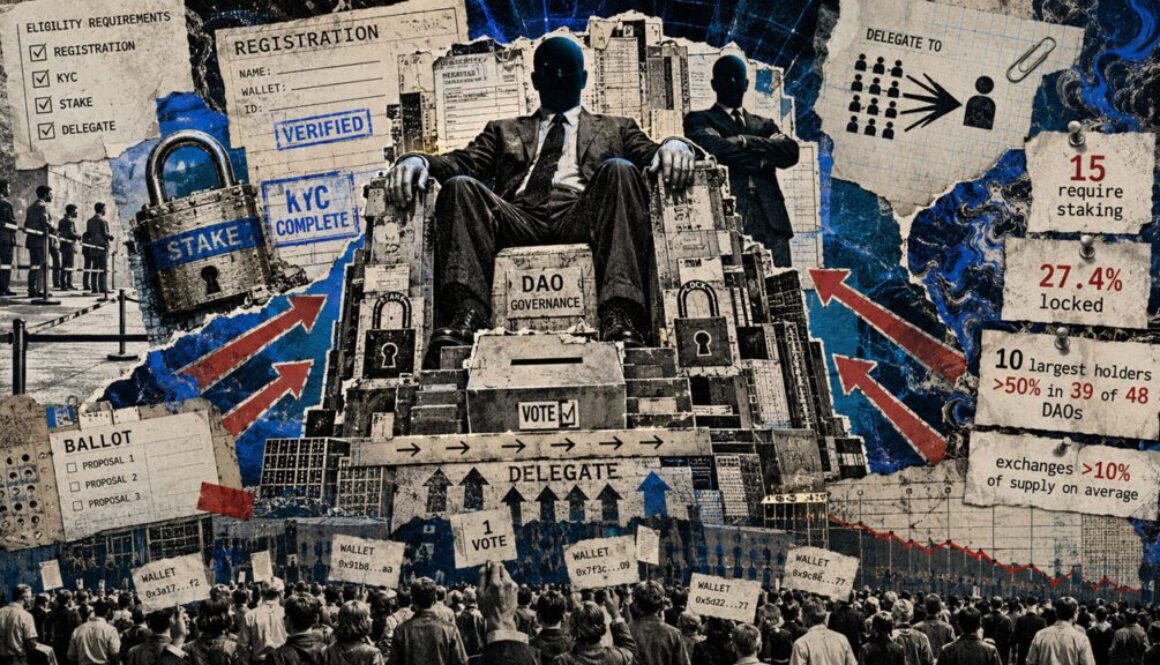
Insider blocs, delegation structures, eligibility rules, and organized opposition all affect whether a given position wins a vote, but the numbers show why governance tokens over large liquid treasuries now carry a control premium the market has not historically priced.
The trade generates a straightforward screen: liquid treasury per token, market discount to adjusted NAV, quorum threshold, delegate concentration, foundation or multisig veto risk, treasury composition, and execution path.
DAOs with legally inaccessible, foundation-controlled, or native-token-heavy treasuries stay stranded at their discounts.
Screen factor
Why it matters
What activists are looking for
Liquid treasury per token
Determines whether there is real redeemable value
Stablecoins, ETH, majors, low-haircut assets
Market discount to adjusted NAV
Defines the potential trade spread
Token price materially below treasury value
Quorum threshold
Measures how much voting weight is needed
Low enough threshold for coordinated holders
Delegate concentration
Shows whether votes can be influenced
Fragmented delegates or persuadable blocs
Insider / foundation control
Determines whether the treasury is practically reachable
Low veto risk from founders, foundations, multisigs
Treasury composition
Separates real NAV from paper NAV
Less native-token circularity, fewer illiquid bets
Execution path
Tests whether a vote can actually move assets
Onchain execution, clear legal wrapper, defined claims
Legal risk
Affects exchanges, holders, and future DAO design
Redemption framed as governance, not investment product
How governance changes when capital enters the room
Traditional DAO governance assumes voters are builders, delegates, users, and participants with operational stakes in the protocol’s future.
Treasury activism imports a different voter through the NAV buyer, who holds governance tokens to extract balance-sheet value and has no particular interest in what the DAO builds next.
A governance forum that used to debate grant allocations, roadmap priorities, and fee-switch parameters now has to answer a prior question: should the DAO retain these assets and, if so, on what terms?
In the bull case, GIP-151 executes cleanly, with liquid assets distributed, illiquid positions handled through a claim token, and legal friction staying contained.
Governance tokens gain a credible new valuation anchor: the probability-weighted right to extract value from the treasury.
Other DAOs with liquid, transparent treasuries and permeable governance face immediate demands to justify why their tokens should trade below the value of the assets they govern. A clean execution could pull GNO toward or briefly above the $115 treasury-value estimate as remaining holders reprice the governance premium.
The bear case runs through execution delays, disputes over eligible supply, heavy haircuts on illiquid assets, or a treasury-defense campaign that exposes insider concentration, leading the market to discount both payout certainty and the post-redemption protocol’s capacity to function.
The wider risk for the DAO market is that several copycat redemption pushes fail simultaneously, demonstrating that most treasury discounts are structurally inaccessible, and the NAV-activism thesis deflates before it fully takes hold.
GNO trades closer to or above the ~$115 treasury-value estimate
DAO tokens with clean liquid treasuries reprice higher on redemption optionality
Base case
Redemption works, but with delays, haircuts, or limited participation
GNO trades around adjusted treasury value, not full headline NAV
Treasury-rich DAOs face pressure to explain reserves, spending, and governance control
Bear case
Execution disputes, eligibility fights, insider resistance, or heavy illiquid-asset haircuts
Market discounts payout certainty and post-redemption protocol value
Most DAO treasury discounts are treated as inaccessible
Black swan
Regulatory, exchange, or litigation pressure reframes redemption as security-like behavior
GNO and similar tokens face sharp legal/liquidity discount
Governance tokens split between “usable governance” and “fund-like treasury claim” buckets
The legal exposure that follows
The SEC’s 2026 crypto guidance holds that a non-security crypto asset can still be sold as part of an investment contract when surrounding facts satisfy the Howey test: investment of money, common enterprise, expectation of profits, and reliance on the managerial efforts of others.
Pro-rata treasury redemption gives regulators cleaner facts to run that analysis.
Regulators can now ask more directly whether buyers hold a governance token to participate in protocol decisions or expect returns from a pooled treasury managed and distributed by others.
Legal risk rises sharply if projects, delegates, activists, or market materials frame tokens explicitly as treasury claims.
The distinction between “governance token that enables redemption” and “redeemable treasury interest” is the line that litigation and enforcement will contest.
A second exposure follows from treasury composition. The Investment Company Act applies to issuers whose primary business resembles investing, reinvesting, or holding securities, with a 40% investment-securities threshold embedded in the statute.
A passed redemption mechanism raises the question of whether a DAO that holds ETH, stablecoins, tokenized securities, RWAs, and LP positions, and can be voted to distribute them pro rata, starts to resemble a redeemable asset pool more than an operating network.
The CLARITY Act debate adds a structural wrinkle, as the Senate bill distinguishes between decentralized and centralized platforms, with the latter subject to financial institution-style obligations, including transaction monitoring and suspicious-activity reporting.
A DAO can be genuinely decentralized at the protocol layer while concentrating treasury control in insiders, multisigs, or delegate blocs. Gnosis provides regulators with a real-world example of that gap.
The DeFi spillover
DAO treasuries fund liquidity programs, grants, market-making budgets, protocol contributors, and LP positions.
Redemption votes, whether isolated or part of an activist norm, force treasuries to liquidate assets, such as stablecoin outflows, ETH sales, unwound LP positions, and cut incentive programs.
The total stablecoin market cap is near $314 billion, with Ethereum holding roughly half, according to DeFiLlama. With the Fed holding its target range at 3.50% to 3.75%, the opportunity cost of idle DAO stablecoin reserves is quantifiable and easy to argue in a governance forum.
The risk from Gnosis compounds if five or ten treasury-rich DAOs simultaneously face coordinated redemption campaigns, because the resulting asset sales and incentive cuts run across protocols that share liquidity, validators, and grant recipients.
Rook DAO, Fei/Tribe, and Aragon each demonstrated that DAO treasury conflicts can be resolved through redemption structures.
Aragon’s roughly $115 million ANT redemption came after a protracted governance fight, which the foundation resolved by returning capital to ANT holders. GIP-151 arrived by passing through standard governance, above quorum, without the DAO visibly collapsing first.
That procedural route converts a pattern of isolated governance crises into a repeatable strategic tool.
Every DAO governing a treasury larger than its market cap now trades at a discount that serves as an activist target. Whether DAO structures prove resilient to that, and whether US regulators settle the legal question before the market does, are the forward-looking variables that Gnosis left open.