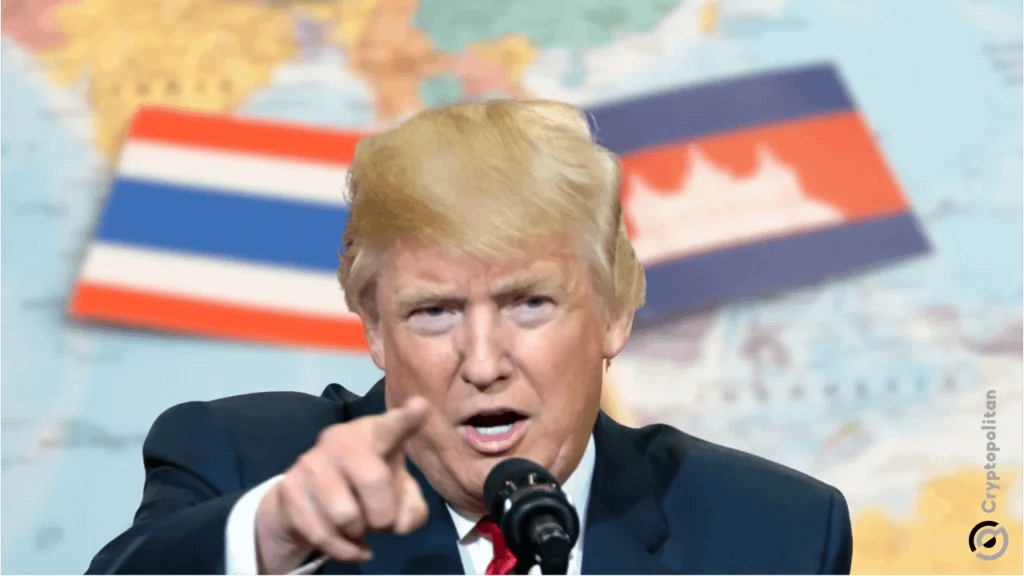

President Donald Trump issued another warning to Iran on Sunday, telling the country it needs to act quickly or face serious trouble.
“For Iran, the Clock is Ticking, and they better get moving, FAST, or there won’t be anything left of them,” Trump wrote on Truth Social. “TIME IS OF THE ESSENCE!”
The two countries have been struggling to reach an agreement since they stopped fighting in early April.
Such a warning has been given before as well when Trump threatened a “whole civilization will die tonight, never to be brought back again”. The warning was aimed at civilian targets like power plants and bridges going against the international war laws.
This time, Trump didn’t say exactly what would happen or what Iran needs to do to avoid these consequences.
The blocked strait has caused big problems for the world economy. Oil prices have jumped up everywhere, and Americans are paying more at gas stations. On Sunday, the average gas price across the country was $4.51 per gallon, according to AAA.
America wants Iran to stop its nuclear weapons work and open the Strait back up. Iran wants money to fix war damage, an end to the port blockade, and all fighting to stop, including battles in Lebanon.
Iran has found a new way to put pressure on the world
The country is looking at the underwater cables that run beneath the Strait of Hormuz. These cables carry internet data and financial information between Europe, Asia, and countries around the Persian Gulf.
Iran wants big technology companies to pay for using these cables. Some government-connected media in Iran have hinted that the cables could be damaged if companies refuse to pay. Iranian lawmakers talked about this plan last week. It would affect cables connecting Arab nations to Europe and Asia.
“We will impose fees on internet cables,” said Ebrahim Zolfaghari, a spokesperson for Iran’s military, in a post on X last week.
Media connected to Iran’s Revolutionary Guards said the plan would make companies like Google, Microsoft, Meta, and Amazon follow Iranian rules. Cable companies would have to pay fees to use the route, and only Iranian companies could fix or maintain the cables.
Some of these technology companies have put money into cables that go through the Strait of Hormuz and Persian Gulf areas. It’s not clear if these cables actually pass through waters that Iran controls.
There’s also a question of how Iran could make these companies pay. American sanctions don’t allow payments to Iran, so the tech companies might think Iran is just making empty threats.
Still, Iranian media have warned that damage to the cables could hurt trillions of dollars worth of global data and mess up internet connections worldwide.
The strait connects Asian technology centers like Singapore to cable stations in Europe. Problems there could slow down financial trading between Europe and Asia. Parts of East Africa might lose internet completely.
Trump says Xi agrees on opening strait, but China won’t confirm
Trump said Chinese President Xi Jinping agreed that Iran must open the Strait of Hormuz, though China didn’t confirm this.
Xi didn’t talk publicly about his Iran discussions with Trump. China’s foreign ministry called the war a conflict “which should never have happened, has no reason to continue.”
Ebrahim Azizi, who leads Iran’s parliament security committee, said Saturday that Iran has prepared a system to manage ship traffic through the strait on a specific route that will be announced soon.
Azizi said only business ships and those cooperating with Iran would benefit, and fees would be charged for special services.
The Senate Banking Committee voted 15-9 on Thursday to move forward on the CLARITY Act, a crypto market structure proposal that has been the subject of debate for a while now.
Nevertheless, just ahead of the vote, the Bank Policy Institute (BPI) put out a series of tweets on X about illicit crypto flows hitting $154 billion in 2025, adding another dimension to what was already an intensely debated topic on the extent of regulation in digital assets.
Bank Advocates Lean on Crime Data
The timing of BPI’s thread drew attention because lawmakers were simultaneously debating amendments tied to stablecoin yield restrictions and enforcement standards inside the CLARITY Act markup session.
According to data from Chainalysis that the institute shared, in 2025, illicit crypto addresses received $154 billion. This was a 162% year-over-year increase, driven largely by a 694% jump in value received by sanctioned entities.
Furthermore, the on-chain money laundering ecosystem grew from $10 billion in 2020 to over $82 billion in 2025, with stablecoins, primarily Tether (USDT), now accounting for 84% of all illicit transaction volume, displacing Bitcoin as the preferred payment method for criminals.
In a separate piece, the BPI argued that banks have spent decades staffing tens of thousands of AML employees while crypto companies have been largely exempt.
It said that the GENIUS Act imposed some obligations on US stablecoin issuers, but did not cover foreign issuers operating stateside. Tether, incorporated in El Salvador, sits outside that net.
The piece also cited the Islamic Revolutionary Guard Corps, whose crypto activity reportedly reached over $3 billion in 2025, representing roughly 50% of Iran’s total crypto ecosystem by Q4 of that year.
According to the BPI, unhosted wallets, cross-chain bridges, and mixers are “specifically designed to frustrate tracing and openly advertised as such.”
The stablecoin debate has become one of the most contentious parts of the CLARITY Act negotiations, with banking groups, including members of the American Bankers Association, spending weeks lobbying senators to tighten language restricting yield-bearing stablecoins.
As CryptoPotato reported earlier this week, banking groups sent Senate offices more than 8,000 letters ahead of the markup vote, while the crypto advocacy group Stand With Crypto said its supporters had contacted lawmakers nearly 1.5 million times in support of the bill.
But despite more than 40 amendments proposed by Senator Elizabeth Warren and procedural disputes during the hearing, the legislation advanced with support from Democratic senators Ruben Gallego and Angela Alsobrooks.
The Counter-Argument
While the BPI is demanding stricter anti-money laundering laws and sanctions regulations to be applied to crypto the same way it has been done to the traditional banking sector, data shared by Binance Research on May 14, offered some pushback to its claims.
According to Binance, trapped illicit funds on-chain have grown every year because less is being successfully laundered, not more.
Their report showed that more exit points are being blocked by KYC and more balances are being frozen by stablecoin issuers. Even the largest mixers have been processing at most $10 million per day.
THORChain’s suspected multichain exploit and emergency halt on May 15 has turned into another DeFi security incident, and another test of cross-chain trust.
Emergency controls moved through chain-specific halts, Halt All Trading, Halt Signing, Halt Chain Global, Halt Churning, and repeated global node-pause updates.
One public alert described the likely exploit affecting Bitcoin, Ethereum, BSC, and Base, resulting in more than $10.7 million in losses, revised from an earlier $7.4 million estimate.
Another security estimate put the loss near $10 million, including 36.75 BTC and about $7 million across BNB Chain, Ethereum, and Base.
The chain scope was later expanded in a TRM Labs assessment, which reported that the attacker drained more than $11 million across at least nine chains. Those chains included Avalanche, Dogecoin, Litecoin, Bitcoin Cash, and XRP, in addition to the initial four-chain framing. The figures may still move as the accounting is reconciled, but the available record points to a multichain infrastructure event touching several native-asset routes.
The halt, therefore, carried consequences beyond THORChain. Cross-chain liquidity is supposed to make crypto feel more useful, liquid, and connected. Yet the same design that lets assets move between isolated networks can also compress the response window when something breaks.
In this case, DeFi’s promise of seamless routing ran straight into the need for an emergency stop.
The Halt Became The Signal
The operational response is documented in the chain’s emergency framework. THORChain’s procedures describe network and chain halts as tools node operators can use when funds are at risk.
Its architecture relies on Bifrost observation, vaults, and threshold-signature signing to move native assets across chains without wrapping them.
Those controls can protect funds by stopping further activity. They also show that cross-chain infrastructure is a stack of observers, validators, vaults, signing logic, node operations, and emergency procedures.
When that stack is tested, the market asks whether a single bug can be patched and whether the system can remain credible while the response itself disrupts routing.
I think that distinction brings the THORChain incident into the broader DeFi story. Mature financial infrastructure is expected to fail safely, explain quickly, and restore confidence with a documented root cause.
DeFi often moves faster than that standard. It ships integrations, new chains, and liquidity routes before users and institutions have a clear way to price the full operational risk.
One of six Asgard vaults was reportedly compromised for roughly $10.7 million; initial indications said individual swaps were unaffected.
Final root cause, final user-impact accounting, and postmortem detail.
THORChain’s May 15 halt showed how suspected multichain losses, emergency controls, and unresolved postmortem questions converged into a broader DeFi infrastructure test.
The Trust Discount Is Now Measurable
The damage from exploits rarely ends with the drained wallet. Immunefi’s 2026 security findings put the average direct theft at $25 million, while the median loss fell to $2.2 million.
That gap shows a market where routine defenses may improve while the largest incidents still define confidence.
The same report found that the top five hacks in 2024 and 2025 accounted for 62% of stolen funds, and hacked tokens saw a median six-month decline of 61%.
Those token moves cannot be cleanly separated from market conditions or project-specific weakness in every case. Still, the pattern supports the core market reaction: exploits become long-tail business events.
They drain capital, consume team time, slow integrations, and make partners question whether the next failure will hit them indirectly.
The trust discount reflects an extra layer of skepticism toward a sector that wants to be treated as financial infrastructure, yet still produces failures that look like crisis drills.
Users, exchanges, market makers, custodians, and institutions require more evidence to trust a protocol’s uptime, monitoring, key management, and emergency processes.
Recent cross-chain incidents reinforce that point. In the KelpDAO bridge exploit, attackers targeted off-chain verification and source-chain watching infrastructure rather than a conventional smart-contract bug.
The result was a false view of reality that led to valid-looking transactions releasing funds. Bridge-security fears have already influenced infrastructure decisions, including Kraken’s move to use Chainlink CCIP for kBTC and future wrapped assets following the KelpDAO shock.
That makes the THORChain halt feel less isolated. The sector is being forced to prove that the trust path across chains is observable, redundant, and controllable before billions of dollars of liquidity are routed through it.
For institutional users, the issue becomes operational due diligence. Cross-chain exposure touches custody policy, liquidity commitments, incident response, and counterparty reviews.
A protocol that routes native assets across chains has to prove that the monitoring and emergency process around that routing is as strong as the connectivity itself.
For builders, that changes what counts as progress. New routes and integrations can deepen liquidity, but they also create more surfaces for monitoring, key management, and incident response.
The next credibility gains will come from showing that controls scale with liquidity before a failure forces counterparties to revisit assumptions.
THORChain Carries A Compliance Layer Too
THORChain’s position is especially sensitive because the protocol combines an attack surface with a routing role in major illicit-flow episodes.
As of TRM’s report, the May 15 exploit had no public actor attribution. That caveat keeps the current incident separate from earlier laundering cases unless new evidence changes the record.
The same analysis described THORChain as a recurring rail for moving stolen funds, including flows tied to the Bybit and KelpDAO incidents.
Federal investigators attributed the February 2025 Bybit theft of about $1.5 billion in virtual assets to North Korea’s TraderTraitor activity.
The FBI also urged private-sector crypto entities, including DeFi services and bridges, to block transactions to or from addresses linked to laundering.
That history sharpens the current episode. A protocol can be useful because it makes native cross-chain swaps efficient. The same utility can make it attractive to attackers and difficult for compliance teams to ignore.
Once a protocol is seen as both exploitable infrastructure and a route for illicit funds, counterparties have to price in more than just smart-contract risk.
They have to price operational interruption, screening exposure, and the chance that integrations become reputational liabilities.
RUNE price reaction stays secondary. Market data on May 16 put RUNE at around $0.44, down 21.90% over 24 hours.
The broader crypto market stood near $2.61 trillion with Bitcoin dominance at 60.2%. The market noticed the incident, but the more important question is whether liquidity providers, routing interfaces, wallet integrations, and compliance desks change behavior after the halt.
The important market signal will come from the next set of operational choices rather than from a one-day chart. Liquidity interfaces can route around protocols that introduce uncertainty; custodians and market makers can raise internal risk scores.
Compliance teams can demand better screening and incident records before supporting integrations. Those reactions are slower than a token selloff, but they are the way a security event becomes a durable trust discount.
That is the slower repricing institutions notice. It shows up in due diligence questions, integration queues, and risk limits long after the emergency halt leaves the alert feed.
The Next Test Is The Postmortem
The next test starts with more than a recovery message: THORChain needs to produce a clear postmortem, reconcile the final loss figure and chain count, explain the root cause without speculation, and show what changed in its vault, key-management, node, monitoring, and halt processes.
Recovery details may help contain user harm while leaving the infrastructure question intact.
If THORChain completes compensation, resumes safely, and documents a credible fix, the incident can remain a severe but contained confidence hit.
If the root cause remains unsettled, final accounting keeps changing, or integrations pull back, the event becomes another data point in a broader repricing of cross-chain DeFi.
That is the sector-level consequence. DeFi wants to present itself as a durable, always-on financial infrastructure.
Every major cross-chain exploit makes that claim harder to defend until the industry can show that the bridges, vaults, signing systems, and emergency controls connecting its markets are as mature as the capital they aim to attract.
Prediction markets processed more than $44 billion in wagers last year, but regulators say many of the top-performing participants are now automated trading bots rather than humans.
On Polymarket, automated bots now run more than 30% of active accounts. Data from the platform’s top earners shows that 14 of the top 20 accounts are controlled by bots.
More than 37% of these automated accounts consistently.
Lawmakers target insider trading risks
Polymarket trading activity fell 8.9% in April for the first time since August, as competitors gained market share.
According to Dune Analytics, the platform and its US operation registered $10.2 billion in bets in April, a decrease from $11.2 billion the previous month.
Meanwhile, rival platform Kalshi saw volume jump 13% to reach $14.8 billion in April.
The decrease occurred as Polymarket tried to rebuild its US footprint while under increased scrutiny from politicians concerned about insider trading.
Senator Elizabeth Warren wrote to the Commodity Futures Trading Commission in March, along with more than 40 other members of Congress.
They wanted laws that would ban government officials from profiting from secret material on these platforms.
“The CFTC maintains that event contracts are a type of swap subject to its jurisdiction, and, therefore, it should ensure that federal employees understand existing restrictions on prediction market insider trading,” the lawmakers said.
Several Polymarket users have drawn suspicion for placing winning bets on sensitive world events, including military actions in Venezuela and potential conflict with Iran.
CFTC Chairman Michael Selig told reporters that the agency utilizes AI tools to examine trade patterns, detect anomalous conduct, and collaborates with blockchain tracking businesses like Chainalysis to monitor offshore platforms such as Polymarket.
According to an AIMPACT update dated May 15, the CFTC uses AI to scan vast volumes of trading data, assisting staff in identifying suspect accounts and deciding whether to initiate investigations or issue subpoenas.
The business is combining blockchain analytics tools with market anomaly detection technologies to monitor both cryptocurrency and traditional financial markets.
The CFTC has received many allegations of odd trading and is actively looking into “hundreds to thousands” of potential cases. Future enforcement efforts are likely to broaden.
Selig stated that the agency will take action against U.S. users who attempt to mask their location by utilizing VPNs to access prohibited services.
That enforcement applies to worldwide marketplaces.
Even while platforms like Polymarket operate outside of the United States and lack U.S. licenses, the CFTC said it will seek enforcement against cross-border trades involving Americans and may utilize extraterritorial authority if necessary.
Platforms are reacting to the demand.
Polymarket and Kalshi have improved their checks for insider trading and market manipulation, bringing in external blockchain data providers to meet regulatory requirements.
The CFTC offered prediction market platforms some regulatory relief on Wednesday, issuing a no-action letter that exempts them from certain swap reporting requirements.
The exemption applies to exchanges and clearinghouses that handle event contracts.
Agency staff said they would not pursue enforcement against platforms that skip those reporting rules, following requests from companies seeking clarity on how event contracts should be regulated.
Although event contracts are officially classed as swaps since they have yes-or-no outcomes, the CFTC believes they work more like futures and options due to their uniform terms and exchange trading.
According to the new guidance, firms can report these transactions directly to the Commission in a manner similar to futures and options markets.
The relief now applies to 19 firms, including Polymarket US, Kalshi, Gemini Titan, and Bitnomial. Other companies listing event contracts may request coverage on the same terms.
Blockchain investigator ZachXBT has published an investigation containing weighty accusations directed at LAB, the multichain trading platform behind the token LAB. ZachXBT’s report details opaque private loans, unilateral vesting changes, and coordinated market-maker activity.
The price of LAB endured a price dip of about 10% at its lowest point following the report, after reaching its all-time high of $6.66 on May 11.
According to ZachXBT, insiders control more than 95% of the token supply and are behind a pump that pushed LAB to a fully diluted valuation (FDV) of over $6 billion.
The token was trading around $5.57 at the time of writing, down by over 17.5% from its all-time high.
ZachXBT’s in his thread frames the project as “everything wrong with the current meta of retail extraction on major centralized exchanges.”
How did a trading platform token become a $6 billion controversy?
LAB launched in October 2025 as a multi-chain trading terminal and had traded way below $1 for months before rising past $1 in early May with no material product announcement to explain the move.
On May 1, the token moved from being traded around $0.68 to over $4.00 in roughly five days, hitting a 24-hour trading volume of over $280 million at some point.
On-chain analysts pointed out that wallets connected to the LAB team had moved 96 million LAB tokens, worth around $63 million, into Bitget ahead of the price surge.
ZachXBT, in his long thread, shared the screenshots of the document of a loan contract obtained from the project’s BVI-registered entity, The Lab Management Ltd., signed by Sadkov as director.
The borrower received USDT at 7.5% per month, with a default clause stipulating repayment in LAB tokens at “market price,” effectively transforming the loan into a token sale at whatever price insiders had driven the token to.
ZachXBT documented offers that LAB made, writing, “Other individuals received a menu over WhatsApp: loans at 5%/month, OTC at 60% discount with 5-month cliff, guaranteed discount OTC at 25% recalculated monthly, and a 20% guaranteed discount tranche.”
LAB also reportedly pitched to key opinion leaders at an 80% discount, with token unlocks contingent on posting promotional content or facing blacklisting.
Why is Bitget at the center of the LAB storm?
Blockchain analytics firm Lookonchain posted on May 12, “Ten fresh wallets withdrew 100M $LAB ($480.33M) from #Bitget over the past 12 hours, 32.26% of the circulating supply.”
Responding to Lookonchain’s post, ZachXBT called out Bitget’s founder Shawn Liu, stating that he is the “big boss who allows these scams to operate behind the scene,” while referring to CEO Gracy Chen as “only the face of it.”
He also referred to the arrangement as a “Chinese CEX cartel” that had gone unchallenged for years, adding that he “thinks it is almost time to increase public attacks against Bitget.”
Bitget had not issued any statements or made any public acknowledgments as it did around the time Zach called out the RAVE token.
ZachXBT has called on Bitget, Binance, and Gate.io to freeze insider profits and redistribute them to users or delist LAB outright.
ZachXBT’s investigation connects the token’s infrastructure to the same entities he previously identified in the RAVE and RIVER manipulation investigations, which he calls an “unknown market maker operating via Chinese exchanges” running a consistent playbook across RIVER, RAVE, SIREN, MYX, SKYAI, and now LAB.
The investigator has offered $10,000 for intel, adding that he has paid around $1,500 out of his own pocket. He also discouraged shorting the token, writing, “With this much supply control, shorts potentially give insiders more fuel to manipulate the price higher.”
The LAB team and its founder, Vova Sadkov, had not issued a public rebuttal at the time of writing.
A joint collaboration between Tether, TRON and blockchain analytics firm TRM Labs called the T3 Financial Crime Unit has announced on Wednesday that it has frozen more than $450 million in USDT suspected to be acquired through illicit, criminal means since the initiative launched in September 2024.
The frozen funds by the crime unit involve investigations into various illicit operations including money laundering, crypto exchange hacks, North Korea-linked cyber operations, terrorist cells financing, drug trafficking, and violent crimes including kidnappings and extortion, according to a statement published by Tether.
The T3 FCU has enlisted the help of multiple law enforcement agencies in its fight against illicit activity in the crypto community. These agencies span five different continents, with countries like the U.S., Spain, Germany, the Netherlands and Bulgaria having the highest volume of assets frozen.
Tether’s T3 puts in the work
The T3 FCU reported that it helped in the recovery of 43.9% more illicit proceeds in 2025 compared to the previous year. The unit claimed it can execute asset freezes within 24 hours of a request by law enforcement regarding an investigation, a pace that traditional banks and services find hard to match.
The group pointed to several high-profile cases where it helped with asset freezing and recovery. One involved the freezing of about $26.4 million allegedly connected to a European money-laundering ring that was dismantled alongside Spain’s Guardia Civil in early 2025.
Another case was “Operation Lusocoin”, a Brazilian Federal Police investigation that froze more than 3 billion Brazilian reais in crypto assets, of which 4.3 million USDT linked to a criminal network was a part, according to Tether’s statement. Additional freezes targeted wallets tied to North Korean cyber activity and funds traced to the Bybit hack, with nearly $9 million in crypto funds identified.
In addition, Tether confirmed a $344 million USDT freeze on TRON in April 2026 following intelligence-sharing with U.S. and international law enforcement.
T3 FCU breaks higher ground amid international recognition
The Financial Action Task Force cited T3 FCU earlier this year as an “invaluable resource for law enforcement agencies worldwide.” The FATF highlighted the unit alongside TRM Labs’ Beacon Network as leading examples of public-private partnerships for combating criminal activity in the crypto community.
The recognition comes amid a sharp rise in illicit cryptocurrency activity, with blockchain-related criminal activity reaching a record $158 billion in 2025, according to estimates from TRM Labs. The figures underscore the growing pressure on stablecoin issuers and blockchain platforms to strengthen compliance frameworks as regulators intensify the crypto sector’s scrutiny.
“Compliance is not an option; it is a part of our commitment to protect our users and stop any illicit behaviors,” said Paolo Ardoino in the announcement. “This $450 million milestone is just the beginning of what T3 is capable of,” he added.
Chris Janczewski, who previously served as a special agent with the IRS Criminal Investigation division, said the initiative combines “real-time intelligence and expertise with coordinated public-private action to disrupt illicit activity as it happens.”
The comments reflect an intensified industry effort to ensure stronger oversight and enforcement capabilities.
Is crypto decentralization a myth?
The scale of the recent asset freezes has reignited debate over the level of control centralized stablecoin issuers retain within blockchain ecosystems that are often said to be ‘decentralized’.
Tether includes issuer-level controls that allow Tether to blacklist specific wallet addresses and freeze associated funds, which goes against the intent behind cryptocurrencies like Bitcoin.
According to onchain data compiled by BlockSec, more than $500 million worth of USDT was frozen over a recent 30-day period. This amount extends beyond the activity linked to the T3 Financial Crime Unit in the statement and proves Tether is doing even more blacklisting on multiple blockchains.
ICP is the worst-performing cryptocurrency today (at least among the top 100), posting a 10% price decline.
However, certain technical indicators suggest this might be only a short-lived pullback, while multiple analysts support the bullish scenario.
ICP Heads South
Just a few hours ago, the asset’s valuation plunged to a one-week low under $3, while its market capitalization sank to approximately $1.6 billion.
ICP Price, Source: CoinGecko
It is important to note that ICP’s negative performance aligns with an overall correction sweeping through the broader crypto market. Bitcoin (BTC) slipped beneath $80,000, while popular altcoins like Worldcoin (WLD), Cronos (CRO), Arbitrum (ARB), and Aptos (APT) tumbled by 7-8% over the past day.
In the meantime, Coinbase could have also played a role in Internet Computer’s downfall. Recently, it removed six non-USD trading pairs, including ICP/USDT and ICP/GBP.
Such actions by one of the biggest cryptocurrency exchanges reduce liquidity for the affected tokens and make it harder for traders to enter or exit positions. Fewer trading options often mean lower volume and weaker investor confidence, especially amid a crypto pullback.
At the same time, one should keep in mind that if Coinbase had removed all ICP-related services, the impact would likely have been far more severe and could have triggered a much sharper price collapse.
The asset remains available on numerous well-known exchanges, including Binance, Bybit, Bitget, OKX, and more. Two months ago, the leading South Korean trading venue Upbit also hopped on the bandwagon, fueling a 16% price increase for ICP following the news.
Resurgence Comes Next?
ICP’s Relative Strength Index (RSI) signals that the price pullback may soon be replaced by a revival. The technical analysis tool runs from 0 to 100, and readings below 30 indicate that the valuation has dropped too much, too quickly, potentially setting the stage for an upside move. Conversely, anything under 70 is considered a warning of impending correction. Currently, the RSI stands at around 28.
ICP RSI, Source: CryptoWaves
Analysts like Kong Trading and JAVON MARKS expressed confidence in the coin’s outlook. The former noted that almost half of ICP’s supply is locked in staking, with people committing for years.
“That’s not weak conviction. Hard to ignore when supply keeps tightening like this,” they added.
For their part, JAVON MARKS recently argued that ICP has displayed a Falling Wedge pattern and shows signs of strength. They believe a potential breakout could spark a 300% move above $10 and “may act as the start of an even larger reversal.”
The Senate Banking Committee’s CLARITY Act is heading into Thursday’s markup, buried under opposition.
According to reports, Senator Elizabeth Warren alone filed more than 40 amendments before Tuesday’s 5 p.m. ET deadline, and American Bankers Association members sent over 8,000 letters to Senate offices in less than a week demanding changes to the bill’s stablecoin yield rules.
Over 100 Amendments Filed
The total number of proposed amendments going into Thursday is still being confirmed, but according to a list obtained by Politico, there have been more than 100 proposed. To put things in perspective, a total of 137 revisions were proposed before the markup scheduled for January, which was canceled.
Warren’s batch alone covers a wide range of restrictions. One amendment that stood out would bar the Federal Reserve from issuing master accounts to crypto companies, which would effectively cut such firms off from the core infrastructure of the US banking system.
The lawmaker also attacked the updated bill on X, arguing that it lacked ethics provisions tied to President Donald Trump’s crypto businesses.
“No bill should move through the Banking Committee without real ethics guardrails,” she wrote.
That dispute has become harder for negotiators to avoid. Late last month, analyst Simon Dedic claimed that Trump’s meme coin and his crypto-related dinners were part of the reason the CLARITY Act was going nowhere, with Democrats demanding conflict-of-interest language before backing the legislation.
Another revision, filed by Senator Jack Reed of Rhode Island, would prohibit crypto from being used as legal tender, including for paying taxes. That proposal runs directly counter to a bill Representative Warren Davidson introduced last year that would have allowed Bitcoin to be used for precisely that purpose.
Senators Reed and Tina Smith of Minnesota also filed a joint amendment that would incorporate bank-requested changes to the stablecoin yield language.
According to journalist Brendan Pedersen, the proposal will force senators to choose between crypto and the banks on a single vote, making it an uncomfortable moment for Republicans who tend to side with both.
Bankers Blitz Senators With 8,000 Letters
Elsewhere, members of the American Bankers Association have reportedly sent more than 8,000 letters to Senate offices since last Friday, pushing lawmakers to change the bill’s stablecoin yield compromise.
However, Stand With Crypto, the crypto advocacy group, responded with its own numbers on Tuesday, saying its advocates had called Congress 8,000 times and sent 300,000 emails over recent months to protect stablecoin rewards, and have contacted lawmakers nearly 1.5 million times in support of the CLARITY Act overall.
Those on the side of digital assets are framing the banking industry’s lobbying campaign as an attempt to block competition from yield-bearing stablecoins.
Senator Bernie Moreno accused banks of trying to “kill stablecoins that would let everyday Americans earn real yields on their own money.” He also described the banking industry as a “cartel” protecting low-interest deposit models.
But not everyone inside Washington thinks this fight ends at Thursday’s committee vote. According to reporter Sander Lutz, banking policy leaders are already preparing for another push on the Senate floor if they lose the markup battle over yield restrictions.
Meanwhile, crypto journalist Eleanor Terrett reported that Senate Minority Leader Chuck Schumer privately encouraged Democrats to work toward supporting the bill.
An attack on the V1 smart contracts of Huma Finance on Polygon resulted in a loss of $101,400 USDC. The exploit added to what’s already been a difficult time for DeFi protocols on the network.
The exploit was reported by web3 security firm Blockaid. The attacker targeted BaseCreditPool deployments related to Huma’s older V1 infrastructure. The total loss was ~$101,400 in USDC and USDC.e coins across various contracts.
Huma Finance confirmed the incident on X, saying “No user funds at risk and PST is not impacted.” The team said its V2 system, which runs on Solana, was built from scratch. It shares no code with the compromised contracts.
Huma’s V1 flaw was in one function
The smart contract flaw was found inside a function named refreshAccount(). Its a function located within the V1 BaseCreditPool contracts. Blockaid security researchers identified the bug. They shared more information on X, saying:
“Bug: refreshAccount() unconditionally promotes a Requested credit line to GoodStanding, bypassing the EA approval step and enabling drawdown().”
refreshAccount() labelled accounts with ‘good standing’ without actual verification or conditions. The attacker took advantage of this flaw and drained funds from the protocol’s treasury pools
The losses were found in three contracts according to Blockaid’s on-chain analysis. One account lost ~82,300 USDC. A second lost ~17,300 USDC.e. And a third account lost ~1,800 USDC.e. According to on-chain data, the entire exploit was completed in one transaction.
There was no cryptographic issue. The attacker just changed the contract’s state machine to trick it into treating an unauthorized account as legit.
Huma’s team wrote on X, “Earlier today a vulnerability in Huma’s legacy v1 contracts on Polygon was exploited for 101,400 USDC.” They continued, “Huma’s v2 system on Solana is a complete rewrite and this issue does not apply to v2 systems.”
Huma said it had already been winding down V1 operations before the exploit occurred. The team said on X, “The teams were already in the process of sunsetting all the legacy v1 pools, and have paused v1 completely now.”
After the incident, the team fully paused all remaining V1 contracts. The company said that user deposits on V2 were untouched and that the newer platform continues to operate normally.
According to a recent report from Cryptopolitan, the exploit took place on the same day that Ink Finance lost almost $140,000 from its Workspace Treasury Proxy contract on Polygon. The attacker deployed a contract matching a whitelisted claimer address to bypass eligibility checks.
In both incidents, the attackers found logic mistakes in smart contract design. The back-to-back exploits on Polygon come after April 2026, setting the record for the worst month of smart contract losses.
Trump Mobile’s T1 gold phone has gone 11 months without a single shipment. The company has collected roughly $59 million in $100 deposits from nearly 590,000 buyers.
The Trump Organization-backed wireless brand has rescheduled the launch at least four times since June 2025. Its latest preorder terms now say the device may never exist.
Trump Mobile Keeps Stalling
Don Jr. and Eric Trump introduced the T1 in June 2025. The company promised an August delivery for the $499 handset, billed as American-made.
📲Announcing Trump Mobile, a transformational, new cellular service designed to deliver top-tier connectivity, unbeatable value and all-American service for our nation’s hardest-working people.🇺🇸
That date passed quietly. Trump Mobile then rescheduled to November, then December. In late December, customer service blamed the federal government shutdown and said buyers should wait until “mid to late January.”
A Q1 2026 window came and went. The release date has since vanished from trumpmobile.com. The site now pushes refurbished Samsung phones and iPhones on its $47.45 “47 Plan,” a nod to Trump’s standing as the 45th and 47th president.
Dedicated product pages (/products/t1-phone) return 404 Not Found.
The waitlist page shows specs (6.78-inch AMOLED, cameras, Android) and illustrations only, with heavy disclaimers.
The Preorder Deposit Terms (updated April 6, 2026) explicitly state that estimated ship dates, launch timelines, and production schedules are “non-binding estimates only” with “No Guarantee of Release, Delivery or Timing.”
“Nearly 600,000 people handed over their money and the fine print no longer promises they get it back or ever get the phone…And now the company quietly removed the guarantees on both delivery AND refunds,” remarked Mario Nawfal.
The handset has cleared Federal Communications Commission authorization, a U.S. launch prerequisite. No production timeline has been followed.
On April 6, T1 Mobile LLC updated its deposit terms. The new language says a $100 deposit “does not guarantee that a Device will be produced or made available for purchase.”
Buyers are now paying for a “conditional opportunity” that the company may exercise at its sole discretion. Estimated ship dates, the document adds, count as “non-binding estimates.”
“I’m paying $100 for the chance to maybe give you more money in the future, if you decide to make the product that I’m paying for in the first place?” Carter Ryan, tech content creator known as CarterPCs, said on TikTok.
Refund requests still flow through customer service. The new document offers little legal obligation to honor them.
With $59 million collected and no production schedule on record, depositors are betting on goodwill from a company whose paperwork no longer promises anything.