
Donald Trump delivered three major policy shocks between July 6 and July 11. He declared the Iran ceasefire over, sending Brent crude oil up 5.2%. The POTUS also ordered a halt to trade with Spain, pushing Spain’s stock market index IBEX 35 down 2.6%.
Trump said the interim agreement with Iran was “over” after renewed attacks on commercial ships and US facilities in the Gulf. American forces then launched fresh strikes against Iranian targets.
Oil markets reacted immediately. Brent settled 5.2% higher, while WTI gained 4.4% and reached a two-week high. The S&P 500 and Dow closed lower, while the STOXX 600 recorded its steepest decline since March.
The surge in oil also pushed Treasury yields higher as investors priced in greater inflation risk. Higher fuel costs could make it harder for the Federal Reserve to lower interest rates.
However, Trump later said the US would continue talks with Iran and played down the prospect of another full-scale war.
Oil just went through one of its most volatile months in years.
The reason is the US-Iran war, which restarted in February after everyone assumed it had ended with last year’s ceasefire.
Since then, oil has swung from $58 to $119 and back down to $71, driven almost entirely by… pic.twitter.com/qtk4mxom6U
Markets will now focus on shipping through the Strait of Hormuz, which carries around one-fifth of global oil supply.
Spain Trade Threat Hits Stocks and Bonds
Trump also ordered Treasury Secretary Scott Bessent to halt trade and visits with Spain. He accused Madrid of failing to spend enough on defence and obstructing the US campaign against Iran.
Spanish markets fell sharply after the comments. The IBEX 35 lost 2.6%, making it Europe’s worst-performing major index that day.
IBEX 35 is Spain’s Benchmark Stock Market Index in Madrid. Source: Yahoo Finance
Santander shares dropped 4.3%, BBVA fell 3% and Zara owner Inditex declined 3.6%. Spain’s 10-year government bond yield rose nine basis points as investors demanded a higher return for holding its debt.
It remains unclear whether Trump can impose a complete bilateral embargo. The European Union handles trade policy for its members, and US-Spain commerce has continued despite earlier threats.
Still, prolonged uncertainty could weigh on Spanish banks, exporters, airlines and tourism companies.
BREAKING: President Trump says the US is “cutting off all trade with Spain.”
— The Kobeissi Letter (@KobeissiLetter) July 8, 2026
Trump Hardens His Position on Russia
Trump made a significant shift on Ukraine during the NATO summit in Ankara. He said the US would license Ukraine to manufacture Patriot air-defence systems, technology Kyiv has requested for years.
Days later, US senators announced an agreement with the Trump administration to advance tougher sanctions against Russia. The legislation could target countries that continue buying Russian oil and gas.
Markets have yet to show a clear reaction because Congress has not approved the final bill. Its impact will depend on the sanctions, exemptions and enforcement measures included in the final text.
President Trump said Wednesday the U.S. will give Ukraine a production license to build its own Patriot missile interceptors for defense, granting a major request from Ukrainian President Volodymyr Zelenskyy amid the ongoing war with Russia. pic.twitter.com/BkG2GIOCRq
Strong secondary sanctions could disrupt Russian oil flows to China, India and Turkey. That would place further pressure on energy prices while increasing demand for alternative supplies.
Meanwhile, the Patriot decision could support defence manufacturers and suppliers. It also signals that Washington may apply greater military and economic pressure on Moscow.
Donald Trump’s scheduled keynote at the Bitcoin Conference in Nashville puts crypto policy back on the main political stage at a time when digital assets are becoming a louder campaign issue.
Donald Trump is listed as a keynote speaker for the Bitcoin Conference in Nashville.
The appearance shows how aggressively political campaigns are courting crypto voters.
The market angle is policy perception, not an endorsement of any candidate.
Bitcoin conferences have always mixed technology, finance, and ideology. This one now has a clearer political layer. A major presidential figure speaking directly to a Bitcoin audience is a sign that crypto is no longer being treated as a niche internet issue by campaign teams.
Crypto Becomes A Campaign Audience
The practical reason is simple: crypto users are organized, vocal, and increasingly focused on regulation. Exchanges, miners, wallet developers, and token holders all have reasons to care about what the next administration does with agencies such as the SEC, CFTC, and Treasury.
That does not mean every Bitcoin holder votes the same way. It does mean campaigns see the industry as worth addressing directly. Policy promises around self-custody, mining, enforcement, banking access, and stablecoins can now become campaign material.
Why Markets Pay Attention
Markets usually care less about speeches than actual law, but political tone still matters. A more crypto-friendly posture can influence expectations around enforcement, appointments, and legislative priorities. A hostile tone can do the opposite.
The keynote should therefore be read carefully and neutrally. It is not a price signal by itself, and it does not settle future policy. But it does show that Bitcoin has become politically important enough to command a national-stage appearance. That alone is a notable shift from previous cycles.
This article is based on the official Bitcoin Conference speaker listing.
This article was written by the News Desk and edited by Samuel Rae.
US President Donald Trump threatened to impose immediate 100% tariffs on any country that taxes American technology firms, a move that would override existing trade agreements and revive global trade tensions.
The warning targets Digital Services Taxes, the levies that several European governments apply to large US tech companies. By pressuring those governments, the threat could ultimately benefit the same firms.
A Renewed Fight Over Digital Taxes
Digital Services Taxes, or DSTs, tax the revenue technology firms earn from local users, not their profits.
France pioneered the model in 2019 with a 3% levy. It raised about €700 million ($797 million) in 2024, almost entirely from large American technology firms. The United Kingdom, Italy, Spain, and Austria run similar measures.
The tactic has a track record. During Trump’s first term, the US Trade Representative ruled France’s tax discriminatory. It readied 25% duties on about $1.3 billion of French goods before suspending them for global talks.
Those OECD negotiations later stalled, reviving the dispute. Canada scrapped its own 3% tax in June 2025 after Trump cut off trade negotiations.
“…any Country that imposes such a Tax will immediately be met with a 100% TARIFF on any and all Goods sent to the United States of America. This TARIFF will supersede Trade Deals made with the Country, whether implemented, signed, or not,” Donald Trump said in a Truth Social post.
A 100% rate would hit European exporters of cars, wine, and luxury goods hardest. It also shows how fast trade policy can spill into other markets, including how tariffs hit crypto.
Big Tech Stands to Gain
The threat aims to protect US technology leaders from foreign taxation. If governments pause their levies, Alphabet (GOOGL), Meta (META), Amazon (AMZN), Apple (AAPL), and Microsoft (MSFT) avoid a recurring cost.
The market reaction was mixed on June 26. Meta climbed toward $555.69, and Microsoft recovered to levels above $370, while Alphabet held near $341.54.
Amazon eased to $231.03 after establishing a higher intra-day high, and Apple ascended to levels above $280. The moves stayed small, despite earlier tariff-risk warnings.
Alphabet (GOOGL), Meta (META), Amazon (AMZN), Apple (AAPL), and Microsoft (MSFT) Stock Performances. Source: TradingView
The benefit is not one-sided. Apple booked about a quarter of its $391 billion in fiscal 2024 sales, roughly $101 billion, in Europe. That exposure means any retaliation from Brussels would also land on these firms.
Crypto stayed calm alongside the stock reaction. Bitcoin (BTC) traded near $60,073, up about 1.5% over 24 hours, holding steady on its Bitcoin price chart. Whether Europe backs down or pushes back will decide if the calm holds in the days ahead.
World Liberty Financial price prediction for 2026 expects the price of WLFI to surge toward $0.41.
By 2032, we expect the World Liberty Financial price to record a maximum price of $1.4.
Donald Trump has embraced the title of the “crypto president”, a label that has fueled massive speculation across the crypto industry.
After Trump’s 2024 election victory, the price of Bitcoin surged, a move many analysts and traders called a bullish signal for the cryptocurrency market. Building on this momentum, Trump introduced his own branded tokens, most notably the $TRUMP token and $MELANIA memecoin, solidifying his direct involvement in the crypto market.
Whether Trump’s push into crypto is driven by policy goals or personal profit, one message is clear: he intends to make cryptocurrency part of both his political strategy and financial portfolio.
However, Trump’s personal involvement in crypto tokens raises critical ethical questions. If a sitting or future U.S. president profits directly from token sales, DeFi projects, or blockchain ventures, it risks blurring the line between public duty and private gain.
One project drawing major attention is World Liberty Financial after major listings, a Trump-backed decentralized finance (DeFi) platform. This article explores what World Liberty Financial is, and what Trump’s embrace of crypto could mean for the future of Bitcoin, memecoins, and U.S. crypto policy.
Consequently, numerous analysts eagerly anticipate the future valuation of its native cryptocurrency, WLFI. This raises the question: Can WLFI price reach $1?
This forecast for World Liberty Financial’s price examines factors such as ecosystem trends, adoption rates, underlying technology, and technical analysis to project the WLFI price prediction from 2026 to 2032.
Overview
Cryptocurrency
World Liberty Financial
Ticker Symbol
WLFI
Rank
27
Current Price
$0.06
Price change 24H
+4%
Market cap
$1.8 Billion
Circulating supply
24.66 Billion WLFI
Trading volume 24h
$116M (-18%)
All-time high
$0.46, September 1, 2025
All-time low
$0.051, May 2, 2026
WLFI price prediction: Technical analysis
Metric
Value
Current Price
$0.06
Price Prediction
$ 0.04452 (-25.19%)
Fear & Greed Index
23 (Extreme Fear)
Sentiment
Bearish
Volatility
7.18% (High)
Green Days
15/30 (50%)
50-Day SMA
$ 0.06807
200-Day SMA
$ 0.1151
14-Day RSI
40.32 (Neutral)
World Liberty Financial technical analysis: WLFI price faces bullish pressure toward $0.06
WLFI price analysis shows a bullish pattern toward $0.06
Resistance for WLFI is present at $0.0633
Support for WLFI/USD is present at $0.06
The WLFI price analysis for 25 June confirms that WLFI faces increasing volatility as it surges toward $0.06. Currently, the bulls are aiming for further surges.
WLFI price chart prediction: World Liberty Financial faces buying pressure toward $0.06
WLFI price is facing a decline as buyers push the price toward $0.06. WLFI price is aiming for a hold above the immediate Fib channels. The 24-hour volume surged toward $8.3 million, showing increased interest in trading activity. The price is trading at $0.06, surging over 4% in the last 24 hours.
The RSI-14 trend line has surged from its previous level and trades around the neutral region at level 48, suggesting upcoming buying pressure.
WLFI/USD 4-hour price chart: Bears aim for a hold below EMA trend lines
The 4-hour WLFI price chart suggests WLFI continues to experience bullish activity around EMA lines, creating a positive sentiment on the price chart. As the price hovers around EMA trend lines, bears prepare for a domination by sending the price below the EMA20 trend line.
The BoP indicator trades in a negative region at 0.62, hinting that sellers are trying to build immediate pressure near resistance levels and boost upward correction. However, the MACD trend line has formed green candles above the signal line, hinting at a bullish pressure.
WLFI technical indicators: Levels and action
Daily Simple Moving Average (SMA)
Period
Value
Action
SMA 3
$ 0.05885
BUY
SMA 5
$ 0.05881
BUY
SMA 10
$ 0.05951
SELL
SMA 21
$ 0.06187
SELL
SMA 50
$ 0.06807
SELL
SMA 100
$ 0.08474
SELL
SMA 200
$ 0.1151
SELL
Daily Exponential Moving Average (EMA)
Period
Value
Action
EMA 3
$ 0.05894
SELL
EMA 5
$ 0.05901
SELL
EMA 10
$ 0.05970
SELL
EMA 21
$ 0.06188
SELL
EMA 50
$ 0.06971
SELL
EMA 100
$ 0.08462
SELL
EMA 200
$ 0.1108
SELL
What to expect from WLFI price analysis next?
The hourly price chart confirms that bears are making efforts to prevent the WLFI price from an immediate surge. However, if WLFI’s price successfully breaks above $0.0633, it may surge higher and touch the resistance at $0.0653.
If bulls cannot initiate a surge, WLFI’s price may drop below the immediate support line at $0.06, resulting in a correction to $0.0566.
Why is the WLFI price up today?
Sellers are losing confidence to maintain their dominance, resulting in an upward push toward $0.06.
WLFI crypto news
As reported by Cryptopolitan, WLFI co-founder arrest video resurfaces as legal dispute with Justin Sun intensifies. Charges from the 2022 arrest were dismissed but footage gains public attention.
Is WLFI a good investment?
Trading $WLFI will be very risky. Since it’s a new and highly hyped token with only a small amount available at launch, the price could change quickly and unpredictably. Liquidity will be thin, so even one big trade might move the market. It’s normal for tokens like this to surge at launch and then drop as early buyers cash out.
However, considering its background and ongoing trading volume, WLFI can turn out to be a good investment option in the long-term.
What is the WLFI price prediction for 2026?
By 2026, analysts predict that World Liberty Financial (WLFI) will start the year at $0.1, with an average trading price of $0.37, and could climb as high as $0.41.
Will WLFI price touch $1?
Yes, WLFI price might touch the $1 milestone by the end of 2031. However, the token might attain this level much earlier, depending on the future market sentiment and buying demand.
Will WLFI Price Reach $10?
If everything remains good and WLFI gains recognition, its price might surpass $10 by 2040.
Is WLFI a good long-term investment?
As World Liberty Financial aims to expand its offerings, it might gain a significant position in the altcoin market. Hence, WLFI can be a good long-term investment option. The WLFI long term price outlook is looking strong due to its strong political support.
WLFI price prediction June 2026
Analysts expect a steady surge in crypto market prices in June. We expect WLFI to record a minimum price of $0.045 and a maximum price of $0.08, with an average of $0.06 in June.
WLFI Price Prediction
Potential low
Potential average
Potential high
WLFI Price Prediction June 2026
0.045
0.06
0.08
WLFI price prediction 2026
By the end of 2026, analysts predict that World Liberty Financial (WLFI) will record a minimum price of $0.04, with an average trading price of $0.37, and could climb as high as $0.41.
WLFI Price Prediction
Potential low
Potential average
Potential high
WLFI Price Prediction 2026
$0.04
$0.37
$0.41
WLFI Price Predictions 2027-2032
Year
Minimum Price
Average Price
Maximum Price
2027
0.4
0.44
0.47
2028
0.55
0.65
0.68
2029
0.7
0.8
0.81
2030
0.72
0.83
0.86
2031
0.89
0.96
1.02
2032
1.26
1.3
1.4
WLFI Price Prediction for 2027
By 2027, experts forecast WLFI to begin at $0.40, maintain an average price of $0.44, and potentially reach $0.47. This represents a healthy climb from 2025, showing that WLFI is gaining traction in the crypto space.
World Liberty Financial Price Prediction 2028
By 2028, market analysts and experts predict that WLFI will start the year at $0.55, with an average price of $0.65, and trade around $0.68.
WLFI Prediction for 2029
By 2029, forecasts suggest WLFI will open at $0.7, trade at an average of $0.8, and could move up to $0.81.
World Liberty Financial Price Prediction 2030
By 2030, analysts expect WLFI to begin at $0.72, maintain an average price of $0.83, and rise toward $0.86.
WLFI Crypto Price Forecast for 2031
By 2031, experts predict WLFI will start at $0.89, trade at an average of $0.96, and potentially reach $1.02. Crossing the one-dollar mark would be a significant psychological milestone for investors and a strong indicator of growth.
World Liberty Financial Price Prediction 2032
By 2032, WLFI is expected to open at $1.26, average around $1.3, and peak at $1.40.
WLFI Price Predictions 2026-2032
WLFI coin price forecast by experts
Firm Name
2026
2027
Coinpedia
$0.539
$0.359
CoinDCX
$0.35
$0.46
Cryptopolitan’s WLFI price prediction
Cryptopolitan is bullish on WLFI price prediction as the token is backed by a strong community. As a result, we are bullish on WLFI future price forecast. By 2027, experts forecast WLFI to begin at $0.40, maintain an average price of $0.44, and potentially reach $0.47. This represents a healthy climb from 2026, showing that WLFI is gaining traction in the crypto space.
WLFI historic price sentiment
WLFI Price History
The $WLFI governance token for World Liberty Financial, the Trump family–backed DeFi platform, launched for public trading and token claims on September 1, 2025, at 12:00 UTC. This token generation event (TGE) kicked off spot trading on Ethereum’s mainnet, following a presale that raised over $550 million from 85,000+ investors since October 2024.
The WLFI token price initially surged toward $0.478 but it later declined toward $0.1611.
On 6 September, the WLFI price again attempted a surge toward $0.2. By the end of September, WLFI declined below $0.2.
By the end of October, the price of WLFI further declined and touched $0.1 in early November.
In early December, WLFI price started trading below $0.15.
However, the price surged in January 2026 as it touched a high around $0.19.
However, WLFI later dropped toward $0.12 in February. WLFI ended that month by trading below $0.1.
By March’s end, WLFI dropped below $0.09. In April, WLFI dropped below $0.06.
In May, the price of WLFI dropped toward $0.056 before recovering slightly.
The US 30-year Treasury yield fell to 4.85% on Wednesday, its lowest level since April 15, after President Donald Trump signaled easing tensions with Iran over Strait of Hormuz shipping.
Bond prices rose as the update pushed oil lower, easing near-term inflation fears and lifting demand for long-dated government debt.
US 30-Year Treasury Yield Performance. Source: TradingView
Oil Slump Drove the 30-Year Treasury Yield Lower
In a Truth Social post, Trump said Iran confirmed no tolls or charges on ships crossing the Strait of Hormuz. He warned that negotiations would end at once if the claim proved false.
The signal eased fears over the waterway that carries about a fifth of the world’s oil. Falling oil prices followed soon after.
West Texas Intermediate (WTI) almost below $70 a barrel for the first time since March 2. Brent crude briefly fell toward $74, its lowest since before the conflict began in late February.
Lower energy costs ease a key driver of near-term inflation. That prospect drew buyers into Treasuries, pushing prices up and yields down.
The drop reversed much of a sharp spring selloff. The 30-year yield had topped 5.19% on May 19, its highest since 2007, when war fears drove inflation bets higher.
Hawkish Fed Clouds the Outlook
The rally sits awkwardly against the Federal Reserve’s latest message. New Chair Kevin Warsh held rates at 3.5% to 3.75% on June 17, yet projections turned more hawkish.
The median official now sees the rate ending 2026 at 3.8%, above the current range. That points to a hike, not a cut, as the base case. These hawkish Fed signals track inflation the Fed projects at 3.6% for 2026.
The split shows in the curve. The policy-sensitive 2-year yield holds above 4.2%, near a multi-month high, even as the long end leads the decline.
Lower long-term yields still feed into borrowing costs. The 30-year fixed mortgage rate eased to 6.47% in mid-June, down from 6.81% a year earlier, Freddie Mac data shows.
US Mortgage Rates,. Source: Freddie Mac data
The relief may prove fragile. Economist Nouriel Roubini, who flagged the 2008 housing crash, has warned that long-dated bonds stay exposed if inflation climbs again.
“With six percent inflation and two real, the 10-year bond yield has to be eight percent. Today it’s at four. It goes from four to eight, the price of the bond is going to fall by 40%…” Roubini told BeInCrypto.
Investors now turn to Thursday’s inflation report, the Fed’s preferred gauge and the next key inflation data point.
Until then, competing market risks from the Fed and the Middle East will keep yields volatile. For now, cheaper oil has handed the long end of the curve a reprieve.
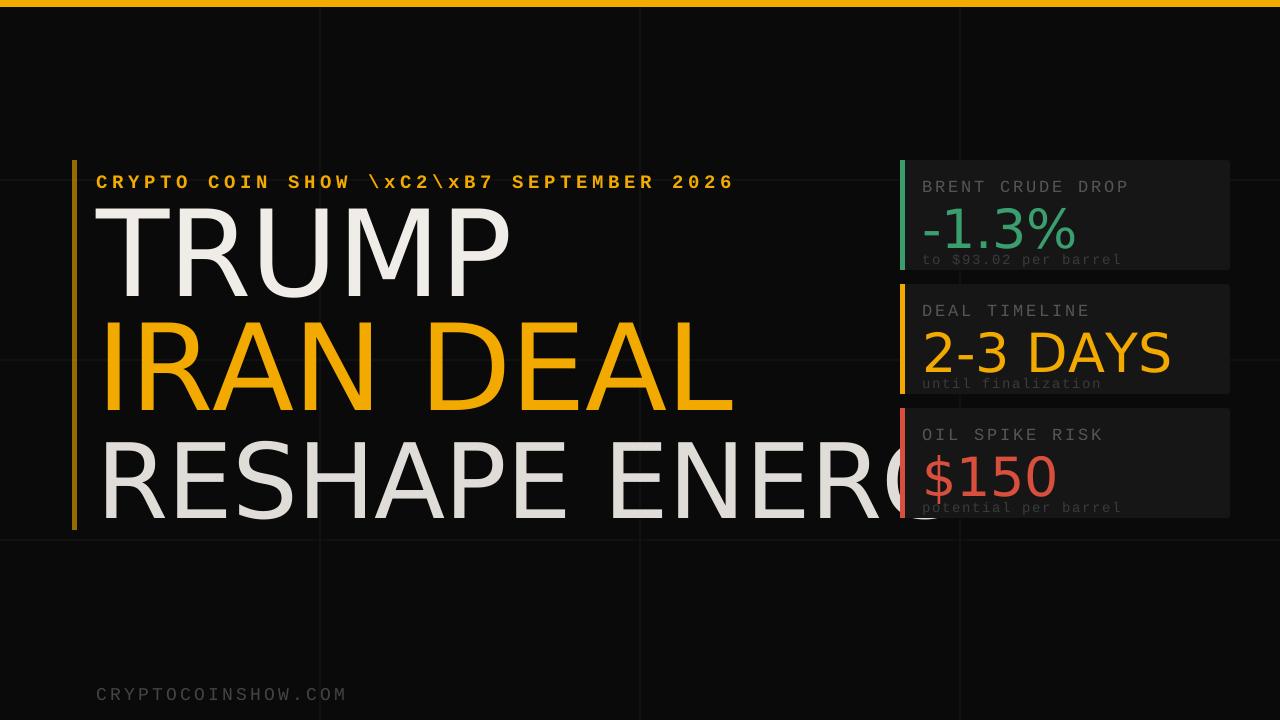
Donald Trump told reporters yet again that a deal to end the war he and Israel started with Iran could be reached in “two or three days,” even as the Middle East ceasefire cracked over the weekend and traders pulled back from oil and gold.
He said the Strait of Hormuz would reopen “immediately” after an agreement, which matters because that waterway is one of the biggest pressure points in global energy trade.
Trump said both sides were near the end of talks on a “very, very good deal that will not in any way allow nuclear weapons.” Sky News Arabia also reported on Monday that a draft agreement had been sent to Washington for review and was “preliminarily acceptable” to the White House.
Trump pushes a near-term Iran deal while new strikes by Israel test the ceasefire
Right before Trump made the aforementioned comments, Iran and Israel traded strikes over the weekend for the first time since the truce began in mid-April.
Iran fired missiles toward northern Israel after accusing Jerusalem of breaking the truce through attacks in Lebanon. Those Israeli strikes included an attack on Beirut’s southern suburbs on Sunday. Israel then said it had carried out a “large-scale strike on strategic defense systems” in response.
As you know, Trump has made many bold calls on his war, and had previously said the fighting would last four to six weeks, but the conflict passed the 100-day line on Sunday.
Trump also addressed a separate U.S. military incident near the Strait of Hormuz. He said the pilots of a U.S. military Apache helicopter that went down on Monday “are fine.” He added that there was “nobody injured” and said the administration would release a report on Tuesday. The cause of the crash was still unknown.
Oil prices fell on Tuesday morning after the ceasefire comments. Brent crude dropped 1.3% to $93.02 a barrel. U.S. West Texas Intermediate fell 1.8% to $89.67 a barrel. Brent was also sitting near $94 during Tuesday’s trading.
Energy and gold analysts cut through the noise with ugly price calls
Meanwhile, Claudio Galimberti, chief economist at private research firm Rystad Energy, said oil could reach $150 per barrel within the next couple of months if the fighting continues and inventories keep falling.
“At this point, unless we solve [the Middle East conflict], unless we start to see an increase in the flow, then we are going to see lower and lower inventories, which means higher and higher prices. The problem, sitting right here, right now, we are absolutely not there,” Claudio said.
Claudio also pointed to a messy, longer-term setup. Even if the current oil squeeze gets fixed, he said the market could later face a huge supply glut because of the unwinding by OPEC and the UAE leaving the cartel. “This is a year of absolute deficit, but fast forward, 2027 may turn out to be a year of humongous surplus,” Claudio said.
Gold had its own ugly setup. Prices have dropped hard since hitting an all-time high of $5,594.82 an ounce on January 29. Analysts at Citi, owned by Citigroup Inc. (C), said gold could fall to $3,500 an ounce if the Strait of Hormuz stays closed until the end of summer.
That would be about 19.7% below the $4,357.90 price seen at 7 a.m. ET on Tuesday. Citi said gold, often treated like the classic safe-haven trade, looks “incredibly high risk” in the short term.
Citi said a long Hormuz closure could slow global gold buying and drag prices back to levels last seen about nine months ago. Since the U.S.-Iran war began on February 28, gold’s safe-haven image has taken hits as traders question the reasons behind its huge run.
A stronger-than-expected U.S. jobs report last week added more pressure because it raised expectations for a year-end interest rate hike. Higher rates usually hurt gold because the metal pays no yield. Citi cut its three-month gold target to $4,000 an ounce from $4,300, while U.S. gold futures for August delivery traded at $4,352.90 on Tuesday morning.
Don’t just read crypto news. Understand it. Subscribe to our newsletter. It’s free.
President Donald Trump endorsed lower interest rates and declared that growth does not cause inflation before walking out of a Meet the Press interview with NBC’s Kristen Welker.
The walkout clip now dominates social feeds. However, the policy signals buried in the exchange matter far more for Bitcoin (BTC), oil, and equities.
The Walkout Buried a Clear Message on Rates
In the interview, Welker pressed Trump on whether the Federal Reserve may need to raise rates under new Chair Kevin Warsh.
The Senate confirmed Warsh on May 13 by 54 votes to 45, the narrowest margin for any Fed chair. He chairs his first policy meeting on June 16 and 17, with rates at 3.50% to 3.75%.
Trump pushed the opposite way.
“There’s no reason to raise interest rates. The country becomes great. We built the country by doing great and having rates low.”
Fresh data gives the President his talking point. May payrolls rose by 172,000, roughly double the 85,000 consensus, while unemployment held at 4.3%.
Trump drew a conclusion that rejects decades of Phillips curve thinking, which links hot labor markets to rising prices.
“Growth is the greatest thing you can have and growth does not cause inflation.”
The stance revives a first-term pattern. Trump publicly hammered then Chair Jerome Powell through 2018 and 2019 to force cuts.
This time the pressure lands on an awkward target. Warsh built his reputation as a hawk and quit the Fed board in 2011 after opposing quantitative easing.
“I think Kevin is fantastic, and I want to do whatever he wants and I don’t want to have a big influence on him…”
Markets are not listening yet. CME FedWatch prices a 96% chance of a hold this month.
The war has rewritten energy math since late February. Brent crude jumped from about $72 per barrel to nearly $120 before easing to about $94 on Friday.
AAA puts the national gas average at $4.17 per gallon, up $1.16 since the Iran war began.
“It depends. It depends where the war goes. It could be after I give them a shot, and it could be if we sign an agreement it will go down now otherwise it will go down after we finish.”
Either path ends the same way, he argued, with gasoline prices set to “drop like a rock.”
Trump also signaled more military spending on top of a record base.
“We have debt and other thing, we have things we want to take care of. I want to go bigger on the military. I really do.”
The FY2027 budget already requests $1.5 trillion for defense, the largest single-year total since World War II, per CSIS.
The OMB projects a $2.06 trillion deficit this fiscal year, rising to $2.17 trillion next. Funding that gap forces the Treasury to issue more than $166 billion in debt every month.
Lower rates plus heavier issuance point to expanding liquidity, the variable Bitcoin traders watch most.
The United States and China have agreed to open a direct government channel on AI collaboration following Donald Trump and President Xi Jinping’s summit, which was covered live by Cryptopolitan.
Beijing confirmed the plan on May 19 through Chinese Foreign Ministry spokesperson Guo Jiakun, who spoke at a regular press briefing after a reporter asked about the AI talks between both leaders.
According to Guo, China and the US are the two great powers in AI, and hence both countries must work together to develop AI and regulate it. This will help the technology promote human development for the good of the entire world population.
He further indicated that Trump and Xi had productive talks about AI during the visit and decided to begin a government-to-government discussion on the matter. Nevertheless, it is important to note that there is no official confirmation from the White House concerning this channel.
Trump says Washington and Beijing discussed AI guardrails while racing each other
Trump did speak about an AI discussion with Jinping in an interview with Bret Baier of Fox News (FOXA, FOX). Bret asked whether the United States and China had reached any kind of agreement on guardrails so AI does not “go crazy.”
Trump answered, “We talked about it. Yes, we talked about it. AI is mostly a great thing. Mostly.”
He then said the United States is ahead of China in AI and tied that lead to electricity.
Trump said he allowed AI companies to build their own power plants because the existing grid would not have been enough. AI data centers need huge amounts of power, and Trump said private energy projects now give U.S. companies more room to build.
Trump then said, “Now you have these very rich companies, headed by lots of geniuses, building electric plants. Because of that, we are leading China by a lot in the AI race.”
He also said the global AI race is between Washington and Beijing, even though other countries are still involved.
Trump said, “Whoever wins the AI race, and we are going to win it. If we are smart, we are going to win it. If we are not smart, we are not.”
He added that Xi was surprised by the speed of U.S. AI progress, because allegedly, China once thought it had a huge early lead, but he now believes the United States is far ahead.
Bret then asked whether both sides could still agree on a setup for AI rules. Trump said it was possible, but not simple, because both countries are trying to beat each other in the same field. He said, “It is a little hard to say, ‘Let’s put on guardrails,’ when we are competing with each other.”
Nvidia waits for China chip approval as senators prepare a $500 million AI bill
The AI talks also sit right inside the chip fight, because Nvidia (NVDA) CEO Jensen Huang (who flew to the Beijing summit with Elon Musk and Trump on AF1) told Bloomberg TV Monday that he thinks China’s market will eventually open again to U.S. chip companies.
While Nvidia already has the license from the U.S. government to sell the chips, it does not automatically allow them to be shipped to China at once. The Chinese officials have not given permission for the sale, and Beijing continues to support its home-grown semiconductor producers. Jensen stated, “My sense is that, over time, the market will open.”
The matter is important as Washington is working on another law regarding Chinese tech sales abroad. According to Reuters, two U.S. senators are set to present a bill on Tuesday, as seen in a document allegedly obtained by the news agency.
The bill is sponsored by Democratic Senator Jeanne Shaheen of New Hampshire and Republican Senator Pete Ricketts of Nebraska.
The bill would create an office inside the State Department to help allied governments buy American technology. It would also make the buying process easier and set up a $500 million fund to help pay for the program if it passes.
The bill says foreign governments are buying cyber and digital tools from strategic competitors such as China because those products often cost less.
President Donald Trump issued another warning to Iran on Sunday, telling the country it needs to act quickly or face serious trouble.
“For Iran, the Clock is Ticking, and they better get moving, FAST, or there won’t be anything left of them,” Trump wrote on Truth Social. “TIME IS OF THE ESSENCE!”
The two countries have been struggling to reach an agreement since they stopped fighting in early April.
Such a warning has been given before as well when Trump threatened a “whole civilization will die tonight, never to be brought back again”. The warning was aimed at civilian targets like power plants and bridges going against the international war laws.
This time, Trump didn’t say exactly what would happen or what Iran needs to do to avoid these consequences.
The blocked strait has caused big problems for the world economy. Oil prices have jumped up everywhere, and Americans are paying more at gas stations. On Sunday, the average gas price across the country was $4.51 per gallon, according to AAA.
America wants Iran to stop its nuclear weapons work and open the Strait back up. Iran wants money to fix war damage, an end to the port blockade, and all fighting to stop, including battles in Lebanon.
Iran has found a new way to put pressure on the world
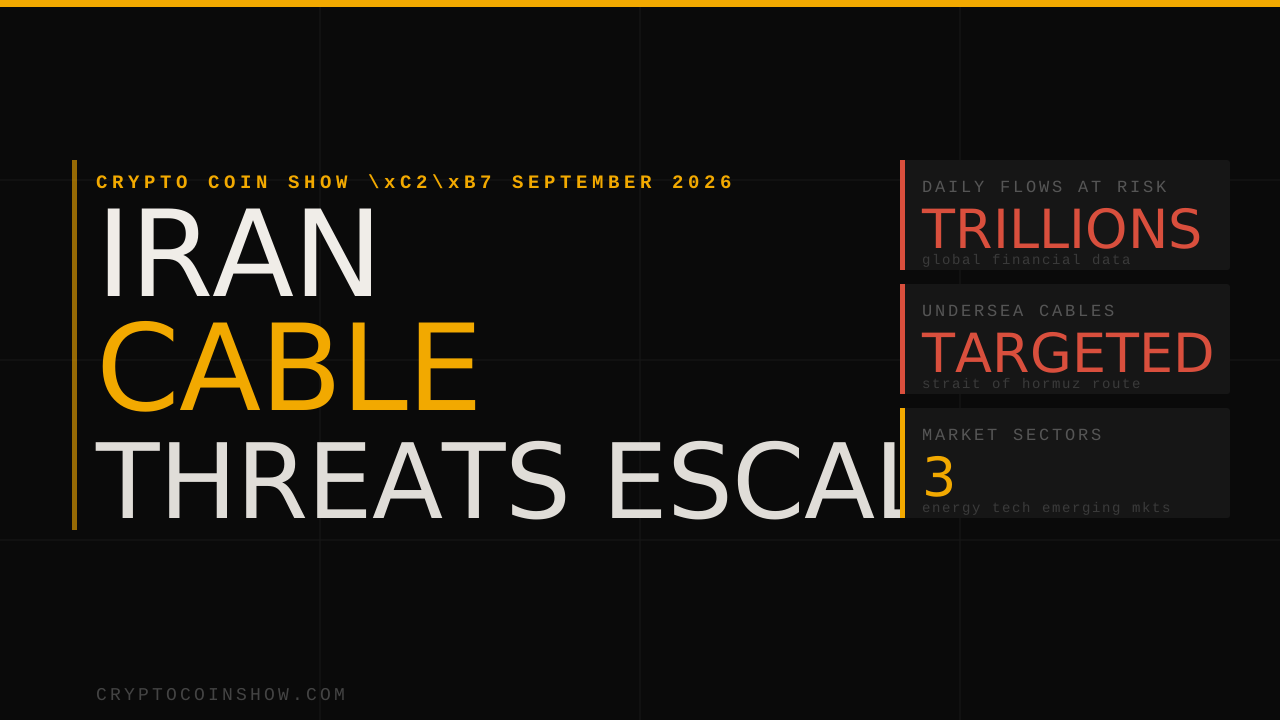
The country is looking at the underwater cables that run beneath the Strait of Hormuz. These cables carry internet data and financial information between Europe, Asia, and countries around the Persian Gulf.
Iran wants big technology companies to pay for using these cables. Some government-connected media in Iran have hinted that the cables could be damaged if companies refuse to pay. Iranian lawmakers talked about this plan last week. It would affect cables connecting Arab nations to Europe and Asia.
“We will impose fees on internet cables,” said Ebrahim Zolfaghari, a spokesperson for Iran’s military, in a post on X last week.
Media connected to Iran’s Revolutionary Guards said the plan would make companies like Google, Microsoft, Meta, and Amazon follow Iranian rules. Cable companies would have to pay fees to use the route, and only Iranian companies could fix or maintain the cables.
Some of these technology companies have put money into cables that go through the Strait of Hormuz and Persian Gulf areas. It’s not clear if these cables actually pass through waters that Iran controls.
There’s also a question of how Iran could make these companies pay. American sanctions don’t allow payments to Iran, so the tech companies might think Iran is just making empty threats.
Still, Iranian media have warned that damage to the cables could hurt trillions of dollars worth of global data and mess up internet connections worldwide.
The strait connects Asian technology centers like Singapore to cable stations in Europe. Problems there could slow down financial trading between Europe and Asia. Parts of East Africa might lose internet completely.
Trump says Xi agrees on opening strait, but China won’t confirm
Trump said Chinese President Xi Jinping agreed that Iran must open the Strait of Hormuz, though China didn’t confirm this.
Xi didn’t talk publicly about his Iran discussions with Trump. China’s foreign ministry called the war a conflict “which should never have happened, has no reason to continue.”
Ebrahim Azizi, who leads Iran’s parliament security committee, said Saturday that Iran has prepared a system to manage ship traffic through the strait on a specific route that will be announced soon.
Azizi said only business ships and those cooperating with Iran would benefit, and fees would be charged for special services.
Trump Mobile’s T1 gold phone has gone 11 months without a single shipment. The company has collected roughly $59 million in $100 deposits from nearly 590,000 buyers.
The Trump Organization-backed wireless brand has rescheduled the launch at least four times since June 2025. Its latest preorder terms now say the device may never exist.
Trump Mobile Keeps Stalling
Don Jr. and Eric Trump introduced the T1 in June 2025. The company promised an August delivery for the $499 handset, billed as American-made.
📲Announcing Trump Mobile, a transformational, new cellular service designed to deliver top-tier connectivity, unbeatable value and all-American service for our nation’s hardest-working people.🇺🇸
That date passed quietly. Trump Mobile then rescheduled to November, then December. In late December, customer service blamed the federal government shutdown and said buyers should wait until “mid to late January.”
A Q1 2026 window came and went. The release date has since vanished from trumpmobile.com. The site now pushes refurbished Samsung phones and iPhones on its $47.45 “47 Plan,” a nod to Trump’s standing as the 45th and 47th president.
Dedicated product pages (/products/t1-phone) return 404 Not Found.
The waitlist page shows specs (6.78-inch AMOLED, cameras, Android) and illustrations only, with heavy disclaimers.
The Preorder Deposit Terms (updated April 6, 2026) explicitly state that estimated ship dates, launch timelines, and production schedules are “non-binding estimates only” with “No Guarantee of Release, Delivery or Timing.”
“Nearly 600,000 people handed over their money and the fine print no longer promises they get it back or ever get the phone…And now the company quietly removed the guarantees on both delivery AND refunds,” remarked Mario Nawfal.
The handset has cleared Federal Communications Commission authorization, a U.S. launch prerequisite. No production timeline has been followed.
On April 6, T1 Mobile LLC updated its deposit terms. The new language says a $100 deposit “does not guarantee that a Device will be produced or made available for purchase.”
Buyers are now paying for a “conditional opportunity” that the company may exercise at its sole discretion. Estimated ship dates, the document adds, count as “non-binding estimates.”
“I’m paying $100 for the chance to maybe give you more money in the future, if you decide to make the product that I’m paying for in the first place?” Carter Ryan, tech content creator known as CarterPCs, said on TikTok.
Refund requests still flow through customer service. The new document offers little legal obligation to honor them.
With $59 million collected and no production schedule on record, depositors are betting on goodwill from a company whose paperwork no longer promises anything.