President Donald Trump issued another warning to Iran on Sunday, telling the country it needs to act quickly or face serious trouble.
“For Iran, the Clock is Ticking, and they better get moving, FAST, or there won’t be anything left of them,” Trump wrote on Truth Social. “TIME IS OF THE ESSENCE!”
The two countries have been struggling to reach an agreement since they stopped fighting in early April.
Such a warning has been given before as well when Trump threatened a “whole civilization will die tonight, never to be brought back again”. The warning was aimed at civilian targets like power plants and bridges going against the international war laws.
This time, Trump didn’t say exactly what would happen or what Iran needs to do to avoid these consequences.
The blocked strait has caused big problems for the world economy. Oil prices have jumped up everywhere, and Americans are paying more at gas stations. On Sunday, the average gas price across the country was $4.51 per gallon, according to AAA.
America wants Iran to stop its nuclear weapons work and open the Strait back up. Iran wants money to fix war damage, an end to the port blockade, and all fighting to stop, including battles in Lebanon.
Iran has found a new way to put pressure on the world
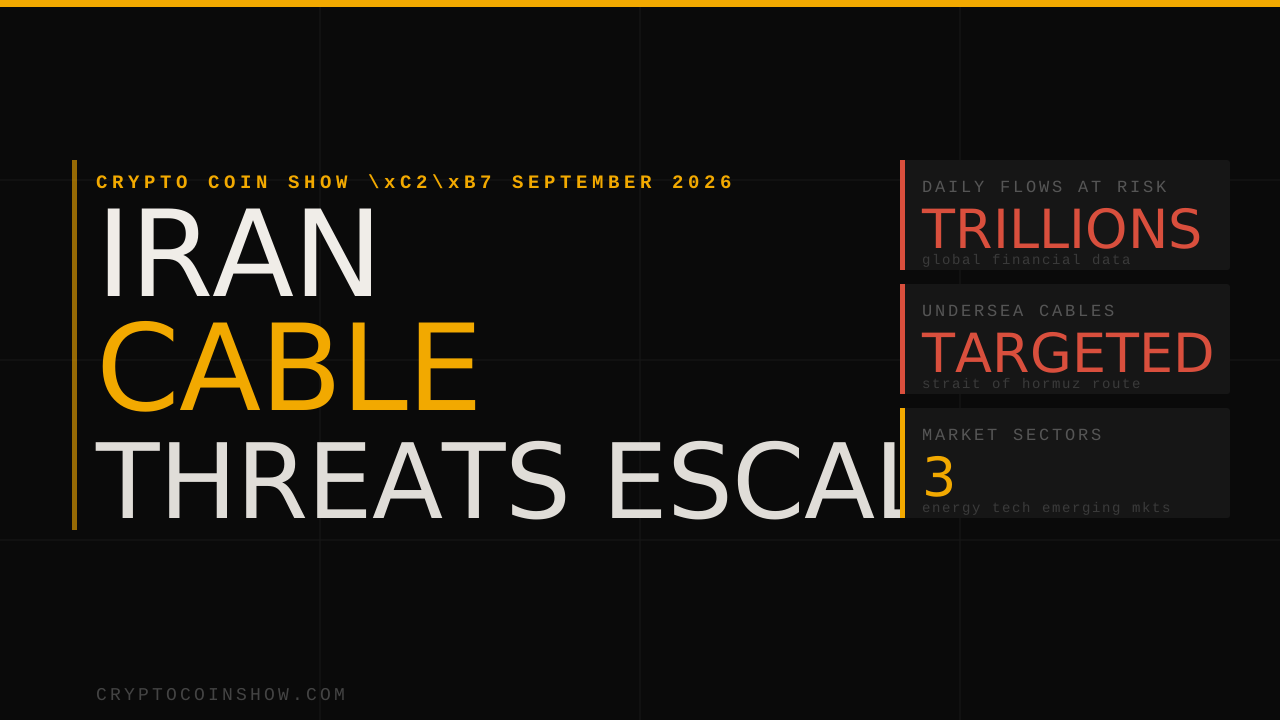
The country is looking at the underwater cables that run beneath the Strait of Hormuz. These cables carry internet data and financial information between Europe, Asia, and countries around the Persian Gulf.
Iran wants big technology companies to pay for using these cables. Some government-connected media in Iran have hinted that the cables could be damaged if companies refuse to pay. Iranian lawmakers talked about this plan last week. It would affect cables connecting Arab nations to Europe and Asia.
“We will impose fees on internet cables,” said Ebrahim Zolfaghari, a spokesperson for Iran’s military, in a post on X last week.
Media connected to Iran’s Revolutionary Guards said the plan would make companies like Google, Microsoft, Meta, and Amazon follow Iranian rules. Cable companies would have to pay fees to use the route, and only Iranian companies could fix or maintain the cables.
Some of these technology companies have put money into cables that go through the Strait of Hormuz and Persian Gulf areas. It’s not clear if these cables actually pass through waters that Iran controls.
There’s also a question of how Iran could make these companies pay. American sanctions don’t allow payments to Iran, so the tech companies might think Iran is just making empty threats.
Still, Iranian media have warned that damage to the cables could hurt trillions of dollars worth of global data and mess up internet connections worldwide.
The strait connects Asian technology centers like Singapore to cable stations in Europe. Problems there could slow down financial trading between Europe and Asia. Parts of East Africa might lose internet completely.
Trump says Xi agrees on opening strait, but China won’t confirm
Trump said Chinese President Xi Jinping agreed that Iran must open the Strait of Hormuz, though China didn’t confirm this.
Xi didn’t talk publicly about his Iran discussions with Trump. China’s foreign ministry called the war a conflict “which should never have happened, has no reason to continue.”
Ebrahim Azizi, who leads Iran’s parliament security committee, said Saturday that Iran has prepared a system to manage ship traffic through the strait on a specific route that will be announced soon.
Azizi said only business ships and those cooperating with Iran would benefit, and fees would be charged for special services.
Bitcoin (BTC) is trying to steady itself after a shaky start to the week. After dipping briefly toward the key $70,000 support level on Sunday, BTC has since bounced back and is now trading above $72,000 on Monday.
However, the next move may depend less on internal crypto dynamics and more on the escalating geopolitical backdrop of tensions between the United States and Iran, and the events that unfold in the days ahead.
$100,000 Bitcoin By Year-End
In a new report, market analyst Sam Daodu argues that Bitcoin’s direction is closely tied to how the conflict unfolds. Rather than pointing to a single likely outcome, Daodu lays out three scenarios, each with a different implication for oil prices, investor sentiment, and ultimately BTC price action.
In Daodu’s bullish scenario, a full peace deal would shift the outlook for both geopolitics and commodities. He suggests oil prices would retreat back toward pre-war levels, roughly in the $65 to $70 per barrel range.
Daodu says that if that happens, Bitcoin could push toward $100,000 by year-end, which would translate to a 39% price increase from current trading levels.
April 15 Agreement Expectations
The base case is more cautious and revolves around what could happen around April 15. Daodu’s view is that if the talks scheduled for that period lead to a new agreement, oil prices might drop below $95 again, similar to what happened after the first ceasefire was announced last week.
Daodu also points to a specific positioning factor: there are reportedly about $6 billion in short positions between $72,200 and $73,500 right now. If oil prices fall quickly and risk sentiment improves fast, those short positions could unwind, triggering a squeeze. That could help drive Bitcoin higher between $75,000 to $80,000.
Bear Path For BTC
The bearish scenario centers on the ceasefire failing—either because it breaks apart completely or because it expires without a workable outcome.
Daodu notes that the two-week ceasefire is already under strain. With talks having collapsed and a blockade being announced, the agreement is described as “hanging by a thread.”
If negotiations fail and oil prices rise above $110 to $120, Daodu says Bitcoin would likely lose the $70,000 support level. From there, the downside path could accelerate, with BTC potentially sliding toward $65,000. If the crisis drags on, he adds that prices could fall further toward $55,000 to $60,000.
Even with these three paths laid out, Daodu’s conclusion is that the base prediction is the most realistic outcome at the moment. In his assessment, Bitcoin is likely to remain range-bound until the next round of talks produces something tangible.
Featured image from OpenArt, chart from TradingView.com
Bitcoin continued to hold near $68,000, a key long-term support level, this morning as traders waited for President Donald Trump’s latest deadline for Iran.
The tension built after Trump said on Truth Social that “a whole civilization will die tonight” as his 8 P.M. Eastern deadline for a deal with Iran approached.
The warning came alongside reports of strikes on Iranian oil infrastructure on Kharg Island, sharpening fears that the confrontation could move from deadline politics to a more disruptive energy shock.
These tensions have left the market suspended between a crypto structure that has so far resisted a deeper breakdown and a macro backdrop growing more difficult by the hour.
Throughout the trading day, Bitcoin has shown some optimism, with prices touching $69,000 before retreating to around $68,500 as traders struggle to decipher Trump’s latest threat that “a whole civilization will die tonight.”
Oil is the transmission engine
Oil has become the main channel through which the US-Iran confrontation is feeding into crypto markets.
Since the US-Iran conflict began, oil prices have soared above $100, thanks in large part to the closure of the Strait of Hormuz, a key oil shipping channel that typically carries about 20% of the world’s oil on a given day.
With Trump’s latest deadline approaching, US crude climbed above $116 a barrel, extending a rally that had already pushed prices toward multi-year highs.
The risks widened further after reports that Iran had threatened to close the Bab al-Mandeb Strait, a route that accounts for roughly 12% of global seaborne trade and has become even more important since the shutdown of Hormuz.
The Kobeissi Letter said that any disruption there could place another major shipping route under pressure and raise the prospect of oil reaching $150 a barrel.
That is where the market threat becomes more serious for Bitcoin.
Once crude moves into that range, the concern extends beyond war headlines or day-to-day swings in risk appetite. Sustained strength in energy prices can reinforce inflation fears, support the dollar, and reduce the room for central banks to ease policy.
Data from CryptoQuant showed the flagship digital asset’s recent rebound occurred while aggregate funding rates across exchanges remained negative.
Bitcoin Funding Rate (Source: CryptoQuant)
This suggests the move has not been driven by traders piling into leveraged bullish bets. Instead, short sellers are still paying to keep bearish positions open even as the price stabilizes and edges higher.
That is usually a healthier setup than a rally fueled by aggressive leverage.
When Bitcoin rises while funding stays negative, it suggests spot buyers are absorbing selling pressure rather than momentum traders chasing the market higher. A rebound built on leveraged longs can fade quickly when sentiment turns.
However, a rebound supported by real buying can keep moving even while the broader market remains skeptical.
Meanwhile, this leaves short sellers vulnerable. Bearish positions opened below current levels can become fuel for a sharper move higher if Bitcoin continues to recover and forced liquidations begin to build.
That dynamic helps explain why Bitcoin has not followed the geopolitical backdrop lower in a more decisive way. The market is still leaning bearish, but price action has not yet confirmed that view.
Still, that support has limits. If the recovery loses momentum before enough short positions are cleared out, the downside can reopen quickly because the market has less leveraged long support beneath it.
A narrow range is making the next move more fragile
At the same time, BTC is trading inside a structure that leaves little room for error.
Glassnode data showed the token in a tight negative gamma pocket between roughly $65,000 and $70,000, an area where dealer hedging can intensify short-term moves in either direction.
Bitcoin Market Positioning (Source: Glassnode)
According to the firm, resistance is building near $72,000, while support below current levels is thinner if momentum fades. The result is a market that can appear stable for stretches and then move abruptly once a catalyst arrives.
The trigger here is coming from Washington, not from within crypto. Traders are not positioning around an earnings release, a network upgrade, or ETF flows. Instead, they are positioning around a deadline that could move oil, shift inflation expectations, and reprice risk assets in the same session.
Markets are weighing another delay against a deeper shock
Part of the restraint in price action reflects pattern recognition.
QCP Capital said markets have spent weeks absorbing weekend escalation rhetoric followed by early-week de-escalation signals, leaving stocks broadly stable and crypto more resilient than the headlines alone would suggest.
The pattern has made traders less willing to fully price in each new threat. At the same time, it has not removed the risk. Each new strike, each new warning, and each new threat to energy infrastructure raises the cost of assuming that this episode will also end in another delay.
Trump has left room for the deadline to move again if talks make progress and something tangible emerges. At the same time, Iran appeared to have halted diplomatic discussions amid the latest threats. That has kept conviction low and volatility close to the surface.
For now, Bitcoin is holding its ground without escaping the pressure around it. Buyers have defended a major support area, and negative funding suggests bearish positioning has not produced the breakdown many expected.
But the market remains stuck in a tight range while oil surges and policy risk dominates trading. A softer turn from Washington could force short sellers to cover, lifting Bitcoin back toward $70,000 and then $72,000.
However, a deeper escalation would shift attention immediately back to inflation, financial conditions, and whether crypto can withstand a broader move out of risk.
Until then, Bitcoin remains tied to the next signal from the White House.
Bitcoin, once promoted by some investors as a hedge against geopolitical turmoil, is behaving like a liquidity-sensitive risk asset at a time when energy prices are climbing, and macro stress is spreading.
This comes as the conflict between the United States and Iran deepens, with shock rippling through oil, the dollar, and broader financial conditions before landing in a crypto market that is already showing signs of fatigue.
That has reopened discussion of a far steeper downside path than the market had been willing to entertain only weeks ago.
Why this matters: This marks a shift in Bitcoin’s behavior under stress. Instead of attracting defensive flows amid geopolitical risk, it is reacting to tighter financial conditions, rising oil prices, and a stronger dollar. That changes how investors position around macro shocks and raises the likelihood of deeper drawdowns if liquidity continues to contract.
By signaling that US military operations could intensify over the next two to three weeks, without offering a clear timeline for an end to hostilities, the administration pushed investors back into a defensive stance.
The initial reaction showed up across equities, though the deeper signal came from energy.
US stocks fell intraday before paring losses by the close, with the S&P 500 down 0.23% and the Dow Jones Industrial Average off 0.39%. In Asia, the sell-off was sharper, with South Korea’s KOSPI dropping 4.2% and MSCI Emerging Asia falling 2.3%.
Oil moved more decisively. Data from Oilprices.com showed that West Texas Intermediate crude jumped 11.41% to $111.54 a barrel, its biggest absolute gain since 2020, while Brent rose 7.78% to $109.03.
The move followed US-Israeli strikes that began on Feb. 28 and Iran’s effective closure of the Strait of Hormuz, the chokepoint that carries roughly one-fifth of global oil and liquefied natural gas flows.
These developments have significant impacts on the crypto market as a sustained rise in crude directly feeds into inflation expectations, tightens financial conditions, and reduces the market’s tolerance for speculation.
With the dollar index up 0.48%, Treasury market spreads wider by 27%, and the VIX climbing toward 25, the broader macro picture is turning against risk assets that depend on abundant liquidity and steady investor appetite.
The Iran escalation may have accelerated the latest sell-off, but it did not create the market’s fragility. Bitcoin was already losing support before the geopolitical backdrop deteriorated.
CryptoQuant data show selling pressure has continued to outweigh institutional accumulation despite earlier support from spot exchange-traded funds and corporate buyers such as Strategy. The firm’s 30-day apparent demand growth stands at -63,000 BTC, indicating that fresh demand has not been strong enough to absorb supply.
Bitcoin Apparent Demand (Source: CryptoQuant)
The same pattern is visible across large holders. Whale wallets holding between 1,000 and 10,000 BTC have shifted from accumulation into one of the sharpest distribution phases of the cycle. The one-year change in whale holdings has swung from an increase of about 200,000 BTC at the 2024 peak to a deficit of 188,000 BTC.
Mid-sized holders have also pulled back. Wallets holding between 100 and 1,000 BTC, often seen as an important layer of market support, have seen their holdings grow by only 429,000 BTC in the current market cycle, compared to about 1 million BTC in late 2025.
This weakness is especially clear in the United States. Coinbase Premium, a common gauge of US spot demand, has remained negative even as Bitcoin fell into the $65,000 to $70,000 range. That suggests American buyers, both retail and institutional, have not returned in enough size to stabilize the market.
Essentially, those figures help to describe a market that had already begun to lose resilience before war headlines intensified.
In calmer markets, that kind of positioning can help maintain price levels. However, it becomes a vulnerability in a macro shock as contracts that might otherwise have rolled forward are more likely to be cut, either by choice or through forced liquidation.
That is how orderly weakness turns into a cascade. Prices fall, leveraged longs are forced out, more selling follows, and the market starts moving on positioning stress rather than conviction.
Analysts at Bitunix told CryptoSlate that Bitcoin remains stuck in a passive pricing regime, with resistance around $69,400 still uncleared and downside liquidity continuing to build near $65,500. In a more hostile macro setting, that lower band could become the trigger point for a broader liquidation wave.
Options markets are sending a similarly cautious message. Greeks.live data show 28,000 BTC contracts expired on April 3 with a put-call ratio of 0.54 and a max pain point at $68,000, representing $1.8 billion in notional value.
According to the firm:
“Bitcoin performed poorly in both price and market sentiment during the first quarter of this year, and the first week of the second quarter has also been weak. Rebuilding confidence may require time and capital support; currently, all indicators point to bear market conditions.”
Why $10,000 is still a tail risk
Bitunix has described the current environment as a triple-constraint regime shaped by elevated inflation expectations, policy limits, and widening geopolitical risk.
That framework helps explain why crypto is reacting so sharply, as liquidity cannot ease much if oil stays high. At the same time, market confidence cannot recover easily if war risk continues to rise, speculative positions become harder to defend as the dollar strengthens, and volatility rises across asset classes.
In a moderate scenario, where the conflict remains contained but inflation stays elevated, unwinding leveraged futures could drag Bitcoin from around $70,000 to $50,000, within a roughly 25% to 30% correction.
Meanwhile, a harsher bear-case path would emerge if ETF outflows accelerate, spot demand remains weak, and the dollar continues to tighten financial conditions. In that setting, Bitcoin could slide into the $20,000 to $30,000 range, erasing 60% to 70% of its value from recent levels.
Bitcoin recovers toward resistance as liquidation pressure subsides.
Possible, but dependent on macro stabilization.
Moderate downside
Around $50,000
Conflict remains contained, but inflation stays elevated and leveraged futures positions unwind.
Roughly 25% to 30% correction from the recent $70,000 area.
Plausible downside case.
Mid-term bear case
$20,000 to $30,000
ETF outflows accelerate, spot demand remains weak, and the U.S. dollar continues to tighten financial conditions.
Bitcoin enters a deeper contraction, wiping out 60% to 70% from recent levels.
More severe, but still within historical drawdown patterns.
Tail-risk black swan
Around $10,000
Prolonged Strait of Hormuz closure or wider regional war sends oil to $150 to $200 a barrel and triggers a collapse in global liquidity.
Bitcoin suffers an extreme drawdown as speculative capital exits the market.
Tail risk, not the base case.
The move to $10,000 sits beyond that as a black swan outcome. It would likely require a prolonged closure of the Strait of Hormuz or a wider regional war severe enough to push oil toward $150 to $200 a barrel, drive a much sharper tightening in global liquidity, and knock equities down by more than 30%.
Under those conditions, speculative capital across crypto would shrink dramatically, leaving Bitcoin exposed to the kind of 80% drawdown seen in earlier cycle washouts.
For now, the immediate takeaway is that Bitcoin is not acting as a safe haven amid war. Instead, it is trading like a highly sensitive risk asset whose direction still depends on liquidity, leverage, and the market’s willingness to absorb macro shock.
The US stock market fell on Friday as rate hike expectations crossed the 50% threshold for the first time, bond yields hit new highs, and the Iran war showed no signs of de-escalation. The S&P 500 dropped 0.92%, heading for its fifth straight weekly decline.
Three forces drove the selling on Friday, all connected to the same root cause. Oil (Brent Crude) above $100 is feeding into inflation, forcing the Fed’s hand and crushing bonds and equities simultaneously.
1. Rate Hike Odds Cross 51% as Fed Cuts Vanish Until December 2027
The CME FedWatch Tool now shows no expected rate cuts until December 2027 and a 51% probability of a rate hike by March 2027. Surging oil prices are feeding into inflation expectations, forcing the Fed into a corner where easing becomes impossible. Higher rates compress earnings multiples and make risk assets less attractive.
BREAKING: The US Federal Reserve is now no longer expected to cut interest rates until December 2027.
There is now a 51% chance of an interest rate HIKE by March 2027.
The 10-year Treasury yield climbed to 4.48%, its highest since the conflict began.
We believe this weekend is a crucial pivot point in the Iran War:
As the bond market continues to get crushed, the 10Y Note Yield just hit a new high of 4.48%. For the first time since the Iran War began, the bond market is nearing or already in “crisis” territory.
When yields rise this sharply, it pressures growth stock valuations and competes with equities for capital. The US Dollar Index (DXY) is gaining strength, squeezing multinational earnings as foreign revenue translates into fewer dollars back home.
With over 40% of S&P 500 revenue coming from overseas, the stronger dollar is pressuring the broader index.
Meanwhile, capital has rotated into gold above $4,400 and silver, reflecting a flight into hard stores of value.
3. Iran Rejects Direct Talks, Brent Holds Above $104
Iranian Foreign Minister Abbas Araghchi said exchanges through mediators do not constitute “negotiations with the United States.” Brent crude held above $104, keeping the geopolitical risk premium intact.
Oil above $100 functions as a tax on consumers and businesses, raising input costs and squeezing discretionary spending.
What Is Happening to Major US Indexes?
At press time, all three major indexes are in the red.
S&P 500: down 59.53 points (−0.92%) at 6,417 (stronger dollar hitting several players)
Dow Jones Industrial Average: down 467.58 points (−1.02%) at 45,492
Nasdaq Composite: down 279.90 points (−1.31%) at 21,128
Market breadth is overwhelmingly negative, with 3,746 stocks declining versus 1,593 advancing.
The S&P 500 continues its decline after breaking down from a bear flag pattern. The breakdown started on March 18 and has already delivered a 3.8% correction. The measured move target sits at 6,347.
If the index fails to reclaim 6,435, the factors above could push it toward 6,347 and even 6,213.
Which Sectors Are Holding Up?
Energy led with a 1.51% gain as Brent stayed above $104. Exxon Mobil (XOM) gained 3.17% at press time, and Chevron (CVX) rose 1.98% as elevated oil prices directly increased producer revenue.
Basic Materials added 1.17% on rotation into commodities. With gold above $4,400 and silver strengthening, mining stocks attracted capital as an inflation and geopolitical hedge.
Utilities gained 1.08% as defensive positioning continued. Risk aversion is overriding the traditional rate sensitivity of the sector, making yield-paying defensives attractive as a parking spot for nervous capital.
Which Sectors Are Falling?
Consumer Cyclical led losses at -1.83%. Oil above $100 acts as a direct tax on spending power. Amazon (AMZN) fell 3.38%, and Tesla (TSLA) dropped 1.83%.
Communication Services lost 1.41% as Meta (META) fell 3.65%. Ad-dependent businesses suffer early in slowdowns because advertising budgets are among the first expenses companies cut. Financials declined 1.30 as the speed of the yield surge, combined with recession fears, creates credit risk concerns that outweigh the margin benefit.
Technology lost 1.07% as the Nasdaq entered correction territory and higher bond yields crushed growth stock valuations.
Major Stock News Investors Are Watching
Unity Software (U) surged 10% after preliminary Q1 revenue of $505 million to $508 million crushed guidance. The company also plans to sell its China division for over $1 billion, streamlining around its AI-powered Vector advertising platform.
Unity Software sharply higher premarket after raising its Q1 revenue guidance above consensus. The company sunsetting its ironSource Ads Network. $U 19.42, +2.29, +13.4% pic.twitter.com/sbVLYl9ka3
CrowdStrike (CRWD) fell 7% after FY27 guidance landed below expectations while AI-powered rivals intensified competitive pressure in cybersecurity.
$CRWD -7%, $PANW -7.2%, $NET -3.75%, $ZS -7.6%, $OKTA -6.7% … [Cybersecurity stocks including CrowdStrike, Palo Alto Networks, Cloudflare, Zscaler, and Okta are falling after Anthropic accidentally leaked details of its new powerful AI model with strong cyber capabilities.]… pic.twitter.com/IZH2vWuL0l
Iran’s counter-proposal to President Trump’s 15-point peace plan is expected today. If the proposal shows willingness to negotiate, oil could retreat and pull equities higher by Monday’s open.
TRUMP AND TOP WHITE HOUSE OFFICIALS HAVE BEEN TOLD THAT IRAN’S COUNTER-PROPOSAL WOULD LIKELY ARRIVE FRIDAY VIA INTERLOCUTORS -SOURCE
If it amounts to another rejection, yields could push above 4.50% next week, and the S&P 500’s 6,347 target comes firmly into play. The weekend could be the most consequential 48 hours for markets since the conflict began.