
Arthur Hayes faces fresh exit liquidity accusations over $CARDS token sale
BitMEX co-founder Arthur Hayes is facing a second round of accusations in as many weeks that he used his public platform to drive retail demand for tokens before liquidating his own holdings, a pattern blockchain investigators say amounts to using retail traders as “exit liquidity.” The allegations, if substantiated through on-chain data, raise governance and disclosure questions for institutional investors evaluating projects Hayes promotes or funds through his venture vehicle Maelstrom.
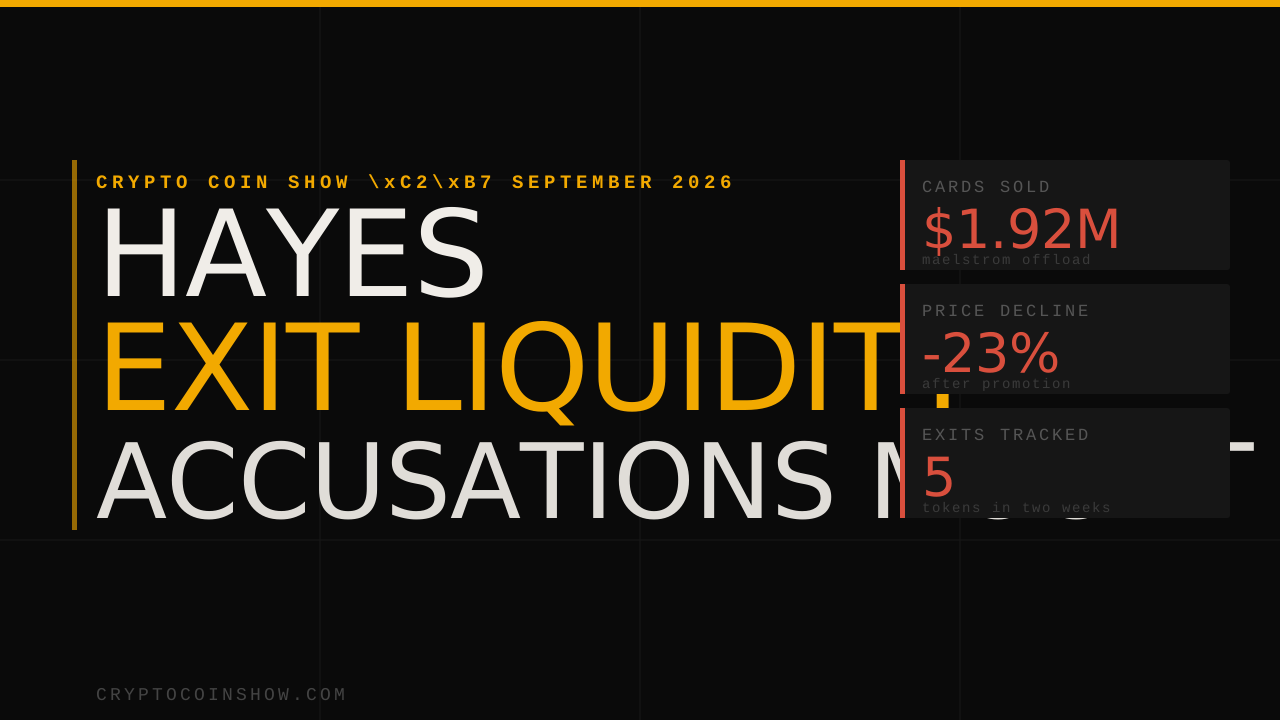
- Hayes promoted $CARDS token on June 23, predicting a price surge, then Maelstrom offloaded $1.92 million in CARDS four days later as price declined 23%
- ZachXBT documented Hayes exiting positions in HYPE, NEAR, ZEC, and WLD within two weeks of publicly endorsing each token as investment thesis
- Pattern suggests potential misuse of influence to generate retail demand for token exits, raising disclosure and conflict-of-interest concerns for fund-backed projects
- $1.92M CARDS tokens offloaded by Maelstrom after Hayes promotion
- 23% Price decline in CARDS from Hayes endorsement to Maelstrom sale
- 4 Tokens Hayes exited within two weeks of public endorsements
Arthur Hayes, the high-profile co-founder of derivatives exchange BitMEX, is confronting renewed scrutiny over what blockchain researchers characterize as a systematic pattern of promoting tokens to retail audiences before personally exiting positions, potentially profiting at the expense of followers who bought on his recommendation.
On June 23, Hayes posted publicly that $CARDS token held a “solid” thesis and predicted its price would surge. Four days later, on-chain data revealed that Maelstrom, his venture fund, transferred $1.92 million worth of CARDS to market maker Flowdesk, a move typically preceding token sales.
The $CARDS token had declined roughly 23 percent from its level when Hayes endorsed it, suggesting that retail buying interest sparked by his promotion provided the liquidity Maelstrom needed to exit.
The $CARDS incident arrives just three weeks after blockchain investigator ZachXBT published detailed findings that Hayes had followed an identical playbook with four separate tokens: HYPE, NEAR, ZEC, and WLD. In each case, ZachXBT documented, Hayes publicly endorsed the token or its underlying thesis, then closed his position within days or weeks, capturing gains while retail interest, generated partly by his social media influence, absorbed the exit.
The pattern has become sufficiently notable that it now carries a name in crypto circles: using retail followers as “exit liquidity,” the demand generated by a trusted voice to help insiders unwind holdings at favorable prices.
Hayes defended his trades as market timing, not market manipulation
When ZachXBT confronted Hayes directly over the HYPE, NEAR, ZEC, and WLD exits, Hayes responded that he had “sold to a willing seller at a price” and that he had “happened to call it right this time” regarding his trading objectives.
The response indicates Hayes views his trades as legitimate market activity, he identified an opportunity, acted on conviction, and executed sales to counterparties who agreed to his pricing. By this logic, if retail buyers chose to purchase $CARDS or $HYPE after his endorsements, that represented their own decision, not manipulation on his part.
However, ZachXBT’s framing of the question, asking Hayes directly “how much exit liquidity his followers had absorbed”, captures the institutional concern at stake. When a figure with Hayes’s platform and credibility publicly champions a token, retail investors often interpret that as due diligence already completed by someone with better information and track record.
If that same figure then sells into the demand they created, they have effectively used information asymmetry and influence to profit at followers’ expense. The legal and ethical distinctions between legitimate trading and market manipulation hinge partly on whether the promoter benefited from the very price movement their promotion caused.
Timing and on-chain evidence strengthen allegations of coordinated exits
The specificity of the on-chain data animates the accusations. In the $CARDS case, on-chain analyst SolanaFloor flagged that Hayes set a $4 price target for the token when it was trading around $0.30, an 1,233 percent upside case, then noted that Maelstrom transferred $1.92 million to Flowdesk the following day.
SolanaFloor added that such transfers to market makers are “likely for selling.” A second analyst, Ericonomic, independently confirmed a similar pattern, noting that an address matching Hayes’s token holdings sold its entire $CARDS stack three days after Hayes’s public endorsement, using the custody service Fireblocks to process the exit.
The ZachXBT investigation into the four earlier tokens documented even tighter timing windows. Hayes called HYPE, ZEC, and NEAR the “Holy Trinity” on May 22, then exited his HYPE and NEAR positions by June 4, just 13 days later.
He dumped ZEC on June 5 after citing an exploit in the Orchard Pool, a technical justification that may have been genuine but nonetheless allowed him to exit near the peak of his own promotional push. His WLD position closed the next day, less than 24 hours after he framed Worldcoin as a “SpaceX IPO play” on social media.
These tight windows between public endorsement and position closure are difficult to explain as coincidence. If Hayes had conviction in these tokens as long-term holds, institutional investors would expect him to hold through volatility. Instead, the pattern suggests Hayes identified near-term windows for price appreciation driven by his own influence, then exited once that window closed.
ZachXBT has established credibility as a tracker of promote-then-dump dynamics
ZachXBT, who operates as an independent on-chain investigator, has built a track record flagging similar dynamics across the broader crypto ecosystem.
Over the prior two months, he had already called out suspicious promote-then-sell patterns involving RAVE, SIREN, and LAB tokens, in each case documenting how insiders or prominent figures used social media to generate retail buying interest before liquidating their own stakes into that demand.
His methodology relies on matching public statements, tweets, interviews, or Discord messages, against on-chain wallet activity, tracking wallet clusters that belong to the same entities, and identifying suspicious timing correlations.
Hayes’s public prominence and repeated endorsements make him an unusually high-visibility target for this kind of analysis. Unlike anonymous crypto insiders, Hayes maintains active social media accounts, funds projects through Maelstrom with disclosed positions, and regularly offers public market commentary.
That visibility cuts both ways: it makes Hayes easier for retail followers to discover and trust, but it also creates a documentary record that independent investigators can audit against on-chain evidence.
ZachXBT’s investigations into Hayes rely on matching Hayes’s own public statements, captured on X, formerly Twitter, against blockchain records that show token movements, many of which Maelstrom publishes or discloses.
Institutional investors must evaluate conflict-of-interest disclosure in fund-backed tokens
For institutional crypto investors, the pattern raises specific due diligence questions about any token that Hayes has publicly promoted or in which Maelstrom holds a stake.
The core issue is not whether Hayes’s trades are technically illegal, that determination would require regulatory investigation, but whether Hayes discloses his positions and exit intentions transparently when he publicly promotes a token.
Traditional venture capital and hedge funds operate under strict conflict-of-interest disclosure requirements, particularly when founders or fund managers hold positions in the very projects they publicly endorse.
In traditional markets, a venture capitalist would face immediate scrutiny, and likely legal liability, if she publicly promoted a company’s stock while simultaneously liquidating her own shares into retail demand generated by her promotion.
Securities law requires that such conflicts be disclosed prominently and that insiders file public forms (such as Form 4 filings with the SEC) documenting their sales in real time.
Crypto markets have not yet implemented equivalent institutional safeguards, leaving retail investors and institutional funds relying on independent blockchain investigators rather than regulatory oversight to uncover these patterns.
Institutional investors evaluating Maelstrom-backed projects face an asymmetric information problem: they know Hayes will publicly promote tokens in his portfolio, but they have no standardized disclosure system telling them when Hayes or