Tether Tron and TRM Labs T3 FCU freezes $450 million worth of illicit crypto funds
Tether’s T3 Financial Crime Unit has frozen $450 million in suspected illicit USDT since launching in September 2024, establishing a compliance infrastructure that executes asset freezes within 24 hours, a speed traditional financial institutions cannot match. The achievement signals that stablecoin platforms can now function as active enforcement partners for law enforcement, reshaping how institutional investors evaluate custody and regulatory risk in digital assets.
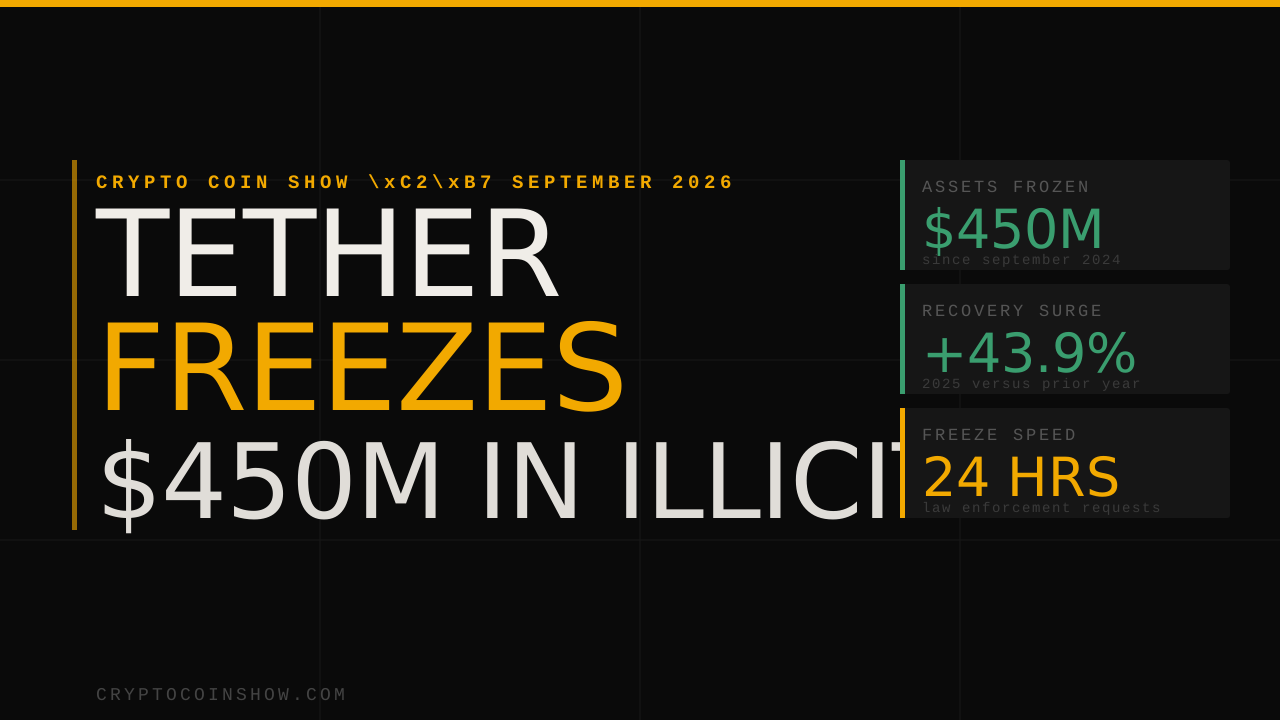
- T3 FCU froze $450 million in illicit USDT since September 2024, involving 43.9% more asset recovery in 2025 versus the prior year
- Unit executes law enforcement asset freeze requests within 24 hours, compared to days or weeks for traditional banking infrastructure
- Financial Action Task Force cited T3 FCU as an invaluable resource for law enforcement, setting a public-private compliance standard for crypto platforms
- $450M in illicit USDT frozen since T3 FCU launch in September 2024
- 43.9% more illicit proceeds recovered in 2025 compared to prior year
- 24 hours maximum response time for law enforcement asset freeze requests
Tether, TRON, and blockchain analytics firm TRM Labs announced Wednesday that their joint Financial Crime Unit has frozen more than $450 million in USDT suspected to stem from criminal activity since the initiative launched in September 2024.
The frozen funds span investigations into money laundering, cryptocurrency exchange breaches, North Korea-linked cyber operations, terrorist financing, drug trafficking, and violent crimes including kidnappings and extortion.
Operating across five continents with active coordination from law enforcement agencies in the United States, Spain, Germany, the Netherlands, and Bulgaria, the T3 FCU has established itself as an operational enforcement arm that bridges the gap between stablecoin platforms and traditional law enforcement capacity.
T3 FCU executes $450 million freeze while outpacing traditional banking response times
The unit’s defining operational advantage is speed. T3 FCU can execute asset freezes within 24 hours of receiving a formal request from law enforcement, a capability that sets it apart from traditional financial institutions, which typically require days or weeks to process similar inquiries.
This acceleration matters strategically for institutional investors evaluating counterparty risk: it demonstrates that digital asset platforms can now compete with legacy banking infrastructure on compliance velocity rather than lag behind it.
In 2025 alone, the T3 FCU reported recovering 43.9% more illicit proceeds compared to the previous year, signaling both rising criminal volume in crypto markets and the unit’s expanding investigative footprint. The organization cited multiple high-profile cases to illustrate its impact.
A European money-laundering operation resulted in the freezing of $26.4 million in coordination with Spain’s Guardia Civil in early 2025. Operation Lusocoin, a Brazilian Federal Police investigation, led to the freeze of over 3 billion Brazilian reais in crypto assets, with 4.3 million USDT identified as proceeds of a criminal network.
The unit also froze wallets connected to North Korean cyber activity and approximately $9 million traced to the Bybit exchange hack.
In April 2026, T3 FCU executed a $344 million USDT freeze on TRON following intelligence-sharing with U.S. and international law enforcement agencies.
Financial Action Task Force endorses T3 as leading compliance model for crypto platforms
The Financial Action Task Force, the international standard-setting body for anti-money laundering and counterterrorism financing, cited the T3 FCU in 2025 as an “invaluable resource for law enforcement agencies worldwide.” The FATF explicitly highlighted T3 alongside TRM Labs’ Beacon Network as exemplary public-private partnerships in the fight against criminal activity in cryptocurrency markets.
This institutional recognition carries weight for compliance officers and risk managers at investment firms evaluating which stablecoin ecosystems meet emerging regulatory standards.
The endorsement arrives as criminal activity in blockchain markets reached a record $158 billion in 2025, according to TRM Labs estimates. The volume reflects both the expansion of crypto adoption and the sophistication of illicit actors who exploit blockchain opacity for money laundering, sanctions evasion, and theft.
Regulators globally are responding with intensified scrutiny of stablecoin issuers and blockchain platforms, creating compliance pressure on the industry.
Compliance is not an option; it is a part of our commitment to protect our users and stop any illicit behaviors.
Paolo Ardoino, Tether
Ardoino’s framing reflects a strategic pivot: compliance and law enforcement cooperation are now positioned as core business functions rather than regulatory burdens.
For institutional investors, this represents a material shift in how stablecoin platforms manage reputational and legal risk, and it directly influences the custody and operational risk profile of digital assets held on those networks.
Institutional demand for compliance infrastructure reshapes stablecoin platform competition
The T3 FCU’s scale and recognition signal that institutional capital flows into crypto markets will increasingly depend on platform-level compliance maturity. Traditional asset managers and regulated institutions cannot deploy capital into ecosystems perceived as havens for illicit finance, regardless of the underlying blockchain technology.
By demonstrating rapid asset-freeze capabilities and coordination with law enforcement across multiple jurisdictions, Tether and TRON are building a competitive moat around their stablecoin rails.
The 24-hour freeze execution time carries strategic implications for market microstructure as well. When law enforcement can freeze suspected criminal funds faster than market participants can move them across decentralized exchanges or mixing services, the marginal cost of illicit activity increases.
This does not eliminate crypto’s use in money laundering, but it raises the operational friction significantly relative to legacy banking channels, which is precisely why the FATF and institutional regulators view platforms with active T3-style units as preferable counterparties.
The recovery rate improvement in 2025 indicates the unit’s enforcement actions are also yielding higher asset recovery ratios, creating a visible track record for regulators evaluating platform compliance effectiveness.
Watch for whether other major stablecoin issuers, including Circle and Paxos, establish comparable financial crime units with published freeze response times and recovery statistics, or whether Tether’s T3 model becomes a differentiating advantage in institutional custody decisions.
Regulatory agencies in the European Union and Asia are expected to impose compliance standards modeled on T3’s framework during 2026 rulemaking cycles, potentially forcing the question of whether the 24-hour freeze standard becomes a baseline expectation for licensed stablecoin platforms.
T3 FCU Outpaces Traditional Banking on Compliance Speed, Reshaping Institutional Risk Assessment
The 24-hour freeze execution window represents a structural advantage over traditional financial infrastructure, where asset recovery typically requires 3 to 14 days of inter-agency coordination and court orders.
A 2023 study by the Financial Crimes Enforcement Network found that U.S. banks averaged 8.2 days to execute freeze requests on suspected proceeds, while international transfers often stretched to 21 days or longer due to correspondent banking delays.
By contrast, T3 FCU’s blockchain-native infrastructure allows near-instantaneous transaction halting once law enforcement provides documentation, compressing the window in which funds can be moved across exchanges or layered through derivative positions.
For institutional investors evaluating custody providers and stablecoin platforms, this compliance velocity has become a material factor in counterparty risk models.
Major asset managers now distinguish between platforms offering reactive compliance (responding after regulatory inquiry) versus proactive enforcement partnerships like T3 FCU, which flag and freeze assets before law enforcement formally requests intervention.
The precedent signals that blockchain platforms meeting this standard face lower regulatory friction and reputational risk than competitors operating on slower compliance cycles.
The Financial Action Task Force’s endorsement of T3 FCU in its recent mutual evaluation report on crypto-asset regulation has prompted at least six additional stablecoin platforms to announce similar financial crime units. Regulators in the EU, Singapore, and the UK are now signaling that adoption of 24-hour freeze capability may become a compliance expectation for platforms seeking authorization in 2025. The next benchmark test will be whether T3 FCU maintains this response time as illicit case volume scales beyond current levels.