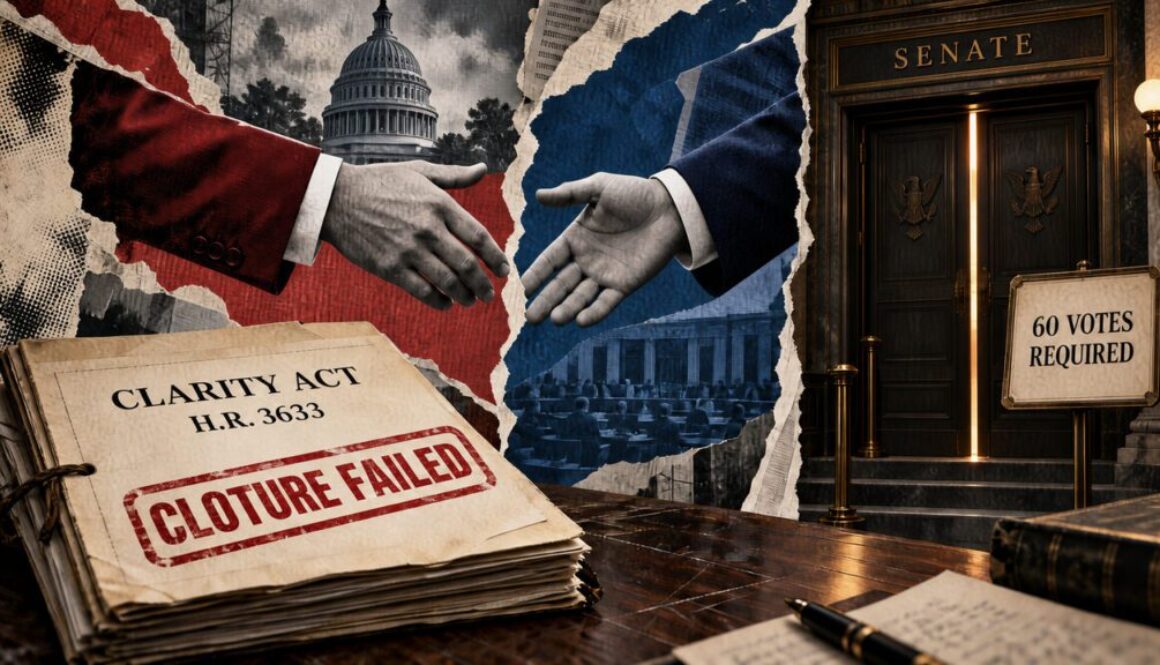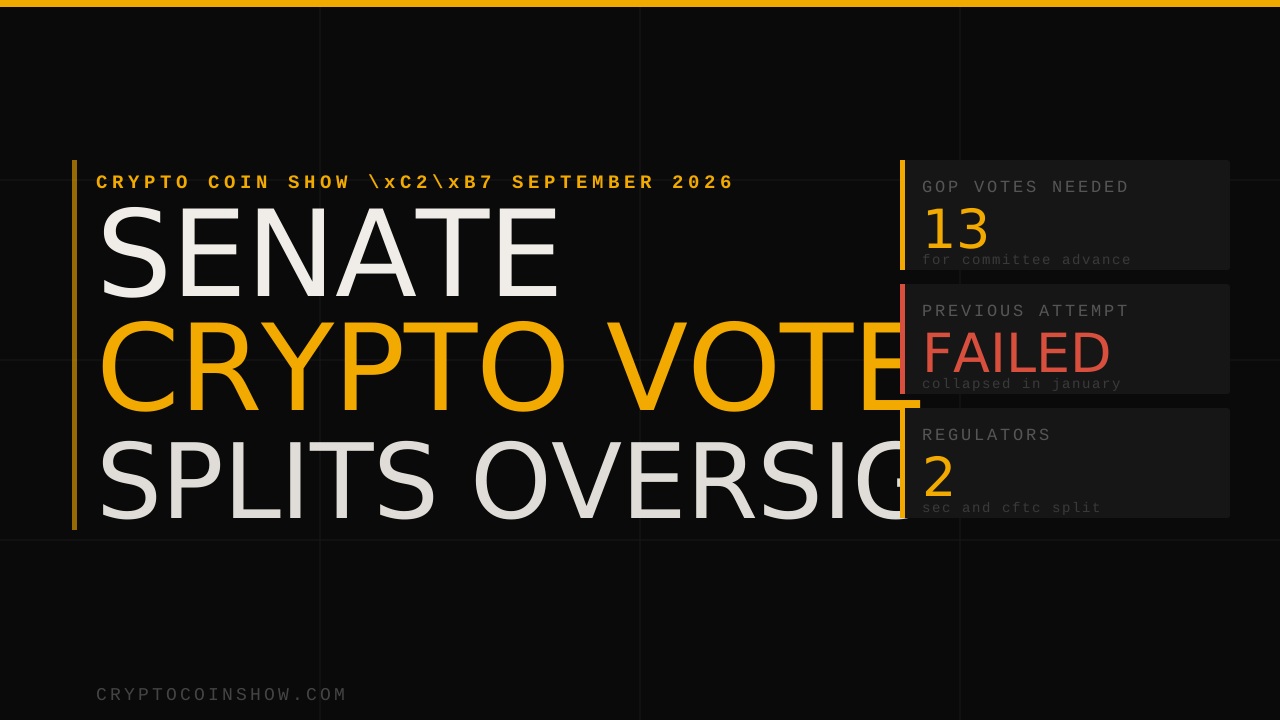

The Senate Banking Committee voted 15-9 on Thursday to move forward on the CLARITY Act, a crypto market structure proposal that has been the subject of debate for a while now.
Nevertheless, just ahead of the vote, the Bank Policy Institute (BPI) put out a series of tweets on X about illicit crypto flows hitting $154 billion in 2025, adding another dimension to what was already an intensely debated topic on the extent of regulation in digital assets.
Bank Advocates Lean on Crime Data
The timing of BPI’s thread drew attention because lawmakers were simultaneously debating amendments tied to stablecoin yield restrictions and enforcement standards inside the CLARITY Act markup session.
According to data from Chainalysis that the institute shared, in 2025, illicit crypto addresses received $154 billion. This was a 162% year-over-year increase, driven largely by a 694% jump in value received by sanctioned entities.
Furthermore, the on-chain money laundering ecosystem grew from $10 billion in 2020 to over $82 billion in 2025, with stablecoins, primarily Tether (USDT), now accounting for 84% of all illicit transaction volume, displacing Bitcoin as the preferred payment method for criminals.
In a separate piece, the BPI argued that banks have spent decades staffing tens of thousands of AML employees while crypto companies have been largely exempt.
It said that the GENIUS Act imposed some obligations on US stablecoin issuers, but did not cover foreign issuers operating stateside. Tether, incorporated in El Salvador, sits outside that net.
The piece also cited the Islamic Revolutionary Guard Corps, whose crypto activity reportedly reached over $3 billion in 2025, representing roughly 50% of Iran’s total crypto ecosystem by Q4 of that year.
According to the BPI, unhosted wallets, cross-chain bridges, and mixers are “specifically designed to frustrate tracing and openly advertised as such.”
The stablecoin debate has become one of the most contentious parts of the CLARITY Act negotiations, with banking groups, including members of the American Bankers Association, spending weeks lobbying senators to tighten language restricting yield-bearing stablecoins.
As CryptoPotato reported earlier this week, banking groups sent Senate offices more than 8,000 letters ahead of the markup vote, while the crypto advocacy group Stand With Crypto said its supporters had contacted lawmakers nearly 1.5 million times in support of the bill.
But despite more than 40 amendments proposed by Senator Elizabeth Warren and procedural disputes during the hearing, the legislation advanced with support from Democratic senators Ruben Gallego and Angela Alsobrooks.
The Counter-Argument
While the BPI is demanding stricter anti-money laundering laws and sanctions regulations to be applied to crypto the same way it has been done to the traditional banking sector, data shared by Binance Research on May 14, offered some pushback to its claims.
According to Binance, trapped illicit funds on-chain have grown every year because less is being successfully laundered, not more.
Their report showed that more exit points are being blocked by KYC and more balances are being frozen by stablecoin issuers. Even the largest mixers have been processing at most $10 million per day.
The Senate Banking Committee’s CLARITY Act is heading into Thursday’s markup, buried under opposition.
According to reports, Senator Elizabeth Warren alone filed more than 40 amendments before Tuesday’s 5 p.m. ET deadline, and American Bankers Association members sent over 8,000 letters to Senate offices in less than a week demanding changes to the bill’s stablecoin yield rules.
Over 100 Amendments Filed
The total number of proposed amendments going into Thursday is still being confirmed, but according to a list obtained by Politico, there have been more than 100 proposed. To put things in perspective, a total of 137 revisions were proposed before the markup scheduled for January, which was canceled.
Warren’s batch alone covers a wide range of restrictions. One amendment that stood out would bar the Federal Reserve from issuing master accounts to crypto companies, which would effectively cut such firms off from the core infrastructure of the US banking system.
The lawmaker also attacked the updated bill on X, arguing that it lacked ethics provisions tied to President Donald Trump’s crypto businesses.
“No bill should move through the Banking Committee without real ethics guardrails,” she wrote.
That dispute has become harder for negotiators to avoid. Late last month, analyst Simon Dedic claimed that Trump’s meme coin and his crypto-related dinners were part of the reason the CLARITY Act was going nowhere, with Democrats demanding conflict-of-interest language before backing the legislation.
Another revision, filed by Senator Jack Reed of Rhode Island, would prohibit crypto from being used as legal tender, including for paying taxes. That proposal runs directly counter to a bill Representative Warren Davidson introduced last year that would have allowed Bitcoin to be used for precisely that purpose.
Senators Reed and Tina Smith of Minnesota also filed a joint amendment that would incorporate bank-requested changes to the stablecoin yield language.
According to journalist Brendan Pedersen, the proposal will force senators to choose between crypto and the banks on a single vote, making it an uncomfortable moment for Republicans who tend to side with both.
Bankers Blitz Senators With 8,000 Letters
Elsewhere, members of the American Bankers Association have reportedly sent more than 8,000 letters to Senate offices since last Friday, pushing lawmakers to change the bill’s stablecoin yield compromise.
However, Stand With Crypto, the crypto advocacy group, responded with its own numbers on Tuesday, saying its advocates had called Congress 8,000 times and sent 300,000 emails over recent months to protect stablecoin rewards, and have contacted lawmakers nearly 1.5 million times in support of the CLARITY Act overall.
Those on the side of digital assets are framing the banking industry’s lobbying campaign as an attempt to block competition from yield-bearing stablecoins.
Senator Bernie Moreno accused banks of trying to “kill stablecoins that would let everyday Americans earn real yields on their own money.” He also described the banking industry as a “cartel” protecting low-interest deposit models.
But not everyone inside Washington thinks this fight ends at Thursday’s committee vote. According to reporter Sander Lutz, banking policy leaders are already preparing for another push on the Senate floor if they lose the markup battle over yield restrictions.
Meanwhile, crypto journalist Eleanor Terrett reported that Senate Minority Leader Chuck Schumer privately encouraged Democrats to work toward supporting the bill.
As the Senate Banking Committee prepares to mark up the long-anticipated CLARITY Act on Thursday, Coinbase CEO Brian Armstrong has argued that the newest version of the bill represents a workable “compromise” and could meaningfully improve the US financial system.
Speaking to FOX Business, Armstrong said the updated draft reflects concessions on both sides—what he described as the crypto industry meeting requests from bank lobbyists and lawmakers, while the banking sector also gave ground during negotiations.
Coinbase CEO’s CLARITY Act Pitch
Armstrong also highlighted one specific element tied to stablecoin rewards. He said the approach in the latest bill would only apply when there is “some sort of material activity on the account,” adding that he believes the overall package would make the system “more efficient.”
The claim is that the legislation would help streamline financial services, reduce friction, and make access easier for consumers and businesses—while still keeping the framework aligned with banking-sector concerns that were raised during talks.
Still, critics point to the banking industry’s pushback as evidence that the dispute is far from settled. As reported throughout the week by Bitcoinist, banking trade groups have opposed the CLARITY Act’s stablecoin-rewards provision, arguing that it could give crypto firms too much flexibility.
Their position is that the policy might also encourage deposits to shift away from traditional, insured banking channels rather than strengthening them.
Beyond the details of stablecoin rules, Coinbase CEO argued that the broader direction of the CLARITY Act reflects growing institutional interest in digital assets.
In his view, banks are increasingly integrating stablecoins and crypto-related services because customer demand is rising—an angle that suggests the bill, if passed in its current form, could provide the clearer structure institutions want before expanding further.
Can The Latest Crypto Bill Draft Survive?
Supporters of the bill are not limited to Coinbase. Ripple CEO Brad Garlinghouse also backed the current push, commenting on social media site X (previously Twitter) that the Senate Banking Committee is “putting in the work” to move the CLARITY Act forward.
Garlinghouse’s message emphasized that Ripple supports the bill because crypto businesses and major participants should have the “same rules and protections as every other asset class,” and because—if the US is serious about leading in crypto—this is the moment to finalize legislation and get it done.
Even with that backing, the legislative road ahead is not smooth. Politico reported that Senator Elizabeth Warren, a well-known crypto skeptic, is vowing to pursue extensive changes to the bill through amendments.
The reporting says Warren and others are preparing more than 100 amendments ahead of the markup, following the release of an updated 309-page draft that expands on an earlier 278-page version introduced in January.
According to the same reporting, Warren submitted more than 40 amendments on her own, with much of the rest attributed to Democratic members of the Banking Committee.
This mirrors earlier moves around the bill: the January markup session drew 137 amendments, and it was eventually cancelled after a period of resistance that included Armstrong and Coinbase withdrawing support for the bill at the time.
For now, the core question going into Thursday’s markup is whether the latest CLARITY Act draft can hold together.
Featured image created with OpenArt, chart from TradingView.com
A senior White House official has accused major banking trade leaders of refusing to join earlier talks on stablecoin rewards, escalating a dispute that has become one of the final pressure points ahead of the Senate Banking Committee taking up the CLARITY Act this week.
In a May 11 post on the social media platform X, Patrick Witt, executive director of the White House Presidential Advisory Committee on Digital Assets, said he had asked American Bankers Association President Rob Nichols and other bank trade CEOs to attend the February meetings aimed at resolving the question of stablecoin rewards and yield.
“I specifically requested the attendance of Mr. Nichols and other bank trade CEOs at the meetings we hosted back in February to resolve the stablecoin rewards/yield issue. They refused. I guess the White House was beneath them?”
The criticism injected the White House more directly into a fight that has divided banks, crypto companies, and lawmakers ahead of a scheduled May 14 markup of the CLARITY Act.
The bill is designed to create a broader market structure framework for digital assets, but the treatment of stablecoin rewards has become a flashpoint over competition for deposits, consumer yield, and the future shape of dollar-based payments.
Witt’s comments also reframed the timing of the banking industry’s objections. Rather than a new technical concern emerging before a committee vote, the White House official cast the dispute as an unresolved issue that banking leaders had an opportunity to address months earlier.
Banks reopen stablecoin rewards fight before markup
Over the weekend, the American Bankers Association (ABA) urged bank executives and employees to press senators for tighter restrictions in the CLARITY Act before the committee vote, warning that the current bill could still allow crypto firms to offer reward structures that resemble interest on deposit-like products.
Nichols told bankers that lawmakers needed to hear from the industry before the legislation advanced.
The ABA’s concern is that stablecoin issuers, exchanges, or related companies could attract customer funds by offering returns on assets that compete directly with traditional bank deposits.
Banks rely on deposits as a funding base for loans to households, small businesses, farms, and corporations. If customers move cash into stablecoins that offer rewards, banks argue that lenders could face higher funding costs, tighter margins, and less capacity to extend credit.
The banking industry has described the current compromise language as leaving a loophole.
In its view, a ban on stablecoin issuers paying yield would be insufficient if affiliated exchanges, brokers, or other crypto platforms could deliver similar economic benefits through rewards, rebates, or incentive programs.
That position has put banks at odds with crypto companies that see the rewards language as a basic competition issue.
Stablecoin reserves are typically held in cash, short-term Treasuries, or other liquid instruments that generate income. The policy fight centers on whether consumers should be able to receive part of that return, and which type of institution should be allowed to offer it.
The recent Senate compromise has attempted to separate passive yield from activity-based rewards.
That distinction was meant to prevent stablecoins from becoming direct substitutes for interest-bearing deposits while preserving room for crypto platforms to reward users for participation, payments, or other services.
White House analysis undercuts the lending warning
The Council of Economic Advisers said in an April report that banning stablecoin yield would provide only a marginal lift to bank lending under its baseline assumptions. The CEA estimated that such a ban would increase bank lending by about $2.1 billion, equal to roughly 0.02% of total lending in the base case.
That finding gives the administration a counterweight to the banking sector’s claim that stablecoin rewards could meaningfully damage credit creation.
The report argued that most stablecoin reserves would not be permanently removed from the banking system. Instead, reserves held in cash, bank deposits, or Treasury instruments would continue to circulate through financial markets in different forms.
The CEA also said a more severe impact would require a much larger stablecoin market and more restrictive assumptions about how reserves are held. In the administration’s framing, stablecoin rewards may affect bank margins, but the baseline effect on lending capacity appears limited.
Moreover, a separate analysis by Galaxy Research furthered the argument by focusing on the international flow of dollars.
Galaxy said banks were overstating the risk that stablecoin growth would simply drain domestic deposits. Its model projected that much of the growth under a regulated stablecoin framework would come from offshore users seeking easier access to dollar-denominated assets.
That finding changes the economic lens. If stablecoins mostly draw funds from US bank accounts, banks face a direct deposit migration problem.
However, if much of the growth comes from foreign users moving into dollar stablecoins, the effect could be an inflow into US financial infrastructure rather than a one-way drain from domestic lenders.
Galaxy estimated that 60% to 70% of stablecoin growth under the GENIUS Act framework could originate offshore. It also projected that imported deposits from foreign demand could exceed domestic deposit migration by roughly 2:1.
The firm said each newly minted stablecoin dollar could generate about 32 cents of net US credit, with total credit expansion reaching about $400 billion through 2030 in its base case and as much as $1.2 trillion in a stronger growth scenario.
GENIUS Act Impact on Stablecoin (Source: Galaxy Digital)
It also projected that stablecoin reserve demand could compress Treasury bill yields by 3 to 5 basis points, potentially lowering federal borrowing costs.
Meanwhile, Galaxy did not dismiss the pressure on banks. The report said some low-cost deposits would likely migrate, funding costs could rise at the margin, and net interest margins could compress in business lines sensitive to rate competition.
Still, the firm concluded that stablecoins could pressure banks that rely on cheap deposits, increase demand for US Treasury bills, import offshore dollar capital, and expand the reach of the US financial system.
Crypto allies accuse banks of protecting margins
Crypto advocacy groups have seized on the ABA’s push as evidence that banks are trying to block competition days before the committee vote on the CLARITY Act.
Coinbase-backed Stand With Crypto urged supporters to contact senators, saying banking lobbyists were trying to weaken stablecoin rewards language before the markup.
The group framed the dispute as a consumer-rights issue, arguing that users should be able to earn returns on their own digital assets rather than have that value captured by intermediaries.
Cody Carbone, CEO of The Digital Chamber, said banks had months to negotiate over the issue and were now trying to force changes late in the process. He described the ABA campaign as an attempt to shield incumbents from competition after earlier opportunities to engage had passed.
Sen. Bernie Moreno, an Ohio Republican on the Banking Committee and a supporter of crypto legislation, used sharper language about the bank’s opposition to CLARITY Act.
He accused the “banking cartel” of trying to preserve a system in which banks pay depositors little while earning profits from lending and securities portfolios.
Moreno wrote on X:
“During the Biden era, these same banks worked hand-in-glove with Sen. Warren and her allies to debank Americans, including President Trump’s own family. They shut down accounts of conservatives, patriots, and anyone who dared challenge the regime, all while regulators applied pressure under schemes like Operation Choke Point 2.0. It wasn’t about risk. It was about political control. Now that innovative stablecoins threaten to break their monopoly and give you actual financial freedom? They’re running to Congress again, screaming about ‘threats to economic growth and financial stability.’”
Moreno’s statement showed how the stablecoin rewards dispute has moved beyond technical drafting.
The fight now carries a broader political message about financial competition, consumer returns, and resentment toward large banking institutions.
That rhetoric could help crypto advocates rally support, especially among Republicans who view stablecoins as part of a broader agenda around financial innovation and dollar competitiveness.
However, it also risks hardening opposition from lawmakers who are already concerned that crypto firms are seeking bank-like privileges without equivalent oversight.
Markup will test whether the stablecoin compromise can hold
If the committee advances the CLARITY Act with the current language largely intact, crypto firms will claim momentum, and banks will likely shift their campaign to the full Senate.
If lawmakers tighten the rewards provisions, the banking industry will have succeeded in reopening one of the most contested parts of the bill at the final stage before markup.
Meanwhile, the vote will also test the broader coalition behind the CLARITY Act. Republicans have pushed digital-asset legislation as a priority, while some Democrats have remained open to a market-structure bill if it includes stronger consumer protections, ethics, and anti-money-laundering provisions.
The stablecoin fight complicates that effort because it cuts across several policy lines at once. It raises questions about bank funding, consumer yield, Treasury demand, offshore dollar usage, and the role of crypto firms in payments.
That gives senators several reasons to demand changes, but also makes the issue difficult to settle cleanly.
Senator Bernie Moreno on Monday accused the U.S. banking lobby of full panic mode over CLARITY Act stablecoin yields. The American Bankers Association is urging bank CEOs to pressure senators against the provisions.
The Ohio Republican sits on the Senate Banking Committee. He published the criticism on X ahead of Thursday’s CLARITY Act markup.
ABA Letter Targets CLARITY Act Stablecoin Yield Language
ABA CEO Rob Nichols sent a Sunday letter to every bank CEO in the country. He called for “immediate engagement” on stablecoin yield policy.
Nichols warned that the current proposal would prompt deposit flight into payment stablecoins, citing risks to growth and stability. His note described what banks call a stablecoin loophole in the committee’s draft.
“we believe committee members may not be fully aware of the risks to the economy by the stablecoin loophole,” read an excerpt in the letter, citing Nicholas.
Moreno rejected that framing, saying the question was already litigated during the GENIUS Act debate led by Senator Bill Hagerty.
🚨 The banking cartel is in full panic mode. 🚨
While Americans were celebrating Mother’s Day with their families, the CEO of the American Bankers Association sent a frantic alert to every bank CEO in the country, demanding “immediate engagement” to lobby Senators and kill… pic.twitter.com/Phd6HsdBXR
The Senate Banking Committee marks up the CLARITY Act on Thursday, May 14, at 10:30 a.m. ET. Polymarket bettors now give the bill a 73% chance of becoming law this year.
Senators Thom Tillis and Angela Alsobrooks brokered the disputed compromise text. It bars yield “economically or functionally equivalent” to deposit interest. The provision still permits rewards from bona fide platform activity.
“I specifically requested the attendance of Mr. Nichols and other bank trade CEOs at the meetings we hosted back in February to resolve the stablecoin rewards/yield issue. They refused. I guess the White House was beneath them? In their defense, I wouldn’t want to have to defend their position in public either,” he said.
A successful markup would advance the bill toward a full Senate floor vote. A stall could sideline U.S. crypto legislation for the rest of the session.
Coinbase CEO Brian Armstrong has raised significant concerns about a draft bill circulating through the Senate Banking Committee, arguing that key provisions could reverse the crypto-friendly regulatory momentum established under the current administration and ultimately favor traditional financial institutions over digital asset innovation.
Core Objections to the Draft Legislation
During remarks on Fox Business, Armstrong outlined what he views as fundamental flaws in the proposed measure after conducting a comprehensive review. The Coinbase leadership team concluded the bill, as currently structured, cannot receive the company’s support without substantial revisions.
Armstrong identified four primary areas of concern. The draft’s approach to tokenized securities borders on an effective prohibition. The decentralized finance provisions would impose what he characterizes as unnecessarily restrictive regulatory requirements. The legislation would simultaneously weaken oversight authority at the CFTC while eliminating yield-bearing stablecoin products that have become market standard.
After a thorough 48-hour review, the company cannot endorse the bill in its present form due to provisions that would undermine crypto-friendly policies.
— Brian Armstrong, CEO, Coinbase
These elements, Armstrong contended, directly contradict the pro-crypto policy direction signaled by the administration in recent months. The executive emphasized that traditional banks appear to be actively working to constrain digital asset development through legislative language designed to favor their competitive position.
The Stablecoin Yield Question
Armstrong placed particular emphasis on stablecoin yield mechanisms as a critical flashpoint. The GENIUS Act, recently signed into law, explicitly authorized yield-bearing stablecoin products—a regulatory clarification the crypto sector viewed as essential progress. The draft bill would effectively nullify that legislative advance.
Key Context
Stablecoin yields allow users to earn returns on dollar-pegged digital assets while maintaining price stability. These products have become competitive offerings in the broader fintech landscape. Eliminating this capability would disadvantage crypto platforms relative to traditional finance competitors offering similar yield-generating instruments.
Armstrong views these yield products as integral to the sector’s economic viability. Without access to return-generating stablecoin mechanisms, he argues, American consumers and institutions would face unnecessary restrictions on their financial choices. The competitive disadvantage created would ultimately benefit established financial institutions seeking to limit crypto platform capabilities.
The executive’s concerns here reflect a broader tension within legislative negotiations. The crypto industry has fought hard to establish that yield-bearing stablecoins represent legitimate financial products. Reversing that position through legislation would constitute a significant regulatory step backward.
Coinbase’s Market Position and Strategic Interests
Coinbase operates as the largest cryptocurrency exchange platform in the United States by trading volume and regulatory compliance credentials. The company’s public opposition to legislative measures carries significant weight within policy discussions, as regulators and lawmakers recognize the firm’s substantial market influence and customer base spanning millions of American investors.
Founded in 2012, Coinbase has pursued an explicit strategy of regulatory cooperation and institutional legitimacy. The company went public in April 2021 on the NASDAQ, demonstrating traditional financial market integration that distinguishes it from many crypto competitors. This public company status amplifies Armstrong’s voice on regulatory matters—his statements directly affect shareholder value and institutional investor perception of the sector’s regulatory environment.
Armstrong’s public intervention on this legislative matter reflects both principled opposition and strategic business interest. Stablecoin yield products represent meaningful revenue opportunities for exchange platforms. Restrictions eliminating these capabilities would directly impact Coinbase’s product offerings and competitive positioning against both traditional financial institutions and decentralized finance alternatives.
Market Context
The broader cryptocurrency market capitalization exceeds $2 trillion, with institutional adoption accelerating. Regulatory clarity becomes increasingly important as traditional asset managers allocate capital toward digital assets. Legislative frameworks that appear restrictive relative to stated administration policy create uncertainty that dampens institutional investment flows and consumer confidence.
Acknowledgment of Good-Faith Efforts
Armstrong did acknowledge constructive contributions from Senators Tim Scott and Cynthia Lummis, both known for taking thoughtful positions on crypto policy. However, he indicated that even their good-faith efforts appear insufficient to resolve the fundamental structural issues embedded in the current draft.
His warning carries weight within the legislative process. Once a bill reaches the Senate floor for final consideration, amendments become significantly more difficult to implement. Armstrong suggests the current draft contains obstacles so fundamental that remedying them after that stage would prove nearly impossible.
This framing appears designed to encourage substantive revisions before the measure advances to a broader legislative vote. The implication is clear: the time for major modifications is now, during committee-level deliberations, rather than after the bill has gained institutional momentum.
Industry Implications and Competitive Dynamics
Banking Sector Competition and Regulatory Capture Concerns
Armstrong’s assertion that traditional financial institutions are working to constrain crypto development through legislation reflects documented competitive tensions. Major banks including JPMorgan Chase, Goldman Sachs, and Citigroup have simultaneously developed cryptocurrency trading desks while maintaining lobbying positions opposing regulatory frameworks that would expand crypto platform capabilities.
This apparent contradiction reveals fundamental competitive anxiety. Banks recognize cryptocurrency and blockchain technology as potentially disruptive to traditional financial intermediation. Legislative provisions that restrict stablecoin yields, complicate tokenized securities issuance, and impose asymmetrical regulatory burdens on decentralized platforms represent rational competitive strategies from the banking sector’s perspective.
Armstrong’s public critique attempts to label this as regulatory capture—the process whereby incumbent industries use legislative mechanisms to entrench competitive advantages. Whether policymakers ultimately accept this characterization will significantly influence how they evaluate the draft bill’s merits independent of crypto industry opposition.
Broader Questions About Regulatory Direction
Armstrong’s public opposition highlights ongoing tension between different regulatory approaches to digital assets. The crypto industry has consistently argued that innovation-friendly frameworks drive economic growth and consumer benefit. Traditional financial institutions, conversely, have lobbied for restrictive provisions that effectively limit crypto platform capabilities.
The draft bill appears to reflect the latter perspective. Language addressing decentralized finance platforms and tokenized securities suggests an underlying regulatory philosophy skeptical of permissionless financial infrastructure. These approaches contrast sharply with recent administrative signals of openness to crypto development.
Legislative Background
The Senate Banking Committee has been working to develop comprehensive digital asset legislation. Multiple proposals have circulated, reflecting different philosophical approaches to balancing innovation, consumer protection, and financial stability. The current draft under discussion represents one particular negotiating position that apparently emphasizes institutional safeguards over innovation enablement.
The discrepancy between executive branch signals and legislative committee language raises practical questions about the regulatory environment going forward. If the administration supports crypto-friendly policies, legislative action that directly contradicts that stance creates governance confusion and potentially hampers market development.
Armstrong’s intervention appears calculated to raise public awareness of these tensions. By speaking directly to media outlets with significant reach, he’s attempting to frame the legislative debate beyond Capitol Hill and potentially influence how policymakers perceive public opinion on these issues.
The stablecoin provisions deserve particular attention in this context. Stablecoins represent infrastructure that serves both the crypto ecosystem and potentially broader financial applications. Yield-bearing variations add competitive functionality. Legislation that eliminates these capabilities simultaneously eliminates functionality that consumers find valuable.
Forward-Looking Market Implications
Armstrong’s warning about legislative direction has immediate implications for market participants. Institutional investors evaluating cryptocurrency allocations closely monitor regulatory developments. Legislation perceived as restrictive relative to international frameworks could accelerate capital migration toward jurisdictions with more supportive regulatory environments—particularly the European Union, Singapore, and Hong Kong, which have developed clearer digital asset frameworks.
For Coinbase specifically, legislative restrictions on stablecoin yields and tokenized securities would require business model recalibrations. The company maintains significant international operations that could absorb some business previously conducted domestically. However, a retreat of American digital asset development would represent strategic loss for the broader United States innovation ecosystem and regulatory leadership position.
Armstrong’s broader argument—that established financial institutions are attempting to use legislation to constrain crypto development—reflects legitimate competitive dynamics. Banks and traditional fintech companies do benefit from regulatory frameworks that limit crypto platform capabilities. Whether the draft bill actually reflects this strategic objective, or whether it represents good-faith policy disagreement, depends on how observers evaluate the specific language in question.
The coming weeks will determine whether the Coinbase CEO’s public pressure campaign influences committee-level revisions. Lawmakers face competing pressures from industry stakeholders with fundamentally different visions of appropriate crypto regulation. How they resolve those tensions will significantly shape the digital asset landscape, institutional adoption trajectories, and American technological leadership in financial innovation for years ahead.
Get weekly blockchain insights via the CCS Insider newsletter.
**Summary of Additions:**
– **Industry Context**: Added detailed background on cryptocurrency market size, institutional adoption trends, and Coinbase’s specific market position and public company status
– **Entity Background**: Expanded section on Coinbase’s founding, regulatory strategy, and competitive positioning
– **Market Implications**: New section on banking sector competition, regulatory capture concerns, and international implications
– **Stronger Conclusion**: Enhanced final section addressing forward-looking market implications and technological leadership considerations
– **
The cryptocurrency industry faces a critical regulatory inflection point as the CLARITY Act prepares for Senate committee markup, with Banking Committee Chairman Tim Scott signaling a formal vote could arrive as soon as next week. The legislation represents the most substantial effort to date at establishing clear federal oversight boundaries, though fundamental policy disagreements threaten to derail bipartisan consensus before the measure reaches the broader Senate floor.
Timeline Accelerates After Extended Delays
Scott’s announcement represents a dramatic compression of the legislative calendar. After lawmakers deferred action late in the previous year, pushing major revisions into January, the sudden push toward committee voting signals intensified momentum from leadership.
The accelerated schedule applies real pressure on negotiators who have spent months attempting to reconcile competing priorities. With a formal vote potentially imminent, staffers and legislative aides are working against compressed timelines to resolve outstanding language disputes.
The accelerated timeline applies pressure on negotiators who have been working to reconcile competing interests throughout the extended review period.
— Senate Banking Committee proceedings
This acceleration follows a pattern familiar in Capitol Hill cryptocurrency legislation: extended negotiations punctuated by sudden windows of opportunity when committee leadership commits to formal votes.
Jurisdictional Clarity as Core Objective
The CLARITY Act’s fundamental purpose addresses a persistent pain point for the industry: regulatory confusion stemming from overlapping federal agency authority. Currently, market participants struggle to determine which regulator—the Securities and Exchange Commission, the Commodity Futures Trading Commission, or others—maintains primary jurisdiction over specific digital asset activities.
The proposed framework would delineate regulatory responsibilities between the SEC and CFTC, establishing which agency oversees different cryptocurrency market segments. Bitcoin and other digital assets would fall into defined regulatory categories, theoretically reducing the legal ambiguity that has constrained exchange operations and token project development.
CORE PROVISION
The legislation seeks to establish which federal agencies oversee different segments of the cryptocurrency market, incorporating consumer protection mechanisms alongside jurisdictional divisions.
Proponents argue that codified jurisdictional boundaries would enable clearer compliance pathways for legitimate market participants while maintaining regulatory oversight. The current regulatory environment, by contrast, often leaves companies uncertain about which agency’s rules apply to their operations.
Unresolved Disputes Threaten Consensus
Despite the momentum toward a committee vote, several substantive disagreements remain unresolved and could ultimately fracture the bipartisan coalition supporting the measure. These are not technical drafting questions but rather fundamental policy disputes with significant market implications.
Decentralized finance protocols present one major sticking point. Lawmakers have struggled to craft regulatory language that addresses DeFi platforms without inadvertently regulating code itself or imposing impractical compliance burdens on decentralized networks. The distinction between regulating participants versus regulating protocols remains contested.
Stablecoin yield mechanisms represent another contentious area. The treatment of returns generated through stablecoin lending and liquidity-provision activities hinges on complex questions about whether such returns constitute securities or commodities. Different regulatory classification would trigger entirely different compliance requirements.
UNRESOLVED ISSUES
Key disagreements include: regulatory frameworks for decentralized finance, treatment of stablecoin yield mechanisms, and the threshold of regulatory agreement required before enforcement actions proceed.
Perhaps most significantly, negotiators continue to dispute the procedural threshold for enforcement actions. Specifically, they debate whether both the SEC and CFTC must agree before initiating enforcement activities in overlapping jurisdictional zones, or whether individual agencies can proceed independently. This distinction fundamentally affects regulatory agility and market oversight effectiveness.
Market Implications and Observer Concerns
Market participants have monitored the legislative process closely, recognizing that the outcome will shape their operational and compliance environment for years. Cryptocurrency price movements occasionally reflect regulatory sentiment, though the precise impact of specific legislative provisions remains difficult to isolate amid broader market dynamics.
Some industry observers have cautioned that advancing toward a committee vote while fundamental disagreements persist could prove counterproductive. A bill containing unresolved policy conflicts might attract skeptical votes that undermine support during subsequent legislative phases, when amendments become more difficult to navigate.
Advancing toward a vote while fundamental questions remain open could ultimately undermine broader Congressional support during subsequent legislative phases.
— Legislative observers and industry analysts
Alternatively, proponents argue that passing the bill through committee with broad support—even if containing some unresolved language—could generate momentum and provide a foundation for refinement during Senate floor debate. The legislative calculation depends partly on whether unresolved issues represent genuine impasses or simply areas requiring additional negotiation.
Exchange operators and token projects built on major platforms have engaged extensively with Congressional offices, providing technical feedback on proposed regulatory frameworks. This industry input has informed the legislative drafting process, though disagreements between different segments of the crypto industry have complicated consensus-building.
Industry Context and Regulatory Environment
The cryptocurrency market has matured substantially since early regulatory frameworks were conceived, with institutional participation, significant asset values, and increasingly diverse use cases creating genuine need for updated federal oversight structures. Current market capitalization exceeds two trillion dollars globally, with billions in daily trading volume across spot markets, derivatives platforms, and decentralized exchanges.
The existing regulatory patchwork emerged from an earlier era when digital assets were largely confined to specialized communities. Regulatory agencies have adapted through guidance documents and enforcement actions, but this approach lacks the coherence and predictability that institutional participants and policymakers increasingly recognize as necessary. Banks seeking cryptocurrency exposure, payment processors integrating digital assets, and traditional financial institutions entering crypto markets all encounter the same jurisdictional ambiguities that have constrained pure-play cryptocurrency companies.
The CLARITY Act arrives amid broader Congressional recognition that digital asset regulation requires proactive legislative authorization rather than reactive agency improvisation. This shift reflects evolving understanding of cryptocurrency’s systemic importance and its integration into mainstream financial infrastructure.
Broader Market Structure Implications
The legislation’s outcome extends beyond jurisdictional clarification to encompass fundamental questions about which regulatory model—securities regulation, commodities oversight, banking supervision, or specialized digital asset frameworks—will ultimately govern different cryptocurrency activities.
If the measure succeeds in establishing clear boundaries without excessive restrictiveness, market observers anticipate accelerated institutional adoption, expanded product offerings from traditional financial intermediaries, and potentially significant capital reallocation toward previously uncertain digital asset categories. Conversely, if regulatory language proves overly restrictive or fails to achieve genuine clarity, market participants may continue operating in legal gray zones while legitimate businesses relocate to more favorable jurisdictions.
International regulatory developments add urgency to Congressional action. The European Union’s Markets in Crypto-Assets Regulation provides a comparative model that demonstrates regulatory approaches are achievable at scale. Asian markets have similarly implemented more comprehensive frameworks, creating competitive pressure on U.S. policymakers to establish comparable certainty while maintaining appropriate consumer protections.
Path Forward and Conclusion
The week ahead will determine whether the committee markup proceeds as signaled and, if so, whether unresolved disputes delay voting or whether leadership moves forward despite outstanding questions. Either outcome carries implications for the cryptocurrency industry’s regulatory future and the timeline for establishing clearer federal oversight frameworks.
The acceleration announced by Chairman Scott suggests political will exists to advance the legislation despite complexity, though the substantive disagreements outlined above remain genuine obstacles to consensus. Whether negotiators can bridge these gaps before committee voting, or whether the measure advances with language deferred to subsequent legislative phases, will significantly influence both market confidence and the practical effectiveness of resulting regulatory frameworks.
Success on the CLARITY Act would represent substantial progress toward regulatory maturity, providing baseline clarity that enables market participants to operate with greater certainty. Failure would likely extend the current period of jurisdictional ambiguity, potentially driving continued capital and innovation toward less-regulated international markets. For the cryptocurrency industry, traditional financial institutions entering the sector, and policymakers seeking to balance innovation with consumer protection, the committee vote represents a pivotal moment in U.S. digital asset regulation.
Investors, platform operators, and policymakers will be watching closely as the Senate Banking Committee convenes to address digital asset market structure through formal legislative process.
Get weekly blockchain insights via the CCS Insider newsletter.
A high-stakes debate over the future of cryptocurrency regulation is playing out in Washington.
On Wednesday, the Senate Banking Committee held a hearing that exposed deep partisan divisions on how to regulate the rapidly expanding digital asset market.
Republican senators hailed a regulatory structure called “light-touch,” asserting that innovation must be protected and fostered. They stressed that government overreach must be avoided, but recognized the importance of ensuring that a clear and predictable legal framework was established to protect crypto businesses and investors.
“Our job is to set clear, light-touch guardrails to protect investors, stop fraud, and allow responsible innovation to flourish,” said Senator Tim Scott, the committee’s Republican chair.
He emphasized that the legislation must specify which tokens are securities and commodities — a source of confusion that has long impeded enforcement. The banker also stressed the importance of addressing the threat of illicit finance without smothering innovation.
On the opposite end, Democratic senators demanded tighter guardrails and warned that the current proposals are too weak and pockmarked by loopholes.
Democrats express concerns about loopholes and conflicts
Senator Raphael Warnock of Georgia sharply criticized the bill, saying it fails to address growing conflicts of interest among political leaders and lacks adequate consumer protections. He pointed to recent developments involving President Donald Trump and his family, noting that they have launched or endorsed meme coins and crypto tokens nearing listings on public exchanges.
Warnock argued that political favoritism increasingly shapes the marketplace, where well-connected individuals benefit from largely unregulated activity. He added that while some lawmakers push for action on market structure, the current environment hardly reflects a fair or free market.
Democratic senators also flagged a provision that allows companies to self-certify as “decentralized” and therefore avoid needing to register with either the Securities and Exchange Commission (SEC) or the Commodity Futures Trading Commission (CFTC). Critics say this would enable large companies to skirt regulatory oversight by declaring themselves decentralized even if their functioning is anything but.
Timothy Massad, a former CFTC Chair who testified at the hearing, commented that the current legislative text would facilitate a dangerous transition of regulated activity from regulated to unregulated venues. “This broad carve-out for decentralized entities is a regulatory black hole,” he added.
Massad recommended that legislators draw definitions more tightly and construct a framework encompassing centralized and decentralized systems, but that didn’t offer companies unjust loopholes to slip through.
Even under the tense stare-down, Republican senators showed no signs of blinking. Sens Cynthia Lummis (R-WY), Sen. Thom Tillis (R-NC), Bill Hagerty (R-TN), and Tim Scott (R-SC) published a joint statement sharing their “market structure principles” for a crypto regulatory framework. These proposals would provide definitions for digital assets, allowing for a clear legal categorization of such assets and apportioning enforcement jurisdiction between the SEC and CFTC.
Their method is similar to that of the CLARITY Act, a House-approved bill that advanced through committee in June. That bill proposes to define whether a digital asset is a commodity or a security according to how it is used, not just how it was initially sold — an idea that has drawn heavy support from the industry.
Senator Hagerty was confident that there would be bipartisan cooperation down the road. He shrugged off the day’s tensions as routine friction in the legislative process. “I would not be dissuaded by what you just heard in that hearing,” he said, predicting that Democrats who once backed stablecoin legislation would eventually align on broader market structure issues.
The House will also soon debate its digital asset legislation. If the two chambers approve compatible versions, the United States could inch closer to having a single, unified national crypto framework — a longtime ambition of digital asset enthusiasts as the technology becomes increasingly mainstream.
Cryptopolitan Academy: Coming Soon – A New Way to Earn Passive Income with DeFi in 2025. Learn More