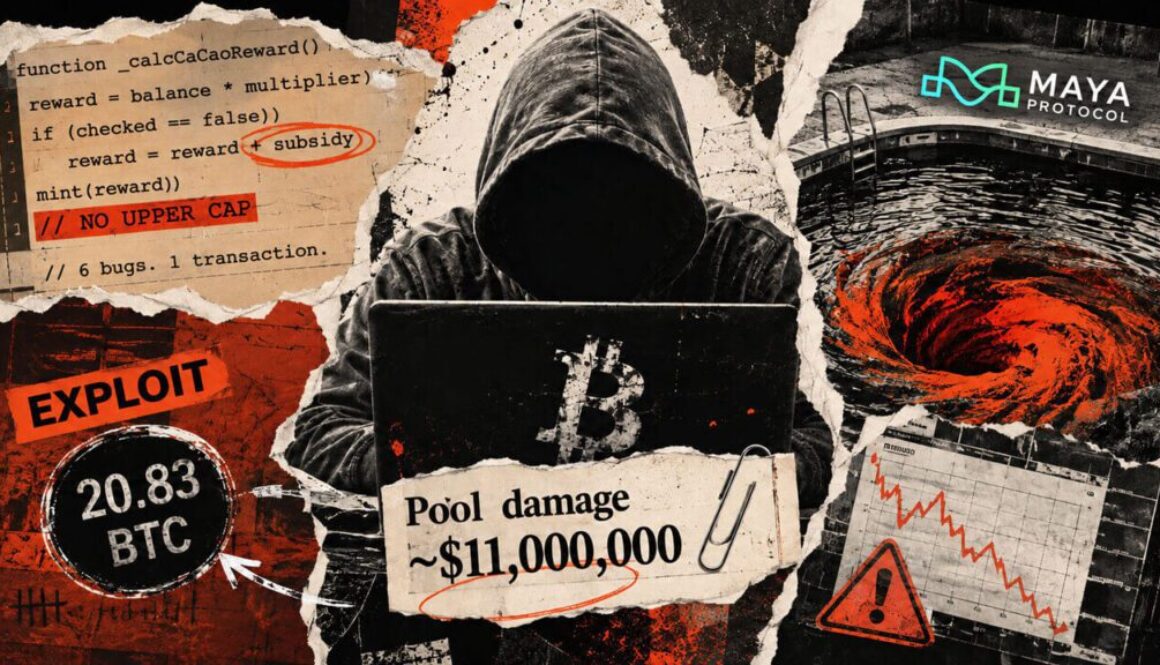

The suspected Bitcoin address at the center of Maya Protocol’s Aug. 18 exploit still held about 20.8273 BTC with no outgoing spend on Aug. 21, while no published recovery plan accounted for the much larger estimated impact across the cross-chain liquidity protocol’s pools.
Public Bitcoin data showed 20.82731228 BTC funded, zero spent, 11 confirmed transactions and none waiting in the mempool. Ten initial deposits totaling 20.82730682 BTC arrived at 17:32:18 UTC on Aug. 18, while a later 546-satoshi transaction raised the total slightly. At today’s Bitcoin price, the balance was worth about $1.59 million.
A technical reconstruction by SigIntZero attributed the exploit to six accounting and state-handling flaws chained inside one 23-message transaction. It said overwritten outbound state produced a false missing-transfer signal, activating a compensation path that credited about 49.45 million CACAO to a thin ARB.LINK pool even though Maya’s reserve held only about 168,000 CACAO.
The reserve transfer failed, but the inflated balance persisted. After adding negligible liquidity, the attacker received about 99.93% of the pool’s ownership units and withdrew roughly 48.87 million CACAO before swapping into assets held by other MAYAChain pools.
SigIntZero estimated that about $1.36 million in assets moved to external chains and roughly $291,000 remained on MAYAChain, putting total attacker-controlled value near $1.65 million to $1.7 million.
Separately, the pool was impacted by $10.9 million. CryptoSlate analysis attributed about $6.4 million to CACAO repricing and about $2.9 million to arbitrage after the token fell from roughly $0.115 to $0.013, an 88.7% decline.
Maya reportedly hopes for a bug-bounty return and, failing that, could seek to replace roughly 20 BTC through Aztec Chain investments and other means. Even if that Bitcoin is returned or replaced, it would cover only one part of the damage. As of press time, Maya had not publicly defined which remaining losses it would restore or who would absorb the gap created by CACAO’s repricing and trades during the dislocation.
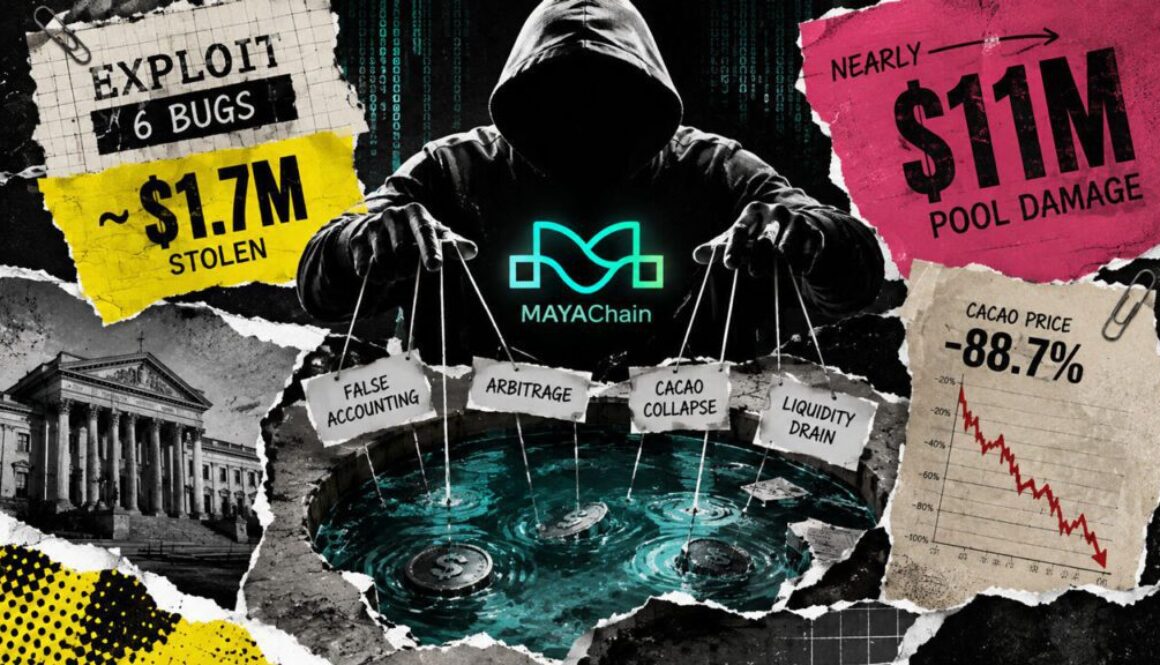
MAYAChain’s attacker moved about $1.36 million in hard assets to external chains, while the estimated impact across the network’s liquidity pools approached $11 million.
The $1.36 million figure tracks assets that left the system, including roughly 20.83 BTC. The larger estimate captures a cascade inside the pools: false accounting created a huge CACAO balance, that balance became withdrawable, and CACAO’s subsequent collapse repriced the network’s remaining liquidity.
Maya Protocol operates MAYAChain as a cross-chain liquidity network where users trade against pooled assets. Its CACAO token connects those markets, which allowed a failure that began in one pool to spread through the value recorded elsewhere.
Founder Aaluxx said on Aug. 18 that the team would fix the incident and “recover in full.” As of the Aug. 20 reporting cutoff, Maya’s official channels had not yet published a confirmed swap restart, the patch deployed on mainnet, an asset-recovery total, a final loss allocation, or comprehensive compensation terms for liquidity providers.
How an unfunded balance became withdrawable
The exploit turned an accounting entry that the reserve could never fund into a liquidity position the attacker could use.
Independent researcher Vini Barbosa traced most of the activity to one MsgDeposit transaction containing 23 messages. In his reconstruction, the final DONATE message overwrote earlier ObservedTxVoter state, including the outbound height used to match transactions.
That wrong height made MAYAChain classify legitimate outbound transfers as missing. The classification activated theft-detection logic designed to compensate a pool after a missing transfer.
The compensation path then calculated a subsidy for a near-empty ARB pool without bounding the amount to the pool’s depth. Barbosa said the calculation recorded roughly 49.45 million CACAO of value even though the reserve held only about 168,000 CACAO.
The reserve lacked enough tokens to complete the module transfer, but the new pool state had already been committed. According to Barbosa, the handler continued after the failed transfer and left the inflated balance in place.
The attacker added a negligible amount of liquidity to the distorted pool and received about 99.93% of its ownership units, enabling a withdrawal of roughly 48.87 million CACAO.
The overwritten height produced false theft detection, the false signal generated an excessive subsidy, the failed subsidy survived in pool records, and the recorded balance then supported a dominant liquidity claim.
Barbosa’s reconstruction attributes the exploit to that combined path. He put hard assets moved to external chains at about $1.36 million, led by 20.83 BTC. His estimate for the network-wide impact was close to $11 million.
The token fell from about $0.115 to $0.013 during the incident, an 88.7% drop.
CACAO represents one side of MAYAChain’s paired liquidity pools. A sharp decline in its dollar price reduces the measured value of CACAO inventory across the system, even when those tokens remain inside a pool.
The exploit-created balance and trades executed against distorted pool prices added another layer of pool impact.
A diagram shows a 23-message transaction triggering a false theft signal, CACAO repricing, and nearly $11 million in network-wide impact.
The original attacker’s external haul and the value lost across the pools are separate measures. One follows assets sent out of MAYAChain, while the other captures how an accounting failure changed the value and composition of liquidity that remained available to providers.
Maya had yet to publish a final ledger dividing the total among hard-asset extraction, CACAO repricing, and trades made during the dislocation. The scale and direction of the multiplier are clear, while an exact dollar allocation for each category remains pending.
For liquidity providers, that distinction determines what recovery would require. Replacing 20.83 BTC would restore one set of assets, while pool accounting, CACAO valuation, and the allocation of trading losses would still need their own treatment.
A full recovery has at least three parts: returning or replacing hard assets, repairing pool balances, and defining how the remaining impact is allocated among liquidity providers and other participants.
Maya’s network-halt documentation says HALTTRADING stops trading while MAYAChain can continue producing blocks. Chain liveness shows that consensus is running, but swap availability depends on the trading controls.
By Aug. 20, Maya’s public channels had yet to supply the confirmed restart time, deployed patch version, recovered-asset total, final pool calculation, and liquidity-provider compensation scope needed to turn the recovery promise into a defined settlement.
MAYANode’s public history shows that its Trade Accounts implementation drew from THORChain merge requests. That establishes shared development lineage around Trade Accounts.
The complete MAYAChain exploit depended on several conditions aligning across transaction state, outbound matching, subsidy calculations, pool-state ordering, and rollback behavior. Public documentation as of press time did not demonstrate that THORChain carries that same complete path.
MAYAChain’s loss multiplier is as much an accounting and market structure story as a theft story. The attacker moved about $1.36 million in hard assets, but the false balance changed pool ownership and arrived alongside an 88.7% collapse in the token connecting the network’s markets.
For liquidity providers, the decisive update will be Maya’s definition of “full”: which assets return, how pool balances are rebuilt, and who absorbs the value changes and trades that recovery cannot simply rewind.
DeFi lending protocol Edel disclosed a $403,000 exploit that hit the layer where tokenized stocks are trying to become DeFi collateral.
Edel said no depositor would bear losses, and the team would absorb the bad debt, restore affected balances one-to-one, and rebuild the protocol’s oracle architecture for a version two release.
The attack manipulated the exchange rate between wGOOGLx, a wrapped version of Edel’s tokenized Google stock, and GOOGLx, the token it wraps. Edel said the manipulation pushed wGOOGLx’s collateral value to roughly 78 times its correct level.
SlowMist traced the root cause to Edel’s price source, which used latestAnswer() to return an ERC-4626-style vault’s convertToAssets() rate. That conversion rate can be manipulated when an attacker controls enough of the underlying flow, and Edel’s price feed reads it directly.
CertiK described the same flaw from the lending side: the attacker manipulated wGOOGLx’s collateral price, which tracked its GOOGLx balance, then borrowed against the inflated value.
GoPlus noted that the attacker used a flash loan to repeatedly supply and borrow, distorting the wGOOGLx/GOOGLx conversion rate. The inflated collateral then supported real borrowed assets, including 384,215 USDC and wrapped positions in SPYx, QQQx, MSTRx, NVDAx, and TSLAx.
Security firms published different estimates. Cyvers put the loss at roughly $353,000, GoPlus cited about $403,000 in losses and roughly $305,000 in attacker profit, and CertiK put the drained funds at roughly $204,000.
The gap appears to reflect different measurements, including bad debt, gross loss, and net attacker profit.
The disconnect probably comes from each firm measuring something different, such as bad debt, gross loss, or net profit.
The critical failure sat in the exchange rate between the wrapped token and its underlying counterpart, a relationship that Edel’s lending market priced as though it were stable. Alphabet’s share price did not drive the exploit.
Infographic outlining the Edel exploit’s five steps, from a flash loan to wrapper mispricing that inflated wGOOGLx collateral roughly 78x before real assets were borrowed.
The market in numbers
RWA.xyz puts tokenized stocks’ onchain value at $1.7 billion, up 2.17% over the past 30 days. Monthly transfer volume sits at $8.92 billion, and holders at over 396,000.
xStocks alone lists more than 100 stocks and ETFs across more than 50 integrated platforms, with over $25 billion in total transaction volume. It describes itself as fully backed and open to plugging into any DeFi protocol without permission.
Backed, the issuer behind xStocks, markets the tokens explicitly for DeFi use: lending tokenized Apple shares or borrowing against them without selling.
Kamino says it became the first major lending protocol to accept tokenized equities as collateral, allowing users to deposit tokens such as SPYx, QQQx, GOOGLx, AAPLx, NVDAx, TSLAx, MSTRx, and HOODx to borrow stablecoins or earn yield.
Robinhood launched stock and ETF tokens for EU customers in June 2025, then opened a public testnet for Robinhood Chain. The network is an Ethereum layer-2 built on Arbitrum, designed around tokenized real-world assets including equities, ETFs, and private assets.
The selling point across all of this is the same: tokenized stocks should move and connect like any other crypto asset. Edel is a reminder that once they move like crypto, they can also break like crypto.
Market layer
What it enables
Examples from the article
Risk Edel exposed
Access
Users gain exposure to stocks and ETFs onchain.
Robinhood stock and ETF tokens for EU customers; xStocks’ 100+ stocks and ETFs.
Legal and issuer-level backing are necessary, but not sufficient.
Trading
Tokenized stocks move across venues, chains, and DeFi platforms.
xStocks across 50+ integrated platforms; $25B+ total transaction volume.
More integrations create more pricing and liquidity dependencies.
Wrapped versions, vault exchange rates, and oracle paths can become attack surfaces.
Future derivatives
Tokenized equities become inputs for structured products and leverage.
Implied next phase as collateral markets mature.
A wrapper or oracle failure can spread beyond one lending market.
The disconnect between backing and safety
A lending market prices several layers, such as the tokenized equity itself, the wrapped version built on top of it, and the exchange rate a vault uses to convert between the two.
It also prices the oracle path that reports a value, the lending market’s own borrowing limits, and whether that collateral can actually be sold during a period of stress. Edel’s exploit sat almost entirely in the wrapper and oracle layers.
Using a tokenized stock as collateral adds a second pricing problem on top of the equity itself. A protocol also has to price every on-chain representation built around that stock, including how a wrapper’s exchange rate behaves under stress. That exposure comes from the collateral integration built around a tokenized stock.
Flash loans, collateral manipulation, and ERC-4626 exchange-rate attacks have all shown up in DeFi exploits before. This exploit’s novelty lies in the asset class these techniques target, and it appears to be one of the first clear tokenized-stock-collateral exploits on record.
How this plays out
In the bull case, protocols spend the next year isolating wrapper risk. That means capping how much collateral in a lending market can come from wrapped tokenized stocks, separating issuer-level prices from wrapper exchange rates, and building oracle paths that a single flash loan cannot move.
Tokenized equities then become credible collateral for conservative borrowing against liquid names like Apple, Nvidia, Tesla, and Google. Edel ends up remembered as the early failure that forced better design before the category scaled.
In the bear case, listings outrun the risk work. More venues accept tokenized stocks as collateral before oracle design and wrapper isolation catch up.
The number of wrapped tokens, bridges, and vaults built around each ticker keeps multiplying faster than anyone can audit them.
Along that path, more exploits in the low hundreds of thousands of dollars continue to surface involving exchange-rate manipulation and thin liquidity. Tokenized stocks have become a security flashpoint over how DeFi protocols use them as collateral.
The first phase of tokenized stocks was access: letting eligible users hold tokenized exposure to names such as Apple or Google. The second phase was trading, which involved making that claim move across chains around the clock.
Scenario
What has to happen
Market outcome
What Edel becomes in hindsight
Bull case: safer collateral markets
Protocols isolate wrapper risk, cap collateral exposure, separate issuer prices from wrapper exchange rates, and harden oracle paths.
Tokenized equities become credible collateral for conservative borrowing against liquid names like Apple, Nvidia, Tesla, Google, SPY, and QQQ.
An early failure that forced better design before the category scaled.
Base case: slower collateral adoption
Lending markets keep tokenized stocks in isolated pools with conservative loan-to-value ratios and tight caps.
Tokenized stocks grow mainly as trading assets, while borrowing use cases expand gradually.
A warning label that slows leverage but does not stop the market.
Bear case: listings outrun risk controls
More venues accept tokenized stocks and wrapped variants before oracle design and wrapper isolation improve.
More small-to-mid exploits appear around exchange-rate manipulation, thin liquidity, bridges, and vault accounting.
The first visible sign that tokenized-stock collateral became a security flashpoint.
Edel arrived at the start of the third phase, collateral, where holding a tokenized stock also allows borrowing against it.
The first two phases of tokenized stocks rewarded whoever listed the most tickers or reached the most chains. The next one rewards whoever can price a wrapped stock correctly under stress, every time.
According to this week’s report from crypto market tracker CryptoRank, DeFi platforms suffered 121 hacks so far this year, resulting in approximately $942 million in losses.
The second quarter accounted for 85 incidents and about $775 million stolen, placing it as the most active period ever for exploits in the crypto sector.
The surge in attacks is against a backdrop of a crypto market struggle, pervaded by weakening investor confidence. Total value locked (TVL) in DeFi protocols has fallen every month this year, dropping from about $115 billion in January to $70 billion in late June.
Drift Protocol, KelpDAO Exploits Hiked Q2 Losses
Per CryptoRank’s data, Q2 2026’s 85 incidents are 49 more than the period with the second-highest frequency of exploits, which happens to be Q1 2026. However, total dollar-denominated losses were not as high as previous peaks, with the data provider reporting that two back-to-back attacks in April accounted for the majority of losses recorded in the quarter.
Drift Protocol and KelpDAO lost a combined $590 million, which is more than half of all the DeFi losses recorded in 2026. Drift Protocol disclosed that attackers had stolen about $285 million in user assets, with blockchain intelligence firm TRM Labs’s investigations linking the operation to hacking outfits connected with North Korea.
According to TRM, preparations for the attack started on-chain as early as March 11 with a 10 ETH withdrawal from Tornado Cash. The crypto tumbler transaction came after months of in-person meetings between the Pyongyang proxies and Drift employees.
“The attacker used social engineering to induce Drift Security Council multisig signers into pre-signing transactions that appeared routine but carried hidden authorizations for critical admin actions,” the firm wrote in a report published April 30.
Just over two weeks later, North Korea’s Lazarus Group exploited the liquid restaking protocol KelpDAO’s LayerZero bridge infrastructure and stole roughly $290 million worth of rsETH.
Chainalysis mentioned at the time that the attackers forged a cross-chain message on April 18 after compromising two remote procedure call nodes used by LayerZero’s Decentralized Verifier Network. At the same time, the criminals struck a third node with a distributed denial-of-service attack, making the system use compromised verifiers.
The verification process was rigged to allow for the creation of rsETH tokens on Ethereum without burning the corresponding assets on Unichain. Within days of the attack, lending protocol Aave’s TVL dropped from $26.4 billion to $14.3 billion, clocking $12 billion in withdrawn funds and a decline of about 46%.
Hacks Were One Problem; a Shrinking Market Was Another
Aave’s TVL dip wasn’t unique, with CryptoRank’s data showing the value locked in all of DeFi falling every single month in 2026, going from $115.3 billion in January to just over $70 billion in June. And while hacks were not the main reason for the decline, the firm noted that the frequency of incidents likely made users less confident, leading to a wider rotation away from the sector.
But the drop hasn’t been as bad as the one in the 2021-2022 cycle when the DeFi TVL tanked more than 70% in seven months. The current dip has been much slower, and the market has also been different structurally, CryptoQuant says, with the stablecoin supply growing to about $300 billion, real-world asset tokenization expanding, and capital dispersed across more sectors like derivatives, infrastructure, and lending, instead of being concentrated in a handful of AMMs and yield farms.
However, among the largest ecosystems by TVL, only Tron and Hyperliquid have managed to grow this year, with the former gaining 5% and the latter adding nearly 7% as it became the dominant venue for on-chain perpetuals. The rest of the top 10 chains are deeply in the red, with the worst hit being Plasma and Arbitrum, which have so far seen their TVL plunge by 74.6% and 55%, respectively.
Security Remediation And User Refund Preparation: Why This Story Matters
SecondFi Completes Refund Snapshot for Wallets Impacted by Recent Cardano Exploit has become one of the stronger weekend crypto stories because it sits at the intersection of price action, market structure, and the kind of narrative that traders tend to follow closely when the broader news cycle slows down.
The key point is not simply that secondFi took a final balance snapshot on June 26, 2026. It is that the development gives the market a fresh way to judge whether the current crypto environment is being driven by genuine network adoption, regulatory progress, liquidity shifts, or short-term speculation.
The Main Details
According to on-chain data, SecondFi took a final balance snapshot on June 26, 2026. The report also notes that the exploit affected 374 wallets between June 21 and June 23.
That distinction matters because crypto markets often move first on headlines and only later separate durable developments from short-lived momentum. In this case, the verified boundaries are especially important: Do not imply refunds have already landed.
Market Context
For traders, the story arrives at a moment when crypto assets are still trying to define a clearer direction. Bitcoin remains the anchor for broader sentiment, but altcoin narratives are increasingly being judged on their own fundamentals, including usage, liquidity, compliance, treasury activity, and developer progress.
That makes this development relevant beyond a single token or company. If the underlying trend proves durable, it could help shape how investors evaluate Cardano, ADA, SecondFi, Yoroi, Security over the coming weeks. If it fades, however, it may become another example of a strong weekend narrative that struggled to translate into sustained market follow-through.
What To Watch Next
The next important question is whether the market receives further confirmation from primary sources, dashboards, official announcements, or on-chain data. Follow-up disclosures, exchange data, governance updates, or wallet activity could all help clarify whether this is an isolated headline or the start of a broader theme.
Readers should also watch whether liquidity responds. In crypto, even fundamentally meaningful developments can fail to move prices if traders remain defensive, leverage is being unwound, or capital is rotating into other sectors. That is why this story should be read alongside broader market structure rather than in isolation.
This report is based on information shared by SecondFi on X.
This article was written by the News Desk and edited by Samuel Rae.
The Raydium AMM V3 exploit drained roughly $1.34 million from a phased-out program tied to five pools outside the current product path, unsupported by Raydium’s UI or SDK, and inaccessible to current users.
The exploit hit legacy DeFi contracts and infrastructure that nobody treated as a live attack surface, exposing a lifecycle-management failure that extends well beyond one Solana decentralized exchange.
The category nobody is counting
Public exploit reports have found at least eight clear cases since March 2025 in which deprecated, obsolete, or legacy DeFi contracts became the attack surface, totaling roughly $10.8 million in losses.
Extending the definition to include broader legacy-vault and legacy-product failures lifts the count to about ten incidents and $22.5 million, including Raydium.
Exploit trackers classify incidents by technical mechanisms, such as smart contract bugs, access control failures, oracle manipulations, private key compromises, and bridge flaws.
Zombie contracts, or legacy DeFi contracts still callable after retirement, belong to a different axis entirely: a lifecycle state that consistently vanishes inside broader exploit labels.
Exploit label databases usually use
What it captures
What it misses
Smart contract bug
The code flaw that let funds move
Whether the contract was deprecated, obsolete, or outside the active product
Access control failure
Missing or broken permission checks
Whether the affected deployment should still have been callable
Business logic flaw
Broken assumptions inside protocol logic
Whether the logic belonged to old infrastructure no longer supported by the UI/SDK
Oracle/accounting issue
Incorrect pricing, balances, or shares
Whether the vault or pool was a legacy product
Zombie-contract / lifecycle risk
Deprecated infrastructure still live on-chain
The missing category: contracts that were “retired” in product terms but not decommissioned technically
Raydium’s AMM V3 pools were deprecated after Serum’s own deprecation rendered them inert. The legacy program was built to place orders on the Serum order book, and once Serum wound down, it lost its only function and left associated liquidity idle.
Raydium’s current programs use a virtual supply mechanism for proportion checks and verify LP mint addresses along with all other relevant account information.
The legacy program skipped both checks, letting an attacker create a new mint, present it as the LP token, and bypass proportion controls entirely.
Roughly 150,177 RAY, 5,603 SOL, and 893,700 USDC had been sitting in pools outside the current product but stayed callable on-chain.
One pattern for eight incidents
In March 2025, 1inch lost roughly $5 million when an obsolete Fusion v1 resolver contract implementation was exploited.
In October 2025, Abracadabra lost $1.8 million due to deprecated Cauldron V4 contracts that remained active and exploitable because of a logic flaw. In December 2025, Yearn’s legacy iEarn TUSD vault was drained of roughly $300,000, while Yearn’s current v2 and v3 vaults remained clean.
Things escalated in May: SlowMist reported Transit Finance losing $1.88 million through a deprecated 2022-era TRON contract, and Huma Finance lost roughly $101,000 through deprecated V1 BaseCreditPool contracts on Polygon.
Renegade lost approximately $209,000 due to a legacy V1 Arbitrum deployment exposed by an unprotected initializer and a migration issue, with white-hat recovery reducing the net impact.
Scallop lost roughly $140,000 due to a deprecated rewards contract, leaving the core lending infrastructure clean.
Every protocol made the same claim that current users were safe and current programs intact, and every protocol still paid out from the treasury, because the old infrastructure had stayed callable long after it left the active product path.
Protocol
Date
Legacy surface exploited
Approx. loss
Why it fits the pattern
1inch
Mar. 2025
Obsolete Fusion v1 resolver implementation
~$5.0M
Old resolver logic remained relevant enough to exploit after the protocol had moved on.
Abracadabra
Oct. 2025
Deprecated Cauldron V4 contracts
~$1.8M
Deprecated contracts remained active and exploitable through a logic flaw.
Yearn
Dec. 2025
Legacy iEarn TUSD vault
~$0.3M
Legacy vault was drained while current Yearn vaults remained unaffected.
Transit Finance
May 2026
Deprecated 2022-era TRON contract
~$1.88M
Old contract surface stayed live after deprecation and became the attack path.
Huma Finance
May 2026
Deprecated V1 BaseCreditPool contracts on Polygon
~$0.101M
Retired architecture still held exploitable value outside the current system.
Renegade
May 2026
Legacy V1 Arbitrum deployment
~$0.209M
Migration and initializer issues exposed an old deployment.
Scallop
2026
Deprecated rewards-side contract
~$0.14M
Core lending infrastructure stayed clean, but old rewards infrastructure was exploitable.
Raydium
2026
Legacy AMM V3 pools
~$1.34M
Current UI/SDK and users were unaffected, but old pools remained callable on-chain.
Why databases lose this
Most exploit classifications focus on how the attacker got in, what they manipulated, and which code failed, a mechanism-first lens that obscures zombie contract exploits, where the core failure is that the infrastructure was supposed to be retired.
Transit’s deprecated TRON contract was an old protocol surface that nobody decommissioned. Scallop’s deprecated rewards contract was an accounting flaw in infrastructure that the team had moved past. Huma’s V1 BaseCreditPool was retired architecture still holding assets on a chain the protocol had migrated away from.
A 2025 SoK paper analyzing 50 severe real-world exploits from 2022 to 2025, totaling over $1 billion in losses, argued that high-impact incidents frequently involve exploit chains spanning human, operational, economic, lifecycle, and governance layers.
The authors proposed a four-tier root-cause framework that treats lifecycle and governance failures as a distinct category alongside implementation errors. Zombie contracts fit that framework: lifecycle failures that exploit databases are absorbed into implementation-bug counts, keeping the cumulative dollar figure buried inside unrelated categories.
The fork in the graveyard
If protocols continue to treat decommissioning as an afterthought, deprecating contracts in product documentation without draining, pausing, or monitoring them, attackers will keep scanning the graveyard.
Every major protocol’s deployment history becomes a searchable attack surface. The $22.5 million current estimate is a floor, based on incidents that made it into public reporting with sufficient detail to classify.
Legacy vaults, forgotten approval surfaces, and old integrations that still hold assets but sit outside active user flows receive far less monitoring than live infrastructure, which is what attackers scan for.
If the category gets named and counted, if decommissioning checklists become standard practice alongside audits, the attack surface shrinks through maintenance.
Raydium’s treasury absorbs the $1.3 million exploit, Transit’s team promised compensation, and Huma covered its losses.
That makes DeFi contract decommissioning a security control rather than a documentation task.
Decommissioning control
What it means
Why it matters
Drain idle assets
Remove funds from retired pools, vaults, and reward contracts.
Eliminates the financial incentive for attackers to scan abandoned infrastructure.
Pause callable functions
Disable swaps, withdrawals, reward claims, or admin functions where possible.
Turns “deprecated” into an actual security state rather than a product label.
Verify LP mints, approvals, and permissions
Review old mint checks, approvals, authorities, and account assumptions.
Prevents attackers from exploiting stale validation logic or forgotten permissions.
Monitor legacy deployments
Keep alerts active for old contracts, pools, and chain deployments.
Prevents abandoned infrastructure from becoming invisible to the team but visible to attackers.
Keep legacy code in bug-bounty scope
Include retired or deprecated infrastructure in security programs.
Gives white hats a reason to report issues before attackers exploit them.
Publish retirement status
Clearly identify whether old products are drained, paused, monitored, or unsupported.
Helps users, integrators, and analysts distinguish “not in the UI” from “not risky.”
Define treasury liability
State whether the protocol will compensate losses from retired infrastructure.
Makes clear whether old code remains an implicit claim on the protocol treasury.
Deprecating a contract transfers the security liability to the treasury while leaving the attack surface intact. Retiring infrastructure without decommissioning it keeps it live, with the team’s attention diverted and the attacker’s incentive intact.
In addition to total value locked, DeFi protocols accumulate history, and history can be exploited.
Socket’s May 24 disclosure of TrapDoor found more than 34 malicious packages and over 384 related versions spread across npm, PyPI, and Crates.io, each targeting the developers who build and maintain protocols, and the credentials that govern access to the systems around them.
What TrapDoor built is a route from a single developer’s compromised machine into the repositories, CI/CD pipelines, cloud accounts, and deployment keys that govern how protocols reach mainnet and stay updated once deployed.
Socket’s report confirms credential theft and infrastructure exposure as the campaign’s documented scope, leaving on-chain exploits as the inferred downstream consequence.
A six-stage flowchart shows how a malicious package moves from developer machine compromise through credential theft to put user funds at risk.
The attack surface developers don’t audit
The campaign delivered payloads through ordinary developer workflows, such as npm packages executing malicious code through postinstall hooks, PyPI packages triggering payloads on import while fetching remote JavaScript, and Rust crates running build.rs scripts during compilation.
Normal developer behavior is the attack surface, as none of these execution paths requires anything beyond a package install, an import, or a build command.
In the environment around a live protocol, any one of those credential classes can represent a path to user funds that no smart contract audit ever examines.
Socket explicitly framed stolen SSH keys as enabling lateral movement, and cloud and GitHub credentials as exposing repositories, CI/CD systems, private packages, and deployment environments.
That chain, comprising malicious package, developer compromise, credential theft, repo and cloud access, and malicious update, describes how a DeFi exploit can arise without a single line of vulnerable Solidity.
The AI instruction injection
Socket found the TrapDoor campaign attempted to plant hidden instructions inside files such as .cursorrules and CLAUDE.md, which are configuration files that AI coding assistants like Cursor and Claude Code read to understand how to behave within a project.
The injected instructions employed hidden Unicode techniques to steer AI-assisted workflows toward secret discovery and exfiltration.
Socket also found pull requests submitted to AI and developer tooling projects that tried to introduce instruction files under benign-sounding labels.
The target was the AI assistant that reads the repo, generates code, and operates with whatever context the project files supply.
If attackers silently manipulate that context through hidden Unicode instructions, the AI-assisted workflow becomes an exfiltration mechanism.
A broader pattern
SafeDep documented a May 11 campaign that compromised more than 170 npm packages and two PyPI packages, hitting 404 malicious versions tied to TanStack, Mistral SDK, UiPath, OpenSearch, and Guardrails AI.
StepSecurity described five major supply-chain attacks in 48 hours across VS Code extensions, GitHub Actions, npm, and PyPI, including a poisoned VS Code extension with 2.2 million installs and trojanized Microsoft PyPI packages.
Sonatype reported more than 454,600 new malicious packages in 2025, bringing the cumulative count to above 1.233 million, with malicious packages now serving as entry points for broader intrusions.
Campaign / source
Timing
Ecosystem affected
Scale cited
Why it matters for this story
TrapDoor / Socket
May 2026
npm, PyPI, Crates.io
34+ malicious packages; 384+ versions/artifacts
Shows crypto developers being targeted before code reaches mainnet
Shows malicious packages spreading through mainstream developer dependencies
StepSecurity 48-hour wave
May 2026
VS Code, GitHub Actions, npm, PyPI
5 major attacks; one VS Code extension had 2.2M installs
Shows attackers moving across multiple layers of developer tooling
Sonatype 2025 data
2025
Major open-source ecosystems
454,600+ new malicious packages; 1.233M+ cumulative
Shows malicious packages becoming an industrialized intrusion channel
The control-plane attack pattern has already resulted in measurable DeFi losses using structurally identical methods.
Resolv’s March incident was a $23 million exploit where the deployed code worked exactly as designed, but off-chain infrastructure and trusted keys failed.
In April 2026, Drift lost $285 million when attackers combined long-running social engineering with valid admin signatures.
KelpDAO lost approximately $292 million the same month when attackers compromised off-chain RPC and DVN infrastructure.
In each case, the failure point was operational: trusted infrastructure, off-chain systems, and admin access layers surrounding the contract.
Where the risk resolves
If TrapDoor-style packages draw quick detection, since Socket’s system logged average detection at 5 minutes and 56 seconds, and teams rotate exposed credentials before downstream access occurs, the campaign ends at the detection layer, with its damage limited to credentials that teams can still rotate.
DeFi losses track near the 2025 Immunefi baseline of $680 million, with TrapDoor’s primary effect being accelerated security reviews of package dependencies, CI/CD secrets, and developer environment hygiene across crypto teams.
The bear case draws on data from Chainalysis, TRM Labs, and Immunefi, measured in 2025 and early 2026.
TRM Labs estimated that North Korean hackers stole approximately $577 million through April 2026, accounting for 76% of all crypto losses during that period. Chainalysis put total crypto service theft at more than $3.4 billion in 2025, with the top three incidents accounting for 69% of that figure.
A TrapDoor-type upstream compromise reaching deployer keys, bridge validator infrastructure, or admin credentials at a mid-to-large protocol could add $100 million to $300 million to 2026’s running total, pushing annual DeFi losses toward $1 billion or above.
One infected developer machine with a GitHub token controlling a deployment pipeline, a cloud credential managing bridge infrastructure, or a wallet key holding protocol admin authority can reach far more than the developer’s own funds.
In the Drift incident, attackers drained assets including cbBTC and WBTC, showing that Bitcoin-linked liquidity wrapped or bridged into DeFi sits inside the same operational infrastructure that TrapDoor targets.
Scenario
What happens
Loss implication
Article takeaway
Contained / bull case
TrapDoor-style packages are detected quickly, exposed credentials are rotated, and no downstream protocol access occurs
DeFi losses remain near the 2025 Immunefi baseline of $680M
Fast detection limits the campaign to credential hygiene and dependency reviews
Annual DeFi losses move above the 2025 baseline but remain below $1B
The exploit surface shifts upstream, but losses stay fragmented
Bear case
One compromised developer machine exposes deployer keys, bridge infrastructure, admin credentials, or repo access at a mid-to-large protocol
One incident adds $100M–$300M, pushing annual DeFi losses toward or above $1B
The next major exploit may begin before vulnerable code is deployed
Black swan
A self-propagating or AI-assisted supply-chain campaign compromises multiple developer environments, packages, or CI/CD systems
Clustered losses approach the scale of major 2025 crypto service theft
DeFi’s control plane becomes the attack surface
What audits don’t reach
The DeFi industry has built a meaningful smart contract security layer over the past four years. Immunefi’s data shows that the median incident size dropped from $6 million in 2022 to $1.5 million in 2025, a sign that core contract-level defenses have matured.
But Resolv, Drift, and KelpDAO show that attackers have absorbed that improvement and moved to systems audits cannot reach, such as deployer permissions, bridge validators, cloud infrastructure, admin keys, off-chain RPC endpoints, and now the developer machines, package dependencies, and AI coding environments that produce and configure all of the above.
A smart contract can pass every audit a protocol commissions and still sit atop a deployment pipeline where a post-install hook has already exfiltrated the deployer’s GitHub token.
TrapDoor is a specific campaign with a specific package count and a detection timestamp. The attack surface it targeted, consisting of developer machines, package registries, CI/CD credentials, AI coding files, and cloud accounts, persists beyond TrapDoor’s own package list.
Other campaigns are already using the same pathways, and the next DeFi exploit may begin on a developer’s laptop, inside a build script, or within an AI coding environment.
THORChain’s suspected multichain exploit and emergency halt on May 15 has turned into another DeFi security incident, and another test of cross-chain trust.
Emergency controls moved through chain-specific halts, Halt All Trading, Halt Signing, Halt Chain Global, Halt Churning, and repeated global node-pause updates.
One public alert described the likely exploit affecting Bitcoin, Ethereum, BSC, and Base, resulting in more than $10.7 million in losses, revised from an earlier $7.4 million estimate.
Another security estimate put the loss near $10 million, including 36.75 BTC and about $7 million across BNB Chain, Ethereum, and Base.
The chain scope was later expanded in a TRM Labs assessment, which reported that the attacker drained more than $11 million across at least nine chains. Those chains included Avalanche, Dogecoin, Litecoin, Bitcoin Cash, and XRP, in addition to the initial four-chain framing. The figures may still move as the accounting is reconciled, but the available record points to a multichain infrastructure event touching several native-asset routes.
The halt, therefore, carried consequences beyond THORChain. Cross-chain liquidity is supposed to make crypto feel more useful, liquid, and connected. Yet the same design that lets assets move between isolated networks can also compress the response window when something breaks.
In this case, DeFi’s promise of seamless routing ran straight into the need for an emergency stop.
The Halt Became The Signal
The operational response is documented in the chain’s emergency framework. THORChain’s procedures describe network and chain halts as tools node operators can use when funds are at risk.
Its architecture relies on Bifrost observation, vaults, and threshold-signature signing to move native assets across chains without wrapping them.
Those controls can protect funds by stopping further activity. They also show that cross-chain infrastructure is a stack of observers, validators, vaults, signing logic, node operations, and emergency procedures.
When that stack is tested, the market asks whether a single bug can be patched and whether the system can remain credible while the response itself disrupts routing.
I think that distinction brings the THORChain incident into the broader DeFi story. Mature financial infrastructure is expected to fail safely, explain quickly, and restore confidence with a documented root cause.
DeFi often moves faster than that standard. It ships integrations, new chains, and liquidity routes before users and institutions have a clear way to price the full operational risk.
One of six Asgard vaults was reportedly compromised for roughly $10.7 million; initial indications said individual swaps were unaffected.
Final root cause, final user-impact accounting, and postmortem detail.
THORChain’s May 15 halt showed how suspected multichain losses, emergency controls, and unresolved postmortem questions converged into a broader DeFi infrastructure test.
The Trust Discount Is Now Measurable
The damage from exploits rarely ends with the drained wallet. Immunefi’s 2026 security findings put the average direct theft at $25 million, while the median loss fell to $2.2 million.
That gap shows a market where routine defenses may improve while the largest incidents still define confidence.
The same report found that the top five hacks in 2024 and 2025 accounted for 62% of stolen funds, and hacked tokens saw a median six-month decline of 61%.
Those token moves cannot be cleanly separated from market conditions or project-specific weakness in every case. Still, the pattern supports the core market reaction: exploits become long-tail business events.
They drain capital, consume team time, slow integrations, and make partners question whether the next failure will hit them indirectly.
The trust discount reflects an extra layer of skepticism toward a sector that wants to be treated as financial infrastructure, yet still produces failures that look like crisis drills.
Users, exchanges, market makers, custodians, and institutions require more evidence to trust a protocol’s uptime, monitoring, key management, and emergency processes.
Recent cross-chain incidents reinforce that point. In the KelpDAO bridge exploit, attackers targeted off-chain verification and source-chain watching infrastructure rather than a conventional smart-contract bug.
The result was a false view of reality that led to valid-looking transactions releasing funds. Bridge-security fears have already influenced infrastructure decisions, including Kraken’s move to use Chainlink CCIP for kBTC and future wrapped assets following the KelpDAO shock.
That makes the THORChain halt feel less isolated. The sector is being forced to prove that the trust path across chains is observable, redundant, and controllable before billions of dollars of liquidity are routed through it.
For institutional users, the issue becomes operational due diligence. Cross-chain exposure touches custody policy, liquidity commitments, incident response, and counterparty reviews.
A protocol that routes native assets across chains has to prove that the monitoring and emergency process around that routing is as strong as the connectivity itself.
For builders, that changes what counts as progress. New routes and integrations can deepen liquidity, but they also create more surfaces for monitoring, key management, and incident response.
The next credibility gains will come from showing that controls scale with liquidity before a failure forces counterparties to revisit assumptions.
THORChain Carries A Compliance Layer Too
THORChain’s position is especially sensitive because the protocol combines an attack surface with a routing role in major illicit-flow episodes.
As of TRM’s report, the May 15 exploit had no public actor attribution. That caveat keeps the current incident separate from earlier laundering cases unless new evidence changes the record.
The same analysis described THORChain as a recurring rail for moving stolen funds, including flows tied to the Bybit and KelpDAO incidents.
Federal investigators attributed the February 2025 Bybit theft of about $1.5 billion in virtual assets to North Korea’s TraderTraitor activity.
The FBI also urged private-sector crypto entities, including DeFi services and bridges, to block transactions to or from addresses linked to laundering.
That history sharpens the current episode. A protocol can be useful because it makes native cross-chain swaps efficient. The same utility can make it attractive to attackers and difficult for compliance teams to ignore.
Once a protocol is seen as both exploitable infrastructure and a route for illicit funds, counterparties have to price in more than just smart-contract risk.
They have to price operational interruption, screening exposure, and the chance that integrations become reputational liabilities.
RUNE price reaction stays secondary. Market data on May 16 put RUNE at around $0.44, down 21.90% over 24 hours.
The broader crypto market stood near $2.61 trillion with Bitcoin dominance at 60.2%. The market noticed the incident, but the more important question is whether liquidity providers, routing interfaces, wallet integrations, and compliance desks change behavior after the halt.
The important market signal will come from the next set of operational choices rather than from a one-day chart. Liquidity interfaces can route around protocols that introduce uncertainty; custodians and market makers can raise internal risk scores.
Compliance teams can demand better screening and incident records before supporting integrations. Those reactions are slower than a token selloff, but they are the way a security event becomes a durable trust discount.
That is the slower repricing institutions notice. It shows up in due diligence questions, integration queues, and risk limits long after the emergency halt leaves the alert feed.
The Next Test Is The Postmortem
The next test starts with more than a recovery message: THORChain needs to produce a clear postmortem, reconcile the final loss figure and chain count, explain the root cause without speculation, and show what changed in its vault, key-management, node, monitoring, and halt processes.
Recovery details may help contain user harm while leaving the infrastructure question intact.
If THORChain completes compensation, resumes safely, and documents a credible fix, the incident can remain a severe but contained confidence hit.
If the root cause remains unsettled, final accounting keeps changing, or integrations pull back, the event becomes another data point in a broader repricing of cross-chain DeFi.
That is the sector-level consequence. DeFi wants to present itself as a durable, always-on financial infrastructure.
Every major cross-chain exploit makes that claim harder to defend until the industry can show that the bridges, vaults, signing systems, and emergency controls connecting its markets are as mature as the capital they aim to attract.
Kraken is moving its wrapped Bitcoin (kBTC) to Chainlink CCIP as bridge-security fears continue spreading across DeFi, turning the bridge-security debate into a decision about wrapped-Bitcoin infrastructure.
In a recent announcement, the exchange said it is deprecating its existing cross-chain provider and moving all Kraken Wrapped Bitcoin to Chainlink’s Cross-Chain Interoperability Protocol. CCIP will become the exclusive cross-chain infrastructure for kBTC and future Kraken Wrapped Assets.
The move adds a centralized exchange‘s Bitcoin wrapper to the migration wave that followed the KelpDAO exploit. It places exchange-issued BTC distribution inside the same risk debate that has already pushed DeFi-native projects to reassess how tokens move between chains.
The asset itself is the difference. kBTC is Kraken’s 1:1 Bitcoin-backed wrapper, designed to make BTC usable across networks outside Bitcoin’s native environment.
Kraken says kBTC can be used on Ink, Unichain, Ethereum, OP Mainnet, and other DeFi ecosystems, with Bitcoin backing held through Kraken Financial and public reserve and contract links available for verification.
That structure creates a trust stack with several layers. Users face a stacked decision involving Kraken custody, the wrapper’s smart contracts, cross-chain messaging, destination networks, and DeFi venues where kBTC is used.
Kraken’s CCIP decision addresses one part of that stack, while also showing why wrapped Bitcoin distribution is now a market-structure question rather than a simple product expansion.
Why kBTC makes the migration different
Wrapped Bitcoin exists because BTC remains the dominant crypto asset, while the Bitcoin network connects poorly with most DeFi applications.
CryptoSlate data shows Bitcoin trading below $80,000 on May 15, with a market value of nearly $1.6 trillion, about 60% market dominance, and $45 billion in 24-hour volume. Even amid the dip, that scale explains why exchanges and protocols keep trying to move Bitcoin liquidity into smart-contract environments.
Kraken’s answer is kBTC. The exchange’s product page describes the token as fully backed and exchangeable for BTC, with each kBTC collateralized by Bitcoin held in Kraken’s custody.
Its whitepaper says that eligible Kraken users can deposit or withdraw kBTC at a 1:1 rate with BTC, with applicable fees deducted, and that BTC backing is held at Kraken Financial, a Wyoming-chartered Special Purpose Depository Institution.
The same materials point users to reserve and contract data, including the SPDI custody wallet and kBTC smart contracts on Ink, Unichain, OP Mainnet, and Ethereum. That transparency is important because wrapped assets depend on the market believing that the issued token remains redeemable for the asset it represents.
The remaining risk remains even with transparency. Kraken’s whitepaper lists smart contract vulnerabilities, possible peg divergence on third-party platforms, regulatory changes, and problems on third-party blockchains or protocols as risks tied to kBTC.
It also says that Kraken effectively controls token management functions through a Kraken-controlled wallet.
That is the tension Kraken’s CCIP decision brings into focus. Wrapped Bitcoin needs distribution to matter in DeFi.
Every added chain and venue can increase utility, but it also makes cross-chain infrastructure choices more visible to users, integrators, and risk teams.
Risk layer
Known facts
What remains to watch
Custody and reserves
kBTC is backed 1:1 by BTC held at Kraken Financial, with reserve links published by Kraken.
Whether future Kraken Wrapped Assets use the same level of public reserve transparency.
Smart contracts and token control
Kraken cites internal reviews, a Trail of Bits audit, and Kraken-controlled token management functions.
How users and protocols assess issuer control alongside contract security.
Cross-chain messaging
Kraken is moving kBTC and future wrapped assets to Chainlink CCIP as exclusive cross-chain infrastructure.
The exact CCIP configuration, migration timing, and rate-limit or attestation design.
Market peg and liquidity
Kraken says kBTC is redeemable 1:1 through eligible Kraken accounts, while third-party markets can diverge.
Whether kBTC liquidity grows across DeFi while peg stress stays limited.
Destination-chain and protocol risk
Kraken discloses technical risks on third-party chains and protocols where kBTC may be used.
Whether broader distribution increases exposure to weak DeFi venues or chain incidents.
How CCIP changes kBTC routing
Chainlink markets CCIP as a cross-chain standard for DeFi and institutional use cases. Its materials say CCIP supports Cross-Chain Tokens, uses decentralized oracle networks and risk-management features, and is covered by ISO 27001 and SOC 2 Type 2 security statements.
Those claims help explain why asset issuers would evaluate it after a major bridge incident.
The safer interpretation is that Kraken is changing the infrastructure layer it wants kBTC and future wrapped assets to depend on. That may reduce some configuration or vendor-risk concerns, while custody risk, smart contract risk, peg risk, and exposure to destination chains remain outside the bridge-provider decision.
The move lands in a specific post-KelpDAO context. CryptoSlate previously reported that more than $3 billion in DeFi value had moved toward Chainlink CCIP after the $292 million KelpDAO exploit intensified scrutiny of bridge security and LayerZero-linked configurations.
LayerZero later said its protocol remained unaffected, but acknowledged that allowing its decentralized verifier network to act as a 1/1 DVN for high-value transactions was a mistake. It recommended stronger multi-DVN configurations and said the affected incident involved a single application.
That admission frames the issue less as a simple bridge-brand fight and more as a debate over defaults, issuer responsibility, and how much security configuration should sit with the application.
Kraken’s move now brings that debate to exchange-issued wrappers. The exchange is deciding how kBTC moves and signaling which interoperability stack it wants future wrapped assets to inherit.
Other migrations show why context matters. Solv Protocol said it moved more than $700 million in SolvBTC and xSolvBTC cross-chain infrastructure from LayerZero bridges to CCIP after a security review.
Re said it moved from LayerZero to CCIP for reUSD after evaluating cross-chain infrastructure, citing $475 million-plus in TVL, $160 million-plus reUSD market cap, 16 independent node operators, native rate limits, and institutional controls.
Those moves make Kraken part of a broader risk reset. But kBTC adds the Bitcoin and exchange-custody dimension.
The test now moves to execution
For users, the practical question is whether Kraken’s migration gives kBTC holders and DeFi integrators a clearer, more resilient operating model.
The first signal will be an operational detail. Kraken has said kBTC and future Kraken Wrapped Assets will use CCIP, but the exchange has yet to disclose the migration timeline, chain-by-chain cutover process, and the exact configuration that will apply to kBTC.
For an asset marketed around reserve transparency and exchange custody, those details matter because infrastructure changes can affect how users evaluate deposits, withdrawals, bridging, and downstream protocol integration.
The second signal will be liquidity. kBTC’s value proposition depends on Bitcoin becoming useful in places outside its native network.
If the CCIP migration helps Kraken expand kBTC usage across Ink, Unichain, Ethereum, OP Mainnet, and future networks while keeping redemption and reserve visibility clear, the move could strengthen the case for exchange-issued wrapped assets in DeFi.
Lagging usage would make the announcement look more like a vendor rotation than a change in wrapped-Bitcoin market structure.
Strong usage would sharpen the tradeoff: kBTC may gain more reach, but users will still be relying on Kraken as issuer and custodian, CCIP as cross-chain infrastructure, and third-party chains and protocols as execution venues.
That is why the migration matters. Kraken is moving more than a token route.
It is putting a Bitcoin-backed exchange wrapper into the same security debate that has already reshaped DeFi bridge decisions after KelpDAO. The next test is whether that decision turns into safer, clearer BTC distribution across DeFi, or simply shifts wrapped-asset trust to a new set of dependencies.
An attack on the V1 smart contracts of Huma Finance on Polygon resulted in a loss of $101,400 USDC. The exploit added to what’s already been a difficult time for DeFi protocols on the network.
The exploit was reported by web3 security firm Blockaid. The attacker targeted BaseCreditPool deployments related to Huma’s older V1 infrastructure. The total loss was ~$101,400 in USDC and USDC.e coins across various contracts.
Huma Finance confirmed the incident on X, saying “No user funds at risk and PST is not impacted.” The team said its V2 system, which runs on Solana, was built from scratch. It shares no code with the compromised contracts.
Huma’s V1 flaw was in one function
The smart contract flaw was found inside a function named refreshAccount(). Its a function located within the V1 BaseCreditPool contracts. Blockaid security researchers identified the bug. They shared more information on X, saying:
“Bug: refreshAccount() unconditionally promotes a Requested credit line to GoodStanding, bypassing the EA approval step and enabling drawdown().”
refreshAccount() labelled accounts with ‘good standing’ without actual verification or conditions. The attacker took advantage of this flaw and drained funds from the protocol’s treasury pools
The losses were found in three contracts according to Blockaid’s on-chain analysis. One account lost ~82,300 USDC. A second lost ~17,300 USDC.e. And a third account lost ~1,800 USDC.e. According to on-chain data, the entire exploit was completed in one transaction.
There was no cryptographic issue. The attacker just changed the contract’s state machine to trick it into treating an unauthorized account as legit.
Huma’s team wrote on X, “Earlier today a vulnerability in Huma’s legacy v1 contracts on Polygon was exploited for 101,400 USDC.” They continued, “Huma’s v2 system on Solana is a complete rewrite and this issue does not apply to v2 systems.”
Huma said it had already been winding down V1 operations before the exploit occurred. The team said on X, “The teams were already in the process of sunsetting all the legacy v1 pools, and have paused v1 completely now.”
After the incident, the team fully paused all remaining V1 contracts. The company said that user deposits on V2 were untouched and that the newer platform continues to operate normally.
According to a recent report from Cryptopolitan, the exploit took place on the same day that Ink Finance lost almost $140,000 from its Workspace Treasury Proxy contract on Polygon. The attacker deployed a contract matching a whitelisted claimer address to bypass eligibility checks.
In both incidents, the attackers found logic mistakes in smart contract design. The back-to-back exploits on Polygon come after April 2026, setting the record for the worst month of smart contract losses.