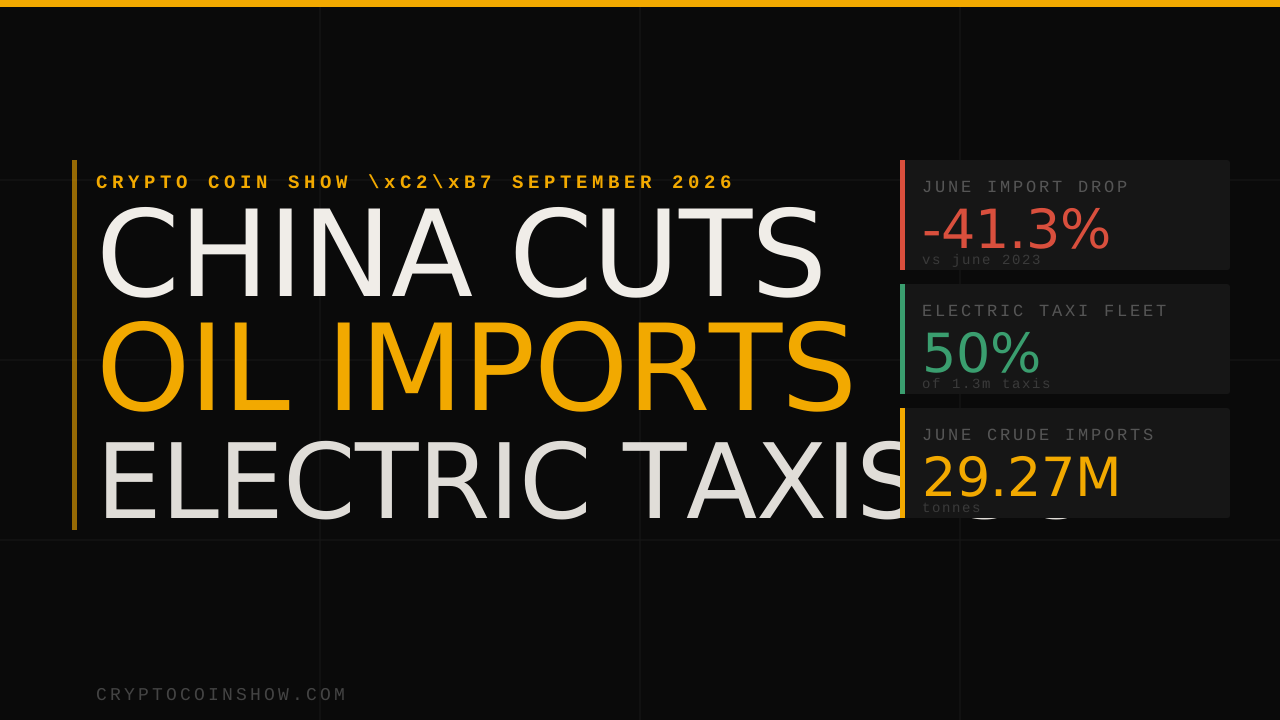
China imported 41.3% less crude oil in June this year compared to the same month a year earlier, with this posing as the country’s fuel import weakest month since October 2016. Electric taxis have helped to absorb a huge slice of the shortfall since the Strait of Hormuz crisis began.
China’s import figures and petrol demand
The figures released by the country’s Customs on July 14 put June imports at 29.27 million tonnes. This comes five months into a conflict that began in late February and has kept the Strait of Hormuz, which carries nearly half of China’s seaborne crude, under enormous threat. Hormuz sees between 45% and 50% of Chinese crude normally, according to Columbia’s Center on Global Energy Policy.
This, understandably, has led to an increased leaning on electric taxis. J.P. Morgan expects Chinese petrol demand to drop 150,000 barrels a day this year and another 50,000 in 2027. The bank’s analyst Natasha Kaneva explained the shift from petrol in a July 2 note, stating “The conflict may have accelerated behavioral changes that were already underway, leaving China structurally less dependent on oil than the market has historically assumed.”
Electric taxi switch happening in real time
The Ministry of Transport estimates that about half of the country’s 1.3 million taxis now run on batteries, a figure that is moving towards a complete 100% in the largest cities.
Cab hailing service Didi added 2 million hybrid and electric vehicles last year, lifting its fleet of cars not using petrol to 8 million. Battery-powered cars now handle 75% of the total mileage booked through the Didi app, according to figures cited by TNW.
The fuel data also gives credence to these noticeable changes. China consumed 10% less petrol and 14% less diesel in May than in the same month a year earlier, even as road freight increased by 2% and holiday travel during the May Day period set a record. Over the same window, riders took 3.05 billion taxi and ride-hailing trips, a 6% increase on the prior year.
There were no policy changes guiding this switch to electric taxis. In fact, the electrification push had already started before the crisis began due to commercial reasons. The crisis, however, added economic changes that favored battery-powered cars. Petrol prices rose while a rush of new drivers and cheap electric cars pushed fares down 10% to 15% over six months, according to TNW. Owners of petrol cars are leaving them parked and booking rides instead.
“Overall travel demand is still increasing, so more trips are shifting to public transport, such as taxis and the subway,” said Daizong Liu, East Asia director at the Institute for Transportation and Development Policy.
China’s pressure on oil demand
June’s import came mostly due to supply. Refiners saw crude distillation units at 57.72% utilization, which ran close to a 10-year low. China’s reduced buying helped to cap crude prices after Brent went above $79 on Monday due to the U.S. Iran ceasefire breaking.
Analysts expect the structural pressure on oil demand to last. Dai Jiaquan, chief economist at the CNPC Economics and Technology Research Institute, stated at a Hong Kong event that Chinese crude demand will peak within five years.
He said that China’s more immediate headache was refining the current overcapacity of 900 million to 1 billion tonnes against reducing demand of 750 million to 800 million.
Greenpeace has also predicted that 90% of taxi and ride-hailing mileage will be electric by 2035.
Don’t just read crypto news. Understand it. Subscribe to our newsletter. It’s free.
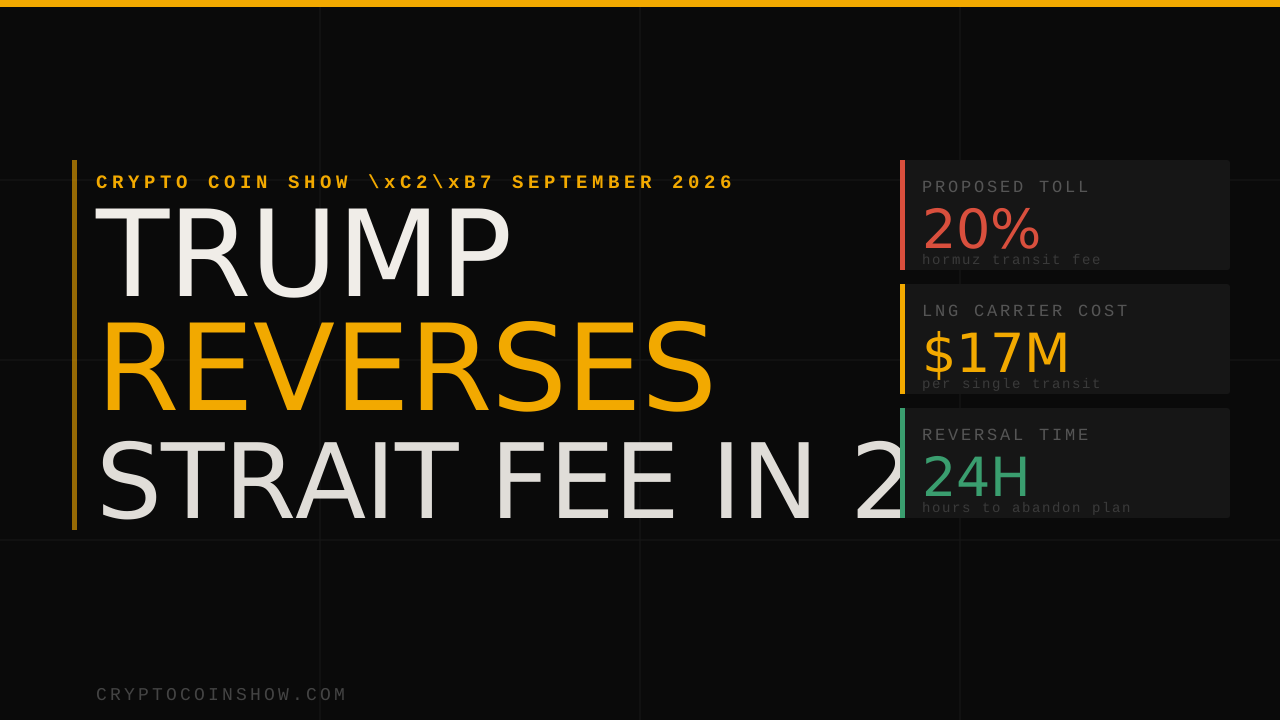
President Donald Trump reversed course on a proposed 20% shipping fee for vessels passing through the Strait of Hormuz on Tuesday, less than a day after announcing it, saying Gulf nations had offered large investment deals in its place.
Trump made the announcement on Truth Social, saying he would swap the transit fee for trade and investment agreements with Gulf states.
“Based on highly productive conversations with Middle East leadership, I have decided to replace the 20% United States Reimbursement Fee with Trade and Investment Deals that the various Gulf States will be making into the United States,” he wrote, adding the investments would be “massive” and good for both sides.
Later, Trump told reporters that several foreign leaders had called him and asked him to take a different approach. He said kings and emirs wanted to invest billions of dollars in the United States instead.
However, he did not name any countries, announce any signed deals, or provide a timeline. He only said the investments would be “massive” and beneficial for both sides.
As of Tuesday, Gulf governments had not publicly responded.
Industry and legal experts push back
Strong outcry from the maritime industry, international organizations, and legal experts who claimed the proposal was illegal led to the decision being overturned.
The tax would have increased the cost of a single cargo by tens of millions of dollars if it had been put into place. A fully loaded natural gas carrier would have paid about $17 million, according to Lloyd’s List estimates.
Analysts also estimated the fee would have added around $16 to the price of every barrel of oil at $80 per barrel, while a very large oil tanker carrying 2 million barrels would have faced a $24 million charge per trip if oil was priced at $60 per barrel.
Petras Katinas, a research fellow in climate, energy, and defense at RUSI Europe, warned that the fee could set a dangerous precedent.
He said if one country starts charging such tolls, other countries may follow and introduce similar fees on their own trade routes. “So, we are totally undermining international maritime law, which is already in a fragile situation.”
Regardless of whether the fee was $200 or $20 million, Lloyd’s List editor Richard Meade was as blunt, stating that “there is no legal basis for charging vessels to exercise their right of transit passage through an international strait.” Whether these demands originated in Washington or Tehran, he continued, was “largely beside the point.”
The United Nations’ International Maritime Organization added its voice, saying it was “firmly against charging fees for passage through straits used for international navigation” and that “there is no legal basis through which to introduce mandatory tolls simply to transit through a strait.”
Opposition from within the administration
Even members of Trump’s own administration had previously opposed the concept.
Secretary of State Marco Rubio said last month that charging fees on international waterways was already illegal under existing law.
As recently as June 25, at a Gulf Cooperation Council meeting in Bahrain, Rubio had warned that Iranian tolls in the strait would trigger “total chaos” and spread “like a contagion.”
The fee was scheduled to go into force at 2000 GMT. Less than five hours prior to that deadline, Trump made it clear that the strait was still open to all commerce, with the exception of ships connected to Iran, which would stay under blockade.
“I like that actually because I don’t think anybody should be able to charge a fee for the strait,” Trump said, though he maintained that the U.S. deserved some benefit for keeping the waterway secure.
Whether the promised Gulf investments will take any concrete form, or simply serve as cover for a quick retreat from a plan widely seen as unworkable, remains unclear.
Overall, the promised Gulf investments currently appear to be a weak and uncertain substitute for the canceled shipping tax, given the lack of specifics and the strong legal and industry opposition that forced the rapid reversal.
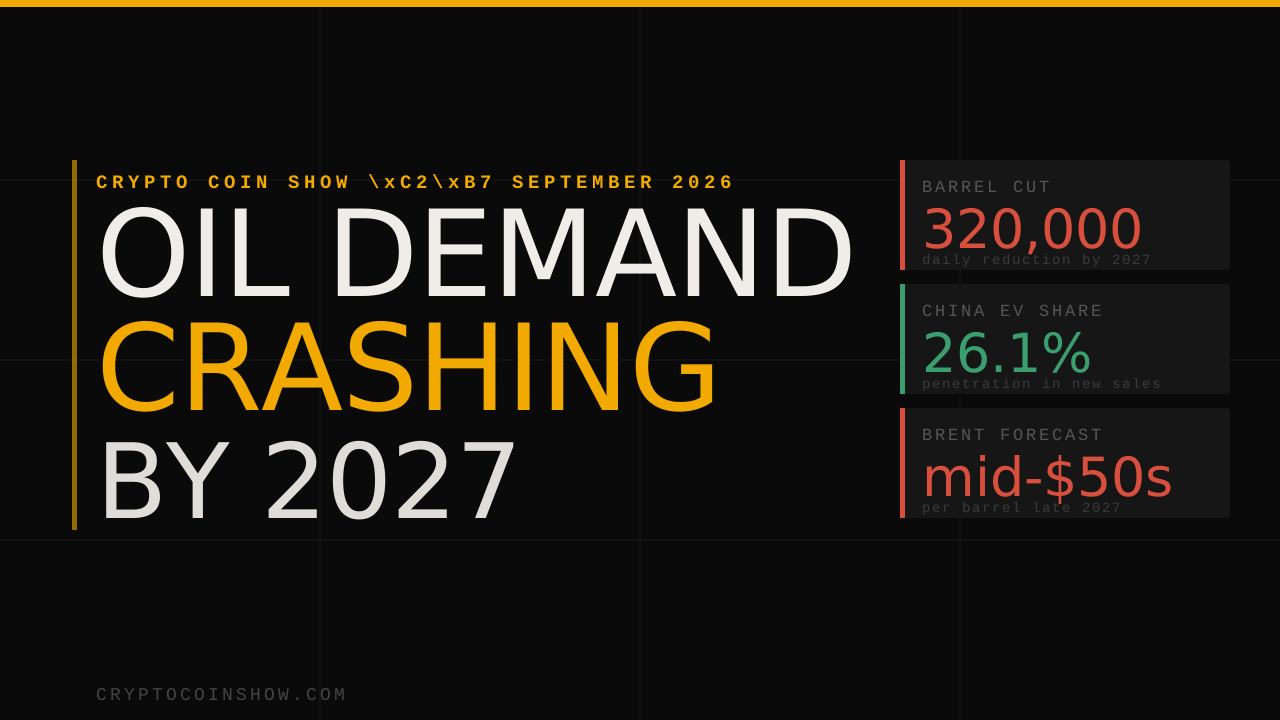
U.S. banking giant, Goldman Sachs, is projecting that rapid electric vehicle adoption, majorly due to higher fuel costs tied to disruptions near the Strait of Hormuz and the US-Iran war, could reduce global oil demand by up to 320,000 barrels per day by the end of 2027.
In a research note published on Sunday June 21, the top investment bank mentioned two different scenarios that end up at the same conclusion. In the “Persistent Acceleration” scenario, where EV market share is expected to grow at the pace seen from February to May 2026, the demand reduction is projected at 0.32 million barrels per day by December 2027. In the more conservative “Temporary Acceleration” scenario, where regional EV adoption rates hold flat at May 2026 levels, production still hits a 130,000 barrel-per-day drop over the same period.
China at the forefront of the EV shift
China accounts for more than 60% of the recent rise in global EV market share, according to Yahoo Finance, with a consistently increasing penetration rate since February. Globally, EV sales reached 26.1% of all new passenger car purchases in May, up 3.4 percentage points over three months, the second-highest level on record.
The trend extends well beyond passenger cars, with Goldman Sachs’ analysts noting that two- and three-wheeled electric vehicles make up the majority of EV sales in India, Vietnam, and China, and each of these displaces about one-third to half the fuel that a passenger car EV would.
This multiplier effect amplifies the demand impact in markets and geographical areas where motorized two-wheelers are the dominant form of transport.
Twelve of the world’s 15 largest EV markets recorded rising adoption rates during the February-to-May period, according to Global Banking & Finance Review.
Goldman Sachs claims oil prices show weaker demand
The EV analysis runs concurrently with signs that fuel consumption is dropping faster than the crude oil markets anticipated.
Goldman Sachs analyst Alexandra Paulus said elevated fuel prices linked to Hormuz supply disruptions likely pushed consumers more toward electric vehicles, a dynamic particularly of weight in China where gasoline demand has weakened as the volume of EVs charging recorded a climb, Yahoo Finance reported.
Separate Goldman Sachs research published earlier this month found that actual retail-use oil demand may have dropped more sharply in response to the higher prices than previously expected.
Retail gasoline sales in China fell by more than 20% from last year’s figures in April, consistent with the lower output from refineries and increased use of rail. Western Europe also saw an average 8% decline in annual retail car-fuel volumes in the same month.
Goldman Sachs has now tied these crude oil demand pressures to a potential slide in Brent crude into the mid-$50s per barrel by late 2027. The bank currently predicts Brent could average $90 a barrel in Q4 2026, but sees a roughly $10-per-barrel drop if demand weakness in China and Europe persists.
The International Energy Agency projects EVs will account for half of all new car sales globally by 2035, even without additional government support, according to Yahoo Finance. Last year, one in four new vehicles sold worldwide was electric.
Don’t just read crypto news. Understand it. Subscribe to our newsletter. It’s free.
Crypto and energy markets are bracing for a possible Black Monday selloff. US-Iran negotiations in Switzerland collapsed over the weekend, reviving fears of an oil shock and a risk-off move into Monday.
Iran’s delegation walked out of the talks in protest over fresh threats from President Donald Trump. Based on this, analysts and traders alike anticipate stocks and crypto could open sharply lower.
Switzerland Walkout Revives Oil and Hormuz Fears
The breakdown came at the Bürgenstock resort in Switzerland. The US, Iran, Pakistan, and Qatar had met there to extend a June 17 truce.
Iran’s team refused a group photo and walked out, state media reported.
Trump had warned he would strike Iran again over its proxies in Lebanon. He also told Iranian officials they would not make it home if Tehran closed the Strait of Hormuz.
That threat carries weight because of the cargo. About 20 million barrels of oil cross the strait each day, near 20% of global consumption, the EIA reports.
Still, the waterway has stayed open through past standoffs. Iran threatened closures in 2011 and 2019 but never followed through.
Brent crude had eased to near $80 a barrel last week as crude oil slipped below the same threshold when tankers resumed transit. However, the walkout now clouds that fragile recovery.
The Iranian delegation will not return to negotiations in Switzerland unless U.S. President Trump apologizes for his threats and Israel withdraws from southern Lebanon, pro-Hezbollah Al-Mayadeen reports. Iran’s state media confirms the Iranians have left the negotiation venue. https://t.co/dxgS8sGLfG
— Ariel Oseran أريئل أوسيران (@ariel_oseran) June 21, 2026
When Trump declared a ceasefire earlier this month, stocks and oil reacted while crypto barely moved.
Bitcoin Holds Steady as Black Monday Calls Spread
So far, crypto has not played along. The Bitcoin (BTC) spot price held near $64,181 on Sunday, a touch higher on the day.
Ethereum (ETH) traded near $1,730. Because crypto runs around the clock, that weekend calm is a live signal, not a closed-market guess.
Crypto also has no brakes. US stocks halt automatically if the S&P 500 falls 7%, 13%, or 20% in a day. Those safeguards were built for exactly this kind of panic.
Crypto carries no such circuit breakers. A Monday slide there would run without a pause. Still, weekend sentiment soured.
“If there isn’t a massive Black Monday Crash tomorrow, I will delete my account,” one user remarked.
The phrase he borrowed carries history. On Black Monday in 1987, the Dow fell 22.6% in one session, still its worst day on record.
However, markets clawed back most of those losses within months.
Trader Ted Pillows made a similar case, calling the risk and reward of buying stocks now poor.
Even so, similar weekend warnings have misfired before, and this one could too, with Qatar and Pakistan are still mediating, and both sides have reasons to step back.
Qatar Announces Launch of Lake Lucerne Summit, First High-Level Committee Meeting with Participation of US, Iran, Pakistan
Doha | June 21, 2026
The State of Qatar announces, in its capacity as a mediator, the launch of the Lake Lucerne Summit and the first meeting of a… pic.twitter.com/Dy99n6Owi1
— Ministry of Foreign Affairs – Qatar (@MofaQatar_EN) June 21, 2026
The risk is not hypothetical. Bitcoin has repeatedly sold off with risk assets rather than acting as a haven.
When Israel struck Iran this month, more than $1 billion in leveraged crypto bets were wiped out in a day. Analysts have since mapped a sharp Bitcoin drop if the war reignites.
Monday’s futures open will be the first real test. A return to fighting could trigger a broad risk-off move across crypto.
A quick path back to talks could calm nerves just as fast. For now, traders are watching oil, the strait, and the next signal from Tehran or Washington.
Robert Kiyosaki says he is watching gold, silver, Bitcoin (BTC), and Ethereum (ETH) for a technical reversal before buying, arguing that the macro backdrop, not falling prices, decides whether hard assets are worth holding.
Precious metals extended a steep retreat this week, and a fresh dispute over the Strait of Hormuz tested a days-old US-Iran ceasefire. BTC and ETH edged higher over 24 hours.
Bitcoin and Ethereum Prices After Reported Strait Closure. Source: Coingecko
Kiyosaki Watches Gold and Silver Context, Not Price
Kiyosaki built his case around the environment rather than the chart. The Rich Dad Poor Dad author said a falling market alone never tells him whether to buy or sell.
He pointed to whether political and banking leaders are fixing the economy or making it worse, and has called dips buying opportunities before.
“I have learned to understand the ‘context’ or the environment the asset is in….not the price… So I am watching prices of gold, silver, Bitcoin, and Ethereum on technical charts and will buy when prices reverse their decline,” Kiyosaki wrote in a post.
The metals he is eyeing set records before the pullback. Gold hit an all-time high near $5,595 an ounce in late January and silver topped $100 for the first time.
Both records capped a run nearly doubling gold and quadrupling silver in a year.
This week’s ceasefire then drained the safe-haven premium the February war and Hormuz threats had rebuilt.
Kiyosaki keeps backing silver and Bitcoin and claims the charts point to a rebound, with no price target or timeline.
Hormuz Dispute Keeps the Safe-Haven Bid Alive
The backdrop Kiyosaki described stayed unsettled. Iran’s Revolutionary Guard declared the Strait of Hormuz closed over alleged ceasefire violations and warned vessels away.
Vice President JD Vance countered that no evidence backed the claim. Vance said the waterway stayed open, and CENTCOM reported 55 ships moving more than 17 million barrels of oil through Hormuz on Saturday.
That is close to the 20 million a day, about a fifth of global oil demand, the EIA says the strait normally carries.
Bitcoin traded above $64,000, up about 1.4%, while ETH held near $1,740, with both gains following developments at the Strait of Hormuz.
Even so, BTC sits roughly 49% below its October record near $126,000 and ETH about 65% under its August peak, with BTC down about 17% and ETH 18% over the past month.
Earlier Hormuz tensions dragged Bitcoin lower, and a US strike on Iran under the truce sent Bitcoin, gold, and oil moving within hours.
With US-Iran talks set for Switzerland on Sunday, the next signal is whether the ceasefire holds. For Kiyosaki, the charts rather than the headlines will decide his next move.
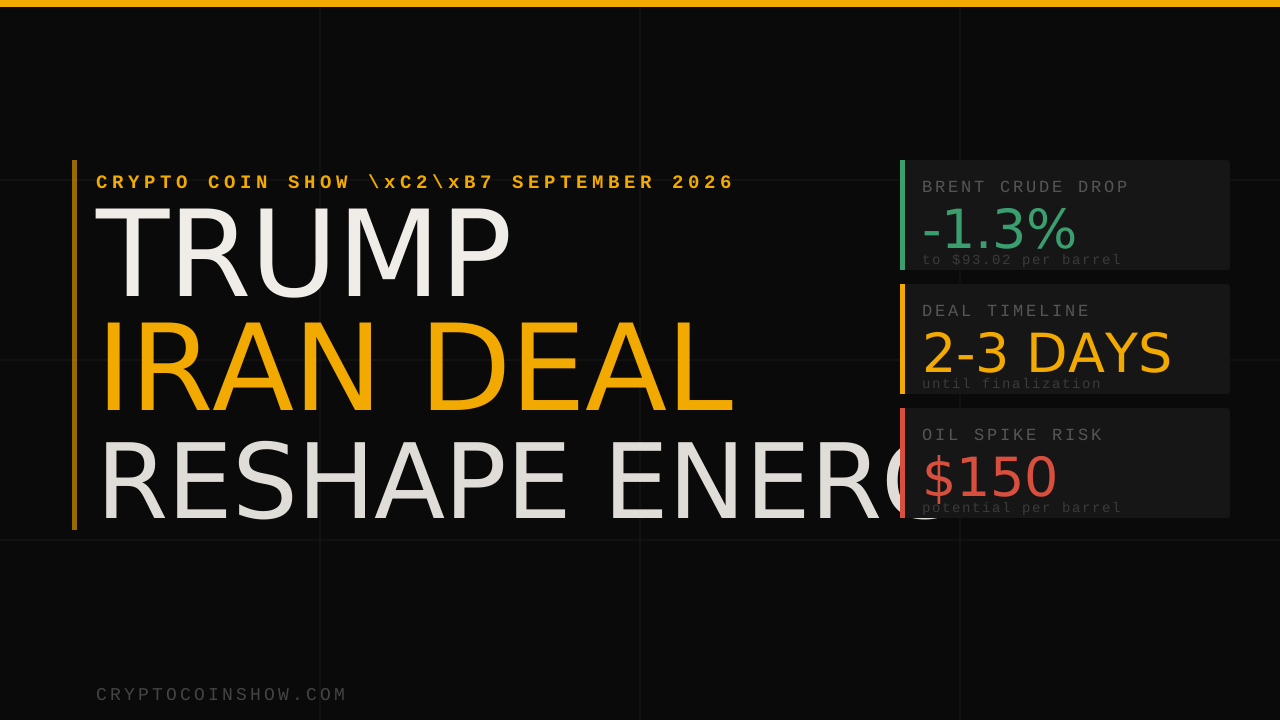
Donald Trump told reporters yet again that a deal to end the war he and Israel started with Iran could be reached in “two or three days,” even as the Middle East ceasefire cracked over the weekend and traders pulled back from oil and gold.
He said the Strait of Hormuz would reopen “immediately” after an agreement, which matters because that waterway is one of the biggest pressure points in global energy trade.
Trump said both sides were near the end of talks on a “very, very good deal that will not in any way allow nuclear weapons.” Sky News Arabia also reported on Monday that a draft agreement had been sent to Washington for review and was “preliminarily acceptable” to the White House.
Trump pushes a near-term Iran deal while new strikes by Israel test the ceasefire
Right before Trump made the aforementioned comments, Iran and Israel traded strikes over the weekend for the first time since the truce began in mid-April.
Iran fired missiles toward northern Israel after accusing Jerusalem of breaking the truce through attacks in Lebanon. Those Israeli strikes included an attack on Beirut’s southern suburbs on Sunday. Israel then said it had carried out a “large-scale strike on strategic defense systems” in response.
As you know, Trump has made many bold calls on his war, and had previously said the fighting would last four to six weeks, but the conflict passed the 100-day line on Sunday.
Trump also addressed a separate U.S. military incident near the Strait of Hormuz. He said the pilots of a U.S. military Apache helicopter that went down on Monday “are fine.” He added that there was “nobody injured” and said the administration would release a report on Tuesday. The cause of the crash was still unknown.
Oil prices fell on Tuesday morning after the ceasefire comments. Brent crude dropped 1.3% to $93.02 a barrel. U.S. West Texas Intermediate fell 1.8% to $89.67 a barrel. Brent was also sitting near $94 during Tuesday’s trading.
Energy and gold analysts cut through the noise with ugly price calls
Meanwhile, Claudio Galimberti, chief economist at private research firm Rystad Energy, said oil could reach $150 per barrel within the next couple of months if the fighting continues and inventories keep falling.
“At this point, unless we solve [the Middle East conflict], unless we start to see an increase in the flow, then we are going to see lower and lower inventories, which means higher and higher prices. The problem, sitting right here, right now, we are absolutely not there,” Claudio said.
Claudio also pointed to a messy, longer-term setup. Even if the current oil squeeze gets fixed, he said the market could later face a huge supply glut because of the unwinding by OPEC and the UAE leaving the cartel. “This is a year of absolute deficit, but fast forward, 2027 may turn out to be a year of humongous surplus,” Claudio said.
Gold had its own ugly setup. Prices have dropped hard since hitting an all-time high of $5,594.82 an ounce on January 29. Analysts at Citi, owned by Citigroup Inc. (C), said gold could fall to $3,500 an ounce if the Strait of Hormuz stays closed until the end of summer.
That would be about 19.7% below the $4,357.90 price seen at 7 a.m. ET on Tuesday. Citi said gold, often treated like the classic safe-haven trade, looks “incredibly high risk” in the short term.
Citi said a long Hormuz closure could slow global gold buying and drag prices back to levels last seen about nine months ago. Since the U.S.-Iran war began on February 28, gold’s safe-haven image has taken hits as traders question the reasons behind its huge run.
A stronger-than-expected U.S. jobs report last week added more pressure because it raised expectations for a year-end interest rate hike. Higher rates usually hurt gold because the metal pays no yield. Citi cut its three-month gold target to $4,000 an ounce from $4,300, while U.S. gold futures for August delivery traded at $4,352.90 on Tuesday morning.
Don’t just read crypto news. Understand it. Subscribe to our newsletter. It’s free.
President Donald Trump issued another warning to Iran on Sunday, telling the country it needs to act quickly or face serious trouble.
“For Iran, the Clock is Ticking, and they better get moving, FAST, or there won’t be anything left of them,” Trump wrote on Truth Social. “TIME IS OF THE ESSENCE!”
The two countries have been struggling to reach an agreement since they stopped fighting in early April.
Such a warning has been given before as well when Trump threatened a “whole civilization will die tonight, never to be brought back again”. The warning was aimed at civilian targets like power plants and bridges going against the international war laws.
This time, Trump didn’t say exactly what would happen or what Iran needs to do to avoid these consequences.
The blocked strait has caused big problems for the world economy. Oil prices have jumped up everywhere, and Americans are paying more at gas stations. On Sunday, the average gas price across the country was $4.51 per gallon, according to AAA.
America wants Iran to stop its nuclear weapons work and open the Strait back up. Iran wants money to fix war damage, an end to the port blockade, and all fighting to stop, including battles in Lebanon.
Iran has found a new way to put pressure on the world
The country is looking at the underwater cables that run beneath the Strait of Hormuz. These cables carry internet data and financial information between Europe, Asia, and countries around the Persian Gulf.
Iran wants big technology companies to pay for using these cables. Some government-connected media in Iran have hinted that the cables could be damaged if companies refuse to pay. Iranian lawmakers talked about this plan last week. It would affect cables connecting Arab nations to Europe and Asia.
“We will impose fees on internet cables,” said Ebrahim Zolfaghari, a spokesperson for Iran’s military, in a post on X last week.
Media connected to Iran’s Revolutionary Guards said the plan would make companies like Google, Microsoft, Meta, and Amazon follow Iranian rules. Cable companies would have to pay fees to use the route, and only Iranian companies could fix or maintain the cables.
Some of these technology companies have put money into cables that go through the Strait of Hormuz and Persian Gulf areas. It’s not clear if these cables actually pass through waters that Iran controls.
There’s also a question of how Iran could make these companies pay. American sanctions don’t allow payments to Iran, so the tech companies might think Iran is just making empty threats.
Still, Iranian media have warned that damage to the cables could hurt trillions of dollars worth of global data and mess up internet connections worldwide.
The strait connects Asian technology centers like Singapore to cable stations in Europe. Problems there could slow down financial trading between Europe and Asia. Parts of East Africa might lose internet completely.
Trump says Xi agrees on opening strait, but China won’t confirm
Trump said Chinese President Xi Jinping agreed that Iran must open the Strait of Hormuz, though China didn’t confirm this.
Xi didn’t talk publicly about his Iran discussions with Trump. China’s foreign ministry called the war a conflict “which should never have happened, has no reason to continue.”
Ebrahim Azizi, who leads Iran’s parliament security committee, said Saturday that Iran has prepared a system to manage ship traffic through the strait on a specific route that will be announced soon.
Azizi said only business ships and those cooperating with Iran would benefit, and fees would be charged for special services.
Bitcoin’s path through 2026 now runs through global economic policy.
The disruption around the Strait of Hormuz has moved beyond a commodity-price event and into the machinery of governments.
The International Energy Agency said crude and refined-product exports through the strait had fallen to less than 10% of pre-conflict levels after about 20 million barrels per day moved through the route in 2025, equal to roughly a quarter of global seaborne oil trade.
That is the scale of shock that stops being only a Brent chart.
The U.S. Energy Information Administration now expects Middle East production shut-ins to average 7.5 million b/d in March, peak at 9.1 million b/d in April, and drive a 5.1 million b/d global inventory draw in the second quarter. It also sees Brent averaging $115 a barrel in 2Q26 before easing later in the year.
For Bitcoin, the issue is whether markets treat the oil shock as a force that keeps inflation sticky and financial conditions tight, or as a shock severe enough to pull governments and central banks toward more support.
That fork leaves Bitcoin with two defensible pathways into year-end: a stagflation-driven liquidity squeeze that pushes it back into high-beta collateral behavior, or a policy-accommodation trade that lets it reclaim its scarce-asset narrative.
The policy response is already visible. IEA members agreed to release 400 million barrels from emergency stocks, the largest coordinated release in the agency’s history.
The U.S. Department of Energy said the White House authorized 172 million barrels from the Strategic Petroleum Reserve, with delivery expected to take about 120 days at planned discharge rates.
Supply additions elsewhere do not change the scale problem. Eight OPEC+ members agreed to add 206 thousand b/d in April, a move that may matter at the margin but sits far below the disruption estimates now embedded in EIA’s outlook.
The more important signal is the spread of emergency policy.
Sri Lanka has introduced QR-based fuel rationing, Korea has odd-even driving restrictions and fuel-price measures, India has LPG and fuel controls, Pakistan has remote-work and public-transport steps, Japan has a subsidy-backed fuel-price cap, Germany has fuel-tax and pricing rules, China has refined-oil price controls, and the UK has heating-oil and industrial support.
The IEA’s separate demand-side report lays out options such as remote work, lower speed limits, public transport, car-access limits, LPG prioritization, and reduced air travel.
Those measures matter for Bitcoin because they shift the oil story from a market-clearing problem to a policy reaction function.
Once governments are cutting taxes, capping prices, rationing fuel, releasing reserves, or subsidizing exposed sectors, the macro signal becomes less clean.
Bitcoin is close enough to the key zone that this macro classification matters immediately. CryptoSlate’s market page showed Bitcoin around $80,794 on May 12, with the broader crypto market near $2.69 trillion and BTC dominance around 60%.
Further, ETF inflows, geopolitical risk, U.S. macro data, Fed signals, and oil stress continue to shape sentiment.
Flows still give the upside case something to work with, but they are not an all-clear signal.
The latest fund-flow report showed $117 million of digital-asset product inflows, a fifth consecutive positive week. Bitcoin products attracted $192 million, while Ethereum products saw $81.6 million of outflows.
The same report noted that four days of outflows were reversed by one strong Friday session, so the flow picture looks resilient but fragile.
That is why the $78,000 to $80,000 area is more than a trading level in this setup. Recent CryptoSlate coverage has tied that band to Bitcoin’s struggle around the Fed, oil-driven inflation pressure, and on-chain supply levels.
If Bitcoin holds it while energy-policy stress stays visible, markets can argue that ETF demand and scarcity narratives are absorbing the macro shock. If it loses the area, the oil shock starts to look less like a debasement trade and more like a real-yield problem.
Two paths now define Bitcoin’s 2026 map
The downside pathway starts with EIA’s oil forecast becoming the macro base case rather than a temporary stress scenario.
Brent at a 2Q26 average of $115, a 5.1 million b/d inventory draw, and multi-million-barrel-per-day shut-ins would keep energy in the inflation conversation even if reserve releases ease the first hit.
Governments can soften the pain with subsidies, tax relief, price caps, direct sector aid, and fuel rules. Those measures can also preserve demand, add fiscal cost, and make it harder for central banks to treat the shock as a clean one-off.
In that version of the year, rate cuts are delayed, real yields stay firm, the dollar remains hard to fight, and Bitcoin trades less like digital scarcity and more like collateral in a risk book.
ETF demand is the transmission channel to watch. CoinShares’ Bitcoin inflow number shows that the bid has not disappeared, but the midweek outflows show how quickly macro caution can drain participation.
If energy inflation keeps Fed expectations tight and ETF flows fade or reverse, Bitcoin does not need a crypto-specific failure to move lower. It only needs the macro backdrop to force de-risking.
Under that pathway, failure to hold $78,000 to $80,000 would make $76,000 to $78,000 the first risk-control zone.
A deeper macro-stress retest would put $70,000 to $73,000 in view. If forced selling and ETF redemptions intensify, the $62,000 to $66,000 area becomes the wider stress band.
These are not stand-alone technical targets; they are the price expression of a market deciding that oil policy is tightening liquidity rather than creating it.
The upside pathway classifies the policy response differently.
In this version, governments absorb enough of the energy shock that growth risk starts to matter more than near-term inflation. Reserve releases, price caps, targeted aid, fuel-tax relief, and demand-reduction measures become a bridge between the shock and eventual policy accommodation.
Markets do not need central banks to ease immediately for that trade to begin. They need real yields to soften, the dollar to stop acting as a wrecking ball, and investors to believe the policy system is moving from inflation restraint toward growth protection.
That is when Bitcoin’s scarce-asset story can return, especially if ETF demand keeps appearing on dips.
The latest CoinShares report does not prove that this path has won, but it keeps it alive. Bitcoin attracted more inflows than the total digital-asset product universe because Ethereum outflows and thinner participation offset BTC demand elsewhere.
That divergence matters. It suggests investors are still willing to isolate Bitcoin as the macro vehicle even when broader crypto participation is uneven.
The confirmation ladder is clear. Bitcoin first has to keep $78,000 to $80,000 intact. It then needs to reclaim roughly $82,500, build acceptance through $88,000 to $92,000, and test $100,000.
A move toward $115,000 to $125,000 into year-end requires more than a chart breakout. It would require continued ETF accumulation, softer real-yield pressure, and policy signals that turn energy relief into a broader liquidity expectation.
That is the mirror image of the downside case. The same subsidies, tax cuts, reserve releases, and conservation measures that can keep inflation sticky can also become the first sign that policymakers will not allow the shock to crush demand.
Bitcoin rises if markets decide that policy support is bigger than the inflation drag.
The test is policy, then price
Bitcoin does not need the oil market to return to normal before it can move higher. It needs markets to decide what the policy response means.
If policy keeps consumers spending while energy remains expensive, central banks have less room to ease and Bitcoin remains vulnerable to the high-beta path.
If policy absorbs enough pain to shift the conversation toward growth support, liquidity, and currency debasement, Bitcoin has a route back into the scarce-asset trade.
The live test is therefore simple but demanding. Bitcoin must keep the $78,000 to $80,000 area while oil stress stays visible in government action.
Holding that zone and reclaiming $82,500 would strengthen the accommodation pathway. Losing it would point back to the stagflation squeeze, where oil policy tightens the financial conditions Bitcoin needs to escape.
Bitcoin (BTC) dropped below $75,000 on April 19 as the Strait of Hormuz shut down entirely and Iran rejected a second round of negotiations with the United States.
The developments mark a sharp escalation in the US-Iran standoff, with zero oil tankers passing through the strait and diplomatic channels appearing to collapse.
Strait of Hormuz Shuts Down as Diplomacy Stalls
No oil tankers passed through the Strait of Hormuz, effectively closing the waterway that handles roughly 20% of global seaborne oil trade.
“It appears that the Strait of Hormuz is now completely closed for the first time in history. The US “blockade” and Iran’s closure are in full force,” wrote The Kobeissi Letter.
Reportedly, thirteen tankers had already turned back mid-route the day before, freezing shipping flows through the critical chokepoint.
Iran’s state media confirmed that Tehran rejected participating in a second round of talks with Washington. Iranian officials cited what they called “deception” from President Trump, pointing to “inconsistency with what is actually happening” during negotiations.
President Trump accused Iran of firing on ships in the strait in violation of the ceasefire agreement. He threatened to “knock out every single Power Plant, and every single Bridge, in Iran” if Tehran refuses a deal.
General sentiment is that both countries are on the verge of a new round of escalation, with futures markets set to open within hours.
Bitcoin has faced sustained pressure from the US-Iran conflict since February 28. The pioneer crypto previously fell from above $100,000 when Iran first moved to close the strait earlier this year. Amid Sunday’s risk-off sentiment, the king of crypto fell below $75,000 for yet another time.
Bitcoin’s price was halted at its multi-month peak at over $78,000 on Friday, and the subsequent conflicting actions and statements from Iran and the US have led to another retracement to under $75,000 as of press time.
The latest set of blame-throwing came minutes ago, as reports emerged that Iran believes they are “facing deception” from US President Donald Trump due to “inconsistency with what is actually happening.”
Moreover, Iranian officials said they believe the two sides are “on the verge of a new round of escalation,” as reported by The Kobeissi Letter.
However, the US blockade remained in place, and Iran decided to close the Strait just a day later. Trump started to threaten once again, while also saying that both nations’ delegations will meet again in Pakistan for another round of peace talks. In contrast, Iran’s Tasnim news agency said there were no such plans.
Trump then alleged that there’s a “divide” in the Iranian government and threatened to “blow up” the entire country if the two nations fail to reach an agreement.
This rather escalating uncertainty, with just a few days left until the ceasefire deal ends, led to a weekend correction for BTC, as the asset just slipped below $75,000. It’s now down by almost $4,000 since the Friday peak.
However, more volatility is to be expected later this evening when the futures legacy markets open and tomorrow morning, as it has happened in previous instances following major weekend developments.