
ZachXBT accuses LAB token team of insider-controlled price manipulation
Blockchain investigator ZachXBT has published detailed allegations that LAB token insiders controlled over 95% of supply and orchestrated a coordinated pump-and-dump scheme, raising serious questions about exchange listing practices and the integrity of price discovery on major centralized platforms.
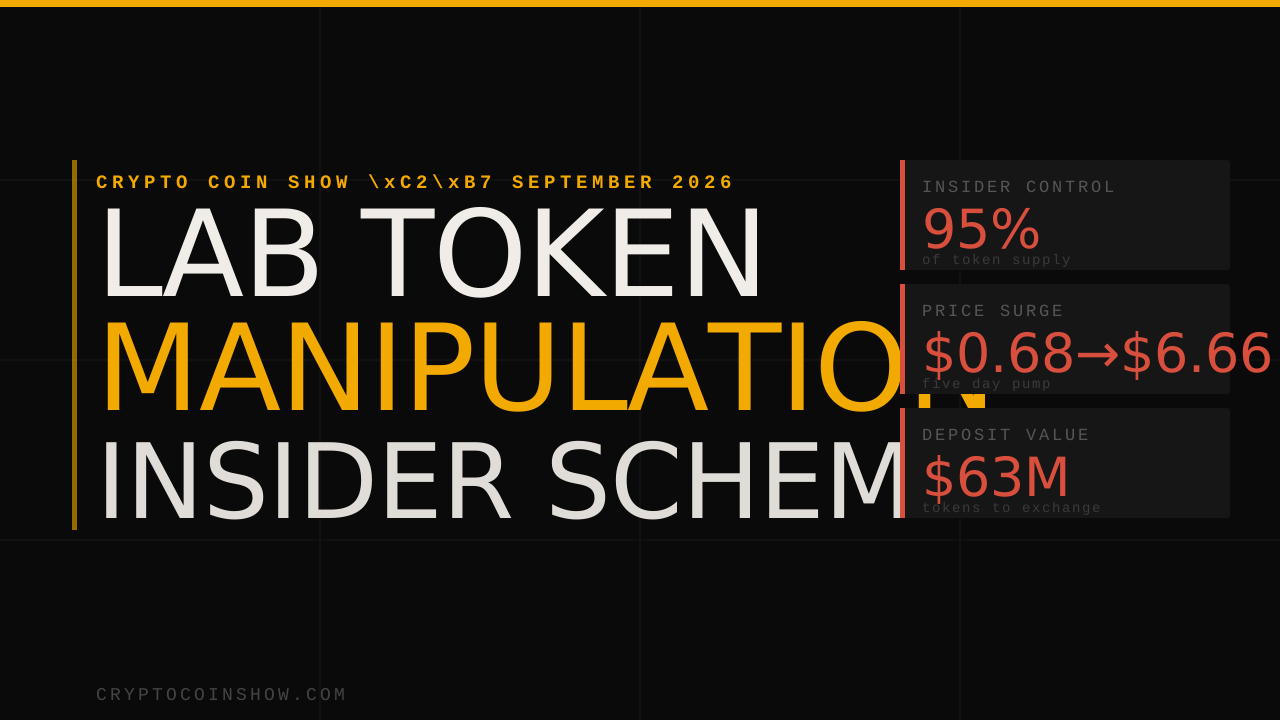
- LAB token surged from $0.68 to over $4.00 in five days starting May 1, reaching $6.66 all-time high before falling 17.5% following ZachXBT’s investigation report.
- On-chain analysis showed LAB team wallets deposited 96 million tokens worth approximately $63 million into Bitget before the price surge began.
- ZachXBT documented opaque loan contracts offering USDT at 7.5% monthly interest with repayment clauses denominated in LAB tokens at “market price,” converting debt into leveraged bets on insider-driven valuations.
- 95%+ LAB token supply allegedly controlled by project insiders versus public holders.
- $6.66 All-time high price reached May 11, compared to $0.68 trading level just days before.
- $6 billion Fully diluted valuation at peak, relative to project launch in October 2025.
A detailed investigation by blockchain researcher ZachXBT has leveled serious accusations at LAB, a multichain trading platform token, alleging that a small group of insiders orchestrated a coordinated price manipulation scheme to pump the token from under $1 to an all-time high of $6.66 in mid-May. The token has since declined over 17% from that peak.
ZachXBT’s analysis, which includes documentation of private loan contracts, unilateral vesting modifications, and coordinated market-maker positioning, portrays LAB as emblematic of what he describes as “retail extraction” by insiders using major centralized exchange listings to distribute tokens at artificially inflated prices to unsuspecting buyers.
LAB team wallets moved $63 million of tokens to Bitget before five-day price rally
The price action in LAB follows a textbook pattern of accumulation followed by coordinated promotion. The token had traded below $1 for months after its October 2025 launch as a multichain trading terminal, with no material product updates or announcements to justify a move higher.
Beginning May 1, LAB entered a sharp rally phase, jumping from approximately $0.68 to over $4.00 within five days, a gain of roughly 490% in a compressed timeframe.
On-chain analysts detected suspicious wallet activity preceding the rally. Wallets identified as connected to the LAB project team transferred 96 million LAB tokens, valued at approximately $63 million at the time of deposit, into Bitget ahead of the price surge.
This timing raised immediate red flags: the tokens were moved to a major exchange precisely before the token began trading vertically, a pattern consistent with insiders preparing inventory for a coordinated pump. Peak 24-hour trading volume on LAB reached over $280 million during the rally, concentrated on Bitget.
The deposit pattern suggests deliberate staging rather than organic market activity. Insiders positioned themselves to benefit from the subsequent price movement they would then catalyze.
Private loan contracts show insiders converted debt into leveraged token bets at any price
ZachXBT’s investigation uncovered documentation of private loan contracts that functioned as disguised token sales with unlimited upside capture for insiders. The Lab Management Ltd., a BVI-registered entity affiliated with the project and signed by director Sadkov, offered USDT loans at 7.5% monthly interest.
The critical detail lies in the repayment clause: borrowers would repay in LAB tokens at “market price,” meaning any rise in token value during the loan period would accrue entirely to insiders who originated the loan at a fixed USDT amount.
This structure transformed what appeared as debt into a leveraged bet on the token’s price. A borrower receiving $1 million USDT at 7.5% monthly interest would face mounting repayment obligations denominated in LAB tokens, effectively forcing them to buy LAB at whatever price insiders had driven it to before repayment fell due.
The loan terms created perverse incentives for insiders to pump the token as aggressively as possible, since their repayment would occur at the highest achievable price.
Beyond structured loans, ZachXBT documented a menu of token acquisition methods offered to various counterparties via WhatsApp.
Terms included loans at 5% monthly interest, over-the-counter sales at 60% discount with five-month cliffs, guaranteed monthly-recalculated discounts of 25%, and discounted tranches at 20%. Key opinion leaders received offers at 80% discounts, with token unlocks contingent on posting promotional content or facing blacklisting, a coercive arrangement tying participation to social media amplification.
Bitget’s role in facilitating LAB raises questions about exchange listing governance
Bitget emerged as the central venue through which the LAB scheme operated. On May 12, blockchain analytics firm Lookonchain identified ten fresh wallets withdrawing 100 million LAB tokens (approximately $480 million in value) from Bitget over a 12-hour period, 32.26% of the circulating supply.
The synchronized withdrawal pattern suggested coordinated insider accumulation off the exchange following the price peak.
ZachXBT responded by directly naming Bitget’s structure and leadership, stating that founder Shawn Liu serves as the “big boss who allows these scams to operate behind the scene,” while characterizing CEO Gracy Chen as “only the face of it.” He characterized the arrangement as part of a “Chinese CEX cartel” that had operated without meaningful public scrutiny.
ZachXBT signaled his intention to escalate public criticism of Bitget’s listing practices, framing the exchange as complicit in enabling insiders to use its platform for extraction.
Bitget had not issued public statements or acknowledged the allegations at the time of this report. The exchange’s silence stands in contrast to its typical practice of responding to similar investigations.
Institutional investors face renewed questions about exchange due diligence and token launch standards
The LAB case exposes structural vulnerabilities in how major centralized exchanges vet tokens before listing and monitor for suspicious on-chain activity post-listing. No material announcement justified LAB’s transition from sub-$1 trading to a $6 billion fully diluted valuation within two weeks.
Yet the token received prominent placement on Bitget’s trading interface, enabling retail order flow to collide with insider selling at manipulated prices.
Institutional investors and fund managers face a practical problem: distinguishing legitimate token launches from schemes designed to extract value depends on detecting patterns that exchanges themselves appear incentivized to overlook.
The coordinated loan structures, vesting manipulations, and KOL blackmail tactics documented in ZachXBT’s investigation require forensic review of off-chain documentation, materials most retail buyers never see and most exchange risk committees may not systematically audit.
The LAB incident demonstrates that listing a token on a major CEX no longer serves as a minimum credential for legitimacy. Exchanges that prioritize trading volume and listing fees over transparent vetting create moral hazard for insider schemes.
Institutional allocators must now assume that listing status reflects venue incentives rather than project quality or insider alignment with public shareholders.
ZachXBT has publicly signaled his intention to intensify scrutiny of Bitget and similar exchanges, framing the LAB case as symptomatic of systematic abuse. Pending regulatory action or exchange policy changes, the question remains whether major CEX platforms will implement substantive pre-listing due diligence standards that verify insider token distribution and lock-up terms, or whether protocols like LAB will continue finding venues willing to facilitate founder extraction at public expense.