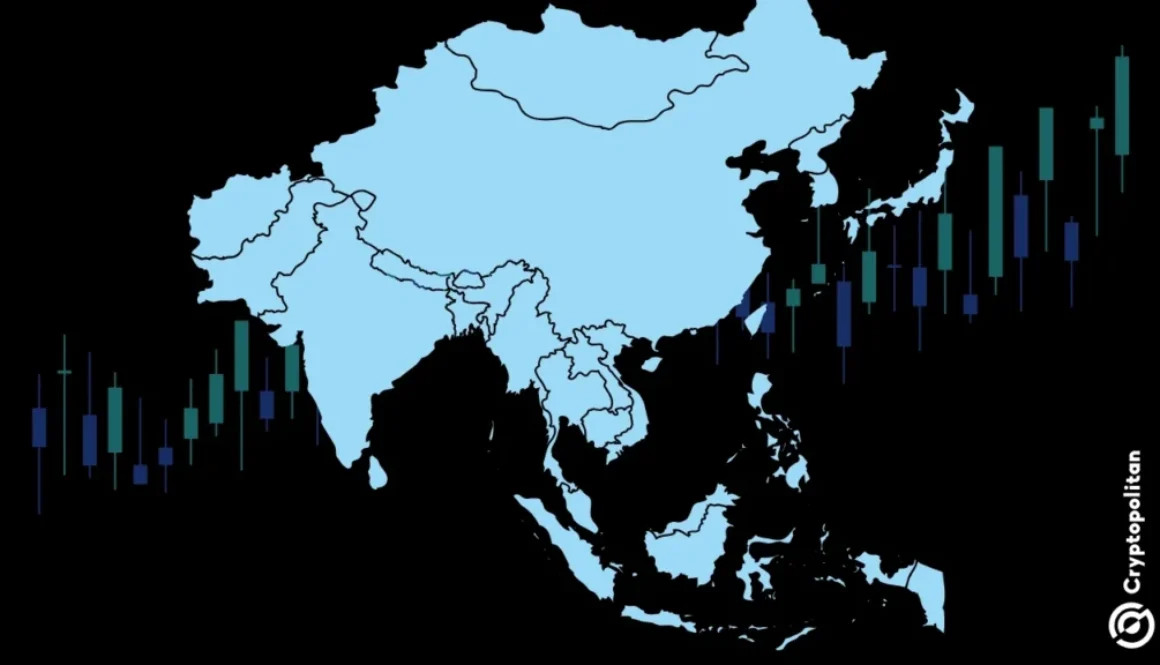
Tether has applied for seven trademarks in South Korea, including for its company name and logo, in a move that market observers see as a hint of the firm expanding into the South Korean market.
The issuer of the largest stablecoin in the world, USDT, is also expanding its reach into Africa and Asia by partnering with Lemfi. Meanwhile, Tether’s rival Circle (NYSE: CRCL) has already been meeting with major financial institutions in South Korea, setting up a potential showdown between number one and two in the stablecoin issuance business.
Tether and Circle are lining up entry into the South Korean market
Tether, the company behind the world’s largest stablecoin USDT, is making progress in its plans to enter the South Korean market. The Korea Intellectual Property Rights Information Service (KIPRIS) recently received multiple trademark applications from Tether, totaling up to seven.
Tether’s previous filings in the country focused on stablecoin product names, but this batch includes the corporate brand itself and its gold-backed stablecoin Tether Gold (XAUT).
South Korea’s proposed Digital Asset Basic Act is expected to require foreign stablecoin issuers to maintain a domestic branch if they want to distribute their tokens locally, and Tether appears to be positioning itself ahead.
Before Tether’s latest filings, Circle’s CEO Jeremy Allaire visited Seoul in April and met with executives from KB Financial Group, Shinhan Financial Group, and Hana Financial Group to discuss stablecoin payment cooperation and real-world asset tokenization.
Allaire acknowledged the potential in the South Korean market and shared Circle’s plans to establish a Korean subsidiary and obtain a license if the final regulatory framework accepts foreign issuers.
Circle has also signed partnerships with Korean exchanges Dunamu, which operates Upbit, and Bithumb to expand USDC adoption on domestic trading platforms.
Cryptopolitan reported earlier that Hana Card, part of Hana Financial Group, launched a pilot in March allowing foreign visitors to pay at local merchants using USDC through a partnership with Circle and Crypto.com. Other Korean financial firms, including BC Card and KB Kookmin Card, have been testing stablecoin payment infrastructure as well.
Tether has been on an expansion trail
Tether also recently announced an investment in LemFi, a cross-border payments platform that works across communities in the UK, US, Canada, and Europe to recipients in Africa and Asia. The deal will integrate USDT as a settlement layer across LemFi’s payment corridors, replacing multi-day SWIFT-based transfers with blockchain settlement.
Tether’s CEO Paolo Ardoino said in the announcement that the goal of the partnership is to expand financial access for its estimated 585 million users globally.
Cryptopolitan previously reported that Tether recorded $1.04 billion in profit for Q1 2026. The company holds excess reserves of $8.23 billion; enough capital to invest in distribution partners and pursue market entry in jurisdictions like South Korea.
South Korea is home to an estimated 18 million crypto investors. Exchanges in the country recorded over $663 billion in trades through mid-2025, and the country’s retail traders remain a significant part of altcoin markets.
Beyond Tether and Circle, multiple projects are building won-denominated stablecoins. Cryptopolitan reported that the Bank of Korea has been advancing “Project Han River,” its wholesale CBDC initiative, which entered a second phase of real-transaction testing earlier this year.
Regulators are still debating whether or not stablecoin issuance should be restricted to commercial banks or follow a more flexible licensing model. The discussion has been postponed until after South Korea’s June local elections.
Best Stablecoin Infrastructure is a category within the BeInCrypto Institutional 100, an annual research-driven program recognising institutional digital asset excellence across 26 categories and six pillars.
This category sits under Pillar 4: Tokenization & On-Chain Finance. The 15 firms below are listed alphabetically and are not ranked. A shortlist will be named in May 2026, with the winner announced at Proof of Talk in Paris on June 2–3, 2026.
Key Facts
Long list: 15 firms across fiat-backed dollar stablecoins, MiCAR-compliant euro and multi-currency issuers, Asian dollar stablecoins, DeFi-native stablecoins, white-label platforms, yield-bearing stablecoins, bank-issued stablecoins, and payment networks.
Initial pool: More than 30 stablecoin issuance and infrastructure firms screened; 15 advanced to the long list
Order: Listed alphabetically, not ranked.
Scoring: 50% quantitative data · 50% Expert Council.
BlackRock and VanEck selected RLUSD as redemption rail for tokenized Treasury funds
Deutsche Bank integration, SBI Japan rollout, and Deloitte attestations
About This List
The BeInCrypto Institutional 100 — Best Stablecoin Infrastructure (2026 Long List) identifies firms that underwrite, issue, settle, and distribute stablecoins at an institutional scale.
The list spans fiat-backed dollar issuers, MiCAR-compliant euro and multi-currency issuers, regulated Asian dollar stablecoin issuers, DeFi-native decentralized stablecoins, white-label issuance platforms, yield-bearing stablecoins, tokenized treasuries, and payment networks operating stablecoin settlement rails.
Tether USDT, Tron USDD, World Liberty Financial USD1, Plasma Network, and Ethena Labs are excluded under reputational and enforcement filters applied across the program.
Methodology
This category is evaluated under Track A of the BeInCrypto Institutional 100 methodology: 50% based on quantitative metrics and 50% on Expert Council scoring.
Assessment spans seven criteria: stablecoin market capitalization and on-chain volume, institutional adoption, regulatory and reserves posture, multi-chain distribution, enterprise integration depth, innovation signal, and ecosystem dominance.
The 50/50 split reflects the availability of quantitative stablecoin data, including on-chain market capitalization, transaction volume, and reserve attestations, balanced against Expert Council assessment of regulatory durability, reserve quality, governance, and product innovation.
Data was verified using regulatory registers, issuer reserve attestations, audited filings, SEC EDGAR, exchange disclosures, partnership announcements, and on-chain analytics providers including CoinGecko, CoinMarketCap, and DefiLlama. Nominees were also reviewed against negative-signal queries covering enforcement, security breaches, depegs, active litigation, and reputational controversy during the award window.
The Senate Banking Committee voted 15-9 on Thursday to move forward on the CLARITY Act, a crypto market structure proposal that has been the subject of debate for a while now.
Nevertheless, just ahead of the vote, the Bank Policy Institute (BPI) put out a series of tweets on X about illicit crypto flows hitting $154 billion in 2025, adding another dimension to what was already an intensely debated topic on the extent of regulation in digital assets.
Bank Advocates Lean on Crime Data
The timing of BPI’s thread drew attention because lawmakers were simultaneously debating amendments tied to stablecoin yield restrictions and enforcement standards inside the CLARITY Act markup session.
According to data from Chainalysis that the institute shared, in 2025, illicit crypto addresses received $154 billion. This was a 162% year-over-year increase, driven largely by a 694% jump in value received by sanctioned entities.
Furthermore, the on-chain money laundering ecosystem grew from $10 billion in 2020 to over $82 billion in 2025, with stablecoins, primarily Tether (USDT), now accounting for 84% of all illicit transaction volume, displacing Bitcoin as the preferred payment method for criminals.
In a separate piece, the BPI argued that banks have spent decades staffing tens of thousands of AML employees while crypto companies have been largely exempt.
It said that the GENIUS Act imposed some obligations on US stablecoin issuers, but did not cover foreign issuers operating stateside. Tether, incorporated in El Salvador, sits outside that net.
The piece also cited the Islamic Revolutionary Guard Corps, whose crypto activity reportedly reached over $3 billion in 2025, representing roughly 50% of Iran’s total crypto ecosystem by Q4 of that year.
According to the BPI, unhosted wallets, cross-chain bridges, and mixers are “specifically designed to frustrate tracing and openly advertised as such.”
The stablecoin debate has become one of the most contentious parts of the CLARITY Act negotiations, with banking groups, including members of the American Bankers Association, spending weeks lobbying senators to tighten language restricting yield-bearing stablecoins.
As CryptoPotato reported earlier this week, banking groups sent Senate offices more than 8,000 letters ahead of the markup vote, while the crypto advocacy group Stand With Crypto said its supporters had contacted lawmakers nearly 1.5 million times in support of the bill.
But despite more than 40 amendments proposed by Senator Elizabeth Warren and procedural disputes during the hearing, the legislation advanced with support from Democratic senators Ruben Gallego and Angela Alsobrooks.
The Counter-Argument
While the BPI is demanding stricter anti-money laundering laws and sanctions regulations to be applied to crypto the same way it has been done to the traditional banking sector, data shared by Binance Research on May 14, offered some pushback to its claims.
According to Binance, trapped illicit funds on-chain have grown every year because less is being successfully laundered, not more.
Their report showed that more exit points are being blocked by KYC and more balances are being frozen by stablecoin issuers. Even the largest mixers have been processing at most $10 million per day.
As the Senate Banking Committee prepares to mark up the long-anticipated CLARITY Act on Thursday, Coinbase CEO Brian Armstrong has argued that the newest version of the bill represents a workable “compromise” and could meaningfully improve the US financial system.
Speaking to FOX Business, Armstrong said the updated draft reflects concessions on both sides—what he described as the crypto industry meeting requests from bank lobbyists and lawmakers, while the banking sector also gave ground during negotiations.
Coinbase CEO’s CLARITY Act Pitch
Armstrong also highlighted one specific element tied to stablecoin rewards. He said the approach in the latest bill would only apply when there is “some sort of material activity on the account,” adding that he believes the overall package would make the system “more efficient.”
The claim is that the legislation would help streamline financial services, reduce friction, and make access easier for consumers and businesses—while still keeping the framework aligned with banking-sector concerns that were raised during talks.
Still, critics point to the banking industry’s pushback as evidence that the dispute is far from settled. As reported throughout the week by Bitcoinist, banking trade groups have opposed the CLARITY Act’s stablecoin-rewards provision, arguing that it could give crypto firms too much flexibility.
Their position is that the policy might also encourage deposits to shift away from traditional, insured banking channels rather than strengthening them.
Beyond the details of stablecoin rules, Coinbase CEO argued that the broader direction of the CLARITY Act reflects growing institutional interest in digital assets.
In his view, banks are increasingly integrating stablecoins and crypto-related services because customer demand is rising—an angle that suggests the bill, if passed in its current form, could provide the clearer structure institutions want before expanding further.
Can The Latest Crypto Bill Draft Survive?
Supporters of the bill are not limited to Coinbase. Ripple CEO Brad Garlinghouse also backed the current push, commenting on social media site X (previously Twitter) that the Senate Banking Committee is “putting in the work” to move the CLARITY Act forward.
Garlinghouse’s message emphasized that Ripple supports the bill because crypto businesses and major participants should have the “same rules and protections as every other asset class,” and because—if the US is serious about leading in crypto—this is the moment to finalize legislation and get it done.
Even with that backing, the legislative road ahead is not smooth. Politico reported that Senator Elizabeth Warren, a well-known crypto skeptic, is vowing to pursue extensive changes to the bill through amendments.
The reporting says Warren and others are preparing more than 100 amendments ahead of the markup, following the release of an updated 309-page draft that expands on an earlier 278-page version introduced in January.
According to the same reporting, Warren submitted more than 40 amendments on her own, with much of the rest attributed to Democratic members of the Banking Committee.
This mirrors earlier moves around the bill: the January markup session drew 137 amendments, and it was eventually cancelled after a period of resistance that included Armstrong and Coinbase withdrawing support for the bill at the time.
For now, the core question going into Thursday’s markup is whether the latest CLARITY Act draft can hold together.
Featured image created with OpenArt, chart from TradingView.com
Visa said its settlement pilot for stablecoins now supports nine blockchains and has reached a run rate of $7 billion a year.
The company announced on April 29 that it added Arc, Base, Canton, Polygon and Tempo to a pilot that already used Avalanche, Ethereum, Solana and Stellar.
Visa said the annualized settlement run rate is up 50% from the prior quarter.
The pilot remains bounded by Visa’s own language, but the signal is in where the volume sits. Stablecoins are entering the part of payments consumers rarely see, the settlement layer that moves value between issuers, acquirers, banks, program managers and treasury systems after a transaction has already been authorized.
That makes the update a settlement-infrastructure signal as much as a blockchain support list. Visa is testing whether stablecoins can become a parallel settlement option inside payment infrastructure that already touches banks, card programs and merchants across markets.
The operational point is direct: crypto adoption is moving into the back office before it becomes visible at the checkout screen.
The conclusion has limits. The company described a pilot and support, gave a run rate for stablecoin settlement, and left the split by chain, stablecoin, partner, and geography undisclosed.
That keeps things bounded: the network is adding optional settlement rails, while traditional settlement remains part of the stack.
Visa has been building toward this point for several years. In 2023, the company said it had moved millions of USDC between partners over Solana and Ethereum to settle fiat-denominated VisaNet payments.
That announcement followed an earlier Crypto.com issuer pilot and expanded the settlement work to merchant acquirers Worldpay and Nuvei.
The operational issue is familiar in card payments. A consumer gets near-instant authorization at the point of sale, but funds still have to move between the issuing bank and the merchant’s bank.
Visa’s treasury and settlement systems sit inside that process, moving value across currencies and institutions.
In December 2025, U.S. issuer and acquirer partners gained the ability to settle with Visa in USDC, with Cross River Bank and Lead Bank initially settling over Solana.
The company cited faster funds movement, seven-day availability, and resilience across weekends and holidays.
The April release also connected the chain expansion to Visa’s stablecoin-linked card programs, which it said numbered more than 130 programs across more than 50 countries.
That makes the nine-chain footprint part of a broader payment operating model, beyond a ledger experiment.
The new run rate gives that timeline a sharper shape. The December 2025 U.S. launch put the prior annualized stablecoin settlement baseline above $3.5 billion.
The April update puts the run rate at $7 billion, with five more blockchains added to the pilot.
Before the April update
Added in April
Operational signal
Avalanche, Ethereum, Solana, Stellar
Arc, Base, Canton, Polygon, Tempo
Visa is widening the settlement pilot across public chains, payment-focused networks and institution-oriented infrastructure.
The table serves as a footprint rather than a volume map. The run rate applies to the pilot as a whole; the available disclosure leaves that volume undivided across the nine supported networks.
The sequence also shows a shift in who the product is for. The early work proved that USDC could move between card ecosystem participants.
The current phase asks whether the same settlement logic can be offered across a wider menu of rails while reducing the need for each partner to build separate crypto operations from scratch.
What the chain mix shows
The five additions suggest the types of environments Visa wants available to partners.
Arc is a stablecoin-native Layer 1 created by Circle. It brings USDC-denominated fees, optional privacy, sub-second deterministic finality and direct integration with Circle’s stack.
That makes Arc relevant to payment flows where predictable costs, stablecoin liquidity and transfer guarantees count more than token speculation.
Arc’s public materials also describe public testnet status, which keeps production claims bounded.
Base brings a different route into the same problem. Visa described Base as powered by Coinbase, while Base offers USDC payments that settle in seconds, use low gas costs and can be funded from a Base Account or Coinbase Account.
Base connects wallets, payment tooling, and exchange-linked liquidity into a consumer and developer surface.
Canton adds the institutional privacy layer. Visa had already said in March that it would become a Canton Super Validator, helping banks and financial institutions explore privacy-preserving payments, settlement and treasury use cases.
Canton centers stablecoin payments on need-to-know privacy, so counterparties, amounts and strategies can remain visible only to the parties that need them, unlike many open blockchains.
As an analytical reading of the chain mix, Polygon and Tempo fit the payment-infrastructure side of the roster. Polygon emphasizes global payments, stablecoin liquidity and lower-cost transactions.
Tempo emphasizes dedicated payment lanes, stablecoin-native gas, payment metadata for reconciliation and deterministic settlement.
Together, the additions create a wider operating menu across chain types. One partner may need low-cost stablecoin movement.
Another may need privacy controls for regulated finance. Another may value Coinbase-connected payment tooling.
Visa’s role is to make those differences usable through a common settlement layer.
The result is a portfolio of settlement options across chain types. That portfolio lets Visa present stablecoins as infrastructure that can adapt to partner constraints, from regulated privacy to low-cost throughput, while keeping the payment-network relationship in the center.
The adoption signal is operational
The broader market context supports the shift while keeping price moves out of the frame. As of April 30, the crypto market stood at around $2.55 trillion, while DefiLlama put total stablecoin market capitalization at around $319.802 billion.
USDC sits in that context as a core settlement asset used for payments, treasury management, collateral, and cross-chain liquidity.
Ethereum, Solana, and Polygon Ecosystem Token are large or payment-relevant networks and tokens that can carry settlement infrastructure while keeping price data in the background.
Stablecoins already have enough liquidity and operating history for large payment networks to treat them as infrastructure options.
The adoption test shifts from whether a consumer chooses a wallet over a card to whether payment firms can use stablecoins to move value after the customer-facing transaction is done.
The market-side thesis has been building. A January analysis of BlackRock’s stablecoin thesis argued that dollar tokens were shifting from trading utility to settlement infrastructure within and alongside traditional finance.
Visa’s update provides a current operating example for that thesis. The company is connecting stablecoin settlement to issuers, acquirers, U.S. banks, and stablecoin-linked card programs.
Its March expansion with Bridge said stablecoin-linked Visa cards were live in 18 countries, with planned expansion to more than 100 countries.
That release also said issuers and acquirers involved in those programs could settle with Visa using stablecoins over supported networks.
Regulation sits in the background. Treasury framed the U.S. GENIUS Act as providing regulatory clarity for a market it expects could become much larger.
Visa tied the expansion to pilots, banks, partners, and supported networks, while the policy debate helps explain why payment stablecoins are drawing more mainstream attention.
The $7 billion run rate shows real activity, while the lack of a chain-by-chain breakdown leaves the depth of each rail unclear.
The nine-chain footprint shows optionality, while the pilot label keeps the conclusion bounded.
The adoption signal is therefore specific. Stablecoins are taking on a role beyond trading-market distribution.
Within Visa’s settlement pilot, they are becoming a treasury and settlement option for institutions already within mainstream payments.
The next test is whether that option remains a specialist rail for selected partners or becomes a routine part of how global payment firms move value after the consumer never sees the transaction again.
This month, Israel and Pakistan supplied a quieter test for crypto than the one playing out in US capital markets. What if the more important 2026 shift is happening where digital assets meet local money and bank accounts?
Israeli crypto firm Bits of Gold said Israel’s Capital Market Authority approved the issuance and distribution of BILS, a shekel-pegged stablecoin, after a two-year pilot. Days earlier, the State Bank of Pakistan issued BPRD Circular Letter No. 10 of 2026, replacing its 2018 virtual-currency prohibition.
The Pakistan circular allows regulated entities to open bank accounts for PVARA NOC or licensed VASPs and their customers under defined compliance conditions.
Those two moves sit far from the US spot ETF cycle. Yet they point to the operational layer that decides whether crypto becomes more than an investment wrapper. The US has supplied legitimacy, liquidity, and a powerful digital-dollar debate.
Other jurisdictions are testing a different operating layer: whether crypto can connect to local money, bank accounts, merchant checkout, and enforceable market rules.
That distinction changes how global adoption should be evaluated. A Bitcoin ETF lets investors buy exposure. A regulated shekel stablecoin lets users hold a domestic currency on-chain.
A central bank circular that lets licensed crypto firms open accounts gives the sector a bridge back into supervised banking. The first validates an asset class. The second and third test whether crypto can become usable financial infrastructure.
The test remains early. BILS still needs proof of issuance and usage. Pakistan still needs licensed VASPs with actual bank relationships. Hong Kong’s new licensees still need business launches.
The UAE still needs clearer public mapping between dirham-token announcements and Central Bank register entries. Still, the pattern is becoming harder to dismiss: in 2026, the practical crypto work is increasingly about where digital assets touch money, banks, merchants, and settlement systems.
Local money and bank access
Bits of Gold says the approved BILS project is a shekel-pegged stablecoin designed initially on Solana, with Fireblocks, QEDIT, EY, and the Solana Foundation involved in the pilot.
The policy signal is the local-currency component. BILS brings the shekel into an on-chain market still dominated by dollar stablecoins and asks whether a national currency can gain a programmable version without ceding the entire payments layer to USD tokens.
That is the monetary-sovereignty angle. Dollar stablecoins have become the working unit of much of crypto’s settlement activity.
A shekel token, if issuance and adoption follow approval, gives Israel a way to test domestic-currency rails inside that same infrastructure. The result would be measured less by market attention and more by whether wallets, exchanges, payment firms, and regulated counterparties find a reason to use it.
Pakistan supplies the banking half of the opening. The State Bank of Pakistan circular is concrete because it replaces FE Circular No. 3 of 2018 and permits SBP-regulated entities to open accounts for PVARA NOC or licensed VASPs and their customers.
The circular also ties access to bank controls, documentation, monitoring, customer-risk checks, and compliance with Pakistan’s virtual-asset framework.
That changes the operating surface for licensed crypto firms. Bank accounts are basic financial plumbing. They determine whether a regulated VASP can hold client money, reconcile flows, satisfy due diligence, and bring activity into monitored channels.
The HKMA register lists both with effective dates of April 10, 2026. That moves the jurisdiction from policy design to named licensed issuers, while leaving the business-launch and user-adoption tests ahead.
The early map is straightforward:
Jurisdiction
2026 signal
Rail being tested
Open test
Israel
Bits of Gold approval statement
Local-currency stablecoin
Issuance, redemption, and user uptake
Pakistan
SBP Circular Letter No. 10
Bank accounts for licensed VASPs
PVARA licensing and bank controls
Hong Kong
HKMA stablecoin issuer licenses
Named licensed issuers
Launches and market use
Japan, UK, EU
Rulemaking and implementation clocks
Market conduct and authorization
How rules behave under stress
UAE, South Korea
Payment-token and merchant-payment activity
Settlement and checkout rails
Scope, transaction flow, and adoption
Rulebooks are becoming operating layers
The same movement shows up in conduct rules. Japan’s Financial Services Agency has published materials pointing toward a shift from Payment Services Act treatment to Financial Instruments and Exchange Act-style oversight for crypto-assets.
The working-group report recommends information provision, crypto-asset service-provider controls, market-abuse rules, insider-trading rules, SESC powers, and stronger user protection. The FSA’s weekly review also notes draft Acts submitted to the Diet tied to FIEA and PSA amendments.
Japan’s signal is about classification and conduct. Crypto assets are being pulled toward a framework where disclosure, surveillance, and misconduct rules shape participation. That makes access conditional on behavior, supervision, and accountability.
It also shows why regulatory design can be a form of infrastructure. Markets use law as a routing layer when participants need to know who can list assets, who can custody them, who can market them, and which forms of trading behavior create liability.
The UK is building a similar operating layer with a longer runway. The FCA says firms that want to carry on new regulated cryptoasset activities can apply from Sept. 30, 2026 to Feb. 28, 2027.
The new regime is expected to come into force on Oct. 25, 2027. A related consultation notice shows the regulator moving through authorization, supervision, consumer-duty, custody, prudential, and market-abuse work.
Europe already has the broader framework in place. ESMA says MiCA establishes uniform rules for crypto-assets covering transparency, disclosure, authorization, supervision, consumer information, market integrity, and financial stability.
A broader global regulatory map has already shown regulation moving as a multi-market process. The 2026 layer adds a sharper point: rulebooks are starting to decide how crypto products enter ordinary financial channels.
The UAE adds a payment-token example, but scope remains the constraint. The Central Bank’s Payment Token Services Regulation provides the rulebook for payment-token activity, while a February CBUAE register provides a public check on licensed entities.
Separately, an ADX-hosted release says IHC, Sirius, and FAB received CBUAE approval to launch the dirham-backed DDSC on ADI Chain for institutional payments, settlement, treasury, and trade flows.
For now, the evidence points to a regulated payment-token framework and institutional settlement ambition; broad retail usage would need separate evidence.
South Korea adds a merchant layer. Crypto.com and KG Inicis said in March that they would integrate Crypto.com Pay across KG Inicis’s merchant network for foreign travelers and K-commerce users, with merchants able to receive fiat or digital assets.
South Korea’s K Bank partnership with Ripple points to another rail where bank and payments activity intersects with crypto. Both examples still need transaction data.
Their relevance is that they move the adoption debate toward checkout, settlement, remittance, and consumer-facing access.
The US-centered interpretation remains powerful because the numbers are large. On April 29, total crypto market capitalization stood near $2.59 trillion, with Bitcoin around $1.56 trillion.
Dollar stablecoins still dominate the working liquidity layer, with Tether‘s 24-hour volume near $111.50 billion and USDC near $47.84 billion.
Those figures explain why US policy and dollar rails keep pulling attention. The dollar stablecoin system is already large. US capital markets supply legitimacy at scale.
The CLARITY Act stablecoin fight shows that the US debate is also about who captures the economics of digital dollars. That benchmark remains essential, because global crypto infrastructure still depends heavily on dollar liquidity.
Usage data complicates that benchmark. Chainalysis said adjusted stablecoin economic volume reached $28 trillion in 2025, with a baseline projection of $719 trillion by 2035 and a catalyst scenario approaching $1.5 quadrillion.
As projections, those figures are scenario math rather than proof of future payment flows. Their direction changes the operating question: stablecoins are being evaluated as payments infrastructure, treasury infrastructure, and settlement infrastructure, alongside their role as trading collateral.
The Chainalysis adoption work shows why emerging markets sit near the center of that debate. It ranked India first, followed by the US, Pakistan, Vietnam, and Brazil, and described adoption as broad-based across income brackets.
It also tied durable adoption to on-ramps, regulatory clarity, and financial and digital infrastructure. Those are the variables being tested by Pakistan’s banking circular and by local-currency stablecoin efforts such as BILS.
The IMF adds the risk side. Its March paper on stablecoin inflows and FX spillovers finds that stablecoin flows can affect parity deviations, local currency depreciation, dollar premia, and financial stability.
Put simply, stablecoins become more consequential once they start behaving like a segment of the FX market.
That creates the live policy tension. Local-currency stablecoins can help keep domestic units relevant in on-chain finance. Banking access can pull VASPs into monitored channels.
Payment integrations can move crypto from portfolio exposure to checkout and settlement. Each rail also creates new supervisory demands around reserves, redemption, money laundering controls, market abuse, and currency pressure.
The evidence points to a specific split. US ETFs and Wall Street adoption have helped financialize crypto by improving access to exposure. The harder adoption test is happening where regulators decide whether crypto can touch local money, bank accounts, merchants, and FX markets.
That test is still early. BILS needs issuance and usage. Pakistan needs licensed VASPs operating through bank accounts. Hong Kong’s new licensees need launches. Japan, the UK, and the EU need rules that work under market stress.
The UAE needs clean issuer and register mapping. South Korea needs merchant activity beyond announcements.
If those signals appear, the global crypto map will look less like a US-led investment-product cycle and more like a set of regional financial systems absorbing crypto under local rules. If they fail to appear, the dollar and US capital markets will keep doing most of the work.
The next test is usage, measured against attention.
The European Union has been cautioned that the restrictive nature of the MiCA (Markets in Crypto-Assets) regulation will harm the bloc’s global competitiveness when it comes to stablecoin development and proliferation.
Despite the digital euro facing heavy skepticism, euro-dominated stablecoins have experienced an increase in popularity due to increased regulatory clarity. Meanwhile, the digital euro’s pilot has been delayed until late 2027, as the ECB tries to cut costs by using open standards and officials refuse to disclose the project’s current spending.
Is the digital euro failing before it even launches?
A new report from Blockchain for Europe, co-authored by former ECB Director General Dr. Ulrich Bindseil, warns that the Markets in Crypto-Assets (MiCA) framework is too restrictive.
The paper argues that the overly strict requirements are weakening the EU’s competitiveness and pushing business outside the bloc, risking placing Europe on the wrong side of the regulatory “Laffer curve.”
Erwin Voloder, Director of Research & Strategy at Blockchain for Europe, is proposing targeted reforms to ensure MiCA supports a globally relevant euro stablecoin ecosystem.
Policymakers are being urged to consolidate recent growth in digital assets rather than relying on a central bank digital currency (CBDC) that critics argue is dead on arrival.
The ECB recently signed agreements with three European standards bodies, namely European Card Payment Cooperation (ECPC), nexo standards, and the Berlin Group. The goal is to reuse existing open payment standards for contactless payments, merchant system links, and alias-based transactions.
The ECB argues that using open standards will cut adoption costs for banks and merchants, ensuring a uniform user experience across the euro area.
ECB Executive Board member Piero Cipollone stated that this “provides a European free alternative to current proprietary standards,” making it easier for new providers to enter the market.
Cryptopolitan recently reported that the Cato Institute’s Nicholas Anthony was denied access to spending records after the bank refused to process his request because he was not an EU citizen.
A subsequent request from a European citizen was also rejected. Based on limited public figures, estimates suggest at least €1.12 billion (approximately $1.28 billion) has already been set aside for the project, with another €2.62 billion (approximately $2.99 billion) expected in the launch year.
A pilot for the digital euro is not expected to start until the second half of 2027, with a 12-month timeline involving only a limited number of banks and merchants.
Meanwhile, the ECB has confirmed that if issued, the digital euro will be free for basic services, but the central bank has no plans to let people make programmed payments for regular bills to avoid competing with commercial banks.
Are euro stablecoins actually taking over the market?
According to TRM Labs’ Q1 2026 Global Crypto Adoption Index, global retail crypto activity slowed for the second consecutive quarter. Total volume fell to $979 billion, down 11% from the previous year.
However, data shows that the volume of euro-denominated stablecoins from January 2025 to March 2026 grew from $69 million to $777 million. TRM Labs attributes this growth directly to MiCA regulatory clarity, which has reduced uncertainty for issuers and users.
EUR stablecoin volume has exploded since January 2025. Source: TRM Labs
Circle’s EURC now holds over 50% of the euro stablecoin market share after securing an early French EMI license, allowing it to operate across all 27 EU member states. Cryptopolitan reported that transaction volume for EURC has surged over 1,100%, while Société Générale-FORGE’s EURCV has seen growth of over 340%.
EUR stablecoins have grown in capitalization relative to USD stablecoins. Source: TRM Labs
Ten major European banks, including BNP Paribas, ING, and UniCredit have formed a consortium to launch a euro-backed stablecoin by mid-2026 through a new entity called Qivalis.
The consortium has already applied for an electronic money institution license with the Dutch Central Bank to provide a regulated, euro-pegged alternative to U.S. dollar stablecoins.
Your bank is using your money. You’re getting the scraps. Watch our free video on becoming your own bank
Ethereum recorded a major on-chain milestone in the first quarter of 2026 across its base layer activity. Data from Artemis shows the network processed over 200 million transactions, its highest quarterly total on record.
On a quarterly basis, this represents a 43% increase from 145 million transactions in the previous quarter ending late 2025. Quarterly activity previously bottomed near 90 million in 2023 before stabilizing through most of 2024.
What’s Driving Ethereum’s Activity Growth?
Growth was driven mainly by Layer 2 networks that process transactions off-chain and settle on Ethereum. Rollups such as Base and Arbitrum bundle activity, increasing recorded base-layer transaction counts significantly over time.
Alongside this scaling effect, stablecoin issuance also expanded, pushing total supply on Ethereum to about $180 billion in the quarter. These dollar-pegged tokens now support decentralized finance activity, payments, and remittance flows across the ecosystem.
Network-level efficiency also played a role. The Dencun upgrade reduced data costs for Layer 2 networks, limiting direct fee pressure on the Ethereum mainnet. As a result, higher usage did not translate into proportional gas fees or increased ETH token burns.
What This Means for Ethereum’s Next Phase
Despite stronger network activity, Ether price remains near $2,400, still more than 50% below its 2025 peak levels. Analysts note a growing divergence between on-chain usage and market valuation trends.
Some market observers view this gap as a sign of delayed pricing response to network fundamentals. Historical cycles suggest sustained on-chain expansion often precedes broader price recovery phases in crypto markets.
However, analysts caution that transaction growth may include automated stablecoin movements rather than new user adoption. This raises questions about how much of the activity reflects genuine economic demand on the network.
Future momentum depends on whether the network maintains over 200 million transactions into the second quarter of 2026, alongside continued stablecoin and Layer 2 activity. These factors will determine whether the current level of network usage is sustained or fades.
The broader question is whether strong on-chain activity will eventually translate into renewed long-term market strength. This uncertainty is amplified as Ethereum’s usage, scaling, and price trends continue to move in different directions.
Russian bankers are now urging their government to soften upcoming crypto rules and admit more coins to the country’s market for digital assets.
Their call comes after lawmakers warned against the overly strict framework currently under review, suggesting regulation in line with global standards.
Russian banks push for liberal cryptocurrency law
The Association of Russian Banks (ARB) has come up with ideas on how to “liberalize” the pending bill “On Digital Currency and Digital Rights.”
The draft law is part of a legislative package meant to comprehensively regulate crypto operations in Russia which is under consideration in the State Duma.
It legalizes cryptocurrencies and platforms working with them but imposes restrictions and penalties threatening to cut off Russia from the global market.
The proposals have been sent to the Chairman of the Financial Markets Committee at the lower house of Russian parliament, Anatoly Aksakov, local media unveiled.
According to reports by RBC and Bits.media, the ARB lobbies for allowing transfers to non-custodial wallets abroad and whitelisting foreign crypto platforms.
Such transactions would be illegal under the current version of the law, which permits only sending coins to custodial wallets and via licensed domestic intermediaries.
The banks, which will be authorized to work with decentralized money, want to be able to exchange cryptocurrencies for Russian digital financial assets such as tokenized securities.
They also suggest regulating stablecoins pegged to fiat currencies or backed by other assets, which are not mentioned in the legislation right now.
Russian bankers are also pushing the country’s monetary authority to relax the standards for cryptocurrencies approved for trading in the country.
The bill admits only the largest coins by capitalization and liquidity to the Russian market, such as Bitcoin, Ethereum, and Solana, as reported by Cryptopolitan.
The ARB further proposes ditching a requirement for digital depositories to disclose information about clients and their crypto holdings.
It also insists on extending judicial protection to cover crypto assets, including those that have not been disclosed to Russia’s tax authority.
Amendments can be made until the second reading of the bill, which was filed in the Duma earlier in April but has yet to hit the floor of the chamber.
Lawmakers call for easing crypto regulations
Meanwhile, the draft law was recently reviewed by the parliamentary Committee for Protection of Competition, and its members were also unhappy with its “excessive rigidity.”
The Russian deputies called for easing the rules for members of the industry, warning they would otherwise lead to monopolization of the market.
“Excessively stringent regulation compared to global regulatory practices may not achieve the bill’s goals,” the legislators remarked in their conclusion.
One of them is to bring the sector out of the shadows, but many Russians may opt to remain under the radar if the framework is adopted as is. The members of the Duma wrote:
“Instead of creating an effective and sustainable digital currency market in the Russian Federation, this could trigger an outflow of retail investors, who will be forced to choose between foreign platforms with more lenient regulations or remain in the gray zone of the domestic market, unwilling to use monopolists’ services under unfavorable terms.”
The other stated goals include introducing requirements for entities processing crypto transactions, such as exchanges and custodians.
Increasing market transparency and developing standards for provided services and investor protection are among the announced priorities, too.
The committee emphasized it has no objections to the need to achieve all this, but made it clear it’s concerned about other aspects of the legislation.
For example, it criticized the strict licensing requirements for crypto companies, including regarding capital, cybersecurity, and corporate transparency.
These will banish small and medium-sized participants from the market, leaving only large players like banks, depositories, and other financial institutions.
Under the currently proposed rules, only the latter will be able to gain full access to cryptocurrency transactions, which would allow them to monopolize the market.
This level of “centralization often leads to the disappearance of innovative startups and creates the risk of high fees,” the lawmakers warned.
They also fear “reduced quality of services and a lack of incentives for the development of new technological solutions.”
The “Digital Currency” bill must be adopted by July 1, 2026. Other acts, introducing fines and penalties for breaking the law, will be enforced a year later.
Higlobe Arriving in India — Zero Fees, Instant Dollars
Global Payments · Stablecoins · Emerging Markets
Higlobe Arriving in India — Zero Fees, Instant Dollars, and the End of the 6% Transfer Tax
The San Francisco fintech that pioneered stablecoin-native payments is bringing its lowest-cost guarantee to one billion global south users — starting with the world’s most globalized diaspora.
AA
Ashton Addison
Founder & CEO · Crypto Coin Show · Since 2014
9 April 2026
For most of the last decade, sending money across a border has meant choosing between speed and cost — and losing on both. Bank wires: five days, six percent. PayPal and Stripe: faster, but the fee is baked into the exchange rate. Stablecoin wallets bolted onto old rails: crypto in, SWIFT out, same problem. Higlobe was built to eliminate all three of those compromises — and it is now bringing that infrastructure to India.
The company is launching in India within days, becoming the first stablecoin provider with direct local rails into the Indian market. The move is significant not just for its scale but for its structure: India’s government permits citizens to invest up to $250,000 USD overseas — a legal opening that does not exist in Brazil or Mexico, two of Higlobe’s existing markets. Combined with the most globally distributed diaspora of any country on earth, India represents a structural opportunity unlike any the company has entered before.
“Waiting lists are bursting at the seams,” said Teymour Farman-Farmaian, Co-founder and CEO of Higlobe. “We’ll be the first stablecoin provider linked into India. Zero fees. USD in, rupees out.”
Higlobe · Key Metrics · April 2026
Active Markets
6
Transfer Time
<60s
Average User Monthly Volume
$5,000 – $6,000
Transfer Fees
Zero — lowest cost guaranteed
Compliance
SOC2 Type 2 · FinCEN MSB Registered
Infrastructure
Dual bank partners · Crypto-native rails
I.The Problem
Why the Old Rails Keep Failing
The traditional cross-border payment system wasn’t designed to fail — it was designed to profit. Banks maintain local currency balances in target markets, a model called netting, which allows faster settlement but requires significant capital. That capital cost flows directly to the user as a percentage fee. The result: industry averages above six percent per transfer, a rate the UN targeted at three percent in 2015 and has never seen met.
Newer entrants like Wise and Revolut compressed fees somewhat but never restructured the underlying incentive. They still make money on the transfer — which means the fee can go lower, but never to zero. PayPal, which processes hundreds of billions in cross-border volume, faces the same constraint. Its shareholders expect per-transfer margin. That model works until a competitor prices it into obsolescence.
“Technology moves faster than the business model. PayPal will keep minting money on the old rails until a competitor takes enough market share — then capitulate. Exactly what happened with music streaming.”
Farman-Farmaian reaches for Clay Christensen’s definition of disruptive technology: cheaper, worse at first, makes money differently. Kazaa gave away music in 2000. Spotify monetized it through subscription in 2005. Apple kept charging 99 cents per download until 2015 — minting profit for a decade before capitulating. Stablecoins were invented in 2014 by Tether. The Genius Act legitimized them in March 2025. “Same arc,” he said. “Five years to the capitulation.”
II.The Architecture
Built Crypto-Native From the Start
Higlobe’s core insight dates to 2019. Farman-Farmaian — who describes himself as “Two Revolution Teymour,” having lived through the Iranian and Venezuelan revolutions and watched family wealth erased twice — made a decision the rest of the industry hadn’t yet reached: go all-in on stablecoin end-to-end. No hybrid. No SWIFT fallback. Crypto-native rails, country by country.
Most competitors, he argues, missed the point entirely. “They slap a stablecoin wallet onto old-world rails. You get paid in stablecoin, but to cash out it goes through SWIFT — five days, three percent fee.” Higlobe builds direct fiat on- and off-ramps at the market level, partnering with local crypto exchanges in each country. Users never see a stablecoin interface. They put money in and it appears as US dollars, instantly, at near-zero cost.
Factor
Legacy Model
Higlobe
Transfer time
1–5 business days
Under 60 seconds
Transfer fee
3–6% (often in FX spread)
Zero — lowest cost guaranteed
Rail architecture
Correspondent banking / netting
Crypto-native, local exchange partnerships
Revenue model
Per-transfer margin
FX, debit card, yield, loans, subscription
User experience
Multi-step, multi-platform
Single interface, no crypto knowledge needed
The lowest-cost guarantee is contractual: if a user finds a better rate anywhere and sends a screenshot, Higlobe returns the full transfer plus a “headache bonus” within 48 hours. It is a structural bet, not a marketing claim.
III.The Business Model
How You Build a Billion-Dollar Business Without Charging for Transfers
When the marginal cost of moving money through a stablecoin rail reaches near zero, the pricing of that transfer trends to zero. Fighting that trajectory — as PayPal and Wise do today — is a posture, not a strategy. Higlobe was built from the start to monetize the relationship, not the transaction.
Revenue today comes from four sources: foreign exchange spread optimization on currency conversion, debit card interchange, yield on user deposits placed with yield providers at three to four percent APY, and loans currently in testing against US receivables. The long-term model points to subscription — a bundled product giving users unlimited access to transfers, jobs, financial services, and lending in a single monthly fee. The analogy Farman-Farmaian returns to is Amazon: retail is the relationship hook, but Prime, advertising, and AWS are where the margin lives.
On yield: Higlobe automatically places user dollar deposits with yield providers at 3–4% APY. For users whose local currency loses 10% or more per month against the dollar — as is common across Latin America — the yield is almost secondary to the stability of simply holding dollars at all.
IV.The India Launch
Why India Changes Everything
Each of Higlobe’s six markets required a country-specific build: local exchange partnerships, regulatory licensing, and on-the-ground compliance infrastructure. The company’s deliberate choice to go six countries deep rather than 150 countries wide is the source of its structural cost advantage — and its defensibility.
India is different in three ways that compound. First, India’s Liberalised Remittance Scheme permits citizens to remit up to $250,000 USD overseas per year — a legal channel unavailable in comparable form in Brazil or Mexico. Second, the Indian diaspora is the most globally distributed of any nation, with large communities in the United States, United Kingdom, Canada, the Gulf, Southeast Asia, and Africa. Third, India’s tech sector has a deep structural connection to the US — software engineers, exporters, and remote workers are exactly the high-volume professional users Higlobe built its first four years around.
Individual onboarding is complete in under 24 hours. From there: dollars arrive, are automatically placed on yield, can be spent on Higlobe’s debit card, and can be withdrawn to a local bank account in rupees — without the user ever interacting with a crypto interface.
Blockchain Interviews · Crypto Coin Show
Teymour Farman-Farmaian, Co-founder & CEO · Higlobe · 9 April 2026
Full Interview
Selected Excerpts
Q Most stablecoin competitors still route cash-outs through SWIFT. What did Higlobe figure out that they didn’t?
We go country by country and work with the best local exchanges for a seamless interface. Our users move in and out of dollars without even knowing it. Instant. No fee. When friction is taken out, growth occurs. That’s what we’ve seen.
Q If you’re not making money on transfers, where does revenue actually come from?
Think of Amazon. It doesn’t make money on retail — it makes money on Prime, ads, and AWS. Move money is the relationship hook. Real revenue is the services around it: FX trading, debit card, yield, loans. We’ll end up with a Spotify-like subscription — unlimited access to jobs, loans, transfers.
Q What makes India different from your other markets?
India allows overseas investment up to $250,000 per person — Brazil and Mexico don’t. The Indian diaspora is the most globalized in the world. We’ll be the first stablecoin provider linked into India. Zero fees, USD in, rupees out. Waiting lists are bursting at the seams.
Q How does the lowest-cost guarantee actually work?
If you think you got a better price somewhere, email us a screenshot and you’ll get your money back plus a headache bonus within 48 hours. We make money differently — so moving money is covered at cost only. We don’t do 150 countries with Frankenstein stablecoin-on-old-rails. We do six countries with the best rails.
Higlobe is currently live in Argentina, Colombia, Brazil, Mexico, the Philippines and India. Sign up and access the lowest-cost guarantee at higlobe.com.
This article draws on an interview conducted by Ashton Addison, Crypto Coin Show, with Teymour Farman-Farmaian, Co-founder and CEO of Higlobe, on 9 April 2026. The full interview is available on the Crypto Coin Show YouTube channel.