
Ripple’s RLUSD Debuts in Japan After Regulatory Approval
StablecoinsJune 25, 2026 · cryptocoinshow.com
Ripple’s RLUSD Debuts in Japan After Regulatory Approval
Japan’s Financial Services Agency greenlights Ripple’s dollar-backed stablecoin — distributed through SBI VC Trade in one of Asia’s most tightly regulated crypto markets.
cryptocoinshow.comCategory: MarketsJune 25, 2026
$1.7BRLUSD market cap
10yr+Ripple–SBI partnership
Type 4Classification under Japan’s Payment Services Act
Ripple and Japan’s SBI Holdings have officially launched RLUSD in the Japanese market after receiving approval from the Financial Services Agency. The dollar-backed stablecoin has been classified as a Type 4 foreign-issued electronic payment instrument under Japan’s Payment Services Act — the same regulatory framework updated on June 1, 2026, to allow qualifying foreign stablecoins to operate inside one of Asia’s most controlled financial markets.
Distribution is handled through SBI VC Trade, a subsidiary of SBI Holdings. The exchange was already licensed to distribute USDC in Japan, meaning the infrastructure for dollar-denominated stablecoins was in place before RLUSD arrived.
“Japan has long been a leader in digital asset adoption, underpinned by both regulatory clarity and financial innovation. Through our collaboration with SBI Group, RLUSD will serve as a bridge for payments, tokenization and collateral management.”
Jack McDonald, SVP Stablecoins, Ripple
The launch marks a key milestone in Ripple’s effort to grow RLUSD beyond the US. Since debuting in late 2024, the stablecoin has reached a market capitalization of roughly $1.7 billion. Ripple and SBI expect RLUSD to play a role in cross-border payments, tokenized financial products, and institutional liquidity management — areas where stablecoins are gaining traction among regulated financial institutions globally.
Key Facts
Regulatory approvalJapan Financial Services Agency (JFSA), June 24, 2026
ClassificationType 4 Electronic Payment Instrument under Japan’s Payment Services Act
DistributorSBI VC Trade (subsidiary of SBI Holdings)
BlockchainEthereum (not Ripple’s own XRP Ledger at launch)
SBI Holdings has been one of Ripple’s most prominent institutional partners globally since 2016, collaborating across cross-border payments, digital asset custody, and now stablecoin distribution. The Japan launch represents more than a new market — it validates the regulatory pathway Ripple spent months building through its dual-jurisdiction structure: NYDFS oversight on the issuance side, FSA approval on the distribution side.
The timing also puts RLUSD directly alongside SBI’s own JPYSC yen stablecoin, which launched the same week. With Metaplanet backing JPYC and the three Japanese megabanks progressing toward their own joint stablecoin, Japan’s on-chain currency stack is being built quickly — and Ripple now has a formal seat at the table.
JPMorgan Chase CEO Jamie Dimon said US banks “will not accept” the current draft of the CLARITY Act. He vowed the industry will fight the bill, escalating a public clash with Coinbase.
At the Reagan National Economic Forum on Friday, Dimon attacked a CLARITY Act provision. The clause lets crypto firms pay interest-like rewards on stablecoin balances without bank-style consumer protections.
Banks ‘Will Fight’ the CLARITY Act
Dimon framed the dispute as a fairness issue. He argued any firm taking deposits should face the same capital, liquidity, and reporting requirements as regulated lenders.
“If he takes deposits like a bank, should have bank rules … If you want to be a bank, be a bank,” Dimon stated in an interview with Fox Business.
The CEO said the American Bankers Association, smaller banks, and credit unions all oppose the current text.
“It will be fought. Don’t bow down to this guy or company.”
“I am not that worried about stablecoin. I would have nothing to do with it. Would blow up on its own.”
The bill is heading for markup in Congress. The dispute now pits Wall Street’s largest bank against the largest US crypto exchange. Dimon said his ask is simple.
The Senate Banking Committee’s CLARITY Act is heading into Thursday’s markup, buried under opposition.
According to reports, Senator Elizabeth Warren alone filed more than 40 amendments before Tuesday’s 5 p.m. ET deadline, and American Bankers Association members sent over 8,000 letters to Senate offices in less than a week demanding changes to the bill’s stablecoin yield rules.
Over 100 Amendments Filed
The total number of proposed amendments going into Thursday is still being confirmed, but according to a list obtained by Politico, there have been more than 100 proposed. To put things in perspective, a total of 137 revisions were proposed before the markup scheduled for January, which was canceled.
Warren’s batch alone covers a wide range of restrictions. One amendment that stood out would bar the Federal Reserve from issuing master accounts to crypto companies, which would effectively cut such firms off from the core infrastructure of the US banking system.
The lawmaker also attacked the updated bill on X, arguing that it lacked ethics provisions tied to President Donald Trump’s crypto businesses.
“No bill should move through the Banking Committee without real ethics guardrails,” she wrote.
That dispute has become harder for negotiators to avoid. Late last month, analyst Simon Dedic claimed that Trump’s meme coin and his crypto-related dinners were part of the reason the CLARITY Act was going nowhere, with Democrats demanding conflict-of-interest language before backing the legislation.
Another revision, filed by Senator Jack Reed of Rhode Island, would prohibit crypto from being used as legal tender, including for paying taxes. That proposal runs directly counter to a bill Representative Warren Davidson introduced last year that would have allowed Bitcoin to be used for precisely that purpose.
Senators Reed and Tina Smith of Minnesota also filed a joint amendment that would incorporate bank-requested changes to the stablecoin yield language.
According to journalist Brendan Pedersen, the proposal will force senators to choose between crypto and the banks on a single vote, making it an uncomfortable moment for Republicans who tend to side with both.
Bankers Blitz Senators With 8,000 Letters
Elsewhere, members of the American Bankers Association have reportedly sent more than 8,000 letters to Senate offices since last Friday, pushing lawmakers to change the bill’s stablecoin yield compromise.
However, Stand With Crypto, the crypto advocacy group, responded with its own numbers on Tuesday, saying its advocates had called Congress 8,000 times and sent 300,000 emails over recent months to protect stablecoin rewards, and have contacted lawmakers nearly 1.5 million times in support of the CLARITY Act overall.
Those on the side of digital assets are framing the banking industry’s lobbying campaign as an attempt to block competition from yield-bearing stablecoins.
Senator Bernie Moreno accused banks of trying to “kill stablecoins that would let everyday Americans earn real yields on their own money.” He also described the banking industry as a “cartel” protecting low-interest deposit models.
But not everyone inside Washington thinks this fight ends at Thursday’s committee vote. According to reporter Sander Lutz, banking policy leaders are already preparing for another push on the Senate floor if they lose the markup battle over yield restrictions.
Meanwhile, crypto journalist Eleanor Terrett reported that Senate Minority Leader Chuck Schumer privately encouraged Democrats to work toward supporting the bill.
Senator Bernie Moreno on Monday accused the U.S. banking lobby of full panic mode over CLARITY Act stablecoin yields. The American Bankers Association is urging bank CEOs to pressure senators against the provisions.
The Ohio Republican sits on the Senate Banking Committee. He published the criticism on X ahead of Thursday’s CLARITY Act markup.
ABA Letter Targets CLARITY Act Stablecoin Yield Language
ABA CEO Rob Nichols sent a Sunday letter to every bank CEO in the country. He called for “immediate engagement” on stablecoin yield policy.
Nichols warned that the current proposal would prompt deposit flight into payment stablecoins, citing risks to growth and stability. His note described what banks call a stablecoin loophole in the committee’s draft.
“we believe committee members may not be fully aware of the risks to the economy by the stablecoin loophole,” read an excerpt in the letter, citing Nicholas.
Moreno rejected that framing, saying the question was already litigated during the GENIUS Act debate led by Senator Bill Hagerty.
🚨 The banking cartel is in full panic mode. 🚨
While Americans were celebrating Mother’s Day with their families, the CEO of the American Bankers Association sent a frantic alert to every bank CEO in the country, demanding “immediate engagement” to lobby Senators and kill… pic.twitter.com/Phd6HsdBXR
The Senate Banking Committee marks up the CLARITY Act on Thursday, May 14, at 10:30 a.m. ET. Polymarket bettors now give the bill a 73% chance of becoming law this year.
Senators Thom Tillis and Angela Alsobrooks brokered the disputed compromise text. It bars yield “economically or functionally equivalent” to deposit interest. The provision still permits rewards from bona fide platform activity.
“I specifically requested the attendance of Mr. Nichols and other bank trade CEOs at the meetings we hosted back in February to resolve the stablecoin rewards/yield issue. They refused. I guess the White House was beneath them? In their defense, I wouldn’t want to have to defend their position in public either,” he said.
A successful markup would advance the bill toward a full Senate floor vote. A stall could sideline U.S. crypto legislation for the rest of the session.
Washington is turning stablecoins into regulated payment instruments while trying to keep issuer-paid yield away from holders. That combination changesthe economics of digital dollars and puts the value of user balances up for grabs across the intermediary stack.
The GENIUS Act bars permitted payment stablecoin issuers and foreign payment stablecoin issuers from paying holders any form of interest or yield solely for holding, using, or retaining a payment stablecoin.
The FDIC’s April 7 proposal would turn parts of that law into operating standards for FDIC-supervised issuers, including reserves, redemption, capital, risk management, custody, pass-through insurance, and tokenized-deposit treatment.
That leaves a practical question for a market that reached roughly $320 billion in stablecoin supply in mid-April. If holders cannot receive direct issuer-paid yield, the value created by tokenized dollars still has to land somewhere.
The redistribution runs through the operating stack. The fight shifts to issuers, exchanges, wallets, custodians, banks, asset managers, card networks, and tokenized-deposit providers. They are the parties positioned to collect reserve income, distribution payments, custody fees, payment fees, settlement benefits, loyalty economics, or deposit economics.
The rulebook pushes yield into the plumbing
The stablecoin framework begins with reserves. GENIUS requires permitted issuers to maintain identifiable reserves backing outstanding payment stablecoins at least 1:1, with reserve categories that include cash, bank deposits, short-term Treasuries, certain repo arrangements, government money market funds, and limited tokenized reserve forms.
It also requires reserve disclosures and redemption policies, restricts reserve reuse, and calls for capital, liquidity, risk management, AML, and sanctions controls.
That makes compliant payment stablecoins look more like regulated cash-management products than free-form crypto instruments. Issuers can hold large pools of income-producing assets. At the same time, the statute blocks those issuers from paying stablecoin holders direct interest or yield merely for holding or using the token.
The economic trade-off looked uneven in the White House’s April 8 yield-prohibition note, which estimated a baseline $2.1 billion increase in bank lending from eliminating stablecoin yield, equal to a 0.02% lending effect, alongside an $800 million net welfare cost.
The same note said affiliate or third-party arrangements could remain unless CLARITY variants close that channel.
That caveat is where the post-CLARITY money map starts. A direct issuer-yield ban controls the issuer-holder relationship. It leaves open the harder economic question of how platforms, partners, payment apps, and bank structures treat the same value once it moves through distribution or product design.
CryptoSlate has already explored how the CLARITY fight is tied to stablecoin yield, regulatory control, market structure, and banking-sector pressure.
The commercial layer asks whether the law captures only the obvious form of yield, or also the ways a platform can turn stablecoin economics into something that feels like rewards, pricing power, or bundled financial service access.
The split runs through two layers. One side of the stack is statutory and prudential: reserve assets, redemption rights, capital standards, and supervision. The other side is commercial: distribution, wallet placement, exchange balances, merchant pricing, and settlement liquidity.
The policy debate becomes sharper when those layers are separated, because a ban at the issuer level can still leave value moving through the rest of the stack.
Issuers and exchanges already show the money trail
One clear example is USDC. Circle’s public filings describe a business built around reserve income, distribution costs, and partner economics. Its 2025 Form 10-K says Coinbase supports USDC usage across key products and that Circle makes payments to Coinbase tied principally to net reserve income from USDC.
The mechanics are more explicit in Circle’s S-1/A. The payment base is generated from reserves backing the stablecoin after management fees and other expenses.
Circle keeps an issuer portion, Circle and Coinbase receive allocations tied to stablecoins held in their own custodial products or managed wallets, and Coinbase receives 50% of the remaining payment base after approved participant payments.
That structure is the money map in miniature. A holder may see a stable dollar token. In the reserve and distribution structure, the reserve yield can move through issuer retention, platform-balance economics, ecosystem incentives, distribution agreements, and payments to approved participants.
Coinbase’s own filing shows why that channel is economically meaningful. Its 2025 Form 10-K reported stablecoin revenue as a business line and said a hypothetical 150 basis-point move in average rates applied to daily USDC reserve balances held by Circle would have affected stablecoin revenue by $540 million for 2025.
The point is specific: a large platform with distribution, balances, liquidity, and a deep issuer relationship can capture economics that the statute keeps away from holders in direct form.
Asset managers and custodial infrastructure sit on the same map. BlackRock’s Circle Reserve Fund showed a 3.60% seven-day SEC yield as of April 27, while Circle’s filing describes BlackRock as a preferred reserve-management partner and discusses the reserve-management relationship.
Stablecoin economics can accrue to the reserve stack, the manager, the custodian, the issuer, and the distributor before a user ever sees a token in a wallet.
Intermediary
Economic lane
User-facing form
Policy constraint
Issuer
Reserve income and issuance scale
Stable dollar token and redemption promise
Issuer-paid holder yield is barred under GENIUS
Exchange or wallet
Distribution payments, platform balances, loyalty incentives
Rewards, fee offsets, product access, liquidity
Third-party reward treatment remains the live CLARITY fork
Custodian or asset manager
Reserve management, custody, safekeeping
Operational trust and reserve transparency
FDIC and issuer rules shape permitted reserve and custody practices
Payment integration raises intermediation and resiliency questions
Bank or tokenized-deposit provider
Deposit economics and insured-bank balance-sheet activity
Deposit-like digital dollars with bank treatment
FDIC says qualifying tokenized deposits would be treated as deposits
Wallets and payment rails turn yield into product economics
The Fed’s April 8 FEDS Note gives the policy version of that table. It identifies complex intermediation chains, vertical integration, and accelerating retail adoption through wallet partnerships as structural stablecoin vulnerabilities.
It also points to integration with payment networks, banks, retail applications, broker-dealer funding, and card networks.
The Fed is studying a market where the issuer is only one node. Wallet providers, infrastructure firms, payment processors, brokers, banks, and card networks can all sit between the reserve asset and the user experience.
The company described instant crypto-to-stablecoin or fiat conversion, a 0.99% merchant transaction rate through July 31, 2026, support for more than 100 cryptocurrencies and wallets, and PYUSD rewards for funds held on PayPal at the time of the announcement.
That is a different economic shape from direct issuer yield. The holder sees payment access, merchant savings, wallet connectivity, or rewards attached to a platform. The platform can monetize conversion, distribution, customer balances, merchant pricing, and product stickiness.
Visa’s December 2025 USDC settlement launch shows the card-network version of the same intermediary lane. Visa said U.S. issuer and acquirer partners could settle VisaNet obligations in USDC, with Cross River and Lead Bank among initial banking participants.
It described more than $3.5 billion in annualized stablecoin settlement volume as of Nov. 30, 2025, and framed the product around seven-day settlement, liquidity timing, treasury automation, and operational resiliency.
Those benefits accrue through payment networks, issuing banks, acquiring banks, fintech partners, and corporate treasury operations. The user-facing return is payment access, faster settlement, or better pricing rather than issuer-paid yield.
That distinction is central to the policy fight. A yield ban can reduce the visible consumer return on a token while allowing platforms to compete through pricing, access, loyalty, and settlement benefits. The economics remain, but the claim on them becomes mediated by the platform relationship.
Banks gain leverage if the third-party channel closes
The banking lobby understands that channel. The Bank Policy Institute argued in August 2025 that GENIUS’s issuer-yield prohibition could be undermined if exchanges, affiliates, or distribution partners are still able to pay interest indirectly on stablecoins.
BPI framed that as a loophole that could increase deposit-flight risk and weaken credit creation.
Crypto trade groups answered from the other side. Their August 2025 response argued that third-party rewards are competitive consumer benefits rather than evasion of the statute.
The dispute determines whether the post-GENIUS stablecoin market becomes a platform-rewards market or a bank-protected payments market.
The FDIC proposal adds the second bank lane. It says tokenized deposits that satisfy the statutory definition of deposit would be treated no differently from other deposits under the Federal Deposit Insurance Act.
That gives banks a cleaner argument if stablecoin rewards face stricter limits: deposit tokens can keep the economics inside the banking perimeter, where interest, insurance, and lending relationships already have a legal home.
CLARITY’s market-structure section-by-section summary points to another intermediary layer. Digital commodity exchanges, brokers, and dealers would face registration, listing, custody, segregation, disclosure, and customer-election requirements.
Customers could elect into blockchain services such as staking under conditions, while access to the exchange could not be conditioned on that election.
Those provisions reinforce the same intermediary shift by moving economic activity into supervised channels. The contested issue is who owns distribution, customer balances, wallet access, custody, settlement, and optional services.
As of press time, USDT was around $189.71 billion in market capitalization and USDC around $77.63 billion.
CryptoSlate rankings also showed USDe around $3.79 billion, PYUSD around $3.42 billion, and RLUSD around $1.6 billion. That scale means the issuer-yield rule lands first on the largest payment-stablecoin rails.
The next test is the definition of indirect yield. If lawmakers and regulators allow third-party rewards, the advantage sits with platforms that own users, balances, payments, and distribution. If they limit those arrangements, banks and tokenized-deposit providers get a stronger path to keep digital-dollar returns inside deposit products.
The emerging U.S. framework decides whether stablecoin holders can receive yield and how much of the economics of digital dollars becomes visible to users. The rest is absorbed by the intermediaries that move, custody, package, and settle those dollars.
Just hours before attending another event in the White House from which he had to be evacuated after multiple gunshots were heard, US President Donald Trump delivered a 45-minute keynote speech at his own meme coin gathering at Mar-a-Lago.
According to attendees cited by several journalists, he spoke about several major hot topics, including the war in Iran, Joe Biden, and the CLARITY Act.
To Sign ‘Immediately’ But…
Introduced by House Committees on Financial Services and Agriculture in June last year, the Digital Asset Market Clarity Act of 2025 (or simply, the CLARITY Act) passed in the House months later, and moved to the Senate Banking Committee where it faced multiple delays as all parties involved continue to dispute over certain regulations, especially those related to stablecoins.
Some of the key features include splitting jurisdictions between the CFTC and the SEC, with the former regulating digital commodities and the latter overseeing investment contract assets (tokens sold via securities offerings). It also wants to enhance DeFi protection by regulating centralized intermediaries rather than software developers or decentralized protocols.
Arguably, the most divisive feature was the regulation of stablecoins and potential yields, with some industry experts calling it a ‘horrible’ bill, while Coinbase was blamed for undermining it.
Nevertheless, US President Donald Trump remains optimistic that it will be passed soon and, while speaking at the Mar-a-Lago event, reportedly said he would “sign it immediately” once it lands on his desk. He has been adamant in the past that this bill has to pass as soon as possible, and even lashed out at some of the parties that were allegedly blocking it.
The Catch
In case the catch isn’t obvious until now: even though the POTUS wants it passed and he pledged to sign it immediately, it still has a long way to go. It has been roughly nine months since the House did its job, and the reports coming within this timeframe have been promising, but to no avail so far.
Deadlines have slipped, interested parties have spoken against each other, while industry experts have weighed in on the potential impact once (or if) it passes. With the midterms approaching and the Democrats’ expected victory, uncertainty is likely to increase if there’s no official resolution by then.
Stablecoin tax treatment in the U.S. is at the center of a new legislative push to exempt qualifying daily transactions involving regulated payment stablecoins from tax.
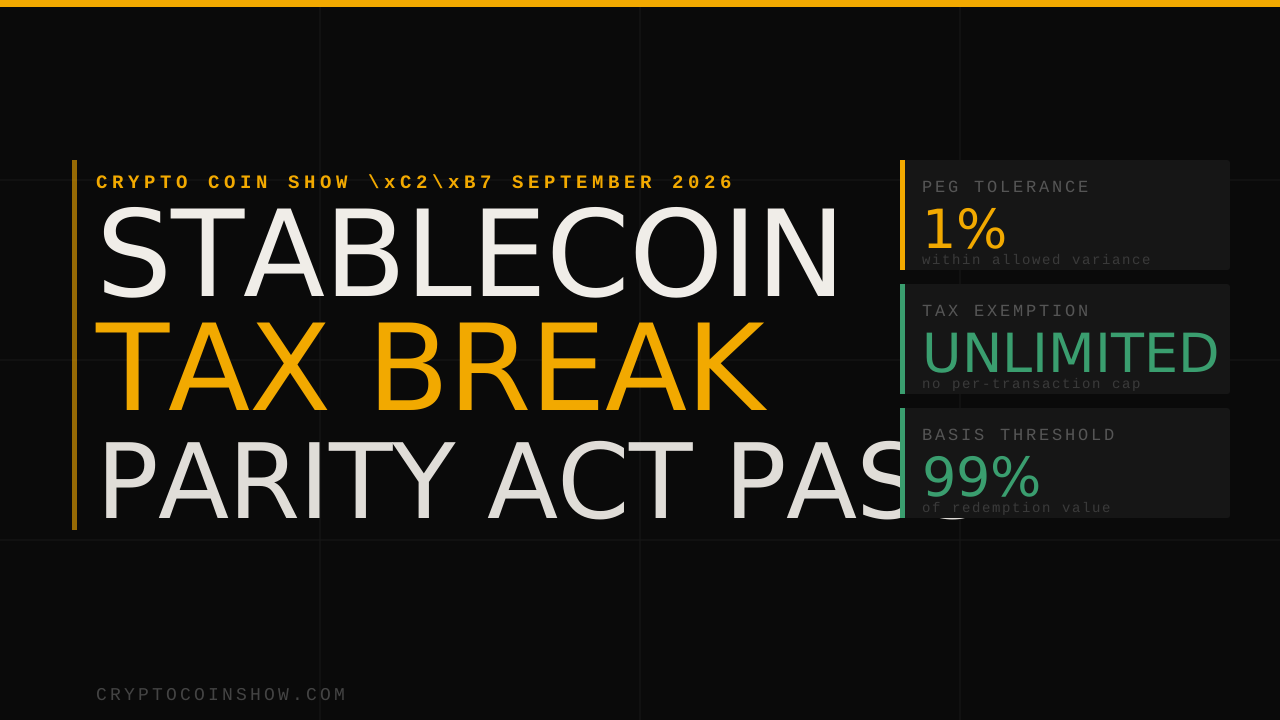
The latest version of the PARITY Act would stop gain or loss recognition on certain stablecoin sales unless a taxpayer’s basis falls below 99% of the token’s redemption value, marking a direct attempt to treat routine stablecoin spending more like cash payments. The proposal also revises rules on staking rewards and digital asset wash sales, while lawmakers in Washington continue to debate broader crypto legislation.
Stablecoin payments provision removes small transaction tax burden
The bill is grounded on the past discussion drafts issued in December 2025 and on March 26, 2026. The earlier proposal recommended a $200 limit on payments made with regulated payment stablecoins, as in the de minimis section.
That structure was altered in the March 2026 draft. Instead of using a de minimis criterion, the text states that no gain or loss would be recognized on the sale of a regulated payment stablecoin unless the taxpayer’s basis in that stablecoin is less than 99% of its redemption value.
Another standard eliminated by the draft was the previous $200 standard. In addition, it created a deemed basis of $1 for exchanges, which the text treats separately from the stablecoin’s sales. That development solves one of the long-term problems of crypto users. The current tax treatment states that any payment made using USDC or USDT can result in a taxable event, even when the change in value is minimal.
Meanwhile, the bill creates a distinction between passive staking and other activities, such as trading. It would also enable taxpayers to decide when to record staking rewards, upon receipt or after a deferral period of not more than 5 years, as indicated in the material. To qualify under the proposed stablecoin treatment, the asset must be regulated under the GENIUS Act and remain within 1% of its $1 peg.
Stablecoin debate comes alongside ongoing crypto policy pressure
The tax proposal comes following pressure on other digital asset legislation, including the CLARITY Act. Senator Cynthia Lummis recently pointed out that the bill could remain stalled until 2030 if the Senate fails to act before the 2026 election cycle.
At the same time, as reported by Cryptopolitan, the Trump White House has pushed back on concerns over stablecoin yield provisions. A Council of Economic Advisors report dated April 8 said the effect on bank lending would be limited, estimating a 0.02% increase, or about $2.1 billion.
The same report said community banks would face about $500 million in additional obligations, equal to a 0.026% increase over current lending activity. It concluded that banning yield would provide little protection for bank lending while giving up consumer benefits tied to competitive returns on stablecoin holdings.
Your bank is using your money. You’re getting the scraps. Watch our free video on becoming your own bank
The stablecoin ecosystem is experiencing a fundamental divergence. While major private issuers like Tether and Circle pursue aggressive expansion strategies through partnerships and technical upgrades, regulatory authorities including the Financial Stability Board and European Central Bank are raising structural concerns about the role of privately-controlled stablecoins in global financial systems. This tension between innovation momentum and regulatory caution is reshaping how digital dollar infrastructure develops globally.
Private Issuers Accelerate Market Expansion
Tether, which operates the world’s largest stablecoin by market capitalization, announced a significant governance milestone this week. The company has secured a major accounting firm to conduct its first comprehensive independent financial statement audit—a step long requested by regulators and market observers. The audit will examine Tether’s reserve holdings, which span digital assets, traditional securities, and the tokenized liabilities underpinning USDT’s $184 billion market cap.
Tether’s newly appointed Chief Financial Officer Simon McWilliams, who joined the organization in early 2025 specifically to oversee this audit process, confirmed the accounting firm was selected through competitive bidding. The firm already operates under the accounting standards required of the “Big Four” professional services networks, positioning it to conduct enterprise-grade financial review of Tether’s complex asset portfolio.
The selection of an audit firm represents a material shift in Tether’s transparency commitments, though questions about the timing and scope of such audits have persisted throughout the company’s operational history.
— Industry Analysts
The announcement comes as Tether has been actively restructuring its reserve composition. The company has been consolidating listed securities and digital assets into proprietary holding companies to ensure sufficient capital availability to maintain USDT’s price stability during market fluctuations. With more than 550 million users, Tether’s operational decisions carry outsized weight across cryptocurrency markets and broader decentralized finance applications.
Tether’s market dominance reflects the broader stablecoin industry’s explosive growth trajectory. The global stablecoin market reached approximately $165 billion in total value locked by early 2025, representing a compound annual growth rate exceeding 45 percent since 2021. This expansion has fundamentally transformed cryptocurrency market infrastructure, with stablecoins now functioning as the primary medium of exchange across decentralized finance platforms, international remittance corridors, and peer-to-peer payment networks. Institutional adoption has accelerated particularly in Asia-Pacific markets, where regulatory frameworks have permitted more rapid integration of stablecoin rails into traditional payment systems.
Circle, the second major private stablecoin issuer, is pursuing geographic expansion rather than technical restructuring. The company formalized a partnership with Sasai Fintech—a subsidiary of Cassava Technologies—to integrate its USDC stablecoin into African digital economies. The initiative targets mobile-first financial participation and aims to reduce transaction costs and friction in cross-border payments across the continent.
Africa represents a significant opportunity for on-chain infrastructure to deliver always-on global connectivity, expanding access to stable digital currency rails that operate independently of traditional banking constraints.
— Jeremy Allaire, Chief Executive Officer, Circle
Circle’s Africa strategy reflects a broader recognition that stablecoins address genuine infrastructure gaps in emerging markets where traditional banking coverage remains incomplete and cross-border transaction costs remain elevated. The initiative underscores an critical market reality: stablecoins are not merely speculative instruments but functional infrastructure addressing real payment friction in underbanked regions. Cross-border remittances through traditional channels cost recipients an average of 6-8 percent in fees, whereas stablecoin-based transfers can reduce friction costs to less than 1 percent. This efficiency differential has generated substantial adoption momentum in Southeast Asia, Latin America, and Sub-Saharan Africa, where remittance volumes exceed $700 billion annually.
Regulators Signal Structural Concerns
The regulatory response to private stablecoin expansion has intensified considerably. The Financial Stability Board, which coordinates financial regulation across the Group of Twenty nations, released its 2025 Annual Report with explicit warnings about cryptocurrency market volatility and the risks posed by inconsistent global regulatory standards for stablecoins.
Key Development
The FSB has established a Nonbank Data Task Force to monitor vulnerabilities within nonbank financial intermediation—a category that increasingly encompasses major stablecoin operations. The board argues that without coordinated regulatory implementation of 2023 global cryptocurrency guidance, systemic financial stability could be threatened.
The FSB’s report specifically calls on all member nations to implement the international cryptocurrency rulebook established in 2023, citing concerns that fragmented regulatory approaches could create arbitrage opportunities and concentrations of risk. The board’s next phase of review will examine why implementation of broader Group of Twenty financial reforms has slowed and identify mechanisms to accelerate adoption. Regulatory coordination challenges have proven substantial: the United States maintains one framework through the Banking Comptroller’s Office, the European Union operates under Markets in Crypto-Assets Regulation (MiCA), Singapore applies its Payment Services Act, and numerous other jurisdictions continue developing independent standards. This fragmentation has created operational complexity for stablecoin issuers and raised systemic concerns about regulatory arbitrage—the potential for stablecoin providers to concentrate reserves in the most permissive jurisdictions.
The European Central Bank has articulated perhaps the most direct challenge to private stablecoin models. The ECB argues that fiat-backed private stablecoins—regardless of the quality of their reserve backing—are inherently unreliable during periods of market stress. Under market pressure, even theoretically backed stablecoins frequently trade below their stated one-to-one value, indicating that backing claims alone cannot guarantee price stability. The ECB’s position reflects concerns grounded in recent market episodes: during periods of broader cryptocurrency volatility, even major stablecoins have experienced temporary depegging events where market prices diverged materially from stated reserve backing.
Central Bank Digital Infrastructure as Alternative
Rather than regulating private stablecoins more permissively, the ECB is advancing its own digital infrastructure initiatives. The bank has announced plans for two major projects: Appia and Pontes. Pontes, scheduled to launch in the third quarter of 2026, will function as a bridge connecting existing distributed ledger technology platforms with the Eurosystem’s TARGET settlement services—the primary payment system used by eurozone central banks and financial institutions.
Technical Note
The Pontes bridge infrastructure would enable settlement of tokenized asset transactions using Eurosystem account balances, effectively creating a central-bank-backed digital settlement layer that competes directly with private stablecoin infrastructure for transaction settlement in the eurozone.
This development represents a fundamental regulatory philosophy: rather than accepting private stablecoins as the architecture for digital commerce, authorities prefer to build central-bank-controlled alternatives that eliminate counterparty risk and ensure regulatory visibility into all transactions settled on the system. The ECB’s approach aligns with broader central bank digital currency initiatives globally, which prioritize control and oversight over the efficiency gains and decentralized attributes that distributed ledger technology potentially enables. The Bank for International Settlements estimates that approximately 130 central banks are actively developing digital currency initiatives, representing approximately 98 percent of global GDP—a clear signal that official digital currency development represents a strategic priority for monetary authorities worldwide.
Market Implications and Industry Trajectory
The parallel expansion of private stablecoins and central bank digital infrastructure suggests fundamental questions about the future architecture of global payment systems. Industry analysts project that by 2030, stablecoin transaction volumes could exceed $2 trillion annually if regulatory constraints remain moderate, or could stagnate below $500 billion if authorities implement stringent restrictions favoring official digital currencies. This wide projection range underscores the material impact that regulatory decisions will exert on market development.
For blockchain infrastructure providers, technology platforms, and cryptocurrency exchanges, regulatory clarity has emerged as a critical business factor. Platforms heavily dependent on stablecoin liquidity—including decentralized finance protocols that collectively manage approximately $50 billion in user deposits—face material business risks if stablecoin availability contracts materially. Conversely, the emergence of central-bank-backed settlement infrastructure could create new integration opportunities for technology platforms that can bridge private applications with official payment rails.
Unresolved Questions on Regulatory Direction
The parallel expansion of private stablecoins and central bank digital infrastructure suggests the market may ultimately support both models—serving different constituencies and use cases. However, regulatory actions suggest authorities intend to constrain the scope of private stablecoin activity rather than permit unchecked expansion.
Tether’s decision to pursue independent auditing may partially address transparency concerns that have dogged the company since its inception, though critics note that audits provide point-in-time snapshots rather than continuous monitoring. Circle’s partnership approach demonstrates that stablecoin adoption in underserved markets can provide real value—a reality that may push regulators toward managed coexistence rather than prohibition.
The fundamental tension remains unresolved: whether private stablecoins represent an efficient financial innovation that complements central banking systems or a systemic risk that requires constraints through either regulation or competitive displacement by official digital currencies. The Financial Stability Board and European Central Bank have clearly signaled their preference for the latter interpretation, but implementation of that preference across diverse regulatory jurisdictions will require sustained coordination among financial authorities globally. The regulatory outcomes over the next 18-24 months will likely determine whether stablecoin markets evolve toward fragmented regional ecosystems anchored to official digital currencies, or whether private stablecoins maintain sufficient autonomy to continue functioning as global payment infrastructure.
For investors and users of stablecoins, the implications are material. Regulatory pressure is likely to increase operational compliance costs for private issuers while accelerating development of central-bank alternatives. The next 18 months—particularly as ECB infrastructure launches and global regulatory standards are implemented—will likely clarify whether private stablecoins evolve into niche applications or become subject to more stringent constraints. Stakeholders should monitor regulatory implementation timelines closely, as divergence between major regulatory jurisdictions could create significant operational and commercial uncertainty.
A bipartisan coalition in Congress is moving forward with comprehensive cryptocurrency tax reform, with Representatives Max Miller and Steven Horsford drafting a framework that addresses stablecoins, staking income, and decades-old tax code misalignment. The initiative marks the first major legislative push from House Ways and Means Committee members to modernize how the federal government taxes digital assets, signaling genuine momentum toward clarifying tax obligations for crypto users and network participants.
A Rare Bipartisan Push on Crypto Taxation
Miller, an Ohio Republican, and Horsford, a Nevada Democrat, distributed their draft proposal on Saturday, attracting immediate interest from the cryptocurrency industry and tax policy advocates. Their positions on the House Ways and Means Committee—the primary chamber authority over federal tax law—give their effort substantial weight in shaping potential legislative outcomes.
The collaboration itself reflects a notable shift in congressional dynamics around digital assets. Rather than the partisan gridlock that has characterized many crypto debates, this effort demonstrates recognition among lawmakers from both parties that tax code clarity benefits legitimate market participants and government revenue collection alike.
America’s tax code has failed to keep pace with modern financial technology. This bipartisan legislation brings clarity, parity, fairness, and common sense to the taxation of digital assets.
— Representative Max Miller, U.S. House of Representatives
The framers have characterized their draft as an opening statement rather than a final proposal. Horsford’s office emphasized that the measure is intended to launch broader committee discussion, suggesting the authors anticipate refinement and input before any formal introduction.
Industry Context and Market Implications
The cryptocurrency market has expanded substantially over the past decade, with total market capitalization reaching hundreds of billions of dollars and institutional adoption accelerating across traditional finance. Yet the underlying tax infrastructure has remained fragmented, with the Internal Revenue Service issuing sparse guidance and interpretations often contradicting practical market usage patterns.
The current ambiguity creates significant compliance burdens for market participants. Cryptocurrency exchanges and custodians struggle with reporting obligations, staking platform operators face uncertainty about withholding requirements, and individual users confront conflicting guidance about transaction documentation and income recognition. This regulatory fog suppresses institutional adoption and discourages retail participation among tax-conscious investors.
Market analysts estimate that tax clarity alone could increase institutional cryptocurrency holdings by 15-25 percent, as pension funds, endowments, and corporate treasuries currently avoid digital assets partly due to accounting and tax compliance uncertainty. A comprehensive legislative framework would likely accelerate this institutional influx while simultaneously increasing tax revenue through clearer compliance pathways and reduced avoidance incentives.
Stablecoins as the Strategic Entry Point
The proposal strategically focuses first on stablecoins—the dollar-pegged tokens that have already attracted congressional regulatory attention. This choice reflects pragmatic legislating; regulators and lawmakers have already established certain guardrails for these assets, creating a foundation for tax treatment specificity.
Key Proposal Element
Transactions using regulated, dollar-pegged stablecoins below $200 would be exempt from capital gains taxation under the draft framework—a de minimis threshold approach common in tax policy.
The exemption structure matters significantly. It applies only to small-value transactions with compliant stablecoins and does not extend to other cryptocurrency types or larger transactions. This narrow scope signals the authors’ intent to provide relief for everyday payments while maintaining tax obligations for speculative activity and trading.
Notably, the framework does not treat stablecoins as de facto legal tender. Rather, it recognizes their practical role in commerce while preserving the government’s ability to tax meaningful economic activity involving digital assets generally.
This approach addresses a critical pain point for payment adoption. Stablecoins like USDC and Tether have become functional payment rails in emerging markets and remittance corridors, yet trivial transactions—a $15 coffee purchase—technically trigger capital gains tracking obligations under current law. The de minimis exemption removes this friction while maintaining compliance requirements for material transactions.
Entity Background and Legislative Authority
Representatives Miller and Horsford bring distinct but complementary perspectives to this collaboration. Miller, a second-term Ohio Republican, has emerged as a prominent crypto-sympathetic voice within House Republican leadership, viewing digital assets as an innovation imperative for American competitiveness. Horsford, a multi-term Nevada Democrat, represents a state with significant cryptocurrency infrastructure and has advocated for regulatory clarity as a prerequisite for responsible industry development.
The House Ways and Means Committee holds exclusive constitutional authority to originate revenue legislation, making its members the ultimate gatekeepers for any federal tax reform. This committee has historically moved slowly on emerging technology, but recent appointments and changing membership demographics have shifted institutional openness toward digital asset taxation discussion.
Miller and Horsford’s draft builds on prior legislative efforts, including failed attempts to clarify mining and staking taxation through narrower amendments. Their comprehensive approach signals a strategic shift toward bundling multiple tax issues into a single reconciliation package, increasing likelihood of passage by addressing constituencies across the political spectrum.
The Staking and Mining Income Debate
Beyond stablecoins, the draft tackles one of crypto taxation’s most contentious questions: how to treat staking and mining rewards. Current IRS guidance taxes these rewards as ordinary income upon receipt, regardless of whether the validator or miner has sold the asset or realized any economic gain.
House Republicans, including Miller, contend this approach creates perverse outcomes. A validator earning $10,000 in staking rewards faces immediate tax liability on that full amount, even if the underlying asset declines in value before sale. This treatment of unrealized gains as taxable income conflicts with how most asset classes are taxed and discourages network participation.
The Core Dispute
The central disagreement centers on whether staking and mining rewards should be taxed as income upon receipt or only when sold. Current rules tax immediately; critics argue this taxes unrealized gains.
Progressive Democrats, however, frame rewards differently. They argue that staking and mining represent compensation for active work—validators are performing computational services to secure networks—and thus should be taxed as earned income immediately, much like wages or professional fees. This interpretation emphasizes the economic function of the reward rather than the asset’s price volatility.
The draft does not yet reveal how Miller and Horsford intend to resolve this tension, suggesting negotiation on this point will be central to legislative development. Economic modeling by various research organizations suggests that deferring taxation until asset sale would increase staking participation by approximately 40 percent, though it would temporarily reduce annual tax revenue before subsequent sales generate capital gains recognition.
Legislative Status and Path Forward
The current draft remains preliminary. It combines legislative language with policy statements but has not been formally introduced as a bill, allowing flexibility for refinement based on committee feedback and stakeholder input.
The timing reflects broader congressional urgency around crypto regulation and taxation. As digital asset adoption grows and institutional participation increases, the tax code’s ambiguities create compliance uncertainty for exchanges, funds, and individual taxpayers. Clear rules benefit market maturity and government revenue projection.
Industry observers will watch whether the Ways and Means Committee embraces this bipartisan framework as a foundation for hearings and markup sessions. The willingness of senior committee members from both parties to co-author a proposal suggests receptiveness to substantive engagement on the topic.
The proposal also signals that meaningful crypto tax legislation may not require complete ideological alignment on cryptocurrency itself. Lawmakers with differing views on whether digital assets represent legitimate financial innovation can nonetheless agree on practical tax code modernization that addresses concrete problems like small-transaction friction and income recognition clarity.
Broader Regulatory Ecosystem
Tax legislation cannot exist in isolation from the broader regulatory environment. The SEC’s ongoing enforcement actions against unregistered exchanges, the CFTC’s derivatives oversight authority, and the Treasury’s anti-money-laundering requirements all intersect with tax administration. A comprehensive tax framework must coordinate with these parallel regulatory regimes to avoid conflicting compliance obligations.
International considerations also matter. The OECD’s cryptocurrency reporting standards and various national tax authorities’ approaches to digital assets create pressure on Congress to establish American positions that protect both tax revenue and international competitiveness. Unilateral American taxation that exceeds global norms could disadvantage domestic platforms and push activity offshore.
What’s Next
The cryptocurrency industry and tax policy community will likely respond with detailed analyses and position statements. Exchanges, staking platforms, and wallet providers have direct interests in how the final framework treats transaction reporting, reward recognition, and compliance obligations.
Congressional staff on the Ways and Means Committee will presumably develop this draft further, potentially circulating revised versions among interested parties. The path from draft to formal bill introduction typically involves substantial behind-the-scenes negotiation over technical language and economic impact modeling.
For investors and digital asset users, this development warrants close attention. Tax treatment directly affects after-return economics and compliance costs, making legislative clarity a material factor in market participation and asset allocation decisions. A finalized framework could emerge within 12-18 months, representing a watershed moment for cryptocurrency’s integration into American financial infrastructure.
Get weekly blockchain insights via the CCS Insider newsletter.
Canada’s central bank is drawing a clear line in the sand on stablecoins, signaling that only the highest-quality digital tokens backed by robust reserves will receive regulatory approval when new rules take effect in 2026. The Bank of Canada’s explicit stance reflects a measured approach to cryptocurrency regulation, one that prioritizes financial stability and consumer protection over rapid innovation.
Setting the Standard for Digital Money
Bank of Canada Governor Tiff Macklem laid out the framework during remarks at the Montreal Chamber of Commerce this week. Stablecoins, he emphasized, must function as genuine money—not speculative investment vehicles. They must be safe, reliable, and worthy of public trust at all times.
The central bank’s core requirement centers on redemption certainty. Users must have absolute confidence they can exchange their stablecoins for full face value, regardless of market conditions or periods of financial stress. This principle echoes the stability expectations placed on traditional bank deposits and physical currency.
Digital money should meet the same standards as cash and bank deposits, and technology is only welcome if it enhances financial stability and public trust.
— Tiff Macklem, Governor, Bank of Canada
Macklem stressed that technology itself is not the goal. Rather, innovation must demonstrably strengthen the financial system and bolster public confidence in digital payments. This measured philosophy contrasts sharply with jurisdictions that rushed to embrace cryptocurrencies with minimal oversight.
The One-to-One Peg Model
Under the Bank of Canada’s framework, approved stablecoins would operate on a one-to-one peg structure tied directly to the Canadian dollar. A digital token issued by a bank would always equal exactly $1 CAD, with that value backed by liquid, readily convertible assets.
Reserve Requirements
Stablecoin issuers will be required to maintain 100% reserves in liquid assets, with transparent redemption conditions and robust risk management frameworks capable of preventing sudden failures or bank-run scenarios.
Government bonds and Treasury bills would likely satisfy the collateral standards, while riskier investments fall outside acceptable bounds. This approach mirrors historical approaches to currency backing, ensuring every digital unit has tangible, recoverable value behind it.
The framework addresses lessons learned from past cryptocurrency failures. When platforms like FTX and Terra collapsed, users discovered that claimed reserves either never existed or were invested in speculative assets. Canada’s approach eliminates those vulnerabilities through strict asset verification and mandatory transparency.
Regulatory Requirements and Consumer Safeguards
Canada’s 2025 federal budget, released in November, codified these principles into formal policy. The requirements extend well beyond reserve ratios. Issuers must establish comprehensive risk management systems designed to withstand operational shocks and prevent cascading failures.
Data protection stands as a cornerstone of the regulatory design. The draft rules mandate strong cybersecurity measures, operational resilience protocols, and rigorous safeguards for personal and financial information. Canadian regulators are explicitly building consumer protection into the architecture rather than treating it as an afterthought.
100% reserve requirements in liquid assets
Transparent redemption conditions and timelines
Robust risk management frameworks
Strong cybersecurity and operational resilience standards
Comprehensive data privacy protections
Regular regulatory oversight and reporting
These standards reflect a deliberate choice to learn from international experience. Other jurisdictions have endured investor losses, platform collapses, and erosion of public trust in digital finance. Canada’s regulators are determined not to repeat those mistakes.
Broader Financial Modernization
The stablecoin framework does not exist in isolation. It forms part of a comprehensive effort to modernize Canada’s financial infrastructure for a population exceeding 40 million people. The government and central bank envision digital payments that are faster, cheaper, and more secure than current systems.
Governor Macklem characterized the reforms as leveling the playing field—ensuring Canadians can access legitimate innovation while maintaining the trust essential to a functioning financial system. The approach recognizes that cryptocurrency markets and digital assets will continue evolving, making thoughtful regulation preferable to prohibition.
The changes could reshape the digital finance landscape in the country. Proposed rules could fundamentally change how Canadians use money and the internet in the long run.
— Lucas Matheson, CEO, Coinbase Canada
Industry observers note the potential significance of this framework. If successful, Canada’s regulatory model could influence how other developed nations approach stablecoin oversight. The balance between enabling innovation and protecting financial stability remains challenging, but the Canadian approach emphasizes the latter without entirely foreclosing the former.
Market Implications and Industry Context
Canada’s stablecoin framework arrives at a pivotal moment in global cryptocurrency markets. As institutional adoption of digital assets accelerates and central banks worldwide explore digital currencies, regulatory clarity has become essential. The Canadian market represents approximately $2 trillion in total financial assets, making regulatory decisions here consequential for fintech operators and institutional investors.
Unlike El Salvador’s adoption of Bitcoin as legal tender or El Salvador’s unregulated approach, Canada has chosen a middle path: permitting stablecoins only when they meet institutional-grade safeguards. This positioning appeals to established financial institutions and conservative investors while explicitly excluding the speculative tokens that have dominated cryptocurrency markets.
Major Canadian banks have signaled interest in digital asset infrastructure, creating natural demand for compliant stablecoin rails. Toronto-Dominion, Royal Bank of Canada, and other major institutions have invested in blockchain capabilities and digital asset trading platforms. A clear regulatory framework removes uncertainty that previously limited their expansion into stablecoin issuance and custody services.
The international payment system stands to benefit from Canadian stablecoin standardization. Cross-border transactions between Canada and the United States, which total over $600 billion annually, could become faster and cheaper through stablecoin settlement layers. Regulated Canadian stablecoins could facilitate commerce across North America more efficiently than traditional correspondent banking networks.
For the broader fintech ecosystem, Canada’s framework signals that innovation and regulation are compatible when both parties engage in good faith. Fintech companies operating in Canada will have incentive to meet these standards, potentially positioning the country as a preferred jurisdiction for responsible digital finance firms seeking regulatory legitimacy.
What This Means for Users and Operators
For Canadian consumers, the framework promises access to faster digital payments without the risks that plagued cryptocurrency users in other markets. Bitcoin and other unpegged cryptocurrencies will continue operating independently, but stablecoins will function under strict guardrails.
For potential stablecoin issuers—whether banks or fintech firms—the requirements are stringent. However, they are also clearly defined. Operators know exactly what regulators expect: full reserves, transparent redemption mechanisms, and fortress-level operational security. Uncertainty has been replaced with explicit standards.
The implementation timeline extends to 2026, giving the industry time to prepare infrastructure and seek approvals. This phased approach allows regulators and operators to work through practical details without rushing implementation.
Key Timeline
New stablecoin rules are expected to take effect in 2026, providing a transition period for regulators to finalize details and for potential issuers to align their systems with Bank of Canada requirements.
Global Regulatory Implications
Canada’s position matters beyond its borders. As a developed economy with a sophisticated financial system, its regulatory choices often influence emerging market regulators and international standard-setting bodies. A stablecoin framework that successfully marries innovation with stability could serve as a template elsewhere.
The Financial Stability Board, which coordinates regulatory policy across major economies, has emphasized the importance of stablecoin regulation globally. Canada’s approach aligns with broader international consensus that unregulated stablecoins pose systemic risks. By implementing comprehensive guardrails, Canada demonstrates how regulation can coexist with blockchain innovation.
European regulators implementing the Markets in Crypto-Assets Regulation (MiCA) and jurisdictions across Asia and Latin America developing their own frameworks will likely examine Canada’s model. The combination of redemption guarantees, reserve requirements, and operational standards provides a replicable blueprint for other central banks.
The Bank of Canada has made its position unmistakable: stablecoins will be permitted, but only those meeting exacting standards for quality, safety, and reserve backing. This is regulation designed to protect the public while enabling beneficial technological advancement—a careful calibration that reflects lessons learned from the cryptocurrency sector’s early years. By combining clear rules with implementation flexibility, Canada’s approach creates space for legitimate innovation while maintaining the financial stability that forms the foundation of economic prosperity.
Get weekly blockchain insights via the CCS Insider newsletter.