President Donald Trump issued another warning to Iran on Sunday, telling the country it needs to act quickly or face serious trouble.
“For Iran, the Clock is Ticking, and they better get moving, FAST, or there won’t be anything left of them,” Trump wrote on Truth Social. “TIME IS OF THE ESSENCE!”
The two countries have been struggling to reach an agreement since they stopped fighting in early April.
Such a warning has been given before as well when Trump threatened a “whole civilization will die tonight, never to be brought back again”. The warning was aimed at civilian targets like power plants and bridges going against the international war laws.
This time, Trump didn’t say exactly what would happen or what Iran needs to do to avoid these consequences.
The blocked strait has caused big problems for the world economy. Oil prices have jumped up everywhere, and Americans are paying more at gas stations. On Sunday, the average gas price across the country was $4.51 per gallon, according to AAA.
America wants Iran to stop its nuclear weapons work and open the Strait back up. Iran wants money to fix war damage, an end to the port blockade, and all fighting to stop, including battles in Lebanon.
Iran has found a new way to put pressure on the world
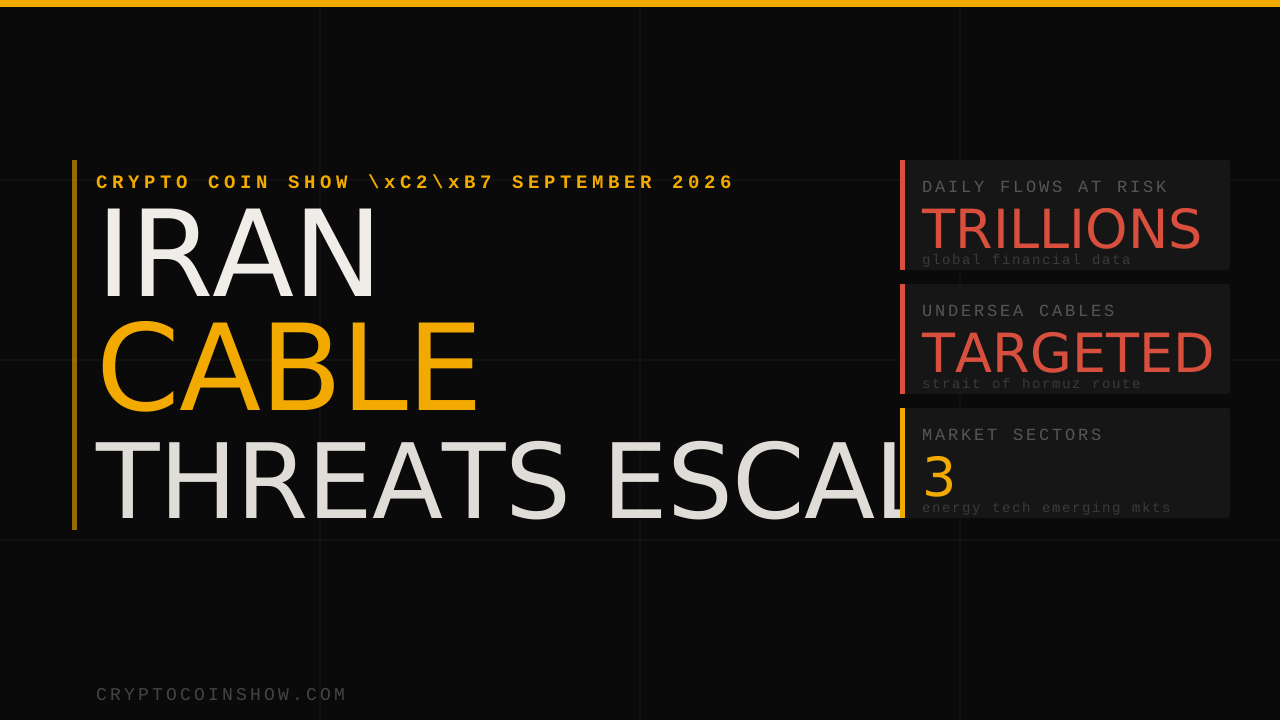
The country is looking at the underwater cables that run beneath the Strait of Hormuz. These cables carry internet data and financial information between Europe, Asia, and countries around the Persian Gulf.
Iran wants big technology companies to pay for using these cables. Some government-connected media in Iran have hinted that the cables could be damaged if companies refuse to pay. Iranian lawmakers talked about this plan last week. It would affect cables connecting Arab nations to Europe and Asia.
“We will impose fees on internet cables,” said Ebrahim Zolfaghari, a spokesperson for Iran’s military, in a post on X last week.
Media connected to Iran’s Revolutionary Guards said the plan would make companies like Google, Microsoft, Meta, and Amazon follow Iranian rules. Cable companies would have to pay fees to use the route, and only Iranian companies could fix or maintain the cables.
Some of these technology companies have put money into cables that go through the Strait of Hormuz and Persian Gulf areas. It’s not clear if these cables actually pass through waters that Iran controls.
There’s also a question of how Iran could make these companies pay. American sanctions don’t allow payments to Iran, so the tech companies might think Iran is just making empty threats.
Still, Iranian media have warned that damage to the cables could hurt trillions of dollars worth of global data and mess up internet connections worldwide.
The strait connects Asian technology centers like Singapore to cable stations in Europe. Problems there could slow down financial trading between Europe and Asia. Parts of East Africa might lose internet completely.
Trump says Xi agrees on opening strait, but China won’t confirm
Trump said Chinese President Xi Jinping agreed that Iran must open the Strait of Hormuz, though China didn’t confirm this.
Xi didn’t talk publicly about his Iran discussions with Trump. China’s foreign ministry called the war a conflict “which should never have happened, has no reason to continue.”
Ebrahim Azizi, who leads Iran’s parliament security committee, said Saturday that Iran has prepared a system to manage ship traffic through the strait on a specific route that will be announced soon.
Azizi said only business ships and those cooperating with Iran would benefit, and fees would be charged for special services.
Bitcoin, Ripple’s token, Solana’s SOL, and several other altcoins made impressive moves over the past few hours, which was rather unexpected given the Sunday market sentiment and lack of major developments.
Interestingly, these recent gains coincided with Donald Trump’s latest message on Iran.
The statement on Truth Social from the POTUS reads that Iran has been “playing games with the United States, and the rest of the World, for 47 years.” He also placed significant blame on former President Barack Obama, saying the situation hit “pay dirt” during his time in office.
“He was not only good to them, he was great, actually going to their side, jettisoning Israel, and all other Allies, and giving Iran a major and very powerful new lease on life. Hundreds of Billions of Dollars, and 1.7 Billion Dollars in green cash, flown into Tehran, was handed to them on a silver platter. Every Bank in D.C., Virginia, and Maryland was emptied out — It was so much money that when it arrived, the Iranian Thugs had no idea what to do with it. They had never seen money like this, and never will again. It was taken off the plane in suitcases and satchels, and the Iranians couldn’t believe their luck.”
After also blaming Joe Biden, Trump said Iran will be laughing no longer at the USA. This statement comes after reports that Iran had sent their response to the US’s latest peace proposal. However, there’s no further information as of press time regarding the actual decision.
As mentioned above, many crypto assets are in the green now. Bitcoin’s gains are among the most modest, but the asset still tapped $81,600. XRP has stolen the show from the larger-cap alts, surging by over 5% daily to a multi-week peak of just over $1.50.
SOL has risen to almost $100 after a 3.5% daily increase, ETH is well above $2,350, and ADA has gained over 5% to sit close to $0.29.
Admiral Samuel Paparo, Jr., who leads U.S. forces across the Indo-Pacific, told a Senate panel that Bitcoin matters to national security.
“Bitcoin is a reality,” he said. “It is a valuable computer science tool as a power projection. And outside of the economic formulation of it, it has got really important computer science applications for cybersecurity.”
The next day, at a House hearing, Paparo confirmed that the Pentagon is running its own Bitcoin node and carrying out “a number of operational tests to secure and protect networks using the Bitcoin protocol.” It was the first time the military had publicly said so.
The admission did not come in a vacuum. Iran is now taking Bitcoin as payment for ships passing through the Strait of Hormuz. Taiwan is weighing it as a reserve asset in case China moves against its finances.
Russia said last week it will accept Bitcoin for international trade starting in July. What was once a fringe digital currency is increasingly being treated as a tool of statecraft.
China stockpiles Bitcoin while banning it at home
China’s position is the most complicated. Beijing banned Bitcoin and all crypto activity in 2021, citing environmental damage, fraud risks, and illegal money flows. Yet China already holds the second-largest government Bitcoin stockpile in the world.
In May 2025, the International Monetary Institute, China’s top financial think tank, translated and shared a report by former White House economist Matthew Ferranti arguing that Bitcoin could help central banks guard against inflation, sanctions, and financial crises. The institute passed it to Communist Party policymakers with a note saying Bitcoin’s rise as a reserve asset “deserves continued attention.”
The clearest sign of China’s real intentions is a legal fight with Washington. According to Cryptopolitan’s report, the U.S. Department of Justice seized 127,000 Bitcoin, worth roughly $15 billion, from Chen Zhi, a Chinese billionaire accused of running fraud operations across Southeast Asia that drained hundreds of American victims.
Before U.S. authorities could detain him, Chinese officials pulled Chen back to China in January, filing their own charges against the 38-year-old. China has no extradition deal with the United States.
Beijing then accused Washington of stealing the Bitcoin through a hack as far back as 2020, claiming U.S. agents broke into Chen’s mining operation, LuBian, and later dressed it up as a law enforcement seizure.
The stakes are straightforward: if China recovers Chen’s holdings, it would control roughly 321,000 Bitcoin, well ahead of the United States at 198,000.
America’s mining strength runs on Chinese hardware
Two Republicans are pushing to cut China’s advantage on the mining end.
In March, a bill, Mined in America, was introduced by Senators Bill Cassidy of Louisiana and Cynthia Lummis of Wyoming. It addresses the 97% of China’s hardware used in 38% of the US global Bitcoin mining activity. About 82% of the global production that specialized chip miners depend on is controlled by Bitmain. Dennis Porter of the Satoshi Action Fund called this “a liability”.
The bill bans certified miners from buying any new China-made hardware from next year. By 2030, the miners are required to fully transition from the existing hardware.
The bill would create a voluntary certification program through the Department of Commerce. Certified miners can no longer buy new Chinese hardware after January 1, 2027, and would need to completely stop the use of any such hardware by 2030.
It also locks in President Trump’s March 2025 executive order creating a Strategic Bitcoin Reserve and lets certified miners sell freshly mined Bitcoin to the Treasury at a tax advantage. “Digital asset mining is a big part of our economy. We should be doing it here in America,” said Senator Cassidy.
In China, the crypto rules have become stricter. Now it’s illegal to even promote crypto online on any platform. The rule will take effect on September 30th.
Congressman William Timmons put the broader contest simply: “If you can’t control your citizenry as it relates to information and money, what do you have left?” The country banning Bitcoin for its people is racing to stockpile it for itself.
Don’t just read crypto news. Understand it. Subscribe to our newsletter. It’s free.
Bitcoin (BTC) dropped below $75,000 on April 19 as the Strait of Hormuz shut down entirely and Iran rejected a second round of negotiations with the United States.
The developments mark a sharp escalation in the US-Iran standoff, with zero oil tankers passing through the strait and diplomatic channels appearing to collapse.
Strait of Hormuz Shuts Down as Diplomacy Stalls
No oil tankers passed through the Strait of Hormuz, effectively closing the waterway that handles roughly 20% of global seaborne oil trade.
“It appears that the Strait of Hormuz is now completely closed for the first time in history. The US “blockade” and Iran’s closure are in full force,” wrote The Kobeissi Letter.
Reportedly, thirteen tankers had already turned back mid-route the day before, freezing shipping flows through the critical chokepoint.
Iran’s state media confirmed that Tehran rejected participating in a second round of talks with Washington. Iranian officials cited what they called “deception” from President Trump, pointing to “inconsistency with what is actually happening” during negotiations.
President Trump accused Iran of firing on ships in the strait in violation of the ceasefire agreement. He threatened to “knock out every single Power Plant, and every single Bridge, in Iran” if Tehran refuses a deal.
General sentiment is that both countries are on the verge of a new round of escalation, with futures markets set to open within hours.
Bitcoin has faced sustained pressure from the US-Iran conflict since February 28. The pioneer crypto previously fell from above $100,000 when Iran first moved to close the strait earlier this year. Amid Sunday’s risk-off sentiment, the king of crypto fell below $75,000 for yet another time.
Bitcoin continued to hold near $68,000, a key long-term support level, this morning as traders waited for President Donald Trump’s latest deadline for Iran.
The tension built after Trump said on Truth Social that “a whole civilization will die tonight” as his 8 P.M. Eastern deadline for a deal with Iran approached.
The warning came alongside reports of strikes on Iranian oil infrastructure on Kharg Island, sharpening fears that the confrontation could move from deadline politics to a more disruptive energy shock.
These tensions have left the market suspended between a crypto structure that has so far resisted a deeper breakdown and a macro backdrop growing more difficult by the hour.
Throughout the trading day, Bitcoin has shown some optimism, with prices touching $69,000 before retreating to around $68,500 as traders struggle to decipher Trump’s latest threat that “a whole civilization will die tonight.”
Oil is the transmission engine
Oil has become the main channel through which the US-Iran confrontation is feeding into crypto markets.
Since the US-Iran conflict began, oil prices have soared above $100, thanks in large part to the closure of the Strait of Hormuz, a key oil shipping channel that typically carries about 20% of the world’s oil on a given day.
With Trump’s latest deadline approaching, US crude climbed above $116 a barrel, extending a rally that had already pushed prices toward multi-year highs.
The risks widened further after reports that Iran had threatened to close the Bab al-Mandeb Strait, a route that accounts for roughly 12% of global seaborne trade and has become even more important since the shutdown of Hormuz.
The Kobeissi Letter said that any disruption there could place another major shipping route under pressure and raise the prospect of oil reaching $150 a barrel.
That is where the market threat becomes more serious for Bitcoin.
Once crude moves into that range, the concern extends beyond war headlines or day-to-day swings in risk appetite. Sustained strength in energy prices can reinforce inflation fears, support the dollar, and reduce the room for central banks to ease policy.
Data from CryptoQuant showed the flagship digital asset’s recent rebound occurred while aggregate funding rates across exchanges remained negative.
Bitcoin Funding Rate (Source: CryptoQuant)
This suggests the move has not been driven by traders piling into leveraged bullish bets. Instead, short sellers are still paying to keep bearish positions open even as the price stabilizes and edges higher.
That is usually a healthier setup than a rally fueled by aggressive leverage.
When Bitcoin rises while funding stays negative, it suggests spot buyers are absorbing selling pressure rather than momentum traders chasing the market higher. A rebound built on leveraged longs can fade quickly when sentiment turns.
However, a rebound supported by real buying can keep moving even while the broader market remains skeptical.
Meanwhile, this leaves short sellers vulnerable. Bearish positions opened below current levels can become fuel for a sharper move higher if Bitcoin continues to recover and forced liquidations begin to build.
That dynamic helps explain why Bitcoin has not followed the geopolitical backdrop lower in a more decisive way. The market is still leaning bearish, but price action has not yet confirmed that view.
Still, that support has limits. If the recovery loses momentum before enough short positions are cleared out, the downside can reopen quickly because the market has less leveraged long support beneath it.
A narrow range is making the next move more fragile
At the same time, BTC is trading inside a structure that leaves little room for error.
Glassnode data showed the token in a tight negative gamma pocket between roughly $65,000 and $70,000, an area where dealer hedging can intensify short-term moves in either direction.
Bitcoin Market Positioning (Source: Glassnode)
According to the firm, resistance is building near $72,000, while support below current levels is thinner if momentum fades. The result is a market that can appear stable for stretches and then move abruptly once a catalyst arrives.
The trigger here is coming from Washington, not from within crypto. Traders are not positioning around an earnings release, a network upgrade, or ETF flows. Instead, they are positioning around a deadline that could move oil, shift inflation expectations, and reprice risk assets in the same session.
Markets are weighing another delay against a deeper shock
Part of the restraint in price action reflects pattern recognition.
QCP Capital said markets have spent weeks absorbing weekend escalation rhetoric followed by early-week de-escalation signals, leaving stocks broadly stable and crypto more resilient than the headlines alone would suggest.
The pattern has made traders less willing to fully price in each new threat. At the same time, it has not removed the risk. Each new strike, each new warning, and each new threat to energy infrastructure raises the cost of assuming that this episode will also end in another delay.
Trump has left room for the deadline to move again if talks make progress and something tangible emerges. At the same time, Iran appeared to have halted diplomatic discussions amid the latest threats. That has kept conviction low and volatility close to the surface.
For now, Bitcoin is holding its ground without escaping the pressure around it. Buyers have defended a major support area, and negative funding suggests bearish positioning has not produced the breakdown many expected.
But the market remains stuck in a tight range while oil surges and policy risk dominates trading. A softer turn from Washington could force short sellers to cover, lifting Bitcoin back toward $70,000 and then $72,000.
However, a deeper escalation would shift attention immediately back to inflation, financial conditions, and whether crypto can withstand a broader move out of risk.
Until then, Bitcoin remains tied to the next signal from the White House.
Iran Threatens U.S. Tech Giants as Middle East Conflict Escalates — Crypto Coin Show
Breaking News · Middle East · Geopolitics
Iran Threatens U.S. Tech Giants as Middle East Conflict Escalates
Oracle’s Dubai tower takes debris strike. Iran’s Revolutionary Guard names Nvidia, Apple, Microsoft and Google as targets. A missing U.S. airman, two downed aircraft and a 48-hour ultimatum from Trump.
AA
Ashton AddisonFounder & CEO · Crypto Coin Show · Since 2014
5 April 2026
Refinitiv TV · 600K+ Subscribers
Location
Dubai Internet City — Oracle Building
Threats Intercepted (UAE)
Dozens in 24 hours
U.S. Aircraft Lost
F-15E downed · A-10 crashed (Kuwait)
Trump Ultimatum
48 hours · Hormuz Strait
01 —
Oracle Building Hit as American Corporate Sites Enter the Blast Zone
Iran launched a broad wave of missile and drone attacks across the Middle East on Saturday, marking a significant shift in the conflict’s geography. The UAE said it intercepted dozens of incoming projectiles in the 24 hours prior — and debris from one intercept struck the facade of the Oracle building in Dubai Internet City.
The Dubai Media Office confirmed no injuries and described the incident as minor. Damage was limited. But the symbolic weight was not: American corporate infrastructure in the Gulf is no longer sitting outside the blast zone.
Iran’s Revolutionary Guard simultaneously issued direct threats against a wider group of U.S. technology companies operating across the region — naming Nvidia, Apple, Microsoft and Google by name.
⚠ Iran’s Revolutionary Guard has directly threatened U.S. tech infrastructure in the Middle East, including Nvidia, Apple, Microsoft and Google.
02 —
Missing Airman, Two Downed Aircraft and Trump’s 48-Hour Warning
The U.S. military continued searching Saturday for a missing airman after an F-15E was shot down over southwestern Iran on Friday — the first U.S. combat aircraft successfully downed by Iranian forces since the conflict began in late February. One crew member was rescued. The second remained missing, with both U.S. and Iranian forces searching the same area.
In a separate incident, an A-10 Warthog pilot ejected after the aircraft was struck by Iranian fire over Kuwait. Two Black Hawk helicopters deployed in the search operation also came under fire inside Iranian airspace, though both returned safely. U.S. officials privately expressed concern the missing airman could be captured and used as political leverage by Tehran.
“Time is running out — 48 hours before all Hell will reign down on them.“
Donald Trump · Truth Social · 5 April 2026
President Trump posted on Truth Social on Saturday referencing his earlier ultimatum over the Strait of Hormuz, warning Iran it had 48 hours before consequences. The threat followed his earlier demand that Iran open the strait or make a deal within ten days.
03 —
India Resumes Iranian Crude as Bushehr Plant Takes Strike
India’s oil ministry confirmed its refiners had secured crude supplies including Iranian oil, after disruptions to Strait of Hormuz shipping lines cut into global supply. India had not received Iranian crude since May 2019, when U.S. pressure pushed buyers away from Tehran’s exports. The ministry also confirmed that 44,000 metric tons of Iranian liquefied petroleum gas had berthed at Mangalore this week aboard a sanctioned vessel.
The move signals a realignment in energy trade. The United States had temporarily removed sanctions on Iranian oil and refined products to reduce supply shortages — a decision now being tested by the ongoing strikes.
Near Bushehr, a projectile struck close to Iran’s nuclear power plant overnight, killing at least one worker and damaging part of the site. The International Atomic Energy Agency confirmed radiation levels remained normal but issued a warning against further strikes near nuclear facilities. Iran’s Foreign Minister said Tehran was not ready to rush into negotiations and would accept only a “conclusive and lasting” resolution to the war.
Russian state nuclear company Rosatom evacuated an additional 198 staff from the Bushehr site. It has been withdrawing workers since the conflict began at the end of February.
This article is based on reporting from Reuters, official statements from the Dubai Media Office, India’s oil ministry, the International Atomic Energy Agency, and Truth Social. Crypto Coin Show has not independently verified all claims made by parties to the conflict.
What looks like a geopolitical threat aimed at US multinationals could quickly become a crypto story too.
That is because several of the companies threatened by Iran now sit inside the infrastructure, payments, and corporate treasury layers that parts of the digital-asset industry rely on.
According to the Wall Street Journal, the IRGC warned that US companies in the region would be targeted from April 1 and named firms including Microsoft, Google, Apple, Intel, IBM, Tesla, and Boeing. Other multinationals mentioned in the reports included JPMorgan Chase, Oracle, Palantir, Cisco, HP, and Nvidia.
Why this matters: Crypto is no longer exposed only through exchanges and token prices. It now depends on cloud platforms, banking rails, and public companies with Bitcoin exposure, which means geopolitical threats aimed at mainstream firms can spill into digital assets faster than many investors expect.
The group said those companies would be treated as “legitimate targets” in retaliation for US and Israeli strikes on Iran.
For crypto markets, the significance is not that these are digital-asset companies in the narrow sense. It is that several of the firms named by Iran sit inside the operating stack that now supports large parts of the industry, from cloud computing and data processing to tokenized payments, treasury management, and corporate Bitcoin exposure.
The threat also comes after the war had already begun to hit infrastructure across the Gulf. Last month, Amazon Web Services data centers in the United Arab Emirates and Bahrain were damaged by drone strikes, disrupting cloud services and prolonging recovery efforts.
Meanwhile, the broader conflict has already expanded well beyond a conventional military exchange. Over more than a month of fighting, the US and Israel have struck Iranian energy and other national infrastructure, while Iran has launched more than 3,000 drones and missiles toward the United Arab Emirates, Saudi Arabia, Bahrain, and Kuwait.
Against that backdrop, the IRGC’s threat points to a wider phase of economic and corporate pressure, one that could extend into parts of the infrastructure surrounding crypto.
Which crypto-related firms are affected?
Not all of the companies named by the IRGC are crypto-native businesses. Still, several already have direct or indirect ties to the industry, making them relevant to the market beyond the usual reaction of Bitcoin and other tokens to war headlines.
Google is the clearest example because it sits deep inside crypto’s operating stack, and its Web3 business is not a peripheral effort.
Google Cloud, a subsidiary of Google, offers managed node infrastructure, analytics tools, and developer services for blockchain applications, and works with firms such as Cardano-backed Midnight blockchain, Coinbase, and others.
In fact, the firm recently took a major step into blockchain infrastructure development with the launch of the Google Cloud Universal Ledger (GCUL). This is a Layer 1 blockchain network designed to enable faster payments and cross-border settlement.
Rather than acquiring mining companies outright, the Alphabet-owned company has provided at least $5 billion in disclosed credit support tied to a handful of miners’ AI projects.
That backing has helped reframe some previously unrated Bitcoin miners as infrastructure-linked borrowers that lenders can view less as pure commodity businesses and more as counterparties with strategic data-center potential.
All of this does not make Google a crypto company, but it does place the firm close to one of the industry’s most important restructurings.
JPMorgan’s link is different, but just as relevant.
For context, JP Morgan launched Kinexys in 2020 as a digital-asset service platform and has since processed more than $3 trillion of transactions.
The bank describes Kinexys as a blockchain-based payment rail that allows participating clients to move funds around the clock, including across borders, with availability spanning Europe, the Middle East, and Africa.
The bank reportedly plans to double daily transaction values on its Kinexys blockchain platform to $10 billion.
Apart from that, JPMorgan has also pushed further into on-chain finance through its asset-management arm.
Tesla is the most direct balance-sheet link among the companies named.
The Elon Musk-led company is not part of crypto’s infrastructure in the same way as Google or JPMorgan, but it remains one of the listed firms with measurable digital-asset exposure on its books.
According to data from BitcoinTreasuries.com, Tesla holds 11,509 Bitcoin as of press time, making it one of the top 20 public firms worldwide with BTC exposure. In fact, Tesla is the only top 10 company by market capitalization with exposure to the top crypto.
This stands it out in the broader market and confirms its conviction in the emerging industry.
Outside of Bitcoin, the company has also shown significant adoption for Dogecoin, the largest memecoin by market capitalization.
These efforts, alongside Musk’s enduring interest in the crypto industry, make it a significant player within the sector.
The core shift here is simple: crypto risk is no longer confined to crypto-native companies.
As the sector becomes more entangled with big tech, banks, and public-company treasuries, threats aimed at those firms can become market-relevant for digital assets even when no exchange or blockchain company is directly named.
Other firms with crypto links
Beyond those first-order examples, the IRGC list also includes companies with looser but still notable ties to digital assets.
NVIDIA is one of them. The company is now defined primarily by AI computing and data-center revenue, but it previously had a long and sometimes contentious history with crypto mining.
However, NVIDIA is no longer central to mining as it once was, but its historical connection to the sector remains part of the market’s memory, especially when crypto and AI capital spending begin to overlap.
The company’s crypto exposure has centered on enterprise blockchain through Azure rather than direct token holdings. It has accepted Bitcoin through BitPay in limited contexts, while also pursuing blockchain-as-a-service tools, decentralized identity work through ION, and research into secure computing systems relevant to digital infrastructure.
At the corporate treasury level, Microsoft has kept its distance. Its shareholders voted against adding Bitcoin to the balance sheet after the board recommended rejecting it. The board said such an assessment was unnecessary and preferred stable, low-risk investments over the volatility of crypto.
Taken together, the companies named by Iran show how far crypto’s exposure now extends beyond exchanges and token prices.
The industry’s links to cloud providers, global banks, AI infrastructure, and corporate treasuries mean geopolitical threats aimed at mainstream US firms can quickly become relevant to digital assets as well.
The next test is whether this threat remains rhetorical or starts to affect the companies and infrastructure layers that parts of crypto now depend on. If that happens, the market impact may show up first through cloud resilience, payments flows, and risk sentiment before it appears in token prices themselves.
Mohammad Bagher Ghalibaf, the speaker of Iran’s parliament, posted a striking piece of market commentary on X before the latest futures swing. Adding fuel to the online propaganda proxy war being fought on social media, the comments lean into accusations of insider trading on Polymarket war bets.
“Pre-market so-called ‘news’ or ‘Truth’ is often just a setup for profit-taking,” he wrote. “If they pump it, short it. If they dump it, go long.”
The market then traded almost exactly as described.
The Kobeissi Letter tracked the move in time order, with S&P 500 futures opening sharply lower on Sunday evening, recovering by late evening, then extending higher after President Trump said on Truth Social that “great progress” had been made on Iran peace talks.
Annotated 30-minute S&P 500 E-mini futures chart showing a sharp overnight rebound after headlines about Trump’s comments on Iran peace talks, with markers highlighting key time-stamped moves from the futures open to the morning recovery.
MarketWatch confirmed the validity of the account that had so publicly offered contrarian trading advice to U.S. investors shortly before the Sunday futures open, and Barron’s described Monday’s rebound as another early-morning market jolt driven by Trump’s social-media messaging on Iran.
Trump’s posts around Iran have repeatedly altered short-term pricing across equities, oil, and crypto.
Bloomberg reported that billions of dollars in oil and stock-index futures changed hands shortly before one of Trump’s Iran posts sent crude lower and equities higher, while The Wall Street Journal described a burst of futures activity ahead of another Trump message that drew scrutiny across trading desks.
The economic climate for the week ahead sits inside that backdrop.
The market faces a geopolitical risk premium in oil, a rising probability of slower growth, and a political communications channel that now functions as an immediate pricing input.
Monday’s cross-asset move makes the interaction plain.
S&P 500 futures added to gains after Trump said the U.S. was in “serious discussions” with a “new, and more reasonable regime” in Iran.
The same message cycle has also included a threat to “completely obliterate” Iran’s energy and water infrastructure if a settlement failed to materialize.
That combination, conciliatory language on one side and escalation risk on the other, shaped the session. The Wall Street Journal reported WTI above $100 a barrel and Brent above $108, while Brent then surged above $116 as the conflict intensified.
Investors are now dealing with diplomacy and disruption at the same time, and the energy channel remains the main route into inflation, rates, and growth.
Bitcoin enters this equation with one structural advantage over every major U.S. risk asset.
It trades through all of it, through weekends, through Asia hours, through the periods when Wall Street’s core cash market is closed.
Bitcoin tracked the same macro shock as equities, then formed its own pattern while Wall Street was offline
Bitcoin’s value in this sequence comes from timing.
It trades continuously, so it acts as a live macro market when U.S. equities are closed.
That gives it two roles at once.
It responds to the same geopolitical inputs that move the S&P 500, and it also offers a real-time view of how those inputs are being absorbed outside the U.S. cash session.
The pattern in the charts around this latest Iran-Trump sequence clearly carries that distinction.
Bitcoin sold off hard into the weekend and into the period around the U.S. close, then moved into a long stabilization band while U.S. equities sat offline.
Bitcoin price fell to the March 27 close, then spent much of the closeout period in a broad range around the mid- to upper $66,000s, before firming into the U.S. open on Monday.
The S&P’s intraday sequence was sharper and more discrete.
Bitcoin’s sequence was earlier, more continuous, and more gradual.
That broad structure lines up with broader market reporting from earlier in the month.
Bitcoin was the first liquid asset to price the Iran war when the initial attack cycle began on a Saturday, dropping 8.5% while traditional markets were closed.
In the days that followed, Bitcoin slid as far as $67,300 before turning higher after Trump said the U.S. had begun talks with Iran. Bitcoin then climbed back above $71,000 when war concerns eased.
Bitcoin also slid below $68,500 last week as another round of mixed messaging from Iran whipsawed markets. There’s a simple interpretation.
Bitcoin has been trading as a macro-sensitive asset throughout this conflict, with oil, rates, and political signals shaping direction.
The latest charts add a more refined point.
Three market charts showing Bitcoin, the U.S. Dollar Index, and the 10-year Treasury yield around the U.S. market open.
Bitcoin mirrored the S&P at the regime level, with both assets weakening under geopolitical stress and firming when Trump’s rhetoric shifted toward talks. Within that regime, the path diverged.
During the hours when the S&P cash market was closed, Bitcoin spent more time absorbing losses and building a base than extending a strong relief move.
The visible lift came closer to the U.S. open.
That timing suggests Bitcoin functioned as a pre-open sentiment gauge for the Monday rebound in equities, with the strongest upside leg appearing from around 00:01 UTC on Monday into the U.S. session.
The U.S. Dollar Index has also climbed steadily into Monday, which gives the move extra texture.
A firmer dollar usually tightens the backdrop for BTC and other risk assets.
Bitcoin’s ability to stabilize and then rise alongside a rising DXY points to a move driven by repricing around Iran and Trump’s messaging, supported by positioning and relief, with less help from the currency side of the macro equation.
Oil, payrolls, retail sales, and Bitcoin’s 24/7 signal define the week ahead
The macro calendar now arrives with crude oil at the center.
The Wall Street Journal said WTI had climbed roughly 50% since the U.S. and Israel began bombing Iran in late February.
Axios wrote that the OECD now sees U.S. inflation reaching 4.2% in 2026, up 1.2 percentage points from expectations in December, because the war and the energy shock have altered the inflation path.
That turns this week’s economic releases into a concentrated stress test.
The Bureau of Labor Statistics says the March Employment Situation arrives Friday, April 3, at 8:30 a.m. ET.
The Census Bureau says the delayed February advance retail sales release lands on April 1.
The Institute for Supply Management says the March Manufacturing PMI will be released at 10:00 a.m. ET on Wednesday, April 1.
Each of those reports now carries a second layer. Investors will judge growth through the lens of oil. That raises the pressure on every risk asset, including bitcoin.
Bitcoin has already outperformed many major assets at points during the stress.
The immediate week-ahead setup is narrower and more practical.
Bitcoin is serving as a high-beta macro instrument during geopolitical repricing, and it is also serving as a 24/7 discovery venue for sentiment shifts that hit outside U.S. cash hours.
That combination makes Bitcoin unusually useful right now.
If Trump posts over a weekend, bitcoin trades first.
If oil surges in Asia hours, bitcoin absorbs that input before New York.
If a diplomatic turn emerges in the early morning, bitcoin can begin revaluing risk before the S&P cash market gets a vote.
The unresolved question for the week sits exactly here.
Trump’s Iran posts have shown enough market impact to count as a working transmission channel, and traders have been watching these moments closely, including bursts of trading activity that arrived shortly before some of the posts.
Markets still need confirmation from events on the ground, from oil, and from the incoming U.S. data.
Bitcoin offers one of the clearest real-time views of how investors are processing that uncertainty.
The recent pattern suggests a sequence with three phases, initial risk repricing, stabilization through the closure, then a firmer advance into the U.S. reopen.
If that sequence repeats during the next round of Iran-related messaging, bitcoin’s weekend and overnight behavior will offer one of the earliest clues about whether traders see another temporary relief move forming, or whether the energy shock is taking control of the week.