Binance sets aside $6.34B to cover record hack as withdrawals stay shut
Updated November 1, 2026: The FBI has attributed the theft to North Korea’s TraderTraitor group, phase one withdrawals reopened Sunday morning and about $2 billion left in the first three hours. Full coverage: FBI pins Binance on North Korea as withdrawals reopen. Earlier update, Updated October 30, 2026, evening: Aave has reopened its markets, Binance is aiming to restore withdrawals by Sunday with a full Proof of Reserves report by Monday, and CEO Richard Teng says the attacker used a self-destruct mechanism to erase its tools. The stolen bitcoin had still not moved in the latest reports. Earlier update: Binance now puts the theft at about $6.3 billion and has set aside $6.34 billion to cover it. This version adds the roughly $3 billion frozen and who froze it, the North Korea attribution, the breach findings so far, Aave’s market freeze, where the unfrozen funds are, and the withdrawal timeline.
Teng told customers in a video on Friday that their assets are safe and were never touched. Binance says it has set aside more than $6.34 billion of its own money to make customers whole after hackers drained about $6.3 billion from its hot wallets on Thursday night, the largest crypto theft on record. About $3 billion is frozen, the rest sits in ETH, BTC and other coins nobody can freeze, and Binance is aiming to restore withdrawals by Sunday.
- Binance estimates about $6.3 billion was taken across ten blockchains and says it will restore every customer balance one for one from company funds and its SAFU reserve.
- Roughly $3 billion is frozen, led by Tether and Circle, with Ripple, World Liberty Financial, First Digital and the Arbitrum Security Council also stepping in. Aave froze lending across 16 networks to block the attacker, then reopened its markets on Friday.
- TRM Labs and Chainalysis attribute the attack to North Korea’s TraderTraitor unit. Binance says it began with a compromised engineer’s laptop and has since found more breach points.
- $6.3B taken from Binance hot wallets, the exchange’s own estimate (TRM Labs puts it at $6.36 billion at the time of transfer, about four times Bybit’s 2025 loss)
- ~$3B frozen by stablecoin issuers, protocols and Binance, per the exchange and Chainalysis
- $6.34B in company resources Binance has set aside to restore customer balances, about $5 billion of it already held in the affected tokens
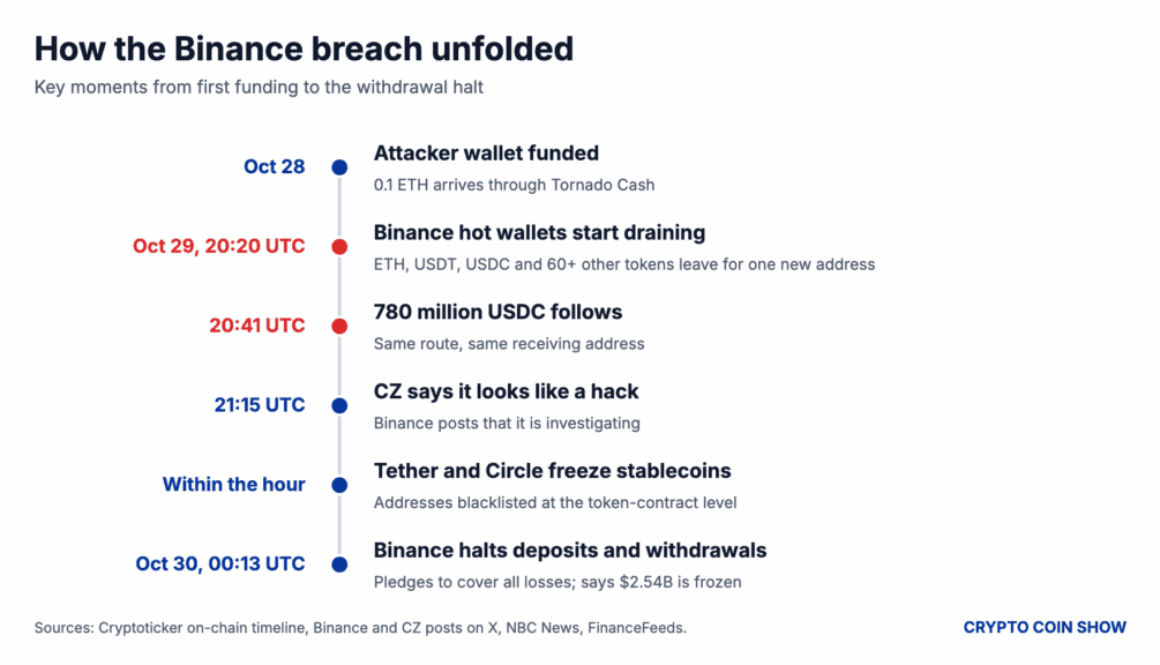
Binance, the world’s largest crypto exchange, is still counting the cost of a breach that emptied hot wallets on ten blockchains in a burst that took about 20 minutes for most of the damage. Outflows started around 20:05 UTC on Thursday (October 29), when Binance wallets on the XRP Ledger began sending tokens out, and spread to Solana, Optimism, Bitcoin, TRON and Ethereum within minutes, according to a timeline from TRM Labs. A second wave hit Avalanche and Polygon wallets about three hours later. Binance halted withdrawals that night, briefly paused deposits too, and early on Friday put the total at about $6.3 billion.
Ethereum took the biggest hit, with $3.8 billion gone
TRM’s breakdown puts about $3.79 billion of the loss on Ethereum: roughly 200,600 ETH plus 185 other tokens, including about 1.875 billion USDT, 823 million USDC and 88.5 million RLUSD. Bitcoin accounts for about $1.47 billion (18,270 BTC), TRON about $628 million (mostly 612.7 million USDT), the XRP Ledger about $296 million (233.46 million XRP) and Solana about $96 million. Arbitrum, Optimism, Base, Avalanche and Polygon make up the rest.
The single largest transfer came from the wallet Etherscan labels Binance 14. At 20:20 UTC the attacker submitted one transaction carrying 50 pre-signed authorizations under EIP-7702, the Ethereum feature that lets an ordinary wallet hand control to contract code. That turned the hot wallet into a sweeper the attacker controlled, and about three and a half minutes later it sent out its entire balance, including 167,464 ETH and 1.615 billion USDT, to the address 0x5227…CB2f8c. On the other nine chains the wallets simply sent ordinary signed transfers.
The setup started at least 36 hours earlier. The wallet that launched the Ethereum attack was funded only through Tornado Cash, with small deposits of about 0.1 ETH on October 28 and 29, which is what first marked the transfers as a theft rather than housekeeping.
Binance traces it to an engineer’s laptop, then finds more breach points
Co-CEO Richard Teng said the initial investigation suggests the attack may have started with a compromised laptop belonging to a DevOps engineer, which attackers used to reach a service container and submit unauthorized withdrawals. He said it was a more complex process than a single click, that no individual has been blamed, and that investigators have found no evidence any wallet private key leaked. A few hours later Binance said it had found additional points of breach beyond the laptop. In a video address on Friday, Teng added that the attacker used a self-destruct mechanism to erase its tooling and traces, and an EIP-7702 delegation that did not pass through Binance’s normal approval controls, Decrypt reported.
“Bottom line, your money is safe, and we’re covering every loss.”
Richard Teng, Binance co-CEO
TRM’s read is that the attacker gained the ability to make Binance’s hot wallet signing system sign whatever it was given, across chains. Binance has not published a root cause and has promised a full post-mortem.
Analysts tie the theft to North Korea’s TraderTraitor
TRM Labs and Chainalysis both say, with high confidence, that the attack was carried out by TraderTraitor, the North Korean unit the FBI blamed for the February 2025 Bybit hack. Chainalysis CEO Jonathan Levin and investigator ZachXBT point to the same evidence: funds from this attack and from Bitget’s September exploit landed in a shared wallet after passing through THORChain. TRM also cites the same playbook seen at Bybit and April’s KelpDAO hack, with a mixer-funded operator wallet, staging well ahead of time and pre-obtained signatures fired in one burst.
Not everyone is ready to call it. Elliptic has urged caution, noting differences in how fast and how the funds are being laundered and the lack of a confirmed root cause, and Binance itself has not attributed the attack to anyone. North Korea routinely denies such claims.
About $3 billion is frozen, and here is who froze it
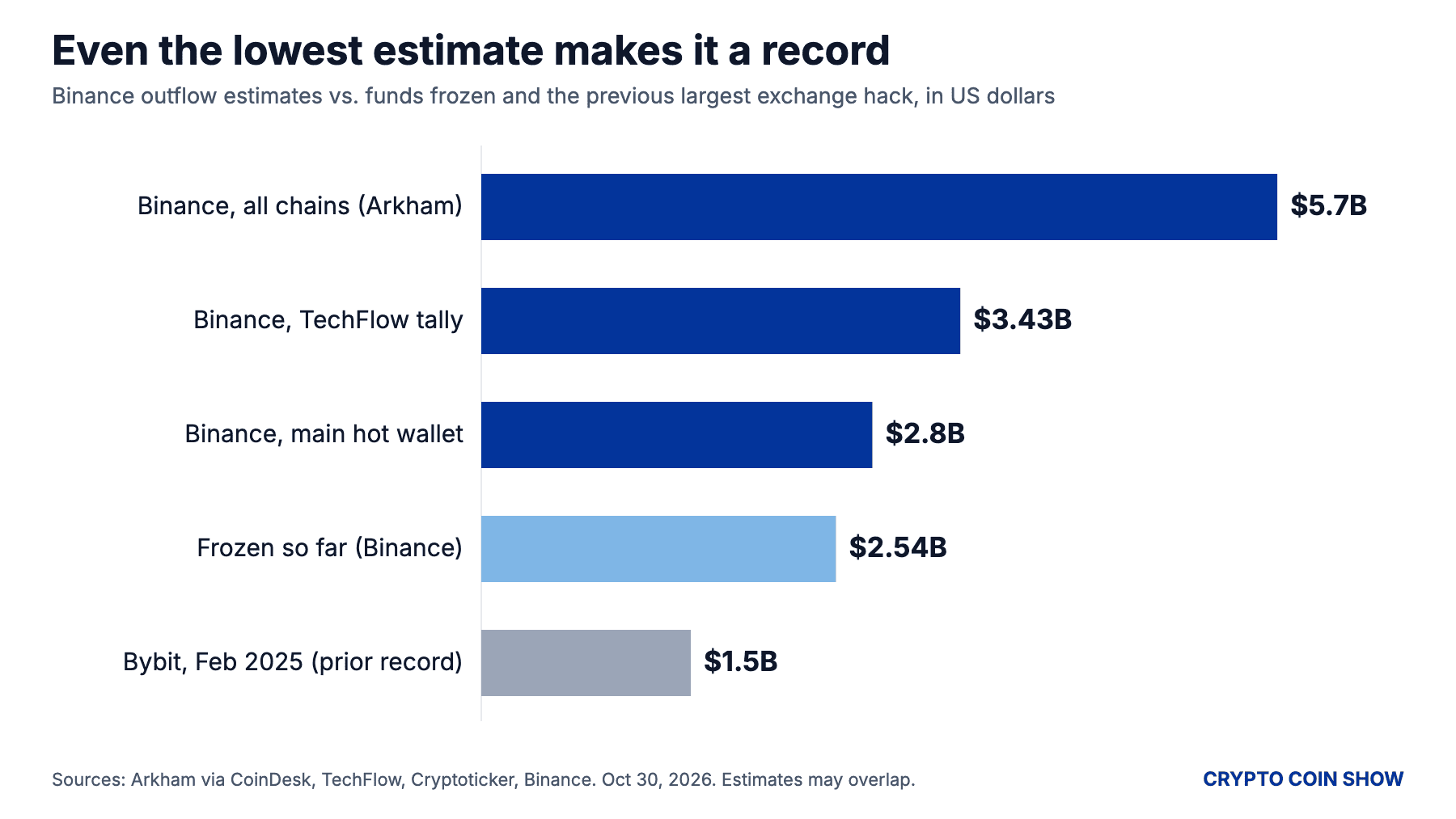
The stablecoin issuers moved first, and fast. Tether says it froze more than $1.5 billion in USDT (TRM counts about $1.77 billion frozen on-chain) and Circle more than $800 million in USDC, as CCS reported on Thursday. Others followed overnight:
- Ripple froze RLUSD tied to the attack. Binance co-founder Yi He says Ripple helped stop about $200 million, though TRM has confirmed 40.5 million RLUSD frozen on-chain so far. The attacker sold about 48 million RLUSD on decentralized exchanges before the freeze landed.
- World Liberty Financial worked with BitGo to freeze about $27 million in USD1 and roughly $2 million in WLFI tokens.
- First Digital froze the FDUSD taken in the attack.
- The Arbitrum Security Council used its emergency powers to move 74.6 million ARB and 8,425 ETH, about $30.5 million, from an exploiter address into a frozen wallet that only the council or an Arbitrum DAO vote can release, Disruption Banking reported.
Binance’s verified frozen figure has climbed from $2.54 billion on Thursday night to about $3 billion, and Elliptic puts it at $2.84 billion. None of that has been recovered yet. Frozen tokens sit blacklisted while issuers, Binance and law enforcement work out how to return them, and Binance has excluded them from its $6.34 billion reserve. Issuers can invalidate frozen tokens and reissue them to the rightful owner, but lawyers told CoinDesk that may take court orders in several countries. The speed of the freezes has also drawn criticism: Circle was attacked in April for not freezing USDC stolen in the roughly $290 million Drift hack, and experts asked whether smaller victims get the same treatment.
Aave froze lending on 16 networks to shut a door, then reopened
The attacker went looking for exits within minutes. Between 20:57 and 21:01 UTC one linked wallet deposited 60 million USDT into Aave V3 on Ethereum and borrowed 19,762 WETH, about $44.6 million, turning freezable stablecoins into ETH that cannot be frozen. Aave’s guardians then froze 292 reserves, 175 on Aave V3 across 16 networks and 117 on Aave V4 across four, Bitcoin.com News reported. New deposits and borrowing are blocked, while existing users can still repay and withdraw.
Risk managers at LlamaRisk said the attacker’s position, about $59.9 million of collateral against $43.8 million of debt, stays overcollateralized and poses no direct threat to Aave lenders. Aave reopened all its V3 and V4 markets on Friday, about 17 hours after the freeze, saying its contracts were never affected, and founder Stani Kulechov said every position remains overcollateralized. Nine assets, USDT, USDC, USDT0, POL, WAVAX, sAVAX, XAUT, PAXG and OP, stay at zero loan-to-value for now, so they cannot back new loans, PANews reported. AAVE fell as much as 11% on Friday. On Solana, Kamino paused borrowing in one market as a precaution, while saying it was not affected.
$2.4 billion or more is still in the attacker’s hands
What cannot be frozen is the real loss. TRM estimates the attacker still holds about $2.4 billion, including more than 420,000 ETH and all 18,270 BTC, while Elliptic counts about $3.33 billion across roughly 43 wallets. The bitcoin was split into 19 wallets, 17 of them holding exactly 1,000 BTC, and none had moved in the latest reports on Friday. The attacker is still active elsewhere: between 11:37 a.m. and 12:12 p.m. ET on Friday, a TRON wallet Arkham ties to the hacker sent about 5.19 million TRX, roughly $1.73 million, to 12 addresses.
The laundering so far has run through decentralized exchanges rather than the bridges used after Bybit. TRM says about 325 million USDT was swapped through UniswapX for about 122,300 ETH at a discount of more than 10% to market, and 300 million USDT on TRON went into the JustLend lending protocol. On-chain trackers have also seen the attacker dump stolen altcoins including UNI, PEPE, ENA and LINK for about 70,480 ETH. Chainalysis says thousands of rapid transfers point to automated laundering scripts. TRM expects bridges, swap services and OTC brokers to be the next stops.
Binance is buying back coins to make customers whole
Binance says it has set aside more than $6.34 billion of company resources to restore customer balances one for one, without touching customer funds, CoinDesk reported. About $5 billion of that is already held in the affected tokens, and it is buying the rest on public markets and over the counter, which may take longer for thinly traded coins. Yi He said the SAFU fund and Binance’s own holdings, which include a large amount of BTC and ETH, are paying for it, and the exchange says balances will be verified through Proof of Reserves. SAFU has typically held around $1 billion in bitcoin, so the balance sheet is doing most of the work.
Binance is aiming to restore withdrawals by Sunday, November 1, after an overhaul of its withdrawal service and address controls, and plans to publish a full Proof of Reserves report by Monday, with an initial view before then. Deposits are working normally, and outflows stopped when withdrawals were paused. Binance Alpha trading was also suspended.
Markets, market makers and the rest of the fallout
Bitcoin fell to a six-week low of $76,368 and Ether to a two-month low of $2,178, Reuters reported, while BNB dropped as much as 9% to below $700 and liquidations hit $627.7 million in a single hour on Thursday night, per Coinglass. The Crypto Fear and Greed Index fell to 30, its first “fear” reading since August. Coinbase shares slid 4.8% though it says it was not affected, and Strategy fell nearly 6% in extended trading.
- Market makers: Wintermute and GSR both disclosed exposure to Binance, under 20% and under 5% of net equity respectively, without giving dollar figures or confirming losses.
- A push to DEXs: Standard Chartered’s Geoffrey Kendrick said the hack could shift more trading toward decentralized exchanges and benefit Uniswap.
- Industry rules: OKX founder Star Xu called for exchanges to agree on shared security standards, including delays and extra checks on large withdrawals to unknown addresses, real-time incident alerts and faster joint freezes, enforced at the signing layer.
- Musk weighs in: Replying to a post about the attacker’s Aave trade, Elon Musk said superintelligent AI agents will one day do the same to gain money for themselves. Nothing suggests AI was involved in this attack.
- KuCoin rumors: Social media claims of a KuCoin hack appear unfounded. KuCoin’s news on Thursday was a planned exit from Russia and Belarus.
The breach also came two days after Binance said on October 27 that it had fended off multiple cyberattacks linked to North Korea with no assets lost, and a day after a scheduled Ethereum wallet maintenance window that CCS covered on October 28. Nothing public ties either to Thursday’s theft.
The CCS read. This is the biggest theft crypto has ever seen, and yet Binance customers look set to lose nothing, because the exchange can write a $6 billion check. That says as much about how concentrated this industry has become as it does about Binance’s balance sheet. The bright spot is the response: issuers, an L2 security council and a DeFi protocol froze about half the haul in hours, a level of coordination that did not exist at the time of Mt. Gox. The weak spot is the other half. ETH, BTC and XRP cannot be frozen, and a group that has now taken more than $7 billion across Bybit and Binance will keep coming back for the signing systems. Not your keys, not your coins still applies, even when the custodian makes you whole.
What to watch: whether withdrawals reopen on Sunday, the Proof of Reserves report due Monday, Binance’s post-mortem and the extra breach points, whether the 18,270 BTC moves or the ETH heads for bridges and OTC desks, how frozen tokens get returned, and when Aave restores the nine zero-LTV assets.
This is a developing story and will be updated as Binance releases more information.