This New Meta “Advertisement” Is Absolutely Brutal
An activist group’s provocative billboard campaign outside Meta’s London office is intensifying institutional scrutiny over privacy safeguards embedded in the company’s AI-enabled smart glasses. The escalating public backlash, including regulatory criticism and consumer reluctance to use the devices, signals potential market and legal risks for institutional investors holding Meta equity or considering exposure to its hardware division.
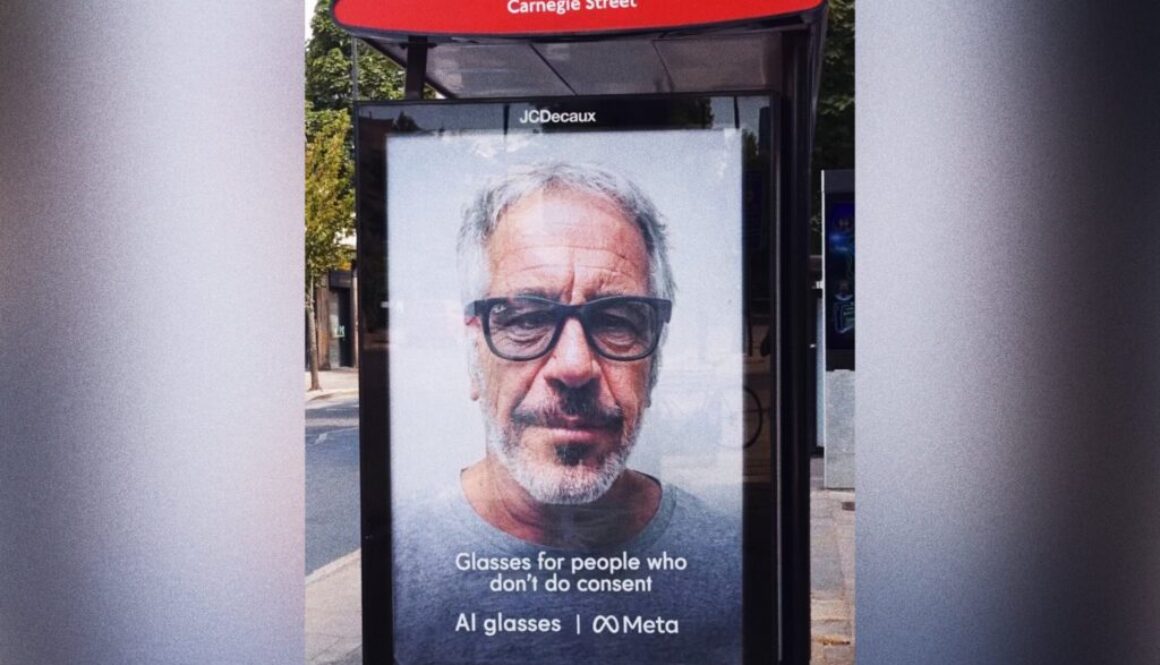
- Everyone Hates Elon posted a billboard near Meta’s King’s Cross office depicting Jeffrey Epstein in Meta glasses with caption “Glasses for people who don’t do consent.”
- Meta is actively attempting to ban users from recording members of the public without consent, acknowledging the privacy invasion risk inherent in the device design.
- Public resistance has grown so acute that even early adopters are choosing not to carry the glasses in public, signaling potential adoption ceiling risk.
- 2019 Year Jeffrey Epstein died, years before Meta launched first-generation smart glasses.
- Dozens Number of girls recruited to Epstein’s operation, many underage, per court records.
- Multiple Hidden cameras installed across Epstein’s Palm Beach home, including inside Kleenex box.
An activist billboard campaign outside Meta Platforms’ London headquarters is forcing institutional attention on the privacy and reputational risks embedded in the company’s camera-equipped smart glasses.
The latest iteration, unveiled near Meta’s King’s Cross office, depicts convicted sex trafficker Jeffrey Epstein wearing the Meta spectacles alongside the caption “Glasses for people who don’t do consent,” directly linking the device’s surveillance capability to non-consensual recording and sexual predation.
The juxtaposition reflects mounting regulatory and consumer concern that Meta has shipped a mass-market product capable of filming strangers without notification or consent, then struggled to contain its misuse.
Meta’s Escalating Effort to Contain Non-Consensual Recording By Device Users
Meta has begun an unprecedented internal enforcement campaign to prevent users from deploying the smart glasses to record members of the public without their knowledge or permission. The effort signals the company’s acknowledgment that the device’s design, a camera-equipped pair of spectacles worn visibly on the face, creates intrinsic privacy hazards that product design alone cannot solve.
Rather than pursue architectural changes to restrict recording capability or require consent confirmations, Meta is attempting to police user behavior after sale, a reactive posture that has failed to contain reported misuse by “manfluencers” and juvenile pranksters.
The enforcement gap reveals a structural problem: Meta shipped the glasses into a consumer market without robust technical or legal guardrails against surveillance, then discovered the device attracted precisely the category of users most likely to exploit its surveillance potential.
Early purchasers who openly market their use of the glasses for social media content have become vectors for non-consensual recording, forcing Meta to ban accounts rather than redesign the product or implement recording notifications visible to bystanders.
The reputational cost has already manifested in adoption behavior: consumers who purchased the glasses report choosing to leave them at home rather than face public association with the device.
Activist Campaign Escalates From Privacy Critique to Criminal Association
The billboard strategy employed by activist group Everyone Hates Elon marks a sharp escalation from earlier privacy-focused messaging.
A prior advertisement had overlaid socialite Kylie Jenner’s face with imagery from the film “They Live,” a science-fiction thriller centered on surveillance and manipulation, with the caption “We’re always watching.” That campaign targeted Meta’s marketing directly, framing the glasses as a privacy invasion tool.
The Epstein billboard advances the critique into association with criminal conduct. Epstein, who died in prison in 2019, years before Meta released the first-generation glasses, operated a documented sex trafficking operation that recruited dozens of girls, many underage. Court records and victim depositions detail how Epstein coerced victims into non-consensual sexual situations and filming.
Email records from 2014 show Epstein directed subordinates to install hidden video cameras throughout his Palm Beach residence, including inside a tissue box. Prosecutors also documented that Epstein kept recordings of prominent individuals engaged in sexual activity, leveraging the footage for coercion and extortion.
If regulators actually did their damn jobs for once, glasses such as these would be illegal.
Reddit user, discussing Meta smart glasses regulation
The billboard’s strategic pairing of Epstein’s image with Meta glasses creates a visual metaphor: a device designed to record without consent, deployed by a user with a documented history of non-consensual recording and sexual coercion. The comparison does not rely on hyperbole; it maps directly onto Epstein’s criminal conduct and the glasses’ documented misuse pattern.
For institutional investors, the comparison represents a significant reputational hazard, particularly if regulators begin framing the device category as inherently incompatible with privacy law.
Regulatory Backlash and the Risk of Hardware Prohibition
Reddit users and consumer advocacy groups are calling for outright prohibition of camera-equipped smart glasses, arguing that the devices should be illegal under privacy and wiretapping statutes already on the books.
One commenter stated: “Pervert glasses have no place in our society.” This language suggests regulatory capture risk, if legislators or privacy authorities adopt the framing that glasses designed for covert recording should be prohibited rather than merely regulated, Meta faces potential product bans in major markets.
The United Kingdom, where this latest billboard appeared, has existing privacy law under the Data Protection Act 2018 and common law privacy protections. The European Union operates under the General Data Protection Regulation, which imposes strict requirements on biometric data collection and recording.
Neither jurisdiction has yet moved to ban the glasses outright, but the activist campaign is functioning as a public pressure campaign to accelerate regulatory response. Meta’s London office location, adjacent to the billboard, ensures UK regulators will see the activist framing as representative of public concern.
Institutional investors should monitor whether the UK Information Commissioner’s Office or the European Data Protection Board issues formal guidance on camera glasses compliance by end of 2024.
Consumer Adoption Risk and the Hardware Division’s Trajectory
The fact that early adopters are choosing not to carry the glasses in public represents a critical adoption ceiling. Hardware businesses depend on visible consumer enthusiasm to drive network effects and social proof. When early users, the demographic most likely to evangelize emerging technology, actively avoid displaying the product, the addressable market contracts sharply.
Meta’s reality labs division, which includes the smart glasses business, has sustained losses of billions annually, and adoption constraints directly impact the path to profitability.
The privacy controversy also creates a differentiation problem for Meta against competitors. If Apple or other hardware manufacturers enter the smart glasses market with explicit privacy-first design, for example, cameras that default to off, or require biometric consent before recording, they can capture market share by directly positioning against Meta’s reputation.
The activist campaign has already established a cultural narrative linking Meta’s glasses to non-consensual surveillance; competitors can exploit that positioning to accelerate Meta’s hardware market share decline.
The next critical signal will be Meta’s Q4 2024 earnings guidance on Reality Labs revenue and unit sales, which will reveal whether the privacy backlash has begun to impact purchase intent quantifiably.
Institutional investors should watch for any statement from the UK Information Commissioner’s Office or proposed legislative action by Parliament regarding biometric recording devices in public spaces. Meta’s ability to continue selling the glasses in its largest European market depends on regulators treating the device as a consumer product subject to opt-in consent frameworks, rather than adopting the activist framing that cameras worn in public represent inherent privacy violations requiring prohibition or near-total restriction. A formal regulatory guidance document or legislative proposal within the next 6-12 months would materially increase legal and market risk for Meta’s hardware business.