Exchange NewsMay 16, 2026·5 min read
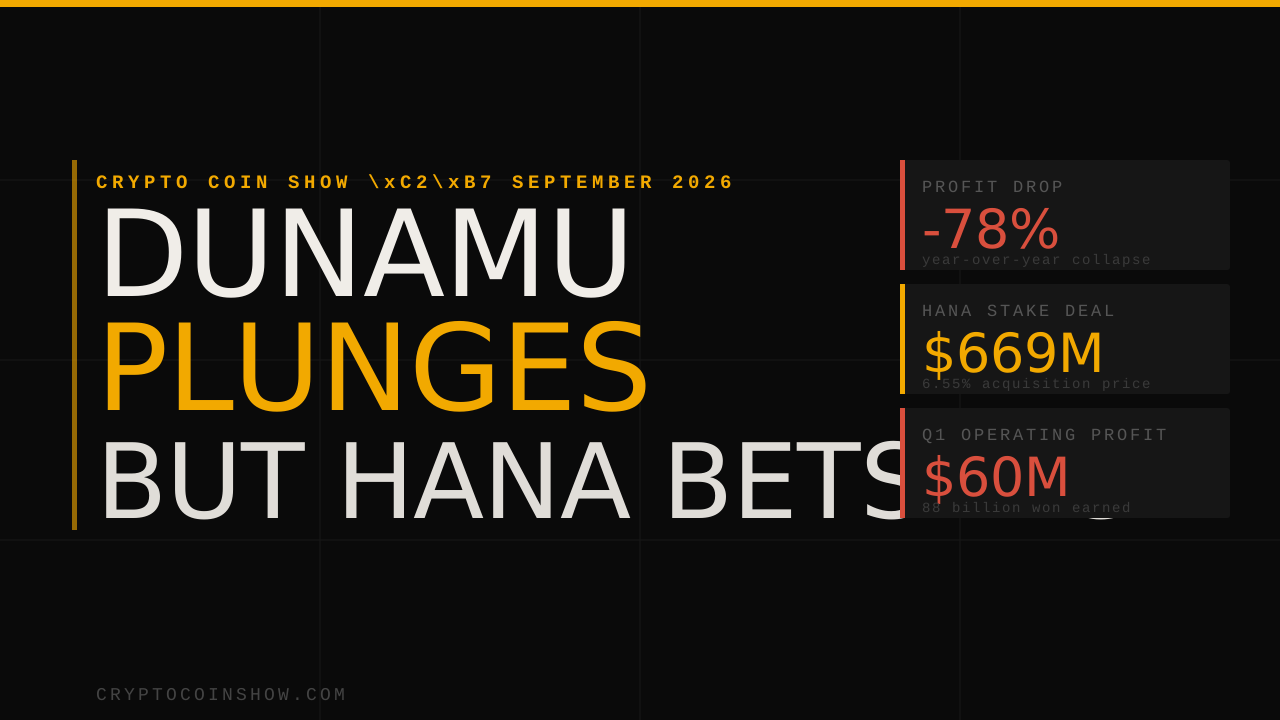
South Korea’s largest crypto exchange operator Dunamu reported a 78% year-on-year collapse in operating profit to 88 billion won ($60 million) in Q1 2026, yet Hana Financial Group proceeded with a 1 trillion won ($669 million) acquisition of a 6.55% stake, signaling institutional conviction in the platform despite near-term market headwinds. The investment underscores how traditional finance continues pursuing crypto infrastructure plays regardless of cyclical revenue swings, even as Korean regulators tighten compliance requirements and retail capital flows toward domestic equities.
- Q1 operating profit fell 78% to 88 billion won from 320.5 billion won year-over-year
- Hana Financial acquiring 6.55% stake for 1 trillion won despite revenue decline
- Client deposits fell 11% to 5.199 trillion won, partly due to shift to domestic AI stocks
Dunamu, operator of South Korea’s Upbit exchange, disclosed consolidated Q1 revenue of 234.6 billion won ($156 million), down 55% compared to 516.2 billion won ($345 million) in the same quarter last year. Net profit declined in tandem to 69.5 billion won ($46 million), falling from 320.5 billion won ($214 million) in Q1 2025.
The company attributed the contraction directly to reduced virtual asset trading volumes, which has compressed the fee revenue that accounts for approximately 97% of total income.
The profit collapse reflects structural headwinds specific to South Korea’s capital markets, not merely cyclical crypto volatility.
Retail capital has migrated from digital assets toward domestic equities, particularly stocks linked to artificial intelligence investment themes. The KOSPI 200 index has surged more than 200% over the past year, drawing retail investor attention away from crypto.
Dunamu’s client fund balance fell to 5.199 trillion won ($3.4 billion) at quarter-end, an 11% decline from December 2025, indicating fewer customers and lower deposit values as trading activity contracted. For an exchange dependent almost entirely on transaction fees, this revenue model proved vulnerable to a sustained shift in local investor preferences.
Hana Financial Commits $669M Despite Dunamu’s Revenue Collapse
Despite the sharp earnings decline, Hana Financial Group confirmed it will acquire a 6.55% stake in Dunamu from Kakao Investment, valuing the position at 1 trillion won ($669 million). The transaction would position Hana as Dunamu’s fourth-largest shareholder and marks a formal institutional commitment to crypto infrastructure at a moment when Upbit’s profitability faces pressure.
The investment signals confidence in Dunamu’s long-term franchise value independent of near-term trading volume cycles. Hana Financial plans to co-develop digital financial products with Dunamu, including stablecoin initiatives, and to deepen the existing banking relationship that provides fiat payment rails for Upbit users.
The partnership extends beyond a passive equity stake; Hana intends to integrate crypto services into its financial ecosystem, suggesting traditional banks view crypto rails as essential infrastructure rather than speculative plays.
The deal still requires regulatory approval, though Hana characterized it as a standard process step.
The Hana transaction arrives amid competing acquisition interest. Naver Financial disclosed plans in November 2025 to acquire Dunamu as a wholly owned subsidiary through a share swap arrangement, though the status of that proposal remains unresolved.
Multiple institutional parties bidding for stakes in Dunamu suggests the exchange retains strategic value despite revenue volatility, particularly given its entrenched market position and regulatory compliance infrastructure.
South Korean Regulators Tighten Compliance Burden on Exchanges
Dunamu’s profitability challenges occur alongside a regulatory environment growing more demanding. The Financial Services Commission mandated in 2026 that major crypto exchanges reconcile internal ledgers with actual crypto holdings every five minutes, a major shift from prior practices.
Exchanges must now also submit to inspections every six months rather than annually, following operational failures at multiple Korean platforms that prompted regulators to enforce stricter accountability measures.
South Korean authorities have also pushed platforms to dilute major shareholder concentrations and improve corporate governance structures. These compliance requirements increase operational costs and complexity, particularly for exchanges like Upbit that handle significant trading volumes and custody.
Hana Financial’s acquisition, which requires regulatory approval, may actually benefit from the broader regulatory focus on institutional shareholding and transparency, traditional financial institutions tend to meet regulator expectations more readily than concentrated private ownership.
The regulatory environment also reflects Seoul’s broader strategy to integrate crypto into the formal financial system while preventing systemic risk. Dunamu has been required to file quarterly and annual reports with regulators since 2022, when it crossed the 500-shareholder threshold per security class, subjecting the company to disclosure standards similar to traditional financial institutions.
This compliance burden, while creating operational friction, also provides regulatory clarity that institutional investors like Hana may view as protection against sudden policy reversals.
Dunamu’s Revenue Decline Masks Underlying Asset Base Strength
The severity of Q1 profit decline should be contextualized against Dunamu’s full-year 2025 performance and balance sheet. At year-end 2025, Dunamu reported total assets of 13.17 trillion won ($8.81 billion) and generated full-year net profit of 709 billion won alongside 1.56 trillion won in consolidated revenue.
While Q1 2026 reflects a steep year-over-year drop, the company retains substantial asset backing and historical profitability.
The 78% profit decline in Q1 represents a cyclical downturn, not an erosion of Dunamu’s underlying business model or competitive position.
Upbit remains South Korea’s largest crypto exchange by trading volume and user base, a competitive moat that persists across market cycles. If Korean retail capital eventually rotates back toward digital assets, a cyclical shift rather than a permanent structural change, Dunamu’s transaction fee revenue would recover rapidly, given its 97% dependence on trading commissions.
Hana Financial’s willingness to invest at this cyclical trough suggests the bank views current valuations as attractive and believes the crypto market will eventually stabilize at higher volumes than the current depressed levels.
Institutional Investment Proceeds as Regulatory Approval Remains Outstanding
The Hana Financial acquisition requires standard regulatory approvals before closing, though both parties have publicly committed to the transaction.
The Financial Services Commission will likely scrutinize the deal for conflicts of interest, Hana provides banking services to Upbit, and to ensure the acquisition complies with shareholder dilution and governance standards the regulator has emphasized.
Given Hana’s institutional standing and the regulatory focus on traditional financial participation in crypto, approval is expected, though not guaranteed.
The competing Naver Financial bid for full acquisition control remains unresolved and may create complexity if both parties pursue overlapping stakes. Regulatory approval timelines typically extend three to six months in South Korea for financial institution transactions, placing a likely resolution in the second or third quarter of 2026.
Dunamu’s Q1 earnings disclosure may accelerate regulatory review as authorities assess whether the declining profitability warrants additional conditions on the Hana stake purchase.
The central question facing institutional investors is whether Dunamu’s Q1 earnings trough represents a temporary valuation opportunity or signals structural headwinds that will persist if Korean retail capital continues rotating into domestic equities. Hana Financial’s confirmed commitment suggests the former view prevails among traditional financial institutions, but the resolution of the Naver Financial competing bid and the trajectory of client deposits in Q2 2026 will clarify whether this bet was premature or well-timed.
Get this in your inboxThe Crypto Coin Show newsletter covers the policy and market moves institutional crypto investors are pricing in.
Subscribe