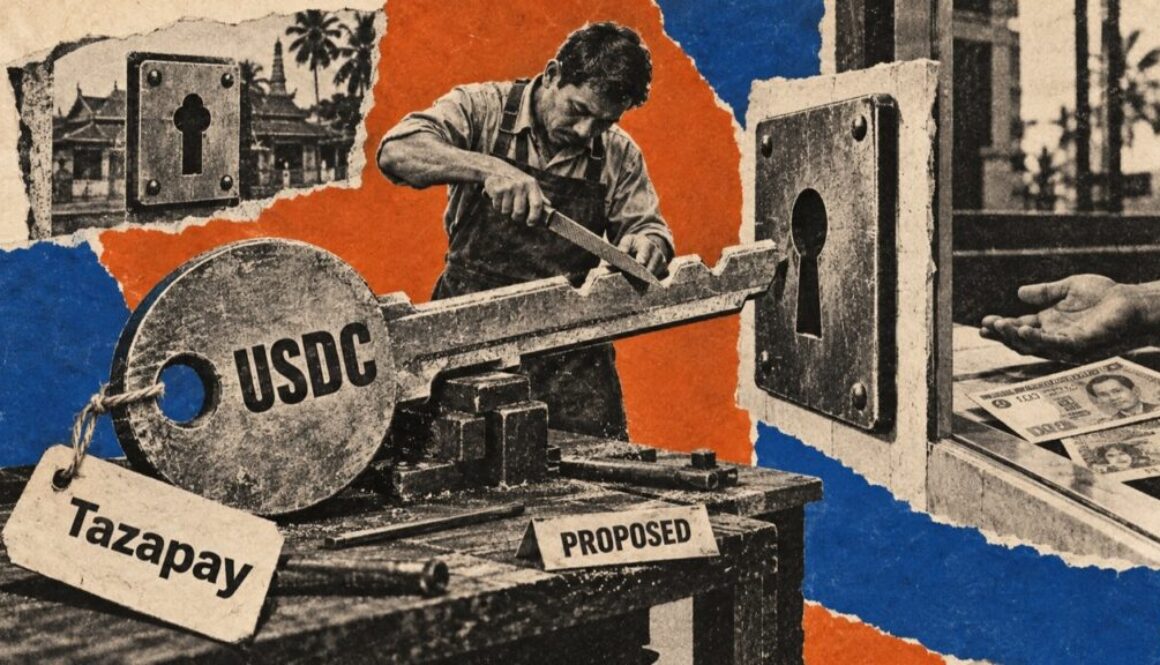
Tether has applied for seven trademarks in South Korea, including for its company name and logo, in a move that market observers see as a hint of the firm expanding into the South Korean market.
The issuer of the largest stablecoin in the world, USDT, is also expanding its reach into Africa and Asia by partnering with Lemfi. Meanwhile, Tether’s rival Circle (NYSE: CRCL) has already been meeting with major financial institutions in South Korea, setting up a potential showdown between number one and two in the stablecoin issuance business.
Tether and Circle are lining up entry into the South Korean market
Tether, the company behind the world’s largest stablecoin USDT, is making progress in its plans to enter the South Korean market. The Korea Intellectual Property Rights Information Service (KIPRIS) recently received multiple trademark applications from Tether, totaling up to seven.
Tether’s previous filings in the country focused on stablecoin product names, but this batch includes the corporate brand itself and its gold-backed stablecoin Tether Gold (XAUT).
South Korea’s proposed Digital Asset Basic Act is expected to require foreign stablecoin issuers to maintain a domestic branch if they want to distribute their tokens locally, and Tether appears to be positioning itself ahead.
Before Tether’s latest filings, Circle’s CEO Jeremy Allaire visited Seoul in April and met with executives from KB Financial Group, Shinhan Financial Group, and Hana Financial Group to discuss stablecoin payment cooperation and real-world asset tokenization.
Allaire acknowledged the potential in the South Korean market and shared Circle’s plans to establish a Korean subsidiary and obtain a license if the final regulatory framework accepts foreign issuers.
Circle has also signed partnerships with Korean exchanges Dunamu, which operates Upbit, and Bithumb to expand USDC adoption on domestic trading platforms.
Cryptopolitan reported earlier that Hana Card, part of Hana Financial Group, launched a pilot in March allowing foreign visitors to pay at local merchants using USDC through a partnership with Circle and Crypto.com. Other Korean financial firms, including BC Card and KB Kookmin Card, have been testing stablecoin payment infrastructure as well.
Tether has been on an expansion trail
Tether also recently announced an investment in LemFi, a cross-border payments platform that works across communities in the UK, US, Canada, and Europe to recipients in Africa and Asia. The deal will integrate USDT as a settlement layer across LemFi’s payment corridors, replacing multi-day SWIFT-based transfers with blockchain settlement.
Tether’s CEO Paolo Ardoino said in the announcement that the goal of the partnership is to expand financial access for its estimated 585 million users globally.
Cryptopolitan previously reported that Tether recorded $1.04 billion in profit for Q1 2026. The company holds excess reserves of $8.23 billion; enough capital to invest in distribution partners and pursue market entry in jurisdictions like South Korea.
South Korea is home to an estimated 18 million crypto investors. Exchanges in the country recorded over $663 billion in trades through mid-2025, and the country’s retail traders remain a significant part of altcoin markets.
Beyond Tether and Circle, multiple projects are building won-denominated stablecoins. Cryptopolitan reported that the Bank of Korea has been advancing “Project Han River,” its wholesale CBDC initiative, which entered a second phase of real-transaction testing earlier this year.
Regulators are still debating whether or not stablecoin issuance should be restricted to commercial banks or follow a more flexible licensing model. The discussion has been postponed until after South Korea’s June local elections.
Circle’s $222 million ARC token presale has given Wall Street a new way to value the USDC issuer, while raising a harder question for one of crypto’s most profitable alliances.
On May 11, Circle said investors led by a16z Crypto backed the presale of ARC, the native token for Arc, its planned public blockchain for institutional finance.
The sale valued the network at $3 billion on a fully diluted basis and came alongside first-quarter results that showed $694 million in total revenue and reserve income, up 20% from a year earlier.
At the same time, USDC in circulation rose 28% to $77 billion, while on-chain transaction volume reached $21.5 trillion, up 263% year over year.
Circle’s Q1 Earnings Report (Source: Circle)
Those figures reinforced Circle’s position as one of the main issuers in the global stablecoin market, where tokenized dollars have become core infrastructure for trading, payments, and settlement.
However, the more important development was Circle’s attempt to move beyond issuance through its new blockchain network, Arc.
Arc gives the company a network-level growth story built around payments, tokenized assets, foreign exchange, capital markets, and AI-driven commerce.
That push places Circle closer to the terrain already occupied by Coinbase, its longtime USDC partner and the operator of Base, the Layer 2 network that the US-based exchange has positioned as a settlement layer for stablecoins, consumer payments, and agentic transactions.
Considering this, Circle’s aggressive expansion could bring a new competition to the crypto landscape: a looming, head-to-head battle with Coinbase.
Circle gives investors a wider story
Circle’s business has long been tied to the economics of stablecoin reserves. The company issues USDC, holds safe assets backing the token, and earns income on those reserves.
That model can be powerful when rates are elevated, but it also raises questions about how durable its earnings will be as interest income declines.
The company is pitching the network as an “economic operating system” for the internet, a shared environment where stablecoins, tokenized assets, and financial applications can operate on common infrastructure.
The chain is expected to be EVM-compatible, with stablecoin-native fees, deterministic sub-second finality, and configurable privacy designed for institutions that need auditability without exposing every transaction detail to the public.
Circle Chief Executive Jeremy Allaire framed the quarter around the convergence of AI platforms and on-chain money, saying:
“Circle’s first quarter reflected strong execution against a much bigger opportunity: the rapid convergence of AI platforms and economic operating systems into a new internet stack. With the ARC token presale, momentum behind the Arc network, and the launch of our Agent Stack, we are building trusted infrastructure for AI-native economic activity and a more programmable internet financial system.”
The investor list shows how far that pitch now reaches. a16z Crypto led the presale with a $75 million investment.
Other participants included BlackRock, Apollo Funds, Intercontinental Exchange, SBI Group, Janus Henderson Investors, Standard Chartered Ventures, General Catalyst,a IDG Capital, Haun Ventures, and Bullish.
The message to investors is clear: Circle wants to be valued less as a stablecoin issuer exposed to rate cycles and more as a full-stack infrastructure company for on-chain finance.
In a note shared with CryptoSlate, Clear Street analysts echoed that view, writing that Circle is “no longer a pure crypto play” and has built the Layer 1 network, application layer, and partner ecosystem required to become a critical infrastructure provider.
The firm raised its price target on the stock from $152 to $157, citing Arc, Agent Stack, Circle Payments Network, and regulatory momentum as potential sources of upside.
USDC already moves across more than 30 blockchains and is integrated throughout exchanges, wallets, fintech platforms, and institutional systems.
That distribution has been one of the stablecoin’s main strengths. Circle could grow as USDC became more widely used, regardless of where the activity settled.
Arc gives Circle a reason to bring more of that activity onto the infrastructure it controls.
The network is designed to support payments, lending, foreign exchange, capital markets, and tokenized assets. Circle has also positioned ARC as a coordination token for validators, builders, liquidity providers, exchanges, institutions, and users.
In that structure, USDC remains the transactional asset, while ARC is intended to help govern economic rules and align network participants.
That creates a broader economic layer around Circle’s core product. If Arc gains traction, investors will not only measure Circle by USDC circulation and reserve income.
They will also track transaction volume, developer adoption, institutional participation, validator activity, and the degree to which Circle can capture revenue from the infrastructure surrounding USDC.
Circle Payments Network adds another part of that strategy. Clear Street said CPN reached $8.3 billion in annualized total payment volume and approached $10 billion by May 7, with 136 financial institutions enrolled.
Managed Payments is intended to reduce friction for banks and payment service providers by handling licensing, liquidity, custody, and compliance burdens.
Taken together, Arc, Agent Stack, CPN, and Managed Payments give Circle a more ambitious public-market story. The company is trying to become the platform where digital dollars move, settle, and interact with software.
That ambition makes the Coinbase relationship more complicated.
Coinbase already controls much of the flow
However, Coinbase has its own claim to the USDC infrastructure story.
In its first-quarter report, the company described itself as the distribution engine for USDC, with more than 25% of total USDC in circulation, or about $19 billion on average, held across Coinbase products.
Coinbase said Base processed 62% of global on-chain stablecoin transaction volume during the quarter, more than all other chains combined.
At the same time, more than 100 million payments were processed through its x402 protocol, with more than 99% completed using USDC.
How Coinbase is Growing Stablecoin Adoption via USDC and Base (Source: Coinbase)
Those figures show why Arc is sensitive for Coinbase.
Coinbase is no longer merely a distribution channel for Circle’s stablecoin. It is building the rails around the asset.
Its stack includes USDC as the programmable dollar, Base as the low-cost settlement network, and Coinbase Developer Platform, AgentKit, and x402 as infrastructure for developers and AI-enabled payments.
Circle’s emerging stack points in the same direction. USDC provides the dollar asset, Arc provides the network, Agent Stack targets AI-native commerce, and CPN connects financial institutions and payment companies.
The companies remain commercially aligned around USDC growth. But their infrastructure strategies increasingly point toward the same flows.
The alliance gets a new scoreboard
For years, the Circle-Coinbase relationship was one of crypto’s cleanest partnerships. Circle issued USDC. Coinbase distributed it across its exchange, wallet, and institutional products. The stablecoin gained scale, and Coinbase shared in the economics.
That relationship helped make USDC one of the most important dollar assets in crypto. It also gave Coinbase a major stablecoin revenue line and helped turn USDC into a regulated alternative to Tether’s USDT for many US-based institutions.
However, Arc introduces a different incentive structure.
Omar Kanji, an investor at Dragonfly, captured the concern in a post asking how long the “marriage” between Circle and Coinbase can stay clean.
His argument was that the old model worked when Circle was the issuer, and Coinbase was the distributor. But Circle’s public-market demands and Arc’s token-backed network now require the company to show investors that it can own more customers, flows, and infrastructure directly.
That is where Arc overlaps with Base. Circle wants Arc to host USDC balances, tokenized assets, payments, settlement, and eventually foreign-exchange activity. Coinbase wants Base to serve as the main venue for stablecoin payments, on-chain consumer transactions, AI-agent activity, and institutional settlement.
The tension is already visible in adjacent products. Coinbase has cbBTC, a wrapped BTC product used across DeFi. Circle is preparing cirBTC, which is designed to integrate with Arc and Circle Mint.
While this overlap does not signal an immediate rupture, it shows that the companies are no longer staying in separate lanes and are beginning to compete on similar products.
AI payments raise the stakes
The competition becomes more significant when viewed through the lens of agentic commerce.
AI agents are expected to become a larger share of internet activity, handling tasks such as purchasing data, paying for software, settling invoices, managing subscriptions, and executing business processes.
Those transactions require programmable money, low-cost settlement, and infrastructure that can authorize spending without constant human intervention.
Stablecoins are well-suited to that environment because they operate continuously, settle quickly, and can be embedded directly into software. That has made agentic commerce one of the most attractive long-term narratives for stablecoin infrastructure providers.
Coinbase is already claiming early leadership. Its first-quarter materials pointed to Base’s share of on-chain agentic stablecoin transaction volume and the rapid growth of x402 payments. The company is presenting Base, USDC, AgentKit, and x402 as a ready-made stack for machine-driven economic activity.
Circle is moving to meet that opportunity with Agent Stack and Arc. Allaire has framed AI platforms and on-chain money as part of a new internet stack, and Circle’s product roadmap suggests the company wants USDC to become a settlement layer not only for humans and institutions, but also for software agents.
Considering this, Tom Wan, the head of data at Entropy Research, concluded:
“[Circle and Coinbase] business lines are converging across blockchain, tokenization, payments and stablecoins. A formal split is unlikely given the mutual benefits still on the table, but the trajectory is clear. Both sides are building toward a less dependent relationship, and the overlap will only create more friction over time.”
Crypto rhetoric has long prized the ability to transact without gatekeepers, to move value across borders without asking permission, and to hold assets no institution could seize.
Crypto culture treated these as design virtues, properties that builders embedded with ethical weight by deliberate architectural choice. Then the Drift exploit happened, and the backlash told a different story.
On Apr. 1, Drift suffered a major exploit. Circle later described the publicly reported losses as exceeding $270 million, while other reports put the figure around $285 million and documented criticism that Circle had not frozen stolen USDC as it moved across its cross-chain rails.
The attacker routed roughly $232 million in USDC from Solana to Ethereum using Circle’s Cross-Chain Transfer Protocol. The backlash stemmed from users and observers wanting to know why Circle had not intervened sooner.
Days later, Tether CEO Paolo Ardoino posted that Tether had frozen 3.29 million USDT tied to the Rhea Finance attacker, framing the intervention as proof that “Tether cares.”
Circle published its formal response on Apr. 10, and its core argument was that USDC freezes occur when the law requires action. Circle is legally compelled by an appropriate authority through a lawful process.
Circle pushed back on the idea that an issuer should act as an ad hoc chain police force, arguing that open access to permissionless infrastructure is a feature, and that the bigger problem is that legal frameworks have not yet kept pace with the speed of on-chain exploits.
The stablecoin issuer also made a property-rights argument, claiming that arbitrary freezes set dangerous precedents for lawful users, and the power to freeze is a compliance obligation, constrained by lawful process and legal compulsion, authorized only through formal legal channels.
The complication is that Circle’s own legal documents tell a more layered story.
USDC terms state that transfers are irreversible and that Circle carries no obligation to track or determine the provenance of balances.
Those same terms also reserve Circle’s right to block certain addresses and, for Circle-custodied balances, freeze associated USDC in its sole discretion when it believes those addresses may be tied to illegal activity or terms violations.
Circle holds meaningful freeze power and frames it as a tightly bound compliance function, constrained by legal process and compulsion.
Ardoino’s Rhea post was a boast, and Tether’s terms grant it broad discretion by stating that the company may freeze tokens as required by law or whenever it determines, in its sole discretion, that doing so is prudent, and authorizing it to blacklist token addresses.
In February, Tether froze approximately $4.2 billion in USDT due to links to illicit activity, with $3.5 billion of that since 2023.
Circle freezes USDC only when legally compelled, while Tether reserves sole discretion to freeze and has frozen $4.2 billion over illicit-activity links.
The feature nobody advertised
What Drift and Rhea forced into the open is a question that stablecoin competition had not yet fully surfaced: in a hack, what do users actually want from an issuer?
The anti-censorship instincts that shaped crypto’s early culture tend to lose their force the moment users need an emergency brake. Affected protocols, exchanges holding stolen funds, and victims watching their balances drain want to know who can stop the thief.
That reframes freeze capacity as more of a consumer-protection feature.
Tether has been accumulating a record of intervention and visibility. Ardoino’s Rhea post was designed to be read as a product statement, and in the context of a fresh exploit, it worked.
The emotional and practical logic is accessible, showing that one issuer froze stolen funds the same day an attacker moved them, while another issuer said legal timelines tied its hands.
This makes optics difficult for Circle regardless of the legal merits of its position.
Stablecoins are quietly differentiating themselves in emergency governance, alongside reserve composition and exchange liquidity.
The cost of the feature
The case for Circle’s position is real and does not require dismissing the Drift backlash to hold. Broad issuer discretion over freezes creates risks that extend far beyond hack scenarios.
An issuer that can freeze tokens in its sole discretion when it determines it is prudent can freeze tokens for reasons unrelated to protecting victims. Politically contentious addresses, disputed transactions, regulatory scrutiny from a single jurisdiction, or simple operational error can all trigger freezes under terms as broad as Tether’s.
The same capacity that lets an issuer stop a thief also lets it stop a protester, a dissident from a sanctioned country, or a business whose activity it finds inconvenient.
Circle’s public writing on the Drift exploit is, among other things, a defense against that risk. The argument that emergency intervention needs new legal frameworks and safe-harbor structures is also an argument that the current situation is a problem, even when the targets are criminals.
The absence of defined standards means an issuer can act generously today and overreach tomorrow, with no formal mechanism to distinguish the two.
Tether’s freeze record has not yet produced a major documented wrongful-freeze controversy, but that record is also vast and not fully transparent.
Reports on the $4.2 billion in frozen USDT withhold the details of each decision, the legal process underlying each freeze, and the error rate across thousands of enforcement actions.
Fast intervention looks different in the abstract when the process generating those interventions is opaque.
Benefit of fast freezes
Cost of broad freeze discretion
Can slow or stop stolen funds
Can enable arbitrary intervention
May improve recovery odds
Can affect lawful users
Helps exchanges/protocols in crises
Can reflect political or regulatory pressure
Looks like consumer protection in hacks
Process may be opaque
Becomes a due-diligence feature
Wrongful-freeze risk may be hard to challenge
Two paths from here
The bull case for intervention-first issuers runs in a world where hacks keep coming, and recoverability keeps rising on the priority list.
More regulatory scrutiny on exchanges to show they take asset protection seriously, and more institutional users who need to demonstrate due diligence in custody and recovery. These are factors that push emergency freeze capacity to the center of stablecoin evaluation.
In that scenario, Tether’s public freeze record and broad discretionary terms become genuine competitive assets. Exchanges and protocols that have experienced exploits now treat fast-intervention capacity as a due diligence criterion when choosing which stablecoin to hold as primary liquidity.
Circle has to either act faster through new legal mechanisms or accept that some market segments will treat its rule-of-law posture as a liability in crises. Ardoino’s Rhea post, in retrospect, looks like an early entry in a competition that the market eventually formalizes.
The bear case for that same model runs through wrongful freezes, regulatory backlash, and the discovery that broad discretion is often a liability as much as a virtue.
A high-profile incorrect freeze, such as an address flagged as malicious that belongs to a legitimate user, a jurisdiction-specific enforcement action that appears to be politically targeted at users in other markets, or an operational error that freezes clean funds during a market stress event, turns the same emergency-governance story toxic.
In that world, Circle’s insistence on lawful process and defined standards looks like principled restraint, a deliberate commitment to defined limits over speed, and users place a real premium on an issuer whose freeze decisions carry formal accountability.
The crypto community’s historical skepticism toward centralized control reasserts itself as hard-won practical wisdom, grounded in the documented costs of unchecked issuer discretion.
The stablecoin winners in that scenario are the ones whose intervention power is real but bounded. Issuers who can act in genuine emergencies and demonstrate they held back in ambiguous ones.
Stablecoin governance splits between intervention-first issuers gaining crisis goodwill and bounded-discretion issuers winning users who reprice centralization risk, per Circle and Tether materials.
As stablecoins deepen their role in institutional payments, treasury workflows, and regulated financial infrastructure, governance under stress becomes as material as reserve quality or distribution reach.
The question that Drift and Rhea put on the table of how much control users want an issuer to have has no clean universal answer. Institutions with large exposures and recovery obligations may want emergency brakes, while individuals holding stablecoins across politically sensitive jurisdictions may want the opposite.
Protocols with mixed user bases need to answer for both.
The real contest now is for the version of stablecoin governance that earns enough trust from enough users to become the default.
Mastercard’s Crypto Power Move Could Reshape Global Payments Forever
The payments giant just unified 85+ crypto-native firms — including Binance, Circle, Ripple, and PayPal — under one global program. Here’s what it means for blockchain’s mainstream moment.
Crypto Coin Show EditorialMarch 11, 20266 min read
85+
Crypto Partner Firms
↑ Launched March 11, 2026
$27.6T
Stablecoin Volume (2025)
↑ Exceeded Visa + Mastercard combined
$4.5B
Stablecoin Card Spend (2025)
↑ +673% YoY
200+
Countries in Mastercard Network
Global on-chain reach
The Announcement
On March 11, 2026, Mastercard dropped what may be the most consequential institutional crypto announcement of the year. The company officially launched its Mastercard Crypto Partner Program — a global initiative bringing together more than 85 companies spanning crypto exchanges, blockchain developers, fintech firms, and traditional banks.
The roster reads like a who’s who of the digital asset space: Binance, Circle, Ripple, Gemini, PayPal, Paxos, BitGo, Crypto.com, and dozens more. But this isn’t a PR stunt or a tentative pilot. Mastercard is signaling that on-chain payments are now a core business line — not a side experiment.
“The next phase of on-chain payments will be built through collaboration. Expertise and insights must flow both ways as we shape the future together.”
— Mastercard, Official Program Statement
What the Program Actually Does
At its core, the Mastercard Crypto Partner Program is a unified integration framework. Unlike previous one-off partnerships, it provides a shared set of technical and compliance standards that allow crypto-native firms to connect their on-chain infrastructure directly to Mastercard’s global payment rails.
The program is built on Mastercard’s Multi-Token Network (MTN), designed to handle tokenized deposits and stablecoins at scale. The goal is to make blockchain technology effectively “invisible” to end users — delivering the speed and programmability of digital assets through the familiar rails of existing card infrastructure.
Program Architecture
Four Core Focus Areas
01
Cross-Border Remittances
Faster, cheaper global money movement using stablecoin settlement — bypassing correspondent banking friction entirely.
02
B2B Payments
Enterprise-grade on-chain transfers with compliance baked in. The $226B annual B2B stablecoin market now has institutional rails.
03
Global Payouts
Connecting crypto-native payroll and treasury operations to Mastercard’s 200+ country network in real time.
04
Collaborative Product Design
Partners co-advise on Mastercard’s future digital asset products — a two-way flow of expertise across 85+ firms.
Why Mastercard Can’t Ignore Crypto Anymore
The numbers tell the story. Stablecoin transaction volumes hit $1.26 trillion in February 2026 alone. Annual stablecoin transfer volumes topped $27.6 trillion in 2025 — a figure that now exceeds the combined transfer volumes of both Visa and Mastercard’s traditional networks. The thing that’s supposed to disrupt you is already bigger than you.
Stablecoin-linked card spending reached $4.5B in 2025, up 673% year-over-year. B2B stablecoin payments hit roughly $226B annually — a staggering 733% growth. These aren’t incremental gains. This is infrastructure-level adoption happening in real time.
Metric
Figure
Growth
Stablecoin Volume (Feb 2026)
$1.26 Trillion
↑ Record high
Annual Stablecoin Transfers (2025)
$27.6 Trillion
↑ Exceeds Visa + MC
Stablecoin Card Spending (2025)
$4.5 Billion
↑ +673% YoY
B2B Stablecoin Payments (2025)
~$226 Billion
↑ +733% YoY
USDC Circulation Share
~70% of volume
↑ Circle dominant
The 85+ Partner Ecosystem
The sheer breadth of firms involved tells a story of industry convergence. Exchanges, infrastructure providers, stablecoin issuers, fintech platforms, and traditional banks — all operating under one Mastercard roof.
Binance
Circle
Ripple
PayPal
Gemini
Paxos
BitGo
Crypto.com
SoFi
Marqeta
Nuvei
+ 74 More
Notably, SoFiUSD — the first stablecoin issued by a US nationally chartered bank — crossed $1B in circulation by March 2026, the same week this program launched. Ripple’s RLUSD similarly exceeded $1B since its late 2024 debut. The stablecoin market is fragmenting in interesting ways, and Mastercard is positioning itself as the connective tissue across all of them.
Key Players to Watch
Not all 85+ partners carry the same weight. Here are the firms whose role in this program will shape how on-chain payments evolve over the next 12–24 months.
Stablecoin
Circle
USDC powers ~70% of stablecoin volume. Circle’s IPO is pending — this program adds institutional credibility at the right moment.
Cross-Border
Ripple
RLUSD crossed $1B in circulation. XRP remains the liquidity layer for fast cross-border settlement at scale.
Exchange
Binance
Largest partner by user volume. Binance’s global reach gives the program instant consumer-facing distribution.
Banking
SoFi
First US nationally chartered bank to issue a stablecoin. SoFiUSD crossing $1B signals TradFi is fully in the game.
Infrastructure
Paxos
Regulated stablecoin infrastructure provider. Paxos is the compliance backbone behind multiple program participants.
Mastercard vs. Visa: The Race Is On
Mastercard isn’t moving in a vacuum. Visa has been equally aggressive — hitting a stablecoin settlement run rate of $3.5B by November 2025 and expanding those services to over 40 countries. The two payment giants are effectively racing to become the default bridge between legacy finance and the crypto economy.
When two $450B+ companies compete aggressively in a new market, the entire ecosystem benefits. Better infrastructure, lower fees, and faster settlement times are all likely outcomes. For blockchain projects, this competitive dynamic is a rising tide.
“This is a legitimacy signal that matters more than another Bitcoin ETF approval. When the company that processes billions of transactions annually builds dedicated infrastructure for digital assets, it validates the thesis.”
— Crypto Briefing Analysis, March 2026
What This Means for the Blockchain Ecosystem
For builders, investors, and projects operating in Web3, Mastercard’s move carries several implications worth tracking closely.
CCS Takeaways
Stablecoin liquidity deepens — more on-ramps and off-ramps through Mastercard’s network means more capital flowing between fiat and crypto
Compliance becomes table stakes — the program’s shared standards will push the whole industry toward cleaner compliance frameworks
Institutional B2B is the real story — consumer crypto card spend is visible, but $226B in B2B stablecoin volume is where the structural shift is happening
Regulatory tailwinds are real — MiCA in the EU and evolving US stablecoin legislation are making institutional players more confident to deploy
The “blockchain is dead” narrative is officially dead — this is infrastructure-level adoption at Mastercard scale
Final Word
Mastercard has spent years dipping its toes in the digital asset space through pilots, Start Path programs, and tentative card integrations. This is different. Organizing 85+ firms under a unified framework, backed by the MTN and focused on enterprise use cases, represents a fundamental posture shift — from observer to architect.
For the Crypto Coin Show audience, this is the kind of institutional validation that takes years to reverse. Whether you’re bullish on USDC dominance, Ripple’s cross-border play, or Binance’s global reach — all roads now run through infrastructure that Mastercard is actively building.
The future of payments is on-chain. And as of March 11, 2026, Mastercard has officially decided to build it.
Coinbase is reviving its stablecoin bootstrap fund program after a nearly six-year hiatus, signaling renewed commitment to expanding USDC liquidity across decentralized finance platforms. The initiative will initially direct capital to four major protocols—Aave and Morpho on Ethereum, alongside Kamino and Jupiter on Solana—with Coinbase Asset Management administering the effort on behalf of Circle, the issuer of USDC.
The reopened fund represents a strategic pivot as on-chain financial services gain mainstream traction. Rather than traditional grants, Coinbase will deploy working capital directly into protocol liquidity pools, reducing borrowing costs and minimizing trading friction for users.
Liquidity as Infrastructure
According to Shan Aggarwal, Coinbase’s chief business officer, the fund exists to “deploy capital in on-chain protocols to ensure sufficient liquidity for their unique use cases.” The exact fund size remains undisclosed, though the company plans to supply liquidity in both USDC and EURC, with additional stablecoins potentially added later.
The initial focus targets protocols addressing distinct DeFi functions. Aave and Morpho operate as lending and borrowing markets on Ethereum, while Kamino provides concentrated liquidity services on Solana, and Jupiter functions as a trade aggregation platform on the same network.
These moves are part of a long-term strategy to guarantee ongoing USDC availability for both established and emerging networks.
— Coinbase statement to CNBC
By concentrating liquidity in key protocols, Coinbase aims to lower friction costs and accelerate protocol growth across multiple blockchain ecosystems.
Lessons from 2019
Coinbase’s original stablecoin bootstrap fund launched in 2019, when USDC was still establishing itself in decentralized markets. The initiative proved remarkably effective at building infrastructure during USDC’s formative period.
The early program directed capital strategically. Compound, a foundational lending protocol, received liquidity injections, as did dYdX, an important derivatives trading venue. Rather than grant distributions, Coinbase repositioned capital within protocol liquidity pools—a mechanical approach that directly addressed user experience.
The fund expanded over time to include Uniswap, the largest decentralized exchange by volume, and PoolTogether, an innovative no-loss savings protocol. Each injection reinforced USDC’s utility across different DeFi segments.
Market Impact
Early liquidity injections helped establish USDC as a foundational store of value throughout DeFi, enabling traders and borrowers to access stablecoins with minimal slippage and stable pricing.
The results reshaped DeFi infrastructure. By guaranteeing consistent USDC availability across protocols, Coinbase helped build user confidence in on-chain financial services. The approach contrasted sharply with traditional venture capital, which funds protocol development but rarely ensures operational liquidity.
USDC’s Multi-Chain Evolution
USDC has since evolved into a multi-chain stablecoin, operating across Ethereum, Solana, Polygon, Arbitrum, Optimism, Base, and numerous other networks. Daily transaction volumes now reach billions, reflecting its emergence as essential infrastructure for on-chain finance.
The stablecoin underpins some of the largest borrowing markets in crypto, with several billion dollars locked across protocols at any given time. Thousands of smart contracts depend on USDC as a settlement layer, making its liquidity a critical variable affecting user costs and protocol competitiveness.
For investors and traders, USDC pricing and availability directly influence their ability to enter and exit positions efficiently. Widespread liquidity reduces slippage—the difference between expected and actual execution prices—particularly during periods of high trading volume or market stress.
Key Context
USDC operates across all major blockchain networks and Coinbase’s Layer 2 solution, Base. It has become the default settlement currency for many DeFi protocols and continues to gain adoption among institutional and retail participants.
Coinbase’s Strategic Position and Ecosystem Leadership
Coinbase itself operates as a critical node in the broader cryptocurrency infrastructure. As one of the largest cryptocurrency exchanges globally, with over 100 million verified users, Coinbase maintains significant influence over DeFi adoption patterns and stablecoin demand signals. The company manages billions in cryptocurrency assets, operates institutional custody services, and recently expanded into blockchain infrastructure through its Base Layer 2 network, which settled over $4 billion in transactions during its first year of operation.
By redeploying capital through the stablecoin bootstrap fund, Coinbase simultaneously strengthens USDC’s competitive positioning and builds network effects that benefit its own ecosystem services. This strategic alignment differs fundamentally from third-party liquidity providers, as Coinbase directly captures value from increased on-chain transaction volumes through trading fees, custody services, and Base network activity.
The company’s scale provides meaningful advantages in executing this strategy. Coinbase Asset Management oversees substantial cryptocurrency holdings and maintains direct relationships with protocol teams, enabling efficient capital deployment and ongoing coordination. This infrastructure positions Coinbase to respond rapidly to emerging liquidity needs or strategic opportunities within the DeFi landscape.
Stablecoin Market Dynamics and Competitive Pressure
The stablecoin market has evolved substantially since 2019, introducing competitive dynamics that inform Coinbase’s relaunch timing. USDT, issued by Tether, maintains the largest market capitalization but faces ongoing regulatory scrutiny and transparency concerns. DAI, an algorithmic stablecoin issued by MakerDAO, offers decentralized issuance but requires substantial collateral and carries liquidation risk. Emerging competitors including PayPal’s PYUSD and projects within the Solana ecosystem have begun fragmenting liquidity across multiple stablecoins.
For Coinbase and Circle, the challenge involves maintaining USDC’s utility and availability even as alternative stablecoins compete for protocol integration and user adoption. Concentrated liquidity provision directly addresses this competitive dynamic—protocols gravitate toward stablecoins offering abundant depth and minimal execution friction. By subsidizing USDC liquidity across top-tier protocols, Coinbase raises the economic cost for protocols to prioritize competing stablecoins.
This dynamic intensifies within the Solana ecosystem, where USDT has historically dominated despite USDC’s technical advantages. Kamino and Jupiter represent strategic choices targeting Solana’s most active participants. Robust USDC liquidity on these platforms could materially shift Solana ecosystem preferences, generating compounding effects as traders and developers optimize around available liquidity.
Strategic Timing and Market Conditions
Coinbase frames the fund’s relaunch amid what it calls an “inflection point” for on-chain financial services. The company argues that both crypto-native users and newcomers increasingly demand accessible, stable-priced entry points into blockchain-based finance.
This timing reflects broader market dynamics. Institutional adoption has accelerated following regulatory clarity in several jurisdictions, while retail interest has rebounded alongside crypto price appreciation. Both cohorts require robust liquidity infrastructure to reduce friction costs. The approval of spot Bitcoin and Ethereum ETFs in major markets has introduced institutional capital flows, intensifying demand for stablecoin infrastructure that can facilitate efficient trading and settlement.
Regulatory developments also support the initiative’s timing. The emergence of coherent stablecoin regulation in the European Union and clearer frameworks in the United States have reduced uncertainty around USDC’s long-term viability. Institutions previously hesitant to engage with cryptocurrency-native stablecoins now view USDC as a legitimate settlement asset, expanding potential liquidity demand.
By repositioning capital in top-tier protocols, Coinbase simultaneously strengthens USDC’s competitive position against alternative stablecoins, including USDT, DAI, and emerging competitors. Liquidity itself becomes a moat—protocols with abundant stablecoin liquidity attract traders and borrowers, generating fees and further protocol value.
The initiative also underscores Coinbase’s broader strategy to leverage its balance sheet for ecosystem development. Unlike traditional venture investors focused on equity returns, Coinbase benefits directly from robust on-chain financial infrastructure, as it drives user acquisition and transaction volumes on its Ethereum-compatible Base network and custodial services.
For DeFi participants, the implications are practical. Lower borrowing costs on Aave and Morpho reduce leverage financing expenses. Improved liquidity on Jupiter reduces trade execution costs for Solana users. Concentrated liquidity on Kamino generates better returns for liquidity providers.
Long-Term Infrastructure Development
The stablecoin bootstrap fund represents a long-term commitment rather than a short-term subsidy. By ensuring that major protocols maintain sufficient USDC depth, Coinbase reduces the likelihood of liquidity crises that historically damaged protocol reputation and user trust.
As on-chain finance matures, reliable stablecoin availability will remain critical infrastructure. Coinbase’s relaunch signals confidence in that thesis and willingness to deploy significant capital to support it. Whether other major crypto platforms follow with similar initiatives may determine how quickly DeFi achieves mainstream adoption.
The success of this program could reshape infrastructure expectations across the broader industry. If competing platforms recognize similar competitive advantages, stablecoin liquidity provision may evolve from differentiator into table-stakes requirement, accelerating the capital deployment necessary to achieve institutional-grade on-chain financial services.
For detailed analysis on bitcoin, ethereum, and broader crypto market movements, explore our research sections.
Get weekly blockchain insights via the CCS Insider newsletter.
Polymarket, the crypto-powered prediction market, is considering entering the stablecoin market with two options on the table. The first one is to introduce its own customized stablecoin, or accept a revenue-sharing deal with Circle based on the amount of USDC held on the platform.
According to reports, Polymarket’s main drive for launching its stablecoin is to earn yield from the reserves that currently benefit Circle. By issuing a native token, the platform could keep that revenue in-house.
Polymarket considering its own stablecoin.
Stablecoin entry could enhance liquidity in prediction markets, providing native economic incentives.
If executed well, this move could expand Polymarket’s ecosystem and increase retention by creating new DeFi opportunities. pic.twitter.com/qheRiixv0Q
Stablecoins have become the main beneficiaries of Polymarket’s rising activity. All transactions on the platform settle in USDC on the Polygon network. This ensures a steady transaction flow and sustained demand for the token.
A deal with Circle or customize its stablecoin?
Legislation around stablecoins passed in the US last week makes issuing a stablecoin an attractive business proposition for crypto native firms and more traditional finance players alike.
To that end, launching a stablecoin is hard for many companies. For instance, Circle, the company that created USDC, is known to be ending revenue-sharing deals with exchanges, payment companies, and other fintechs. The reason behind this is to stay competitive in a field that is changing so quickly.
A Polymarket representative said no decision has yet been made on the stablecoin question. However, of the two options, for Polymarket, issuing its own stablecoin is a much easier lift from a regulatory standpoint.
According to a person familiar with the matter, “In the case of Polymarket, it’s a closed ecosystem and all they really need to do is to be able to exchange USDC or USDT into whatever their custom stablecoin is. They don’t have to worry about the last mile on ramp and off ramp. That’s a very simple thing to build, and easy to secure and control.”
In addition, Polymarket has grown in popularity. According to SimilarWeb, over $8 billion in bets were placed during last year’s US election cycle, and the site saw nearly 16 million visits in May. Also, Polymarket announced plans to overhaul its reward and oracle-resolution system.
The new framework, part of its 2028 Election Holding Rewards program, will offer more accurate pricing and easier migration for users.
Meanwhile, Polymarket wants to buy QCEX, a CFTC-licensed exchange and clearinghouse, in a $112 million deal that clears the path for regulated operations in the world’s largest financial market. It is based in the US. This follows the closure of civil and criminal investigations into its allowing US-based customers to place bets on its platform.
Polymarket has handled more than $14 billion in trades since its launch. It had more than $1 billion in monthly volume in May alone, with 20,000 to 30,000 active daily traders. After Trump’s re-election in November 2024, the platform moved $2.5 billion in a single month, making it one of its busiest times.
During that surge, there were a lot of USDC transfers and more action on the bridges to move money around.
Cryptopolitan Academy: Tired of market swings? Learn how DeFi can help you build steady passive income. Register Now
Anchorage Digital, a federally chartered crypto bank, is under fire after announcing it will delist several stablecoins, including the widely used USDC.
This week, the firm released a “Stablecoin Safety Matrix” that evaluates digital dollar tokens based on regulatory oversight and reserve quality. USDC, Agora USD (AUSD), and Usual USD (USD0) failed to meet the firm’s internal criteria and will be phased out.
Anchorage urged its institutional clients to switch to Global Dollar (USDG), a rival stablecoin issued by Paxos and supported by a consortium in which Anchorage itself is a founding member.
“Following our Stablecoin Safety Matrix, USDC, AUSD, and USD0 no longer satisfy Anchorage Digital’s internal criteria for long-term resilience,” Rachel Anderika, head of global operations at Anchorage, said in a statement justifying the decision.
She continued to say that they specifically identified elevated concentration risks associated with the issuer structures — something they believe institutions should carefully evaluate.
Stablecoin race heats up as lawmakers act and Circle defends USDC
Anchorage’s move comes amid a flurry of activity in the stablecoin world. Financial giants and crypto firms are vying for dominance in the $250 billion market, which Citi and Standard Chartered analysts predict could grow to the trillions.
Nordic lawmakers are trying to give stablecoin issuers regulatory accommodation as well. Recent developments came from the GENIUS Act, which the US Senate passed. White House crypto policy lead David Sacks has said the bill may become law by next month.
Despite Anchorage’s move, other stablecoin evaluators remain favorable toward USDC. S&P Global recently gave USDC a “strong” stability rating. The crypto-native ratings firm Bluechip gave it a B+ in economic safety.
Circle, which issues USDC, pushed back on Anchorage’s claims, defending its “long-standing compliance record” and full backing by fiat reserves. “We were the first stablecoin issuer to comply fully with the EU’s crypto regulations,” a spokesperson said.
Industry pushes back on Anchorage
Anchorage’s move has drawn sharp criticism from key players in the crypto space. Nick Van Eck, founder of Agora and the issuer of AUSD, accused the firm of spreading misinformation and failing to disclose its financial interest in USDG.
Nick Van Eck said he would have understood if Anchorage had delisted USDC and AUSD to prioritize stablecoins from which it profits. However, he criticized the firm for smearing competitors under the guise of safety, calling the move unserious.
Viktor Bunin of Coinbase, which co-launched USDC, also criticized Anchorage’s report and described it as a poorly executed hit piece.
Jan Van Eck, CEO of asset manager Van Eck and father to Nick, mocked the company’s safety matrix and suggested it was laughable, predicting that the firm might soon take it down.
Circle reiterated that regulated institutions back USDC and maintain robust liquidity and transparency. Other custodians also supported USDC and AUSD.
BitGo’s chief revenue officer, Chen Fang, said the company was not ceasing support for USDC.
Agora and Circle are longtime partners in AUSD, and Joshua Lim, co-head of markets at FalconX, said the firm can accommodate the needs of clients trading AUSD and USDC.
While Anchorage moves forward with its stablecoin revamp, it may face increased scrutiny of its motives and transparency. The stablecoin wars are not over — and trust, it seems, is the true currency at play.
KEY Difference Wire helps crypto brands break through and dominate headlines fast