JPMorgan’s artificial intelligence (AI) agents beat a traditional 60/40 portfolio across two decades of backtests. The bank celebrated the result, then warned investors not to trust it.
The test asks whether AI can move from assisting analysts to allocating capital itself. It lands as Jack Dorsey champions a similar shift in how people work with machines.
How JPMorgan’s AI Agents Beat the 60/40 Portfolio
JPMorgan’s cross-asset strategy team built eight AI agents that move between stocks and bonds as conditions change. The strategists, led by Thomas Salopek, shared the results in a July 9 note. The system reads four macro regimes set by growth and inflation.
The benchmark is fair and meaningful. The 60/40 split anchored balanced portfolios for decades. In 2022 it had its worst year since 1937, when stocks and bonds sank together.
The agents favored stocks when growth looked strong and bonds when it weakened. Over 20 years of backtests, the best agent topped the 60/40 portfolio by 0.7 percentage point a year.
It did so with 2.8% lower annual volatility. All eight agents won on a risk-adjusted basis, with Sharpe ratios of 0.74 to 0.95 against the portfolio’s 0.61.
JPMorgan Says AI Can Beat 60/40
The agents ran on off-the-shelf models from OpenAI and Anthropic, yet beat JPMorgan’s own rules-based regime model. That extends the bank’s recent AI calls into riskier territory.
Why the Bet Echoes Dorsey’s Agent-First Vision
The approach mirrors a philosophy Jack Dorsey described. The Block chief executive now defers to AI agents rather than directing them.
i’ve shifted from telling agents what to do, to asking them what to do, and pulling the best thread.
Dorsey has already bet his company on it, cutting over 4,000 jobs at Block in February and crediting AI. That was about 40% of staff. JPMorgan’s agents apply the same logic to markets, part of a wider push toward AI agents handling money.
The Warning Veteran Quants Know Well
JPMorgan was clear about the limits. The results come from historical simulations, not live trading, and the bank cautioned against over-reading them.
Richard Bernstein, a veteran Wall Street quant, put it more sharply. New strategies, he noted, rarely publish backtests that lose.
As one of Wall Street’s original #quants I would caution about getting too excited about #AI outperforming benchmarks. Have you ever seen a new strategy’s publicly disclosed #backtest that underperformed?https://t.co/w3NmdoGDMc
— Richard Bernstein Advisors (@RBAdvisors) July 10, 2026
His point is publication bias. Flexible AI models can fit past noise, then fade when live costs and unseen regimes hit.
JPMorgan also warned that crowded AI trades could amplify market stress, echoing broader cracks in AI spending. Backtests have flattered many strategies that later stumbled. Whether these agents survive live markets is the real question.
GenLayer Foundation and a cohort of crypto firms, including MetaMask, OKX, Matter Labs’ ZKsync and 0G Labs have backed the launch of Internet Court, an open standard that handles escrow funds and settles contract disputes for AI agents.
What is Internet Court for AI agents?
According to GenLayer, Internet Court is a standard to connect agentic protocols into one lifecycle: discovery and reputation, negotiation, contracts, payment and escrow, execution, and lastly verification and disputes.
To date, the agentic commerce development has occurred across multiple layers and different protocols. Coinbase’s x402 settles payments, A2A takes care of agent-to-agent negotiation, and the ERC-8004 standard handles agent identity.
What GenLayer is pitching Internet Court as is the venue to resolve the unavoidable situation where two agents read the same contract differently.
Internet Court runs on Intelligent Contracts, which are agreements that combine code, natural language, and outside information scored by validators powered by different large language models.
Who is on the team?
The founding team includes GenLayer Labs, Matter Labs’ ZKsync, the exchange OKX, MetaMask, and 0G Labs.
MetaMask has a concrete role in all of this. Internet Court is built on the MetaMask Smart Accounts Kit, using ERC-7710 delegations and MetaMask’s x402 Facilitator to give agents spending authority that is bounded and revocable.
“AI Agents are becoming a core part of how commerce works,” said Ryan McPeck, Smart Accounts Lead at MetaMask, describing the account and payment rails as what the agent economy needs underneath it.
Matter Labs is supplying the chain. “It gives agentic commerce a complete standard, from settlement to the resolution of inevitable disputes, and the chain powering it runs on the ZK Stack,” said Vassilis Tziokas, the company’s VP of growth.
What it looks like in practice
There are three cases of Internet Court in application: In the first case, an owner funds an agent through a MetaMask smart wallet capped to a single merchant and budget, while a GenLayer reviewer checks each purchase against a plain-language mandate such as “sports news only” and revokes the agent’s access on-chain if it drifts off course.
In the second case, Internet Court makes a small service agreement enforceable. An agent buying AI inference and paying per token in USDC can hold the payment in escrow against agreed terms, say 99.5% successful responses and sub-800-millisecond latency. The contract docks the payout automatically and releases the rest, no support ticket, if the provider misses.
A third case involves the handling of contested records. Collective Memory, one of the consortium partners, runs a staked layer of timestamped, first-person accounts of real events, and a GenLayer validator panel can rule on which competing records hold up as evidence, with the reasoning and any dissent recorded on-chain.
Why launch now?
The pitch rests on scale and speed. The group cites McKinsey figures projecting AI agents will mediate $3 trillion to $5 trillion in consumer commerce worldwide by 2030, up to $1 trillion of it in the US. Adobe data it references showed traffic from generative AI tools to US retail sites climbing 4,700% year over year in July 2025.
Human courts were not built for that tempo. The consortium notes that complex civil disputes in the US take an average of 344 days to resolve, a pace that makes sense for parties with bodies and patience but not for software settling thousands of micro-deals a second.
Internet Court is not the only group chasing this problem. In June, the American Arbitration Association and Integra Ledger released the Legal Context Protocol, an open standard for attaching verifiable legal terms to agent transactions, with Google, IBM, and Circle among its founding contributors. The competing efforts point at the same hole from different sides: agents can now pay each other faster than any existing system can referee them.
The standard is open and openly governed, with any agent free to adopt it now.
Don’t just read crypto news. Understand it. Subscribe to our newsletter. It’s free.
Artificial intelligence (AI) is changing how crypto and traditional markets get traded, yet four leading analysts agree it rewards skill rather than replacing it. The edge in AI in crypto trading still comes from clean data and human judgment.
Charles Edwards of Capriole Investments and Julio Moreno of CryptoQuant call AI an accelerant for serious research. Benjamin Cowen and Michael van de Poppe, speaking on a separate panel, reach the same conclusion from the trading desk.
Four Analysts, One Conclusion
On-chain analytics and AI tools have moved from niche to mainstream across crypto research. Two BeInCrypto panels gathered four analysts who use them every day.
Edwards founded Capriole Investments, a quantitative Bitcoin (BTC) hedge fund. Moreno serves as Head of Research at CryptoQuant. Cowen and van de Poppe are widely followed, independent market analysts.
Speaking at the Market Intelligence Council, Edwards said AI shifts the opportunity toward those who do the work.
“I think AI as well is making that… playing field more opportunistic for certain people.”
On a separate panel, van de Poppe set the limit plainly.
“It’s not going to make you a great trader if you weren’t a good trader in the first place.”
Where AI Already Helps
The clearest gains show up in routine research. AI now compresses tasks that once took hours.
Edwards pointed to faster analysis as the main benefit.
“The tool sets to do that are much more powerful and… it can be done more quickly today with AI.”
Van de Poppe showed how accessible this has become. He built a sample crypto portfolio using a chatbot and free data feeds. Tools like AI agents now pull live market data on demand.
“You can build a portfolio and a dashboard of cryptocurrencies within five minutes with just free APIs.”
Van de Poppe demonstrates a crypto portfolio built by Claude, scored on technicals, fundamentals, and on-chain flow. Source: YouTube
Why AI Still Needs a Human
Speed does not equal skill. Van de Poppe noted that his AI portfolio missed important context.
“It didn’t create a basket of uncorrelated cryptos… it doesn’t have any macros in there.”
He said judgment fills that gap.
“That’s where the human knowledge and experience comes in and the intuition… That the AI agent doesn’t have or the LLM.”
He also warned against treating AI as magic. The tool will not deliver “some sort of magic that creates an infinite money loop.” That caution matches the wider market, where few experts back hands-off trading bots.
Moreno said institutions trust data but keep testing it.
“They do trust it but they verify a lot, and are continuously monitoring if the data remains relevant.”
Inside the Models
Professional funds treat AI as infrastructure, not a crystal ball. Edwards built his firm around large, tested models.
“We build hundreds of metrics and we also use hundreds of other data sources to build out comprehensive models… Combining onchain technicals and macro data for many years to build out trading models.”
Capriole’s Macro Index reflects that approach. The firm combines more than 60 on-chain, macro, and equities metrics into one machine-learning model. Most data platforms publish thousands of metrics, yet models still need careful curation.
Capriole’s Macro Index blends more than 60 metrics into a single machine-learning oscillator, shown here below Bitcoin price / Source: X
Cowen is building his own bot from the ground up.
“Right now all the bot does really is regurgitates things that I say. It’s almost like an AI version of me.”
He avoids training on low-quality AI output to prevent model decay.
“I don’t want it to use AI slop that’s out there to create more AI slop”
Van de Poppe runs his fund the same way. AI writes the base of his trading algorithms, but a human keeps steering it, or it keeps “working on stuff that is wrong for your system.”
The Data Behind the Models
Every model depends on the data beneath it. Moreno gave the sharpest example of a data edge.
“They will trade for example mining stocks instead of waiting for your quarterly report you’re tracking in real time actually what they’re mining.”
Network hashrate offers one such real-time signal. It tracks how much computing power miners commit to Bitcoin each day.
Bitcoin network hashrate, a real-time gauge of mining activity, has climbed alongside price since 2022 / Source: CryptoQuant
The same method applies to equity exchanges. Bitcoin miner stocks have drawn fresh attention as AI infrastructure spending climbs. Julio Moreno continues:
“Some of the crypto exchanges have also started trading on stock exchange and so you can be monitoring the trading volume to assess the revenues.”
Cowen added that data quality decides the outcome. He values records from before the AI era.
“Data before 2022 in some ways is actually really valuable because it was data before all the AI stuff was even here.”
For institutions and retail traders alike, the lesson holds. AI compresses the work and widens access, but the advantage flows to operators with clean data and the judgment to steer the model. As adoption spreads, that judgment becomes the real differentiator.
MetaMask has opened early access to Agent Wallet, a self-custodial wallet built so AI agents can transact across DeFi while the person funding them keeps control of the rules.
The product, launched on June 8, 2026, is aimed at traders, automators, and builders who want software agents to execute onchain workflows.
MetaMask says those workflows can include swaps, perpetuals, prediction markets, liquidity provision, EVM chains, and Hyperliquid.
The launch marks an early attempt to answer a problem that autonomous finance creates as soon as a model can move from suggestion to execution. A human wallet protects a person at the moment of signing.
An agent wallet has to govern software behavior before the human is present, during a chain of possible actions, and after a transaction has been routed through contracts the user may never inspect directly.
MetaMask’s answer is a wallet with a leash. The agent can act, but the user defines the leash in advance through spend limits, allowlists, operating modes, transaction simulation, threat scanning, MEV protection, and two-factor approval when a transaction is flagged or falls outside policy.
The question is whether that leash makes agentic DeFi materially safer or turns wallet security into a more programmable attack surface.
The Agent Wallet explainer describes a self-custodial wallet for AI agents that connects through a command-line interface and lets users set operating rules before an agent starts transacting.
The user keeps control of the keys, while the agent receives an agent-specific wallet and operates within the policy boundaries the user selects.
Within the server-wallet mode described in MetaMask’s technical docs, the security model has two public operating modes. Guard Mode is the default.
It enforces daily spend or rolling outflow limits, allowlisted protocols and addresses, and human approval through 2FA when a transaction is malicious, outside policy, or requires a limit increase.
Beast Mode is opt-in and gives power users fewer policy interruptions, but MetaMask’s developer documentation says malicious transactions and risky contracts still require 2FA approval.
MetaMask says every Agent Wallet transaction passes through simulation, Blockaid-powered threat scanning, and Smart Transactions MEV protection where supported.
Transactions deemed safe may also be backed by Transaction Protection coverage, although that protection is conditional and subject to eligibility terms.
Control
What it contains
What remains exposed
Spend and outflow limits
Caps how much an agent can move before approval is required.
A badly chosen limit can still be too high for the task.
Protocol and address allowlists
Constrains where the agent can route transactions.
Approved venues can still contain risky contracts, bad routes, or changed conditions.
Simulation and Blockaid scanning
Checks transactions before execution and flags malicious behavior.
Detection quality becomes part of the security boundary.
2FA escalation
Stops flagged or out-of-policy actions until a human approves.
Approval fatigue can turn the human back into the weak link.
Beast Mode
Allows more autonomous execution for advanced users.
Less friction also means more trust is placed in the rule layer.
The structure is useful because it treats autonomy as a permission problem, rather than a binary yes-or-no decision. An agent can be useful when wallet access is limited.
It needs enough authority to complete a defined task while avoiding a signature requirement for every minor step.
The Approval Layer Becomes The Security Boundary
A March analysis of autonomous agents framed the broader issue plainly: as software starts researching, buying, coordinating, and completing tasks with limited supervision, it needs wallets, credentials, budgets, payment systems, and operating rules.
Crypto rails are attractive because they are programmable and always on, but those same traits make the approval boundary critical.
That boundary is already visible in agentic payments. A May analysis of x402 payments showed how low-value machine payments push against manual wallet confirmation.
For sub-dollar API, data, or compute payments, user approval can take more time than the payment itself. For larger DeFi actions, the same approval gate is a safety feature.
Agent Wallet sits directly on that line. It lets an agent spend while defining when the user has already approved enough in advance and when the transaction must come back for review.
The failure mode for an AI wallet can also involve instructions being converted into spend authority.
The Grok-linked Bankrbot incident showed a different path: another system treated public model output as an executable instruction, turning language into spend authority via that instruction path rather than through a private-key compromise.
In that kind of setup, the parser, social trigger, permission layer, and execution policy all become security surfaces.
MetaMask’s model is designed to interrupt some of those paths. If a transaction routes to a non-allowlisted contract, exceeds a limit, touches a flagged address, or is classified as malicious, the agent must pause for approval.
But the strength of that model depends on how specific the user’s rules are and how meaningful the approval moment remains as the agent moves quickly.
The leash can still fail when attackers target the constraints themselves. Prompt or content injection can push an agent toward an unintended action before the wallet sees a transaction.
A malicious contract can appear inside a route that looked acceptable at the instruction layer. A broad allowlist can turn a limited agent into a flexible one.
A high daily outflow limit can make the leash symbolic. A stream of routine approval prompts can train users to tap through the one prompt that counts.
These pressure points can appear before any specific product exploit because the financial authority delegated to software gives attackers more targets than a seed phrase or private key.
Agentic systems need controls matched to their level of autonomy, with governance that evolves as access expands, according to a May Gartner governance warning.
At the highest level of autonomy, the firm said that agents need continuous monitoring, enforced guardrails, rollback mechanisms, circuit breakers, and clear behavioral ownership.
In DeFi, those requirements translate into practical questions about wallets. Can an agent’s rules be scoped tightly enough for a task while keeping the product usable?
Does the 2FA screen show enough transaction detail for a person to reject a dangerous route? Do policy templates keep permissions aligned with intent as routes, markets, or contracts change?
How quickly can a user halt an agent that is behaving inside the letter of the policy but outside the user’s intent?
The risk rises because agents operate at software speed. MetaMask’s explainer says a trading agent can watch markets, respond to prompts, generate routes, and attempt transactions faster than a person at a keyboard.
That speed is the product’s appeal. It is also why the rules must be right before execution begins.
The Next Test Is Defaults
MetaMask is launching Agent Wallet in limited early access. That gives the company a controlled window to learn how real traders and builder-traders set policies when actual funds are on the line.
The sharper signal is how users configure their agents. If early users keep Guard Mode tight, use specific allowlists, set low limits, and reserve Beast Mode for cases they truly understand, Agent Wallet could become a template for safer autonomous DeFi execution.
If users relax rules to avoid friction, the same infrastructure could make wallet risk easier to automate.
The broader agent economy makes that question harder to postpone. Agentic commerce is also becoming an identity and accountability problem.
The World Economic Forum framed it that way in January and cited forecasts for the AI agents market to grow from $5.4 billion in 2024 to $236 billion by 2034.
Those numbers are outside estimates, but the direction is clear enough: more software will be allowed to act on behalf of humans and organizations.
For crypto, the control layer is now moving into the wallet. MetaMask’s early access product leaves the safety question open.
It sets up the decisive test before agent activity scales: whether wallet rules can become strong enough, specific enough, and easy enough to use before attackers learn to program around them.
A 24-year-old former OpenAI researcher has turned a gloomy essay about artificial intelligence into one of the hottest trades on Wall Street. Leopold Aschenbrenner’s AI hedge fund, Situational Awareness, now manages about $20 billion.
The fund gained roughly 270% after fees this year through May, according to figures reported by the Wall Street Journal. In plain terms, money left there in January would have nearly quadrupled by spring.
The Big Idea, Explained Simply
Think of the AI boom as a gold rush. Aschenbrenner is not betting on who finds the most gold. He is betting on whoever sells the shovels.
His shovels are electricity and computers. Powerful AI needs huge amounts of both. He argues those physical limits, not clever software, will decide who gets rich.
He laid this out in a 165-page essay in 2024, and it went viral. Some of the shovel sellers he favors are Bitcoin miners hosting AI instead of mining coins.
What the AI Hedge Fund Actually Owns
His biggest public holding is Bloom Energy, a company that makes fuel cells to generate power on site. He also owns CoreWeave, which rents out AI computing power, plus several former mining data centers now running AI.
Here is the clever twist. While betting on power, he is also betting against the chipmakers everyone loves. He has wagered more than $1.5 billion that Nvidia’s stock will fall, and over $2 billion against a basket of chip stocks.
Traders call these short bets. His reasoning is simple. Chip prices already assume everything goes perfectly, while the real shortage will be electricity.
He bought in during February 2025, when Anthropic was worth about $60 billion. By May 2026 that price tag had jumped to $965 billion after a fresh funding round. That one bet now makes up roughly a fifth of the whole fund.
His firm even shows up among Anthropic’s listed investors, and the AI maker has since moved toward an Anthropic confidential IPO.
Jane Street, a secretive trading giant that rarely backs outsiders, has also put money into the fund.
The Catch
Betting big on one idea cuts both ways. If companies slow their AI spending or the power crunch eases, the fund could fall just as fast as it rose.
For now the wager is paying off, and much rides on whether Anthropic’s soaring private valuation holds up. The coming months will show whether shovels really do beat gold.
It’s not looking good for finance bros as another major banker has sung the praises of AI automating their profession.
On Monday, CEO of JPMorgan Jamie Dimon said that the multinational lender would likely hire less traditional bankers in the future, and instead favor bringing in more AI specialists. Out with the pencil pushers, and in with the prompters.
“I think it will reduce our jobs down the road,” Dimon said in a Bloomberg Television interview during the bank’s China Summit. “There will be all different types of jobs, and I think we will be hiring more AI people and fewer bankers in certain categories, and it will make them more productive.”
Dimon’s remarks come amid a lot of unrest over how AI will shakeup white collar industries, as tools like Anthropic’s Claude Code and Claude Cowork have received significant hype for their ability to handle types of knowledge work ranging from programming to legal tasks.
He’s also adding to the commotion surrounding some particularly ghoulish-sounding comments made by Standard Chartered CEO Bill Winters, who while discussing plans to fire 8,000 employees this week blithely enthused that the bank was replacing its “lower-value human capital” with AI. Demonstrating the touchiness of the issue, the backlash that the comments sparked was so intense that Winters rushed like a man fearful of mutiny to issue a memo to his employees the next day, claiming that the quote was “out of context.”
Dimon defended his fellow CEO-in-arms — somewhat back-handedly.
“It was an inartful way to say something,” he said of Winters’ comments, per Bloomberg. “I think it will be old jobs. If back-office jobs disappear, we need more front office jobs to cover more clients.”
Make no mistake: Dimon is all for AI automation, believing it will create new roles where old ones get replaced. But he would rather it happen more slowly through natural turnover, though, not by firing people en masse. (How thoughtful.) With an attrition rate of roughly ten percent, or around 30,000 departures per year, he thinks JPMorgan has the ability to retrain staff, reassign workers, or offer them early retirement, per Bloomberg.
“I think it’s incumbent upon us, society, to think through if it happens too fast,” Dimon added.
Best Autonomous Agentic Payments Platform is a category within the BeInCrypto Institutional 100, an annual research-driven program recognising institutional digital asset excellence across 26 categories and six pillars.
This category sits under Pillar 4: Tokenization & On-Chain Finance. The 10 firms below are listed alphabetically and are not ranked. A shortlist will be named in May 2026, with the winner announced at Proof of Talk in Paris on June 2–3, 2026.
Key Facts
Long list: 10 firms across stablecoin agent stacks, x402 protocol ecosystems, full-stack agent payment platforms, agent identity standards, settlement layers, agentic onramps, and network-level payment rails
Initial pool: More than 30 firms screened; 10 advanced to the primary long list
Order: Listed alphabetically, not ranked
Scoring: 30% quantitative data · 50% Expert Council · 20% disclosed company data
Criteria assessed: Agentic transaction volume, agent integration depth, programmability, developer adoption, security and compliance, funding and viability, innovation signal
Eligibility: Each firm must have a verifiable AI-agentic product, program, fund, standard, or pilot live or announced during the award window
Firm
HQ
Agentic Platform / Sub-Segment
Reach
Representative Work
Ant Digital Technologies
Hangzhou, China
Agent-to-agent economy infrastructure platform
Anvita platform: Anvita TaaS and Anvita Flow
Supports x402 payments, Agent Store modules, OpenClaw, and Claude Code
Anvita launched Mar 31, 2026 at Real Up Cannes
USDC integration with Circle in progress; stablecoin licences pending in Hong Kong, Singapore, and Luxembourg
Circle Internet Group
New York, USA
Stablecoin issuer Agent Stack on USDC rails
USDC settles 99.8% of x402 agentic payments
Live on 11 EVM chains; Agent Marketplace launched with 500+ endpoints
Circle Agent Stack launched May 11, 2026
Includes CLI, Agent Wallets, Marketplace, Nanopayments, and Circle Skills
Coinbase
San Francisco, USA
x402 protocol layer and AgentKit developer ecosystem
About 69,000 active AI agents on x402
167M+ transactions and $50M volume as of Apr 21, 2026
x402 V2 launched Dec 2025 under Linux Foundation umbrella
Selected protocol layer for Amazon Bedrock AgentCore Payments
Crossmint
New York, USA
Full-stack agent payment platform
About $23.6M raised
40,000+ companies and developers; live across 40+ blockchains
Smart contract wallets across EVM, Solana, and Stellar
Virtual Visa and Mastercard cards for agents with spending caps
Ethereum Foundation (dAI Team)
Zug, Switzerland
Standards body for AI agent on-chain identity
Dedicated AI initiative launched Sept 15, 2025
Two-track mandate: AI Economy on Ethereum and Decentralized AI Stack
ERC-8004 finalized at Devconnect Buenos Aires
Creates on-chain identity and reputation layer for AI agents
Mesh
San Francisco, USA
Settlement layer for agentic commerce
$75M round in Jan 2026 at $1B valuation
400M users via partners across 100+ countries
Integrates Google AP2 for natural-language agent purchases
Visa Intelligent Commerce Connect launch pilot partner
MoonPay
Miami, USA
Agentic onramp and card-rail spending product
30M+ customers across 180 countries
NYDFS Trust Charter, BitLicense, and MiCA Netherlands registration
MoonAgents Card launched May 1, 2026
MoonPay Agents launched Feb 2026 with non-custodial AI wallets
Skyfire
San Francisco, USA
Agent identity and payment protocol
$9.5M raised
Customers include Anthropic, Cohere, Replicate, and Hugging Face
KYAPay built for verifiable agent identity and USDC settlement
F5 Networks partnership for enterprise agentic commerce
Solana Foundation
Zug, Switzerland
Network-level agentic payments rail
$650B stablecoin volume in Feb 2026
15M+ on-chain agent payments cleared to date
Pay.sh launched May 5, 2026 with Google Cloud
Solana Agent Kit provides 60+ pre-built actions
TRON DAO
Geneva, Switzerland
Sovereign agentic AI fund and payment rail
977M transactions in Q1 2026
$86B stablecoin supply and $26B TVL
AI Fund expanded from $100M to $1B in Mar 2026
B.AI launched on TRON with 8004 identity and x402 standard support
About This List
The BeInCrypto Institutional 100 — Autonomous Agentic Payments (2026 Long List) identifies firms that enable AI agents to hold assets, access wallets, sign transactions, and settle payments on crypto rails with minimal human intervention.
Coverage spans network-level rails, stablecoin issuer agent platforms, full-stack payment platforms, settlement layers, agent identity protocols, and agentic onramp or card-rail products. Pure AI agent frameworks without a dedicated payment module are out of scope.
Methodology
This category is evaluated under Track B of the BeInCrypto Institutional 100 methodology: 30% quantitative metrics, 50% Expert Council scoring, and 20% disclosed company data.
Assessment spans seven criteria: transaction volume on agentic rails, integration depth across AI frameworks, wallet programmability and policy controls, developer adoption, security and compliance, funding and viability, and innovation during the award window.
The higher Expert Council weighting reflects the early stage of the agentic payments category, where on-chain data exists for some platforms but many launches remain too recent for traditional financial metrics to capture their market importance.
Data was verified using regulatory registers, audited filings, on-chain analytics, x402 Foundation metrics, public company earnings transcripts, partnership announcements, and direct company disclosures.
WalletV: The First AI-Native Crypto Wallet Has Arrived
Exclusive
The First AI-Native Crypto Wallet Has Arrived
Virgo Group’s WalletV launches with seven integrated large language models, autonomous trading agents, and real-time decision transparency, marking a pivotal shift in how everyday users interact with decentralized finance.
By Ashton Addison·Editor in Chief, Crypto Coin Show·Consensus Miami 2026·4 min read
For years, the promise of an AI-powered crypto wallet has floated at the edges of the industry, an obvious next step that no one had yet fully executed. At Consensus 2026 in Miami, Virgo Group CEO Adam Cai made that promise concrete: WalletV is live, and it is the first self-custody wallet built from the ground up with artificial intelligence at its core.
The milestone matters not just as a product launch, but as a signal of where the industry is heading. Two forces, Cai argues, will define the next wave of crypto adoption: AI agents and stablecoin payments. WalletV is Virgo’s answer to both, designed to lower the barrier to entry for everyday users while giving them tools that previously required deep technical knowledge or constant market attention.
What makes WalletV different
Most crypto wallets bolt AI onto an existing product, a chatbot here, a help widget there. WalletV’s architecture inverts that logic. The AI layer is not a feature. It is the interface.
At launch, users can choose from seven different large language models and write a natural language prompt instructing the agent how to manage their portfolio. From there, the agent operates autonomously, executing trades, managing swaps, and optimizing yield farming positions according to the logic the user defines, continuously, without requiring the user to watch the market.
Seven LLMs to choose from, giving users the ability to select the model that fits their trading style or risk tolerance.
Autonomous 24/7 operation, with agents executing strategy without requiring constant manual monitoring.
Rationale transparency every 15 minutes, surfacing exactly why the agent opened or closed positions at each decision point.
Top-tier DeFi protocols natively integrated, covering trading, swapping, and yield farming within a single mobile-first interface.
Prompt-driven iteration, allowing users to refine their strategy over time based on the agent’s own reasoning logs.
“Think about it this way. A lot of wallets provide skills documentation for people to connect their own agents. But for a normal day-to-day user to train their own AI and connect with skills, it’s not an easy job. We built that within the app.”
Adam Cai, CEO, Virgo Group · Consensus Miami 2026
The point Cai is driving at is a real one. Connecting a large language model to a DeFi wallet via documentation and custom integrations requires meaningful technical fluency. Virgo has abstracted all of that away, putting the capability directly in the hands of users who simply describe what they want and let the system handle execution.
Solving the hallucination problem in financial AI
The most serious objection to AI-driven trading is the risk of model hallucination, AI systems generating confident but incorrect output, which in a financial context can mean real losses. It is a challenge Cai has thought through carefully, and WalletV’s architecture reflects a deliberate engineering response.
Rather than letting models roam freely across all possible inputs, WalletV constrains its agents to specific, user-defined technical parameters. Users working with technical analysis select from a curated set of 10 to 15 dimensions within which the AI makes decisions. It cannot speculate beyond those bounds, and it must maintain memory of prior context to ensure its reasoning stays grounded over time.
How WalletV controls AI risk
Each agent is constrained to a specific set of user-defined parameters, preventing the model from making decisions outside those bounds while requiring it to retain contextual memory across its operating window. Users can review every decision rationale and adjust their prompts over time, creating a feedback loop between human judgment and machine execution.
The transparency piece matters especially here. Where copy-trading gives you the trade but never the thinking behind it, WalletV surfaces its agent’s reasoning every 15 minutes. If the logic sounds wrong, you update your parameters. If it checks out, you let it run, and benefit from the emotional detachment that a rules-driven system provides, one of the most underrated advantages retail investors can have.
Where the growth is coming from
Virgo Group began as a predominantly Canadian operation before spending five years reshaping its focus around global markets, a shift Cai described as one of the most consequential decisions the company has made. The clearest demand signal right now is coming from Southeast Asia, where retail crypto traders who have lived through painful liquidations are looking for systematic tools that manage risk without requiring constant intervention.
Australia has also emerged as a growth market, with additional regions targeted for expansion through the remainder of 2026. The mobile-first approach positions WalletV well in markets where smartphone penetration outpaces access to traditional trading infrastructure. Users reach for a phone, not a desktop terminal, to manage their financial exposure, and that is exactly where Virgo has built.
The road ahead
Cai set a clear internal target: by the end of 2026, WalletV should be the default choice for users who want AI-assisted portfolio management across trading, swapping, and yield farming. The team is already running weekly performance analyses across its AI modules, comparing win rates and decision quality across models to inform ongoing improvements.
The broader vision is one of access. For the large population of retail participants who lack the time or expertise to make consistently informed decisions, AI could represent something meaningful: a way to participate in decentralized finance on more equal footing. Whether WalletV can deliver on that promise at scale remains to be seen. But as of Consensus 2026, no other crypto wallet has shipped what it has shipped. The first mover on AI-native self-custody is no longer theoretical.
Watch the Interview
Recorded Live at Consensus Miami 2026
Adam Cai, CEO of Virgo Group, speaks with Ashton Addison on the floor of Consensus Miami 2026 about WalletV, AI agents, and the future of decentralized finance.
After riding the tap-to-earn wave and crashing dramatically, TON is making a strategic comeback. The network is placing itself in the race to become the go-to platform for autonomous AI agents by introducing a new open, self-custodial wallet standard, which grants each agent a personal on-chain wallet.
Released today, April 28, 2026, the new standard introduced by the TON Tech team is pivotal to the network’s rise after its failed attempt at infiltrating the gaming era. With TON currently trading at $1.29, the pressure is on the network to find the next credible growth engine.
Toncoin price. Source: CoinMarketCap
What is the agent wallet standard?
TON’S new agentic wallet standard was created to give AI agents their own on-chain financial identity. Each wallet is made up of a smart contract that consists of two separate keys: one for the user and the other for the agent, allowing the agent to approve and carry out transactions using only its own operator key.
This means the agent can make swaps, pay fees, and interact with decentralized apps on its own without needing access to the user’s main wallet or exposing user credentials.
Additionally, the system is also designed to ensure users keep full control, as any fund placed in the agent’s control is limited to the amount the user chooses. Furthermore, the user can change the agent’s key, remove its access, or withdraw funds whenever they wish through a dedicated dashboard at agents.ton.org.
Lastly, there’s no cap on how many agents a user can deploy, so users who wish to have multiple agents can do so, with each agent having access to its own independent wallet and balance.
An earlier Cryptopolitan report cited McKinsey analyst projections that AI agents could be running anywhere from $3 trillion to $5 trillion of global consumer commerce by 2030.
TON joins the agentic payment wave
The agentic AI trend is growing immensely throughout the ecosystem, with TON’s edge in this race being its integration with Telegram, which grants developers direct access to over a billion daily users, an added benefit most chains can’t provide.
While the future looks bright, it’s worth noting that the agentic wallet contracts have not yet passed a formal security audit. TON’s own documentation described the current version as a developer preview, hinting that the product needs further testing before being widely adopted.
What TON has made clear, however, is that it is no longer counting on casual games to carry the network. However, given what happened with Hamster Kombat and its evident crash, the crypto market is going to need more than a promising architecture before rewarding TON with a sustained recovery.
Can TON avoid a repeat of the tap-to-earn era downturn?
In 2024, the TON blockchain introduced one of the fastest-growing digital products in history called Hamster Kombat. The project ended up pulling in over 300 million users and was publicly praised as a breakthrough moment in Web3 adoption.
After the launch of its native token HMSTR in September 2024, Hamster Kombat lost over 260 million active players, thus shedding 86% of its users within three months. The token itself dropped more than 76% from its launch price, eventually taking a toll on other projects, including Catizen, Tapswap, and other tap-to-earn games.
With the lessons from the collapse now in the history books, the question now is whether the TON blockchain can return to those highs. And if it does, how will it avoid returning to its current lows?
Don’t just read crypto news. Understand it. Subscribe to our newsletter. It’s free.
Inside Kuvi.ai: The OS That Wants to Decentralize Financial Strategy | CCS
CCS FeatureAgentic Finance$KUVI · TGE Coming
Company Profile · Kuvi.ai
Inside Kuvi.ai: The OS That Wants to Decentralize Financial Strategy
Kuvi.ai is building the infrastructure layer that lets anyone automate complex financial strategies — wiring prediction markets, real-time narratives, and conditional execution into a single platform. Welcome to Agentic Finance.
For decades, the ability to react fastest, automate decisions, and execute without friction has been the exclusive domain of hedge funds. Kuvi.ai is the platform built to change that — giving anyone with capital the infrastructure to manage wealth with institutional-grade sophistication.
The core thesis: financial strategy itself should be programmable. Not just assets, not just smart contracts — the decisions. Kuvi’s Agentic Finance Operating System (AF-OS) lets users define what they want in plain language, then executes it autonomously across markets and chains, responding to prediction markets, on-chain data, social narratives from X, and volatility signals in real time.
This isn’t social trading. It isn’t copy trading. It’s programmable wealth management — the same conditional logic, automated execution, and data-driven triggers that once required a quant desk, now accessible to any user with capital and a strategy.
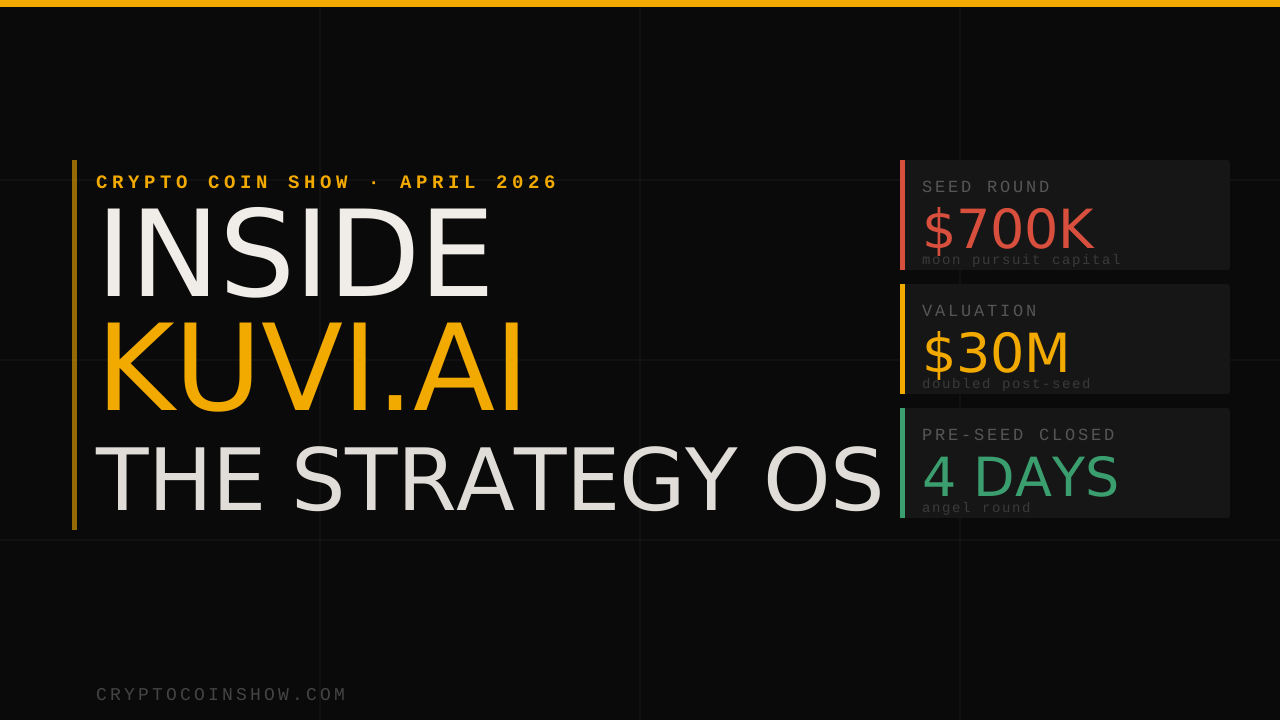
$700KSeed round, Moon Pursuit Capital
$30MValuation post-seed (doubled from $15M)
$KUVI$KUVI token · TGE upcoming
4 daysTo close the pre-seed angel round
Core Capabilities
The AF-OS is built on a modular agentic framework. The key mechanism is Executables — condition-based automations that fire across chains and data sources simultaneously when user-defined triggers are met.
Example — User intent → AF-OS Executable
“Buy $1K in memecoins when sentiment spikes and gas is low — exit when BTC dominance increases“
Prediction market automation
Conditional portfolio daemons
Narrative-driven triggers from X & social feeds
Strategy simulation & backtesting
Cross-venue execution routing
Risk & policy constraints
On-chain + off-chain data fusion
Natural language text-to-trade interface
Planned integrations include X, Polymarket, Reddit, Blockworks, and Messari — each new data source expanding the signals users can wire into their strategies. Early live integrations are with Solana-native protocols Raydium and Jupiter, with Ethereum and Bitcoin support following.
Business Model
Kuvi runs on two revenue streams: transaction fees on executed trades, and premium subscriptions for advanced automation, higher execution limits, and exclusive data integrations. The $KUVI token adds a BNB-parallel utility layer — stake dynamically to unlock free usage, fee discounts, and execution privileges, aligning token value directly with platform activity.
Token holdersGovernance rights over protocol parameters & ecosystem development
The Team
DD
Dylan Dewdney
Co-Founder & CEO · Toronto, Canada
Crypto-native entrepreneur active since 2011 — early Bitcoin miner, Ethereum genesis participant, $20M+ raised across Web3 and DeFi ventures. Published Agentic Finance thesis in Cointelegraph. Spoke at Skynet vs. Bitcoin Conference and Canada’s Futurist Conference on AI agents in crypto.
JN
Jay Nasr
Co-Founder & CTO
Built a DeFi protocol from scratch in 2016 and was among the first developers to integrate GPT-2 into Telegram. Brings rare depth across both early DeFi architecture and applied AI engineering — the technical core behind the AFOS daemon and strategy graph system.
COO Maxim Sindall brings experience scaling Web3 gaming startups. The team is distributed across Toronto and Germany, with women representing two of five core team roles.
Investors & Advisors
Moon Pursuit Capital
Lead seed investor · Managing Partner Utkarsh Ahuja, MIT Sloan MBA
Michael Terpin
Transform Ventures · Early advisor to Ethereum, TRON, Shiba Inu, Tether
Dennis Liu (VirtualBacon)
1.3M+ followers · retail ecosystem & community growth advisor
Peter Vincer
Government Relations Advisor · U.S. policy & institutional access
“By aligning incentives and democratizing access to advanced financial tooling, $KUVI ensures that algorithmic trading and wealth automation are no longer the exclusive domain of hedge funds and elites. We’re building the rails for the next era of value.”
Dylan DewdneyCo-Founder & CEO, Kuvi.ai
Ecosystem & Collaborators
Beyond the core investor table, Kuvi has built relationships across an unusually wide network — from privacy advocates and Ethereum founders to major crypto funds, exchange partners, and academic institutions.
Angel round closes in just 4 days at $15M valuation
August 2025
$700K seed round closes led by Moon Pursuit Capital · valuation doubles to $30M · AF-OS private beta launches with Solana integrations (Raydium, Jupiter)
August 2025
Acquisition of Altura (Web3 gaming infrastructure) · forensic report on prior exploit published · criminal report filed with Canadian authorities
2026
Whitepaper v2.0 published — the “Strategy Layer of Finance” · $KUVI TGE upcoming · continued multi-chain expansion toward Ethereum and Bitcoin protocol integrations
This article is for informational purposes only and does not constitute financial or investment advice. The $KUVI token and all digital assets carry risk, including potential loss of capital. Crypto Coin Show does not endorse any specific investment. Always conduct your own due diligence. Crypto Coin Show is listed as an ecosystem partner of Kuvi.ai.