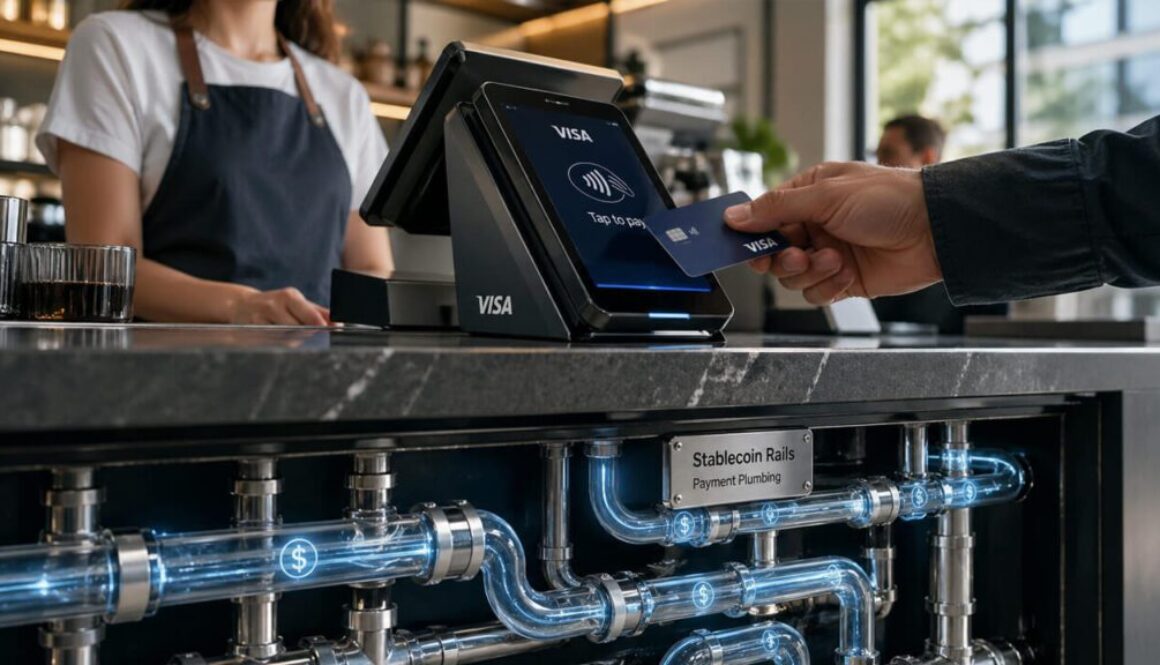
Global $2.75B payments deal shows stablecoins moving into the rails they were meant to bypass
Nuvei’s $2.75 billion acquisition of Payoneer signals that stablecoin adoption by mainstream commerce will depend on traditional payment processors that already control merchant relationships, regulatory licenses, and settlement networks. This suggests institutional crypto investors should expect stablecoin volume to flow through regulated infrastructure providers rather than autonomous blockchain rails, fundamentally reshaping how on-chain payments reach real-world merchants.
- Nuvei acquiring Payoneer for $2.75 billion to embed stablecoins into unified payment infrastructure serving 2.4 million customers globally
- Combined entity will process over $500 billion in annual payment volume across 190+ countries with integrated stablecoin capability
- Stablecoin adoption now depends on licensed payment processors holding merchant relationships and local regulatory approvals, not decentralized networks
- $2.75B Nuvei acquisition price, valuing stablecoin distribution integration
- $500B+ Annual payment volume processed by combined entity post-close
- 190+ Countries and territories covered by integrated payment infrastructure
Nuvei announced on June 15 that it would acquire all outstanding shares of Payoneer for $7.40 per share in an all-cash transaction valued at approximately $2.75 billion. The combined company is expected to generate roughly $3 billion in annual revenue and process more than $500 billion in annual payment volume, serving more than 2.4 million customers across over 190 countries and territories.
The deal, subject to Payoneer shareholder approval and regulatory clearances, is expected to close in mid-2027.
The strategic significance lies not merely in scale but in architecture: the two companies have embedded stablecoin functionality directly into their unified payment platform, positioning tokens as one settlement option within a broader infrastructure designed for traditional merchant acquiring, cross-border payouts, currency conversion, and fraud controls.
Payoneer’s Cross-Border Network Becomes the Distribution Channel for Stablecoins
Payoneer’s value to this deal flows from its existing position as a cross-border payments and financial services platform for businesses, marketplaces, contractors, and sellers requiring international money movement. The company operates a banking network, multi-currency accounts, and same-day or real-time settlement capability across more than 150 markets.
Critically, Payoneer holds regulatory assets that major cryptocurrency-only platforms lack: online payment services licensing in mainland China and in-principle authorization as a cross-border payment aggregator in India under the Reserve Bank of India’s framework. These approvals cannot be replicated quickly by blockchain-native companies and represent gatekeeping power over market access.
The stablecoin layer inside Payoneer’s infrastructure addresses a specific problem: a dollar token can settle value rapidly on-chain, but merchants and platforms still require acceptance protocols, risk screening, currency conversion, local payout rules, reconciliation systems, and usable bank accounts.
By integrating stablecoins into Payoneer’s existing cross-border network, the combined entity offers businesses a single partner capable of accepting, holding, and moving money, including token-based value, across jurisdictions where Payoneer already operates. This is materially different from stablecoins as a standalone technology.
The token becomes one settlement rail inside a regulated commerce stack, not a replacement for it.
Nuvei Adds Merchant Acceptance and Fraud Controls to Token Settlement
Nuvei contributes the demand-side infrastructure: global merchant acquiring, alternative payment methods, card issuing, currency management, and fraud and risk controls. The company already operates a platform designed to onboard merchants, process their transactions, manage multiple payment types, and handle compliance across geographies.
When merged with Payoneer’s supply-side payout and liquidity infrastructure, the combined platform can offer merchants both acceptance (Nuvei) and settlement (Payoneer) in a single system.
The addition of stablecoins to this stack addresses a specific operational problem for merchants: traditional cross-border payment settlement can take days and incur significant FX and intermediary costs. A stablecoin settlement option can theoretically reduce this friction, provided the merchant already trusts the processor and the token issuer.
By embedding stablecoins directly into Nuvei’s merchant platform, rather than requiring merchants to integrate a separate blockchain wallet or token protocol, the companies lower adoption friction.
Neither company has disclosed stablecoin-specific transaction volume or growth projections, keeping revenue claims modest and forward guidance uncertain.
Stablecoin Volume Will Flow Through Licensed Processors, Not Autonomous Chains
The strategic implication for institutional crypto investors is structural. Stablecoin adoption at commercial scale does not appear to depend on blockchain technology improving or competing directly with traditional banking rails. Instead, mainstream merchant adoption depends on regulated payment processors integrating tokens into their existing business models and compliance frameworks.
Nuvei and Payoneer are not building a blockchain-native platform; they are building a traditional fintech business that includes stablecoins as one capability.
This mirrors a pattern already evident in Visa’s stablecoin integration strategy. Visa’s stablecoin settlement pilot now spans nine blockchains and has reached a $7 billion annualized run rate across payment infrastructure, but those stablecoins are moving through Visa’s merchant relationships and settlement networks, not through decentralized alternatives.
Similarly, Payoneer’s existing licensing and banking partnerships in restricted markets like China and India give stablecoins access to geographies and merchant bases they could not reach independently.
Stablecoin volume is expected to concentrate within regulated fintech infrastructure, not distribute across autonomous blockchain networks.
Regulatory Approvals Will Determine Speed and Scope of Stablecoin Rollout
The deal closes in mid-2027, subject to Payoneer shareholder approval and regulatory clearances. The latter requirement matters more to stablecoin adoption than blockchain development.
Regulators in the 190+ countries Nuvei and Payoneer serve will determine whether stablecoin settlement is permitted, which issuers are acceptable, what capital or reserve requirements apply, and how proceeds are reconciled for anti-money laundering compliance. The companies have not disclosed which stablecoins will be integrated or under what regulatory framework.
That silence reflects the ongoing uncertainty around stablecoin regulation in most major jurisdictions.
In the European Union, the Markets in Crypto-Assets Regulation (MiCA) establishes stablecoin reserve requirements and issuer licensing. In the U.S., stablecoin regulation remains fragmented across the Federal Reserve, OCC, state banking authorities, and the SEC. In Asia, where Payoneer’s China and India licenses are most valuable, stablecoin frameworks remain nascent or restrictive.
The deal’s value depends partly on regulatory clarity that does not yet exist.
Stablecoin adoption by the combined entity will depend on regulatory approval timelines in each of the 190+ markets served, not on blockchain scalability or token protocol maturity.
Institutional Investors Should Monitor Stablecoin Volume Disclosure and Regulatory Filings
For institutional crypto investors, the Nuvei-Payoneer deal is significant precisely because it lacks hype and offers measurable commercial traction. The companies claim $3 billion in annual revenue and $500 billion in payment volume at closing. Neither company has disclosed stablecoin-specific volume or revenue contribution, which suggests initial integration will be modest.
Volume and adoption data will come through regulatory filings, quarterly earnings calls, and investor presentations after the deal closes in mid-2027.
The institutional signal is not about blockchain disruption but about mainstream finance absorbing stablecoins into existing infrastructure. If Payoneer and Nuvei successfully integrate stablecoin settlement into their merchant platforms and deliver meaningful volume growth, it will validate the use case for cross-border B2B payments.
If stablecoin volume remains negligible or fails to differentiate the combined company’s competitive position, it will suggest that regulatory friction, merchant indifference, or issuer risk limits adoption even within licensed payment infrastructure.
Watch for stablecoin volume disclosure in