Uniswap’s founder, Hayden Adams, has shared that the company collects roughly $5.2 million in fees per day. Data from DefiLlama backs the figure at $5.16 million over the past 24 hours.
The surge is largely thanks to Robinhood’s two-week-old blockchain, which now accounts for most of that fee flow. Meanwhile, a key governance vote is underway that could extend UNI token burns to v4 pools.
Why is Robinhood Chain so important for Uniswap?
Uniswap’s CEO, Hayden Adams, has revealed through a post on X that it is raking in over $5 million in fees every day, with Robinhood’s new blockchain, which launched on July 1, accounting for most of that money.
Of the $5.16 million in fees Uniswap collected over 24 hours, DefiLlama attributes $4.38 million to Robinhood Chain. In comparison, Ethereum, which used to be the protocol’s core market, contributed only about $296,000. Base was close behind at roughly $288,000.
Robinhood Chain, built on Arbitrum’s technology, went live on July 1. The trading activity on the blockchain has exploded since then, with more than 220,000 daily traders and cumulative volume hitting $1 billion in just nine days.
For UNI token holders, this could mean more token burns if a current “snapshot” vote regarding extending its fee-and-burn mechanism to v4 pools passes.
Uniswap was integrated as the main automated market maker from day one. Its v2, v3, v4, and UniswapX products were all deployed at launch. Over seven days, Robinhood Chain accounts for $10.98 million of Uniswap’s $20.1 million total weekly fees.
UNI is trading around $3.62, up roughly 35% from its early-July low of about $2.70. However, it remains about 92% below its all-time high of $44.97 reached in May 2021.
Across all 47 chains it operates on, Uniswap logged $2.112 billion in 24-hour DEX volume, more than five times the next-largest exchange, PancakeSwap.
The company’s CEO, Hayden Adams, posted on X that the protocol was out-earning every crypto project except the stablecoin issuers behind USDC and USDT.
However, it is important to note that these “fees” are not the same as protocol income. DefiLlama shows Uniswap’s 24-hour revenue at just $73,454. The bulk of the $5.2 million flows to liquidity providers, not to the treasury or token holders directly.
How will the snapshot vote affect users?
Cryptopolitan previously reported that Uniswap Labs is running a “Snapshot” vote from July 7th to the 12th. The vote is regarding whether or not to extend its fee-and-burn mechanism to v4 pools.
This mechanism is part of the UNIfication program approved in December 2025 that requires anyone who wants to claim fees from the protocol to first burn an equivalent value of UNI tokens. The burned tokens are permanently removed from circulation.
Early Snapshot results indicate over 93% approval, with about 13.9 million UNI votes in favor. If passed, binding on-chain votes are expected the week of July 13.
The proposal would activate fees on three families of v4 pools across 11 different blockchain networks, including Ethereum, Arbitrum, and Polygon. This expansion would broaden the burn engine to its largest scope yet.
Uniswap holds a record of burning 186,000 UNI in a single day last month, surpassing the previous daily high of 134,000.
However, liquidity providers have warned that the v4 fee switch could drive them away. Protocol fees are taken from the amount that LPs earn, so fee-enabled pools will offer slightly lower returns than those with zero fees.
Don’t just read crypto news. Understand it. Subscribe to our newsletter. It’s free.
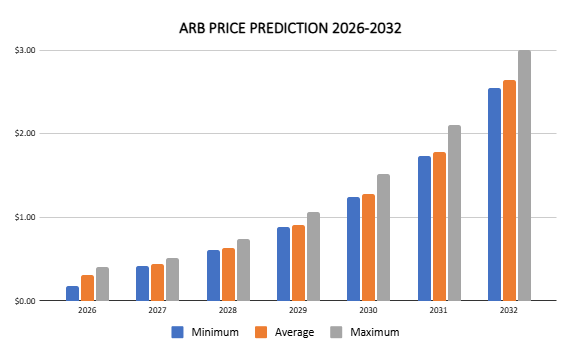
Our ARB predictions anticipate a high of $0.31 in 2026.
In 2028, the range is expected to be between $0.61 and $0.74, with an average price of $0.63.
In 2030, it will range between $1.24 and $1.52, with an average price of $1.28.
Arbitrum price prediction points to a modest near-term outlook and a stronger long-term move: our ARB forecast sees a high of $0.31 in 2026, with the token potentially reaching between $1.24 and $1.52 by 2030 and averaging $1.28, which suggests it could reclaim and move past $1 by the end of the decade.
Layer 2s have generated considerable buzz for their efficiency, and the Arbitrum network is in the top 5 pack, with a total value locked (TVL) of $1.24 billion. Arbitrum is an Optimistic Rollup solution that shifts network operations away from the Ethereum mainnet while maintaining Ethereum-level security.
For crypto investors, traders, and enthusiasts weighing ARB’s upside, this analysis examines Arbitrum’s current price action, technical indicators, market trends, competition, historical sentiment, and the key factors shaping its forecasts from 2026 to 2032. Is Arbitrum a good investment? Will it go up? Where will it be in 5 years? Let’s answer those questions with a data-driven Arbitrum price prediction to help you make more informed decisions in a volatile market.
Overview
Cryptocurrency
Arbitrum
Current Arbitrum price
$0.07930
Market cap
$504.43M
Trading volume
$42.92M
Circulating supply
6.36B
All-time high
$2.40 on Jan 12, 2024
All-time low
$0.07067 on Jun 26, 2026
24-hour high
$0.08141
24-hour low
$0.07757
Arbitrum price prediction: Technical analysis
Metric
Value
Volatility (30-day variation)
4.99% (Medium)
50-day SMA
$0.08892
200-day SMA
$0.1233
Sentiment
Bearish
Green days
15/30 (50%)
Fear and Greed Index
27 (Fear)
Arbitrum price analysis
On July 7, Arbitrum’s price fell 0.78% over 24 hours and 3.16% over the last 30 days. The drop reflected recent ARB price action, accompanied by waning trading volume (-15.59%). Broader cryptocurrency markets and ETH prices can shape short-run sentiment, influence Layer 2 activity, and drive ARB price movements as market conditions shift.
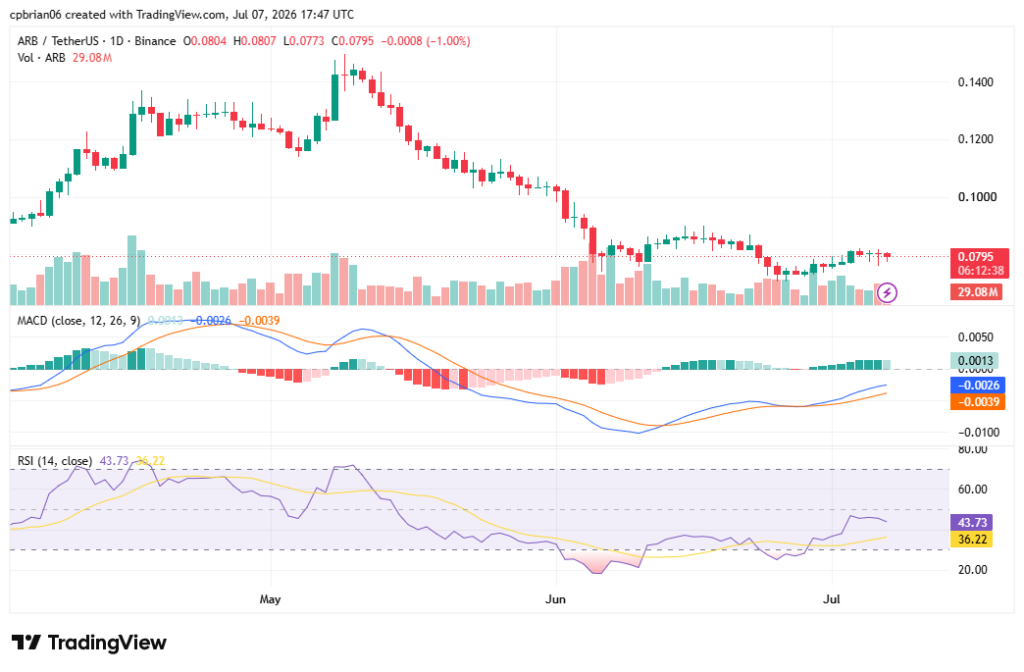
ARB has consistently traded lower, reflecting a short-term bearish trend. The drop tracked the broader altcoin rally, driven by capital rotation from the sector — reflected in a declining Altcoin Season Index. ARB now has support at $0.073, and traders watch such low prices as potential support floors for buying interest in the week ahead.
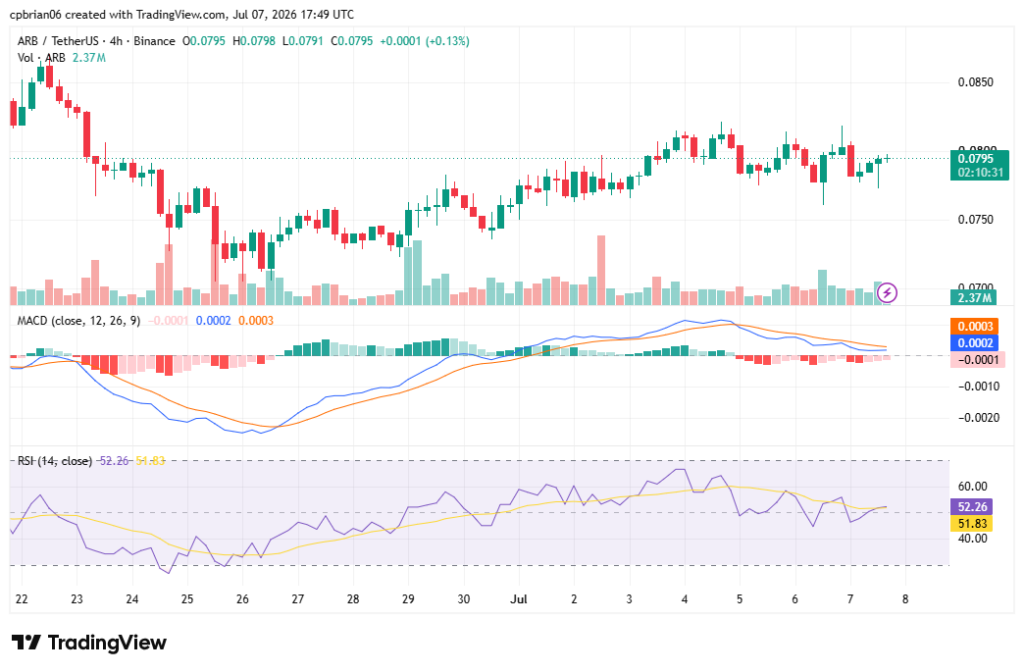
ARB registered a new all-time low (ATL) of $0.071 last month. The chart highlights ARB run following the drop. With its Relative Strength Index at 51,83, it is neutral. Psychological resistance around $0.08 could cap any rebound, though the selected time frame may change how traders interpret that signal, as bearish pressure persists.
Arbitrum technical indicators: Levels and action
Daily simple moving average (SMA)
Period
Value ($)
Action
SMA 3
0.07991
SELL
SMA 5
0.07951
SELL
SMA 10
0.07723
BUY
SMA 21
0.07902
BUY
SMA 50
0.08892
SELL
SMA 100
0.1035
SELL
SMA 200
0.1233
SELL
Daily exponential moving average (EMA)
Period
Value ($)
Action
EMA 3
0.07970
SELL
EMA 5
0.07922
SELL
EMA 10
0.07853
BUY
EMA 21
0.08000
SELL
EMA 50
0.08855
SELL
EMA 100
0.1020
SELL
EMA 200
0.1412
SELL
What to expect from the ARB price analysis next?
Arbitrum is moving downwards on the shorter timeframes, with moving averages still leaning bearish. Analysts use technical indicators to predict near-term price movements over the next week and next month.
Why is Arbitrum down?
ARB’s price remains below major moving averages, confirming the bearish trend structure. The RSI14 at 36.22 in neutral territory. Volume fell, indicating the move lacks conviction but also shows no urgency to buy the dip.
Does Arbitrum have a future?
As a Layer-2 scaling solution for the Ethereum network, Arbitrum uses optimistic rollups to process transactions off-chain and submit proofs back to Ethereum; high adoption is crucial to Arbitrum’s long-term success and sustainability. Arbitrum’s performance in this regard is a positive sign for its future prospects despite price declines. The ARB token is a governance token, and ARB holders use it to govern the Arbitrum DAO through protocol upgrades, treasury management, and ecosystem grants. It is not used to pay transaction fees on the network. As an L2 network, its growth also depends on Ethereum upgrades, rollup-focused development, and the broader ecosystem supporting the base layer. Rising active addresses, transaction volume, and dApp expansion can signal growth across the DeFi ecosystem, where Arbitrum supports over 575 protocols and holds about 45.53% of Layer 2 TVL, while remaining a leading chain among Layer 2s with strong transaction-fee revenue.
Recent news
A scheduled unlock of 14.4M ARB tokens, valued at $1.1 million, is set for July 7. Such events often create anticipatory selling pressure as the market prices in the potential dilution from newly liquid tokens, and further token unlocks later in 2026 add to that overhang.
ARB price prediction July 2026
The Arbitrum price forecast for July is estimated at a range of $0.0750 to $0.1001, and this monthly outlook is one of several short run price predictions investors may track. The average price for the month will be $0.0809.
Month
Potential low ($)
Potential average ($)
Potential high ($)
July
0.0750
0.0809
0.1001
Arbitrum price prediction 2026
For 2026, ARB’s price will range between $0.06 and $0.31. The average price for the period will be $0.21. Other market analysis projects 2026 between $0.08574 and $0.251, with an average of $0.1683.
Year
Potential low ($)
Potential average ($)
Potential high ($)
2026
0.0608
0.2122
0.3109
Arbitrum price prediction 2027-2032
Year
Potential low ($)
Potential average ($)
Potential high ($)
2027
0.4207
0.4364
0.5134
2028
0.6123
0.6341
0.7447
2029
0.8807
0.9124
1.06
2030
1.24
1.28
1.52
2031
1.73
1.78
2.10
2032
2.55
2.64
3.00
Arbitrum price prediction 2027
Arbitrum market price prediction climbs even higher into 2027. Some external forecasts place ARB’s price in a much more bullish $5.00 to $8.00 range across 2027-2028. Some crypto analysts place 2027 in a wider comparative range of $0.157 to $0.446, with an average near $0.3015. According to arbitrum’s price forecast, ARB’s price will range from $0.42 to $0.51, with an average of $0.44.
Arbitrum coin price prediction 2028
Our analysis indicates a further acceleration in ARB’s price. It will trade between $0.61 and $0.74 and an average price of $0.63.
Arbitrum price prediction 2029
According to the 2029 Arbitrum forecast, ARB’s price will range from $0.88 to $1.06, with an average of $0.91.
ARB price prediction 2030
The ARB price prediction for 2030 is $1.24-$1.52, with an average of $1.28. Broader 2030 projections place ARB between $2.46 and $5.78, with an average of $4.12. In a bullish scenario, some forecasts extend toward $12.00, though the long-term impact depends on several factors, including on-chain metrics, market conditions, Layer-2 adoption, Ethereum scaling upgrades, TVL, and competition.
Arbitrum price prediction 2031
The Arbitrum price forecast for 2031 is a high of $2.10. It will reach a minimum price of $1.73 and an average price of $1.78.
Arbitrum ARB price prediction 2032
The year 2032 will also be bullish. Our analysis estimates a price range of $2.55 to $3.00, with an average price of $2.64. A conservative model suggests ARB could be around $0.13 by 2036 and $0.26 by 2051.
This table compares analyst market analysis on the price of Arbitrum across leading platforms and acts as a simple price prediction tool for reviewing outside analyst forecasts.
Cryptopolitan’s arbitrum price forecast indicates that ARB will reach a high of $0.31 in 2026, and whether it looks like a good buy depends on your risk tolerance and timeframe. At its current price below $1, ARB would need a 1000% surge to reach $10. Any path there faces potential short-term constraints from supply growth and market sentiment, so it would likely take several years even in favorable conditions. Since its launch, ARB has peaked at $2.40, so a $10 target at the current price level seems highly implausible. In 2028, the range is expected to be between $0.61 and $0.74, with an average of $0.63. In 2030, the range is likely to be between $1.24 and $1.52, with an average of $1.28. Do your own research and invest at your own risk.
The Arbitrum airdrop snapshot occurred on Feb 6, 2023, and eligible participants, including early users, started claiming ARB tokens on Mar 23, 2023. The claiming period ended on Sep 24, 2023.
The airdrop granted 11.5% of the total supply to eligible users, 1.1% to DAOs operating in the Arbitrum ecosystem, and 44% to employees and Offchain Labs investors. The 44% is subject to lock-up periods and a vesting schedule, while whales control 57.13% of the supply, which can influence price movements when large holders reposition. The rest was sent to the Arbitrum DAO treasury.
ARB is the native token of the network, with a total supply capped at 10 billion, annual inflation of 2%, and 12.75% of the supply initially distributed to eligible users and DAOs.
A significant share of supply remains locked and is released gradually into circulation, potentially creating selling pressure if demand does not keep pace.
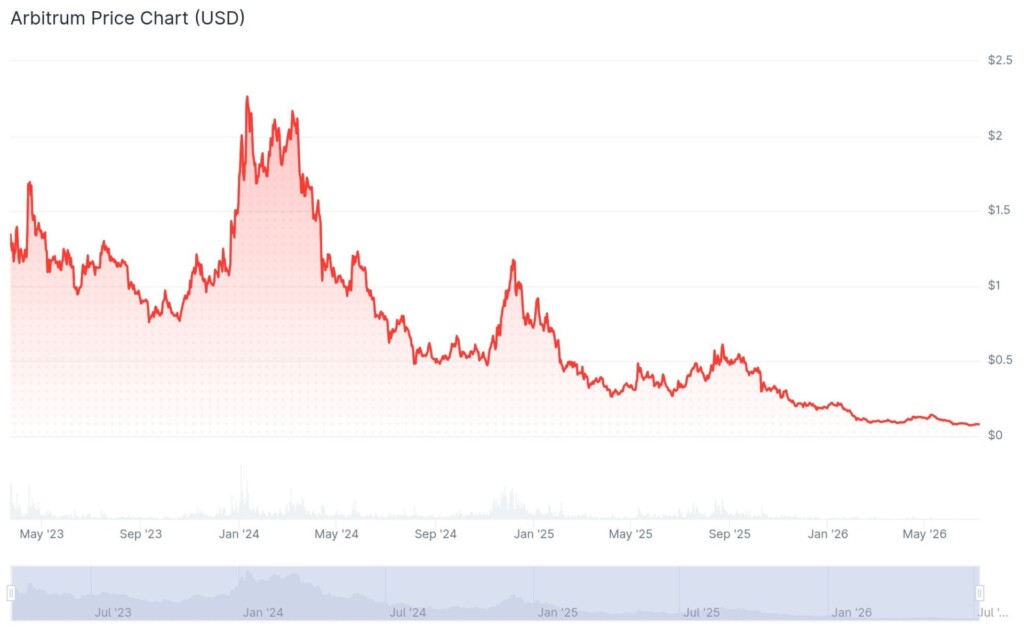
On Sep 11, 2023, it fell to its all-time low at $0.7453.
Bitcoin’s halving and the hype around crypto ETFs helped the coin recover from its October slump. By the end of the year, it had risen to $1.4.
The run continued into 2024. On Jan 12, it reached its all-time high at $2.40.
According to CoinMarketCap data, ARB fell below its listing price in June 2024.
On August 5, 2024, it registered a new all-time low of $0.4317
It then recovered in September, reaching a high of $0.67.
The bullish run continued into November, reaching $1.12 in December.
The Arbitrum network includes Arbitrum One for dApps that need stronger security and Arbitrum Nova for high-throughput use cases such as gaming and social apps; for example, this structure lets more security-sensitive DeFi apps stay on One while lighter social activity can run on Nova.
The coin entered 2025 trading at $0.72 before entering a bear run, falling to a low of $0.40 in February.
It recovered later and crossed into October, trading at $0.45. The trend later reversed, and by date 11, it had fallen to $0.136.
In December, it traded at $0.20.
ARB then entered a bear market in 2026, and on Mar 30, 2026, it hit an all-time low of $0.08653.
It later began to recover, and by May it had crossed above $0.12. The trend reversed in June, trading at $0.08. It maintained the level into July.
Competition from other blockchain projects remains a key factor for ARB, and Arbitrum faces competition from Optimism and zkSync, as well as Ethereum L2 rivals such as Base.
Autheo Presents ETHToronto 2026, Bringing Builders Together to Shape the Future of Web3 & AI
DateJuly 22, 2026
LocationToronto, ON
Edition5th Annual
Part ofCanada Crypto Week
The 5th Annual ETHToronto returns on July 22, 2026, bringing together builders for an afternoon of sessions, panels, and networking. Presented by Autheo and held as part of Canada Crypto Week, the event is designed to connect the people building the future of Web3 and AI.
Program
ETHToronto opens with Whitepaper Reading Club, a discussion-first session exploring blockchain whitepapers and the technical concepts shaping the future of Web3. This is followed by a full slate of speaker sessions.
Featured Speakers
Edward Johnson
Autheo
Ben Greenberg
Arbitrum
Arman Mamyan
Animoca Brands
Jerry Qian
OPTN Labs
Matthew Glezos
Toronto DAO
Elizabeth McFaul
Solana Foundation
Charles St. Louis
Ethereum Foundation
Top Sponsor
Autheo joins ETHToronto as the Top Sponsor, supporting the developers driving the next generation of Web3. Autheo is a Layer-0 Operating System with an integrated Layer-1 blockchain that combines identity, compute, storage, developer tooling, and AI capabilities into a single interoperable platform.
“Builders and developers are the foundation of every major innovation in Web3. We’re proud to support ETHToronto and help bring together the community creating the next generation of sovereign decentralized applications, infrastructure, and AI-powered technologies.”
— Edward Johnson, Chief Product Officer, Autheo
Evening Program
Following the sessions, attendees are invited to Devs & Bevs, an evening networking event designed to bring together developers, founders, and builders for meaningful conversations and new connections.
World Boss Media will also be onsite conducting live interviews with leaders throughout the event. As a leading Web3 marketing agency, World Boss Media helps companies grow through branding, influencer marketing, and community-driven campaigns.
ETHToronto takes place on July 22, 2026, as part of Canada Crypto Week and alongside Blockchain Futurist Conference — Canada’s largest Web3 and AI event.
ETHToronto is an annual gathering of developers, founders, and innovators building the future of Web3. Held as part of Canada Crypto Week, the event brings together the builder community through technical discussions, networking opportunities, and collaborative learning in the city where Ethereum was born.
About Autheo
Autheo is a Layer-0 Operating System with an integrated Layer-1 blockchain that unifies identity, compute, storage, developer tooling, and AI capabilities into a single interoperable environment. By simplifying infrastructure and providing powerful tools for builders, Autheo is helping accelerate the next generation of Web3 innovation.
Arbitrum’s Security Council Seizes $71M in Stolen ETH After KelpDAO Bridge Hack
BREAKING · APRIL 21, 2026 · ARBITRUM · DEFI ANALYSIS
Arbitrum’s Security Council Seizes $71M in Stolen ETH After KelpDAO Bridge Hack
Arbitrum’s Security Council just immobilized $71 million in stolen ETH. One emergency vote.
Nine signatures. And a question that won’t go away: can a “decentralized” network
really freeze your funds?
ETH Frozen30,766 ETH ≈ $71M
Original Exploit$292M rsETH
Council Vote9 of 12 in favor
Suspected ActorLazarus Group (DPRK)
$292MTotal Exploit Value
$71METH Frozen by Arbitrum
18%rsETH Supply Drained
$230MPotential Aave Bad Debt
§ 01 — The Attack
How 116,500 rsETH Materialized Out of Thin Air
On Saturday, April 18, 2026, at precisely 17:35 UTC, someone
did something extraordinary: they minted 116,500 rsETH tokens on Ethereum mainnet
with zero legitimate backing behind them. Worth roughly $292 million
at the time, this wasn’t a flash loan attack or a smart contract reentrancy bug.
The contracts ran exactly as written. The verification layer was the weapon.
KelpDAO is a liquid restaking protocol built on EigenLayer. Users deposit ETH,
which earns compounding yield across EigenLayer’s Actively Validated Services,
and receive rsETH — a tradeable liquid restaking token representing
their position. To enable rsETH to move across the multi-chain ecosystem, KelpDAO
deployed a LayerZero-based bridge architecture using the OFT
(Omnichain Fungible Token) standard. As of the exploit, that bridge held the
backing reserve for rsETH deployed across more than 20 networks — Arbitrum, Base,
Linea, Blast, Mantle, Scroll, and more. The protocol had roughly $1.07 billion
in total value locked, making it the second-largest participant in EigenLayer’s
ecosystem. This was the reserve that was drained.
// Forged origin packet → EID 30320 (Unichain)
→ 116,500 rsETH released from escrow
→ Single Transfer · One OFTReceived · One PacketDelivered
→ ~$292,000,000 exited the protocol
The Technical Root Cause: A 1-of-1 DVN
LayerZero’s security model is built on Decentralized Verifier Networks
(DVNs) — independent entities that verify and attest to the authenticity
of cross-chain messages. When a message travels from Chain A to Chain B, one or
more DVNs must observe the packet on the source chain and deliver a signed
attestation to the destination. The critical configuration choice is how many
DVNs must agree.
KelpDAO’s rsETH bridge was configured with a 1-of-1 DVN setup —
LayerZero Labs itself as the sole verifier. A single signature was all that stood
between the bridge’s escrow and the open internet. The attackers, preliminarily
attributed to North Korea’s Lazarus Group (TraderTraitor unit),
exploited this exactly.
April 18 · 10:20 AM PT
RPC Node Compromise Begins
Attackers compromise two of LayerZero’s downstream RPC nodes, swapping out
op-geth binaries with malicious versions engineered to selectively lie to the DVN
while reporting accurate data to all other querying IP addresses.
April 18 · ~11:30 AM PT
DDoS Triggers Failover
Attackers DDoS the uncompromised RPC nodes, forcing LayerZero’s DVN to failover
to the poisoned endpoints. The malicious nodes confirm fraudulent cross-chain
transactions that never occurred on the source chain.
April 18 · 17:35 UTC
The Drain — 116,500 rsETH Released
A forged LayerZero packet claiming origin from KelpDAO’s Unichain deployment
passes the single compromised DVN. The OFT Adapter releases 116,500 rsETH
from escrow to the attacker’s address. ~$292M exits in a single transaction.
April 18 · 18:21 UTC
KelpDAO Emergency Pause (46 Minutes Later)
Kelp’s emergency multisig freezes core contracts. Two subsequent follow-up
attacks at 18:26 and 18:28 UTC — each attempting another 40,000 rsETH (~$100M)
— both revert. The pause held.
April 18–19
DeFi Contagion Spreads
Attackers weaponize stolen rsETH as Aave v3 collateral, borrowing $196M in WETH.
Aave WETH markets hit 100% utilization. Aave, SparkLend, and Fluid freeze rsETH
markets. $6.6B in TVL collapses within 48 hours across affected protocols.
§
§ 02 — The Intervention
Arbitrum’s Security Council Acts: A Race Against the Bridge
As stolen funds began moving through the ecosystem, blockchain security firm
PeckShield flagged a critical development: the exploiter had
already initiated a native bridge withdrawal from Arbitrum back to Ethereum
mainnet. The clock was ticking. If the 30,766 ETH that had been consolidated
on Arbitrum One completed the withdrawal, it would enter Ethereum’s base layer —
far harder to intercept.
The Arbitrum Security Council — a 12-member body elected by
the Arbitrum DAO through semi-annual elections — convened an emergency session.
According to council member Griff Green, the deliberation involved
“countless hours of debates, technical, practical, ethical and political.”
Nine of the twelve members voted to act. The council coordinated with law enforcement,
who provided input on the exploiter’s identity. Security researchers later linked
the operation to North Korea’s Lazarus Group.
“The Security Council identified and executed a technical approach to move
funds to safety without affecting any other chain state or Arbitrum users.”
— Arbitrum Security Council · April 21, 2026
Using the 0x0000000000000000000000000000000000000DA0 precompile
— a standard native ETH transfer mechanism — the council moved 30,766 ETH
to a protocol-controlled intermediary address. The freeze was confirmed by
Lookonchain approximately 20 minutes after execution. The
funds were intercepted before the bridge withdrawal completed.
Represents ~24% of the total $292M stolen PARTIAL RECOVERY
Remaining ~$220M moved via other chains UNRECOVERED
Lazarus Group suspected to be routing remainder LAUNDERING
For observers watching the situation unfold in real time, the move carried a weight
that went beyond the mechanics of a single freeze. Dylan Dewdney, Founder of Kuvi AI,
was among those who felt the historical echo immediately.
“It’s a fascinating moment for crypto governance — reminds me actually of the same
gravitas as TheDAO, in a way. On one hand, decentralization purists will hate it.
On the other, a DAO effectively looked at a state-sponsored hacking group and said:
not this time. Arbitrum just demonstrated that onchain systems can defend themselves
in real time. In a strange way, they out-coordinated one of the most sophisticated
adversaries in the world. Legitimately onchain gangster moves.”
— Dylan Dewdney, Founder, Kuvi AI
§
§ 03 — The Blame Game
LayerZero vs. KelpDAO: Who Owns a $292M Default?
Even as funds were being frozen, a parallel battle erupted between the two parties
at the center of the exploit. LayerZero moved first with a post-mortem attributing
responsibility squarely to KelpDAO’s configuration choices. Kelp fired back with
documentation. The dispute cuts to the heart of modular DeFi architecture.
LayerZero’s Position
LayerZero stated that KelpDAO “chose to utilize a 1/1 DVN configuration”
despite the protocol’s consistent recommendation of multi-DVN redundancy.
The firm argued that a properly hardened setup would have required consensus
across multiple independent verifiers, making the attack ineffective even with
a single node compromised. LayerZero announced it would stop signing
messages for any application using a single-validator setup going forward,
forcing a broad migration across its ecosystem.
KelpDAO’s Counter
Kelp pushed back hard. The team argued the 1-of-1 DVN was not a rogue customization
but LayerZero’s own documented default. The protocol’s
V2 OApp Quickstart — including the sample layerzero.config.ts — wires
every pathway with one required DVN and no optional DVNs. Kelp added that approximately
40% of protocols currently on LayerZero use the same configuration,
and that in the direct communications channel with LayerZero open since July 2024,
there was no specific recommendation to change the rsETH DVN setup.
@cryptogoblin · April 19, 2026
“The KelpDAO exploit (~$290M) is NOT a LayerZero protocol bug. It’s a configuration
issue and a case study every project with a cross-chain token needs to look at today.
The smart contracts weren’t broken. The verification layer was.”
@FishyCatfish · April 19, 2026
“There is no security floor. A configuration can be a 1/1 DVN and the DVN you chose
can be a single node ran by a single entity. This is a design flaw.”
Independent analysis from Blockaid confirmed: “The KelpDAO exploit will be studied
as the definitive case study in bridge DVN configuration risk. It did not require a
zero-day. It exploited a weak governance policy and limited controls.” Chainalysis
put it more bluntly: the attack proves that detecting malicious code isn’t
enough — protocols must detect when a system enters an impossible state.
§
§ 04 — DeFi Implications
The Contagion Map: From rsETH to Aave to the Whole Ecosystem
The KelpDAO exploit did not stay contained. Within 46 minutes of the drain, the
attackers began weaponizing the stolen rsETH across DeFi’s interconnected lending
infrastructure. The mechanics were straightforward and devastating.
Attackers deposited the minted rsETH on Aave v3 as collateral and
borrowed $196 million in WETH against it. Aave’s WETH market hit
100% utilization, rendering deposits inaccessible
and triggering a $5.4 billion liquidity withdrawal cascade. Total DeFi TVL collapsed
by $6.6 billion within 48 hours. Aave, SparkLend, and Fluid all froze
their rsETH markets. Lido disclosed approximately $21.6 million in rsETH exposure
through its EarnETH product and signaled it may deploy a $3 million loss buffer.
Scenario A: Losses socialized across all rsETH holders across chains
$123.7M bad debt · ~15% depeg
Scenario B: Losses isolated to L2 markets (Arbitrum, Mantle)
Up to $230.1M impact
Aave treasury backstop available $181M treasury
Umbrella model available in certain cases Active
April 2026 has become the worst month for crypto hacks since February 2025,
with over $606 million lost in just 18 days.
The KelpDAO incident came on the heels of the Drift Protocol breach
($285M, April 1) — also linked to Lazarus Group — suggesting a sustained,
coordinated campaign targeting DeFi infrastructure rather than isolated opportunistic
attacks.
The structural lesson is uncomfortable: liquid restaking tokens (LRTs)
as collateral on money markets create systemic amplification. When an
LRT loses peg or backing, lending protocols don’t just feel the impact of the
token — they absorb the entire downstream leverage built atop it. This is the
second time in 2026 that an LRT collateral accepted on Aave has produced a
nine-figure incident downstream of a non-Aave failure.
§
§ 05 — The Core Tension
The Decentralization Paradox: Safety Valve or Fatal Contradiction?
Arbitrum’s intervention was precise, effective, and — for many in the crypto
community — deeply troubling. In a single emergency session, a 12-person council
immobilized 30,766 ETH that an external party held in their address.
The funds were moved without a DAO vote, without the standard governance delay,
and without consulting the broader community before execution. The legality, the
ethics, and the precedent are all contested.
“A 12-person committee — elected by ARB token holders, sure — just demonstrated
it can immobilize any funds on the network given sufficient justification. For a
technology built on the promise of permissionless transactions, that’s either a
necessary safety valve or a fundamental contradiction.”
— Blockchain.news analysis · April 21, 2026
The Arbitrum Security Council is defined in the Constitution of the
Arbitrum DAO as a 12-member body divided into two cohorts, with members
elected in semi-annual elections by ARB token holders. The council is bound by
the Constitution to use its emergency powers only when necessary for
declared security emergencies, and must issue a transparency report when those
powers are invoked. The frozen ETH can only move through further governance action —
ARB holders will ultimately vote on its fate.
The Community Splits
For the Freeze
$71M recovered, likely from state-sponsored thieves
Zero impact on legitimate users or applications
Law enforcement coordination adds legitimacy
Funds remain under governance — not taken
DPRK laundering would have made recovery impossible
Security Council acted within its constitutional mandate
Against the Freeze
Permissionless transactions is the core value proposition
Council can theoretically freeze any funds on the network
Sets precedent for future, potentially non-consensual freezes
“Decentralized” becomes a marketing term, not a guarantee
Who decides what justification is “sufficient”?
Ethereum community has concerns about L2 centralization
@Leonidas (DOG creator) · April 21, 2026
“Decentralized has become a marketing term. Only Bitcoin is actually decentralized.”
@baeyeee · April 21, 2026
“WLFI is accused of wrongfully freezing user assets, while ARB froze stolen funds
linked to DPRK hackers. One is ethically accepted, the other is criticized — but both
prove the same point. When it matters most, governance overrides decentralization.”
@JoelKatz (Ripple CTO David Schwartz) · April 21, 2026
“They can make the chain claim that they did whatever they want to all of the funds
on the chain. But they cannot compel anyone to listen to those claims. Everyone else
can make different claims and choose which set of claims to honor.”
The Stage 2 Problem
The Arbitrum DAO’s own governance documentation asks the question directly:
“Can the governance process be further decentralized? How and when can the
Security Council’s power be further minimized, or eliminated entirely?”
These don’t have easy answers. Arbitrum achieved Stage 1 decentralization
with permissionless fraud proofs via the BoLD upgrade. But Stage 2
— which would limit the Security Council to adjudicating only demonstrable bugs —
remains a future aspiration, not a current reality.
The irony is sharp: the same emergency power that just recovered $71M in stolen funds
is precisely the mechanism that prevents Arbitrum from claiming Stage 2 decentralization.
Security and trustlessness are in direct tension, and today’s events demonstrated
that tension is not theoretical.
§
§ 06 — What Comes Next
Open Questions & The Road Forward
As of April 21, 2026, the 30,766 ETH remain locked in the protocol-controlled
address at 0x000...0DA0. No timeline has been
set for final disposition. The ARB community will vote on what happens to the funds
— options range from returning them to affected KelpDAO users to holding them pending
law enforcement proceedings. KelpDAO’s rsETH contracts remain paused. Founders
Amitej G and Dheeraj B have not announced a recovery timeline.
Open Questions as of Publication
How will ARB governance vote to allocate the frozen $71M? PENDING VOTE
Will other chains with similar emergency powers freeze their portions? UNCERTAIN
Who bears legal liability — KelpDAO, LayerZero, or both? DISPUTED
Will Aave deploy its Umbrella backstop for rsETH bad debt? MONITORING
Will LayerZero’s forced DVN migration affect other protocols? IN PROGRESS
Can the remaining $220M be traced before laundering completes? UNLIKELY
The KelpDAO exploit has accelerated three structural conversations that DeFi has
been deferring: bridge configuration standards (who sets them, who
enforces them, and who is liable when defaults cause catastrophic losses);
LRT collateral risk in money markets (the second $100M+ incident
in 2026 with restaked ETH tokens as the vector); and Layer 2 emergency
powers (the legitimate tension between user protection and permissionless
guarantees).
Chainalysis’s recommendation cuts through the noise: protocols must build systems
capable of detecting when they have entered an “impossible state” —
where issued tokens exceed locked collateral. For a cross-chain bridge, that means
real-time consistency monitoring across every deployed chain. For DeFi as a whole,
it means acknowledging that the “code is law” principle has never been fully true —
and deciding what replaces it.
“The Lazarus Group, if indeed responsible, has already moved the remaining $220 million
through various chains. Arbitrum caught what it could. The rest is likely gone.”
Ethereum recorded a major on-chain milestone in the first quarter of 2026 across its base layer activity. Data from Artemis shows the network processed over 200 million transactions, its highest quarterly total on record.
On a quarterly basis, this represents a 43% increase from 145 million transactions in the previous quarter ending late 2025. Quarterly activity previously bottomed near 90 million in 2023 before stabilizing through most of 2024.
What’s Driving Ethereum’s Activity Growth?
Growth was driven mainly by Layer 2 networks that process transactions off-chain and settle on Ethereum. Rollups such as Base and Arbitrum bundle activity, increasing recorded base-layer transaction counts significantly over time.
Alongside this scaling effect, stablecoin issuance also expanded, pushing total supply on Ethereum to about $180 billion in the quarter. These dollar-pegged tokens now support decentralized finance activity, payments, and remittance flows across the ecosystem.
Network-level efficiency also played a role. The Dencun upgrade reduced data costs for Layer 2 networks, limiting direct fee pressure on the Ethereum mainnet. As a result, higher usage did not translate into proportional gas fees or increased ETH token burns.
What This Means for Ethereum’s Next Phase
Despite stronger network activity, Ether price remains near $2,400, still more than 50% below its 2025 peak levels. Analysts note a growing divergence between on-chain usage and market valuation trends.
Some market observers view this gap as a sign of delayed pricing response to network fundamentals. Historical cycles suggest sustained on-chain expansion often precedes broader price recovery phases in crypto markets.
However, analysts caution that transaction growth may include automated stablecoin movements rather than new user adoption. This raises questions about how much of the activity reflects genuine economic demand on the network.
Future momentum depends on whether the network maintains over 200 million transactions into the second quarter of 2026, alongside continued stablecoin and Layer 2 activity. These factors will determine whether the current level of network usage is sustained or fades.
The broader question is whether strong on-chain activity will eventually translate into renewed long-term market strength. This uncertainty is amplified as Ethereum’s usage, scaling, and price trends continue to move in different directions.
KelpDAO has reportedly lost more than $280 million after attackers drained positions across multiple Decentralized Finance (DeFi) protocols on Ethereum and Arbitrum.
On-chain investigator ZachXBT flagged the incident on April 18, identifying six attacker-controlled wallets actively moving the stolen funds.
How the KelpDAO Attack Happened
Blockchain data shows the attacker wallets received initial funding through Tornado Cash, the privacy mixer, hours before the theft began.
The wallets then interacted with DeFi protocols, executing token approvals and swaps through KyberSwap and KelpDAO before converting all positions into ether (ETH).
“KelpDAO appears to have had $280M+ stolen one hour ago on Ethereum and Arbitrum. The attack addresses were funded via Tornado Cash,” ZachXBT wrote on Telegram.
Within roughly one hour, the attackers consolidated approximately 75,700 ETH, worth around $178 million at current prices, into a single wallet.
The remaining stolen value includes additional tokens and positions on Arbitrum. As of publication, no outflows from the consolidation wallet had been detected.
The pattern suggests a private-key compromise rather than a smart-contract exploit in any specific protocol.
The victim appears to have held significant DeFi exposure across both chains, and the attacker systematically withdrew and swapped those positions into raw ETH.
AAVE MULTISIG GUARDIAN FREEZES RSETH ON LENDING MARKETS: ONCHAIN
In January 2026 alone, a single phishing victim lost $284 million, accounting for over 70% of the month’s total crypto theft losses.
If confirmed at $280 million, this would rank among the largest individual wallet compromises on record.
Security analysts are expected to publish deeper on-chain analysis in the coming hours.
Elsewhere, reports also indicate that the Instagram account of Solana meme coin launchpad Pump.fun has been compromised.
“Any posts made from the official pump fun Instagram account should not be trusted. Ignore any and all posts made by the account until we have secured the account,” the team wrote.
Nevertheless, Pump.fun platforms remain operational and user funds are safe.
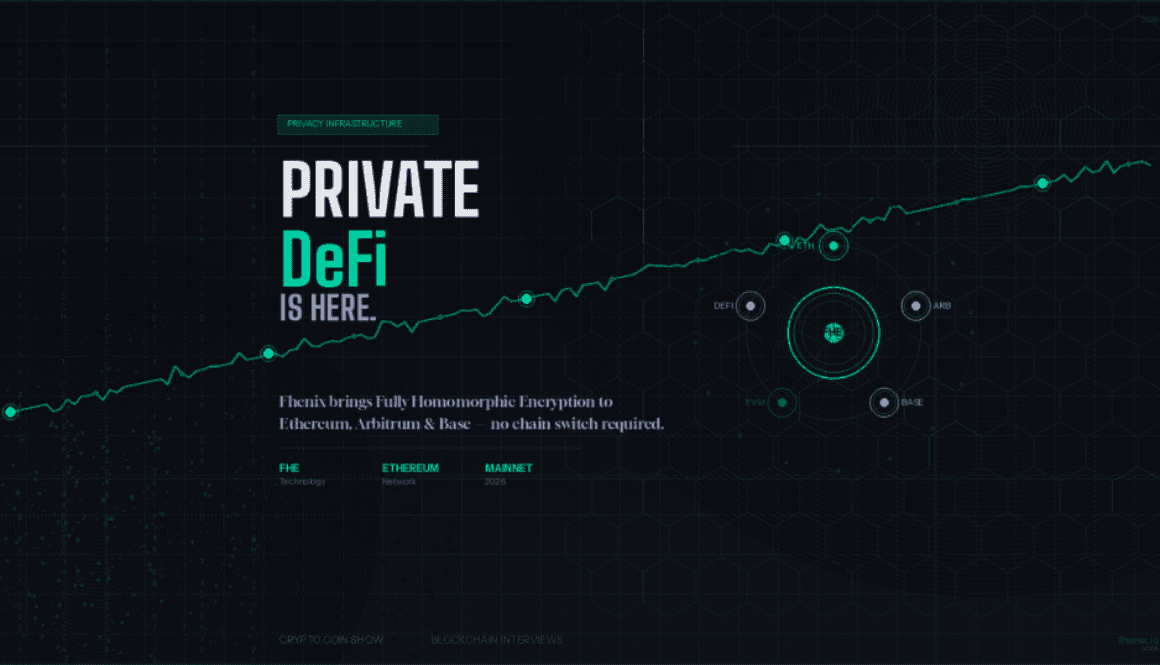
Fhenix Brings Fully Homomorphic Encryption to DeFi — Private Smart Contracts on Ethereum, Arbitrum & Base
Privacy InfrastructureMar 19, 2026
Fhenix Is Making Private DeFi a Reality — Without Asking You to Switch Chains
Using Fully Homomorphic Encryption, Fhenix lets developers add on-chain confidentiality to Ethereum, Arbitrum, and Base smart contracts — a few lines of Solidity away from private lending, dark pools, and compliant institutional finance.
AA
Ashton Addison
Crypto Coin Show · Blockchain Interviews
Founder
Guy Itzhaki — ex-Intel TEE lead, co-founder Secret Network
Core Technology
Fully Homomorphic Encryption (FHE)
Supported Chains
Ethereum · Arbitrum · Base
Current Stage
● Testnet Live · Mainnet 2026
The Privacy Problem Hiding in Plain Sight
Every transaction on a public blockchain is visible to anyone with a browser. Open Etherscan, and you can trace wallets, balances, and strategies back to the genesis block. For retail users, that might feel abstract — but for institutional players, DeFi protocols, and enterprise payments, transparent ledgers are a non-starter.
That is the gap Fhenix is building to close. Founded by Guy Itzhaki, a former Intel executive who led the company’s Trusted Execution Environment (TEE) division, and the co-founder of Secret Network, Fhenix is developing what it calls the fastest privacy infrastructure for blockchain — powered by Fully Homomorphic Encryption (FHE).
If you want to bring real money, bring the large players in, see mass adoption — there needs to be a level of maturity that includes privacy. But not just privacy: it also includes compliance.
— Guy Itzhaki, Co-Founder & CEO, Fhenix
What Is Fully Homomorphic Encryption?
Most people understand encryption as a lock: you can encrypt data to hide it, but you have to decrypt it before you can do anything useful with it. FHE breaks that assumption entirely.
The term “homomorphic” comes from mathematics — it refers to preserving structure during transformation. In practice, FHE encrypts data in a way that retains enough mathematical structure for computation to happen on the ciphertext itself. The result is decrypted only at the end, meaning no one — including the nodes processing the transaction — ever sees the raw data.
FHE has existed as a theoretical concept for decades, long regarded as too slow for real-world use. Itzhaki, who worked on hardware acceleration for FHE at Intel before leaving to co-found Fhenix, says the performance trajectory has changed dramatically — and that gap is exactly what Fhenix is engineered to close.
Privacy Approaches Compared
Technology
What It Does
Compute on Encrypted Data?
Trust Requirement
Zero-Knowledge Proofs
Hides identity / proves a statement without revealing it
No
Math-based
Trusted Execution Environments (TEE)
Computes in a secure hardware enclave
Partial
Hardware trust required
Fully Homomorphic Encryption (FHE)
Computes directly on encrypted data — no decryption needed
Yes
Pure math — trustless
From L2 to Co-Processor: Meeting Developers Where They Are
Fhenix did not start where it is today. The original architecture was an independent Layer 2 — another chain for developers to migrate to. Within months, the team recognized the strategic error: the market doesn’t need another L2. It needs privacy on the chains where developers already live.
The pivot led to what Fhenix now calls a co-processor architecture — or, more simply, Privacy as a Service. The Fhenix co-processor plugs into existing EVM chains (currently Ethereum, Arbitrum, and Base) and exposes a library developers can import directly into their Solidity smart contracts.
No new toolchain. No new language. No chain migration. Developers import a library, call encrypt and decrypt functions, and their contracts gain data confidentiality. Itzhaki puts the integration at roughly four lines of code for a basic private stablecoin implementation.
Use Cases Already in Development
With eight projects actively building on the testnet, early implementations span a range of confidential finance applications: private lending protocols, confidential payment rails, dark pools, and OTC settlement. Each addresses a category where on-chain transparency has historically been a dealbreaker for serious capital.
One of the most persistent objections to blockchain privacy tools is regulatory: if transactions are opaque, how do you enforce KYC and AML? Fhenix’s architecture directly addresses this tension.
Rather than giving users a binary choice between private and auditable, Fhenix’s smart contract framework lets developers define programmable disclosure conditions. A regulator or auditor can be granted access to specific transaction data only when predefined criteria are met — without the protocol itself ever holding or exposing a master key.
This is what Itzhaki calls KYT — Know Your Transaction — a compliance primitive built natively into the privacy layer.
Institutional players still want KYC. They still want AML. You need a solution flexible enough to give them the privacy levels they need — but that doesn’t open the door for regulators to walk in and say this isn’t what we need.
— Guy Itzhaki, Fhenix
Private Stablecoins: A Dual-Mode Future
One concrete product demonstration Fhenix has already shipped is a dual-mode stablecoin framework. Rather than issuing a purely private stablecoin — which would be incompatible with most existing DeFi yield applications — Fhenix’s model allows issuers to deploy a token that users can toggle between private mode (for transfers and balance privacy) and public mode (for composability with yield-bearing protocols like lending markets).
Asked whether this could be applied to USDC or USDT, Itzhaki confirmed that Fhenix is actively in conversations with major stablecoin issuers. The technical lift, he says, is surprisingly minimal.
Why Privacy Is Having a Moment in 2026
After spending years defending privacy as a legitimate need rather than a criminal one, Itzhaki sees three structural forces finally converging:
1. Stablecoins found product-market fit. Payments with stablecoins are a real use case. Real payments demand real privacy — the question becomes obvious once money starts moving seriously.
2. Institutions are arriving with a different set of requirements. JP Morgan, Robinhood, and others entering the space are not coming with a cypherpunk ethos — they’re coming with compliance departments. Privacy infrastructure that satisfies both camps is now a prerequisite, not a nice-to-have.
3. AI agent payments are early but accelerating. The emerging narrative around agent-to-agent micropayments on stablecoin rails points toward a future where machine-speed transactions carrying confidential business logic will require privacy at the infrastructure level. Fhenix already shipped a private implementation of the x402 AI payment standard roughly three months ago.
Roadmap: Testnet Now, Mainnet by Year-End
Fhenix is currently live on testnet across Ethereum, Arbitrum, and Base. A new SDK version was shipping at the time of this writing, described by Itzhaki as a major improvement in developer experience and performance. Mainnet is targeted for later in 2026, with significant engineering work focused on security hardening and production-grade performance.
Parallel to the engineering path, Fhenix is running a builder program, a planned buildathon, and active outreach to established DeFi protocols. The team also recently co-hosted an open house with Arbitrum in New York, where projects building on Arbitrum explored FHE integrations in real time.
Developers can access documentation, SDK downloads, and testnet resources at fhenix.io. The DevRel team is available for direct support.
Stay in the loop
Follow Fhenix on X for the latest on private DeFi
SDK updates, mainnet progress, buildathon announcements & more — straight from the team.