
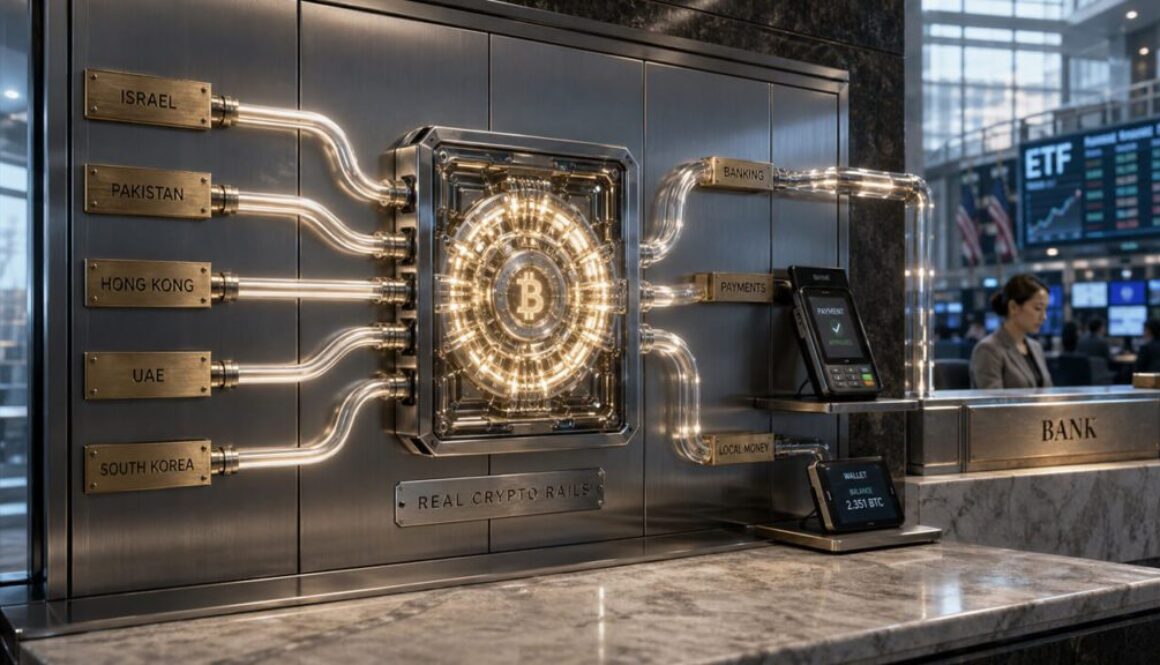
Everyone is watching America’s crypto boom but Israel and Pakistan may be showing what comes next
Israel’s approval of a shekel-pegged stablecoin and Pakistan’s reversal of its crypto banking ban signal a critical shift in institutional crypto adoption away from US spot ETFs toward embedded financial infrastructure. For institutional investors, the real test of crypto maturity is no longer asset-class validation but operational integration with local money, regulated bank accounts, and settlement systems.
- Israel’s Capital Market Authority approved BILS, a shekel-pegged stablecoin, after a two-year pilot program led by Bits of Gold.
- Pakistan’s State Bank issued a circular replacing its 2018 virtual-currency ban, permitting regulated entities and licensed VASPs to open bank accounts under defined compliance conditions.
- Both moves prioritize domestic-currency integration and banking infrastructure over spot-trading vehicles, marking a shift in how jurisdictions are structuring crypto adoption.
- 2 years Duration of BILS pilot before Israeli regulatory approval was granted
- 2018 Year Pakistan originally banned virtual currencies, now reversed in 2026
- 2026 The year practical crypto infrastructure work shifted to money and banking layers
Two major regulatory moves in a single month are reshaping how institutional investors should evaluate global crypto adoption. While US capital markets focused on spot Bitcoin ETFs and digital-asset legitimacy through traditional finance channels, Israel and Pakistan tackled a different frontier: embedding cryptocurrency into domestic banking systems and local-currency infrastructure.
The contrast reveals a fundamental distinction between crypto as an investment wrapper and crypto as operational financial infrastructure.
Bits of Gold, an Israeli crypto firm, announced that the Capital Market Authority approved the issuance and distribution of BILS, a shekel-pegged stablecoin, marking the conclusion of a two-year pilot program. The approval represents the first time a national financial regulator has greenlit a domestically issued stablecoin pegged to its own currency on a live blockchain network.
Days before, Pakistan’s State Bank issued BPRD Circular Letter No. 10 of 2026, formally replacing its categorical virtual-currency prohibition from 2018 with a framework permitting regulated entities and licensed Virtual Asset Service Providers (VASPs) to open bank accounts for themselves and their customers, provided they meet defined anti-money laundering and know-your-customer standards.
These two approvals sit outside the US regulatory apparatus that has dominated institutional crypto conversation since 2024.
Israel approves shekel stablecoin after two-year regulatory pilot with global infrastructure partners
The BILS approval carries implications that extend beyond Israel’s domestic payments system. The stablecoin was designed initially on the Solana blockchain, with infrastructure support from Fireblocks, QEDIT, EY, and the Solana Foundation embedded in the pilot structure.
This consortium model signals a regulatory pathway in which crypto infrastructure firms, major consulting houses, and blockchain networks collaborate to meet local compliance standards before launch. The Capital Market Authority’s decision to approve the project after a defined pilot period suggests that Israeli regulators moved beyond theoretical frameworks into practical infrastructure testing.
The monetary-sovereignty angle embedded in BILS cannot be overstated for institutional investors evaluating long-term crypto adoption. Dollar stablecoins have become the de facto settlement unit across most crypto exchanges and on-chain protocols, meaning the US dollar has captured the payments layer without explicit central-bank involvement or regulatory approval in most jurisdictions.
A shekel-pegged stablecoin allows Israel to test whether a national currency can operate as a programmable asset on decentralized networks without conceding the entire payments infrastructure to USD-denominated tokens.
If BILS achieves meaningful adoption, it establishes a model that other central banks and regulators may replicate: state-backed currency infrastructure that competes with dollar stablecoins on technical and convenience grounds rather than currency denomination alone.
Institutional investors should note that approval does not equal deployment. BILS still requires proof of actual issuance, establishment of reserve backing, and measurable usage in either merchant payments or institutional settlement before the project can be declared operational.
The pilot phase involved theoretical stress testing and regulatory compliance validation; the live phase will test merchant adoption, exchange integration, and whether users and businesses prefer shekel stablecoins over traditional banking channels or dollar tokens for domestic transactions.
Pakistan reverses eight-year crypto ban to allow licensed VASPs and bank account access
Pakistan’s regulatory move carries equal weight for a different reason: it represents a reversal of categorical prohibition rather than first-time approval. The State Bank’s 2018 virtual-currency ban was near-total, blocking banks from serving crypto firms and users from accessing mainstream financial infrastructure for digital-asset activities.
The new circular of 2026 replaces that stance with a defined regulatory perimeter. Licensed VASPs and their customers can now open bank accounts at regulated financial institutions, provided they meet compliance thresholds and obtain a No Objection Certificate (NOC) from the State Bank.
This structural change has immediate implications for institutional adoption. A VASP with a legitimate bank account can hold customer funds in regulated deposits, offer fiat onramps and offramps through traditional banking rails, and conduct settlement with other VASPs through the domestic banking system.
Previously, VASPs in Pakistan operated entirely outside the supervised financial sector, meaning customers could neither deposit nor withdraw Pakistani rupees through mainstream channels.
The new framework eliminates that infrastructure gap by explicitly permitting supervised financial institutions to provide banking services to regulated crypto firms, creating a bridge between decentralized protocols and central-bank oversight.
The circular does not automatically generate a thriving crypto ecosystem; it removes a structural barrier that previously made one impossible.
For institutional investors, Pakistan’s move signals that other emerging-market regulators may follow a similar pattern: rigid prohibition followed by defined-permission frameworks rather than jumping directly to comprehensive regulatory regimes. India, Bangladesh, and other South Asian jurisdictions have maintained crypto bans or severe restrictions.
Pakistan’s shift, if implemented successfully, could become a template for how large emerging markets normalize crypto banking infrastructure while maintaining state oversight and AML compliance.
Institutional infrastructure test still in early phases across multiple jurisdictions
Neither Israel nor Pakistan’s regulatory approvals constitute complete tests of the larger hypothesis: that crypto becomes economically significant through integration with local money, banks, merchants, and settlement systems rather than through spot-trading vehicles. The timeline for validation extends across 2026 and potentially beyond.
BILS remains unarguably in its earliest deployment phase. The stablecoin must prove actual issuance mechanics, establish clear reserve backing with Israeli regulators, and demonstrate measurable transaction volume in either merchant checkout or institutional settlement. Dollar stablecoins, by contrast, operate across thousands of venues and trillions in volume.
A shekel token achieving even 1 percent of that would require years of merchant integration, exchange listing, and user adoption.
Hong Kong’s new virtual-asset exchange licenses, approved by regulators in 2024 and 2025, still lack meaningful business launches or published trading volumes, suggesting that regulatory approval and operational deployment are separated by significant implementation timelines.
Pakistan’s framework faces similar practical hurdles. Licensed VASPs require actual bank relationships with domestic financial institutions willing to serve them. Previous crypto banking initiatives in emerging markets have foundered on precisely this point: regulators permitting activity while banks refuse to participate due to reputational or compliance concerns.
The State Bank’s circular provides permission but does not guarantee that Pakistani commercial banks will actively onboard VASPs or that customer demand for crypto services will justify the compliance costs.
The UAE has announced dirham-token initiatives with minimal public mapping between announcements and actual Central Bank register entries.
The institutional investment framework for evaluating these moves differs fundamentally from US spot-ETF analysis. A Bitcoin ETF validates crypto as an investment asset class and permits institutional capital deployment through familiar vehicles.
A shekel stablecoin or Pakistan’s VASP banking framework validates crypto as financial infrastructure, which requires operational metrics: transaction velocity, merchant adoption rates, regulatory compliance costs, and settlement efficiency compared to traditional banking. These metrics emerge slowly and demand on-the-ground infrastructure development rather than capital market pricing.
2026 marks the year practical crypto adoption shifted from legitimacy to operational embedding
The pattern emerging across Israel, Pakistan, Hong Kong, and the UAE suggests a fundamental reorientation in how regulators and institutional stakeholders evaluate crypto progress. The US spot-ETF cycle of 2023-2025 supplied legitim