James Comer opens House probe into Crypto.com, Hyperliquid over identity verification
House Oversight Committee Chairman James Comer opened a formal inquiry confirmed on September 29, 2026
Every Crypto Coin Show story tagged Digital Asset Regulation, newest first, alongside the guides and interviews that give it context.
House Oversight Committee Chairman James Comer opened a formal inquiry confirmed on September 29, 2026
Congressional staffers are extensively using AI chatbots to draft legislation, research, and official documents with minimal oversight or formal guidelines, creating a direct risk that hallucinations and errors could embed themselves into U.S. law. For institutional investors evaluating regulatory clarity and crypto policy frameworks, this systemic lack of rigor in legislative drafting raises material concerns about the quality and durability of future digital asset regulations.
Congressional staffers have adopted AI chatbots as routine tools for drafting legislation, summarizing research, and preparing official documents, according to reporting by the Washington Post. The practice spans both the House and Senate, with staffers openly acknowledging use of OpenAI’s ChatGPT, Anthropic’s Claude, and xAI’s Grok.
Representative Anna Paulina Luna (R-FL) disclosed that her office employs these tools regularly, and in one documented instance, her staff accidentally pasted raw Claude output, including garbled prompts and AI formatting artifacts, directly into the public record of the National Defense Authorization Act.
The incident underscores a broader institutional problem: there is no formal oversight, no mandatory training, and no Capitol Hill-wide policy governing how these tools are deployed in the legislative process.
The most concrete evidence of AI risk seeping into legislative language came when Luna’s office submitted a chunk of unredacted Claude output into the NDAA record. The pasted text read: “increasing example specific factors.
Identical to H.R. 100 (118th Congress).11:25 AM????Claude responded:”, a fragment that bore no relation to actual legislative language and appeared to include timestamp data and formatting markers from the AI interface itself. Luna later told the Washington Post that the incident was routine staff workflow and saw no issue with the practice.
A lot of staff will use ChatGPT, Claude, Grok. I personally like Grok better, but my staffer prefers Claude. I’m not gonna knock him for that. There’s nothing illegal about him doing a summary.
Representative Anna Paulina Luna (R-FL)
Luna’s stance reflects a broader consensus among congressional leadership: AI use is neither regulated nor discouraged.
The incident illustrates the absence of quality control at the legislative level. If AI-generated text can slip into an official defense bill without detection or consequence, the pathway for errors to reach enacted law is not theoretical but demonstrable.
Institutional investors and corporate policy teams tracking regulatory development face a material risk that crypto legislation emerging from Congress could contain similar artifacts, logical errors, or fabrications embedded by AI systems that congressional staffers treated as reliable sources.
Congressional leadership has not implemented formal rules governing AI use in legislative drafting or official communications. The Washington Post found no instances of staffers being formally disciplined for AI use, despite the widespread adoption of the tools.
This absence of guardrails means staffers across both chambers operate under individual discretion, with no mandatory training, no usage audits, and no consequences for misuse.
Some staffers have voluntarily adopted their own safeguards. Sydney Broome, an aide to representative Cleo Fields (D-LA), told the Post she decided never to use AI tools to write documents from scratch, a rule she developed independently based on college-era guidance she encountered. Her choice was personal, not institutional.
Congress itself has established no equivalent standard. This fragmented approach means the quality and reliability of AI-assisted legislative work depends entirely on individual judgment rather than systematic policy.
The contrast is stark: corporate compliance teams and law firms have begun restricting or auditing AI use following high-profile errors and hallucinations, while Congress has taken no formal action.
This regulatory vacuum carries direct implications for how digital asset rules will be drafted. If staffers preparing crypto legislation lack guidance on AI tool verification, fact-checking, or citation accuracy, the resulting bills could reflect the same hallucination patterns that led lawyers to cite nonexistent cases and consulting firms to generate nonsensical reports.
Institutional investors evaluating whether future crypto regulations will be durable or subject to legal challenges tied to drafting quality have reason to be concerned.
The widespread use of AI chatbots in Congress accelerated amid the Trump administration’s mandate for federal agencies to adopt AI across all operations. That pressure has filtered into Capitol Hill, where staffers treat AI adoption as a productivity imperative rather than a discretionary tool requiring governance.
The result is adoption without corresponding oversight mechanisms, a pattern consistent with how federal agencies have approached the technology more broadly.
The absence of formal discipline reflects a deeper institutional reality: Congress has not prepared for the governance challenges posed by AI-assisted policymaking. While legislative bodies in other democracies have begun exploring guardrails on government AI use, the U.S. Congress remains reactive.
The irony is direct and material: the institution responsible for regulating AI across the private sector has implemented no rules for its own use of the technology.
This gap suggests federal crypto regulations will likely continue to emerge from a legislative process that itself lacks AI governance frameworks.
For investors tracking regulatory risk, this matters because it indicates the institutional capacity for rigorous, technically informed policymaking on digital assets remains constrained.
Crypto regulations drafted by staffers using unsupervised AI tools are more likely to contain errors, outdated references, or logically incoherent provisions, increasing the probability of legal challenges, amendment cycles, and regulatory uncertainty.
The quality of crypto rules may therefore reflect not just legislative intent but the quality control failures baked into the drafting process itself.
The lack of oversight creates a specific risk vector for digital asset policy. Crypto legislation typically involves technical language around custody, custody standards, proof-of-stake mechanisms, and stablecoin reserve requirements. These provisions require precision; an error or hallucination embedded at the drafting stage could render a rule unworkable or open it to legal challenge.
Staffers without training in AI verification and accuracy standards are more likely to rely on AI summaries without fact-checking them against source material or regulatory precedent.
Representative Luna’s case also signals how little consequence staffers face for AI mishaps. Her office submitted garbled AI text to the public record of a major defense bill, and no formal review, correction, or disciplinary action was documented.
If that same tolerance applies to crypto legislation, and there is no reason to believe it does not, then institutional investors should expect digital asset rules to be drafted under similarly loose standards.
The immediate question for the crypto industry is whether Congress will establish formal AI governance guidelines before the next major wave of digital asset legislation. So far, no such effort has been announced. Senator Cynthia Lummis and other crypto-focused legislators have not publicly called for congressional AI use standards, and House leadership has not proposed oversight mechanisms. Investors should monitor whether the crypto industry, through industry associations or direct lobbying, demands that Congress establish verification and accuracy standards before finalizing digital asset rules, or whether those rules will continue to be drafted under the current lack of institutional guardrails.
The BeInCrypto Institutional 100 Awards named 16 finalists shaping digital asset regulation and governance across compliance, corporate risk controls, and regulatory frameworks, with winners announced at Proof of Talk in Paris on June 2, 2026. For institutional investors, this cohort signals which vendors and banks are winning custody, compliance, and governance contracts, the operational backbone determining which platforms survive regulatory scrutiny.
The BeInCrypto Institutional 100 Awards, now in its 2026 cycle, has completed its shortlisting process for the Regulation and Governance pillar with 16 finalists spanning four categories: digital asset compliance programs, corporate governance standards, institutional legal counsel, and active regulatory frameworks.
The awards honor firms and government bodies directly shaping the infrastructure through which digital assets enter regulated financial markets.
Winners were announced June 2 at Proof of Talk in Paris, marking the culmination of a selection process focused on identifying the vendors, banks, and policy architects most actively embedding blockchain compliance and custody into traditional institutional finance.
In the Best Digital Asset Compliance Program category, four firms emerged as shortlisted leaders: Chainalysis, Elliptic, Sumsub, and TRM Labs. These vendors operate the analytical and Know-Your-Customer infrastructure now mandatory for banks and exchanges managing digital assets at scale.
Chainalysis, serving more than 1,000 institutional, government, and crypto-native clients, represents the deepest client concentration in the category. The firm’s platform spans blockchain analytics, newly launched AI Agents deployed in April 2026, and its ACE compliance engine, which in Q2 2026 expanded coverage across both cryptocurrency exchanges and traditional banking infrastructure.
Elliptic’s May 2026 Series D round, which raised $120 million at a $670 million post-money valuation, represents the largest single funding event among shortlisted compliance vendors this cycle.
Led by growth investor One Peak, the round consolidated Elliptic’s position as the primary cross-chain blockchain analytics provider for regulators, banks, and exchanges operating outside the United States.
The timing of Elliptic’s raise, just weeks before the Proof of Talk awards announcement, signals institutional capital’s continued confidence in compliance-as-infrastructure as a sustainable B2B model within digital asset markets.
TRM Labs, by contrast, achieved unicorn status earlier in the funding cycle, closing a $70 million Series C in February 2026 at a $1 billion valuation under Blockchain Capital’s lead. TRM’s competitive differentiation centers on financial crime coverage spanning more than 100 blockchains and 200 million individual assets, paired with revenue growth exceeding 150% annually.
Sumsub, the fourth finalist, operates at a different scale: serving 4,000+ clients including exchanges Bybit and Huobi, the firm completes identity verification in roughly 30 seconds and coordinates Travel Rule compliance across 1,800 virtual asset service providers.
Sumsub’s ranking in the top 20 of the Chartis FCC50 financial crime compliance report underscores institutional validation of its compliance-first product roadmap.
The Best Crypto Corporate Governance category reflects a sharper institutional divide than compliance. BNY Mellon, Coinbase, Circle, and Standard Chartered were shortlisted, each representing a different approach to embedding digital assets into regulated financial operations.
BNY Mellon’s governance distinction rests on its scale and regulatory precedent: the custodian oversees $59.4 trillion in assets under custody and administration globally, and was the first US bank to receive an SEC exemption from Statement of Accounting Standards (SAB) 121 for digital asset custody services.
That exemption removed a major accounting obstacle to banks offering crypto services; BNY is now extending its governance framework into tokenized deposits through its Digital Assets Platform.
Coinbase’s shortlisting reflects its hybrid institutional positioning: the firm combines its public market status, trading under COIN on the New York Stock Exchange, with custody of more than 80% of US spot Bitcoin and Ether exchange-traded fund assets through Coinbase Custody.
This concentration of institutional custody, paired with public company governance requirements, positions Coinbase as the primary compliance test case for how digital asset platforms operate under SEC oversight and public market discipline.
For institutional investors, Coinbase’s custody dominance in US spot ETF markets means virtually all regulated spot exposure to Bitcoin and Ether flows through its operational and governance framework.
Standard Chartered’s inclusion highlights the expansion of digital asset stacks within global systemically important banks.
The London-based lender operates one of the deepest institutional digital asset ecosystems, spanning Zodia Custody (acquired in May 2026), Zodia Markets trading platform, Libeara tokenization infrastructure, and a newly launched prime brokerage service announced in January 2026.
Standard Chartered’s May 2026 investment in GSR Markets, valued at above $1 billion, signals the bank’s commitment to deepening market-making and liquidity provision alongside custody, a model distinct from pure custodians or compliance vendors.
Beyond compliance and corporate governance, the awards process identified leading institutional legal counsel and active regulatory frameworks as separate categories, though specific finalists in these areas were not fully enumerated in the initial announcement.
The inclusion of these categories reflects the institutional market’s recognition that digital asset adoption depends not only on vendor selection and internal governance but on the legal and regulatory environment in which these systems operate.
Awards honoring regulatory frameworks acknowledge that certain jurisdictions have moved beyond restrictive postures to build functional licensing regimes and legal clarity, creating tangible competitive advantages for institutions operating within them.
The June 2 announcement in Paris underscored Europe’s emergence as a center for regulatory clarity, following the European Union’s adoption of the Markets in Crypto Assets Regulation (MiCA) framework in 2023.
MiCA’s implementation timelines and stablecoin licensing requirements have pushed institutional banks and fintechs toward compliance infrastructure investments that later informed global standards.
Awards recognizing institutional legal counsel signal that in-house expertise and outside counsel’s sophistication in structuring digital asset operations now carry institutional weight comparable to technology vendors or compliance platforms.
The 16 shortlisted names across compliance, governance, legal, and regulatory categories establish a de facto institutional roster for digital asset infrastructure. For institutional investors evaluating counterparty risk, custody, and compliance partners, this cohort represents the firms and frameworks most actively stress-tested by banks and regulators. Attention should focus on whether Chainalysis and Elliptic’s complementary funding trajectories lead to consolidation, whether BNY Mellon’s SAB 121 exemption precedent accelerates similar approvals for JPMorgan Chase and other money center banks, and whether Standard Chartered’s prime brokerage model gains adoption among other global systemically important banks, all outcomes that would materially expand institutional digital asset market depth and reduce operational friction in 2026 and beyond.
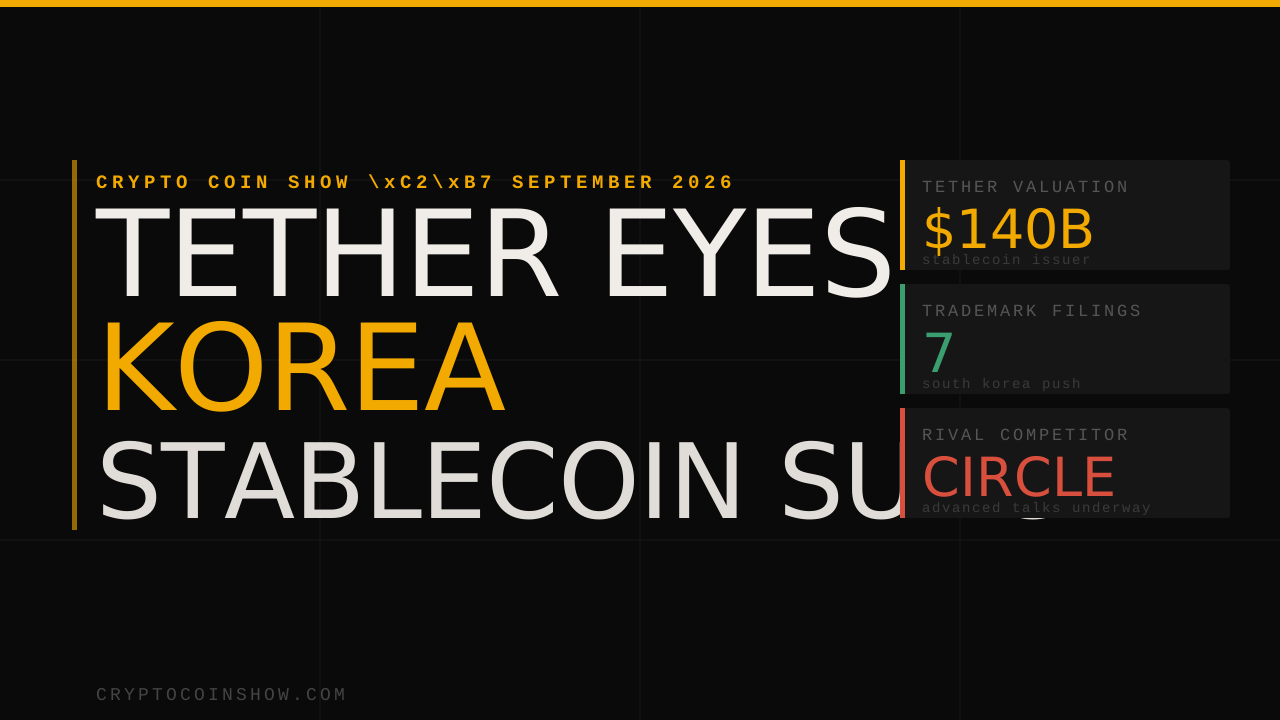
Tether has filed seven trademarks in South Korea covering its corporate brand and stablecoin products, signaling a major push into one of Asia’s largest crypto markets as regulatory clarity emerges. The move positions the $140 billion stablecoin issuer ahead of rival Circle, which is already in advanced talks with Korean financial institutions, setting up a direct competition for market share in a jurisdiction poised to formalize stablecoin rules.
Tether, issuer of USDT, the world’s largest stablecoin by market capitalization, has formally initiated its South Korean market entry through trademark applications filed with the Korea Intellectual Property Rights Information Service.
The seven applications represent a significant escalation beyond Tether’s previous filings in the country, which focused narrowly on individual stablecoin product names. This batch includes the corporate brand itself and Tether Gold (XAUT), a gold-backed token that serves institutional clients seeking inflation-hedged stablecoin exposure.
The timing reflects institutional anticipation around South Korea’s regulatory environment.
South Korea’s proposed Digital Asset Basic Act is expected to impose a critical requirement: foreign stablecoin issuers seeking to distribute tokens domestically will need to maintain a domestic branch, creating a structural incentive for early movers to establish on-the-ground operations before final rules crystallize.
Circle, the issuer of USDC and Tether’s primary stablecoin competitor by institutional adoption, has already begun executing what appears to be a more aggressive Korean strategy. Circle CEO Jeremy Allaire visited Seoul in April and held meetings with three of South Korea’s largest financial conglomerates: KB Financial Group, Shinhan Financial Group, and Hana Financial Group.
Those discussions centered on stablecoin payment infrastructure and real-world asset tokenization, the concrete use cases that financial institutions care about.
Allaire publicly stated that Circle intends to establish a Korean subsidiary and pursue a formal license, contingent on the final regulatory framework accepting foreign issuers. Circle has already formalized distribution partnerships with two major Korean crypto exchanges: Dunamu, which operates Upbit, and Bithumb.
Those partnerships accelerate USDC availability on domestic trading platforms where Korean retail and institutional traders execute spot and derivatives trades. Hana Card, a unit of Hana Financial Group, has moved beyond discussion into pilot deployment, allowing foreign visitors to make payments at Korean merchants using USDC through a Circle partnership that launched in March.
KB Kookmin Card and BC Card are also testing stablecoin payment rails, indicating that Korean financial institutions view stablecoin infrastructure as operationally urgent.
Tether’s trademark filings do not yet signal the same depth of institutional partnership. Institutional investors watching stablecoin competition typically read trademark filings as defensive positioning, essential groundwork before entering a market, rather than evidence of live partnerships or payment deployments.
While Tether prepares its Korean entry, the company has simultaneously announced a strategic investment in LemFi, a cross-border payments platform operating across the UK, US, Canada, and Europe with payment corridors into Africa and Asia.
The partnership will integrate USDT as the settlement layer across LemFi’s payment corridors, replacing traditional multi-day SWIFT transfers with blockchain-based settlement. Tether CEO Paolo Ardoino characterized the deal as a play for financial inclusion, targeting an estimated 585 million underbanked users globally who lack access to fast, low-cost international transfers.
This investment reflects Tether’s capital position. The company reported $1.04 billion in profit during Q1 2026 and holds $8.23 billion in excess reserves, substantially more capital than it needs for basic stablecoin backing and operations.
That reserve buffer enables the company to invest in distribution partners and geographic expansion without straining balance sheet metrics that institutional investors scrutinize. The LemFi move also diversifies Tether’s revenue exposure beyond trading volume and USDT issuance fees, building recurring payment settlement economics into partnerships with established fintech platforms.
For institutional investors, the LemFi investment signals that Tether is not confining its growth strategy to developed markets like South Korea or Europe. Instead, the company is building redundancy: simultaneous pushes into Asian financial hubs, African remittance corridors, and US/European payment rails reduce dependency on any single geographic regulator or partnership.
The South Korean market carries outsized strategic importance for both Tether and Circle because the country hosts some of the world’s largest crypto trading venues and a sophisticated financial services sector with genuine appetite for stablecoin-based payments and tokenized assets. Upbit, Bithumb, and other Korean exchanges process hundreds of billions of dollars in annual trading volume.
Korean financial institutions, particularly the three major banking groups, have distribution networks that reach tens of millions of consumers and businesses. A credible stablecoin payment product embedded in Korean financial infrastructure could scale to meaningful transaction volume faster than equivalent launches in less developed or less crypto-mature markets.
However, regulatory uncertainty remains. South Korea’s Digital Asset Basic Act has not yet passed into law, and the final text will determine whether foreign stablecoin issuers can operate subsidiaries with minimal restrictions or face structural barriers that favor domestic issuers or require surrendering too much operational control. Ardoino and Allaire are both tracking this text closely.
If the final rule permits unrestricted foreign subsidiary operations, Tether’s trademark filings and Circle’s institutional partnerships will translate directly into market access. If the rule imposes heavy collateralization requirements, mandatory reserve audits conducted by Korean regulators, or reserve-holding restrictions that favor domestic banks, both issuers may face unexpected friction.
The trademark filings also carry a legal dimension. Securing trademark registration before competitors reduces the risk that a Korean entity could register confusingly similar branding and claim squatter’s rights or demand expensive buyouts.
The next critical deadline is the passage of South Korea’s Digital Asset Basic Act and publication of final implementing rules. Until that law crystallizes, both Tether and Circle are conducting exploratory preparation, trademark filings, financial partnerships, exchange integrations, that positions them to move quickly once regulatory clarity arrives. Institutional investors should monitor the final text of the Act for specific language on foreign subsidiary licensing, reserve requirements, and collateral standards; that language will determine whether Tether’s first-mover trademark advantage translates into operational market share or whether Circle’s deeper financial institution relationships prove more valuable under the final regime.
President Trump pledged to sign the Digital Asset Market Clarity Act immediately upon passage, but the bill remains stalled in the Senate Banking Committee nearly nine months after House approval, with fundamental disagreements over stablecoin regulation blocking forward momentum. For institutional investors, the delay extends a critical period of regulatory uncertainty that has already reshaped trading strategy and compliance planning across the sector.
President Donald Trump delivered a 45-minute speech at a Mar-a-Lago cryptocurrency event where he publicly committed to signing the Digital Asset Market Clarity Act of 2025 “immediately” upon its arrival at his desk. The declaration came as the bill languishes in the Senate Banking Committee, blocked by unresolved disputes over stablecoin regulation despite winning House passage months earlier.
Trump’s pledge signals administration pressure to move the legislation, yet the continued stalemate reflects deeper structural disagreements among lawmakers, regulators, and industry stakeholders that executive intent alone cannot resolve.
The CLARITY Act, introduced jointly by the House Committees on Financial Services and Agriculture in June 2024, establishes a bifurcated regulatory model dividing digital asset oversight between two agencies.
The Commodity Futures Trading Commission would regulate tokens classified as digital commodities, while the Securities and Exchange Commission would govern assets sold as investment contracts through securities offerings.
This jurisdictional split aims to end the regulatory ambiguity that has defined the sector for nearly a decade, creating clear on-ramps for compliance-focused firms and removing the threat of retroactive enforcement actions.
The bill’s approach to decentralized finance diverges sharply from earlier regulatory proposals by targeting centralized intermediaries rather than software developers or decentralized protocols themselves. This distinction proved attractive to core developer communities and many DeFi platforms, which had feared direct regulatory exposure to underlying code.
However, the most contentious provision covers stablecoin issuance and yield generation, where fundamental disagreements about who may issue tokens, what capital requirements should apply, and how yield mechanisms should be treated have deadlocked negotiations.
Industry participants have split sharply on the stablecoin language. Some institutional crypto firms and exchanges have criticized the framework as overly restrictive, potentially limiting the utility and competitiveness of U.S.-based stablecoin projects.
Others, including traditional finance stakeholders, have pushed back against provisions they view as insufficiently protective of consumer deposits and payment system stability. These competing visions have prevented Senate Banking Committee consensus, keeping the bill in limbo despite Trump’s explicit backing.
Trump has signaled that digital asset regulation ranks among his administration’s legislative priorities, stating previously that the CLARITY Act “has to pass as soon as possible” and criticizing parties he believed were blocking its progress.
His Mar-a-Lago pledge to sign immediately represents an unusually direct executive commitment to a specific legislative text, effectively foreclosing the possibility of major presidential amendments or conditions that might otherwise delay implementation.
Yet administrative enthusiasm has failed to break the legislative bottleneck. Since House passage months ago, the Senate Banking Committee has issued multiple deadline extensions without advancing the bill to a committee vote.
The repeated delays suggest that pressure from Trump’s office, while politically significant, does not override the substantive policy disagreements that committee members and their staffs have flagged.
With midterm elections approaching and Democrats expected to gain seats, the political calculus for Senate Republicans may shift toward protecting certain amendments or negotiating leverage that could slip away in a new Congress.
Institutional investors monitoring regulatory risk have increasingly based trading and hedging decisions on the assumption that comprehensive CLARITY Act passage may not occur in the current Congressional session.
The stablecoin dispute centers on three interconnected issues: who holds the authority to issue U.S. dollar-backed tokens, what minimum capital and reserve requirements should apply, and whether protocols can offer yield without triggering securities law.
Lawmakers from states with significant financial centers have advocated for provisions that preserve state banking charters, while others prefer a federal-only licensing regime.
Industry figures representing different market segments have lobbied intensely in conflicting directions, with some exchange operators and asset managers seeking permissive yield frameworks and others backing stricter protocols to minimize moral hazard.
These disagreements carry practical consequences for the competitive positioning of major stablecoin issuers and for the infrastructure firms that integrate stablecoins into payment rails and trading systems.
A restrictive final bill could favor existing incumbents such as USDC and Tether by making new entrants prohibitively expensive to launch, while a permissive framework could unlock innovation but potentially expose retail and institutional counterparties to issuer risk if capital requirements remain loose.
The Senate Banking Committee’s hesitation suggests members are waiting for technical analysis and stakeholder input to crystallize around a specific compromise, rather than rushing to a vote that satisfies no major faction.
The timeline for CLARITY Act passage has compressed sharply as the calendar advances. Senate Banking Committee members have historically balked at advancing digital asset legislation during periods of market volatility, citing a need to monitor real-world outcomes before codifying new frameworks.
The committee’s deliberative pace, while frustrating to industry participants, reflects institutional caution about embedding rules into statute law that may require amendment if market structure or threat vectors evolve.
Trump’s “immediately sign” pledge constrains future presidential flexibility but does not alter the fundamental Senate arithmetic.
For the bill to reach his desk before the current Congress adjourns, the Banking Committee must vote, floor consideration must proceed, and reconciliation with any House amendments must conclude, a sequence that typically requires six to twelve weeks at minimum, and which cannot begin until internal committee disputes resolve.
Sources close to negotiations have indicated that staff-level talks continue, but no breakthrough date has been publicly announced.
Institutional investors should monitor the Senate Banking Committee calendar for any scheduled markup session on the CLARITY Act as the proximate catalyst; absent a formal markup announcement within the next two weeks, the probability of passage before adjournment falls materially, potentially deferring the bill to a new Congress where Trump’s commitment to immediate signature will carry less legislative force.
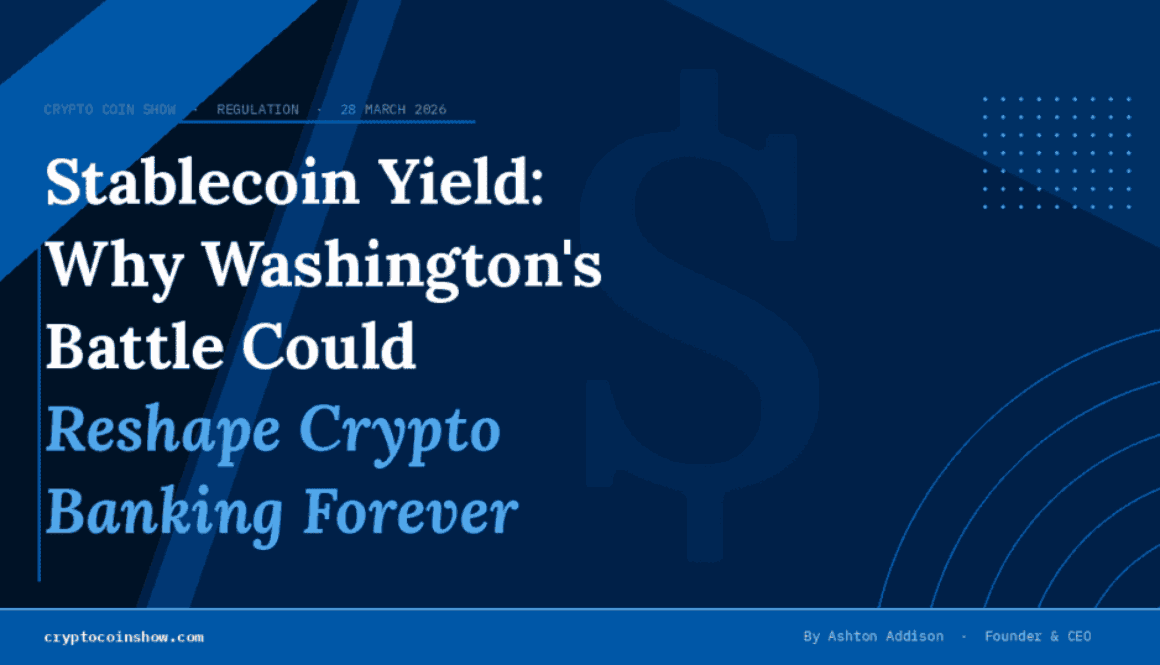
A single clause in the US CLARITY Act has sent Circle’s stock to its worst-ever single-day drop, alarmed Coinbase, and put stablecoin yield at the centre of a fight that will determine whether crypto platforms or traditional banks control the future of digital money.
A leaked draft of the Digital Asset Market Clarity (CLARITY) Act sent shockwaves through crypto markets on 24 March 2026, when provisions proposing to ban stablecoin platforms from offering yield on customer balances were reported by The Wall Street Journal. Circle Internet Group recorded its largest-ever single-day share price decline, while Coinbase also fell sharply — before both partially recovered the following day. By 25 March, Senate negotiators announced they had reached an agreement in principle with the White House on the disputed yield provisions, but the broader regulatory uncertainty remains unresolved.
The stablecoin yield dispute has been the single largest obstacle blocking the CLARITY Act’s advancement through the Senate. On one side, traditional banks — led by the American Bankers Association — have argued that allowing crypto platforms to pay yield on stablecoin balances risks triggering significant deposit flight away from savings accounts, ultimately threatening bank lending capacity. On the other, the crypto industry has maintained that restricting yield would leave US platforms uncompetitive against offshore alternatives and damage innovation domestically.
SEC Chairman Paul Atkins, speaking at the Blockworks Digital Asset Summit in New York on 24 March, described the prior week as “a historic week for America’s digital asset markets” and characterised recent regulatory actions as “the end of the beginning” — while cautioning that congressional legislation remains the only route to a durable framework. Atkins also criticised the prior administration’s enforcement-first approach, acknowledging that it had pushed crypto activity toward offshore jurisdictions.
The stakes of the yield debate extend well beyond compliance costs. If enacted in their strictest form, the CLARITY Act’s yield restrictions would align stablecoins more closely with traditional deposit products — effectively handing incumbent banks a structural advantage they have lobbied hard to preserve. For crypto-native stablecoin issuers, the consequences vary significantly by business model.
“The impact may be less about restriction and more about redistribution — determining who captures value and under what conditions.”
Circle, issuer of USDC and the most US-regulated of the major stablecoin operators, faces the most direct exposure given its business model’s reliance on yield-generating activities. Tether, by contrast, operates largely outside US jurisdiction and would face fewer direct constraints. This competitive asymmetry is one reason analysts suggest that a strict yield ban could paradoxically strengthen offshore operators while pressuring the more compliant, domestically-oriented platforms the legislation ostensibly aims to support.
Compounding the picture, the New York Stock Exchange announced on 24 March a collaboration with digital asset infrastructure firm Securitize to develop a blockchain-based trading platform capable of 24/7 settlement using stablecoin funding. If stablecoin yield is curtailed, the economic incentive underpinning much of that institutional infrastructure weakens alongside it.
What may distinguish the current regulatory moment from prior crypto policy cycles is not merely the content of the rules, but the approach underpinning them. Earlier frameworks largely focused on enforcement after misconduct, or on clarifying asset classifications as disputes arose. The CLARITY Act represents a more proactive posture — attempting to define market structure before it fully matures rather than reacting to crises once they develop.
Whether the Senate’s reported agreement in principle on stablecoin yield translates into final legislative language — and how that language is ultimately worded — will determine how value flows through digital asset markets for years to come. For crypto-native firms, the challenge is to demonstrate that innovation can operate within regulatory constraints. For traditional institutions, it is to move quickly enough to remain relevant in a market they did not build.
The CLARITY Act’s March deadline passed without a final signing. Institutional money has remained hesitant, and altcoin sentiment has stayed subdued as traders wait for Washington to deliver a definitive answer. The bill’s trajectory in the coming weeks will be one of the most consequential regulatory developments in digital assets since the FTX collapse in 2022.
The Securities and Exchange Commission is signaling a fundamental shift in its regulatory posture toward digital assets, with Chair Paul Atkins publicly acknowledging that previous enforcement-heavy tactics created unnecessary barriers to innovation. As Bitcoin steadies near $67,000, market participants are reassessing the implications of a potentially more constructive regulatory environment, particularly for institutional investors who have long cited clarity as a prerequisite for meaningful capital allocation in crypto markets.
Under former SEC Chair Gary Gensler, the agency pursued an aggressive enforcement strategy that relied on lawsuits rather than prospective rulemaking. The SEC took the position that most digital assets should be classified as securities, leading to a wave of litigation against platforms and projects that failed to register their offerings.
Atkins has openly questioned the effectiveness of this approach. Speaking at recent policy forums, he characterized the enforcement-driven model as having cost the United States competitive ground relative to other jurisdictions offering clearer regulatory pathways. The tension between the SEC and the crypto industry intensified during this period, with firms repeatedly arguing that guidance was sparse while legal jeopardy was acute.
Regulatory clarity is essential for institutional participation. When rules are predictable, large asset managers and pension funds can justify entry into markets with confidence that their compliance frameworks are sound.
— Industry analysts, CCS Research
That friction has noticeably diminished since the change in federal administration. The SEC has already withdrawn several high-profile enforcement actions, established a dedicated cryptocurrency task force, and launched Project Crypto, an initiative designed to modernize SEC rules for digital asset technologies.
The SEC recently granted exemptive relief to WisdomTree for a tokenized money market fund, permitting 24/7 trading and instant settlement—a milestone approval signaling the agency’s willingness to accommodate blockchain-native financial infrastructure.
Bitcoin’s persistence near the $67,000 level reflects more than short-term price dynamics. Market observers note that the absence of panic selling amid regulatory announcements suggests participants are pricing in longer-term institutional inflows driven by reduced legal uncertainty.
Large institutional investors—pension funds, asset managers, insurance companies—have historically avoided crypto markets due to regulatory ambiguity. When rules remain vague, fiduciary obligations and compliance protocols become difficult to establish. A clearer SEC framework removes this friction significantly.
The WisdomTree approval exemplifies this shift. By permitting a regulated tokenized fund to operate with continuous settlement capabilities, the SEC has implicitly validated both blockchain technology and the asset class broadly. This precedent is expected to unlock a pipeline of similar product approvals.
While public discourse focuses heavily on Bitcoin price action, Atkins has emphasized a different opportunity: distributed ledger technology’s capacity to modernize financial infrastructure itself. His specific interest centers on blockchain’s potential to accelerate payment clearing and settlement mechanisms.
Traditional financial infrastructure requires multiple intermediaries and multi-day settlement windows. This architecture generates costs and introduces counterparty risk. Blockchain systems can collapse these timelines and reduce intermediary requirements substantially.
The real value proposition isn’t speculative price appreciation—it’s the operational efficiency gains when settlement happens in minutes rather than days.
— SEC Chair Paul Atkins, Policy Briefing
The SEC’s recent focus on tokenization reflects this understanding. Project Crypto aims to develop rules that acknowledge blockchain’s technical capabilities while maintaining investor protections and market integrity standards. The framework is still in development, but the directional shift is unmistakable.
Atkins has explicitly referenced the risk that the United States loses crypto talent and capital to jurisdictions with more accommodating regulatory regimes. Singapore, the European Union, and other regions have invested in creating clearer digital asset frameworks, attracting development teams and capital that might otherwise base in the United States.
This competitive concern appears to be driving policy urgency. The SEC’s task force and Project Crypto appear designed to establish clear rules quickly rather than litigate edge cases year after year. If successful, this approach could restore U.S. standing as a preferred jurisdiction for digital asset development and infrastructure.
Whether Bitcoin price appreciation directly results from these regulatory shifts remains an open question. However, the removal of policy uncertainty typically benefits risk assets, particularly those that have faced regulatory headwinds. Institutional investors monitoring the SEC’s actions are likely to interpret regulatory relief as a green light for portfolio deployment.
The crypto industry has matured significantly since Bitcoin’s 2009 inception. Today, the digital asset ecosystem encompasses custody providers, trading venues, derivatives platforms, and blockchain infrastructure companies managing hundreds of billions in assets. Market capitalization for digital assets exceeds $3 trillion, rivaling major commodity markets and asset classes. Yet institutional participation remains constrained relative to traditional markets, primarily due to regulatory uncertainty and the perception that crypto operates in legal gray zones.
The SEC’s policy recalibration addresses this constraint directly. When major custodians, exchanges, and asset managers can operate within clearly defined regulatory boundaries, the barriers to institutional entry collapse dramatically. Consider that pension funds manage over $40 trillion in assets globally, yet allocate less than 1% to crypto despite decades of institutional crypto infrastructure development. Regulatory clarity could unlock meaningful reallocation.
The SEC’s acknowledgment of enforcement limitations also reflects broader market realities. The crypto industry has developed sophisticated compliance systems, custody standards, and operational frameworks that meet or exceed traditional finance requirements. Treating digital assets as inherently riskier or requiring uniquely stringent regulation contradicts the technical evidence. Atkins appears to be aligning SEC policy with operational reality rather than ideological presumption.
Market implications extend beyond price appreciation. A regulatory framework that accommodates tokenized financial infrastructure could reshape settlement mechanics across equity, fixed income, and derivatives markets. If blockchain-based clearing and settlement becomes standard, transaction costs decline, counterparty risk reduces, and market efficiency improves—benefits accruing throughout the financial system, not merely crypto-native participants.
Paul Atkins brings decades of securities regulation experience to the SEC chair role, having previously served as an SEC commissioner during the 2008 financial crisis. Unlike his predecessor, Atkins has publicly expressed skepticism toward regulatory overreach and emphasized the importance of technological innovation in markets. His appointment signals a deliberate shift toward accommodating emerging technologies rather than constraining them through enforcement uncertainty.
This philosophical difference matters substantially. Gensler’s approach viewed unregulated crypto as inherently suspicious and pursued litigation to compel compliance with existing securities laws. Atkins views crypto as a technological innovation requiring new rules tailored to blockchain’s characteristics. The distinction between these postures explains the rapid policy shifts observed since the SEC’s leadership change.
The SEC’s institutional position also supports this recalibration. As enforcement actions proliferated under Gensler, court rulings increasingly questioned the SEC’s legal authority to regulate certain digital assets. Federal judges have expressed skepticism about stretching existing securities laws to cover blockchain technologies. Atkins appears to be recognizing that litigation may ultimately undermine SEC authority rather than enforce it, making prospective rulemaking the more effective long-term strategy.
The SEC will continue refining Project Crypto’s specific rules throughout 2025. Expect additional exemptive relief approvals for tokenized financial products and clearer guidance on digital asset classification. The agency may also recalibrate its stance on staking, decentralized finance, and other areas previously subject to enforcement uncertainty.
For market participants, the timeline matters. Institutional deployment typically follows regulatory certainty, not precedes it. As the SEC’s framework becomes concrete rather than directional, capital flows should reflect the reduced legal risk premium.
Bitcoin’s consolidation near $67,000 may represent a pause before larger institutional movements. If the SEC delivers on its modernization commitment, the next phase could feature broader adoption by mainstream asset managers seeking exposure to both the asset class and blockchain infrastructure opportunities. The convergence of regulatory clarity, technological maturity, and institutional readiness suggests the digital asset market stands at a genuine inflection point—one driven by policy alignment rather than speculative fervor. For investors and industry participants, this transition from enforcement-driven uncertainty to rules-based clarity represents a more durable foundation for sustainable growth.
Get weekly blockchain insights via the CCS Insider newsletter.
A potential shake-up in equity index membership threatens to reshape how institutional investors access digital asset treasury companies. Strategy, the publicly traded Bitcoin treasury firm formerly known as MicroStrategy, faces possible removal from major stock indexes over its substantial cryptocurrency holdings, raising concerns about broader implications for crypto-native firms seeking legitimacy within traditional financial markets.
MSCI, one of the world’s largest index operators, proposed in October that companies deriving more than half their value from digital assets should be excluded from its global benchmarks. The reasoning centers on how these firms are classified: MSCI views them as investment vehicles rather than operational companies.
Strategy and similar organizations dispute this characterization entirely. They argue they function as legitimate businesses innovating in the cryptocurrency space, not as passive asset holdings wrapped in corporate structure. The distinction matters significantly for how regulators and index providers assess their place within the broader economy.
MSCI’s index methodology typically categorizes companies based on their primary business operations and revenue generation models. The organization maintains thousands of indexes globally, serving as the backbone for trillions of dollars in invested assets. Its classification decisions carry enormous weight precisely because passive investment funds—which now represent roughly 40% of the U.S. equity market—automatically adjust holdings whenever MSCI makes methodological changes to its benchmarks.
The MSCI decision will likely establish a template for the entire indexing industry. Once MSCI moves on digital asset treasury companies, most competing equity indexes are expected to harmonize their approach.
— Kaasha Saini, Head of Index Strategy, Jefferies
Saini’s assessment points to a critical reality: MSCI’s move would likely cascade across the indexing world. Competing providers like S&P Dow Jones Indices, FTSE Russell, and Nasdaq-100 typically follow the lead of major index operators, creating industry-wide alignment on controversial classification questions. This standardization occurs because institutional investors require consistency across benchmark providers to manage global portfolio construction effectively.
Strategy, formerly known as MicroStrategy Incorporated before its 2023 restructuring, operates as a publicly traded company with an explicit mandate to acquire and hold Bitcoin as its primary treasury asset. The firm has accumulated over 200,000 Bitcoin through a combination of corporate earnings reinvestment and strategic capital raises specifically designated for digital asset acquisition.
Unlike passive cryptocurrency investment trusts or funds, Strategy maintains registered employee bases, conducts research and development initiatives, and generates operational expenses typical of traditional public companies. Management contends this operational structure, combined with stated plans to eventually monetize cryptocurrency holdings strategically, differentiates the company from pure investment vehicles.
The company’s market capitalization has climbed substantially alongside Bitcoin’s price appreciation, making it one of the largest publicly traded vehicles for institutional exposure to cryptocurrency holdings. This scale makes the indexing question particularly acute—exclusion would affect hundreds of institutional portfolios simultaneously.
The numbers driving this debate are substantial. Strategy’s leadership, including CEO Phong Le and co-founder Michael Saylor, calculated that removal from MSCI’s benchmarks alone could force approximately $2.8 billion in stock liquidations as passive investment funds rebalance their portfolios.
But the damage wouldn’t stop there. Industry analysts now project the total potential decline in share demand could reach $9 billion when accounting for secondary effects across all digital asset treasury companies facing similar exclusion pressures. These secondary effects include forced selling pressure as fund managers rebalance not just MSCI-tracking funds but also related benchmarks, plus the psychological impact on active investors who frequently use major index composition as a signal of institutional legitimacy.
Asset managers control roughly 30% of large-cap companies’ free-floating shares. When major indexes remove a holding, passive funds tracking those benchmarks must sell to maintain alignment, creating automatic downward pressure on share prices. This mechanical selling pressure operates independently of fundamental business performance.
This mechanism creates a vicious cycle. Digital asset treasury companies like Strategy typically raise capital for Bitcoin acquisitions by selling equity at premium valuations reflecting their crypto holdings. Index exclusion would suppress share prices precisely when these firms need strong equity valuations to finance their growth strategies. A lower share price requires issuing more shares to raise equivalent capital amounts, diluting existing shareholders while potentially signaling market loss of confidence to other investors.
The timing compounds these pressures. Bitcoin has demonstrated high correlation with risk asset appetite, meaning cryptocurrency adoption cycles often coincide with equity market enthusiasm and vice versa. Index exclusion during a strong Bitcoin bull market would force the opposite trading action—mechanical selling pressure regardless of favorable market conditions—creating an artificial headwind against the companies’ fundamental narratives.
The stakes extend far beyond Strategy’s individual situation. A successful exclusion would establish precedent for how the entire indexing industry treats crypto-focused public companies going forward. This decision could influence whether similar firms—including Microstrategy competitors pursuing digital asset treasury strategies—gain or lose access to mainstream institutional capital flowing through index-tracking vehicles.
The indexing industry itself generates substantial revenue from benchmark licensing and related services. When major index providers change methodology, they typically consult extensively with stakeholders including the affected companies, institutional investors, and sometimes regulators. MSCI’s willingness to proceed with this proposal despite predictable opposition suggests the organization views the classification issue as sufficiently important to withstand the inevitable political pressure from affected companies and their supporters.
The broader question cuts to the heart of crypto’s institutional integration challenge. Can digital-native companies achieve full legitimacy within traditional financial infrastructure, or will categorical barriers prevent their participation in major investment vehicles? This question extends beyond indexing into regulatory treatment, banking relationships, and corporate governance norms.
Strategy’s public opposition to the MSCI proposal signals management believes the company can mount an effective defense. However, the firm faces structural disadvantages in any debate framed around regulatory classification rather than operational merits. Index methodology discussions inherently focus on categorical questions—”What is an investment vehicle versus an operating company?”—rather than company-specific performance metrics.
Removal from MSCI alone could force $2.8 billion in stock liquidations and would chill investment enthusiasm across the entire digital asset treasury sector.
— Strategy Leadership, in public letter to index providers
If Strategy and peers are excluded from major benchmarks, institutional investors benchmarked to those indexes face legal and fiduciary constraints preventing ownership. This locks out a significant portion of passive and indexed capital, regardless of the underlying company’s fundamental strength. For Strategy shareholders in index-tracking retirement accounts and institutional portfolios, exclusion would force automatic liquidation regardless of their personal investment preferences.
The MSCI proposal echoes broader regulatory struggles with cryptocurrency classification. U.S. regulators have debated whether Bitcoin functions primarily as a commodity, a security, or a distinct asset class requiring novel regulatory frameworks. Index methodology questions operate within similar conceptual territory—should digital asset treasury companies be classified based on their asset holdings or their operational characteristics?
International regulatory approaches vary significantly. Some jurisdictions explicitly permit banks to hold cryptocurrency treasuries, while others maintain bright-line prohibitions. These divergent approaches create complexity for global index providers attempting to maintain consistent methodology across multiple regulatory regimes. MSCI’s proposal might partly reflect pragmatic accommodation of regulatory fragmentation rather than pure methodology concerns.
The timeline for MSCI’s final decision remains unclear, but industry observers expect resolution within the coming months. Strategy and other affected companies have submitted formal responses contesting the classification rationale, and major institutional investors have weighed in on both sides of the debate.
Watch for whether other index providers move independently or wait for MSCI’s decision before acting. The indexing industry typically coordinates on major classification questions, but occasional divergence does occur when competitive pressures are substantial. S&P and FTSE Russell could differentiate themselves by maintaining digital asset treasury companies within their benchmarks, potentially attracting investment from firms seeking exposure to this emerging asset class.
For crypto investors and those tracking institutional adoption trends, this index debate represents a critical test case for whether blockchain-focused companies can fully integrate into traditional capital markets infrastructure. The outcome will ripple through investment decisions, regulatory policy, and corporate strategy across the entire sector for years to come.
The resolution may ultimately depend less on operational merit than on whether index providers can overcome categorical thinking about what constitutes a legitimate public company. If digital assets remain treated as fundamentally different investments requiring separate treatment, mainstream institutional capital will face legal barriers to participation—regardless of individual company strength or Bitcoin’s proven track record as a treasury asset. Conversely, if MSCI or other providers determine that digital asset treasury companies operate sufficiently like traditional businesses to merit index inclusion, it would represent a significant milestone in cryptocurrency’s journey toward mainstream financial legitimacy.
Get weekly blockchain insights via the CCS Insider newsletter.
Belarus President Aleksandr Lukashenko has demanded his government implement stricter crypto regulation, citing widespread investor losses and gaps in current oversight frameworks. Speaking at a high-level government conference on September 5, Lukashenko pointed to a state audit revealing that approximately half of all citizen investments directed to foreign cryptocurrency platforms have failed to return, underscoring what he views as critical vulnerabilities in the country’s regulatory approach.
The State Control Committee’s inspection uncovered two significant problems. First, foreign crypto platforms are absorbing substantial citizen capital without adequate investor protections. Second, domestic platforms are operating with registration violations that allow financial operations to proceed outside proper regulatory channels.
Lukashenko characterized the situation as unacceptable, asserting that his government has delayed action for years. He revealed that he had ordered a comprehensive regulatory framework for digital tokens and cryptocurrencies as far back as 2023, yet binding legislation has still not materialized on his desk.
The President criticized the government for allowing “digital life” to outpace the law, urging officials to finalize regulations that guarantee financial stability while protecting investors.
— Belarus Presidential Statement, September 5
Approximately 50% of Belarusian citizen investments sent to foreign crypto platforms have not returned, according to state audit findings.
Belarus has carved out a unique position within Eastern European cryptocurrency markets over the past decade. The nation’s relatively open stance toward digital assets attracted blockchain developers, mining operations, and fintech entrepreneurs seeking alternatives to more restrictive jurisdictions. This approach generated tax revenue and positioned Minsk as a competitive hub for technology innovation in a region where regulatory uncertainty often prevails.
However, this permissive environment came with costs. The influx of foreign platforms and the lack of standardized oversight created conditions ripe for investor exploitation. Unlike regulated financial markets where disclosure requirements, capital adequacy standards, and customer asset segregation are mandated, Belarus’ crypto sector operated with minimal such protections. This gap between regulatory ambition and market reality has finally captured presidential attention at the highest levels.
The scale of capital flight cited in the audit—with 50% of invested funds disappearing into unrecoverable positions—suggests losses potentially exceeding hundreds of millions of dollars. For a country of approximately 9.3 million people with a GDP of roughly $68 billion, such concentrated losses among retail investors represent both an economic and political liability that can no longer be ignored.
Belarus currently governs digital asset activity through the Hi-Tech Park, a special economic zone established under Ordinance No. 8. This framework was designed to stimulate the country’s information technology sector by providing legal structures for token creation and trading.
While Lukashenko acknowledged the existence of this special economic zone approach, he explicitly rejected it as sufficient for managing modern cryptocurrency markets. The framework, he indicated, was designed for a different era and lacks the protective mechanisms now required.
The President signaled that traditional state agencies would soon assume expanded roles in cryptocurrency oversight, suggesting a shift away from the current special economic zone model toward conventional regulatory bodies. This represents a fundamental change in how Belarus approaches digital asset governance.
The country is also exploring the creation of a central bank digital currency tied to the Russian ruble, adding another layer to its broader digital financial strategy.
This regulatory pivot mirrors approaches taken by other countries that initially adopted light-touch crypto frameworks. El Salvador, while maintaining a pro-Bitcoin stance, eventually implemented stricter exchange oversight. Switzerland expanded its Financial Market Supervisory Authority mandate to encompass digital asset service providers after recognizing gaps in investor protection. Even crypto-friendly jurisdictions like Malta and Singapore have tightened requirements as they matured their regulatory ecosystems.
Lukashenko’s stated objectives reflect a dual mandate. On one hand, he emphasized the need for transparent rules, standardized safeguards, and capital controls that keep investor funds within Belarus’ borders.
On the other hand, he acknowledged the value of maintaining what he termed a “digital haven” for legitimate local businesses and foreign investors. This apparent contradiction reflects a common challenge for regulators: how to protect citizens without stifling innovation or economic opportunity.
The government aims to create transparent rules for market participants while ensuring funds remain within the country, all while allowing legitimate local businesses and foreign investors to continue operating.
— Presidential Directive Summary
No official timetable for new crypto regulations has been announced, though Lukashenko’s ultimatum suggests significant regulatory changes are likely within months.
The challenge of maintaining this balance has proven difficult globally. Regulators in jurisdictions ranging from major developed nations to emerging markets have grappled with identical tensions between consumer protection and sector growth. Germany’s BaFin, for instance, expanded licensing requirements for digital asset trading platforms while attempting to preserve the country’s fintech competitiveness. Hong Kong adopted a dual licensing system allowing both professional and retail-focused platforms under different rulesets.
For Belarus, the stakes are particularly high given the country’s geopolitical isolation and dependence on economic diversification. The technology sector remains one of few areas where Belarus can attract foreign capital and talent without relying on commodity exports or regional political alignments. Overly restrictive regulation could drive legitimate operators to neighboring countries, while insufficient safeguards perpetuate investor losses that undermine public confidence in digital markets.
The regulatory shift in Belarus will have ripple effects across Eastern European crypto markets. Many platforms currently operating from Minsk serve customers throughout Russia, Ukraine, Moldova, and neighboring regions where cryptocurrency regulation remains uncertain or hostile. If Belarus implements comprehensive licensing and compliance requirements, platforms may relocate to jurisdictions offering more favorable treatment, or they may simply cease service to Belarusian citizens.
Conversely, if the new framework establishes Belarus as a trustworthy, transparent jurisdiction for digital asset trading with genuine investor protections, it could attract institutional players and legitimate retail investors who currently avoid the region due to regulatory concerns. Countries including Switzerland and Singapore demonstrated that rigorous regulation combined with innovation-friendly policies can attract rather than repel capital.
The timing of Belarus’ regulatory initiative also reflects broader post-pandemic developments. Global cryptocurrency adoption accelerated significantly between 2020 and 2023, and with it came increasing regulatory pressure from international bodies including the Financial Action Task Force and the International Organization of Securities Commissions. Belarus cannot indefinitely maintain a permissive approach without facing reputational costs and potential sanctions related to financial compliance and anti-money laundering standards.
The absence of a published timeline suggests ongoing internal debate within Belarusian government agencies about implementation details. However, Lukashenko’s direct intervention and unambiguous language indicate that cryptocurrency regulation will receive accelerated attention.
Market participants operating in Belarus should anticipate a significant increase in state scrutiny across the coming months. The shift from special economic zone governance to traditional regulatory oversight will likely introduce new compliance requirements, reporting standards, and potentially capital control mechanisms.
Expected regulatory areas may include mandatory licensing for cryptocurrency exchanges and custodians, reserve requirements ensuring platforms maintain customer assets in segregated accounts, KYC (Know Your Customer) and AML (Anti-Money Laundering) compliance aligned with international standards, limits on leverage and margin trading to protect retail investors, and structured dispute resolution mechanisms for customer complaints.
For investors and traders focused on digital asset markets, understanding these regulatory developments matters. Belarus has positioned itself as a relatively crypto-friendly jurisdiction in Eastern Europe, and any regulatory tightening could reshape investment flows in the region.
The presidential directive also reflects broader global trends. Governments worldwide are moving away from light-touch regulation toward more comprehensive frameworks designed to protect retail investors while maintaining market functionality. The European Union’s Markets in Crypto Assets Regulation establishes baseline requirements for member states. The United States continues developing comprehensive legislation. Even developing nations are establishing clearer crypto regulatory frameworks.
Belarus’ forced reckoning with cryptocurrency regulation demonstrates that jurisdictions cannot indefinitely rely on permissive approaches while investor losses mount. The outcome of its regulatory reform efforts will likely influence how other Eastern European countries approach similar challenges, potentially establishing regional standards for digital asset governance.
Get weekly blockchain insights via the CCS Insider newsletter.