
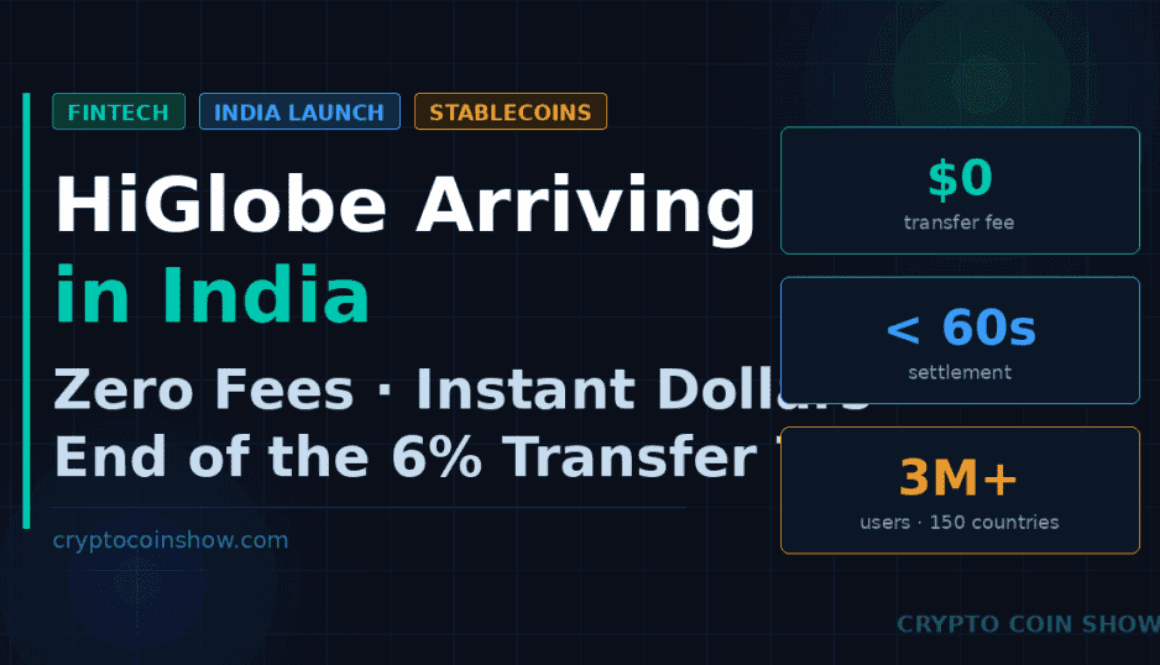
Higlobe Arriving in India —Zero Fees, Instant Dollars, and the End of the 6% Transfer Tax
Higlobe Arriving in India —
Zero Fees, Instant Dollars,
and the End of the 6% Transfer Tax
The San Francisco fintech that pioneered stablecoin-native payments is bringing its lowest-cost guarantee to one billion global south users — starting with the world’s most globalized diaspora.
For most of the last decade, sending money across a border has meant choosing between speed and cost — and losing on both. Bank wires: five days, six percent. PayPal and Stripe: faster, but the fee is baked into the exchange rate. Stablecoin wallets bolted onto old rails: crypto in, SWIFT out, same problem. Higlobe was built to eliminate all three of those compromises — and it is now bringing that infrastructure to India.
The company is launching in India within days, becoming the first stablecoin provider with direct local rails into the Indian market. The move is significant not just for its scale but for its structure: India’s government permits citizens to invest up to $250,000 USD overseas — a legal opening that does not exist in Brazil or Mexico, two of Higlobe’s existing markets. Combined with the most globally distributed diaspora of any country on earth, India represents a structural opportunity unlike any the company has entered before.
“Waiting lists are bursting at the seams,” said Teymour Farman-Farmaian, Co-founder and CEO of Higlobe. “We’ll be the first stablecoin provider linked into India. Zero fees. USD in, rupees out.”
Why the Old Rails Keep Failing
The traditional cross-border payment system wasn’t designed to fail — it was designed to profit. Banks maintain local currency balances in target markets, a model called netting, which allows faster settlement but requires significant capital. That capital cost flows directly to the user as a percentage fee. The result: industry averages above six percent per transfer, a rate the UN targeted at three percent in 2015 and has never seen met.
Newer entrants like Wise and Revolut compressed fees somewhat but never restructured the underlying incentive. They still make money on the transfer — which means the fee can go lower, but never to zero. PayPal, which processes hundreds of billions in cross-border volume, faces the same constraint. Its shareholders expect per-transfer margin. That model works until a competitor prices it into obsolescence.
“Technology moves faster than the business model. PayPal will keep minting money on the old rails until a competitor takes enough market share — then capitulate. Exactly what happened with music streaming.”Teymour Farman-Farmaian · Co-founder & CEO, Higlobe
Farman-Farmaian reaches for Clay Christensen’s definition of disruptive technology: cheaper, worse at first, makes money differently. Kazaa gave away music in 2000. Spotify monetized it through subscription in 2005. Apple kept charging 99 cents per download until 2015 — minting profit for a decade before capitulating. Stablecoins were invented in 2014 by Tether. The Genius Act legitimized them in March 2025. “Same arc,” he said. “Five years to the capitulation.”
Built Crypto-Native From the Start
Higlobe’s core insight dates to 2019. Farman-Farmaian — who describes himself as “Two Revolution Teymour,” having lived through the Iranian and Venezuelan revolutions and watched family wealth erased twice — made a decision the rest of the industry hadn’t yet reached: go all-in on stablecoin end-to-end. No hybrid. No SWIFT fallback. Crypto-native rails, country by country.
Most competitors, he argues, missed the point entirely. “They slap a stablecoin wallet onto old-world rails. You get paid in stablecoin, but to cash out it goes through SWIFT — five days, three percent fee.” Higlobe builds direct fiat on- and off-ramps at the market level, partnering with local crypto exchanges in each country. Users never see a stablecoin interface. They put money in and it appears as US dollars, instantly, at near-zero cost.
| Factor | Legacy Model | Higlobe |
|---|---|---|
| Transfer time | 1–5 business days | Under 60 seconds |
| Transfer fee | 3–6% (often in FX spread) | Zero — lowest cost guaranteed |
| Rail architecture | Correspondent banking / netting | Crypto-native, local exchange partnerships |
| Revenue model | Per-transfer margin | FX, debit card, yield, loans, subscription |
| User experience | Multi-step, multi-platform | Single interface, no crypto knowledge needed |
The lowest-cost guarantee is contractual: if a user finds a better rate anywhere and sends a screenshot, Higlobe returns the full transfer plus a “headache bonus” within 48 hours. It is a structural bet, not a marketing claim.
How You Build a Billion-Dollar Business Without Charging for Transfers
When the marginal cost of moving money through a stablecoin rail reaches near zero, the pricing of that transfer trends to zero. Fighting that trajectory — as PayPal and Wise do today — is a posture, not a strategy. Higlobe was built from the start to monetize the relationship, not the transaction.
Revenue today comes from four sources: foreign exchange spread optimization on currency conversion, debit card interchange, yield on user deposits placed with yield providers at three to four percent APY, and loans currently in testing against US receivables. The long-term model points to subscription — a bundled product giving users unlimited access to transfers, jobs, financial services, and lending in a single monthly fee. The analogy Farman-Farmaian returns to is Amazon: retail is the relationship hook, but Prime, advertising, and AWS are where the margin lives.
On yield: Higlobe automatically places user dollar deposits with yield providers at 3–4% APY. For users whose local currency loses 10% or more per month against the dollar — as is common across Latin America — the yield is almost secondary to the stability of simply holding dollars at all.
Why India Changes Everything
Each of Higlobe’s six markets required a country-specific build: local exchange partnerships, regulatory licensing, and on-the-ground compliance infrastructure. The company’s deliberate choice to go six countries deep rather than 150 countries wide is the source of its structural cost advantage — and its defensibility.
India is different in three ways that compound. First, India’s Liberalised Remittance Scheme permits citizens to remit up to $250,000 USD overseas per year — a legal channel unavailable in comparable form in Brazil or Mexico. Second, the Indian diaspora is the most globally distributed of any nation, with large communities in the United States, United Kingdom, Canada, the Gulf, Southeast Asia, and Africa. Third, India’s tech sector has a deep structural connection to the US — software engineers, exporters, and remote workers are exactly the high-volume professional users Higlobe built its first four years around.
Individual onboarding is complete in under 24 hours. From there: dollars arrive, are automatically placed on yield, can be spent on Higlobe’s debit card, and can be withdrawn to a local bank account in rupees — without the user ever interacting with a crypto interface.
Higlobe is currently live in Argentina, Colombia, Brazil, Mexico, the Philippines and India. Sign up and access the lowest-cost guarantee at higlobe.com.
This article draws on an interview conducted by Ashton Addison, Crypto Coin Show, with Teymour Farman-Farmaian, Co-founder and CEO of Higlobe, on 9 April 2026. The full interview is available on the Crypto Coin Show YouTube channel.