
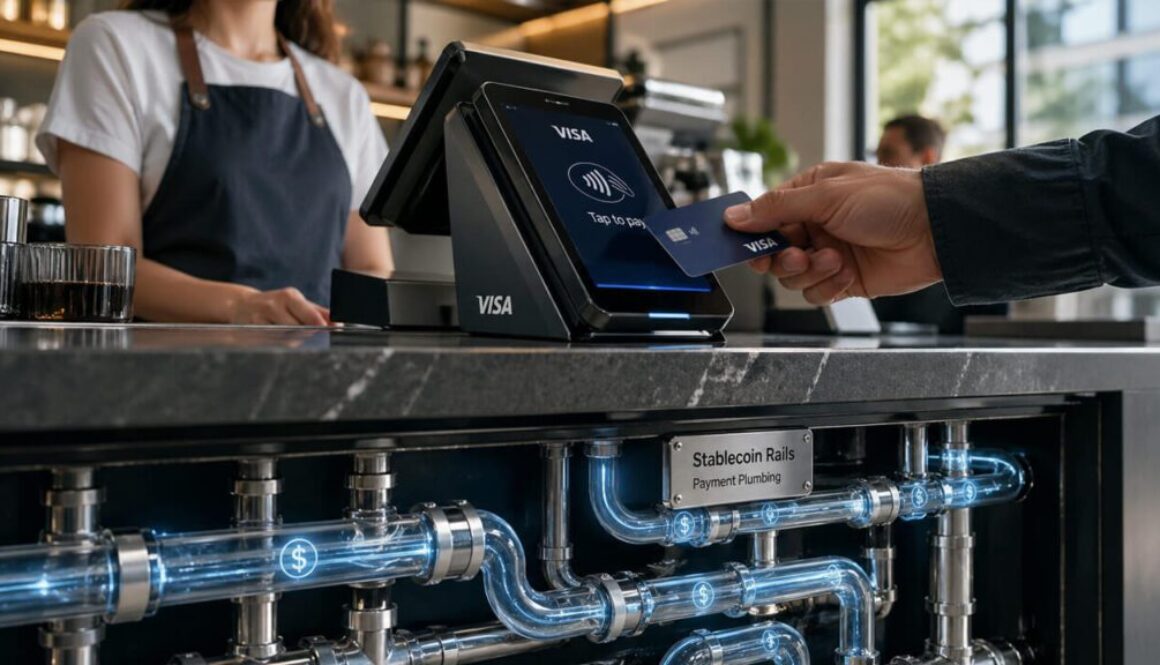
Visa is quietly building stablecoins into mainstream payment plumbing without you knowing
Visa’s stablecoin settlement pilot has expanded to nine blockchains and reached a $7 billion annualized run rate, a 50% increase in a single quarter, signaling that institutional crypto adoption is moving into the payment infrastructure layer that banks and financial institutions rely on daily, not at the consumer checkout. For institutional investors, this represents validation that stablecoins are transitioning from speculative assets to settlement utilities embedded in legacy financial plumbing, with Visa now bridging crypto rails directly into its VisaNet backbone that processes trillions annually.
- Visa expanded its stablecoin settlement pilot from four blockchains to nine in April 2024, adding Arc, Base, Canton, Polygon and Tempo.
- The annualized settlement run rate reached $7 billion, up 50% from the prior quarter, demonstrating material velocity growth.
- Visa linked stablecoin settlement directly to over 130 card programs across 50+ countries, embedding crypto into existing payment networks.
- $7B annualized stablecoin settlement run rate, up 50% quarter-over-quarter
- 9 blockchains now supported, expanded from four in prior period
- 130+ stablecoin-linked card programs across 50 countries globally
Visa announced on April 29 that it had expanded its stablecoin settlement infrastructure to nine blockchains, with the annualized settlement volume reaching $7 billion, a 50% increase from the previous quarter. The expansion added Arc, Base, Canton, Polygon and Tempo to a pilot that previously operated on Avalanche, Ethereum, Solana and Stellar.
While the announcement framed the update as a technical chain-support milestone, the underlying significance lies deeper: Visa is embedding stablecoins into the settlement layer, the operational infrastructure that moves funds between issuing banks, acquiring banks, merchants and payment processors after a transaction has already cleared at the point of sale.
This is institutional plumbing, largely invisible to consumers but critical to how modern finance operates.
The strategic positioning matters for institutional investors because it represents a structural shift in how crypto adoption enters the financial system. Stablecoins are not entering retail payments at the checkout counter; they are entering the back-office infrastructure that banks and payment networks depend on.
Traditional payment authorization still happens in seconds at the consumer level, but settlement, the actual transfer of funds between institutions, has historically taken days and involved multiple intermediaries, correspondent banks and settlement windows.
Visa’s pilot tests whether stablecoins can compress this timeline and reduce friction in that backend process, operating as an optional parallel settlement layer within existing payment infrastructure.
Visa integrated USDC settlement into VisaNet in December 2025, enabling direct stablecoin funding between U.S. banks
The April expansion builds directly on infrastructure Visa operationalized months earlier. In December 2025, the company enabled U.S. issuer and acquirer partners to settle payments with Visa directly in USDC, with Cross River Bank and Lead Bank conducting initial settlements over the Solana blockchain.
Visa highlighted three operational benefits: faster fund availability compared to traditional settlement, seven-day fund availability versus the standard two-to-three-day window, and settlement that continues through weekends and holidays when traditional settlement networks are offline. These are incremental but material improvements for institutions managing liquidity and cash positioning.
The December rollout demonstrated that Visa had already built the technical and operational capability to route stablecoin payments through its core settlement infrastructure, VisaNet, the backbone system that processes authorizations and settlement for trillions of dollars in card payments annually.
By connecting USDC settlement directly into VisaNet, Visa created a direct on-ramp from traditional payment authorization into blockchain-based settlement. This bypasses the step of converting stablecoins back to fiat within Visa’s legacy system; instead, stablecoins move natively through the settlement process and only convert to fiat at the end, if at all.
The institutional implication is significant: this architecture allows banks and payment networks to hold stablecoins as a settlement asset without requiring new systems or separate operational workflows.
Settlement in USDC operates within existing Visa infrastructure, meaning a bank’s treasury operations team does not need to manage a parallel crypto settlement operation, it integrates into their existing Visa settlement view.
Five new chains joining the pilot reflects Visa’s strategy to avoid vendor lock-in to any single blockchain
The April expansion to nine blockchains signals Visa’s deliberate approach to stablecoin settlement: maintain compatibility across multiple chains rather than betting on a single blockchain’s ecosystem dominance.
By supporting Avalanche, Ethereum, Solana, Stellar, Arc, Base, Canton, Polygon and Tempo, Visa creates an ecosystem where stablecoin settlement rails compete on speed, cost and settlement finality rather than forcing institutions into choosing one blockchain. This mirrors Visa’s historical strategy in card payments, maintain network neutrality while extracting value from payment volume.
For institutional settlement operations, chain diversity reduces counterparty risk and operational lock-in. If settlement volume on Solana faces regulatory scrutiny or technical issues, volumes can flow to Ethereum or another supported chain without disrupting the underlying settlement workflow.
From Visa’s perspective, the multi-chain approach also increases total addressable volume: institutions can choose settlement rails based on their existing stablecoin holdings or preferred blockchain infrastructure, rather than being forced to migrate assets to a single chain.
The announcement also linked the nine-chain expansion directly to Visa’s stablecoin-linked card program portfolio: over 130 programs across more than 50 countries. These are consumer-facing card programs that hold or transact in stablecoins.
By expanding settlement chain support, Visa simultaneously increases settlement options for the treasuries managing those card programs, creating a tighter integration between consumer-level stablecoin adoption and institutional settlement infrastructure.
Visa’s multi-year build toward crypto settlement reveals institutional adoption is outpacing regulatory clarity
Visa’s stablecoin infrastructure initiative extends back to 2023, when the company first announced it had moved millions of USDC between partners over Solana and Ethereum to settle fiat-denominated VisaNet payments. That initial pilot expanded to include merchant acquirers Worldpay and Nuvei, testing settlement with multiple institution types, not just Visa’s internal systems.
By the time of the December 2025 rollout with Cross River Bank and Lead Bank, the infrastructure had matured enough to move from internal testing to live settlement operations with actual institutional partners managing real transaction flows.
The progression, from proof-of-concept in 2023 to live settlement in December 2025 to nine-chain expansion in April 2026, suggests Visa faced sufficient institutional demand and regulatory confidence to advance the timeline.
The company has not disclosed the specific regulatory approvals or exemptions required in the U.S. to enable USDC settlement directly within VisaNet, but the fact that Cross River Bank and Lead Bank deployed live settlements implies they obtained necessary regulatory clearance.
Cross River Bank operates as a licensed depository institution and a significant stablecoin issuer partner, giving it both the regulatory standing and the commercial incentive to test stablecoin settlement infrastructure.
This institutional adoption is advancing with minimal public visibility or regulatory intervention. The settlement layer operates behind the authorization layer that consumers see; most businesses and consumers are unaware of how funds actually move between institutions after a payment is authorized.
That invisibility has given Visa and its banking partners room to build and test stablecoin settlement infrastructure without the regulatory scrutiny that would greet a consumer-facing crypto payment product.
The $7 billion run rate signals material velocity but represents a fraction of Visa’s total transaction value
The annualized $7 billion stablecoin settlement run rate requires context: Visa processed approximately $12 trillion in global payment volume in 2024, making the stablecoin settlement volume roughly 0.06% of total flow. However, the 50% quarter-over-quarter growth rate suggests the trajectory is accelerating.
If that growth rate continues, stablecoin settlement volume could reach $10.5 billion annualized in the next quarter, $15.75 billion the quarter after that, and so on, though actual growth will likely moderate as the base increases and market saturation effects emerge.
For institutional investors, the $7 billion