
Tether plans South Korean expansion with trademark filings
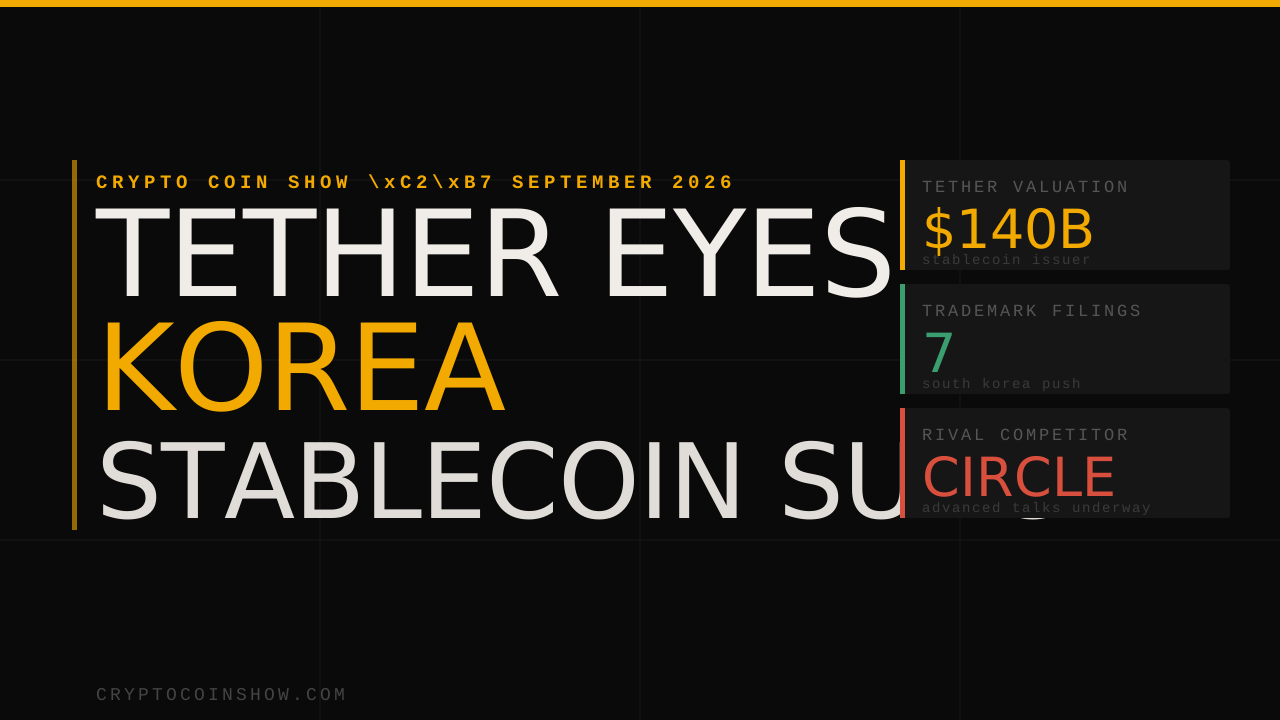
Tether has filed seven trademarks in South Korea covering its corporate brand and stablecoin products, signaling a major push into one of Asia’s largest crypto markets as regulatory clarity emerges. The move positions the $140 billion stablecoin issuer ahead of rival Circle, which is already in advanced talks with Korean financial institutions, setting up a direct competition for market share in a jurisdiction poised to formalize stablecoin rules.
- Tether filed seven South Korean trademarks including corporate name, logo, and Tether Gold stablecoin product
- Circle CEO met with KB Financial, Shinhan, and Hana Financial executives in April to discuss stablecoin payments
- South Korea’s Digital Asset Basic Act may require foreign stablecoin issuers to establish domestic branches before distributing tokens
- 7 Trademark filings by Tether in South Korea covering company branding and token products
- $8.23B Excess reserves Tether holds, providing capital for distribution partnerships and expansion
- 585M Estimated global users Tether aims to reach through LemFi cross-border payments integration
Tether, issuer of USDT, the world’s largest stablecoin by market capitalization, has formally initiated its South Korean market entry through trademark applications filed with the Korea Intellectual Property Rights Information Service.
The seven applications represent a significant escalation beyond Tether’s previous filings in the country, which focused narrowly on individual stablecoin product names. This batch includes the corporate brand itself and Tether Gold (XAUT), a gold-backed token that serves institutional clients seeking inflation-hedged stablecoin exposure.
The timing reflects institutional anticipation around South Korea’s regulatory environment.
South Korea’s proposed Digital Asset Basic Act is expected to impose a critical requirement: foreign stablecoin issuers seeking to distribute tokens domestically will need to maintain a domestic branch, creating a structural incentive for early movers to establish on-the-ground operations before final rules crystallize.
Circle advances Korean partnerships while Tether moves on branding
Circle, the issuer of USDC and Tether’s primary stablecoin competitor by institutional adoption, has already begun executing what appears to be a more aggressive Korean strategy. Circle CEO Jeremy Allaire visited Seoul in April and held meetings with three of South Korea’s largest financial conglomerates: KB Financial Group, Shinhan Financial Group, and Hana Financial Group.
Those discussions centered on stablecoin payment infrastructure and real-world asset tokenization, the concrete use cases that financial institutions care about.
Allaire publicly stated that Circle intends to establish a Korean subsidiary and pursue a formal license, contingent on the final regulatory framework accepting foreign issuers. Circle has already formalized distribution partnerships with two major Korean crypto exchanges: Dunamu, which operates Upbit, and Bithumb.
Those partnerships accelerate USDC availability on domestic trading platforms where Korean retail and institutional traders execute spot and derivatives trades. Hana Card, a unit of Hana Financial Group, has moved beyond discussion into pilot deployment, allowing foreign visitors to make payments at Korean merchants using USDC through a Circle partnership that launched in March.
KB Kookmin Card and BC Card are also testing stablecoin payment rails, indicating that Korean financial institutions view stablecoin infrastructure as operationally urgent.
Tether’s trademark filings do not yet signal the same depth of institutional partnership. Institutional investors watching stablecoin competition typically read trademark filings as defensive positioning, essential groundwork before entering a market, rather than evidence of live partnerships or payment deployments.
Tether’s LemFi investment targets 585 million cross-border users across Africa and Asia
While Tether prepares its Korean entry, the company has simultaneously announced a strategic investment in LemFi, a cross-border payments platform operating across the UK, US, Canada, and Europe with payment corridors into Africa and Asia.
The partnership will integrate USDT as the settlement layer across LemFi’s payment corridors, replacing traditional multi-day SWIFT transfers with blockchain-based settlement. Tether CEO Paolo Ardoino characterized the deal as a play for financial inclusion, targeting an estimated 585 million underbanked users globally who lack access to fast, low-cost international transfers.
This investment reflects Tether’s capital position. The company reported $1.04 billion in profit during Q1 2026 and holds $8.23 billion in excess reserves, substantially more capital than it needs for basic stablecoin backing and operations.
That reserve buffer enables the company to invest in distribution partners and geographic expansion without straining balance sheet metrics that institutional investors scrutinize. The LemFi move also diversifies Tether’s revenue exposure beyond trading volume and USDT issuance fees, building recurring payment settlement economics into partnerships with established fintech platforms.
For institutional investors, the LemFi investment signals that Tether is not confining its growth strategy to developed markets like South Korea or Europe. Instead, the company is building redundancy: simultaneous pushes into Asian financial hubs, African remittance corridors, and US/European payment rails reduce dependency on any single geographic regulator or partnership.
South Korea’s regulatory framework will determine which stablecoin issuer wins domestic market access
The South Korean market carries outsized strategic importance for both Tether and Circle because the country hosts some of the world’s largest crypto trading venues and a sophisticated financial services sector with genuine appetite for stablecoin-based payments and tokenized assets. Upbit, Bithumb, and other Korean exchanges process hundreds of billions of dollars in annual trading volume.
Korean financial institutions, particularly the three major banking groups, have distribution networks that reach tens of millions of consumers and businesses. A credible stablecoin payment product embedded in Korean financial infrastructure could scale to meaningful transaction volume faster than equivalent launches in less developed or less crypto-mature markets.
However, regulatory uncertainty remains. South Korea’s Digital Asset Basic Act has not yet passed into law, and the final text will determine whether foreign stablecoin issuers can operate subsidiaries with minimal restrictions or face structural barriers that favor domestic issuers or require surrendering too much operational control. Ardoino and Allaire are both tracking this text closely.
If the final rule permits unrestricted foreign subsidiary operations, Tether’s trademark filings and Circle’s institutional partnerships will translate directly into market access. If the rule imposes heavy collateralization requirements, mandatory reserve audits conducted by Korean regulators, or reserve-holding restrictions that favor domestic banks, both issuers may face unexpected friction.
The trademark filings also carry a legal dimension. Securing trademark registration before competitors reduces the risk that a Korean entity could register confusingly similar branding and claim squatter’s rights or demand expensive buyouts.
The next critical deadline is the passage of South Korea’s Digital Asset Basic Act and publication of final implementing rules. Until that law crystallizes, both Tether and Circle are conducting exploratory preparation, trademark filings, financial partnerships, exchange integrations, that positions them to move quickly once regulatory clarity arrives. Institutional investors should monitor the final text of the Act for specific language on foreign subsidiary licensing, reserve requirements, and collateral standards; that language will determine whether Tether’s first-mover trademark advantage translates into operational market share or whether Circle’s deeper financial institution relationships prove more valuable under the final regime.