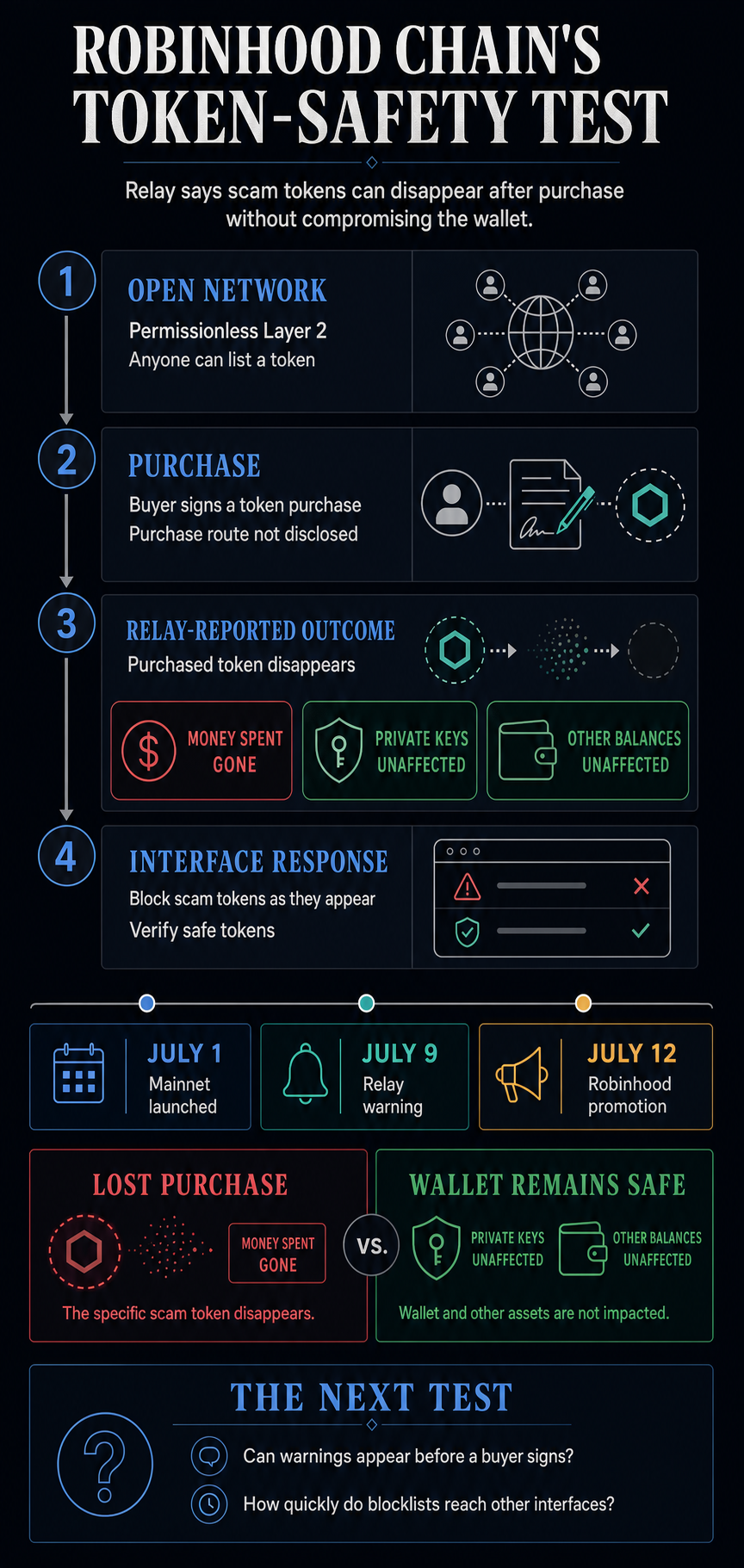
Cross-chain transaction protocol Relay has claimed that buyers on Robinhood Chain, Robinhood’s permissionless Ethereum Layer 2, lost money after tokens they purchased disappeared from their wallets.
Relay highlighted the issue and said the money was gone, without promoting the tokens or saying why they disappeared from wallets.
The incidents were reportedly not wallet or private-key compromises. Keys and balances beyond the identified tokens remained untouched, it said. Relay is blocking tokens as they appear, verifying assets it deems safe, and reminding users that anyone can list a token.
Relay linked the losses to specific, likely dubious, token purchases on the Robinhood Chain. However, it did not say the trades went through Robinhood Wallet or suggest that brokerage accounts and other Robinhood products were affected.
Relay announced,
We’re aware of reports of tokens disappearing from wallets after purchase on Robinhood Chain. There’s been an increase in scam tokens designed to remove themselves after purchase.
If you bought one, the funds you spent are unfortunately gone. We’re blocking these tokens as they show up and verifying safe ones.
Relay did not publish the affected contract addresses or transactions, leaving the reported losses independently unverified.
Robinhood launched the permissionless public mainnet on July 1. The company says it serves nearly 28 million customers across 38 countries, though that figure reflects its companywide reach rather than the number of chain users or affected buyers.
The warning arrived during Robinhood Chain’s first surge in speculative trading. Decentralized exchange volume peaked near $400 million on July 7, and Pump.fun added trading for Robinhood Chain tokens on July 8.
Open token creation allows developers to deploy contracts without Robinhood’s approval. Third-party tokens and liquidity can form around Robinhood’s brand without an app listing. Relay’s warning shifts the issue from which assets attract attention to what buyers see before they sign.
Relay operates a separate bridge and swap interface that supports Robinhood Chain. Robinhood Wallet’s own support page says its in-app swaps route through 0x API and LI.FI, and the interface used by the affected buyers remains unidentified.
0x says it supports tokens by default unless they are blocked for compliance reasons, while custom ERC-20 tokens become tradable once liquidity exists on a market the API sources. Relay says it screens transactions against sanctions and risk databases and maintains an internal blocklist.
Its warning said it was blocking the affected tokens and verifying others, but did not establish whether buyers saw a warning before signing or only after completing their purchases.
Robinhood’s general scam guidance covers malicious smart contracts, pump-and-dump schemes and rug pulls, and tells users to review transaction details before signing. The page does not explain what token screening, if any, occurs before an in-wallet swap or address tokens whose balances disappear after purchase.
The next test is how quickly warnings and blocklists move across trading interfaces, and whether a token removed from Relay remains available elsewhere. Relay’s post leaves the contract addresses, buyer count, total losses, and technical cause undisclosed. Users need an asset’s status before an irreversible purchase, when a warning can still change the outcome.
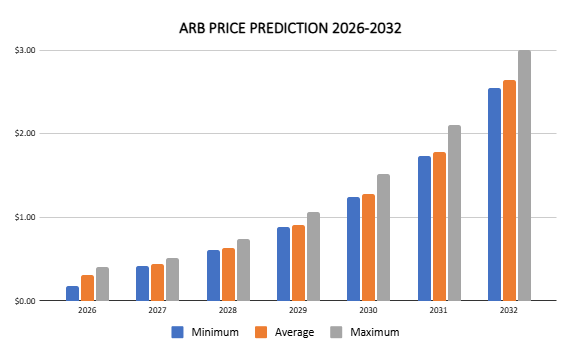
Our ARB predictions anticipate a high of $0.31 in 2026.
In 2028, the range is expected to be between $0.61 and $0.74, with an average price of $0.63.
In 2030, it will range between $1.24 and $1.52, with an average price of $1.28.
Arbitrum price prediction points to a modest near-term outlook and a stronger long-term move: our ARB forecast sees a high of $0.31 in 2026, with the token potentially reaching between $1.24 and $1.52 by 2030 and averaging $1.28, which suggests it could reclaim and move past $1 by the end of the decade.
Layer 2s have generated considerable buzz for their efficiency, and the Arbitrum network is in the top 5 pack, with a total value locked (TVL) of $1.24 billion. Arbitrum is an Optimistic Rollup solution that shifts network operations away from the Ethereum mainnet while maintaining Ethereum-level security.
For crypto investors, traders, and enthusiasts weighing ARB’s upside, this analysis examines Arbitrum’s current price action, technical indicators, market trends, competition, historical sentiment, and the key factors shaping its forecasts from 2026 to 2032. Is Arbitrum a good investment? Will it go up? Where will it be in 5 years? Let’s answer those questions with a data-driven Arbitrum price prediction to help you make more informed decisions in a volatile market.
Overview
Cryptocurrency
Arbitrum
Current Arbitrum price
$0.07930
Market cap
$504.43M
Trading volume
$42.92M
Circulating supply
6.36B
All-time high
$2.40 on Jan 12, 2024
All-time low
$0.07067 on Jun 26, 2026
24-hour high
$0.08141
24-hour low
$0.07757
Arbitrum price prediction: Technical analysis
Metric
Value
Volatility (30-day variation)
4.99% (Medium)
50-day SMA
$0.08892
200-day SMA
$0.1233
Sentiment
Bearish
Green days
15/30 (50%)
Fear and Greed Index
27 (Fear)
Arbitrum price analysis
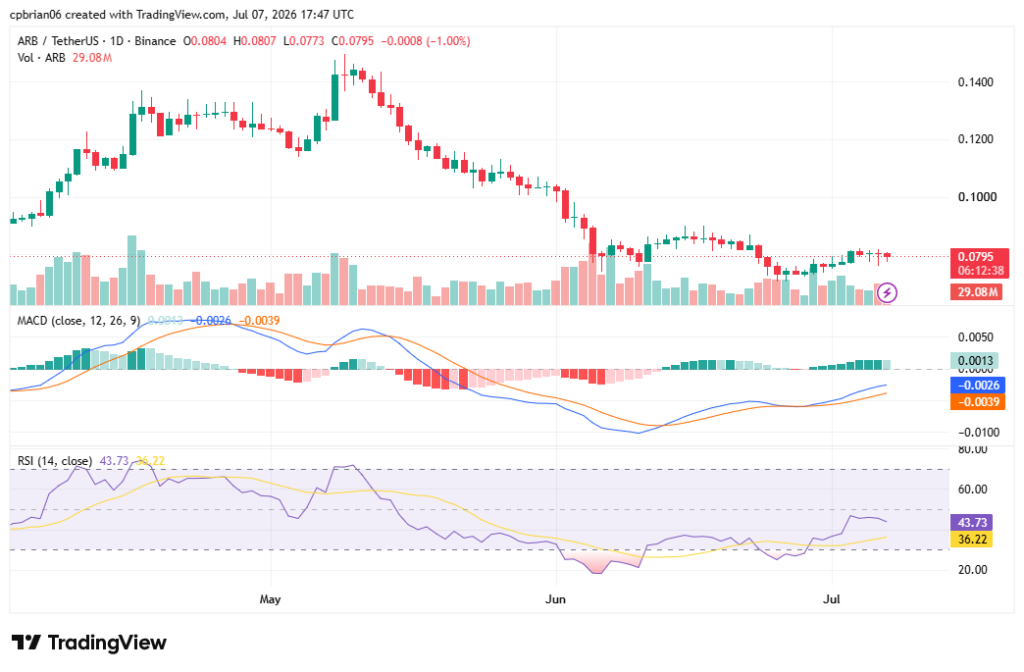
On July 7, Arbitrum’s price fell 0.78% over 24 hours and 3.16% over the last 30 days. The drop reflected recent ARB price action, accompanied by waning trading volume (-15.59%). Broader cryptocurrency markets and ETH prices can shape short-run sentiment, influence Layer 2 activity, and drive ARB price movements as market conditions shift.
ARB has consistently traded lower, reflecting a short-term bearish trend. The drop tracked the broader altcoin rally, driven by capital rotation from the sector — reflected in a declining Altcoin Season Index. ARB now has support at $0.073, and traders watch such low prices as potential support floors for buying interest in the week ahead.
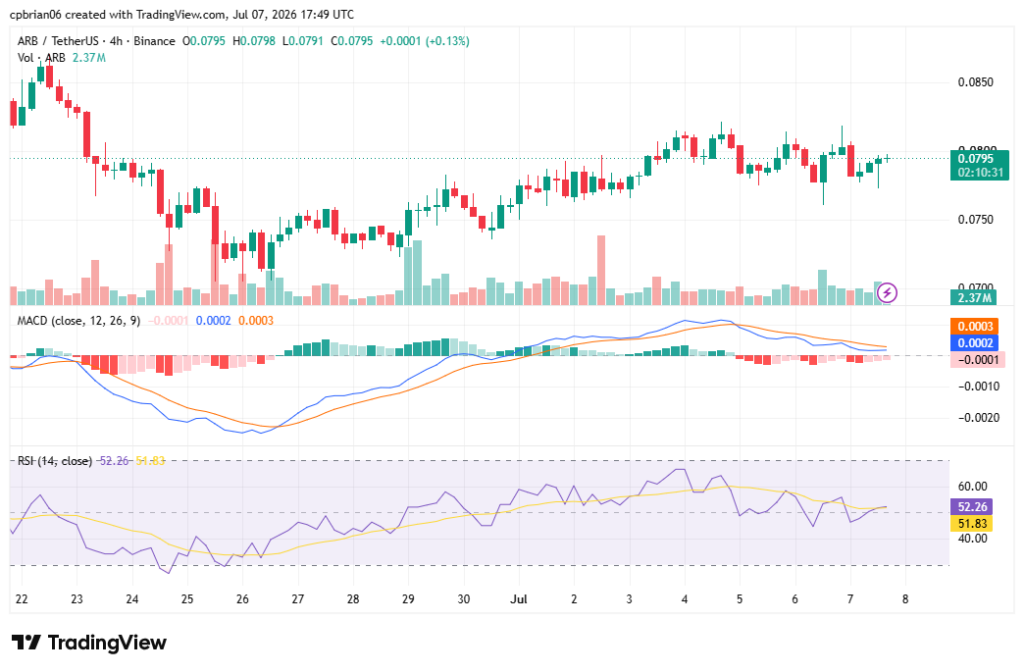
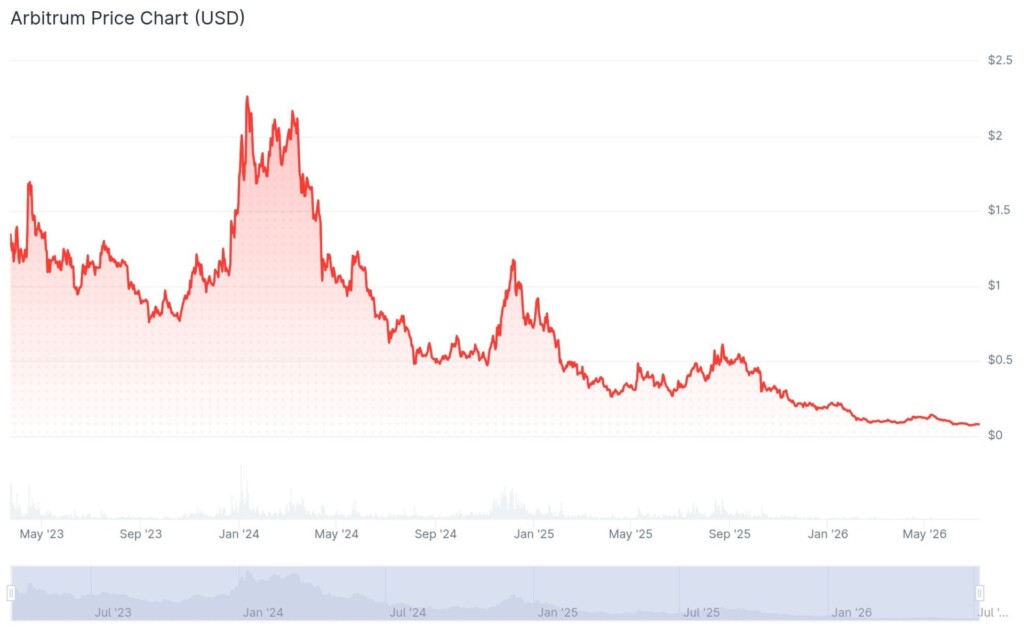
ARB registered a new all-time low (ATL) of $0.071 last month. The chart highlights ARB run following the drop. With its Relative Strength Index at 51,83, it is neutral. Psychological resistance around $0.08 could cap any rebound, though the selected time frame may change how traders interpret that signal, as bearish pressure persists.
Arbitrum technical indicators: Levels and action
Daily simple moving average (SMA)
Period
Value ($)
Action
SMA 3
0.07991
SELL
SMA 5
0.07951
SELL
SMA 10
0.07723
BUY
SMA 21
0.07902
BUY
SMA 50
0.08892
SELL
SMA 100
0.1035
SELL
SMA 200
0.1233
SELL
Daily exponential moving average (EMA)
Period
Value ($)
Action
EMA 3
0.07970
SELL
EMA 5
0.07922
SELL
EMA 10
0.07853
BUY
EMA 21
0.08000
SELL
EMA 50
0.08855
SELL
EMA 100
0.1020
SELL
EMA 200
0.1412
SELL
What to expect from the ARB price analysis next?
Arbitrum is moving downwards on the shorter timeframes, with moving averages still leaning bearish. Analysts use technical indicators to predict near-term price movements over the next week and next month.
Why is Arbitrum down?
ARB’s price remains below major moving averages, confirming the bearish trend structure. The RSI14 at 36.22 in neutral territory. Volume fell, indicating the move lacks conviction but also shows no urgency to buy the dip.
Does Arbitrum have a future?
As a Layer-2 scaling solution for the Ethereum network, Arbitrum uses optimistic rollups to process transactions off-chain and submit proofs back to Ethereum; high adoption is crucial to Arbitrum’s long-term success and sustainability. Arbitrum’s performance in this regard is a positive sign for its future prospects despite price declines. The ARB token is a governance token, and ARB holders use it to govern the Arbitrum DAO through protocol upgrades, treasury management, and ecosystem grants. It is not used to pay transaction fees on the network. As an L2 network, its growth also depends on Ethereum upgrades, rollup-focused development, and the broader ecosystem supporting the base layer. Rising active addresses, transaction volume, and dApp expansion can signal growth across the DeFi ecosystem, where Arbitrum supports over 575 protocols and holds about 45.53% of Layer 2 TVL, while remaining a leading chain among Layer 2s with strong transaction-fee revenue.
Recent news
A scheduled unlock of 14.4M ARB tokens, valued at $1.1 million, is set for July 7. Such events often create anticipatory selling pressure as the market prices in the potential dilution from newly liquid tokens, and further token unlocks later in 2026 add to that overhang.
ARB price prediction July 2026
The Arbitrum price forecast for July is estimated at a range of $0.0750 to $0.1001, and this monthly outlook is one of several short run price predictions investors may track. The average price for the month will be $0.0809.
Month
Potential low ($)
Potential average ($)
Potential high ($)
July
0.0750
0.0809
0.1001
Arbitrum price prediction 2026
For 2026, ARB’s price will range between $0.06 and $0.31. The average price for the period will be $0.21. Other market analysis projects 2026 between $0.08574 and $0.251, with an average of $0.1683.
Year
Potential low ($)
Potential average ($)
Potential high ($)
2026
0.0608
0.2122
0.3109
Arbitrum price prediction 2027-2032
Year
Potential low ($)
Potential average ($)
Potential high ($)
2027
0.4207
0.4364
0.5134
2028
0.6123
0.6341
0.7447
2029
0.8807
0.9124
1.06
2030
1.24
1.28
1.52
2031
1.73
1.78
2.10
2032
2.55
2.64
3.00
Arbitrum price prediction 2027
Arbitrum market price prediction climbs even higher into 2027. Some external forecasts place ARB’s price in a much more bullish $5.00 to $8.00 range across 2027-2028. Some crypto analysts place 2027 in a wider comparative range of $0.157 to $0.446, with an average near $0.3015. According to arbitrum’s price forecast, ARB’s price will range from $0.42 to $0.51, with an average of $0.44.
Arbitrum coin price prediction 2028
Our analysis indicates a further acceleration in ARB’s price. It will trade between $0.61 and $0.74 and an average price of $0.63.
Arbitrum price prediction 2029
According to the 2029 Arbitrum forecast, ARB’s price will range from $0.88 to $1.06, with an average of $0.91.
ARB price prediction 2030
The ARB price prediction for 2030 is $1.24-$1.52, with an average of $1.28. Broader 2030 projections place ARB between $2.46 and $5.78, with an average of $4.12. In a bullish scenario, some forecasts extend toward $12.00, though the long-term impact depends on several factors, including on-chain metrics, market conditions, Layer-2 adoption, Ethereum scaling upgrades, TVL, and competition.
Arbitrum price prediction 2031
The Arbitrum price forecast for 2031 is a high of $2.10. It will reach a minimum price of $1.73 and an average price of $1.78.
Arbitrum ARB price prediction 2032
The year 2032 will also be bullish. Our analysis estimates a price range of $2.55 to $3.00, with an average price of $2.64. A conservative model suggests ARB could be around $0.13 by 2036 and $0.26 by 2051.
This table compares analyst market analysis on the price of Arbitrum across leading platforms and acts as a simple price prediction tool for reviewing outside analyst forecasts.
Cryptopolitan’s arbitrum price forecast indicates that ARB will reach a high of $0.31 in 2026, and whether it looks like a good buy depends on your risk tolerance and timeframe. At its current price below $1, ARB would need a 1000% surge to reach $10. Any path there faces potential short-term constraints from supply growth and market sentiment, so it would likely take several years even in favorable conditions. Since its launch, ARB has peaked at $2.40, so a $10 target at the current price level seems highly implausible. In 2028, the range is expected to be between $0.61 and $0.74, with an average of $0.63. In 2030, the range is likely to be between $1.24 and $1.52, with an average of $1.28. Do your own research and invest at your own risk.
The Arbitrum airdrop snapshot occurred on Feb 6, 2023, and eligible participants, including early users, started claiming ARB tokens on Mar 23, 2023. The claiming period ended on Sep 24, 2023.
The airdrop granted 11.5% of the total supply to eligible users, 1.1% to DAOs operating in the Arbitrum ecosystem, and 44% to employees and Offchain Labs investors. The 44% is subject to lock-up periods and a vesting schedule, while whales control 57.13% of the supply, which can influence price movements when large holders reposition. The rest was sent to the Arbitrum DAO treasury.
ARB is the native token of the network, with a total supply capped at 10 billion, annual inflation of 2%, and 12.75% of the supply initially distributed to eligible users and DAOs.
A significant share of supply remains locked and is released gradually into circulation, potentially creating selling pressure if demand does not keep pace.
On Sep 11, 2023, it fell to its all-time low at $0.7453.
Bitcoin’s halving and the hype around crypto ETFs helped the coin recover from its October slump. By the end of the year, it had risen to $1.4.
The run continued into 2024. On Jan 12, it reached its all-time high at $2.40.
According to CoinMarketCap data, ARB fell below its listing price in June 2024.
On August 5, 2024, it registered a new all-time low of $0.4317
It then recovered in September, reaching a high of $0.67.
The bullish run continued into November, reaching $1.12 in December.
The Arbitrum network includes Arbitrum One for dApps that need stronger security and Arbitrum Nova for high-throughput use cases such as gaming and social apps; for example, this structure lets more security-sensitive DeFi apps stay on One while lighter social activity can run on Nova.
The coin entered 2025 trading at $0.72 before entering a bear run, falling to a low of $0.40 in February.
It recovered later and crossed into October, trading at $0.45. The trend later reversed, and by date 11, it had fallen to $0.136.
In December, it traded at $0.20.
ARB then entered a bear market in 2026, and on Mar 30, 2026, it hit an all-time low of $0.08653.
It later began to recover, and by May it had crossed above $0.12. The trend reversed in June, trading at $0.08. It maintained the level into July.
Competition from other blockchain projects remains a key factor for ARB, and Arbitrum faces competition from Optimism and zkSync, as well as Ethereum L2 rivals such as Base.
Bankless co-founder David Hoffman said he sold his Ether holdings because he believes the long-standing “ETH is money” thesis has already largely played out. Despite this, he remains strongly bullish on Ethereum as a network.
According to Hoffman, the decision did not come lightly, given that he built his career, business, community, and identity around Ethereum.
Ethereum Chose the Hard Path Unlike Bitcoin
In his latest tweet, Hoffman stated that the “ETH is money” thesis depended on Ethereum succeeding across multiple layers of coordination, including decentralized leadership, governance, Layer 2 ecosystems, roadmap execution, and technological development.
Hoffman described Ethereum as “not Bitcoin,” and said that Bitcoin simplified its blockchain to maximize the value of BTC, while Ethereum pursued a more ambitious path by expanding utility across decentralized applications, finance, tokenization, and infrastructure. He even went on to add that Ethereum achieved part of that vision and earned the market capitalization it currently has, but said the opportunity for ETH to be significantly rerated higher by the market now appears to be closing.
The Bankless co-founder also explained that the broader “strong version” of crypto, which focused on decentralized finance, NFTs, DAOs, and crypto-native systems, failed to maintain long-term mainstream support outside the 2020 to 2022 period. He said crypto’s reputation later became associated with scams, grifts, and speculative behavior, which ended up weakening the social belief system required for ETH to function as money at a global scale.
He further stated that Ether’s utility increasingly benefits other forms of money, especially stablecoins and tokenized dollars, rather than ETH itself. Hoffman described Ethereum as a “giver, not a taker,” while saying that the network provides secure blockspace, tokenization infrastructure, and DeFi support at minimal cost rather than extracting maximum value for ETH holders. He said Ethereum’s architecture prioritizes applications, rollups, and ecosystem growth over ETH itself, which makes it difficult for the underlying crypto asset to fully achieve global money status without overwhelming market dominance.
Ethereum in Crisis?
Hoffman’s decision also comes at a time when bearish sentiment around Ethereum has been intensifying. A recent report by Santiment found that social media discussions have increasingly shifted from optimism toward frustration and concerns about further downside.
The analytics firm said traders have increasingly viewed ETH as “dead money” compared to stronger-performing crypto assets in 2026, as weakening ETF flows, declining on-chain activity, and growing competition from ecosystems such as Solana and BNB Chain added pressure on sentiment.
Rumors about prominent Ethereum figures reducing or exiting ETH positions, including discussions surrounding Hoffman, have also contributed to rising uncertainty in the market, especially as traders worried about insiders losing confidence in the asset.
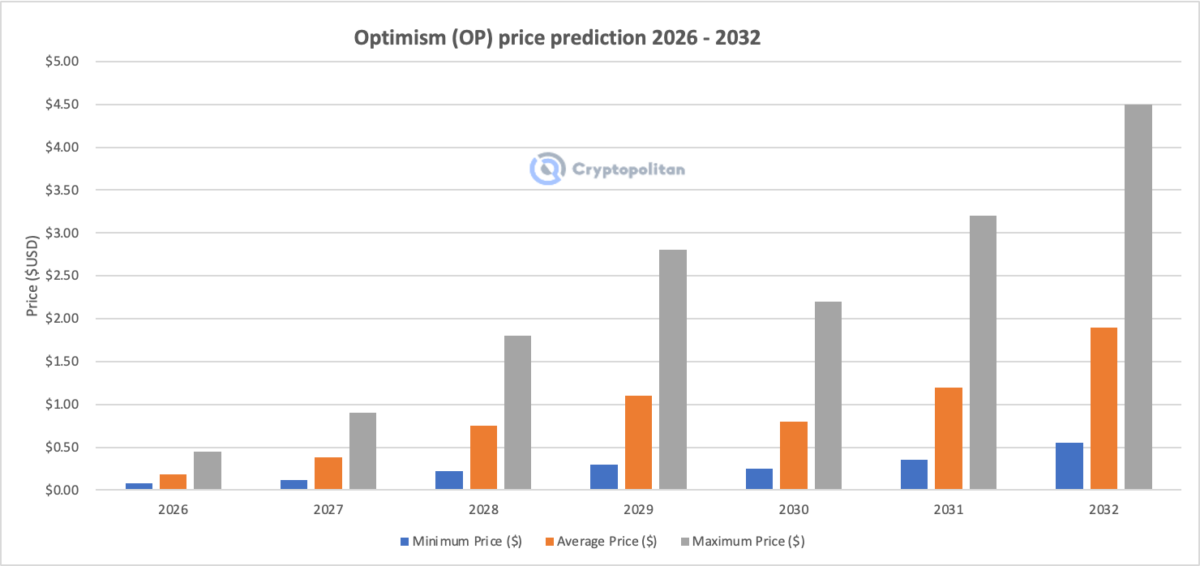
By the end of 2026, OP is expected to have a minimum and maximum price of about $0.08 and $0.45, respectively.
Optimism price prediction for 2029 suggests the token could reach a maximum value of $2.80.
In 2032, OP tokens will range between $0.55 and $4.50, with an average value of $1.90.
Optimism’s (OP) commitment to innovation is highlighted by its support for Layer-3 solutions. These solutions enable the development of decentralized applications (dApps) on top of Layer-2 chains, contributing to the expansive Optimism Superchain.
The platform’s initiatives, including introducing custom gas tokens and Plasma mode aimed at reducing onboarding and operational costs, make it more accessible for new users and developers. As the market closely watches the price movements and growth trajectory of the token, can Optimism reach $10 soon?
Let’s get into the OP price prediction for 2026 – 2032.
Overview
Cryptocurrency
Optimism
Token
OP
Price
$0.1255
Market Cap
$271.45M
Trading Volume
$54.66M
Circulating Supply
2.150B OP
All-time High
$4.85 (Mar 06, 2024)
All-time Low
$0.2519 (Dec 26, 2025)
24-hour High
$0.1314
24-hour Low
$0.1243
Optimism price prediction: Technical analysis
Metric
Value
Volatility (30-day Variation)
10.55% (Very High)
50-Day SMA
$0.1254
14-Day RSI
43.56 (Neutral)
Sentiment
Bearish
Fear & Greed Index
28 (Fear)
Green Days
13/30 (43%)
200-Day SMA
$0.2242
Optimism price analysis
TL;DR Breakdown:
OP has fallen roughly 30% from its recent local high near $0.18.
The daily MACD and the 4-hour structure both confirm bearish momentum.
RSI is oversold, but bulls still lack confirmation of a reversal.
Optimism 1-day price chart
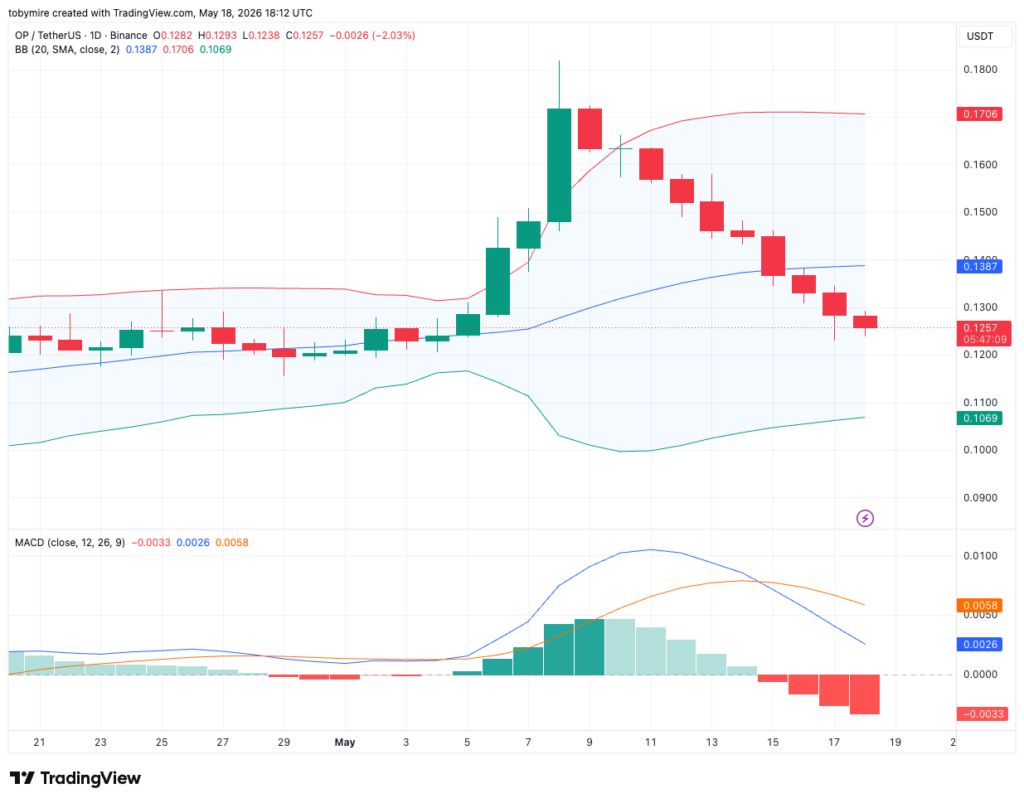
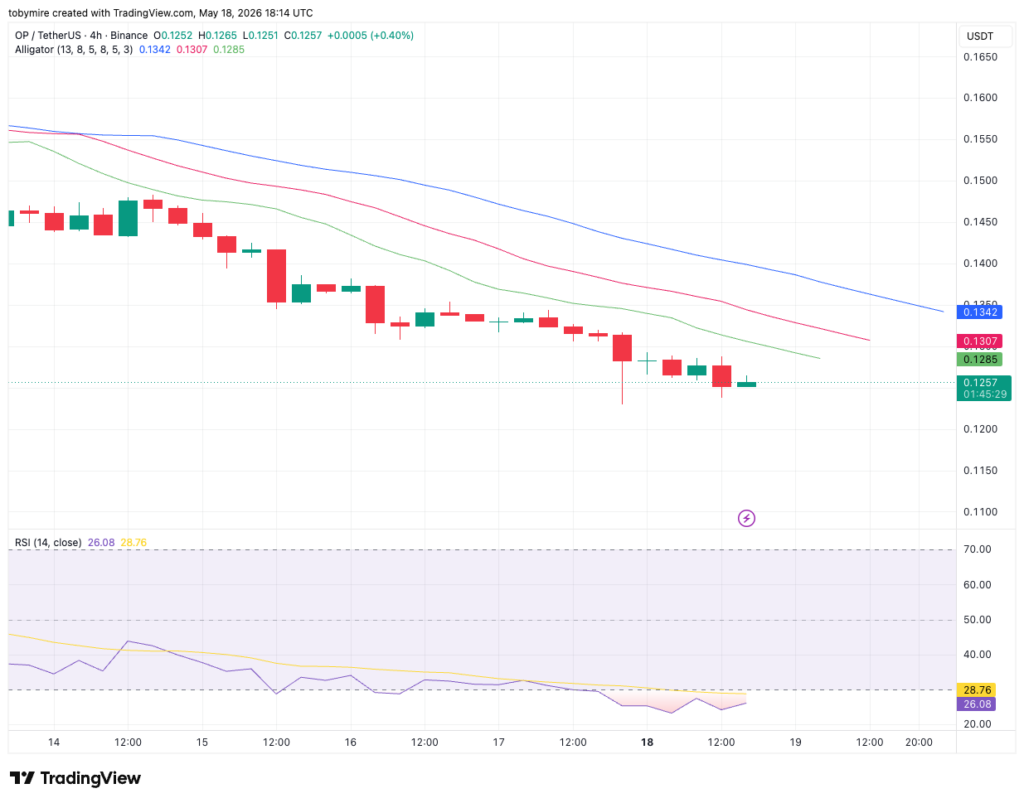
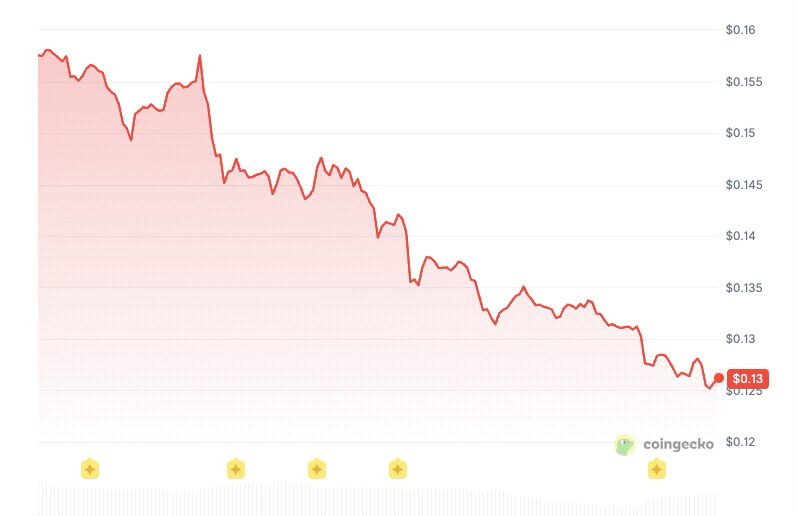
As of May 18, OP remains under heavy bearish pressure after failing to sustain its sharp breakout rally earlier this month. The token surged toward $0.18 before reversing aggressively and has now dropped to $0.1257, marking a decline of roughly 30% from the recent peak.
OPUSDT 1-day price chart by TradingView
The daily chart shows OP trading below the Bollinger mid-band at $0.1387, while MACD has completed a bearish crossover with expanding red histogram bars, confirming fading momentum and increasing seller dominance. Consecutive lower closes also suggest buyers are struggling to defend key support zones.
The immediate support sits near $0.123-$0.125. If this range breaks, OP could revisit the psychological $0.12 level and potentially slide toward $0.11. On the upside, bulls need to reclaim $0.13 first before any meaningful recovery attempt toward $0.138 becomes possible.
Optimism 4-hour price chart
The 4-hour chart remains decisively bearish, with OP trading below all Alligator moving averages while printing a clear lower-high structure. RSI has dropped to 26, signaling oversold conditions, though no strong reversal confirmation has appeared yet.
OPUSDT 4-hour price chart by TradingView
OP continues drifting downward with weak bullish candles failing to gain momentum. The trend still favors sellers unless OP can recover above the $0.128-$0.13 resistance zone in the short term.
A short relief bounce is possible due to the oversold RSI reading, but sustained upside remains unlikely while momentum indicators stay negative.
Optimism technical indicators: Levels and action
Daily simple moving average (SMA)
Period
Value
Action
SMA 3
$0.1324
SELL
SMA 5
$0.1376
SELL
SMA 10
$0.1496
SELL
SMA 21
$0.1376
SELL
SMA 50
$0.1254
BUY
SMA 100
$0.1311
SELL
SMA 200
$0.2242
SELL
Daily exponential moving average (EMA)
Period
Value
Action
EMA 3
$0.1326
SELL
EMA 5
$0.1367
SELL
EMA 10
$0.1406
SELL
EMA 21
$0.1383
SELL
EMA 50
$0.1344
SELL
EMA 100
$0.1583
SELL
EMA 200
$0.2422
SELL
What to expect from Optimism?
Optimism’s recent rally has fully cooled off, and both timeframes now point to continued bearish pressure. Unless buyers reclaim key resistance levels quickly, OP could continue grinding lower toward the $0.12-$0.11 range.
Is Optimism a good crypto investment?
Optimism (OP) could be a good investment if you believe in Ethereum scaling and the growth of Layer 2 solutions. However, like all crypto, it’s risky, and its value depends on adoption and market trends. Only invest what you’re willing to lose!
Will OP recover?
A recovery is possible, but we fear the overall bearish sentiment makes a short-term rebound unlikely. However, as the market consolidates, we expect reduced volatility, which may lead to a breakout in either direction, depending on market dynamics.
Will OP reach $50?
Reaching $50 for Optimism (OP) would be an ambitious target, requiring a significant increase in its price. This level would likely only be achievable in a highly favorable market environment, with substantial advancements in Ethereum adoption, widespread use of Layer 2 solutions, and strong overall market growth.
Will OP reach $100?
Reaching $100 for Optimism (OP) would be extremely ambitious and require unprecedented growth and adoption.
Does Optimism have a good long-term future?
Yes, Optimism shows strong potential for growth and sustained interest, indicating a positive long-term outlook.
Recent news/opinion on Optimism
Alchemix v3 is now live on OP Mainnet. The release introduces Mix-Yield Tokens, a Fixed-Duration Transmuter, and 90% LTV vaults.
The next era of Alchemy has arrived.
Alchemix v3 caps are raised, and Transmuters are open.
After years of building on what we learned from v2, today we open up 90% LTV vaults, new Mix-Yield Tokens, and the Fixed-Duration Transmuter.
Optimism’s price prediction for May 2026 suggests a potential low of $0.1053, an average of $0.115, and a high of $0.1302.
Optimism price prediction
Potential Low
Potential Average
Potential High
Optimism price prediction May 2026
$0.1053
$0.115
$0.1302
Optimism price prediction 2026
The price of Optimism is predicted to reach a maximum value of $0.45 in 2026. Traders can anticipate a minimum price of $0.08 and an average trading price of $0.18.
Optimism price prediction
Potential Low
Potential Average
Potential High
Optimism price prediction 2026
$0.08
$0.18
$0.45
Optimism price predictions 2027–2032
Year
Minimum Price ($)
Average Price ($)
Maximum Price ($)
2027
$0.12
$0.38
$0.90
2028
$0.22
$0.75
$1.80
2029
$0.30
$1.10
$2.80
2030
$0.25
$0.80
$2.20
2031
$0.35
$1.20
$3.20
2032
$0.55
$1.90
$4.50
Optimism price prediction 2027
In 2027, the Optimism price prediction suggests a maximum price of $0.90, an average trading price of $0.38, and a minimum price of $0.12.
Optimism price prediction 2028
Per the Optimism price forecast for 2028, OP could reach a peak price of $1.80. The average price is projected around $0.75, with a minimum expected at $0.22.
Optimism price prediction 2029
The Optimism price prediction for 2029 suggests a peak value of $2.80. The minimum trading price is expected to be $0.30, while the average market value is projected to be around $1.10.
Optimism price prediction 2030
The Optimism forecast for 2030 suggests a minimum price of $0.25, a maximum price of $2.20, and an average price of $0.80.
Optimism price prediction 2031
According to the Optimism price prediction for 2031, OP could potentially reach a maximum price of $3.20, a minimum price of $0.35, and an average value of around $1.20.
Optimism price prediction 2032
In 2032, the minimum price of Optimism is forecasted to be around $0.55. OP’s value can reach a maximum of $4.50 with an average trading value of $1.90.
Optimism price prediction 2026 – 2032
Optimism market price prediction: Analysts’ OP price forecast
Firm
2026
2027
CoinCodex
$0.1274
$0.3488
DigitalCoinPrice
$0.15
$0.0578
Cryptopolitan’s Optimism (OP) price prediction
Cryptopolitan’s overall price prediction for Optimism (OP) suggests a conservative outlook for the cryptocurrency in the near term. For 2026, the maximum forecast price is between $0.6 and $0.8. Over the next few years, Optimism is projected to appreciate substantially, with prices anticipated to rise from a minimum of $4 to a maximum of $6 by 2032.
OP launched with an initial value of $4.57 on May 31 but dropped sharply in June due to the UST stablecoin de-pegging and LUNA collapse, closing June at $0.5434. It further declined to $0.4147 by mid-July. In August, OP briefly surged above $1.90, but by mid-October, it dropped to $0.70 following the FTX collapse.
In Q1 2023, OP surged past $3.00 during a crypto bull run but lost 66% shortly after. A recovery saw it close the year at $3.90.
OP saw an eventful 2024, reaching an all-time high of $4.85 in March before sliding below $2.30 by mid-April. After a brief recovery to over $2.90 in May, it entered a bearish phase, trading at $1.82–$1.96 by July and $1.54–$1.62 by October. November brought a spark of hope with a peak at $2.60. OP closed December within the range of $1.611–$2.773.
In January 2025, OP peaked at $2.18 but lost momentum, dropping to as low as $0.84 in February. OP peaked at $0.9346 in March, $0.8523 in May, $0.7478 in June, and in July, $0.86.
In August, OP traded between $0.6178 and $0.880, and in September, it maintained an average price of $0.74.
In November, OP traded between $0.2888 – $0.4516, and in December, the coin traded between $0.3117 – $0.3264.
In January 2026, the coin maintained a trading range of $0.2213 and $0.3731, and in February, it traded between $0.109 – $0.2. In March, OP traded between $0.1001 – $0.1391, and in April, the coin maintained an average price of $0.11.
In May, the coin is trading between $0.1252 – $0.1581.
Binance will list MegaETH’s MEGA token on April 30, 2026, with spot trading set to open at 11:00 UTC. The exchange received no allocation or listing fee, drawing wide praise from analysts and founders.
Binance applied its Seed Tag to MEGA. Every major centralized exchange has now added MEGA without taking project tokens, a rare outcome for a Layer 2 (L2) launch.
Binance Joins MEGA Exchange Spread Without Tokens
Spot pairs including MEGA/USDC and MEGA/USDT went live shortly after the Binance announcement. Deposits and trading remain restricted in the United States, Canada, the Netherlands, and other jurisdictions for regulatory reasons.
MegaETH publicly committed earlier in 2026 to a no-pay listing policy. The team refused to send tokens for fees, liquidity rewards, or promotional airdrops.
The team argued that listings should follow merit and demand, not supply transfers.
“MegaETH has not, and will not, give away MEGA tokens as “fees or airdrops” to any centralized or decentralized exchange for a listing. If an exchange chooses to list the MEGA token, it is because they believe it is a strong project,” the team articulated.
By launch day, Coinbase, Bybit, Upbit, Bithumb, and Binance had each added MEGA without taking project tokens.
Smaller venues including OKX, Bitget, and MEXC also enabled trading. Community members called the spread a “royal flush” and a first for an organic Layer 2 listing run.
2x+ for ICO buyers 2.2x paper gains for those who locked for 12 months
Looks like @megaeth was able to pull the rabbit out of the hat with the royal flush of listing spreads: Coinbase, Bybit, Upbit, Bitthumb, and now even Binance.
Industry Figures Frame Listing as a Shift in Exchange Practice
Simon Dedic, chief executive at Blockhead Capital, said Binance “bent the knee” by listing without compensation. He framed the outcome as a positive signal for token founders weighing exchange demands during launches.
“Honestly, I wouldn’t have expected them to bend the knee and list it for free, so kudos to Binance here. Imagine being such a sought-after project that every major CEX lists you without receiving a single token,” wrote Dedic.
Analyst DeFi Ignas pointed out that Binance had previously committed to supporting builders with large communities. He argued that skipping MEGA would have contradicted that stance.
The general sentiment is that the launch is “substantive and principled,” given MegaETH’s avoidance of KOL payments, point-farming campaigns, and supply allocations to exchanges.
The project’s mUSD stablecoin and proximity market design are potential routes for the token to capture network value.
“It’s a rare sight in a space that rewards crime. Good to see good teams win. Hopefully an inspiration playbook for other quality projects to follow,” stated Grail.eth, a popular user on X.
MEGA Trades Near $2 Billion Fully Diluted Valuation
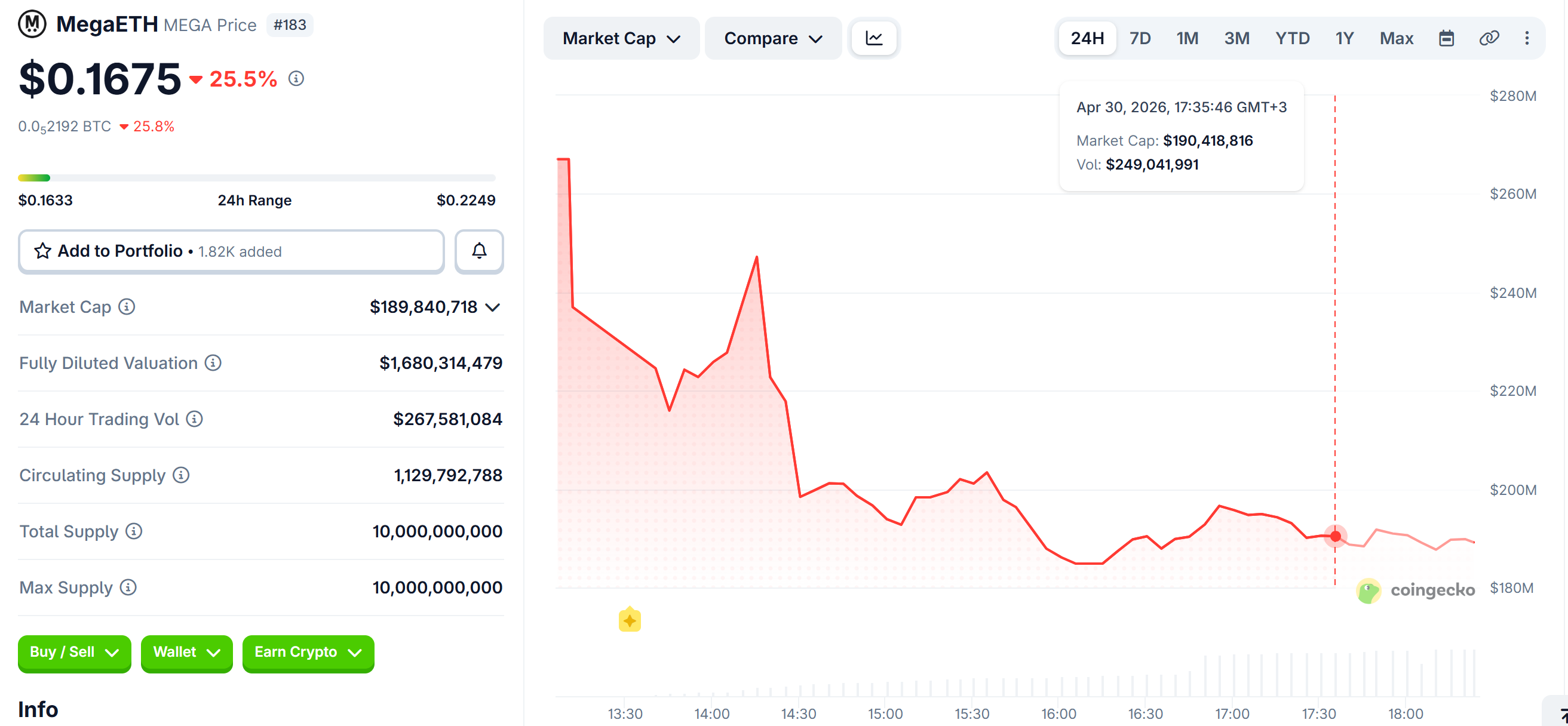
MEGA traded around $0.16 in the hours after the Binance listing announcement. The price placed circulating market cap near $190 million and fully diluted valuation around $1.7 billion. Total supply is 10 billion tokens.
— IAm⭕️hJay | Σ:(CTNG HOUSE) (@OhJay_001) April 30, 2026
Community responses pointed to compromised approvals or phishing rather than a protocol fault. Users urged claimants to revoke unused permissions before interacting with new contracts.
The MEGA listing run sets a precedent for other Layer 2 teams to point to. Whether future launches replicate the playbook may depend on whether their tokens see comparable demand.
Supply concessions have long shaped exchange decisions, and few projects have refused them.
Ethereum recorded a major on-chain milestone in the first quarter of 2026 across its base layer activity. Data from Artemis shows the network processed over 200 million transactions, its highest quarterly total on record.
On a quarterly basis, this represents a 43% increase from 145 million transactions in the previous quarter ending late 2025. Quarterly activity previously bottomed near 90 million in 2023 before stabilizing through most of 2024.
What’s Driving Ethereum’s Activity Growth?
Growth was driven mainly by Layer 2 networks that process transactions off-chain and settle on Ethereum. Rollups such as Base and Arbitrum bundle activity, increasing recorded base-layer transaction counts significantly over time.
Alongside this scaling effect, stablecoin issuance also expanded, pushing total supply on Ethereum to about $180 billion in the quarter. These dollar-pegged tokens now support decentralized finance activity, payments, and remittance flows across the ecosystem.
Network-level efficiency also played a role. The Dencun upgrade reduced data costs for Layer 2 networks, limiting direct fee pressure on the Ethereum mainnet. As a result, higher usage did not translate into proportional gas fees or increased ETH token burns.
What This Means for Ethereum’s Next Phase
Despite stronger network activity, Ether price remains near $2,400, still more than 50% below its 2025 peak levels. Analysts note a growing divergence between on-chain usage and market valuation trends.
Some market observers view this gap as a sign of delayed pricing response to network fundamentals. Historical cycles suggest sustained on-chain expansion often precedes broader price recovery phases in crypto markets.
However, analysts caution that transaction growth may include automated stablecoin movements rather than new user adoption. This raises questions about how much of the activity reflects genuine economic demand on the network.
Future momentum depends on whether the network maintains over 200 million transactions into the second quarter of 2026, alongside continued stablecoin and Layer 2 activity. These factors will determine whether the current level of network usage is sustained or fades.
The broader question is whether strong on-chain activity will eventually translate into renewed long-term market strength. This uncertainty is amplified as Ethereum’s usage, scaling, and price trends continue to move in different directions.
Ethereum (ETH) has entered Q2 2026 with a steep 55% drop from its August 2025 high above $4,900, as macro-driven pressures weigh on the price.
New data suggests that the unprecedented surge in the Total Transfer Count metric highlights that on-chain activity has reached peak levels.
Ethereum Usage Peaks
Ethereum’s on-chain activity has returned to record levels, as the 7-day simple moving average of Total Transfer Count climbed back above 1.3 million, matching its previous peak seen in mid-February, according to CryptoQuant.
The rise in transfer activity points to steady network usage, which means continued participation across decentralized finance (DeFi) applications, Layer 2 ecosystems, and other smart contract operations. This trend indicates that the Ethereum network is being actively used rather than simply held as a speculative asset.
At the same time, ETH’s price has remained relatively subdued as it continues to consolidate near the $2,100 level and is still trading well below its historical highs. This divergence between rising network activity and muted price action suggests that the network’s underlying utility is expanding faster than its market valuation.
To top that, the increase in transaction volume contributes to higher gas consumption, which in turn accelerates ETH burning under Ethereum’s fee-burning mechanism. Such a process gradually reduces the circulating supply and can contribute to long-term pressure on the asset’s availability. The data essentially reveals a period where network usage is strong despite relatively restrained price performance.
If high levels of activity continue, CryptoQuant stated that the chances of ETH’s price eventually catching up with these robust on-chain fundamentals in the mid-term remain highly favorable.
Target Points For ETH
According to an earlier analysis by Ali Martinez, Ethereum’s next rally may depend on reclaiming the $2,500 level, which he identifies as a major trigger for a new bullish phase. He flagged subtle signs of accumulation, especially as the $1,800 level continues to hold as support. This area also aligns with the 0.80 MVRV band near $1,880, a zone linked to market stress and potential bottoms where investors begin accumulating.
However, if the current structure flips, the crypto asset risks further downside, during which $1,550 and $1,070 will act as potential lower targets.
On a macro level, the violation of the ceasefire has added uncertainty to the market. As such, analyst Ted Pillows stated that the $2,150-$2,200 range is now a crucial support zone to watch. If ETH manages to hold this level, it could pave the way for another upward move. Losing this range may open the door to more declines.
TEN Protocol Launches Community-First Raise: Infrastructure Ownership for the Next Era of Ethereum
LONDON, August 5, 2025 – TEN Protocol, the Ethereum Layer 2 building encrypted execution for next-gen blockchain applications, is opening its public round via Legion from August 5–12. This community-first raise offers early access to The Final Network, the TEN Protocol infrastructure powering applications previously impossible on transparent chains, marking a shift from institutional backers to community ownership of infrastructure already proven at scale.
Unlike traditional fundraises, TEN’s public round is about enabling open ownership of working infrastructure. With over 548,000 wallets on testnet and a growing developer ecosystem, TEN already delivers encrypted execution for real-world use cases across gaming, AI, and institutional finance.
“We believe the people building, testing, and using TEN should be the ones who own it,” said Gavin Thomas, CEO of TEN Protocol. “This isn’t about speculation, it’s about giving early users a direct stake in infrastructure that’s already working and unlocking new markets for Ethereum.”
TEN’s encrypted execution layer solves what many see as Ethereum’s “transparency trap” – the inability to build apps requiring confidential logic, such as real gaming mechanics, private auctions, or institutional DeFi. By leveraging Trusted Execution Environments (TEEs), TEN enables smart transparency, the next step in Ethereum’s evolution.
The Final Network’s public round via Legion is built around three core pillars:
Community-First Ownership: No insider deals. No exclusive allocations. Just direct access for users to own a piece of the network.
Smart Transparency: A breakthrough in privacy-preserving smart contracts, enabling billion-dollar categories like gaming, AI, and TradFi to go fully on-chain.
Credibility at Scale: The team previously built R3 Corda, trusted by central banks and institutions to settle trillions and manage over $10B in real-world assets.
TEN’s approach challenges the current L2 model, dominated by institutional capital and extractive economics, by offering sustainable infrastructure aligned with its users from the start.
“The infrastructure that powers global markets shouldn’t be controlled by a handful of investors,” said Cais Manai, Co-Founder of TEN Protocol. “We’ve proven this can be done differently, and now we’re inviting the community to own what they help create.”
The TEN x Legion public round is part of a broader campaign to redefine how networks grow, one rooted in transparency, credibility, and long-term alignment. In line with this mission and TEN’s commitment to rewarding active early users, the first 200 contributors from the Cookie3 campaign will receive guaranteed allocation (up to $5K ticket size). Investors who participate in the round will receive TEN tokens directly via the Legion platform, with TEN’s Token Generation Event (TGE) and public listing scheduled for later this year.
Media Contact:
Liam Quinn – liam@obscu.ro Head of Growth TEN Protocol
About TEN Protocol
TEN Protocol is a next-generation Layer 2 solution built on Ethereum, enabling confidential smart contract execution, programmable cryptography and encrypted data processing. The protocol provides industrial-grade encryption solutions for decentralised applications while maintaining the security guarantees of the Ethereum network.
In 2021, Shiba Inu (SHIB) transformed from a meme-based cryptocurrency to a market sensation, skyrocketing over 46,000,000% from $0.0000000001 in January to a peak of $0.00008845 in October. Launched in August 2020 as an Ethereum-based token, SHIB capitalized on Dogecoin’s hype, fueled by retail investor enthusiasm on platforms like Reddit and Twitter. Elon Musk’s tweets and Vitalik Buterin’s donation of 50 trillion SHIB to India’s COVID relief fund amplified its visibility. Trading volume surged, with SHIB briefly ranking among the top 10 cryptocurrencies by market cap, hitting $39 billion.
Its decentralized exchange, ShibaSwap, launched in July 2021, boosting utility with staking and liquidity pools. Despite its meteoric rise, SHIB faced volatility, dropping 50% by year-end. The frenzy highlighted meme coins’ speculative appeal, drawing millions of holders, though its lack of fundamental use cases sparked debate about sustainability.
Dual Lending System: Flexibility and High-Yield at Layer-2 Speed
Shiba Inu (SHIB) made history in 2021 when it skyrocketed from a meme to a market sensation, delivering unbelievable returns in a matter of weeks. But while the hype was real, many investors were left chasing the tail end of its parabolic move. Today’s smarter capital isn’t hunting for viral spikes — it’s focused on real utility, DeFi infrastructure, and long-term growth. That’s where Mutuum Finance (MUTM) enters with powerful fundamentals and presale momentum that’s capturing serious attention.
Currently in Phase 5 of its presale, Mutuum Finance (MUTM) is trading at just $0.03, with over $12.2 million raised, 13,200+ token holders, and 73% of the phase already sold out. A 20% price jump to $0.035 is imminent in the next phase, and listing is set at $0.06 — meaning current buyers are locking in 2x upside before launch, with analyst projections aiming far higher in the years to come.
Unlike meme tokens, Mutuum Finance (MUTM) will be a structured Layer-2 lending ecosystem, enabling real earning mechanisms through two robust models — peer-to-contract (P2C) and peer-to-peer (P2P) lending. In the P2C model, users will deposit assets like DAI, USDT, ETH, AVAX, or MATIC into pooled contracts and will earn passive yield based on real-time pool utilization and dynamic interest rates. With lucrative loan-to-value (LTV) ratios, the system will be optimized to protect deposits while delivering consistent rewards.
Meanwhile, P2P lending on Mutuum Finance (MUTM) will unlock a personalized DeFi experience. This model is being designed to support assets that traditional DeFi protocols often exclude — including meme coins like DOGE, SHIB, and PEPE. Lenders will negotiate one-on-one deals, setting their own interest rates, loan durations, and loan-to-value ratios. This flexibility allows both parties to create custom agreements, making it a powerful option for users holding unconventional or volatile tokens.
Built on Layer-2 infrastructure, Mutuum’s entire lending and borrowing process will benefit from lower gas fees, faster finality, and a seamless user experience. With the upcoming beta launch scheduled around the time of listing, the project will aim to onboard thousands of users into a scalable DeFi network designed to support real-time loan execution and yield tracking.
In parallel, a $100,000 giveaway campaign is building excitement among early participants and social followers — now surpassing 12,000 on X (Twitter) — while also boosting visibility across DeFi communities.
Stablecoin Architecture and Early Investor Gains Signal Strong Long-Term Growth
Mutuum Finance (MUTM) is laying the foundation for a decentralized, overcollateralized stablecoin that will only be minted when users borrow against assets like ETH. This stablecoin will be burned automatically upon loan repayment or liquidation, preventing unnecessary inflation. Its $1 peg will be maintained through governance-adjusted interest rates and arbitrage opportunities, ensuring price stability without relying on market-driven rate changes.
Only approved issuers with set minting caps will be able to create this stablecoin, keeping system risk in check. All loans will remain overcollateralized and subject to automatic liquidation when necessary, helping preserve the integrity of the ecosystem over time.
Mutuum also rewards depositors with mtTokens, which reflect the user’s underlying principal and earned interest. These mtTokens can be staked in the designated smart contracts to earn dividends from the protocol’s revenue — offering a second layer of passive income for long-term holders. This dual-yield setup separates Mutuum from traditional DeFi platforms, where users typically earn yield from only one source.
Consider the investor who rotated $5,000 of capital from Ethereum (ETH) into Mutuum during Phase 1 at just $0.01. Today, that holding is worth $15,000 at the current $0.03 price — a 3X gain before launch. With the token set to list at $0.06, that position will soon reflect a 6x return, and a known analyst — known for spotting Solana (SOL) at $1 in 2020 — is now calling $0.30 targets by 2026, giving MUTM a 10x path forward.
Mutuum’s credibility is also reinforced by a CertiK audit with a 95.00 score, an active $50,000 bug bounty, and a roadmap that includes Layer-2 deployment, multi-chain integration, and governance expansion in later phases.
Shiba Inu (SHIB) may run again — but while retail chases past hype, smart investors are securing real utility. Only 27% of Phase 5 tokens remain at $0.03. Once Phase 6 begins, that price disappears forever. This is the final discounted entry for one of the most utility-packed projects of the cycle.
For more information about Mutuum Finance (MUTM) visit the links below:
Shiba Inu has gone viral once again, lighting up social feeds with meme-powered momentum—but behind the noise, Lightchain AI is quietly gaining traction where real investors are paying attention. With all 15 presale stages completed and the Bonus Round now live, the project is moving beyond the hype cycle and into serious accumulation territory.
Lightchain AI brings forward an AI-native blockchain architecture featuring a purpose-built virtual machine and a consensus model that rewards actual computational value. As the July 2025 mainnet launch nears, early movers aren’t chasing memes—they’re looking to Lightchain AI as a platform built for intelligent, long-term utility.
Shiba Inu Trends Once More on Meme-Driven Hype
Shiba Inu (SHIB) hasn’t led the altcoin rally in the market but has recently gone breakout for the second time owing to meme coin hype and ecosystem related developments. At the time of writing, on May 26, 2025, SHIB is trading around $0.00001454, rising by only 0.02% in the last 24 hours. The rebound is a reflection of the growth in Shibarium, the Shiba Inu Layer 2 blockchain network, and the significant on-chain activities it witnessed, such as the spurt in its registered accounts and transfers.
A dramatic rate of SHIB burned — more than 2,200% over the past 24 hours — has lowered the supply for the token, potentially increasing its value. These developments show that the Shiba Inu may be growing beyond its meme roots for sustained relevance in the world of cryptocurrency.
Lightchain AI Gains Quiet Strength Among Serious Investors
Lightchain AI is gaining quiet strength among serious investors who look beyond short-term hype and focus on long-term infrastructure. The project’s Bonus Round, priced at $0.007, continues to attract steady accumulation due to its sophisticated tokenomics and technical depth.
Gas optimization is built directly into the protocol, ensuring that AI tasks run efficiently, with costs dynamically adjusted based on task complexity—keeping network usage both scalable and affordable. Lightchain’s tokenomics ensures balanced distribution, with clear utility across AI task payments, governance, and premium feature access.
Its architecture supports a structured workflow and data flow that enables seamless interaction between the AIVM, validator nodes, and off-chain storage. As attention sharpens, Lightchain AI is becoming a calculated pick for value-focused, technically-minded investors.
Unlock Massive Potential with Lightchain AI
Lightchain AI is revolutionizing the game by blending cutting-edge AI innovation with the power of blockchain. Imagine unparalleled efficiency and scalability at your fingertips! With its AIVM technology, developers can deploy smart AI tasks effortlessly across distributed networks, creating endless possibilities.
Backed by advanced tokenomics, Lightchain AI fuels a thriving ecosystem built to solve real-world challenges. Whether you’re an investor or a developer, this platform is your gateway to a decentralized future powered by intelligent solutions. The future isn’t just coming—it’s here with Lightchain AI.