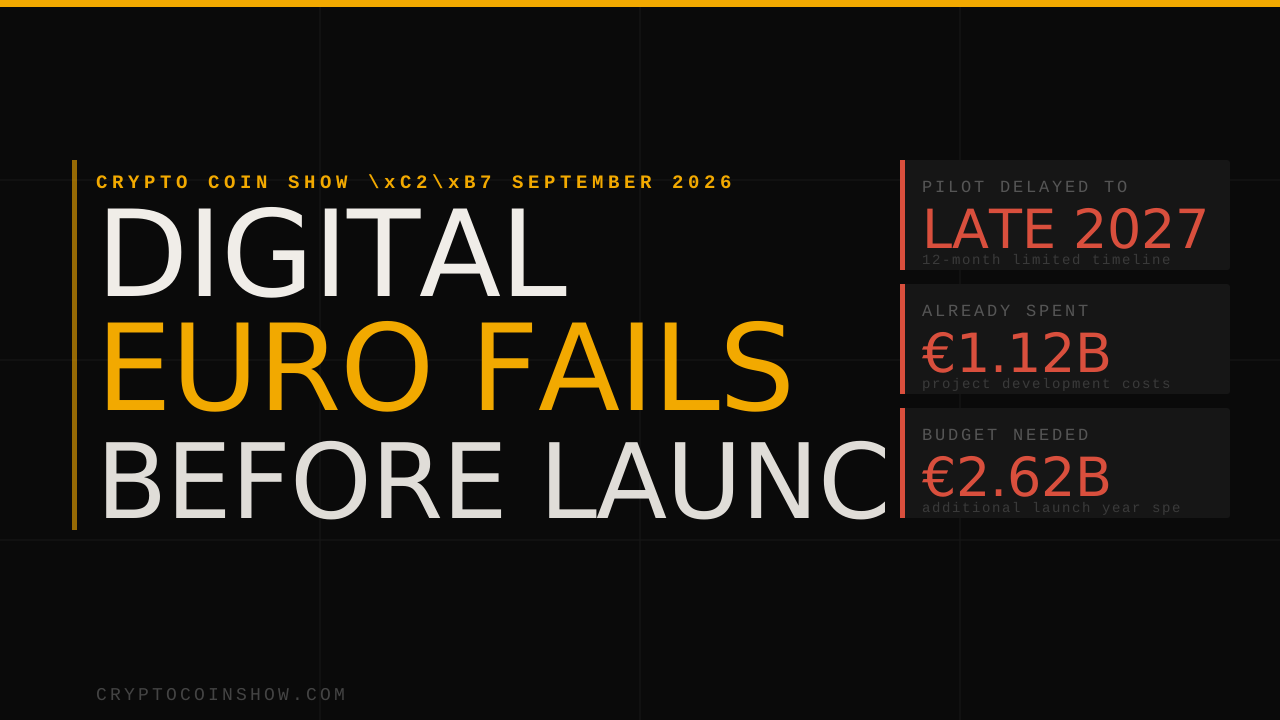
Is the digital euro failing before it even launches?
The European Central Bank’s digital euro project faces mounting criticism over delayed timelines and restrictive regulations that may handicap the EU’s stablecoin competitiveness globally. A new report from Blockchain for Europe argues that the bloc’s MiCA framework is pushing crypto business outside Europe while a pilot launch remains years away, raising questions about whether a central bank digital currency can succeed when private euro stablecoins are already gaining traction.
- Digital euro pilot delayed to late 2027 with 12-month limited timeline involving only select banks and merchants
- At least €1.12 billion already spent with €2.62 billion more expected in launch year, spending details undisclosed
- MiCA regulations deemed too restrictive by Blockchain for Europe, risking EU competitiveness against private stablecoin alternatives
- Late 2027 Projected digital euro pilot start date, delayed from earlier ECB timelines
- €3.74 billion Total estimated spending through launch year, combining committed and projected funds
- 12 months Expected duration of limited pilot phase with restricted participant base
The European Central Bank’s digital euro project is facing a credibility test. With a pilot launch now scheduled for late 2027 at the earliest, and limited details on how €3.74 billion in public funds will be deployed, the ECB is racing against a more nimble competitor: privately issued euro stablecoins that are already gaining institutional adoption.
A new analysis from Blockchain for Europe, authored by former ECB Director General Ulrich Bindseil and the organization’s Research Director Erwin Voloder, contends that the EU’s Markets in Crypto-Assets (MiCA) regulatory framework is so restrictive that it is actively undermining European stablecoin development while the central bank digital currency remains years from deployment.
The implications extend beyond Brussels politics to institutional investors evaluating euro exposure and stablecoin infrastructure.
MiCA Framework Pushes Stablecoin Development Outside the EU, Bindseil Report Warns
The Blockchain for Europe report frames the regulatory environment as self-defeating. MiCA, which took effect in June 2023, imposes strict capital requirements, reserve rules, and operational constraints on stablecoin issuers.
Rather than nurturing a robust European stablecoin ecosystem, the framework is functioning as a barrier to entry that deflects innovation toward jurisdictions with lighter-touch regulation.
Bindseil and Voloder argue this places the EU on the wrong side of the “regulatory Laffer curve”, a concept borrowed from tax policy suggesting that excessively strict rules reduce compliance and push activity elsewhere rather than controlling it.
The urgency of this critique stems from observable market movement. Euro-denominated stablecoins have experienced measurable growth in adoption and trading volume despite the skepticism surrounding a government-backed digital euro. Institutional investors and payment processors are deploying capital into private alternatives that offer regulatory certainty without central bank operational risk.
The Blockchain for Europe analysis calls on policymakers to pursue targeted MiCA reforms rather than rely on a CBDC that Voloder and others characterize as “dead on arrival”, a phrase reflecting deep industry doubt about the digital euro’s market relevance once it finally launches.
ECB Executive Board member Piero Cipollone countered this skepticism by emphasizing interoperability. He stated that the digital euro’s use of open payment standards “provides a European free alternative to current proprietary standards,” signaling an attempt to lower adoption friction for banks and merchants.
The ECB has signed agreements with three European standards bodies, the European Card Payment Cooperation, nexo standards, and the Berlin Group, to reuse existing contactless payment and merchant system infrastructure rather than building proprietary rails.
ECB Commits €3.74 Billion Through Launch Year While Refusing to Disclose Spending Details
Transparency around the digital euro’s cost remains a flashpoint. Public estimates suggest at least €1.12 billion has already been allocated to the project, with another €2.62 billion expected during the launch year, totaling €3.74 billion in identified spending. Yet the ECB has refused formal disclosure of detailed budget breakdowns, citing unspecified cost-control measures.
When the Cato Institute’s Nicholas Anthony requested spending records, the bank rejected the request because he was not an EU citizen. A follow-up request from a European citizen was also denied.
The lack of public accounting undermines institutional confidence in project governance and cost discipline.
This opacity is unusual for a public initiative of this scale and creates a governance gap. Central banks in other jurisdictions pursuing CBDC projects have published pilot budgets, personnel headcounts, and technical architecture documents to build public support.
The ECB’s refusal to disclose comparative figures, such as how digital euro development spending stacks against costs incurred by other central banks’ CBDC programs, invites speculation that either costs are escalating or that the bank is managing expectations by controlling information flow.
Pilot Timeline Extends to Late 2027 with Severely Limited Participant Pool
The pilot phase itself reflects the project’s extended runway. Rather than launching immediately upon completion of technical development, the ECB has scheduled the pilot to begin in the second half of 2027 at the earliest.
The pilot will run for approximately 12 months and will involve only a limited number of participating banks and merchants, far below the scale needed to test systemic payment flows or real-world adoption dynamics.
This phased approach contrasts sharply with the urgency on the private stablecoin side. Issuers of euro stablecoins are already operating in EU-regulated markets, servicing institutional clients, and building integrations with payment infrastructure. By the time the digital euro’s pilot begins, these private alternatives will have had years of operational data and market feedback.
Institutional investors evaluating euro-denominated settlement and custody solutions are now choosing between waiting for a government product that may not launch until 2028 or later, versus adopting proven private stablecoins that are available today.
The ECB has also clarified that the digital euro, if issued, will be free for basic services. However, the central bank has explicitly stated that it will not support programmed payments for regular bills, a deliberate constraint designed to avoid competing with commercial banks on recurring transactions.
This self-imposed limitation reduces the digital euro’s functional utility compared to private stablecoins, which already support automated payments and smart contract integration on compatible blockchains.
The critical fork in the road emerges in 2027. If the digital euro’s pilot demonstrates meaningful institutional adoption and technical reliability, it could reshape European settlement markets and vindicate the ECB’s investment. If adoption during the pilot remains marginal, a distinct possibility given the head start of competing private stablecoins and the regulatory constraints Blockchain for Europe has outlined, the project will face a credibility crisis at precisely the moment when large-scale deployment would begin. The ECB’s next concrete decision point is the formal pilot launch parameters, expected to be announced within the next 12-18 months; that announcement will determine whether the bank is treating the digital euro as a genuine payments infrastructure upgrade or as a defensive hedge against private stablecoins it cannot control.