Fed stablecoin rule leaves 76 billion dollars trapped at exchanges
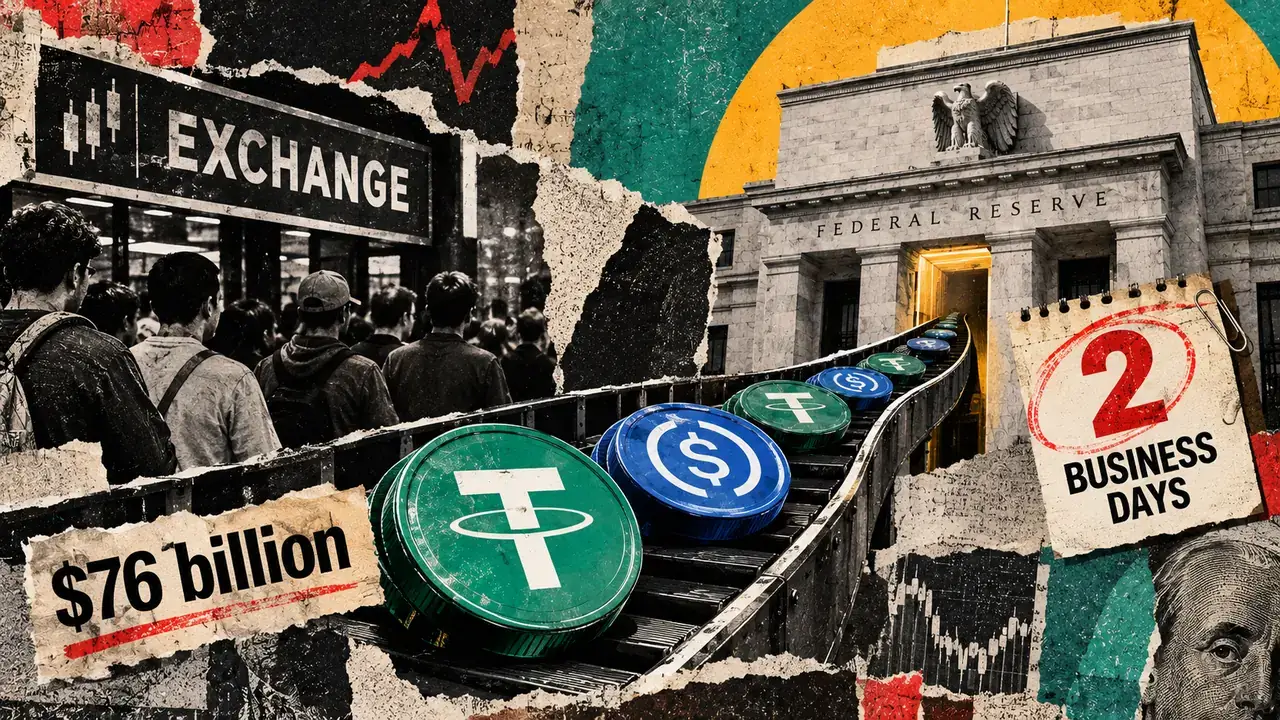
The Federal Reserve Board’s proposal to force a two-business-day redemption floor on supervised stablecoin issuers leaves the exchange layer, where most holders actually try to cash out, governed by separate contracts. New data from the Andersen Institute for Finance and Economics show $76 billion of reserve-backed stablecoins sitting at centralized exchanges, where Circle, Coinbase and Tether each impose their own eligibility rules before an issuer’s clock even starts.
- The Fed’s proposal, published in the Federal Register on Tuesday, September 29, 2026, would cap issuer redemption at two business days under proposed section 247.12.
- The Andersen Institute’s July 28, 2026 snapshot found $76 billion at exchanges, including $61.5 billion of USDT and $10.1 billion of USDC.
- During the March 2023 USDC stress episode, exchanges held just 15.2% of USDC supply but absorbed 40% of the token’s total outflow.
- 2 days Fed’s proposed ceiling on issuer redemption turnaround
- $76B stablecoins parked at exchanges versus $269.4B total supply
- 40% share of USDC’s 2023 outflow tied to exchanges holding 15.2% of supply
The Federal Reserve Board announced on Thursday, September 24, 2026, that it would require stablecoin issuers under its supervision to honor redemption requests within two business days. The Board formalized the plan in a filing published in the Federal Register five days later, on September 29.
Proposed section 247.12 would require a Board-supervised issuer to disclose its redemption procedure and accept requests for at least one token, subject to onboarding and screening checks. The Board can extend that window for safety, financial stability or public interest reasons, and the proposal carves out limited safe harbors for delays tied to required customer checks.
Andersen Institute Finds $76 Billion Sitting at Exchanges, Not With Issuers
Researchers at the Andersen Institute mapped supply across 12 reserve-backed dollar stablecoins and found that centralized exchanges held $76 billion as of their July 28, 2026 snapshot. USDT accounted for 81% of the exchange total.
The institute calls its exchange figure a lower bound because some exchange wallets cannot be identified. It also found the intermediated share of total supply, meaning tokens locked in exchanges or DeFi contracts rather than sitting in unattributed wallets, has climbed to 47.8% from an average of 42.8% in 2023, even as aggregate stablecoin supply has stayed roughly flat since October 2025.
Roughly $20 billion moved out of DeFi protocols and into exchanges and unlocated wallets over that same stretch, according to the report, a reallocation the aggregate figure alone would not reveal.
Lending protocols that absorb part of that flow, such as those under review in Aave’s governance discussions on a V4 lending framework, held $21 billion of stablecoins in the Andersen snapshot. That is a fraction of the $76 billion parked at exchanges, underscoring where redemption pressure would concentrate first.
Circle, Coinbase and Tether Each Guard Their Own Exit Door
The Fed’s two-day clock only applies once a qualifying redemption request reaches a supervised issuer. Getting there first requires clearing a venue’s own terms, an analytical gap that CryptoSlate’s reporting laid out by comparing the three largest platforms’ agreements directly.
Circle’s USDC terms make direct redemption available to an eligible holder with a Circle Mint account in good standing; a holder without that account cannot redeem directly with Circle until eligible and registered, as the firm describes Mint as a service for institutional distributors. Coinbase’s US user agreement states that a customer owns the balance in a USDC wallet but that Coinbase is not obliged to repurchase it for dollars; it may choose to, and otherwise directs customers to redeem with Circle under Circle’s separate terms.
Tether’s current terms require a verified customer and impose a $100,000 minimum for direct redemption, a threshold that filters out most retail holders entirely.
March 2023 USDC Run Shows How Fast Exchange Pressure Can Reverse
The Andersen data trace the last major stress test in detail. From March 10 to 13, 2023, total USDC supply fell $2.7 billion while identified exchange balances actually rose $600 million, meaning tokens moved onto exchanges even as overall supply contracted.
After March 13, the pattern flipped: supply fell another $8.1 billion while exchange balances dropped $4.9 billion, the sharper decline that ultimately produced the 40% exchange share of total outflow.
That single episode offers limited guidance for how USDT or the other ten coins in the Andersen dataset would behave under a future shock, since wallet-location data cannot reveal the order or size of individual redemption requests. The Fed’s proposal remains open for public comment, with no closing date specified in the filing.
The CCS read. The Fed’s two-day rule protects the issuer relationship but does nothing for the exchange leg where 28% of supply actually sits, so institutional desks holding stablecoins on venues still face Circle’s Mint gate, Coinbase’s discretionary repurchase and Tether’s $100,000 floor regardless of what the Board finalizes. Treasury and risk teams should keep pricing exchange counterparty risk separately from issuer risk.
The Fed’s proposal remains under public comment with no stated deadline, leaving open whether the final rule will address the exchange-to-customer leg at all or stop, as drafted, at the issuer’s