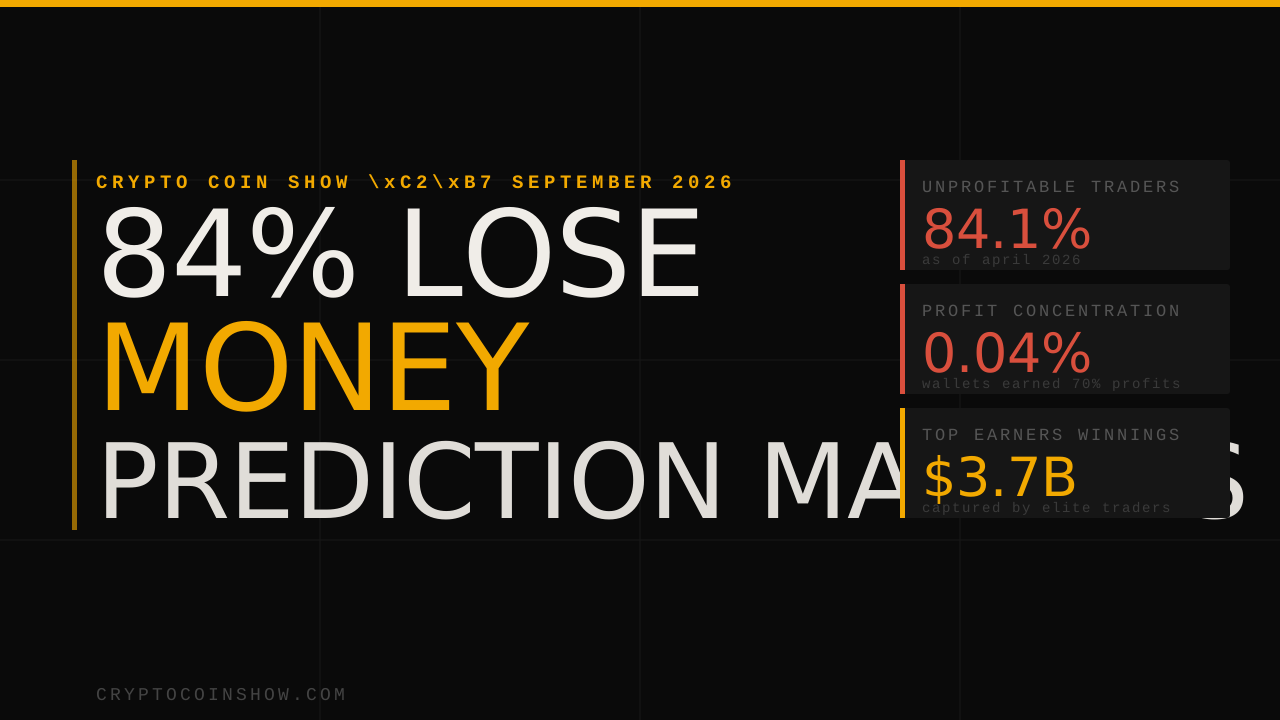
84% of prediction market traders lose money
An April 2026 analysis reveals that 84.1% of Polymarket traders operate at a loss, a sharp deterioration from 40% two years prior, driven by an influx of inexperienced retail users chasing speculative bets on political events. For institutional investors evaluating prediction markets as a mainstream asset class, the data exposes structural winner-take-all dynamics that concentrate profits among a tiny fraction of participants, raising questions about market efficiency and regulatory viability.
- 84.1% of Polymarket traders are unprofitable as of April 2026, down from 40% profitability two years earlier.
- Only 0.04% of wallet addresses captured more than 70% of all realized profits, totaling $3.7 billion in winnings.
- Just 2% of 2.5 million wallets studied have ever earned more than $1,000 in total trading profit on the platform.
- 84.1% Polymarket traders operating at a loss versus 40% unprofitable two years prior
- $3.7B Realized profits captured by top 0.04% of addresses on Polymarket
- 2% of wallets ever exceeding $1,000 cumulative profit from 2.5 million total studied
Prediction markets have emerged as one of cryptocurrency’s most ambitious use cases, presenting themselves as efficient discovery mechanisms for collective forecasting on geopolitical and economic events. Platforms like Polymarket and Kalshi processed $28 billion in trading volume by 2025, attracting retail participants seeking returns and institutional players interested in sentiment signals.
Yet beneath the volume metrics lies a profitability structure so skewed that it resembles a wealth transfer mechanism rather than a price discovery tool, according to newly published research that has triggered alarm among policymakers and sparked debate within the institutional crypto community about whether these markets can function as legitimate financial infrastructure.
Polymarket’s 84.1% Loss Rate Marks Dramatic Reversal from Two-Year Baseline
Research published in April 2026 by analyst Andrey Sergeenkov documented that 84.1% of traders on Polymarket, the largest U.S.-based prediction market by volume, have never turned a profit.
The figure represents a sharp deterioration from approximately 40% unprofitable traders two years prior, a swing driven primarily by the arrival of inexperienced retail users seeking to capitalize on high-profile betting opportunities, particularly around the November 2024 U.S. presidential election.
Sergeenkov’s analysis accounts for wallet splits and merges, a methodological refinement that earlier studies omitted. This technical adjustment matters substantially: when wallet-level transactions are not carefully parsed, a single trader’s losses can be hidden across multiple addresses, artificially inflating apparent profitability.
“When splits are left out, an address looks more profitable because one category of expenses is simply invisible,” Sergeenkov noted. His method produced a higher loss rate than a competing 2025 study by researchers Felix Reichenbach and Martin Walther, who estimated the losing share at around 70 percent, illustrating how sensitive headline figures are to analytical assumptions.
The influx of retail volume followed the high-profile nature of the 2024 election betting cycle, which drew mainstream media attention and celebrity participation to prediction markets as a novel way to monetize political conviction.
Top 0.04% Captured $3.7 Billion as Median Trader Bleeds Capital
A December 2025 on-chain analysis by blockchain researcher DeFi Oasis documented the concentration of winnings across the smallest subset of participants. The study found that fewer than 0.04% of Polymarket wallet addresses, representing a handful of professional traders or sophisticated market-making entities, captured more than 70% of all realized profits, totaling $3.7 billion.
The finding contradicted a widely cited claim by Arizona Representative Yassamin Ansari, who asserted that 99.96% of users lose everything while the top 0.04% walk away with billions. Analysts clarified that Ansari conflated two separate metrics: the 0.04% figure identifies who captured most profits, not the total percentage of all participants who failed to gain any edge whatsoever.
The wealth concentration on Polymarket appears structurally embedded rather than temporary. Of 2.5 million wallets studied, only 2% had ever accumulated more than $1,000 in total profits across their trading history.
Just 0.32% of addresses cleared $10,000, suggesting that meaningful returns require either exceptional skill, access to information asymmetries, or capital sufficient to absorb substantial losses while waiting for rare profitable positions to compound.
For retail participants, the vast majority of users, the platform functions as a mechanism for transferring capital to a thin layer of professional traders and market makers.
Less experienced users tend to trade less successfully.
Andrey Sergeenkov, Analyst
The data aligns with long-standing patterns in retail financial markets, where most participants underperform and a tiny fraction of skilled or well-capitalized traders extract the majority of gains. What distinguishes prediction markets is the velocity and transparency of losses.
Unlike equity or derivatives markets, where holding periods can stretch across quarters or years, prediction market bets resolve on fixed dates, compressing the feedback loop between decision and outcome. New users rarely learn fast enough to reverse course before substantial capital has been depleted.
Congressional Scrutiny Targets Prediction Markets as Unregulated Betting Platforms
The profitability data has fueled legislative pushback. Representative Ansari, alongside Senators Chris Murphy of Connecticut and Representatives Greg Casar and Rashida Tlaib of Texas and Michigan, is co-sponsoring the BETS OFF Act, which would ban wagering on events including war, terrorism, assassination, and government decisions.
The bill frames prediction markets not as financial discovery tools but as unregulated casinos that concentrate risk among uninformed retail participants while enriching insiders. “Casinos where the rich and powerful are the house and everyone else is the chips,” Ansari posted on X, characterizing Polymarket’s structure in language designed to resonate with retail investor frustration.
The regulatory framing matters substantially for institutional adoption. Prediction markets have marketed themselves to sophisticated investors as efficient mechanisms for extracting collective wisdom on uncertain events, justifying their existence through epistemological claims rather than speculative opportunity.
If policymakers treat them as gambling platforms, which the 84.1% loss rate arguably supports, then regulatory oversight shifts from the Commodity Futures Trading Commission’s light-touch framework toward state-by-state gaming restrictions that could fragment the market or ban it outright in major jurisdictions.
Such an outcome would eliminate the network effects that currently make platforms like Polymarket valuable to institutional traders and market researchers seeking liquid sentiment signals.
The BETS OFF Act does not yet have a clear path to passage, but its sponsorship across both chambers and both parties signals bipartisan receptivity to prediction market regulation ahead of 2026 midterm elections.
Retail Influx After 2024 Election Accelerated User Growth and Loss Concentration
The 2024 U.S. presidential election functioned as a watershed moment for prediction market adoption. Media coverage, celebrity endorsements, and viral social media discussion drew millions of retail participants who lacked experience in probabilistic reasoning or position management.
The result was a surge in trading volume that superficially validated platforms’ growth narratives but masked a simultaneous collapse in median trader profitability. The proportion of users losing money nearly doubled in just two years, indicating that new cohorts were entering the market at worse-than-historical retention and profitability rates.
This pattern reflects a common dynamic in speculative retail markets: periods of highest volume growth correlate with periods of lowest median returns, because new retail capital typically flows in at the peak of attention cycles.
Experienced traders and market makers exploit information asymmetries and behavioral patterns among inexperienced participants, extracting disproportionate returns during high-volume episodes.
Once the attention cycle fades, as it has partially since the November 2024 election resolved, the excess retail participants either exit with losses or continue to bleed capital into positions held by professionals.
For institutional investors, the implication is that prediction markets may be most useful