Japan’s economy is finally growing again after 30 lost years, JPMorgan Asset Management strategist David Lebovitz says. The escape from the Lost Decades is real, and crypto may end up paying for it.
The Lost Decades were Japan’s long slump after its 1990 bubble burst, when prices fell and rates stayed near zero. That cheap money quietly funded risk bets around the world, including crypto.
Timeline chart of BOJ policy rates from 1990 to 2026 against USD/JPY, Source: BeInCrypto
Japan’s Lost Decades Made the Yen the World’s Cheapest Money
Japan’s slump had one global side effect. The Bank of Japan (BOJ) held rates near zero from 1999. It even went negative in 2016 and stayed there until 2024.
That made the yen the cheapest money on Earth. Investors borrowed it for almost nothing and bought assets that paid more, from US bonds to tech stocks. Traders call this the yen carry trade.
Crypto grew up inside that easy-money era. So did every other risk asset.
Crypto Growth Trajectory
Japan’s recovery is now closing the tap.
The Recovery Comes With a Bill
The good news is real. JPMorgan Asset Management global strategist David Lebovitz made the case in a televised interview. Japan is posting nominal growth, meaning growth in cash terms, for the first time in decades, he said.
“Japanese economy is generating nominal growth for the first time in decades,” said.
However, growth brought inflation, and inflation crushed the yen. The currency hit a 40-year low near 164 per dollar in July. In real terms, it was the cheapest since the 1960s, the Council on Foreign Relations notes.
Japan and the U.S. spent $88 billion propping it up. The relief lasted two weeks before the rescue faded. The dollar is back near 159.50 yen.
US Treasury Secretary Scott Bessent says the real fix is higher Japanese rates. Markets agree and price another hike by October, Japan’s third in 12 months.
Voters are pushing the same way. Analyst account Bull Theory noted that 71% disapprove of Prime Minister Sanae Takaichi’s handling of living costs.
THE US IS PUSHING JAPAN TOWARD A DECISION THAT COULD BREAK ITS ECONOMY
US and Japan jointly intervened to support the yen, with Japan alone reportedly spending $88 billion.
It temporarily pushed the yen from nearly ¥164 to ¥155 per dollar. But it has already weakened back to… pic.twitter.com/jwZcHKlnK9
Higher rates already sting at home. They sit at their highest since 1995, and Japan’s biggest insurers are nursing $96 billion in bond losses.
Crypto Has Seen This Squeeze Before
The last one was brutal. In July 2024, a surprise BOJ hike blew up the carry trade. The Bank for International Settlements (BIS) documented the shock in a bulletin. Bitcoin (BTC) fell about 25% in one week to near $49,000. Japan’s stock market had its worst day since 1987.
Bitcoin Price Performance on July 31, 2026. Source: TradingView
The trade survives because the rate gap is still wide. US rates sit at 3.50% to 3.75%, while Japan’s are at 1%. Every new hike makes cheap yen less cheap.
For now, markets are calm. Bitcoin trades near $64,700, little changed in 24 hours, per BeInCrypto Markets data.
Not everyone expects pain. BitMEX co-founder Arthur Hayes argues a Fed-backed yen defense could add liquidity and pump Bitcoin instead.
Japan waited 30 years for this recovery. Crypto is about to learn what defending it costs. The first answer comes at the BOJ’s September and October meetings.
Japan’s exit from decades of ultra-low interest rates is beginning to expose the hidden costs of higher borrowing costs. The country’s four largest life insurers are now sitting on roughly $96 billion in unrealized losses on Japanese government bonds (JGBs).
On their own, the losses are largely an accounting issue. However, they also highlight a broader challenge facing the Bank of Japan (BOJ). Every additional rate hike helps stabilize the yen and curb inflation, yet it also pushes bond prices lower, deepening losses across insurers, banks, and pension funds.
Japan’s Return to Higher Rates Comes at a Cost
Japan’s four largest life insurers, Nippon Life, Dai-ichi Life, Sumitomo Life, and Meiji Yasuda, reported combined unrealized losses of ¥15.13 trillion ($96 billion) on domestic government bonds as of the end of June 2026, up roughly 7% from the previous quarter.
Japan‘s four largest insurers are sitting on ¥14.5 trillion in bond losses, roughly $91 billion. Source: Bloomberg
The losses reflect one of the fastest shifts in Japan’s bond market in decades. As the BOJ abandoned negative interest rates and gradually normalized monetary policy, yields climbed sharply from the near-zero levels that prevailed for years.
Bond prices move inversely to yields. As rates rise, the market value of older bonds paying lower coupons falls. Much of the insurers’ portfolios were accumulated during the BOJ’s years of aggressive monetary easing, leaving them exposed to today’s higher-rate environment.
Despite the eye-catching figure, the losses remain largely unrealized because insurers generally intend to hold these bonds until maturity to match long-term policy obligations.
Higher interest rates also reduce the present value of future insurance liabilities, partially offsetting the decline in bond values from an economic perspective.
The bigger concern is liquidity rather than solvency. Should policyholders surrender contracts at a faster pace, insurers could be forced to sell bonds before maturity.
$96 BILLION IN LOSSES ARE NOW SITTING INSIDE JAPAN’S BIGGEST INSURERS.
The country’s 4 biggest life insurers are now sitting on ¥15.13 trillion ($96 billion) in unrealized losses on Japanese bonds.
Such a move would potentially convert paper losses into realized ones while adding further pressure to Japan’s bond market.
Why the BOJ Has Become Increasingly Constrained
The insurer losses illustrate the difficult balancing act facing the Bank of Japan.
Inflation remains above the BOJ’s long-term target, while the yen has experienced persistent periods of weakness against the US dollar. Normally, these conditions would support additional interest-rate increases.
Higher yields continue to erode the market value of government bonds held by financial institutions. While stronger rates can help stabilize the currency and improve long-term market functioning, they also risk creating broader financial strains if yields rise too quickly.
The result is a narrowing policy path. Moving too slowly risks renewed yen weakness and imported inflation. Moving too aggressively risks amplifying losses throughout Japan’s financial sector.
Why America’s Debt Market Is Paying Attention
Japan’s importance extends far beyond its domestic financial system.
The country remains the largest foreign holder of US Treasury securities, with holdings of roughly $1.14 trillion. Any meaningful changes in how Japanese institutions manage overseas portfolios can ripple through global bond markets.
🚨 JAPAN JUST EXPOSED AMERICA’S BIGGEST VULNERABILITY…
Japan is the largest foreign holder of U.S. Treasuries.
If Japan is forced to sell to defend its own market, U.S. yields could surge even higher.
There is little evidence that Japanese investors are preparing for large-scale Treasury sales. In fact, outright selling would likely crystallize losses while pushing US borrowing costs even higher.
Instead, authorities have alternative tools. During periods of currency intervention, Japan can access the Federal Reserve’s Foreign and International Monetary Authorities (FIMA) Repo Facility, temporarily obtaining dollar liquidity by pledging Treasuries as collateral rather than selling them outright.
Nevertheless, investors continue to monitor Japanese portfolio flows because even relatively modest reallocations by the world’s largest foreign Treasury holder can influence US yields during periods of market stress.
Bitcoin Is Watching the Yen Carry Trade
For Bitcoin, the insurer losses themselves are not the main story.
For years, investors borrowed cheaply in Japanese yen, where interest rates were close to zero, and invested those funds into higher-yielding assets around the world, including stocks, bonds, and increasingly digital assets.
As Japanese interest rates rise, that strategy becomes less attractive.
Higher borrowing costs and a strengthening yen can force leveraged investors to unwind positions, selling risk assets to repay yen-denominated loans. Previous episodes of BOJ tightening and sharp yen appreciation have coincided with periods of heightened volatility across both traditional markets and cryptocurrencies.
So far, Bitcoin has remained relatively resilient. Following the insurers’ earnings reports, the pioneer crypto continued trading above $65,000, up by over 3% in the last 24 hours.
This suggests markets view the bond losses as a symptom of Japan’s policy transition rather than an immediate financial crisis.
Still, macro traders increasingly see Japanese bond yields and the yen as early indicators of shifts in global liquidity conditions.
What Investors Should Watch Next
The $96 billion in unrealized losses does not, by itself, threaten Japan’s financial system.
Instead, it highlights the growing costs of the country’s departure from decades of extraordinary monetary stimulus.
The next phase will depend on several closely watched indicators:
Whether Japanese bond yields continue climbing.
Whether policy surrender rates remain contained, and
How aggressively the BOJ believes it can continue normalizing interest rates without destabilizing financial markets.
For Bitcoin investors, the key signal may not be the insurers’ balance sheets at all. It will be whether higher Japanese rates begin triggering a broader unwind of the yen carry trade, a development that has historically tightened global liquidity and weighed on risk assets long before the effects became visible elsewhere.
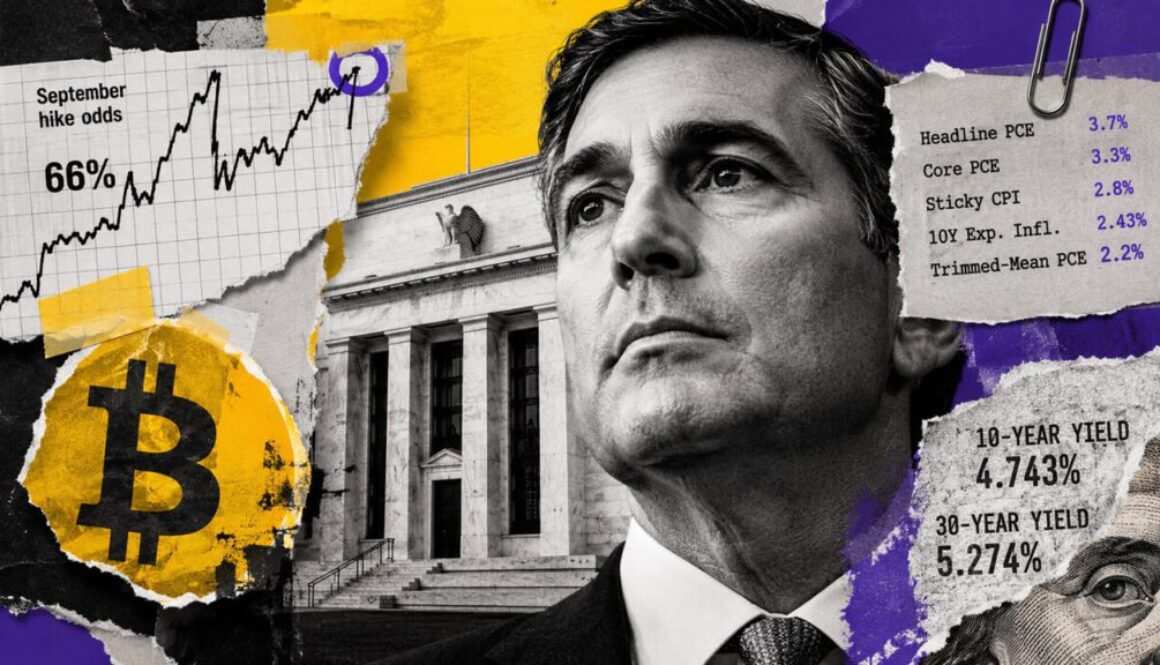
Bitcoin is trading near $63,000, with rate markets assigning roughly 66% odds to a September Federal Reserve hike, under a policy framework Kevin Warsh has left partly hidden.
The Fed chair has defined his reaction function around “underlying inflation,” then declined to disclose how he weighs the indicators that produce that judgment.
One economy supplies readings from nearly twice the Fed’s 2% goal to barely above it.
Inflation measure
Latest reading
Gap from 2% target
What it tells Warsh
Headline PCE
3.7%
+1.7 pp
Inflation still far above target
Core PCE
3.3%
+1.3 pp
Underlying pressure remains elevated
Atlanta Fed sticky-price CPI
2.8%
+0.8 pp
Persistent inflation is cooling, but not at target
Cleveland Fed 10-year expected inflation
2.43%
+0.43 pp
Long-term expectations remain contained
Dallas Fed trimmed-mean PCE
2.2%
+0.2 pp
Broad inflation is close to target
Warsh told reporters that the Fed’s January strategy document keeps PCE as its formal objective. He invoked Goodhart’s Law, said the central bank could revisit its strategy in January 2027, and described a broader data project that aims to “separate the noise from the signal.”
His operative judgment can therefore come from a wider set of inputs than the measure the formal framework identifies.
That distinction leaves Bitcoin traders pricing two unknowns at once: the next inflation readings and the weight Warsh assigns each one. A 3.7% headline figure supports tighter policy, and a 2.2% trimmed mean gives the Fed room to wait when long-term expected inflation sits near 2.43%.
The Fed is rebuilding its inflation lens
The Federal Reserve created five monetary-policy task forces on July 9. Raj Chetty, Doug McMillon, and Kevin Murphy head its Data Sources group, which will seek timelier economic information.
A separate Inflation Frameworks group will reconsider how the central bank interprets the drivers of inflation.
Warsh plans to review the groups’ work before Jackson Hole, and he left open the possibility that their early findings could shape his August speech. The next hard policy deadline arrives Sept. 15-16, when the FOMC meets with a new Summary of Economic Projections.
January 2027 then offers the first formal opening for a revised strategy statement.
The FOMC kept its target range at 3.50% to 3.75% through a 9-3 vote, with Beth Hammack, Neel Kashkari and Lorie Logan supporting a quarter-point increase. September hike odds neared 65% on July 31, and the Atlanta Fed tracker had placed the probability at 83.05% on July 29, illustrating how quickly traders reprice the path.
The 10-year Treasury yield ended July near 4.743%, and the 30-year reached 5.274%, its highest level in 19 years. Subtracting Cleveland Fed 10-year expected inflation of 2.434% from the nominal 10-year yield produces a simple expected real rate near 2.31%.
That real return competes directly with Bitcoin, which offers zero cash yield. Higher real rates raise the opportunity cost of holding BTC, support the dollar, and reduce the balance sheet capacity available for risk assets.
Bitcoin’s move toward $63,000 has occurred inside that tighter liquidity setting.
US-traded spot Bitcoin funds took in $233.1 million on July 30, then recorded $87.9 million of net redemptions on July 31. Cumulative net inflows stand near $51.56 billion, giving Bitcoin an institutional demand channel whose daily support can still reverse.
Date / marker
What happens
Bitcoin relevance
July 9
Fed creates five monetary-policy task forces
Confirms Warsh is formally rebuilding the policy lens
July 29
FOMC holds rates at 3.50%–3.75% in a 9-3 vote
Three dissents show September tightening risk is live
July 29
Atlanta Fed tracker probability at 83.05%
Shows how aggressively traders can price a hike
July 31
September hike odds near 65%
Shows rate pricing remains volatile
Late August
Jackson Hole
First possible clue on Warsh’s weighting system
Sept. 15–16
FOMC meeting and new projections
First major rate decision after the data cycle
January 2027
Possible revised Fed strategy statement
Formal opening for changes to the inflation framework
When headline PCE sets policy
The bearish path starts with Warsh treating headline PCE at 3.7% and core PCE at 3.3% as the best evidence of generalized inflation.
Higher oil prices, firmer inflation expectations and continued economic resilience would reinforce that interpretation, giving the three July dissenters a stronger case for September.
Rate markets would push up hike odds, Treasury yields would stay firm, and the dollar would gain another source of support. Bitcoin would then face tighter financial conditions alongside mixed ETF flows, placing renewed stress on the $62,000 area.
A sustained loss of $62,000 would bring $60,000 into the immediate price map. The late-June zone near $58,000 enters only once sellers establish acceptance below $60,000. Confirmation would come from higher real yields, firmer breakevens, a stronger dollar and another round of ETF redemptions.
The lower inflation gauges would carry less policy weight under this path. Warsh could conclude that trimmed measures remove too much of the tariff and energy transmission entering household prices, leaving the 2.2% reading unable to justify patience.
The path through trimmed inflation
The bullish path requires Warsh to classify energy and other volatile categories as noise, giving greater weight to trimmed-mean PCE at 2.2%, sticky-price inflation at 2.8%, and 10-year expected inflation near 2.43%. Continued cooling across those measures would give the Fed room to hold in September.
Lower hike odds would ease real yields and weaken the dollar’s support, reopening liquidity for Bitcoin. BTC would first need to recover $64,500, then clear the Friday high near $65,300.
A clean move through that area would reopen $66,000 and $68,000.
Scenario
Warsh’s inflation read
Macro reaction
Bitcoin confirmation
Price map
Bear case: headline PCE drives policy
3.7% headline PCE and 3.3% core PCE are treated as the signal
Hike odds rise, yields stay firm, dollar strengthens
ETF redemptions resume, real yields rise, $62,000 fails
$60,000 comes next; $58,000 only after $60,000 breaks
Base case: dashboard stays unresolved
High headline inflation and low trimmed inflation both remain plausible
Rates and dollar swing with each Warsh comment
BTC fails to hold above $65,300 but does not lose $62,000
Range between $62,000 and $65,300
Bull case: trimmed inflation drives patience
2.2% trimmed mean, 2.8% sticky CPI and 2.43% expectations carry more weight
Hike odds fall, real yields ease, dollar support weakens
Spot-market buying, falling open interest during the rebound and renewed ETF creations would strengthen that case. Those conditions would tie the advance to spot demand and reduced hedging demand, giving Bitcoin a firmer foundation than a derivatives-led burst.
Jackson Hole may provide the first public clue about Warsh’s weighting system, and Sept. 16 carries the rate decision and fresh projections.
By then, markets may know every major inflation print and still lack the formula that converts those readings into policy, and Bitcoin is already trading that gap.
Although there was some uncertainty about the monetary direction the United States Federal Reserve will take following the July FOMC meeting, the central bank approved with a 9-3 vote to maintain the interest rates at 3.50% to 3.75%.
All eyes have turned to the incoming press conference by the new Fed Chair, Kevin Warsh, as investors anticipate which way he will lean.
“The Committee decided to maintain the target range for the federal funds rate at 3-1/2 to 3-3/4 percent, in support of the Federal Reserve’s dual mandate. The Committee is continuing its policy of maintaining ample reserves in the banking system,” reads the statement.
As reported earlier today, this meeting was described as the most unpredictable since the COVID-19 pandemic broke out in March 2020. The reason for this is that all meetings since then had a 99% agreement about the outcome ahead of their conclusion.
In contrast, futures markets and prediction platforms had assigned a 30%-38% probability for a rate hike for today’s meeting.
Investors apparently had de-risked from more volatile assets like bitcoin ahead of the event today, as the asset slumped by $3,000 yesterday. It rebounded to $64,500 today, where it was rejected and slipped to under $63,800 before the meeting.
Its minor volatility returned after the announcement, pumping above $64,000 as of now. However, it’s likely that the Warsh speech will impact it even more, especially if the new Fed chair hints at what the central bank will do next – a rate hike or another pause.
The Federal Reserve held interest rates steady on Wednesday, but three policymakers voted to raise them. Bitcoin and gold both climbed within minutes of the announcement.
The split vote is the most contested outcome of Kevin Warsh’s short tenure as chair. Interest rate swaps then pulled back from a fully priced September increase.
Why the Fed Rate Hold Split the Committee
The Federal Open Market Committee (FOMC) kept the federal funds target range at 3.50% to 3.75% by a vote of 9 to 3. Cleveland’s Beth Hammack, Minneapolis chief Neel Kashkari, and Dallas president Lorie Logan each wanted a quarter point increase.
FED HOLDS, THREE OFFICIALS PUSH FOR HIKE
The Federal Reserve kept rates unchanged at 3.50%–3.75% in a 9–3 vote.
Hammack, Kashkari and Logan dissented, preferring a 25-basis-point hike.
The policy statement was largely unchanged from June, but the split signals growing internal…
All three dissenters run regional reserve banks. Nobody on the Washington-based Board of Governors broke ranks with Warsh, which keeps the divide outside the Fed’s centre of power.
Warsh took over in May, and his first meeting in June produced a unanimous hold. Analysts had warned he might get a Fed family feud this time instead.
The statement itself barely moved. Policymakers again described activity as expanding solidly despite uncertainty tied to the conflict in the Middle East. They repeated that productivity growth and capital investment are strong.
Inflation, however, remains above the 2% goal. The Committee again blamed supply shocks in certain sectors, energy among them, and repeated its pledge that it “will deliver price stability.”
Traders had treated a hike as a live risk. CME FedWatch showed rare hike odds priced near 30% a day earlier, while Kalshi put the chance at roughly 23% on Wednesday morning.
Bitcoin and Gold Climb as Hike Bets Fade
Bitcoin (BTC) rose from about $63,700 to an intraday high near $64,700 in the quarter hour after the release. Bitcoin’s post-decision price action left it near $64,325, up 1.1% over 24 hours, with a market capitalization of $1.29 trillion.
Gold moved in step. Spot prices climbed from roughly $4,000 to a high above $4,084 before easing back toward $4,076, according to OANDA data.
Bitcoin and Gold Price Performance. Source: TradingView
Rate markets did the rest. Swaps no longer fully price a September hike, which eases some of the strain that had lifted global bond yields to their highest levels since 2008.
Oil remains the swing factor. Brent fell sharply after Washington paused its strikes on Iran, though oil markets moved again on Wednesday as tensions resurfaced.
What Comes Next for Rates and Crypto
Bank of America told clients a July increase would have been without precedent. The bank noted the Fed has not hiked since 1994 with less than 60% odds priced in.
BOFA: JULY FED RATE HIKE WOULD BE UNPRECEDENTED
BofA expects the Fed to hold rates in July, despite markets pricing a small chance of a hike.
The bank says a July increase would be unprecedented, noting the Fed has never hiked since 1994 with less than 60% odds priced in.
JPMorgan had modeled a hawkish hold as its base case at 50%, with a quarter point hike at 20%. Three dissents hand that hawkish reading more weight than an unchanged rate implies.
Attention now shifts to Warsh’s press conference and to September. Should oil turn higher again, the dissenters regain the argument they lost on Wednesday.
Federal Reserve Chair Kevin Warsh has appointed a high-profile group of economists, former central bankers, and technology leaders to help review how the US central bank conducts monetary policy.
While the initiative is not focused on digital assets, the inclusion of prominent Bitcoin supporter Marc Andreessen has drawn attention from crypto investors looking for signs of a more technology-aware Federal Reserve.
Warsh Launches Sweeping Fed Policy Review
The Federal Reserve announced five independent task forces on Thursday to examine communications, balance sheet policy, inflation frameworks, economic data, and the impact of artificial intelligence on productivity and employment.
“The Federal Reserve’s commitment to price stability and maximum employment is unwavering,” Warsh said in the central bank’s announcement. He added that the reviews will assess whether the Fed’s analytical tools and policy approaches can be improved.
Former Reserve Bank of India Governor Raghuram Rajan
Former Brazilian central bank chief Arminio Fraga
Nobel laureate Thomas Sargent, and
Harvard economist Greg Mankiw
Bitcoin Bull Joins AI Task Force
The appointment attracting the most attention from crypto markets is Andreessen, the co-founder of Andreessen Horowitz and one of Silicon Valley’s most influential Bitcoin and blockchain investors.
Andreessen will co-lead the Productivity and Jobs task force with Stanford economist Charles I. Jones and Microsoft Xbox CEO Asha Sharma.
The group will study how AI and other emerging technologies could reshape economic growth and labor markets, factors that directly influence monetary policy.
Although the review does not include cryptocurrency regulation, Andreessen’s participation introduces a well-known digital asset advocate into discussions that could shape how the Fed evaluates technological change.
The task forces are expected to submit recommendations to the Federal Open Market Committee by year-end. Investors across traditional and crypto markets will closely watch whether the findings influence future thinking on inflation, productivity, and interest rates, all of which remain key drivers of Bitcoin’s long-term outlook.
The Federal Reserve released minutes from its June 16-17 meeting on July 8, showing a divided committee that unanimously held rates steady at 3.50% to 3.75% while flagging inflation risks tied to artificial intelligence spending.
The meeting was Chair Kevin Warsh’s first since taking over the Fed. All 12 voting members backed the hold, though the minutes revealed disagreement over whether a hike is still needed this year.
Officials Split Over the Case for a Hike
A few participants argued a rate increase was justified at the June meeting but ultimately supported holding steady, the minutes said. Most officials cited persistent inflation risk from tariffs, Middle East energy costs, and AI-driven demand for tech, data centers, and electricity.
Nine of 19 officials penciled in at least one rate hike before the end of 2026, a reversal from earlier projections that showed no hikes at all. Warsh did not submit a projection.
At his post-meeting press conference, Warsh described the internal debate in blunt terms.
“We had a good family fight on it for a couple of days, and we ended up, I think, in a better place.”
Fed staff raised inflation forecasts for 2026 and 2027, citing tariff pass-through, Middle East supply shocks, and surging AI infrastructure investment. Core inflation ran at 3.3% in April and was estimated near 3.4% in May, well above the Fed’s 2% target.
Several participants said AI spending could eventually lower costs through productivity gains, though that effect would take years to appear. Meanwhile, demand for data centers and high-tech equipment keeps adding upward pressure on prices.
Bitcoin Dips as Markets Digest the Hawkish Tone
Bitcoin (BTC) traded near $62,240 on Wednesday, down about 2.7% over the past 24 hours, according to BeInCrypto data at press time.
The next FOMC meeting is scheduled for July 28-29. With inflation still running above target and nine officials now leaning toward a hike, upcoming inflation and jobs data will likely determine whether Warsh’s “family fight” ends in a rate increase or another hold.
The Bank for International Settlements (BIS) has reported its assessment of stablecoins based on specific variables, and has concluded that they do not function as money was originally intended. The institution has warned in its latest 2026 Annual Economic Report that dollar-pegged tokens are driving a new form of dollarization in emerging economies.
The report was based on an assessment using multiple criteria for money, and made a distinct comparison of stablecoins to ETFs.
BIS report on stablecoins
The umbrella institution for central banks evaluated stablecoins on four criteria considered essential for entities described as money. These criteria include singleness, elasticity, interoperability, and integrity. Stablecoins were said to have failed all four, according to the report.
Singleness translates to the concept of one unit always being equal to one unit of the underlying currency regardless of the issuer. Stablecoin prices on secondary markets tend to drift from their $1 peg, sometimes just slightly.
Elasticity requires the supply of any entity seen as money to increase and decrease with economic demand. Stablecoins use a model where issuers mint tokens only after receiving equivalent cash deposits, which prevents this flexible expansion according to demand from happening.
The BIS compared stablecoins to ETFs, stating that stablecoins behave more like shares in an exchange-traded fund instead of cash deposits.
Dollar dominance has increased globally
Over 99% of the roughly $320 billion stablecoin market, as of the end of May 2026, is denominated in US dollars. Tether’s USDT and Circle’s USDC account for most of that figure. A separate BIS research paper from May 5 estimated dollar dominance in stablecoin value at approximately 98%.
The report states that this concentration is a structural problem for emerging markets and developing economies. The BIS calls this “stablecoin dollarization” and warns it mirrors the historical pattern of deposit dollarization, where savings are shifted into foreign bank accounts during crises, happening at a faster pace since crypto operates outside traditional banking infrastructure.
Countries including Turkey, Argentina, and Nigeria have already had a lot of stablecoin adoption as citizens seek dollar exposure outside formal channels.
Several emerging economies have imposed restrictions on cross-border stablecoin use. The BIS has expressed skepticism on how well these restrictions can hold, since controls that function against traditional bank deposits do not translate well to self-custodial crypto tokens.
Potential negative economic effects of stablecoins
The BIS created a model exploring possible happenings if the stablecoin market cap grew to between $1 trillion and $3 trillion, and concluded that the net effect on economic output would still be “modestly negative.”
As deposits migrate from traditional banks to stablecoin issuers (who park reserves in US Treasuries and money market instruments), banks continue to lose a cheap funding source. To compete, they would need to raise deposit rates, which would increase lending costs, and slow economic activity.
The BIS has recommended building what it calls a “unified ledger” for central bank monies, aiming to combine tokenized central bank reserves with commercial bank money on a shared infrastructure. The report cited Project Agora, a cross-border payments prototype, as evidence that this “unified” approach is technically feasible, according to Binance News.
A senior Federal Reserve official has put a possible 2026 interest rate hike back in focus, adding new pressure on US stocks. Neel Kashkari, president of the Federal Reserve Bank of Minneapolis, said Friday that he now expects one rate increase in 2026 and does not see cuts coming soon.
His comments are critical because Kashkari has long been seen as one of the Fed’s more dovish policymakers. His shift suggests inflation concerns are spreading inside the central bank, leaving investors to rethink how long borrowing costs may stay high.
FED’S KASHKARI: I HAVE ONE RATE HIKE PENCILED IN FOR 2026; I SEE RATES ON HOLD IN 2027
Why the Kashkari Rate Hike Call Matters for Stocks
Kashkari’s comments came shortly after the Fed’s June policy meeting, where officials voted 12-0 to hold interest rates between 3.50% and 3.75%.
The bigger signal came from the Fed’s own projections. Nine of the 18 officials now expect at least one rate hike in 2026. The median forecast also moved higher, rising to 3.8% from 3.4% in March.
Investors had spent much of the year expecting the next major move to be a cut. The June meeting weakened that assumption and pushed markets toward a more uncomfortable possibility: borrowing costs may stay higher for longer.
Fed Chair Kevin Warsh also moved away from forward guidance, the practice of giving markets a clearer sense of where policy may go next. That makes each inflation report and jobs report more important, because traders now have fewer signals from the central bank in advance.
Markets are already reacting to that risk. Futures prices show traders see about a 30% chance of a July hike, according to CME FedWatch data. They also put the odds of at least one rate increase by December at roughly 76%, keeping the risk of another Fed hike firmly in view.
“I’m concerned about inflation, and it’s not only tied to what’s happening in the Middle East, it’s just the impression of broader inflationary pressures in the economy,” Kashkari said.
The last hiking cycle shows the stakes. As the Fed raised rates through 2022, Bitcoin fell from about $69,000 to near $15,500.
A late-2026 hike would reinforce the backdrop behind recent bearish calls.
BitMEX co-founder Arthur Hayes sees a $40,000 Bitcoin bottom within six months, citing a hawkish Fed. His six-month window runs into late 2026, the same stretch Kashkari flagged for a possible hike.
China’s top Bitcoin miner, Jiang Zhuoer, expects a similar floor around $42,000 to $44,000 in late 2026. He built the call on Strategy’s mNAV near 0.72, close to its 2022 bear-market low. Both targets sit between about 27% and 34% below current levels.
Other signals cut the other way. Wintermute says leverage has largely cleared, while Hayes still holds a year-end target above $200,000.
Investors now look to upcoming inflation and jobs data for the next signal. Whether Kashkari’s hike lands in late 2026 may shape equity valuations and Bitcoin price forecasts into year-end.
“This week’s FOMC meeting exemplified the best of the Fed traditions: vigorous debate, open-mindedness, commitment to mission, responsibility and accountability for performance… Getting monetary policy right — or as near to it as we can do. That is our North Star.”
The committee held the target range for the federal funds rate at 3.50%–3.75%.
Economic activity is “expanding at a solid pace,” with strong productivity, capital investment, and stable labor market, but inflation has run well above 2% for over five years.
On commitment to price stability:
“I’m pleased to report that members of the FOMC are unambiguous and unanimous that this committee will deliver price stability.”
On the new, shorter policy statement:
“It is a bit shorter, a bit simpler, and dispenses with some older language. It just gives you the facts, as best we can judge it.”
“Absent, also, is so-called forward guidance, which we agreed was not well suited to the current policy conjuncture.”
On the dot plot/SEP:
“It has been the practice of this committee for participants to submit these projections and I have encouraged my colleagues to continue to do so. I, however, have refrained from offering projections of my own.”
Median projections showed a slightly higher rate path, with nine officials seeing at least one hike in 2026.
On the five task forces (communications, balance sheet, data sources, productivity/jobs/AI, inflation frameworks):
“These subjects are timely, consequential, and in my view, worthy of a fresh look… They will have a straightforward charge: ask hard questions, examine current practice, consider alternatives.”
“Each task force will have an objective shared by everyone… A Federal Reserve that is clear-eyed about its mission, fit for purpose, and focused on the future.”
Key Q&A Quotes
On the 2% inflation target:
“That is the Federal Reserve’s long-held objective of 2%. The ‘two’ is the left of the decimal point. For now, ‘zero’ is to the right.”
“I see no reason until we have reestablished our commitment and ability to deliver on the 2% inflation objective to revisit that.”
On internal decision-making (“family fight”):
“We can agree to some of the recommendations, disagree with others, have a good family fight about it. But what comes from them will — I hope and believe — make the discussion we have internally better, stronger, more of a dialectic, so that we can finally deliver on that price stability objective.”
On inflation being a choice / commitment:
“The commitment to deliver is strong, unanimous, and unambiguous, and that’s I think an important message we’ve missed for five years, and we’re going to fix that.”
Warsh emphasized data-dependency, reduced forward guidance, and letting markets react to data rather than Fed signals.
He avoided locking in future rate paths and focused on long-term institutional improvements.