
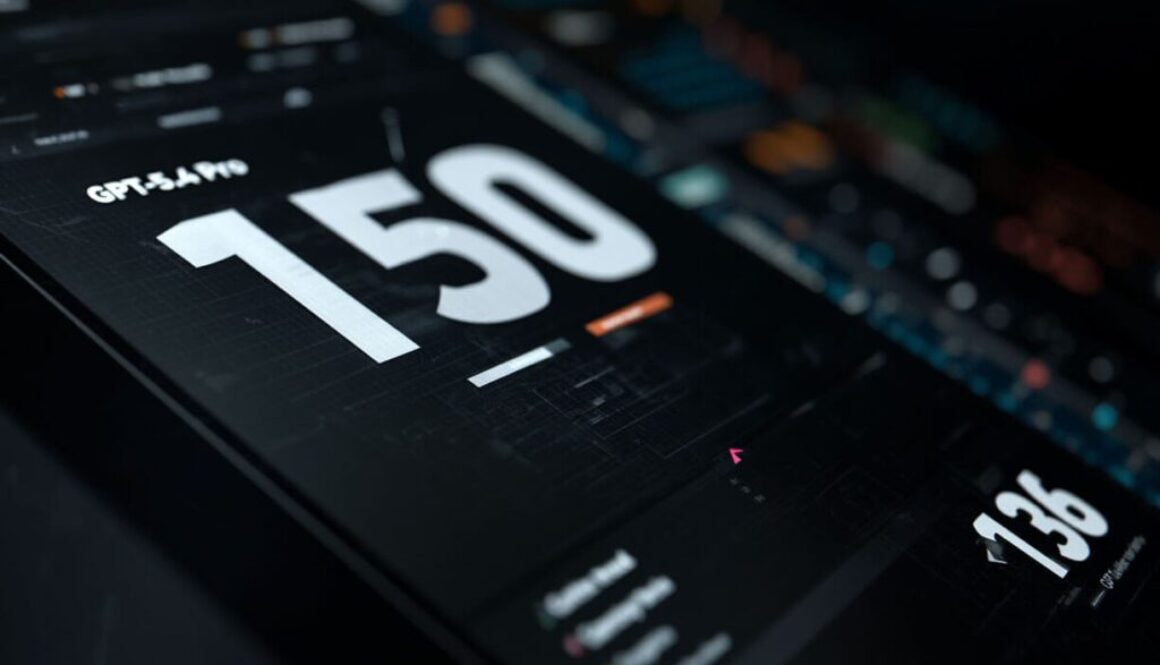
GPT-5.4 Pro Hits IQ 150 as AI Capability Becomes a Macro Variable
OpenAI’s GPT-5.4 Pro has achieved an IQ score of 150 on public benchmarks, surpassing 99.96% of humans and marking a significant jump in measurable AI capability that institutional investors are beginning to treat as a macro economic signal alongside traditional inflation and growth data. The shift reflects how frontier AI performance is now moving fast enough to influence capital allocation decisions across automation, workforce planning, and technology spending.
- GPT-5.4 Pro scored 150 on TrackingAI’s Mensa-style benchmark, up from o3’s 136 last year.
- The score places the model at a level historically associated with figures like Einstein and Feynman.
- AI capability metrics are now being monitored alongside CPI, FOMC minutes and PPI as economic signals.
- 150 GPT-5.4 Pro’s IQ score versus 136 for prior o3 model
- 99.96% Share of human population outperformed on benchmark
- 136 o3’s Mensa Norway test score from last year
OpenAI’s latest flagship model, GPT-5.4 Pro, has crossed a numerical threshold that is beginning to reshape how institutional investors and corporate strategists assess the timeline and scale of AI-driven economic disruption.
The model achieved a score of 150 on TrackingAI’s public Mensa-style benchmark, a 14-point advance from its predecessor o3’s score of 136 on the Mensa Norway test released last year.
That compressed gain now sits at the statistical edge of human cognitive distribution: a score of 150 places GPT-5.4 Pro in a range historically associated with historical figures like Albert Einstein and Richard Feynman, individuals whose pattern recognition and multi-step reasoning capability shaped entire fields.
The benchmark climb matters less as a claim about AGI than as a concrete measurement of capability acceleration. OpenAI framed GPT-5.4 as its most capable and efficient frontier model for professional work, featuring improvements in coding, tool use, and computer use alongside a context window of up to one million tokens.
The model also achieved new state-of-the-art performance on GDPval and exceeded human performance on OSWorld-Verified, two separate technical benchmarks that point in the same direction without relying on IQ-style testing alone.
From 136 to 150: OpenAI Breaks Its Own Record as Capability Growth Accelerates
The 14-point jump from o3 to GPT-5.4 Pro represents more than a marginal improvement in test performance. On conventional IQ distributions, the difference between 136 and 150 separates the top 1% of humans from the top 0.04%, a gap that translates into measurable shifts in problem-solving speed, abstraction capacity, and the ability to navigate complex multi-step reasoning with minimal guidance.
For institutional investors tracking AI as a portfolio macro variable, the speed of that gain has become the core signal: the distance between models is closing faster than models themselves are being released.
OpenAI’s release cadence and the performance improvements embedded in each generation have begun to follow a pattern that capital markets analysts now monitor with the same attention applied to semiconductor roadmaps or pharmaceutical trial data.
A move from 136 to 150 in a single model generation compresses a capability jump that, five years ago, might have been spread across three to five major releases.
That acceleration directly feeds into corporate decisions around automation budgets, software procurement timelines, and headcount planning, decisions that shape earnings guidance, productivity forecasts, and sector rotation across technology, financial services, and knowledge work categories.
The benchmark score also arrived in a specific macro context: with CPI, Federal Open Market Committee minutes, and PPI data all due within the same week as the announcement.
AI Capability Now Trades Alongside Traditional Economic Indicators
What distinguishes the GPT-5.4 announcement from prior capability releases is the timing and the framing. Institutional investors have traditionally treated AI breakthroughs as technology-sector news, interesting to software and semiconductor portfolios, but separate from macro economic forecasting. That separation has begun to collapse.
A frontier model achieving 150 on an IQ benchmark does not directly set interest rates or unemployment, but it does materially shift expectations around productivity growth, labor displacement timelines, and the timing of cost reductions across entire service sectors.
Large asset managers and institutional research platforms have started flagging AI capability advances as variables in their macro economic models. The logic is straightforward: if GPT-5.4 can now handle complex coding, browser automation, and desktop navigation tasks that previously required human specialists, the cost basis for delivering those services changes.
If that cost change happens faster than labor markets can adjust, it creates deflationary pressure in specific sectors, potentially offsetting inflation signals in energy or goods. Conversely, if businesses frontload AI spending in anticipation of capability gains, that pulls forward capital expenditures in the current period, supporting growth forecasts in the near term.
The benchmark score of 150 is not the mechanism of that economic impact; it is the signal that the mechanism is accelerating. Investors do not need to accept every premise behind an IQ-style test to recognize that a 14-point jump in a single generation, combined with demonstrated performance gains across coding, tool use, and computer navigation, points to a capability threshold being crossed.
The question for institutional allocators is no longer whether AI matters to macro economic forecasting, it is how quickly to front-load exposure before the market consensus fully prices in the timeline.
Benchmark Methodology Remains Contested, But the Cluster of Gains Tells a Clearer Story
IQ-style benchmarks remain imperfect instruments, and the methodological critiques are familiar and substantive. A single number compresses a narrow slice of cognitive performance while obscuring variation across reasoning types, context handling, creativity, and real-world problem-solving capability.
Scores are sensitive to test design, training exposure, and pattern familiarity, making them a noisy proxy for general capability even when conducted rigorously. The questions that surrounded o3’s 136 score remain active: prompt structure, reproducibility, training-set contamination, and format familiarity all introduce variance that no single benchmark can fully isolate or control.
However, the strength of the signal has begun to shift from isolated benchmark results to a cluster of correlated gains across multiple independent tests. One result from one proprietary benchmark is explainable as noise, test design bias, or overfitting.
A consistent pattern of advances across TrackingAI’s public IQ-style testing, coding performance metrics, browser automation accuracy, desktop navigation success rates, and knowledge-work task completion carries more analytical weight. That diversification of evidence reduces the probability that any single methodological flaw explains the entire capability jump.
Anthropic’s Claude and Google’s Gemini have not yet matched GPT-5.4 Pro’s score on the public TrackingAI leaderboard, creating a competitive dynamic that will likely drive additional model releases and benchmark competition across frontier labs in the coming quarters.
Corporate Automation Budgets and Workforce Planning Now Hinge on Capability Timeline Certainty
The practical impact of GPT-5.4 Pro’s benchmark score is already visible in corporate decision-making around automation and headcount. Executives and CFOs who were previously planning three-to-five year technology transition roadmaps are now compressing those timelines or reassessing the ROI on hiring in roles that frontier models are demonstrating they can increasingly automate.
A capability jump from 136 to 150 is not a claim that the model can replace all knowledge workers; it is evidence that the range of tasks where human labor remains the economically optimal choice has narrowed further.
For institutional investors, this creates a bifurcated opportunity and risk landscape. Companies in sectors where AI capability directly automates routine or semi-routine knowledge work, legal research, financial analysis, coding, customer service, content moderation, face downside pressure on margins as software captures pricing power and labor costs decline.
Companies that can successfully embed GPT-5.4-class capability into their product offerings or internal operations gain competitive advantage and productivity multipliers that will show up in earnings growth and return on invested capital.
The timeline for that transition is no longer measured in years
GPT-5.4 Pro Hits IQ 150 as AI Capability Becomes a Macro Variable
OpenAI’s latest model scores higher than 99.96% of humans on a public IQ benchmark — a jump that is no longer just a lab milestone. With CPI, FOMC minutes and PPI all due this week, AI capability growth is beginning to behave like an economic signal.
From 136 to 150: OpenAI Breaks Its Own Record
OpenAI’s GPT-5.4 Pro has reached an IQ score of 150 on TrackingAI’s public Mensa-style benchmark — a sharp step up from the 136 score its o3 model posted on the Mensa Norway test last year. A score of 150 sits in a range historically associated with figures like Albert Einstein and Richard Feynman, implying fast abstraction, strong pattern recognition, and the ability to navigate complex multi-step problems with limited guidance.
GPT-5.4 was introduced by OpenAI as its most capable and efficient frontier model for professional work, with improvements in coding, tool use, and computer use, and a context window of up to one million tokens. OpenAI also said GPT-5.4 achieved a new state of the art on GDPval and exceeded human performance on OSWorld-Verified — two separate benchmarks pointing in the same direction.
| Model | Developer | Test | IQ Score |
|---|---|---|---|
| GPT-5.4 Pro | OpenAI | TrackingAI / Mensa-style | |
| o3 | OpenAI | Mensa Norway | |
| Claude (latest) | Anthropic | TrackingAI public board | |
| Gemini | TrackingAI public board |
A move from 136 to 150 compresses a complex capability shift into a single portable signal. For businesses, it feeds directly into decisions around automation, software budgets and headcount planning. For markets, it adds a variable alongside rates, inflation and growth expectations.
Public Benchmarks Have Limits — But the Curve Is Still Moving
IQ-style tests remain imperfect instruments for measuring frontier models. They compress a narrow slice of cognitive performance into a single number, obscuring variation across reasoning types, context handling, creativity and real-world problem-solving. Scores are sensitive to test design, training exposure, and pattern familiarity — making them a noisy proxy for general capability.
The methodology raises familiar questions: prompt structure, reproducibility, training-set contamination, and format familiarity. Those concerns were visible when o3 hit 136, and they remain active now.
Even so, the broader pattern has become harder to dismiss. One isolated benchmark result can be explained away. A cluster of gains across public IQ-style testing, coding, browser use, desktop navigation and knowledge-work performance carries more analytical weight.
“Investors do not need to accept every premise behind an IQ-style test to recognise that a jump of this size suggests acceleration rather than drift.“
Enterprise buyers also do not need to believe IQ equals general intelligence to see that systems with stronger pattern recognition, stronger tool use and stronger long-horizon task handling are moving toward economically useful territory. This points toward systems that can search, plan, verify, navigate and produce real work across extended contexts.
AI Capability Is Beginning to Overlap with the Economic Week Ahead
The week ahead runs through macro. Markets are focused on FOMC minutes, CPI and PPI — all due within days. But beneath that surface, a second economic track is taking shape, and OpenAI sits near its centre.
Capability growth in frontier AI increasingly intersects with capital allocation. A model that pushes higher on public reasoning tests while also improving in coding, search and computer use changes how businesses think about workflow redesign. It changes what enterprise buyers expect from copilots and agents. It changes how quickly organisations move from experimentation to deployment.
Jack Dorsey recently described Block moving “from hierarchy to intelligence,” using AI to take over coordination work once handled by management layers. That direction is becoming a commercial pattern, not an outlier.
The effects move through document workflows, spreadsheet workflows, customer support, research tasks, browser automation, internal operations, code generation and verification loops. The answer to where spending flows next extends beyond model subscription revenue into cloud demand, chips, data centres, networking, power and software licences.
Is the growth in intelligence itself beginning to behave like a macro variable? Faster capability gains can alter enterprise spending plans, tighten competitive pressure across white-collar functions, support higher infrastructure outlays and strengthen the case for AI-linked capital expenditure even in a slower nominal growth environment.
When TrackingAI shows GPT-5.4 Pro at 150, the number falls within a market that already views OpenAI as more than a lab — it is a platform company, a deployment company, an infrastructure customer and a signal generator for adjacent sectors. The score is compact, legible and easy to circulate. Its deeper relevance comes from the same place as the company’s broader product push: the frontier is still climbing, and the economic footprint of that climb is becoming harder to keep in a separate category.