Starknet Memory Protocol Draft Puts User-Owned AI Data On The Crypto Agenda is a useful reminder that crypto coverage is not only about token prices. Sometimes the more important story is the infrastructure, regulation, security, or product layer sitting underneath the market noise.
The immediate point is straightforward: a Starknet community draft proposes a user-owned memory protocol for AI agents. That gives readers something concrete to work with, rather than another vague sentiment update.
TL;DR
A Starknet community draft proposes a user-owned memory protocol for AI agents.
The design uses scoped, temporary, auditable access through capability tokens.
It reflects a growing push to make AI-agent data control more user-owned.
Why This Matters Now
The timing matters because Starknet is already part of a wider conversation across the market. Traders want to know whether the development changes liquidity or risk. Builders want to know whether it changes what can be deployed. Compliance teams want to know whether it changes how platforms operate.
In that sense, the story is bigger than one headline. It sits inside the ongoing shift from speculative crypto cycles toward more practical questions: who can use these systems, how safe are they, and whether the underlying incentives actually work.
The best way to read it is with discipline. It is not a guarantee of immediate upside, and it should not be treated as one. But it does add a fresh data point to the way the market is thinking about Starknet.
The Starknet Angle
For Starknet, the important part is the specific mechanism. If this is a security issue, the risk sits in dependencies and user protection. If it is a listing or product launch, the question is access and liquidity. If it is a governance or research proposal, the question is whether the idea can survive implementation.
That is where this update becomes useful. It is not just a label attached to a trend. It gives readers a way to understand what might actually change if the development gains traction.
Crypto has a habit of turning every announcement into a broad market claim. This one deserves a narrower read. The value is in seeing how it affects the users, developers, institutions, or traders closest to the issue.
The Risk Side
There is also a caution attached. Source material can confirm that a development exists, but it cannot prove that adoption will follow. A proposal still needs support. A product still needs users. A chart still needs confirmation. A compliance tool still needs integration.
That is why the responsible reading is not to oversell the story. The stronger takeaway is that this adds to a pattern. The crypto market is steadily becoming more professional, more technical, and more sensitive to real operational details.
Readers should also watch for follow-up signals. That could mean developer feedback, exchange support, regulatory response, wallet adoption, liquidity data, or simply whether market participants continue reacting after the first headline fades.
What Comes Next
The next stage will decide whether this remains a narrow update or becomes part of a larger market theme. In crypto, that difference matters. Plenty of stories look important for a few hours and then disappear. The ones that last usually show up again through usage, liquidity, enforcement, governance, or developer adoption.
For now, this gives the market another piece of information to weigh. It is specific enough to be useful, but still early enough that readers should keep the caveats in view.
That makes it worth covering without pretending it settles anything. The story is a signal, not a final verdict.
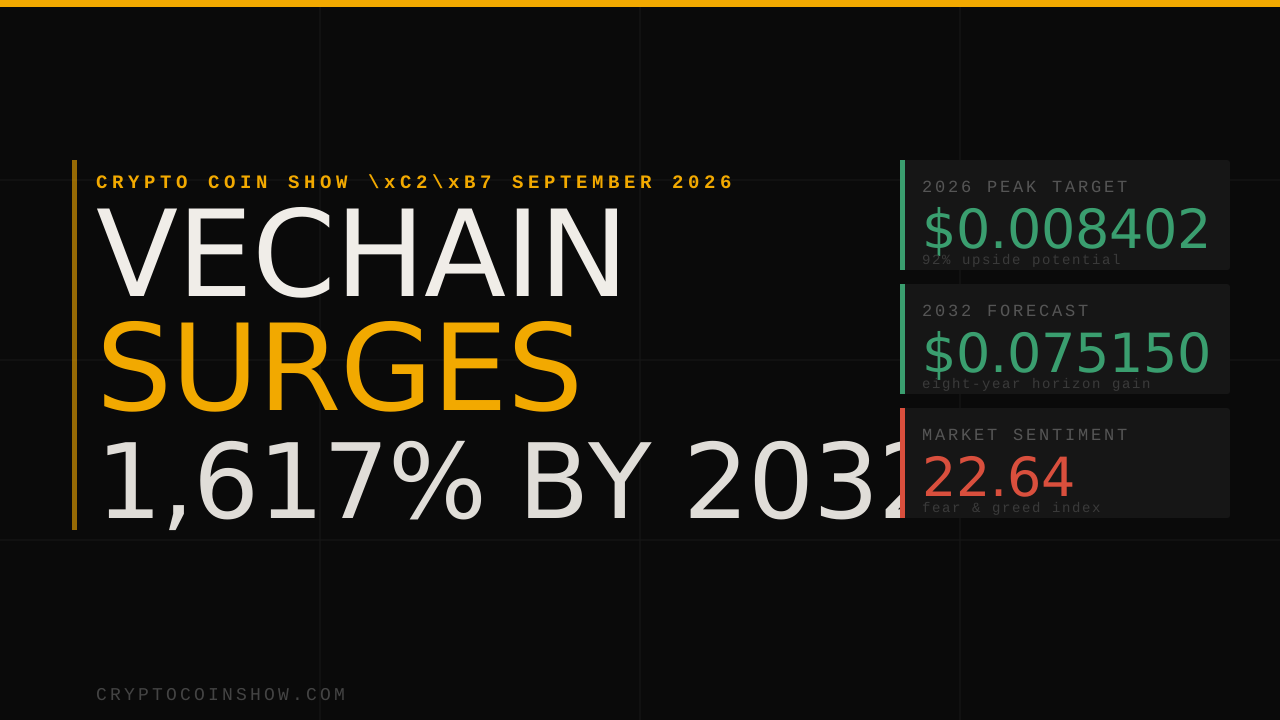
VeChain price projection suggests a peak price of $0.008402 by 2026.
Traders can expect a minimum price of $0.018272 and a maximum price of $0.033129 by 2029.
By 2032, VeChain’s price could potentially surge to $0.075150.
VeChain initially marketed itself as a blockchain network to provide transparency and efficiency to real-world applications enhancing customer trust, providing real-time tracking of goods and items across supply chains and preventing counterfeiting. The main focus of the chain was to track products from their creation to their delivery to the end-consumer as well as provide verification. However, as any good tool, VeChain and its aim have evolved since its launch in 2018.
With global trends shifting towards a greener, a more environment friendly future, VeChain has expanded its focus towards the same. VeChain now offers sustainability incentives, a digital identity as well as rewards environmental friendly actions through its programs. To prove its dedication to the cause, it introduced VeBetter, a Web3-powered ecosystem that rewards users with B3TR tokens for engaging in eco-friendly habits. VeBetter acts as a DAO-governed marketplace for sustainability-focused apps.
With growing optimism around the VeChain ecosystem, especially following recent collaborations with Walmart and other major partners, VeChain is positioning itself as one of the leading blockchain networks for real-world utility and sustainability-focused innovation.
VeChain overview
Cryptocurrency
VeChain
Symbol
VET
Price
$0.004377(-3.6%)
Market Cap
$400.16 Million
Trading Volume (24-h)
$14.24 Million
Circulating Supply
85.98 Billion VET
All-time High
$0.2782, Apr 17, 2021
All-time Low
$0.001678, Mar 13, 2020
24-h High
$0.004544
24-h Low
$0.004328
VeChain price prediction: Technical analysis
Market Sentiment
Bearish
50-Day SMA
$0.00609
200-Day SMA
$0.00820
Price Prediction
$0.00401 (-5%)
Fear & Greed Index
22.64 (Extreme Fear)
Green Days
8/30 (27%)
14-Day RSI
38.65 (Neutral)
VeChain price analysis: VET falls to $0.004370
TL;DR Breakdown:
VeChain price analysis shows fall to $0.004370
Cryptocurrency lost 3.6% of its value in 24 hours
VeChain coin finds support at $0.004370
VeChain (VET) current price analysis for 30 June shows strong bearish movement across the last few days as the price fell below the $0.00440 mark.
VeChain 1-day price chart: VET falls to $0.00437
VeChain (VET) price action shows a bearish week as the price dropped from the highs of $0.004500 mark to the $0.004370 mark where it trades at press time.
The Relative Strength Index (RSI) falls to 29.67, with the slope showing rising momentum as the price moves back towards $0.004300. The indicator leaves low room for volatile movement in downwards direction. Meanwhile, the Bollinger Bands suggest rising volatility, with the bands diverging across the past few days.
VeChain 4-hour price chart: VET shows neutral momentum
VeChain (VET) live price trades at $0.004377 on the 4-hour chart, showing slight recovery in recent hours.
The Relative Strength Index (RSI) stands at 38.42, showing a bearish market sentiment as VET hovers around $0.004370. The Bollinger Bands are converging and show support and resistance levels at the $0.004332 and $0.004666 levels respectively.
Vechain price analysis showed a sharp decline across the past few days as the price failed to rise past the $0.00460 mark and crashed. VET found support at the $0.004500 mark, before it crumbled causing a decline to the $0.004370 mark.
Overall, Vechain suggests that the price may fall towards $0.004200 as it fails its attempts to climb towards the $0.005600 mark. However, if the bulls are able to hold the $0.004350 level and establish support above $0.004700 mark, VET may rise to the $0.005000 level.
Is Vechain a good investment?
VeChain, as a notable blockchain project, stands out among crypto tokens in cryptocurrency because it focuses on supply chain management and enterprise solutions, which is not considered financial advice. VeChain operates on a dual-token model with two tokens: VET and VTHO. VET tokens are used for staking and governance, while VTHO is used to pay for transaction fees and smart contract execution. Users expend VET to participate in the network, and writing data to the blockchain is managed through VTHO, separating the cost of data submission from the value of VET. Smart contracts play a crucial role in automating business processes and enhancing trust, increasing transparency and efficiency in global trade.
With partnerships with major companies and a strong emphasis on real-world applications, many believe VeChain is a good buy due to its significant growth potential. Its innovative use cases and practical implementations appeal to businesses seeking operational improvements, making it an attractive option for informed investors.
However, it is advised to do your own research and conduct experts opinion before investing in the volatile market.
Why is VET down?
VeChain (VET) price shows that the bulls were rejected at $0.004500 and the rejection caused a crash to the current $0.004370 mark.
Will VeChain recover?
VeChain has experienced a notable selloff in the last thirty days, with the price falling from near the $0.03 mark to its highest price of the period to the current $0.021 level. However, industry analysts suggest that this downturn in the financial markets may not be long-term, a sentiment shared by many VET holders. Most projections indicate that VeChain could regain strength as market conditions improve, with expectations for the asset to potentially close the year between the $0.035 and $0.05 price levels.
Will VeChain reach $0.05?
Analysts suggest VeChain could attain $0.05 by 2031, as the minimum price is projected to be $0.0434 and the average price at $0.0500, as per the VET price prediction 2031. with a potential peak of $0.0585.
Will VeChain reach $0.10?
VET is expected to trade above $0.10 by 2035.
Does VET have a good long-term future?
VET has a good long-term future due to its strong use cases, growing on chain activity, and active development team at the Vechain Foundation.
Recent news/opinion on Vechain
Vechain’s recently revealed its Roadmap for 2026 including key information regarding planned developments including full Ethereum compatibility.
Our 2026 roadmap just dropped & the vision for $VET has never been bigger.
VeChain lived through four ‘chapters’ with a key thesis: trust is its own asset class.
Business needs it, individuals need it, & soon, billions of AI agents will, too.
In June 2026, the price of VeChain is anticipated to reach a minimum of $0.00410. The VET price can be expected to peak at $0.00620, maintaining an average of $0.00510 by the end of the month.
Month
Minimum Price ($)
Average Price ($)
Maximum Price ($)
June
0.00410
0.00510
0.00620
VeChain price prediction 2026
In 2026, the price of the VeChain coin is anticipated to touch a minimum of $0.003831, reflecting the current VeChain sentiment. The VET price might peak at $0.008402, maintaining an average of $0.005317 by the end of the year.
Year
Min. Price ($)
Average Price ($)
Maximum Price ($)
2026
0.003831
0.005317
0.008402
VeChain price prediction 2027-2032
Year
Min. Price ($)
Average Price ($)
Maximum Price ($)
2026
0.003831
0.005317
0.008402
2027
0.010044
0.011049
0.012153
2028
0.013674
0.016546
0.025592
2029
0.018272
0.028151
0.033129
2030
0.023265
0.036511
0.050684
2031
0.027701
0.055753
0.068318
2032
0.030117
0.062107
0.075150
VeChain Price Prediction 2027
For 2027, VeChain (VET) is expected to reach a minimum price of $0.010044. It could potentially climb to a high of $0.012153, averaging around $0.011049.
VeChain Price Prediction 2028
By 2028, VeChain price prediction suggests VET could trade at a minimum value of $0.013674. It might surge to a high of $0.025592, with an average price of $0.016546.
VeChain Price Prediction 2029
VeChain price prediction estimates VET to trade at a minimum of $0.018272 in 2029. It might reach a maximum of $0.033129, with an average value of $0.028151.
VeChain Price Prediction 2030
In 2030, VeChain’s price will likely hit a floor of $0.023265. Based on analysis, it could peak at $0.050684, with an average closing price of $0.036511.
VeChain Price Prediction 2031
The VeChain price prediction for 2031 projects a minimum price of $0.027701, a maximum price of $0.068318, and an average trading price of $0.055753.
VeChain Price Prediction 2032
In 2032, VeChain forecast suggests VET could trade at minimum and maximum prices of $0.030117 and $0.075150, respectively. The price might maintain an average of $0.062107
Vechain price prediction 2026-2032
Vechain Price Forecast: By Analysts
Firm
2026
2027
Coincodex
$0.01498
$0.01274
DigitalCoinPrice
$0.0208
$0.0291
Cryptopolitan’s VeChain (VET) price prediction
Cryptopolitan’s market analysis predictions show that VeChain will achieve a high of $0.008402 in 2026. In 2028, it will range between $0.013674 and $0.025592, with an average of $0.016546. In 2032, it will range between $0.030117 and $0.075150, with an average of $0.062107. Note that these predictions are not investment advice. Seek independent professional consultation or do your own research.
VeChain historic price sentiment
VeChain Price History
VeChain began in 2015 as a private consortium chain for blockchain applications. It transitioned to a public blockchain with the ERC-20 token VEN in 2017 and launched its mainnet as VET in 2018.
In 2018, VeChain partnered with DHL to develop blockchain solutions for logistics but saw a significant price correction, stabilizing at lower levels.
The price remained relatively stable in 2019 and 2020, with occasional spikes as VeChain continued developing technology and forming partnerships.
In 2021, VeChain’s price surged to an all-time high of $0.20 in May but dropped to $0.070 by December.
In 2022, VeChain attempted to recover but remained below $0.10, with continued volatility throughout the year and into early 2023.
Towards the end of 2023, the price saw a slight uptick, stabilizing around $0.020 by early 2024.
In 2024, VeChain’s price fluctuated, recovering to $0.025 by mid-March but dropping due to bearish trends, reaching a low of $0.019 by August.
It traded around $0.021 in September but ended the month above the $0.024 mark. The price remained mostly stable in October, with the occasional bearish movement causing a decline from the $0.02400 level to start November at the $0.02100 price level.
The asset closed November at a high level, with prices near the $0.04600 mark and a strong bullish outlook. However, the bulls only took the price higher in December, as the $0.0500 resistance was crushed swiftly.
As of January 2025, VET traded around the $0.04300 mark as it started and closed the month around the same level.
In February, the price fell towards the $0.03000 mark as bears took over, ending the month at $0.02800. In March, the net movement was low, but the volatility was very high, as the price fell to $0.02200 where it closed the month.
In April the price saw an initial crash but observed sharp recovery ending the month above the $0.02600 mark. In May the price dwindled again ending the month around $0.0250. In June the price continued to struggle as it dropped to $0.0200 to end the month.
July saw a sharp rise to the asset’s volatility with VET crossing the $0.02800 mark. However, the price could not be maintained and VET ended the month around the $0.02200 level. In September, the price saw high volatility reaching as high as $0.0260 but failed to stay at the level and ended the month below the $0.02200 mark.
In October, the price declined further and ended the month below the $0.01500 mark as bears dominated the crypto markets during the later half of the month. in November, the downtrend continued with VET ending the month below the $0.0130 mark. In December, the price continued to move downwards ending the year at $$0.0122.
In January, the trend continued with VET falling below the $0.0100 mark and ended the month below the $0.0080 level. In February the trend continued with the price ending the month below the $0.0070 mark. In March, the trend continued with VET closing the month at the $0.00677 mark.
By the end of April, VET price hovered around $0.007. a trend that did not continue into May as the price saw rapid decline in the month ending below the $0.0050 mark.
Sony Interactive Entertainment is removing 551 purchased films from UK PlayStation Store accounts on September 1, 2026, citing content licensing agreements with StudioCanal.
The affected library spans decades of cinema, from Terminator 2: Judgment Day and Rambo: First Blood to Bridget Jones’ Diary, Pan’s Labyrinth, and Paddington. Customers who paid for those titles will lose access regardless of their purchase history.
When a Purchase is Not Ownership
Sony published a formal legal notice confirming the removal, attributing it to the expiration of its licensing agreement with StudioCanal. The notice offered no refunds or alternative compensation for affected buyers.
The situation exposes a structural reality most consumers overlook at checkout. A digital “purchase” on any platform-controlled storefront functions more like a temporary license than outright ownership.
Therefore, Sony and StudioCanal can modify or terminate that license, and the buyer absorbs the loss.
With 551 titles set for deletion, this is one of the largest single-event disappearances of purchased digital content in recent memory.
PlayStation is deleting 551 purchased movies from its customers’ accounts, reminding us nothing digital is ever truly ours https://t.co/sXW4Uj10FR
PlayStation Digital Ownership and the Gaming Parallel
The concern is not limited to films. When GTA 6 pre-orders opened this week, Rockstar confirmed that physical retail editions would include only a digital download code, with no disc.
For buyers who assumed a boxed copy meant a physical artifact they owned outright, that detail reinforced a growing unease. The GTA launch also sent shockwaves through crypto markets that same day, highlighting how far the digital ownership question now extends across gaming and finance.
Together, the two events make the same point. Across entertainment and gaming, consumers are paying for access, not ownership.
The Web3 Argument Gets Louder
Non-fungible tokens (NFTs) were built to address exactly this problem by creating on-chain, portable title deeds that no single platform can revoke. If StudioCanal had issued film rights as NFTs, Sony could not have overridden them.
Those tokens would remain in the buyer’s wallet, transferable and verifiable, independent of any licensing dispute between corporations.
That argument is gaining fresh credibility. Earlier this year, market observers noted a shift in the NFT sector away from speculation toward tangible utility, with digital ownership emerging as the strongest long-term use case.
Meanwhile, Worldcoin’s biometric identity push brought parallel questions about who controls proof-of-ownership in digital spaces into mainstream debate. Across the broader GameFi sector, 2026 has already seen renewed investor appetite for blockchain-backed digital economies.
The PlayStation film deletions may appear to be a routine licensing dispute on paper.
However, they crystallize a question that streaming, gaming, and digital media platforms have not resolved: when a platform changes its terms, what does a consumer actually own?
For blockchain advocates, Sony just provided the most mainstream illustration yet.
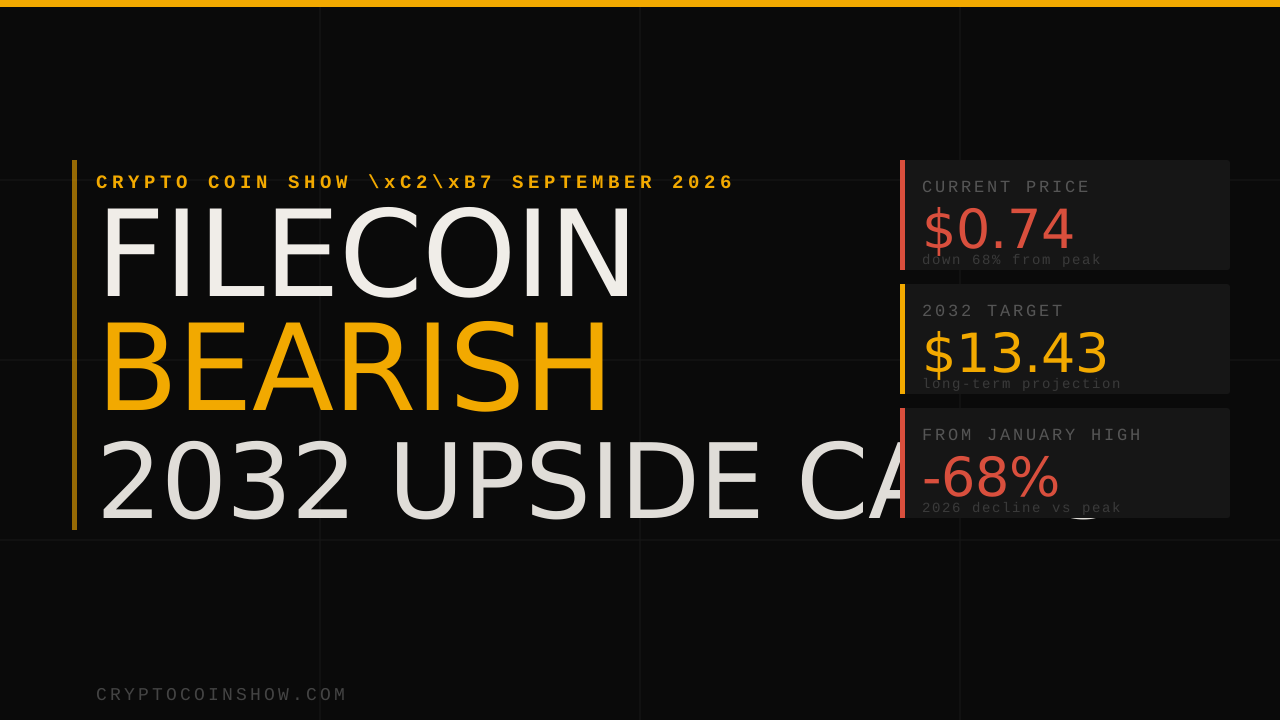
Filecoin price predictions suggest an average market price of $1.26 in 2026.
By 2029, the price is projected to reach $4.45.
By 2032, FIL may reach $13.43.
Filecoin is a decentralized storage network designed to securely and efficiently store humanity’s most important information. Launched by Protocol Labs in October 2020, it utilizes blockchain technology to create a peer-to-peer digital storage marketplace. Users can rent unused hard drive space to earn Filecoin tokens (FIL), the network’s native cryptocurrency.
The system operates on a proof-of-replication and proof-of-spacetime consensus mechanism, ensuring that data is reliably stored over time and that storage providers hold the exact copies they claim. This approach incentivizes a robust and distributed network of storage providers, enhancing data retrieval speeds and security compared to traditional centralized servers.
Filecoin aims to reduce storage costs by leveraging the global surplus of storage capacity. As part of the broader Web3 ecosystem, it supports decentralized applications (dApps) and services that require secure, decentralized data storage, significantly advancing the decentralized internet infrastructure.
Filecoin is trading at $0.748, up 1.75% on the day, staging a modest relief bounce after yesterday’s sell-off pushed price to a low of $0.702 — dangerously close to fresh 2026 lows. The 1D structure remains broadly bearish, with FIL declining from January’s $1.75 peak through a volatile year of lower highs. The brief May spike to $1.35 has been entirely erased, with price now consolidating in a tight $0.70–$0.80 horizontal zone that represents critical 2026 support. Today’s green candle shows tentative buyer interest emerging at depressed levels. A daily close above $0.80 would signal short-term stabilization; losing $0.70 risks a drop toward $0.60.
Filecoin’s 4H chart shows price at $0.748, up 1.72%, attempting a tentative recovery after yesterday’s sharp drop to the $0.70 support floor — the lowest level of 2026. The 4H structure mirrors the 1D, revealing a prolonged decline from January’s $1.75 peak with the entire May spike to $1.35 fully retraced. Price is now compressing tightly in the $0.73–$0.75 range, with small candles reflecting cautious buyer interest rather than strong conviction. The $0.80 horizontal level remains the key barrier to overcome for any meaningful recovery. A 4H close below $0.72 would signal renewed selling pressure toward $0.60 lows.
Filecoin technical indicators: Levels and action
Daily simple moving average (SMA)
Period
Value
Action
SMA 3
$0.7564
SELL
SMA 5
$0.7676
SELL
SMA 10
$0.7815
SELL
SMA 21
$0.7711
SELL
SMA 50
$0.9073
SELL
SMA 100
$0.9047
SELL
SMA 200
$1.04
SELL
Daily exponential moving average (EMA)
Period
Value
Action
EMA 3
$0.7513
SELL
EMA 5
$ 0.7611
SELL
EMA 10
$0.7730
SELL
EMA 21
$0.7982
SELL
EMA 50
$ 0.8569
SELL
EMA 100
$0.9265
SELL
EMA 200
$ 1.13
SELL
Filecoin technical analysis: Conclusion
Filecoin remains in a broadly bearish state across both timeframes, though today’s modest +1.75% bounce from the $0.70 support floor offers a rare glimmer of hope. The 1D and 4H charts tell a consistent story — FIL has lost over 57% from January’s $1.75 peak, with every recovery attempt, including May’s sharp spike to $1.35, quickly reversed by sellers. Price is now compressing in the $0.73–$0.75 zone with no strong buying conviction. A confirmed close above $0.80 could signal short-term stabilization, but until that happens, the path of least resistance remains downward with $0.60 as the next major risk level.
Why is Filecoin up today?
FIL is up today due to a technical bounce from deeply oversold levels combined with a slight improvement in broader market sentiment. On the charts, yesterday’s drop to the $0.70 support floor triggered natural relief buying after price became significantly oversold. Trading volume increased 6.60% in the last 24 hours, signaling a recent rise in market activity supporting the bounce. Fundamentally, Filecoin is undergoing a major narrative shift from storage hype to real revenue generation, with AI and enterprise data demand growing and the network pushing into decentralized cloud infrastructure to compete with centralized providers like AWS, keeping long-term buyer interest alive at depressed price levels.
Is Filecoin a good investment?
Filecoin is a decentralized storage network aiming to revolutionize data storage. Its investment potential depends on market adoption and competition. Like all cryptocurrencies, it carries significant risks due to volatility. Investors should carefully research and assess their risk tolerance before considering investing.
What will Filecoin be worth in 2026?
Filecoin is predicted to reach a high of $2.67 by 2026.
How high can Filecoin go?
Filecoin (FIL) has the potential for significant price appreciation, especially if adoption in the decentralized storage sector increases. Historically, FIL reached an all-time high of $236.84 in 2021, but its price has since retraced significantly. Looking forward, realistic long-term projections depend on market conditions, demand for decentralized storage, and crypto adoption.
In a bullish scenario, FIL could reach $2.67 by 2026 if institutional interest and on-chain activity increase. More optimistic forecasts suggest $50+ in the next major bull run. However, market risks remain, and sustained growth depends on ecosystem developments and competitive advantages over traditional cloud storage solutions.
Can Filecoin reach 100 dollars?
Filecoin (FIL) reaching $100 is possible, but it would require significant market momentum, adoption, and favorable conditions in the broader crypto space. The token hit an all-time high of $236.84 in 2021, proving that such price levels are achievable during bullish cycles.
For FIL to reach $100 again, it would need strong institutional adoption, increased demand for decentralized storage solutions, and a broader crypto bull market. However, competition from traditional cloud providers and other blockchain-based storage networks could limit growth. While possible, it would require a massive market resurgence and sustained network adoption to materialize.
What is the all-time high price of Filecoin?
For FIL to reach $100 again, it would need strong institutional adoption, increased demand for decentralized storage solutions, and a broader crypto bull market. However, competition from traditional cloud providers and other blockchain-based storage networks could limit growth. While possible, it requires a massive market resurgence and sustained network adoption to materialize.
Does Filecoin have a future?
Filecoin’s future appears promising, given its unique position in decentralized data storage and its ability to address the growing demand for secure alternatives to traditional cloud services. Analysts predict potential price increases, with estimates suggesting it could reach $6.64 by 2032, contingent on market conditions and adoption rates.
Is it worth investing in Filecoin?
Investing in Filecoin may be worthwhile due to its innovative approach to decentralized data storage, which meets growing demand in the tech sector. However, potential investors should consider market volatility and conduct thorough research, as price predictions vary widely, reflecting both optimism and caution among analysts
Is Filecoin safe?
Filecoin uses cryptographic security for its decentralized storage network and employs robust security protocols, including cryptographic proofs of data integrity; however, it is not without risks. Potential issues include market volatility, regulatory uncertainty, and technical vulnerabilities. Users should thoroughly research and exercise caution when using or investing in Filecoin.
Is Filecoin built on Ethereum?
Filecoin is not built on Ethereum; it operates on its own blockchain. However, it has integrated with Ethereum to enhance functionality, enabling smart contracts and facilitating interactions between the two ecosystems. This collaboration allows developers to leverage both platforms for decentralized storage and applications.
Recent news/opinions on Filecoin
Filecoin Onchain Cloud targets AI agent payments with sub-cent transactions and automatic settlement
Filecoin Onchain Cloud enables AI agents to execute sub-cent micro-payments automatically, bypassing legacy payment rails that charge a $0.30 minimum per transaction.
Legacy payment rails charge $0.30 minimum per transaction.
Agents execute hundreds of sub-cent micro-payments per workflow. That math doesn’t work.
Filecoin Onchain Cloud gives agents storage that proves what it holds, payments settle automatically, and a full audit trail. pic.twitter.com/DlbpNkb3JC
In June 2026, the Filecoin price is expected to hit a low of $0.8304, with an average expected price of $1.01, and the FIL price might reach a maximum of $1.25.
Filecoin price prediction
Potential Low
Potential Average
Potential High
Filecoin Price Prediction June 2026
$0.8304
$1.01
$1.25
Filecoin FIL price forecast 2026
The price of Filecoin (FIL) is predicted to reach a minimum value of $1.22 in 2026, with a maximum of $1.44 and an average trading price of $1.26. This projection is driven by increasing use of decentralized cloud storage, continuous protocol improvements, and expanding partnerships, while cautious market sentiment keeps growth steady rather than explosive.
Filecoin price prediction
Potential Low
Potential Average
Potential High
Filecoin price prediction 2026
$2.07
$2.41
$2.67
Filecoin price forecast 2027- 2032
Filecoin price prediction
Potential Low ($)
Potential Average ($)
Potential High ($)
2027
1.13
1.32
1.50
2028
2.52
2.89
3.27
2029
4.96
6.20
7.44
2030
2.78
3.31
3.84
2031
3.45
3.84
4.22
2032
5.11
5.88
6.64
Filecoin price prediction 2027
Filecoin’s price is forecast to decline to $1.13 in 2027. According to analysts, the FIL price could reach a maximum of $1.50, with an average forecast of $1.32.
Filecoin price prediction 2028
According to forecasts and technical analysis, in 2028 the price of Filecoin (FIL) is expected to range from $2.52 to $3.27, with an average of $2.89. This growth outlook is fueled by expanding demand for decentralized data storage, integration with AI and cloud services, and broader enterprise adoption, strengthening Filecoin’s position as a leading Web3 storage infrastructure provider.
Filecoin (FIL) price prediction 2029
According to technical analysis of past FIL price data, in 2029 the price of Filecoin is forecast to reach a minimum of $4.96, a maximum of $7.444, and an average trading price of $6.20. This projection is driven by increasing global demand for decentralized cloud storage, enhanced data privacy awareness, and Filecoin’s expanding ecosystem supporting Web3 and AI-driven data solutions, fostering consistent network utility and long-term value growth.
Filecoin price prediction 2030
The price of 1 Filecoin (FIL) is expected to reach a minimum level of $2.78 in 2030, with a maximum of $3.84 and an average price of $3.31.
Filecoin price prediction 2031
The price of Filecoin is predicted to reach a minimum level of $3.45 in 2031. The FIL price can reach a maximum level of $4.22, with the average trading price of $3.84.
Filecoin (FIL) price prediction 2032
The price of Filecoin (FIL) is predicted to reach a minimum price of $5.11 in 2032, with a maximum of $6.64 and an average price of $5.88. This projection reflects Filecoin’s maturity as a global decentralized storage network, large-scale enterprise integration, and increasing demand for secure, censorship-resistant data solutions, solidifying its position as a key infrastructure layer in the Web3 economy.
According to Cryptopolitan’s projections, FIL’s price could reach $1.89 by 2026. However, traders should also be aware of potential market volatility. The average trading price for FIL is expected to hover around $1.82, indicating both optimistic market trends and the risks of potential declines.
2017–2021 boom: FIL traded under $30 until mid-2020, then surged to an all-time high of $237.24 on April 1, 2021, before reversing sharply lower.
2022–2023 slump: Entered 2022 at higher levels but slid with the wider crypto downturn; in 2023, it ranged mostly between $3 and $4.32, showing only modest recovery.
2024–early 2025 weakness: Fell from $7.65 early 2024 to around $3.4 late in the year, briefly spiked to $8.03 (Dec 5), then slid through early 2025 toward $2.3–$3.0.
Mid-2025 grind lower: Mostly traded in the $2.2–$2.8 zone July–September, briefly bounced near $4.2–$4.8, then collapsed in October–November toward $1.45–$1.95.
Late-2025 to Jan 2026 stabilization: A November rally to ~$3.0 faded into December lows near $1.25–$1.35, followed by a mild rebound and consolidation around $1.28–$1.33 in early January 2026.
Early January to late January 2026 — FIL started around about $1.28–$1.33 and showed modest recovery and sideways consolidation through mid-January.
Late January to February 9, 2026 — The price remained relatively stable with low volatility around similar levels near $1.25–$1.35, reflecting continued consolidation rather than strong upward or downward moves.
FIL opened March 3 at around $0.95–1.00, attempted a brief recovery toward $1.10 in mid-March, before aggressive selling pushed the price below the critical $1.00 psychological level by March 27, closing the month at approximately $0.84.
Through late March into April 5, FIL continued sliding to lows near $0.81, representing a total decline of roughly 15–18% over the period — with the bearish structure intact, down 69.57% year-over-year as selling pressure showed no signs of reversal.
FIL entered April 5 trading around $0.84, having already declined sharply from its earlier highs, with the token sitting near multi-year lows as bearish momentum dominated across both daily and weekly timeframes.
By May 5, FIL recovered to around $0.93 to $0.95, posting a 6.20% gain over the past seven days and outperforming the broader crypto market, supported by the launch of Filecoin’s Onchain Cloud mainnet and renewed buying interest following Bitcoin’s push above $80,000.
FIL entered May 4 trading around $0.90 to $0.95, recovering from its all-time low of $0.775 set on March 29, 2026, before surging over 10% during the week of May 5 to 10 alongside infrastructure tokens, driven by renewed AI storage narrative interest and the Filecoin Onchain Cloud launch.
By June 5, FIL had pulled back sharply to around $0.86 to $0.87, down 8.80% over the past seven days and significantly underperforming the broader crypto market, with declining on-chain activity, record-low social dominance, and quiet development activity keeping sellers firmly in control heading into June.
ETHWomen Returns to Toronto, Bringing Together Women Building the Future of Web3 and AI
A full day of networking, learning, and community takes over July 22 as part of Canada Crypto Week.
LOCATION:Toronto, ON
DATE:July 22, 2026
ETHWomen returns on July 22, 2026, bringing together women from across the Web3 and AI industries. As part of Canada Crypto Week, the event features networking, educational sessions, and community-driven experiences designed to foster connection and collaboration.
Now in its fifth year, ETHWomen continues to bring together an incredible community of women who are helping shape the future of Web3 and AI.
Featured Speakers Include:
Eve Lam, Morgan Stanley
Jaime Leverton, ReserveOne
Dr. Guneet Kaur, CCN
Lalla Asmaa Alaoui, Hello Agentic
Amber Scott, Outlier Ventures
Laura Leparulo, Futurist Conference
Ashley Wright, The Wright Success
Karin Kusano, Association for Women in Cryptocurrency
Along with more than 30 women speakers from across the Web3, AI, finance, and technology industries.
Community Experiences
In addition to speaker sessions, ETHWomen will feature a series of community experiences including:
SheFi Morning Social Breakfast presented by SheFi
Facilitated Networking presented by the Association for Women in Cryptocurrency (AWIC)
Book Signings with Amanda Wick, Audrey Nesbitt, and Annelise Osborne
The SheFi Morning Social Breakfast presented by SheFi kicks off ETHWomen with breakfast and community-building alongside one of the largest women’s networks in Web3. SheFi is known for its 8-week MBA-style program, global community events, and career development opportunities designed to help women grow in the Web3 industry.
Supporting Organizations
ETHWomen is proud to bring together a growing network of organizations supporting women in Web3, including:
CryptoChicks
SheFi
Association for Women in Cryptocurrency (AWIC)
FemTech
Babes Net
Women in Blockchain Canada
ShibWomen
Attendance is free and open to women, allies, founders, builders, investors, students, and professionals interested in the future of technology.
ETHWomen is part of the larger Futurist Conference, bringing together leaders, innovators, and builders across the blockchain and AI ecosystem during Canada Crypto Week.
Exclusive Code: Use code CCSHOW25 for special pricing
Andy Burnham’s landslide by-election win has handed Labour’s most crypto-friendly figure a clear route to challenge Keir Starmer for the party leadership.
The Greater Manchester mayor will be sworn in as an MP this week, removing the last barrier to a leadership bid. His enthusiasm for Web3 sits awkwardly beside Starmer’s recent crackdown on crypto.
Burnham’s Win Reopens the Leadership Question
Burnham took the Makerfield seat on June 18 with 54.8% of the vote. He beat Reform UK by a majority of more than 9,200, on a turnout that climbed to almost 59%.
By-election turnouts usually fall, so the result reads as a genuine mandate.
He is due to be sworn in within days. On Polymarket, the crypto-settled prediction market, traders have wagered more than $11 million on the succession and make Burnham the clear favorite to take over.
Andy Burnham Fronted As Possible Next UK PM in 2026. Source: Polymarket
Starmer insists he will fight any challenge.
Weekend reports suggested the prime minister was weighing his future, though his office dismissed talk of an imminent exit.
Congratulations, @AndyBurnhamGM, Labour’s new MP for Makerfield.
Voters chose Labour’s campaign of hope and optimism over division and hate.
Cabinet ministers, union leaders and party donors have all joined talks about the timing of a handover.
A Pro-Web3 Voice Against a Crypto Crackdown
Burnham ranks among the few senior Labour figures to openly back digital assets. He told about 100 Web3 founders at a Stand With Crypto event that he was “bought in.”
“Manchester was the home of the Industrial Revolution. Let’s make it the home of the web3 revolution,” Andy Burnham, Mayor of Greater Manchester, in remarks to crypto founders.
That tone clashes with the national party. In March, Starmer’s government imposed a moratorium on crypto donations to political parties.
The independent Rycroft Review had warned that crypto’s anonymity could mask foreign money entering UK politics.
Even so, Burnham’s support looks regional and pragmatic, tied to Manchester jobs rather than markets.
Any read-through also depends on a retail base that is shrinking. Crypto ownership among UK adults has slipped to about 8%, down from 12% a year earlier, the FCA found.
A Burnham premiership could still soften the tone toward Web3 after a year of tighter UK crypto rules, though bond investors look more worried about his spending than his digital-asset views.
His swearing-in and any leadership timetable this week will set the near-term direction. A warmer crypto stance surviving Britain’s fiscal squeeze is the real question for a shrinking crypto electorate.
Canada Crypto Week Returns July 20–26, Celebrating the Future of Web3, Digital Assets & AI
Canada’s largest week-long gathering of conferences, networking events, and community experiences — uniting entrepreneurs, builders, investors, and institutions.
Toronto, ON — June 2026
Canada Crypto Week returns July 20–26, 2026, for its sixth year, bringing together dozens of events across Canada focused on cryptocurrency, digital assets, and artificial intelligence. The week connects entrepreneurs, builders, investors, and institutions through a diverse lineup of events taking place across the country.
The flagship event is Blockchain Futurist Conference — Canada’s largest Web3 and AI event — taking place July 21–22 at Rebel Entertainment Complex and Cabana Pool Bar in Toronto, attracting thousands of attendees and serving as the hub for the week’s featured events and experiences.
Canada Crypto Week kicks off with Web3TO Toronto Conference 2026 on July 20, bringing together the Web3 community for a full day of insights on the future of the industry.
Returning to Canada Crypto Week, Cayman Finance will host its annual Rum Bar Cayman Experience in the VIP Cabana Area on July 21 and 22, giving VIP attendees an opportunity to experience Cayman hospitality, connect with companies from the Cayman Islands, and learn more about doing business in one of the world’s leading financial jurisdictions.
A key addition this year is the Compliance Breakfast on July 22, presented by VerifyVASP, Inca Digital, XReg Consulting, Crystal Intelligence, and Cloudburst Technologies. The invite-only event brings together regulators, policymakers, compliance leaders, and industry executives for meaningful discussions on digital assets, AI, regulation, and the future of innovation.
Also featured is Agentic Day presented by Hello Agentic on July 21 — a dedicated afternoon program exploring the future of AI agents and autonomous intelligence, bringing together innovators building the next generation of agentic AI.
Featured Events & Activations
Agentic Day by Hello Agentic
Cayman Finance Rum Bar Experience
Compliance Breakfast by VerifyVASP et al.
Invest Hong Kong Workshop
Pudgy Penguins Vibes Card Game Event
SheFi Morning Social at ETHWomen
House of Intelligence by House of ZK
AWIC Facilitated Networking
Whitepaper Reading Sessions
Book Signings: Wick, Nesbitt & Osborne
ETHToronto by Autheo
5th Annual ETHWomen
Bored Ape Meetup
Doginal Dogs VibeZone
Solana VibeStation
Sponsors & Community Partners
Canada Crypto Week is made possible through the support of sponsors, community organizations, and media partners from across the industry. Stablecorp and QCAD join as the Official Stablecoin Partner, supporting the growth and adoption of digital assets in Canada. CryptoNomads connects global Web3 professionals and digital nomads through its worldwide network. CCN (Crypto Citizens Network) will conduct live interviews and capture insights from leading voices across Web3 throughout the week.
“Canada Crypto Week is where Canada’s Web3, digital asset, and AI communities come together to connect, collaborate, and build the future.”
Canada Crypto Week is Canada’s largest week-long celebration of cryptocurrency, blockchain, Web3, digital assets, and artificial intelligence. Now in its sixth year, the initiative brings together more than 50 independent events, conferences, meetups, networking experiences, educational sessions, and community gatherings designed to connect and grow Canada’s innovation ecosystem.
Big Tech OwnsYour Compute.Here’s Who’sTaking It Back.
While Big Tech races to build ever-larger data centers, 80% of existing GPU capacity sits idle. io.net is betting that the future of AI compute looks nothing like the past.
The numbers coming out of the hyperscalers are staggering. An estimated $650 billion is being spent on AI data center infrastructure in 2026 alone, with Amazon, Microsoft Azure, and Google Cloud racing to stake out compute real estate across the United States and beyond. Headlines about planned campuses have become routine. So have the headlines about delays.
Grid constraints, community opposition, soaring construction costs, and permitting backlogs have pushed back roughly half of planned US data center openings. The irony is sharp: the industry most loudly declaring a compute shortage is struggling to build its way out of one.
But there is a more uncomfortable truth underneath the construction race. The data centers that already exist are chronically underused. Industry estimates suggest that around 80% of global GPU capacity goes unutilized at any given time. Compute workloads are spiky by nature. A company trains a model, then the chips sit. Inference traffic surges and then falls quiet. The infrastructure built for peak demand idles through the troughs.
“Instead of having to build lots of data centers all over the world constantly, we should be juicing the data centers we have more effectively.”
Jack Collier, CMO, io.net
It is this inefficiency, not just the cost, that io.net was built to address. The company aggregates spare GPU capacity from secondary data centers, mining operations, and consumer-grade hardware, pooling it into a single marketplace that anyone can access. Three providers — AWS, Azure, and Google Cloud — control roughly 70% of global compute. The remaining 30% is fragmented across thousands of secondary operators and consumer hardware. io.net connects that fragmented supply into a single, accessible network.
The Business Case
Under $2 an Hour for an H200. That Is Not a Typo.
The flagship claim io.net makes is cost. H200 GPUs, among the most powerful chips available for AI workloads, are listed on the io.net platform today for under $2 per hour. The same hardware on AWS or Google Cloud runs $25 to $30 per hour. For a startup burning 40 to 60 percent of its operating budget on compute, that difference is not marginal. It is existential.
H200 on io.net
<$2
per hour
H200 on AWS
$25–30
per hour
Devices live
10K+
across 138 countries
Cluster setup
~2 min
no waitlist, no KYC
Token
$IO
staked by suppliers
Leonardo.ai, the AI imaging company recently acquired by Canva, is perhaps io.net’s most prominent case study. The team uses io.net for inference workloads and has credited the cost savings with giving them room to innovate faster. That kind of reference point matters when trying to convince web2 companies that decentralized infrastructure is not an experiment.
And that, according to io.net CMO Jack Collier, is where most of the company’s revenue actually comes from today. “Most of our revenue comes from web2,” he noted, “people who don’t even know that they’re building on crypto rails.” The blockchain layer, in other words, is infrastructure, not identity.
Why Web2 Companies Aren’t Switching Faster
Lock-in is real. Once a business has built its stack on AWS or Azure, the connective tissue runs deep through every service, billing integration, and workflow. Extraction is costly and disruptive. Add to that the narrative pressure from hyperscalers themselves, who have significant marketing budgets dedicated to reinforcing fears of GPU shortages, and the inertia becomes easier to understand. io.net’s answer is to let the price differential speak for itself and build the track record one customer at a time.
Resilience and Geography
When AWS Goes Down, Everything Goes Down. That Is the Problem.
Centralized infrastructure carries a centralized failure mode. When a major cloud provider experiences an outage, the cascade is immediate and broad. Thousands of services, often unrelated to one another, go dark simultaneously because they all share the same dependency.
Decentralized compute inverts this logic. io.net customers can distribute their workloads across GPU clusters in four or five countries simultaneously. If one node fails, traffic reroutes. For global products, this also enables something else: local inference. A company serving customers in Japan can run its models from Japan. Customers in South Africa get inference from South Africa. Latency drops. Performance improves. The infrastructure adapts to geography rather than forcing geography to adapt to infrastructure.
This geographic flexibility, available today across more than 138 countries, is one of io.net’s less-discussed advantages. It quietly solves a problem that hyperscalers solve only expensively and slowly, by building new regional data centers.
Full Interview — CCS Blockchain Interviews
Jack Collier, CMO of io.net, speaks with Ashton Addison of the Crypto Coin Show about decentralized compute, the IDE, Agent Cloud, and the future of AI infrastructure.
Fixing the Economics
The Incentive Dynamic Engine: From Inflation to Utility
Most decentralized physical infrastructure networks, DePIN projects in crypto parlance, share a structural problem. They incentivize suppliers by minting new tokens and distributing them as rewards. When token prices rise, suppliers flood in. When prices fall, they leave. The network’s supply is held hostage to speculation rather than anchored to real demand.
io.net has responded with what it calls the Incentive Dynamic Engine, or IDE, scheduled for full implementation in Q2 2026. The shift is fundamental: instead of paying suppliers a fixed amount of IO tokens each month, suppliers are now compensated in proportion to actual demand on the network. Payments are denominated in USDC-equivalent value of IO, meaning suppliers receive stable dollar-value compensation regardless of token price fluctuations.
Revenue above what is needed to pay suppliers flows into a reserve vault. That vault absorbs volatility. In price downturns it subsidizes supplier rewards. In stronger markets, excess emissions from that vault are burned. io.net has committed to burning at least 50 percent of those excess emissions permanently, meaning the total IO supply contracts over time as the network grows.
IDE Change
Detail
Status
Network model
Supply-driven → demand-driven
Q2 2026
Supplier payments
USDC-equivalent IO (stable dollar value)
Q2 2026
Emissions burn
50% minimum of vault excess
Ongoing
Network direction
Inflationary → deflationary over time
By design
“Tokens aren’t just there as an investment vehicle. They’re there to power a trustless network.”
Jack Collier, CMO, io.net
The result is a tokenomic model where the value of IO is tied directly to the utility of the network it powers, not to sentiment cycles. For anyone evaluating whether a blockchain project is serious, that kind of alignment is among the clearest signals available.
The Agent Economy
AI Agents That Buy Their Own Compute
One of io.net’s more forward-looking product moves is Agent Cloud, launched in March 2026. The premise is simple and slightly startling: AI agents, which already automate enormous swaths of software work, can now autonomously purchase the compute power they need to run. No human in the loop. No approval workflow.
Launched
Mar 25
2026
Protocol
MCP
library by io.net
Payment
Both
crypto or fiat
Guardrails
Yes
spend limits built in
Agent Cloud is built on a Model Context Protocol library created by io.net. An agent with access to a wallet can query the io.net marketplace, identify the GPU configuration it needs, and complete the purchase automatically. Guard rails prevent runaway spending, with limits on how many devices can be acquired and for how long.
The concept points toward something larger. If AI agents are going to be first-class economic participants, they need infrastructure that is programmatically accessible. Centralized cloud providers require account creation, billing agreements, and human oversight at the procurement layer. A permissionless marketplace, accessible via API and payable in crypto or fiat, removes those friction points entirely.
“Our CEO talks quite passionately about a world where AI agents are being spun up themselves and are able to purchase their own compute power and run entirely autonomously,” Collier said. It is a vision of compute as a commodity that intelligent systems consume on demand, the same way applications consume electricity or bandwidth.
Where This Goes
The Demand Curve Only Runs One Direction
The case for decentralized compute rests on a straightforward projection: AI demand will grow faster than centralized infrastructure can be built, and the inefficiency of today’s capacity utilization leaves enormous room for networks that can aggregate and reallocate idle supply. io.net is not alone in making this argument, but it is among the furthest along in proving it with revenue.
From zero to $25 million in annualized revenue, in roughly a year of serious commercial operation, against a global data center market measured in the hundreds of billions, there is a long road ahead. But the trajectory is real, the product is live, and the customers are increasingly the kind of companies who do not think of themselves as crypto users at all.
That quiet expansion — blockchain as invisible infrastructure rather than explicit identity — may be the most durable growth story in the space. Spin up a cluster at io.net in two minutes. No waitlist. No KYC labyrinth. Just compute, available to whoever needs it.
Istanbul Blockchain Week Launches Institutional Markets Summit: Pioneering Institutional Adoption of Digital Assets
Istanbul, Türkiye · April 2026 · June 2, 2026 · Hilton Bomonti Hotel
Closed-Door Institutional Forum — Invite Only
Istanbul Blockchain Week announces the launch of The Institutional Markets Summit — a closed-door forum for policymakers, regulators, financial institutions, asset managers, exchanges, and infrastructure providers. The summit will take place on June 2, 2026 at the Hilton Bomonti Hotel, organized by Web3 marketing agency EAK Digital.
The event will examine the structural evolution of digital assets within regulated financial markets.
What to Expect at the Institutional Markets Summit
The summit serves as the ultimate meeting point for top industry leaders across traditional finance, private markets, tokenized capital markets, regulation, and custody — exploring evolving market structures at the highest level.
Open only to senior decision-makers including:
Government policymakers
Financial regulators
Central bank representatives
Institutional investors
Market operators
Stablecoin issuers
Payment networks
Risk management leaders
As the first edition of the event under Istanbul Blockchain Week, the summit builds on the success of previous IBW editions, which featured speakers including:
Mehmet Çamır — Chairman, OKX TR
Ali İhsan Güngör — Executive Vice Chairman, Capital Markets Board of Türkiye
Onur Güven — CEO, Garanti BBVA Digital Assets
Petra Janež — Head of Supervision, Fintech & Digital Assets, Ministry of Finance, Slovenia
Paul Brody — Global Blockchain Leader, Ernst & Young Global
“With traditional financial institutions increasingly embracing digital assets, blockchain technologies, and cryptocurrencies, we are proud to launch a dedicated summit to explore these developments, navigate opportunities and shape the future of institutional adoption.”
— Erhan Korhaliller, CEO of EAK Digital & Founder of Istanbul Blockchain Week
Summit Focus Areas
Liquidity FormationCapital Markets IntegrationCustodySettlement InfrastructureCompliance FrameworksDigital Asset AdoptionTokenized Capital MarketsSovereign Fund Roundtables
Exclusive closed-door roundtables with sovereign funds and institutional leaders will also take place, fostering strategic discussions among key decision-makers driving the evolution of global digital assets.
Why Istanbul?
Positioned at the crossroads of Europe, the Middle East, and Asia, Istanbul’s strategic location provides a central meeting point for capital and institutions across these regions — offering both geographic and economic connectivity for institutional dialogue and cross-border collaboration.
$200BCrypto transaction volume in Türkiye — 2025 (Chainalysis)
Türkiye processed nearly $200 billion in crypto transaction volume in 2025, making it one of the world’s largest markets by raw transaction activity. The introduction of a new economic bill and reporting frameworks for digital assets — including a 10% withholding tax on crypto gains — further signals a major step in aligning digital assets more closely with traditional financial instruments.
With increasing cross-border liquidity and settlement connectivity, Istanbul has established itself as a key hub for a rapidly developing fintech ecosystem, with digital asset usage deeply integrated with broader economic activity.
Participation in the Institutional Markets Summit is limited to invited institutional leaders, policymakers, and Istanbul Blockchain Week VIP pass holders, ensuring a high-level audience of senior decision-makers across global financial markets.
— ENDS —
About Istanbul Blockchain Week (IBW)
Istanbul Blockchain Week (IBW) is Türkiye’s flagship Web3 conference and expo, bringing together founders, developers, investors, enterprises, creators, and policymakers in the heart of Istanbul. Produced by EAK Digital, IBW showcases the technologies and people shaping crypto, DeFi, AI agents, gaming, and real-world assets.
Across recent editions, IBW has welcomed 20,000+ attendees and 500+ speakers from leading protocols, exchanges, and institutions. The program features a main-stage conference, large-scale expo, a KOL Summit, investor roundtables, workshops, and curated networking designed for real deal-flow.
Press Release: Blockchain Futurist Conference Returns to Toronto — 9th Year
Published viaCrypto Coin Show
For Immediate Release · March 4, 2026
Press Release
Blockchain Futurist
Conference Returns
to Toronto
for Its Ninth Year
Canada’s largest and longest-running Web3 and AI conference continues to differentiate itself through business development and immersive experiences.
DateJuly 21–222026
LocationToronto, ON
VenueRebel × Cabana Pool Bar
Edition9th Year
Toronto, ON — March 4, 2026 — Blockchain Futurist Conference returns to Toronto on July 21–22, 2026, bringing Canada’s largest Web3 and AI event back to its iconic flagship venue, Rebel Entertainment Complex and Cabana Pool Bar.
In its ninth edition, Blockchain Futurist Conference is set to deliver its largest show yet. Now part of Emerald Expositions’ global portfolio of industry-leading B2B events, the conference has expanded its scale and international reach while remaining under the leadership of its founding team. The 2026 event marks a defining new chapter for Canada’s flagship Web3 and AI gathering.
Rather than hosting events in traditional convention centers, Futurist structures its experiences to maximize networking and deal-making — widely recognized as a place where real business gets done. The conference convenes founders, C-suite executives, institutional investors, policymakers, and business development representatives in an environment intentionally designed for high-value connections.
The conference was born at Rebel Entertainment Complex and Cabana Pool Bar, the largest nightclub and day club venue in North America. This setting unlocks features that most Web3 and AI conferences simply cannot offer: a multi-million-dollar sound and lighting system powering the main stage, unconventional booths designed for conversation, and ample space to host side events, happy hours, and workshops onsite.
One of the conference’s most recognizable features is its signature VIP cabanas. Located on the waterfront with views of Toronto’s skyline, these private spaces are hosted by sponsors to meet with teams, investors, and senior executives. Situated within the VIP area, the cabanas consistently sell out each year, reflecting strong demand for premium, business-focused networking.
This concept was proven again in 2025 when the Futurist team expanded to South Florida, hosted at a comparable indoor-outdoor nightclub and day club venue — confirming that Futurist’s business development-focused approach resonates beyond Toronto and delivers consistent value in new markets.
The 2026 program will cover key topics including Web3 and AI convergence, Canadian and global regulation, the future of finance, payments, and stablecoins, RWAs, and institutional adoption.
// Confirmed Speakers
Don Tapscott
Executive Chairman & CEO Blockchain Research Institute
Janet Adams
Board Member Artificial Superintelligence Alliance
Ethan Buchman
CEO Informal Systems / Cycles
Michael Sanders
Sr. Director, Partnerships Polygon
Chaddy Huussin
Executive Director JPMorgan Chase & Co.
Eric Turner
CEO Messari
Ada Vaughn
Sr. Director, DeFi Partnerships Stellar Development Foundation
Jaime Leverton
CEO ReserveOne
With more speakers and sponsors to be announced in the months ahead, Blockchain Futurist Conference Toronto 2026 marks a defining moment for the event’s ninth year.
// Key Topics
Web3 × AI ConvergenceCanadian & Global RegulationFuture of FinancePayments & StablecoinsReal World AssetsInstitutional Adoption
Canada’s largest and longest-running Web3 and AI conference, now in its ninth year and part of Emerald Expositions’ global portfolio of industry-leading B2B events. Blockchain Futurist Conference convenes founders, C-suite executives, institutional investors, policymakers, and BD representatives at Rebel Entertainment Complex and Cabana Pool Bar in Toronto — a must-attend event on the 2026 conference calendar built for meaningful engagement and long-term collaboration.