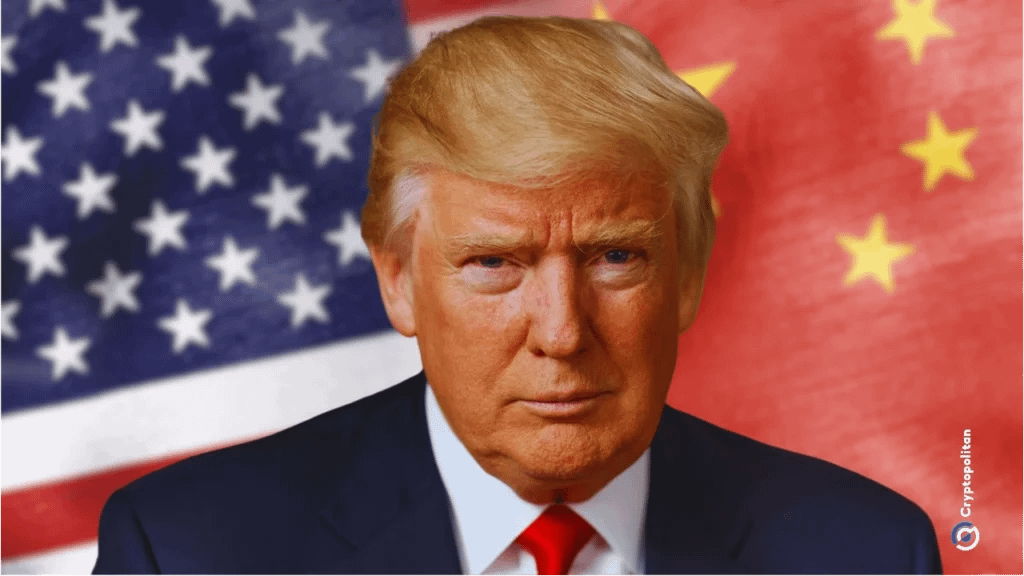

U.S. and China agreed to start a government-level AI dialogue after Trump and Xi discussed AI governance
The United States and China have announced plans to establish a government-level dialogue channel on artificial intelligence governance following a Trump-Xi summit, marking the first formal bilateral commitment to coordinate AI policy between the world’s two leading AI powers. The agreement comes amid intensifying competition for AI dominance and raises critical questions for institutional investors about how regulatory alignment, or continued friction, will reshape the competitive landscape for chip makers, AI infrastructure firms, and blockchain applications dependent on computational resources.
- China’s Foreign Ministry confirmed on May 19 the opening of a direct government channel for AI collaboration between Washington and Beijing.
- Trump stated the U.S. has pulled ahead of China in the AI race, crediting energy policy allowing AI firms to build private power plants.
- The agreement remains unconfirmed by the White House, leaving the scope, timeline, and binding nature of the dialogue still undefined.
- May 19 Date China’s Foreign Ministry publicly confirmed the AI dialogue agreement after Trump-Xi discussions.
- $500M Proposed Senate bill for AI investment while chip export controls remain contested between nations.
- 2 The two great powers in AI, according to Beijing’s rationale for the bilateral channel.
China’s Foreign Ministry spokesman Guo Jiakun formally announced on May 19 that the United States and China will establish a government-to-government discussion channel on artificial intelligence, following private talks between President Donald Trump and Chinese leader Xi Jinping.
The statement came during a regular press briefing in Beijing when reporters pressed Jiakun about the scope of the AI discussions held during Trump’s visit.
Jiakun framed the agreement as a natural consequence of both nations’ dominant positions in AI development: “China and the US are the two great powers in AI, and hence both countries must work together to develop AI and regulate it.” He added that collaboration on AI governance would serve broader human development goals across the global population.
The White House has not yet issued a parallel public statement confirming the channel or its terms.
Trump credits U.S. energy policy for pulling ahead in AI race against China
Trump provided more granular detail about the AI discussions in a subsequent Fox News interview with Bret Baier, asserting that the United States has achieved a substantial lead over China in AI capability.
When asked whether both nations had agreed on guardrails to prevent AI from running unchecked, Trump confirmed that the topic had been raised but characterized the outcome as preliminary: “We talked about it. Yes, we talked about it. AI is mostly a great thing.
Mostly.” He explicitly tied America’s competitive advantage to energy infrastructure policy, noting that he had enabled AI companies to construct their own private power generation facilities, bypassing bottlenecks in the existing electrical grid.
Trump reasoned that massive data center operations demand enormous quantities of electricity, and permitting private companies, particularly the well-capitalized AI firms led by “lots of geniuses”, to build their own plants has given U.S. competitors a structural advantage China cannot easily replicate. “Now you have these very rich companies, headed by lots of geniuses, building electric plants.
Because of that, we are leading China by a lot in the AI race,” Trump stated. He added that Xi had expressed surprise at the velocity of U.S. AI progress, after previously believing China held a decisive edge. Trump positioned the AI competition as fundamentally a two-nation race, despite ongoing AI development elsewhere: “Whoever wins the AI race, and we are going to win it.
If we are smart, we are going to win it. If we are not smart, we are not.”
Tension between competition and cooperation makes enforceable guardrails unlikely
When pressed on whether the two sides could formalize AI safety rules in any meaningful agreement, Trump acknowledged the structural tension undermining such efforts. He conceded that guardrails are theoretically possible but cautioned that the competitive dynamic makes real coordination difficult.
“It is a little hard to say, ‘Let’s put on guardrails,’ when we are competing with each other,” Trump explained. The comment captures a core institutional investor concern: any bilateral AI governance agreement risks becoming a symbolic gesture rather than a binding regulatory framework, particularly if each nation believes compliance might erode its competitive position.
For investment managers overseeing semiconductor, cloud infrastructure, and AI software portfolios, this ambiguity matters substantially. Guardrails that actually constrain AI model development, data access, or computational capacity could reshape capital allocation toward compliance-focused versus pure performance-focused AI vendors.
Conversely, if the dialogue remains largely ceremonial, institutional players betting on unencumbered AI scaling, including through blockchain-based distributed compute networks, would face less regulatory friction.
The Trump administration’s emphasis on energy infrastructure as the binding constraint on AI progress, rather than algorithmic governance, suggests that investment in power generation and grid connectivity may remain the bottleneck that shapes which firms and geographies win the AI race.
Nvidia CEO signals market opening while chip export controls remain unresolved
The AI governance announcement occurs against the backdrop of intensifying U.S.-China semiconductor competition and ongoing export restrictions. Nvidia CEO Jensen Huang, who attended the Trump-Xi summit on Air Force One alongside Elon Musk, told Bloomberg Television that he expects China’s market will eventually reopen to U.S. chip manufacturers.
Huang’s remarks suggest confidence that diplomatic warming could translate into relaxed export licensing for advanced semiconductors, a critical input for both Chinese AI development and Nvidia’s revenue growth.
However, the company continues to operate under U.S. government licensing restrictions that limit which chips it can sell into China, creating a structural cap on Nvidia’s addressable market in one of the world’s fastest-growing AI regions.
The Senate is simultaneously preparing a $500 million AI investment bill, while chip export policy remains contested between the executive branch and Congress.
For institutional investors, the gap between Huang’s optimism and actual policy outcome remains a critical watch point. Any loosening of semiconductor export controls would dramatically expand Nvidia’s China revenue and reduce pricing pressure in Western markets, benefiting the company’s margins and valuation.
Conversely, if Capitol Hill maintains or tightens restrictions despite executive-level warming, U.S. chip makers could face sustained revenue ceiling in China while Chinese competitors accelerate domestic chip development to close the gap.
The dialogue channel announced by Trump and Xi will likely become a vehicle through which such export licensing disputes are eventually negotiated, making the formal charter and decision-making structure of the new AI discussion channel a material question for supply chain investors and semiconductor equity allocators.
The institutional investor watchpoint is concrete: monitor whether the U.S. and China publish a charter document for the AI dialogue channel within the next 90 days, specifying which government agencies hold decision authority, what topics fall within scope, and whether export licensing disputes over semiconductor sales will be addressed through the channel or remain under separate bilateral trade mechanisms. Without such structural clarity, the May 19 announcement risks remaining a symbolic gesture, leaving chip export policy, energy infrastructure investment, and AI regulatory arbitrage exposed to continued executive volatility and legislative fracture.