WLFI Price Prediction 2026-2032: Will World Liberty Financial Price Hit $1?
Key Takeaways:
- WLFI price prediction faces buying pressure toward $0.06.
- World Liberty Financial price prediction for 2026 expects the price of WLFI to surge toward $0.41.
- By 2032, we expect the World Liberty Financial price to record a maximum price of $1.4.
Donald Trump has embraced the title of the “crypto president”, a label that has fueled massive speculation across the crypto industry.
After Trump’s 2024 election victory, the price of Bitcoin surged, a move many analysts and traders called a bullish signal for the cryptocurrency market. Building on this momentum, Trump introduced his own branded tokens, most notably the $TRUMP token and $MELANIA memecoin, solidifying his direct involvement in the crypto market.
Whether Trump’s push into crypto is driven by policy goals or personal profit, one message is clear: he intends to make cryptocurrency part of both his political strategy and financial portfolio.
However, Trump’s personal involvement in crypto tokens raises critical ethical questions. If a sitting or future U.S. president profits directly from token sales, DeFi projects, or blockchain ventures, it risks blurring the line between public duty and private gain.
One project drawing major attention is World Liberty Financial after major listings, a Trump-backed decentralized finance (DeFi) platform. This article explores what World Liberty Financial is, and what Trump’s embrace of crypto could mean for the future of Bitcoin, memecoins, and U.S. crypto policy.
Consequently, numerous analysts eagerly anticipate the future valuation of its native cryptocurrency, WLFI. This raises the question: Can WLFI price reach $1?
This forecast for World Liberty Financial’s price examines factors such as ecosystem trends, adoption rates, underlying technology, and technical analysis to project the WLFI price prediction from 2026 to 2032.
Overview
| Cryptocurrency | World Liberty Financial |
| Ticker Symbol | WLFI |
| Rank | 27 |
| Current Price | $0.06 |
| Price change 24H | +4% |
| Market cap | $1.8 Billion |
| Circulating supply | 24.66 Billion WLFI |
| Trading volume 24h | $116M (-18%) |
| All-time high | $0.46, September 1, 2025 |
| All-time low | $0.051, May 2, 2026 |
WLFI price prediction: Technical analysis
| Metric | Value |
| Current Price | $0.06 |
| Price Prediction | $ 0.04452 (-25.19%) |
| Fear & Greed Index | 23 (Extreme Fear) |
| Sentiment | Bearish |
| Volatility | 7.18% (High) |
| Green Days | 15/30 (50%) |
| 50-Day SMA | $ 0.06807 |
| 200-Day SMA | $ 0.1151 |
| 14-Day RSI | 40.32 (Neutral) |
World Liberty Financial technical analysis: WLFI price faces bullish pressure toward $0.06
- WLFI price analysis shows a bullish pattern toward $0.06
- Resistance for WLFI is present at $0.0633
- Support for WLFI/USD is present at $0.06
The WLFI price analysis for 25 June confirms that WLFI faces increasing volatility as it surges toward $0.06. Currently, the bulls are aiming for further surges.
WLFI price chart prediction: World Liberty Financial faces buying pressure toward $0.06
WLFI price is facing a decline as buyers push the price toward $0.06. WLFI price is aiming for a hold above the immediate Fib channels. The 24-hour volume surged toward $8.3 million, showing increased interest in trading activity. The price is trading at $0.06, surging over 4% in the last 24 hours.
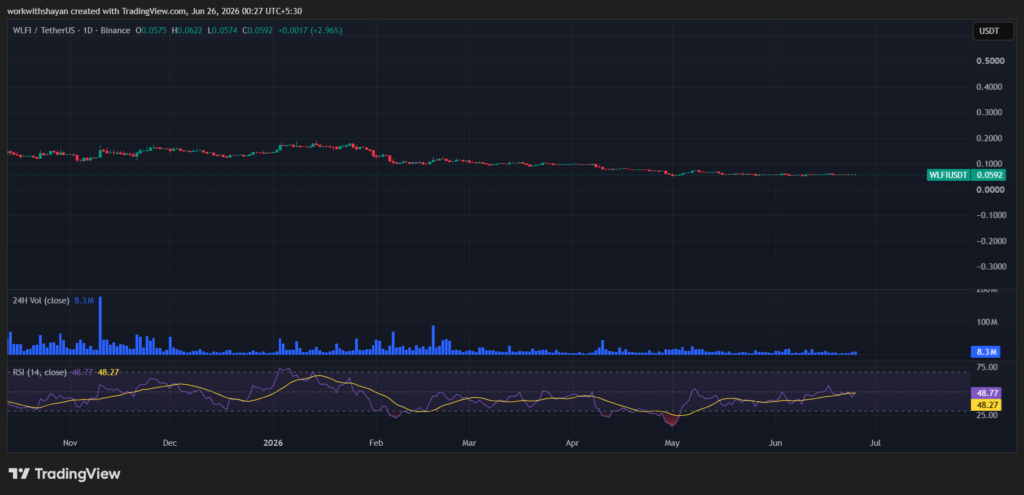
The RSI-14 trend line has surged from its previous level and trades around the neutral region at level 48, suggesting upcoming buying pressure.
WLFI/USD 4-hour price chart: Bears aim for a hold below EMA trend lines
The 4-hour WLFI price chart suggests WLFI continues to experience bullish activity around EMA lines, creating a positive sentiment on the price chart. As the price hovers around EMA trend lines, bears prepare for a domination by sending the price below the EMA20 trend line.
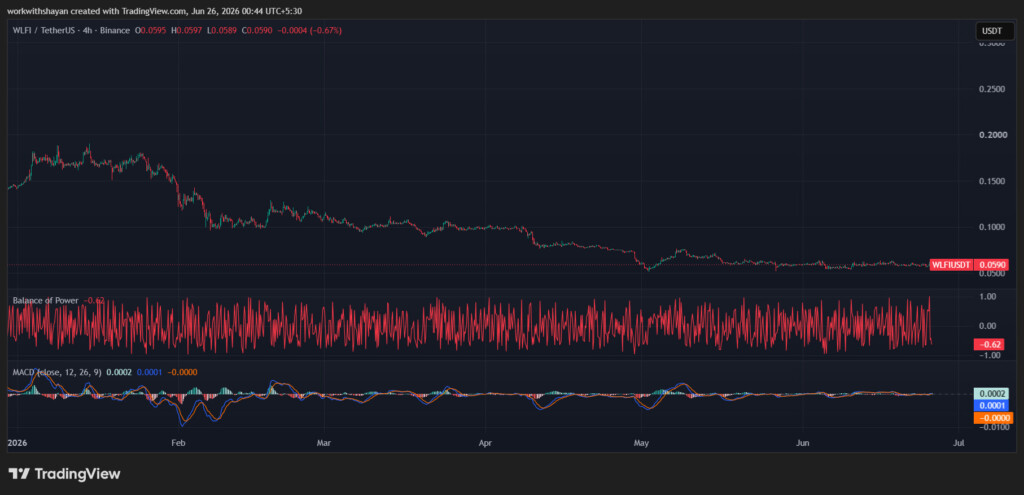
The BoP indicator trades in a negative region at 0.62, hinting that sellers are trying to build immediate pressure near resistance levels and boost upward correction. However, the MACD trend line has formed green candles above the signal line, hinting at a bullish pressure.
WLFI technical indicators: Levels and action
Daily Simple Moving Average (SMA)
| Period | Value | Action |
| SMA 3 | $ 0.05885 | BUY |
| SMA 5 | $ 0.05881 | BUY |
| SMA 10 | $ 0.05951 | SELL |
| SMA 21 | $ 0.06187 | SELL |
| SMA 50 | $ 0.06807 | SELL |
| SMA 100 | $ 0.08474 | SELL |
| SMA 200 | $ 0.1151 | SELL |
Daily Exponential Moving Average (EMA)
| Period | Value | Action |
| EMA 3 | $ 0.05894 | SELL |
| EMA 5 | $ 0.05901 | SELL |
| EMA 10 | $ 0.05970 | SELL |
| EMA 21 | $ 0.06188 | SELL |
| EMA 50 | $ 0.06971 | SELL |
| EMA 100 | $ 0.08462 | SELL |
| EMA 200 | $ 0.1108 | SELL |
What to expect from WLFI price analysis next?
The hourly price chart confirms that bears are making efforts to prevent the WLFI price from an immediate surge. However, if WLFI’s price successfully breaks above $0.0633, it may surge higher and touch the resistance at $0.0653.
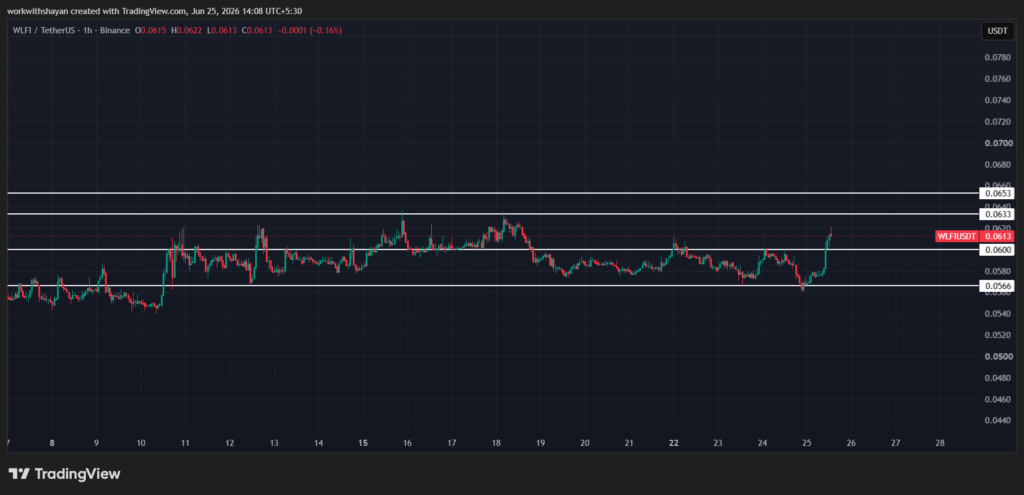
If bulls cannot initiate a surge, WLFI’s price may drop below the immediate support line at $0.06, resulting in a correction to $0.0566.
Why is the WLFI price up today?
Sellers are losing confidence to maintain their dominance, resulting in an upward push toward $0.06.
WLFI crypto news
As reported by Cryptopolitan, WLFI co-founder arrest video resurfaces as legal dispute with Justin Sun intensifies. Charges from the 2022 arrest were dismissed but footage gains public attention.
Is WLFI a good investment?
Trading $WLFI will be very risky. Since it’s a new and highly hyped token with only a small amount available at launch, the price could change quickly and unpredictably. Liquidity will be thin, so even one big trade might move the market. It’s normal for tokens like this to surge at launch and then drop as early buyers cash out.
However, considering its background and ongoing trading volume, WLFI can turn out to be a good investment option in the long-term.
What is the WLFI price prediction for 2026?
By 2026, analysts predict that World Liberty Financial (WLFI) will start the year at $0.1, with an average trading price of $0.37, and could climb as high as $0.41.
Will WLFI price touch $1?
Yes, WLFI price might touch the $1 milestone by the end of 2031. However, the token might attain this level much earlier, depending on the future market sentiment and buying demand.
Will WLFI Price Reach $10?
If everything remains good and WLFI gains recognition, its price might surpass $10 by 2040.
Is WLFI a good long-term investment?
As World Liberty Financial aims to expand its offerings, it might gain a significant position in the altcoin market. Hence, WLFI can be a good long-term investment option. The WLFI long term price outlook is looking strong due to its strong political support.
WLFI price prediction June 2026
Analysts expect a steady surge in crypto market prices in June. We expect WLFI to record a minimum price of $0.045 and a maximum price of $0.08, with an average of $0.06 in June.
| WLFI Price Prediction | Potential low | Potential average | Potential high |
| WLFI Price Prediction June 2026 | 0.045 | 0.06 | 0.08 |
WLFI price prediction 2026
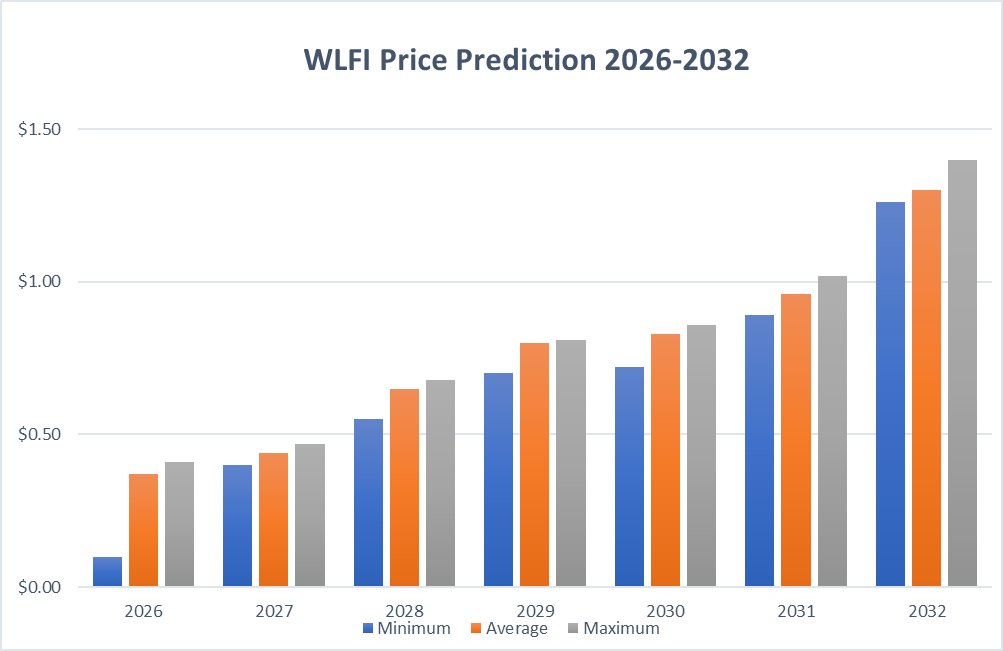
By the end of 2026, analysts predict that World Liberty Financial (WLFI) will record a minimum price of $0.04, with an average trading price of $0.37, and could climb as high as $0.41.
| WLFI Price Prediction | Potential low | Potential average | Potential high |
| WLFI Price Prediction 2026 | $0.04 | $0.37 | $0.41 |
WLFI Price Predictions 2027-2032
| Year | Minimum Price | Average Price | Maximum Price |
| 2027 | 0.4 | 0.44 | 0.47 |
| 2028 | 0.55 | 0.65 | 0.68 |
| 2029 | 0.7 | 0.8 | 0.81 |
| 2030 | 0.72 | 0.83 | 0.86 |
| 2031 | 0.89 | 0.96 | 1.02 |
| 2032 | 1.26 | 1.3 | 1.4 |
WLFI Price Prediction for 2027
By 2027, experts forecast WLFI to begin at $0.40, maintain an average price of $0.44, and potentially reach $0.47. This represents a healthy climb from 2025, showing that WLFI is gaining traction in the crypto space.
World Liberty Financial Price Prediction 2028
By 2028, market analysts and experts predict that WLFI will start the year at $0.55, with an average price of $0.65, and trade around $0.68.
WLFI Prediction for 2029
By 2029, forecasts suggest WLFI will open at $0.7, trade at an average of $0.8, and could move up to $0.81.
World Liberty Financial Price Prediction 2030
By 2030, analysts expect WLFI to begin at $0.72, maintain an average price of $0.83, and rise toward $0.86.
WLFI Crypto Price Forecast for 2031
By 2031, experts predict WLFI will start at $0.89, trade at an average of $0.96, and potentially reach $1.02. Crossing the one-dollar mark would be a significant psychological milestone for investors and a strong indicator of growth.
World Liberty Financial Price Prediction 2032
By 2032, WLFI is expected to open at $1.26, average around $1.3, and peak at $1.40.
WLFI coin price forecast by experts
| Firm Name | 2026 | 2027 |
| Coinpedia | $0.539 | $0.359 |
| CoinDCX | $0.35 | $0.46 |
Cryptopolitan’s WLFI price prediction
Cryptopolitan is bullish on WLFI price prediction as the token is backed by a strong community. As a result, we are bullish on WLFI future price forecast. By 2027, experts forecast WLFI to begin at $0.40, maintain an average price of $0.44, and potentially reach $0.47. This represents a healthy climb from 2026, showing that WLFI is gaining traction in the crypto space.
WLFI historic price sentiment
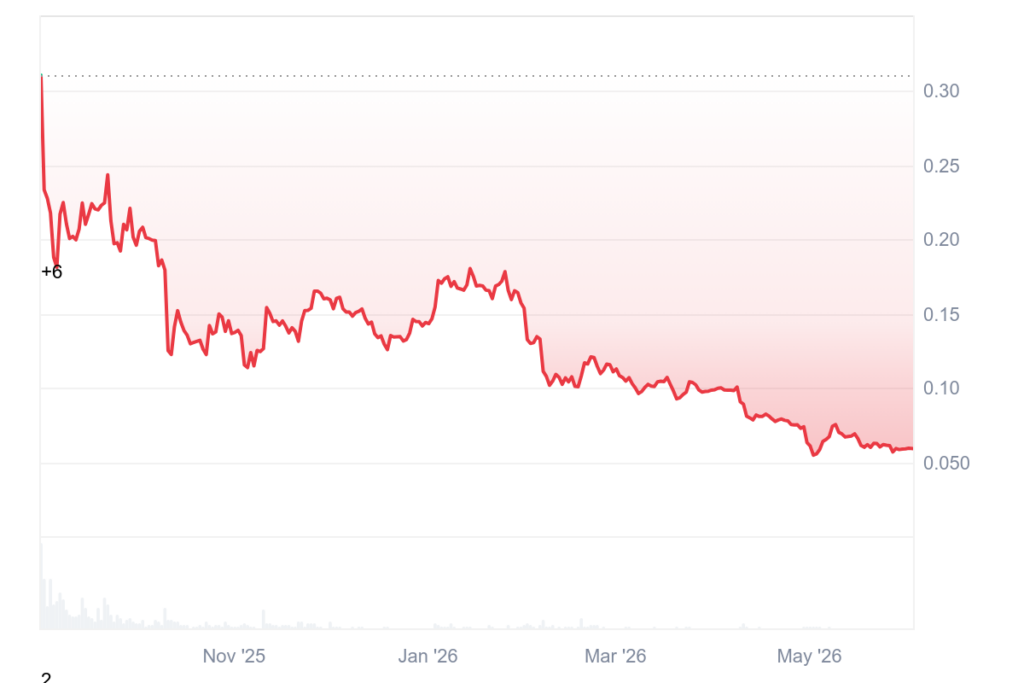
- The $WLFI governance token for World Liberty Financial, the Trump family–backed DeFi platform, launched for public trading and token claims on September 1, 2025, at 12:00 UTC. This token generation event (TGE) kicked off spot trading on Ethereum’s mainnet, following a presale that raised over $550 million from 85,000+ investors since October 2024.
- The WLFI token price initially surged toward $0.478 but it later declined toward $0.1611.
- On 6 September, the WLFI price again attempted a surge toward $0.2. By the end of September, WLFI declined below $0.2.
- By the end of October, the price of WLFI further declined and touched $0.1 in early November.
- In early December, WLFI price started trading below $0.15.
- However, the price surged in January 2026 as it touched a high around $0.19.
- However, WLFI later dropped toward $0.12 in February. WLFI ended that month by trading below $0.1.
- By March’s end, WLFI dropped below $0.09. In April, WLFI dropped below $0.06.
- In May, the price of WLFI dropped toward $0.056 before recovering slightly.