Intelligence involves imagination and emotions, attributes that machines can’t replicate. Successful companies pay attention to people and to what they can do that machines can’t.
Wall Street keeps setting records, yet a growing chorus of institutional voices now names artificial intelligence (AI) itself as the biggest threat facing global markets.
The S&P 500 sits at the center of that argument, and its concentration explains why.
S&P 500 Index (SPX) – All-Time Performance. Source: TradingView
Why Fund Managers Now Fear AI Most
A tail risk is a low-probability event with severe consequences, the kind fund managers watch even when markets look calm. AI just claimed the top spot on that list.
Bank of America’s July Global Fund Manager Survey found 45% of respondents naming an AI bubble as the biggest tail risk, up from 28% the previous month.
Wall Street’s New Top Fear: The AI Bubble Displaces Inflation in BofA’s Fund Manager Survey. Source: BofA via Hedge Fund Tips
That figure displaced second-wave inflation from its first-place position. The same survey identified long positions in global semiconductors as the world’s most crowded trade.
Analyst Mac10 sharpened the warning on August 8. He argued that forward earnings growth is accelerating at a record pace only because companies are pouring unprecedented cash into artificial intelligence.
S&P 500 forward earnings estimates are growing at the fastest rate in history, as record balance sheet capital gets thrown down the shit hole of AI, where it flows throw the P&L as a ONE TIME event.
His concern centers on accounting mechanics. That spending often appears as a one-time boost on profit statements rather than sustainable operating performance.
Institutional bodies echo those doubts. The Bank for International Settlements warned earlier this year that Big Tech’s spending spree risks becoming a prolonged investment bust. The numbers behind that alert are substantial. The five largest hyperscalers are expected to deploy more than $1 trillion across 2025 and 2026.
Household exposure raises the stakes further. Ordinary investors now hold more stocks relative to their wealth than in past cycles, so any sharp drop would hit harder than the dot-com crash.
What the S&P 500 Actually Reveals
The structural problem explains why the index matters. J.P. Morgan Global Research estimates that the top 20 stocks now account for roughly 50.8% of total market capitalization.
That concentration has no modern precedent. Half a century has passed since the index depended so heavily on so few companies. The practical implication is uncomfortable. Buying the market increasingly means buying the AI trade, regardless of how the remaining 480 companies perform.
Cumulative Weight of S&P 500 Companies. Source: Slickcharts
Capital commitments keep expanding regardless. Goldman Sachs estimates annualized AI-related spending could exceed $800 billion by the end of 2026.
Morgan Stanley projects even larger flows. Its research points toward nearly $3 trillion of AI infrastructure investment by 2028, with over 80% still ahead.
Summer has already delivered a stress test. The Nasdaq fell almost 10% from its June peak by late July before staging a near-9% rebound in early August to a new all-time high, according to TradingView data.
Momentum names showed particular fragility. Sandisk and Western Digital, up roughly 396% and 145% year-to-date, both displayed sell-the-news vulnerability during earnings season.
The bull case rests on delivered results, however. Goldman Sachs found 64% of reporting S&P 500 companies beat consensus earnings by at least a standard deviation.
BlackRock rejects the bubble framing outright. Today’s leaders generate real profits, maintain strong balance sheets, and largely fund investments from their own cash flow.
Extraordinary earnings are buying time for the AI trade. Whether returns eventually justify trillions in capital expenditure remains the question holding up the entire index.
The Situational Awareness Collapse: A Warning Shot for the AI Trade
If markets needed a case study of AI concentration risk, July delivered one. Situational Awareness, the hedge fund founded by former OpenAI researcher Leopold Aschenbrenner, grew to as much as $45 billion before steep losses on AI infrastructure stocks like SK Hynix forced it to sell its entire public portfolio to Ken Griffin’s Citadel.
The timing was brutal: on July 24, Aschenbrenner had sent investors a letter reporting a 439% net return for the first half of 2026 — even suggesting it was a good time to add funds.
One hedge fund turned a 225% winner into a 40% loss in a single month, and it may have marked the low.
A long/short momentum trade inside US tech returned 225% in the year to June, then shed nearly 40% in July as Situational Awareness, Leopold Aschenbrenner’s AI fund, imploded… pic.twitter.com/0EljZeuCbb
— Kurt S. Altrichter, CRPS® (@kurtsaltrichter) August 7, 2026
Six days later, Citadel absorbed a stake once estimated at $16 billion in one of the largest rushed equity transactions in Wall Street history. A cascade of margin calls shrank the fund’s assets from $45 billion to roughly $10 billion in a matter of weeks.
Yet the story did not end there. Just days after the near-collapse, Aschenbrenner returned to the market with a $400 million investment in a privately held company — bringing his combined commitment to that unnamed target to $500 million, alongside the fund’s retained private stakes.
The episode does not prove the AI trade is over, but it exposes how concentration, leverage, and thin liquidity can destroy a portfolio before a long-term thesis has time to play out — the same fragility now embedded, at index scale, in the S&P 500 itself.
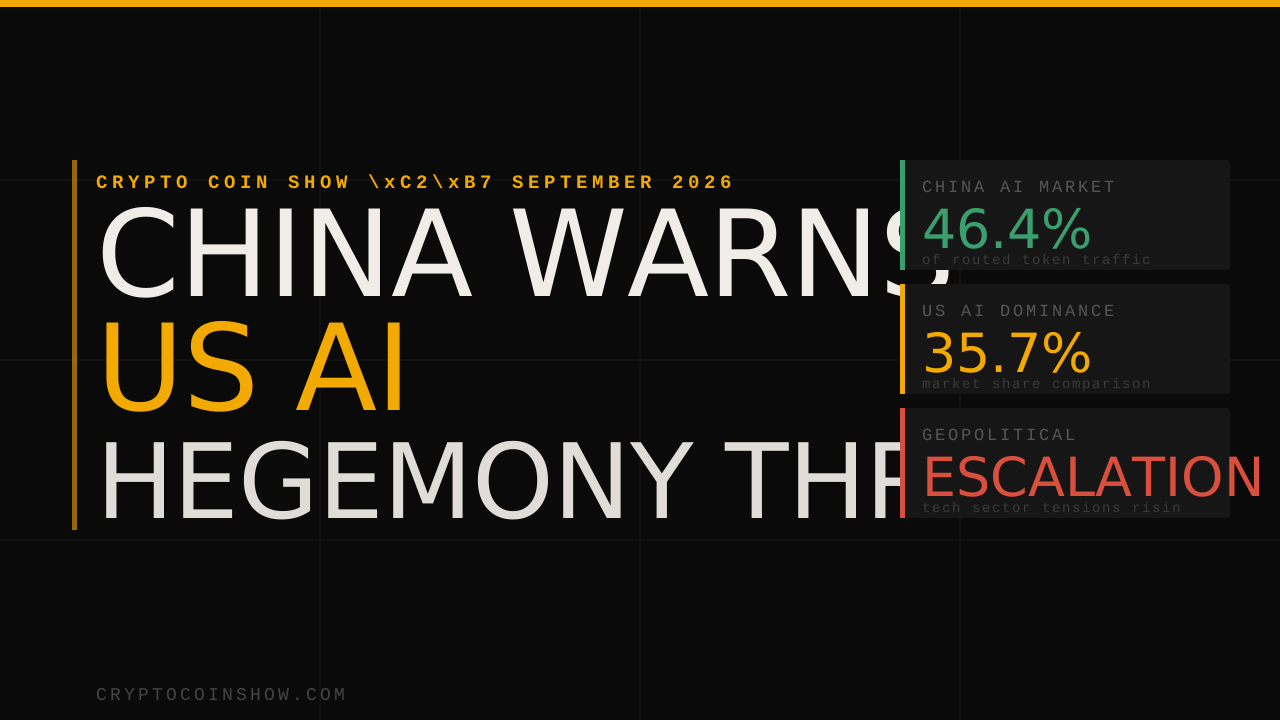
China’s Ministry of Commerce has told the United States to stop threatening to impose sanctions on Chinese artificial intelligence companies.
The ministry has warned that it will take “all necessary measures” to defend its interests if Washington acts against them.
Why did the U.S. sanction China’s AI?
A spokesperson for China’s Ministry of Commerce said the continuous sanction threats from the United States lack any factual or legal grounding and amount to what China calls “AI hegemony.”
Senior U.S. officials reportedly want to investigate Chinese labs over the alleged “distillation” of advanced American models and might sanction them on claims of intellectual-property theft.
The same spokesperson argues that several of the Chinese models shipped at roughly the same time as leading U.S. systems and already rank among the best in certain areas, including front-end coding. Innovation, the spokesperson added, belongs to no single country.
China’s sharpest point is that many U.S. AI firms have distilled Chinese models during research and training, according to the Ministry of Commerce. The ministry also noted that close to 200 U.S. startups have asked their own government not to cut off access to Chinese open-source models, arguing a cutoff would blunt their competitiveness, as Cryptopolitan reported.
A government spokesperson also previously dismissed the theft allegations, calling them an unfounded “smear” rooted in prejudice.
Beijing closed by suggesting both countries honor a consensus reached by the two nations’ leaders.
Why is the money moving to Chinese models?
Cryptopolitan reported that Chinese models now account for 46.4% of routed token traffic on OpenRouter, a platform that lets developers swap between systems, against 35.7% for US-built models. DeepSeek alone contributes 17.6% of that total as of July 2026. A Hugging Face study published March 16, 2026, found Chinese open-source models made up 41% of all open-source model downloads.
The reasons for this massive adoption of Chinese technology are that its compute runs far cheaper, and the U.S. export limits that were imposed earlier in 2026 on frontier models such as Anthropic’s Claude Mythos 5 and Fable 5 created openings that foreign systems filled.
Following Moonshot AI’s launch of Kimi K3 and developers’ claims that the model’s performance is close to Anthropic’s Fable and OpenAI’s ChatGPT, offered at a far lower price, the U.S. has been considering new measures against Chinese technology.
OpenAI’s most recent valuation stood at $852 billion and Anthropic’s at $965 billion, against a reported roughly $30 billion for Moonshot.
Cryptopolitan reported July 20 that the U.S. is likely to impose new procurement rules, renew its threats to add Chinese labs to the Commerce Department’s Entity List, and apply public pressure on American companies that use Chinese models. The Entity List already restricts hundreds of Chinese firms from buying U.S. goods without a license.
Is it possible to not like a movie in a normal way? Can it simply not be “your thing” without being transposed onto some intangible, ever-raging culture war?
It certainly isn’t if you’re an anti-woke crusader like SpaceX CEO Elon Musk. Like a lot of very online right wingers who are suddenly qualified classicists, he’s very upset about the new Odyssey adaptation directed by Christopher Nolan.
Nolan, according to Musk, “desecrated Homer and groveled on his knees just to meet the woke rules required to win an Oscar.” That’s because his movie dares to do stuff like cast Black women and a trans man in prominent roles, making the director what Musk termed an “anti-White racist.” In other words, it’s supposedly not “historically accurate” — never mind the fact that the epic poem contains gods wandering the Earth and a Cyclops.
Thankfully, there’s a wonderful piece of technology called AI out there that’s perfect for realizing the juvenile aesthetic predilections of stunted creatives who want to wallow in an imagined idea of what the past was like.
“Before this year ends, Grok Imagine will make a full-length movie of The Odyssey that is historically accurate and true to the art of Homer,” Musk declared Tuesday, referring to his own AI video generator.
Musk’s post quoted, and implicitly endorsed, a three minute dialogue scene that another user generated with Grok Imagine, featuring a virtual cast that looks more Western European than Mediterranean. No comment from Musk on if this was sufficiently “historically accurate,” of course, despite previously accusing Nolan of having “total contempt for the Greek people” with his casting.
Before this year ends, Grok Imagine will make a full-length movie of The Odyssey that is historically accurate and true to the art of Homer https://t.co/bVHzUmY9WN
Someone should probably let Musk know that there’s already a fully AI-generated Odyssey adaptation coming out, but the creators behind that one seem to respect Nolan, so it probably won’t be anti-woke enough for his taste.
But maybe the perfect Odyssey film doesn’t have to be AI-generated, if it’s in the hands of the right director.
One Musk fanboy suggested that he should “give Mel Gibson $100 million” to create a “painstakingly historically accurate” adaptation. Musk replied, “I’m down.” (The last movie Gibson directed, “Flight Risk,” was ripped to shreds by both critics and audiences.)
Though for the past few months Musk has fought like a combatant in the Trojan War to drum up controversy over Nolan’s film, his efforts have failed spectacularly. It opened to $264 million globally and will probably make a billion dollars, if not more, by the end of its run. It’s gotten rave reviews from critics, and moviegoers seem to love it, too.
And is anyone surprised? Nolan is a beloved figure in Hollywood with legions of fans. Musk has his own army of devout followers, too, but the difference is that Musk is constantly miserable, alienating even some of his own followers with his extreme takes.
Nolan, whether you like his movies or not, is a showman that wants you to have a good time. Even Musk said Nolan was “awesome” a few years ago. Audiences will remember that they liked some of his other films and turn out for his new one. They probably won’t take notice Musk melting down about it online, even if each of his posts gets hundreds of thousands of likes on his platform he remolded to be his personal echo chamber.
Fundstrat’s Tom Lee has stated that Ethereum is set to benefit from the artificial intelligence boom, publishing his case on Friday, July 17, the same day a global rout in chip stocks erased over $3.3 trillion in market value and pushed semiconductors to the edge of a bear market.
Lee, who founded the Ether treasury company Bitmine Immersion Technologies (NYSE: BMNR) and is the current chairman, called Ethereum “a key AI downstream story” in a post on X.
Lee added that AI systems will need guardrails, and consumers are unlikely to trust governments, big technology firms, or banks to protect them.
In a chairman message released on July 16, under the title “ETH is the Cure for the Uncanny Valley of Wealth,” Lee spoke on two exponential tailwinds for Ethereum and also mentioned that crypto’s headwinds of 2026 are ending. He also said that Bitmine is primed for the next bull cycle.
The Philadelphia Semiconductor Index fell by 4.8% on Friday, extending a month-to-date drop of about 20% that carried it into technical bear-market territory.
Other reports put the scale of the damage at around $3.3 trillion wiped from global chip stocks since June 22, with the index sitting less than 1% above the level that would confirm a 20% decline from its June high.
Nvidia fell by 3.7%, with Apple reclaiming its title as the world’s most valuable company. Arm dropped 7%, and Advanced Micro Devices (AMD) fell 7.8%.
TSMC also dropped by 7.29%. Netflix fell more than 9% after disappointing forecasts, while Japan’s Nikkei 225 shed 4.03% and South Korea’s KOSPI slid 6.37% before its market closed. Traders say that the crash was triggered by fading conviction that the AI-driven rally will hold.
Crypto did not escape the risk-off mood. Bitcoin traded near $63,200 on Friday, down about 2%.
What is Lee actually selling?
Lee’s Ethereum thesis rests on a view that has support beyond Bitmine’s own marketing. BlackRock’s CEO Larry Fink has called Ethereum “the toll road to tokenization,” a line his former head of crypto Joseph Chalom repeated in March, pointing to the network’s role in moving traditional assets on-chain.
This week, SBI, one of Japan’s largest financial groups with 78 million customers, chose Ethereum to issue JPYSC, described as Japan’s first trust-based yen stablecoin, built with Startale Group.
Apollo Global Management’s Torsten Sløk warned that a mistimed pullback by AI hyperscalers “would risk tipping the economy into recession and the S&P 500 into a correction.”
However, not everyone is bearish. UBS Wealth Management’s Charlie Anderson forecast the S&P 500 would reach 7,900 by year-end, saying that the market has shifted from macro headlines to company fundamentals.
Bitmine’s own numbers cut against the pitch
Bitmine holds 5.77 million ETH, about 4.8% of the total supply and 96% of the way to its stated goal of owning 5%, Cryptopolitan reported. But with ETH trading around $1,840, which is well below the firm’s average cost of roughly $3,997 per token, Bitmine is carrying an unrealized loss of about $9 billion.
BMNR has traded near 52-week lows, and the company’s market value has fallen below the worth of the ETH on its balance sheet.
The company is leaning on staking to bridge the gap. Bitmine has staked about 4.92 million ETH, which is 85% of its position, earning a 2.7% annualized yield that Lee projects will generate around $242 million a year. This is enough to cover the 9.5% dividend on the preferred stock it issued in June.
Japan has bought its way into the advanced models and chip industry after a year of the United States dominating the space, with China pouring subsidies into the machines that use them.
Why is Japan suddenly making a big AI chip purchase?
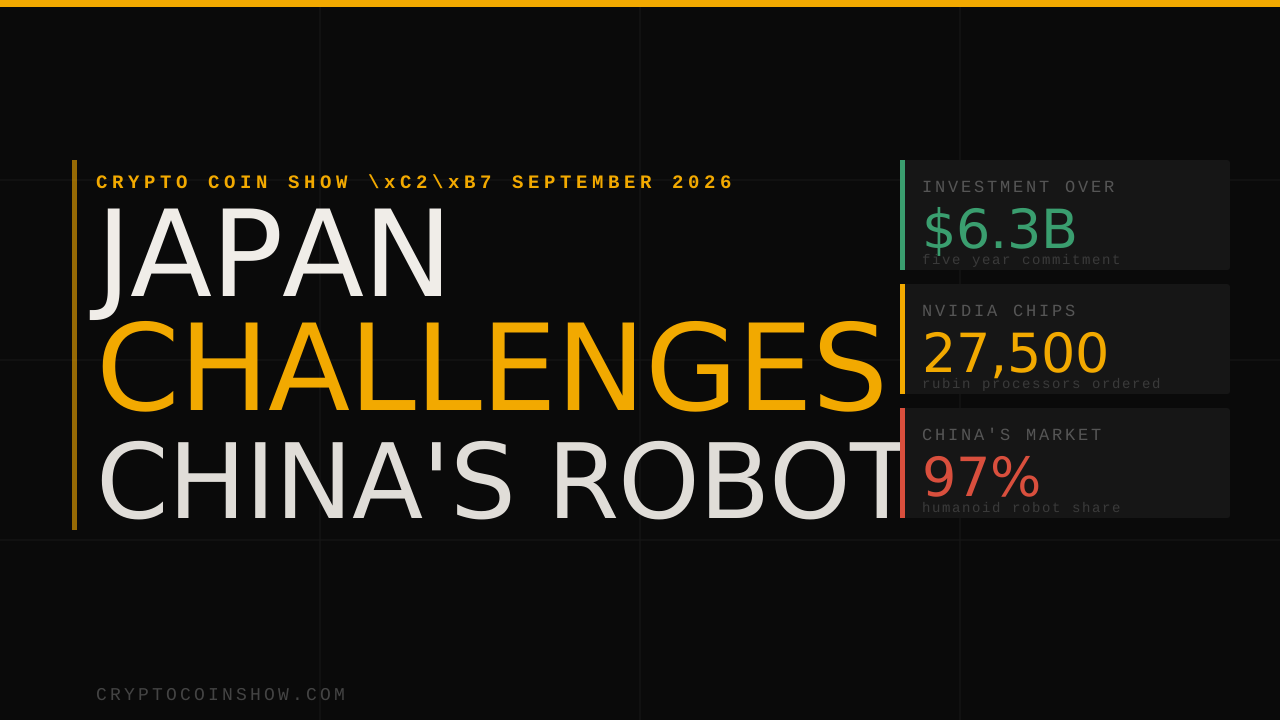
Japan’s trade ministry has announced that it will buy 27,500 of Nvidia’s (NASDAQ: NVDA) next-generation “Rubin” AI chips to power a state-backed AI project called Noetra, led by SoftBank (TYO:9984) and backed by ¥1 trillion (about $6.3 billion) over five years. Construction is scheduled to begin in April 2027, with operations expected to start in June 2028.
So far in the AI race, the U.S. has been protecting its lead in advanced models and chips, while China has owned the robotics front. Cryptopolitan reported that Chinese factories shipped roughly 97% of the world’s humanoid robots last year, about 19,000 units, and operate the largest industrial robot fleet on the planet, nearly 2 million units.
Instead of trying to beat the U.S. or China in general-purpose AI, Japan is focusing on “physical AI,” which is the software that lets robots sense a factory floor and act on it. The Noetra consortium plans to build a massive 140-megawatt AI factory around the 27,500 Rubin chips.
Nvidia CEO Jensen Huang framed Japan’s manufacturing background as the asset that makes the plan work, saying the manufacturing industry’s “know-how” is the country’s treasure.
Noetra brings in 44 companies, including NEC, Honda, and Sony Group. Nvidia will supply its Nemotron and Cosmos foundation models plus chip technology for robots, while Fujitsu is building an operating system for physical AI.
At a roundtable hosted by Fujitsu, Nvidia discussed manufacturing, logistics, and healthcare uses with robot makers Fanuc, Yaskawa Electric, and Kawasaki Heavy Industries.
Nvidia is already developing manufacturing robots with Toyota and wants to widen the work to Honda, Mitsubishi Heavy Industries and Hitachi. 13 research bodies, including Tokyo University of Science, the University of Cambridge and the University of Oxford have been brought together in a national institute to push the underlying research.
The government is putting ¥387.3 billion (about $2.4 billion) into the effort this year alone. The computing power will sit in a large data center on the site of a former Sharp factory in Sakai, Osaka Prefecture.
However, due to its declining population, Japan is suffering from severe labor shortages. Huang pointed out the shortage, saying that automation, AI, and robotics will make the economy boom again.
Can Japan catch up to China’s huge lead in robotics?
China’s dominance in robotics came from its electric-vehicle supply chain and roughly $300 billion in planned robotics and AI subsidies under its 2026-2030 five-year plan. Its lead in industrial robots is about 4.5 times Japan’s installed base.
However, the Mercator Institute for China Studies found that Chinese humanoids lack precision and dexterity and lean heavily on Nvidia’s chips and software— the same hardware that Japan will be using.
The Japanese government aims to capture more than 30% of the estimated ¥60 trillion (about $378 billion) global robotics market by 2040.
Noetra’s president, Hironobu Tamba, who previously led SoftBank’s large language model development, said the goal is to provide a “genuine third option,” not just for Japan, but for others as well. Noetra plans to release an AI model by March next year, followed by regular updates, with a model tailored for robotics applications within a few years.
Cryptopolitan recently reported that robotics is only about 1% of Nvidia’s revenue. The company is chasing that revenue growth in Japan even as it restricts chip sales to China under U.S. export rules.
Is it not enough to simply watch the beautiful game, unadorned?
These days you might use an AI chatbot to keep abreast of what’s happening in the World Cup. And that AI chatbot, in a sign of the times, might try to shove prediction market odds in your face as another way of ostensibly keeping you up to speed. Because are you really getting the full picture if you don’t know where a bunch of gamblers fall on the outcome?
This is exactly what OpenAI is doing. The Sam Altman-led company quietly struck a deal with Kalshi, which lets you bet on outcomes far beyond sports, to show its prediction market data in ChatGPT, the New York Times reported.
It’s perhaps the inevitable melding of two of the most divisive innovations to come out of the tech industry in recent years.
Searching France and Spain on ChatGPT ahead of their quarterfinal clash on Tuesday returned a graphic that showed that Les Bleus had a 60 percent chance of winning, according to the reporting. (We hope no one acted on that information.) Asking about the England and Argentina game on Wednesday showed that the Three Lions had a 54 percent chance of coming out on top.
Neither side promoted the deal, and the graphic is tellingly light on branding. There are no logos and no outbound links. The only sign of the collab is a small notice in the bottom left corner stating, “Source: Kalshi.”
This is the first partnership of its kind for OpenAI. The company recently updated its help page to stress that users “cannot place bets through ChatGPT,” with the Kalshi data being limited to “queries related to the 2026 World Cup,” according to the NYT.
Zooming out, it’s another sign of prediction markets laundering their image by glomming themselves onto other, more credible brands. In January, Kalshi partnered with CNN to provide its real-time prediction data on the news network’s broadcasts. Its rival Polymarket entered into a similar partnership with Dow Jones, the publisher of The Wall Street Journal, that same month. Both have also partnered with Google to show their data in search results.
Their fuzzy legal framework, plus their Wild West approach to gambling, has led to numerous controversies. Suspiciously timed bets on massive events like the US’s capture of ousted Venezuelan president Nicolás Maduro have raised concerns of rampant insider trading and put pressure on lawmakers to crackdown on the platforms. Arrests have been madein some cases, but these have been rare.
Put simply, for OpenAI, it may be somewhat risky to associate itself with all this baggage, which might be why the Kalshi collaboration is very limited — at least for now.
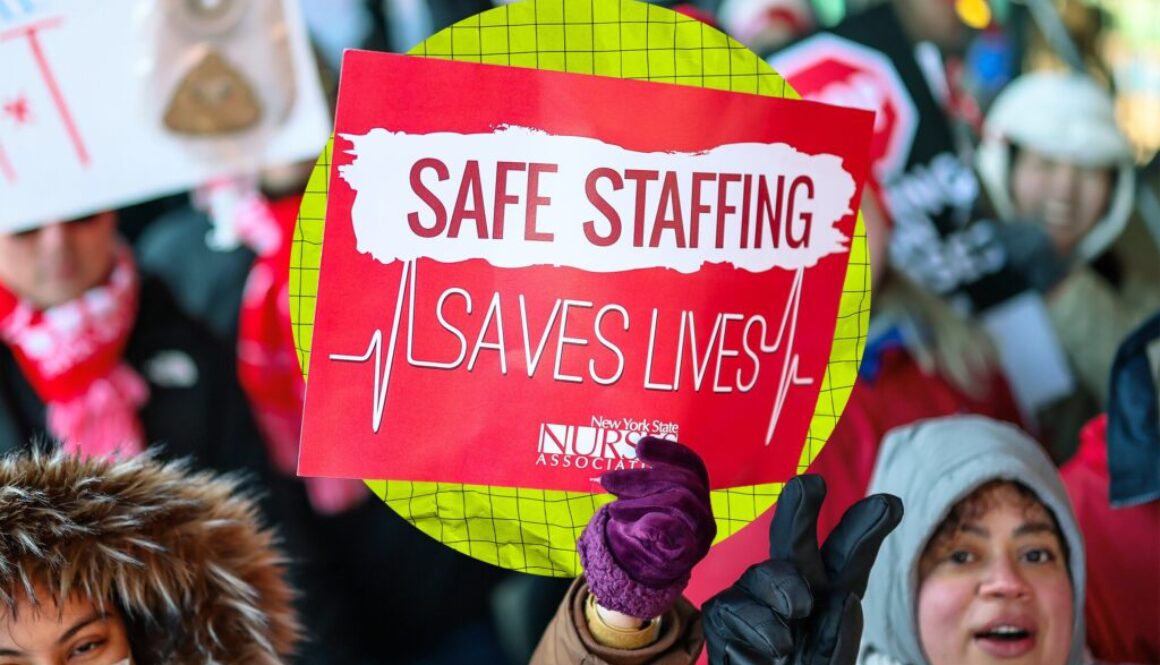
Twelve nurses in New York City were laid off on Sunday and replaced with AI software, according to their union — a move that comes not long after nurses went on strike and fought for safeguards against AI.
One of the laid off workers, Marilyn Shuler, had worked at Montefiore hospital in the Bronx as a utilization nurse for 39 years before suddenly losing her job. Utilization nurses review patient charts to show that their care is medically necessary so that an insurance company will cover it.
“I’ve always, always taken so much pride in the organization that I’ve worked for all these years, and just to be treated this way,” Shuler told The Guardian. “It’s disrespectful, and it’s very disheartening, and my colleagues feel the same way as well.”
The New York State Nurses Association (NYSNA), which represents the healthcare workers, issued a statement earlier this month warning that Montefiore intended to replace nurses with AI. That has now come to bear. It also drew attention to the fact that the company providing the AI software, Datavant, has partnerships with Palantir, the surveillance tech firm which has stirred considerable controversy for its collaboration with ICE.
In January, some 15,000 nurses started what would become a 41-day strike at several of the state’s largest hospitals. The outcome of this was a new three-year contract which included historic safeguards against AI.
But when Shuler and others returned to work in February, their workflow was changed without explanation, according to The Guardian. After a period of radio silence from management, the dozen nurses abruptly received 45-day notices in late May saying that they would be laid off.
“We are outraged about these layoffs because these dedicated nurses are being replaced by AI,” Shaiju Kalathil, a Montefiore nurse and a union committee member, said in the statement. “This is a violation of the contract that we recently won by going on strike. It should also concern every practitioner and patient who cares about the future of healthcare and the quality of care they receive.”
There’ve been clear warning signs that AI could disrupt healthcare workers. Doctors and nurses use AI tools for clinical notes, and some clinics use AI to help triage patients. Shortly after the nurses’ strike, the CEO of the NYC Health and Hospitals, the largest city healthcare system in the US, openly enthused about replacing radiologists with AI.
The transition to using AI could carry significant risks. In Brazil, a 32-year-old woman reportedly died after an AI system for assigning hospital beds left her waiting five days to be transferred to an intensive care unit.
Montefiore denies the framing that it replaced workers with AI.
“As is often the case, the claims by NYSNA are inaccurate and misleading,” Joe Solmonese, senior vice-president for government relations and strategic communications at Montefiore, told The Guardian. “What is true is that we are always investing in new technology to ensure the best care and outcomes for our patients and will continue to do so for the betterment of the people we serve.”
Two humanoid robots exchanged vows created by artificial intelligence at Moscow’s Pushkin Library. Russia’s first robot wedding, according to the organizers, was a staged demonstration intended to raise awareness of the nation’s humanoid robotics efforts.
The two robots, Robert and Matilda, were constructed by the Russian company IT-Imperial. There is no legal marital status for either. The purpose of the event, according to Deputy CEO Anna Bagdasaryan, was to demonstrate the capabilities of humanoid machines and encourage greater public interaction with technology.
The robots operate on open platforms, so anyone can create their own behavioral algorithms, she continued.
Robert plays office worker, Matilda dances as ballerina
Robert was designed to resemble a blogger and office worker. Matilda danced during the event and was dressed like a ballerina. The couple exchanged wedding bracelets for rings. They were carried onto the stage by Dogmatik, a robot dog, and the vows were AI-generated.
The ceremony was planned to take place on Russia’s Family, Love, and Fidelity Day. Prior to their library debut, the two machines made their public debut at the 2026 St. Petersburg International Economic Forum. Additionally, IT-Imperial donated a number of books on automation, robotics, and artificial intelligence to the Pushkin Library.
Images and videos from the event quickly went viral on social media, featuring the robots dancing and interacting with attendees. The event was described by the outlet as symbolic and playful, a tech demonstration with no legal significance. It stated that as robots enter the fields of education, entertainment, and customer service, the wedding reignited the online discussion about how humans and machines will coexist.
Two humanoid robots, Robert and Matilda, became the centre of attention during what organisers described as Russia’s first robotic wedding ceremony, an event designed to showcase advances in humanoid technology rather than blur the line between humans and machines pic.twitter.com/ljegdOFiyS
Nowadays, public robot theater is a common marketing strategy. Researchers in China, the US, and Russia are racing to create more machines that resemble humans. The Moscow wedding was held in the midst of competition, with businesses showcasing their advancements through demonstrations.
A Unitree G1 humanoid was captured on camera kneeling on a sidewalk in the Sichuan province of China, according to a June report from Cryptopolitan. It included a donation plate, a QR code, and an LED sign that said, “no money to recharge,” and it accepted payments via Alipay and WeChat Pay. Nobody took credit for placing it there. A G1 unit kicked a child during a martial arts demonstration in Xinjiang, and another toppled over while attempting to dance, according to separate incidents that Cryptopolitan documented.
In May, Taiwan Semiconductor Manufacturing Company chairman Wei Zhejia declared that Chinese humanoids “jump around, bounce about” and are “just for show.” Industry analysts agreed, stating that the majority of these machines are only used as props for entertainment. Without revealing a commercial timeline, IT-Imperial has now presented Robert and Matilda to two audiences: a public library and an economic forum.
Don’t just read crypto news. Understand it. Subscribe to our newsletter. It’s free.
HDFC Bank ended the March financial year with 3,343 fewer employees, a major contraction for India’s biggest private lender.
Total headcount stood at 211,178 as of March 31, down from 214,521 a year earlier. The lender said it is steadily moving routine processing onto digital and automated systems.
AI Automation Hits Back-Office Jobs Hardest
The greatest impact fell on operational staff. Non-supervisory employees, classified as workmen or clerical, and subordinate staff fell by more than 8,000 to 162,797. New hiring also slowed, dropping by 3,811 across the period.
Higher tiers moved the other way. Middle-level headcount rose by 1,252, junior-level by 3,543, and senior management added 15 roles.
The bank tied the shift to strategy. The report said it is steadily shifting routine tasks, such as cash deposits, to Cash Recycler Machines and other automated channels.
That effort runs on Neev, the bank’s in-house AI platform for model access, governance, and workflow integration. Chief Executive Officer Sashidhar Jagdishan said the bank is “consciously redeploying talent from backend functions” toward customer-facing roles as technology takes over routine work.
“As we accelerate the transformation toward becoming a technology-led, customer-centric bank, employees need to keep pace,” he said.
HDFC Bank is not alone. Standard Chartered plans to trim 15% of corporate function roles by 2030 as it scales automation. The trend is now evident in the data. AI drove 38,579 US job cuts in May, roughly 40% of the monthly total, according to Challenger, Gray & Christmas.
However, not every leader shares the gloom. Jeff Bezos argues AI will lift productivity and living standards rather than erase work.
so far at least, i’m pretty sure AI has been net job-creating.
this was not what i expected–although i was much less pessimistic than others, i thought by this level of capability we’d have seen some impact.
For HDFC Bank, the math already favors fewer hands. Profit after tax rose 10.9% to ₹74,671.3 crore, about $7.83 billion, in FY26, even as the workforce shrank.