
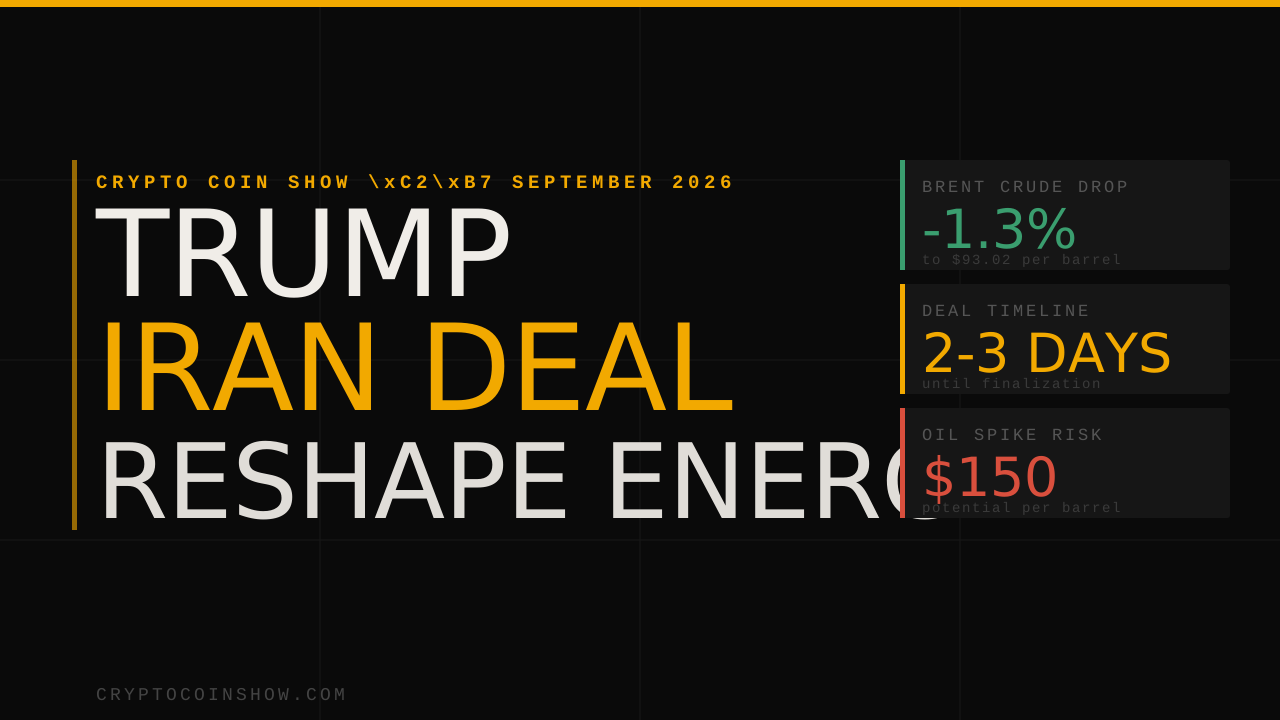
Trump said an Iran deal could come within two or three days
Donald Trump said an Iran nuclear deal could be finalized within two to three days, with the Strait of Hormuz to reopen immediately upon agreement, a development that would reshape energy markets and reduce geopolitical risk premiums embedded in oil and gold prices. Institutional investors watching inflation hedges and commodity exposures must monitor whether this timeline holds or whether ceasefire violations signal prolonged regional instability.
- Trump claims Iran deal imminent within two to three days with White House finding draft agreement “preliminarily acceptable”
- Brent crude fell 1.3 percent to $93.02 per barrel on ceasefire deal comments, signaling market confidence
- Rystad Energy chief warns oil could reach $150 per barrel within months if Middle East conflict continues
- $150/bbl Potential oil price within two months if regional conflict persists, per Rystad analysis
- 1.3% Brent crude decline on Tuesday following Trump’s Iran deal announcement
- $5,594.82 Gold all-time high reached January 29 before recent sharp pullback
President Trump declared on Tuesday that negotiations over Iran’s nuclear program had reached a critical stage, with both parties nearing agreement on what he described as a “very, very good deal that will not in any way allow nuclear weapons.” The timeline matters: Trump specified two to three days for a finalized accord, and Sky News Arabia reported that Washington had already received a draft agreement deemed “preliminarily acceptable” by the White House.
The statement immediately triggered market reactions. Brent crude fell 1.3 percent to $93.02 a barrel, while U.S. West Texas Intermediate dropped 1.8 percent to $89.67 per barrel, as traders priced in the risk reduction from a potential de-escalation.
The Strait of Hormuz, which Trump said would reopen “immediately” upon agreement, remains one of the world’s most critical energy chokepoints, roughly one-third of all seaborne oil passes through the waterway annually.
Israel and Iran exchange strikes as ceasefire framework fractures
The optimistic deal timeline collided with battlefield reality over the weekend when Iran and Israel conducted direct military strikes for the first time since a ceasefire commenced in mid-April. Iran fired missiles toward northern Israel after accusing Jerusalem of violations in Lebanon, where Israeli strikes hit Beirut’s southern suburbs on Sunday.
Israel responded with what it characterized as a “large-scale strike on strategic defense systems,” reasserting military pressure even as diplomatic channels claimed to be moving toward resolution. This tit-for-tat escalation raises the credibility question around Trump’s two to three day timeline, negotiations often stall when military commanders signal continued readiness to strike.
The broader conflict has already lasted over 100 days, exceeding Trump’s own earlier prediction of four to six weeks, undercutting confidence in his near-term estimates.
Separately, Trump addressed a U.S. military incident in the region, stating that pilots of an Apache helicopter downed on Monday “are fine” with “nobody injured,” though the cause remained unknown. The administration promised to release a detailed incident report on Tuesday, a procedural step that underscores how many moving parts remain in active management of the theater.
Rystad Energy forecasts $150 oil if conflict persists beyond immediate term
Oil market professionals are preparing contingency scenarios far less optimistic than Trump’s public messaging. Claudio Galimberti, chief economist at Rystad Energy, outlined a stark supply-side case: if fighting continues and inventory declines accelerate, crude could reach $150 per barrel within the next two months.
The math hinges on a simple dynamic: without conflict resolution or rising production flows, global stockpiles will continue to tighten, mechanically pushing prices higher. “Unless we solve the Middle East conflict, unless we start to see an increase in the flow, then we are going to see lower and lower inventories, which means higher and higher prices,” Galimberti said.
The current situation, he emphasized, falls squarely into deficit territory with no relief valve visible.
Galimberti also flagged a longer-dated structural risk that complicates the medium-term outlook. Even if the immediate crisis resolves, OPEC’s unwinding of production cuts and the United Arab Emirates’ departure from the cartel will flood markets with additional supply starting in 2027.
“This is a year of absolute deficit, but fast forward, 2027 may turn out to be a year of humongous surplus,” he said. For institutional commodity investors, this creates a bifurcated scenario: potential upside to $150 in 2025 if geopolitics worsen, followed by a structural supply glut three years out that could pressure prices lower despite cyclical demand growth.
The combination of near-term upside risk and medium-term downside risk renders traditional long-term oil hedges less effective without tactical rebalancing.
Gold pullback signals fading safe-haven demand amid mixed geopolitical signals
Gold prices have retreated sharply from their all-time high of $5,594.82 per ounce struck on January 29. The decline reflects a mixed readout from geopolitical risk: while ceasefire progress reduces catastrophic tail-risk scenarios, it also dampens the safe-haven premium that kept bullion elevated during peak uncertainty.
Tuesday’s market action showed traders rotating out of defensive positions on the assumption that Trump’s deal timeline signals lower probability of major regional escalation. This creates a valuation trap for long-only gold allocations, if the deal materializes, downside pressure continues; if the deal fails, re-escalation could offset further losses through flight-to-safety demand.
Institutional treasurers and risk managers face a tactical challenge: holding overweight gold positions when the tail-risk they guard against appears to diminish creates drag versus benchmarks. Yet selling into weakness when ceasefire claims remain unverified and military strikes continue exposes portfolios to whipsaw should negotiations collapse.
The gold market’s recent behavior suggests professional money is hedging the announcement rather than embracing it, waiting for confirmation before committing new capital to risk assets.
The critical date is Trump’s stated two to three day window, if no agreement materializes by end of week or if fresh ceasefire violations erupt, both energy and precious metals markets face repricing.
Institutional investors should monitor whether the White House issues an official statement confirming the deal has been signed before treating Tuesday’s price action as a durable shift in risk appetite.
Oil Market Sensitivity to Middle East Deal Timing Versus Historical Precedent
The 1.3 percent single-day decline in Brent crude following Trump’s Iran deal announcement represents a modest repricing compared to the volatility observed during previous geopolitical flashpoints in the region.
When tensions escalated in January 2020 following the killing of Iranian General Qasem Soleimani, Brent crude spiked 4.7 percent in one session before settling into a wider trading range over subsequent weeks.
The muted response this week suggests institutional investors are pricing in genuine negotiation progress rather than treating Trump’s statement as rhetoric, though the absence of a signed accord leaves substantial downside risk to the oil complex if talks collapse.
Rystad Energy’s warning that crude could breach $150 per barrel within two months should regional conflict persist adds urgency to the deal timeline. That threshold represents a 61 percent premium over current levels and would mark the highest nominal price since July 2008, when WTI reached $147.27 during the global financial crisis.
For portfolio managers with inflation-hedged allocations or energy sector exposure, the difference between a confirmed Iran deal and a breakdown is material: a $60 per barrel swing translates to roughly 4 percent moves across broad commodity indices and measurable CPI impacts within two quarters.
Institutional traders should monitor whether Trump’s two-to-three-day timeline produces a signed agreement by Thursday or Friday; any extension beyond that window historically signals either tokenistic progress or substantive impasse, and markets have typically repriced crude upward within 24-48 hours of missed deal deadlines in similar negotiations.